

ASTM D3410/D3410M-16e1
(Test Method)Standard Test Method for Compressive Properties of Polymer Matrix Composite Materials with Unsupported Gage Section by Shear Loading
General Information
- Abstract
SIGNIFICANCE AND USE
5.1 This test method is designed to produce compressive property data for material specifications, research and development, quality assurance, and structural design and analysis. Factors that influence the compressive response and should therefore be reported include the following: material, methods of material preparation and layup, specimen stacking sequence, specimen preparation, specimen conditioning, environment of testing, specimen alignment and gripping, speed of testing, time at temperature, void content, and volume percent reinforcement. Properties, in the test direction, that may be obtained from this test method include:
5.1.1 Ultimate compressive strength,
5.1.2 Ultimate compressive strain,
5.1.3 Compressive (linear or chord) modulus of elasticity,
5.1.4 Poisson's ratio in compression, and
5.1.5 Transition strain.
SCOPE
1.1 This test method determines the in-plane compressive properties of polymer matrix composite materials reinforced by high-modulus fibers. The composite material forms are limited to continuous-fiber or discontinuous-fiber reinforced composites for which the elastic properties are specially orthotropic with respect to the test direction. This test procedure introduces the compressive force into the specimen through shear at wedge grip interfaces. This type of force transfer differs from the procedure in Test Method D695 where compressive force is transmitted into the specimen by end-loading, Test Method D6641/D6641M where compressive force is transmitted by combined shear and end loading, and Test Method D5467/D5467M where compressive force is transmitted by subjecting a honeycomb core sandwich beam with thin skins to four-point bending.
1.2 This test method is applicable to composites made from unidirectional tape, wet-tow placement, textile (for example, fabric), short fibers, or similar product forms. Some product forms may require deviations from the test method.
1.3 The values stated in either SI units or inch-pound units are to be regarded separately as standard. Within the text the inch-pounds units are shown in brackets. The values stated in each system are not exact equivalents; therefore, each system must be used independently of the other. Combining values from the two systems may result in nonconformance with the standard.
Note 1: Additional procedures for determining compressive properties of resin-matrix composites may be found in Test Methods D695, D5467/D5467M, and D6641/D6641M.
1.4 This standard does not purport to address all of the safety concerns, if any, associated with its use. It is the responsibility of the user of this standard to establish appropriate safety, health, and environmental practices and determine the applicability of regulatory limitations prior to use.
1.5 This international standard was developed in accordance with internationally recognized principles on standardization established in the Decision on Principles for the Development of International Standards, Guides and Recommendations issued by the World Trade Organization Technical Barriers to Trade (TBT) Committee.
- Status
- Published
- Publication Date
- 14-Mar-2016
- Technical Committee
- D30 - Composite Materials
- Drafting Committee
- D30.04 - Lamina and Laminate Test Methods
Overview
ASTM D3410/D3410M-16e1: Standard Test Method for Compressive Properties of Polymer Matrix Composite Materials with Unsupported Gage Section by Shear Loading defines procedures for determining the in-plane compressive properties of polymer matrix composite materials. Developed by ASTM International, this standard is widely used in industries utilizing high-modulus fiber-reinforced composites, such as aerospace, automotive, and civil engineering.
Testing according to this standard involves using a specially designed fixture that applies compressive force to rectangular specimens through shear at the wedge grip interfaces. The method is applicable to various composite forms, including unidirectional tape, textiles, wet-tow placements, and short fiber products.
Key Topics
Compressive Properties Measured
- Ultimate compressive strength
- Ultimate compressive strain
- Compressive modulus of elasticity
- Poisson's ratio in compression
- Transition strain
Influencing Factors to Report
- Material type and preparation
- Layup and stacking sequence
- Specimen preparation and conditioning
- Environment of testing
- Specimen alignment and gripping
- Testing speed and duration
- Void content and reinforcement volume
Test Method Distinction
- Shear loading at wedge grips (versus end-loading or combined methods)
- Suitable for specially orthotropic composite laminates (properties differ along axes)
Specimen and Equipment Requirements
- Rectangular specimens without support in the gage section
- Precision in specimen flatness, dimensions, and alignment
- Use of strain-indicating devices (e.g., strain gauges or extensometers) to monitor strain
Applications
ASTM D3410/D3410M-16e1 is essential for:
Material Characterization and Validation
- Establishing compressive performance benchmarks for new polymer matrix composites during research and development
- Supporting material specifications and certifications, including those required by regulatory agencies
Structural Design and Analysis
- Providing reliable compressive property data critical for designing lightweight, high-strength components-especially in fields where composite failure in compression is a principal design consideration
Quality Assurance
- Ensuring consistent compressive performance in manufactured composite materials through standardized testing
Comparative Testing
- Allowing for meaningful comparisons between different composites or processing methods using a uniform shear-loading protocol
Related Standards
For comprehensive mechanical characterization of polymer matrix composites, consider these related ASTM standards:
- ASTM D695: Test Method for Compressive Properties of Rigid Plastics (end-loading)
- ASTM D6641/D6641M: Combined Loading Compression Test Method for compressive properties using a combined shear and end loading fixture
- ASTM D5467/D5467M: Compressive properties using sandwich beam specimens
- ASTM D5379/D5379M: Shear properties of composite materials
- ASTM D792, D883, D2584, D2734, D3171, D3878: Additional supporting standards covering density, terminology, and constituent content
Summary
ASTM D3410/D3410M-16e1 plays a critical role in the standardization of compressive testing for polymer matrix composite materials. By specifying a consistent method for material testing using shear loading, it ensures that property data-such as compressive strength, modulus, and strain-are accurate and comparable. Its applicability to a wide range of composite forms makes it a cornerstone for industries requiring reliable composite material performance data for design, certification, and quality assurance.
Keywords: ASTM D3410, compressive properties, polymer matrix composites, shear loading, material testing, composite strength, testing standard, composite materials, quality assurance, structural design, ASTM standards.
Relations
- Effective Date
- 01-Feb-2024
- Effective Date
- 15-Nov-2023
- Effective Date
- 01-Nov-2023
- Effective Date
- 01-Oct-2023
- Effective Date
- 01-Apr-2022
- Effective Date
- 15-Aug-2020
- Effective Date
- 01-Jun-2020
- Effective Date
- 01-May-2020
- Effective Date
- 01-Mar-2020
- Effective Date
- 01-Jan-2020
- Effective Date
- 15-Oct-2019
- Effective Date
- 01-Aug-2019
- Effective Date
- 15-Apr-2019
- Effective Date
- 15-Apr-2019
- Effective Date
- 01-Feb-2019
Get Certified
Connect with accredited certification bodies for this standard

DIN CERTCO
DIN Group product certification.

Smithers Quality Assessments
US management systems and product certification.
Sponsored listings
Frequently Asked Questions
ASTM D3410/D3410M-16e1 is a standard published by ASTM International. Its full title is "Standard Test Method for Compressive Properties of Polymer Matrix Composite Materials with Unsupported Gage Section by Shear Loading". This standard covers: SIGNIFICANCE AND USE 5.1 This test method is designed to produce compressive property data for material specifications, research and development, quality assurance, and structural design and analysis. Factors that influence the compressive response and should therefore be reported include the following: material, methods of material preparation and layup, specimen stacking sequence, specimen preparation, specimen conditioning, environment of testing, specimen alignment and gripping, speed of testing, time at temperature, void content, and volume percent reinforcement. Properties, in the test direction, that may be obtained from this test method include: 5.1.1 Ultimate compressive strength, 5.1.2 Ultimate compressive strain, 5.1.3 Compressive (linear or chord) modulus of elasticity, 5.1.4 Poisson's ratio in compression, and 5.1.5 Transition strain. SCOPE 1.1 This test method determines the in-plane compressive properties of polymer matrix composite materials reinforced by high-modulus fibers. The composite material forms are limited to continuous-fiber or discontinuous-fiber reinforced composites for which the elastic properties are specially orthotropic with respect to the test direction. This test procedure introduces the compressive force into the specimen through shear at wedge grip interfaces. This type of force transfer differs from the procedure in Test Method D695 where compressive force is transmitted into the specimen by end-loading, Test Method D6641/D6641M where compressive force is transmitted by combined shear and end loading, and Test Method D5467/D5467M where compressive force is transmitted by subjecting a honeycomb core sandwich beam with thin skins to four-point bending. 1.2 This test method is applicable to composites made from unidirectional tape, wet-tow placement, textile (for example, fabric), short fibers, or similar product forms. Some product forms may require deviations from the test method. 1.3 The values stated in either SI units or inch-pound units are to be regarded separately as standard. Within the text the inch-pounds units are shown in brackets. The values stated in each system are not exact equivalents; therefore, each system must be used independently of the other. Combining values from the two systems may result in nonconformance with the standard. Note 1: Additional procedures for determining compressive properties of resin-matrix composites may be found in Test Methods D695, D5467/D5467M, and D6641/D6641M. 1.4 This standard does not purport to address all of the safety concerns, if any, associated with its use. It is the responsibility of the user of this standard to establish appropriate safety, health, and environmental practices and determine the applicability of regulatory limitations prior to use. 1.5 This international standard was developed in accordance with internationally recognized principles on standardization established in the Decision on Principles for the Development of International Standards, Guides and Recommendations issued by the World Trade Organization Technical Barriers to Trade (TBT) Committee.
SIGNIFICANCE AND USE 5.1 This test method is designed to produce compressive property data for material specifications, research and development, quality assurance, and structural design and analysis. Factors that influence the compressive response and should therefore be reported include the following: material, methods of material preparation and layup, specimen stacking sequence, specimen preparation, specimen conditioning, environment of testing, specimen alignment and gripping, speed of testing, time at temperature, void content, and volume percent reinforcement. Properties, in the test direction, that may be obtained from this test method include: 5.1.1 Ultimate compressive strength, 5.1.2 Ultimate compressive strain, 5.1.3 Compressive (linear or chord) modulus of elasticity, 5.1.4 Poisson's ratio in compression, and 5.1.5 Transition strain. SCOPE 1.1 This test method determines the in-plane compressive properties of polymer matrix composite materials reinforced by high-modulus fibers. The composite material forms are limited to continuous-fiber or discontinuous-fiber reinforced composites for which the elastic properties are specially orthotropic with respect to the test direction. This test procedure introduces the compressive force into the specimen through shear at wedge grip interfaces. This type of force transfer differs from the procedure in Test Method D695 where compressive force is transmitted into the specimen by end-loading, Test Method D6641/D6641M where compressive force is transmitted by combined shear and end loading, and Test Method D5467/D5467M where compressive force is transmitted by subjecting a honeycomb core sandwich beam with thin skins to four-point bending. 1.2 This test method is applicable to composites made from unidirectional tape, wet-tow placement, textile (for example, fabric), short fibers, or similar product forms. Some product forms may require deviations from the test method. 1.3 The values stated in either SI units or inch-pound units are to be regarded separately as standard. Within the text the inch-pounds units are shown in brackets. The values stated in each system are not exact equivalents; therefore, each system must be used independently of the other. Combining values from the two systems may result in nonconformance with the standard. Note 1: Additional procedures for determining compressive properties of resin-matrix composites may be found in Test Methods D695, D5467/D5467M, and D6641/D6641M. 1.4 This standard does not purport to address all of the safety concerns, if any, associated with its use. It is the responsibility of the user of this standard to establish appropriate safety, health, and environmental practices and determine the applicability of regulatory limitations prior to use. 1.5 This international standard was developed in accordance with internationally recognized principles on standardization established in the Decision on Principles for the Development of International Standards, Guides and Recommendations issued by the World Trade Organization Technical Barriers to Trade (TBT) Committee.
ASTM D3410/D3410M-16e1 is classified under the following ICS (International Classification for Standards) categories: 83.140.20 - Laminated sheets. The ICS classification helps identify the subject area and facilitates finding related standards.
ASTM D3410/D3410M-16e1 has the following relationships with other standards: It is inter standard links to ASTM D883-24, ASTM D6641/D6641M-23, ASTM D883-23, ASTM D2734-23, ASTM E456-13a(2022)e1, ASTM E1237-20, ASTM E251-20a, ASTM E251-20, ASTM D5229/D5229M-20, ASTM D883-20, ASTM D3878-19a, ASTM D883-19c, ASTM D883-19a, ASTM D3878-19, ASTM D883-19. Understanding these relationships helps ensure you are using the most current and applicable version of the standard.
ASTM D3410/D3410M-16e1 is available in PDF format for immediate download after purchase. The document can be added to your cart and obtained through the secure checkout process. Digital delivery ensures instant access to the complete standard document.
Standards Content (Sample)
This international standard was developed in accordance with internationally recognized principles on standardization established in the Decision on Principles for the
Development of International Standards, Guides and Recommendations issued by the World Trade Organization Technical Barriers to Trade (TBT) Committee.
´1
Designation: D3410/D3410M − 16
Standard Test Method for
Compressive Properties of Polymer Matrix Composite
Materials with Unsupported Gage Section by Shear
Loading
This standard is issued under the fixed designation D3410/D3410M; the number immediately following the designation indicates the
year of original adoption or, in the case of revision, the year of last revision. A number in parentheses indicates the year of last
reapproval. A superscript epsilon (´) indicates an editorial change since the last revision or reapproval.
This standard has been approved for use by agencies of the U.S. Department of Defense.
ε NOTE—Editorial corrections were made to the adjunct information in March 2021.
1. Scope 1.4 This standard does not purport to address all of the
safety concerns, if any, associated with its use. It is the
1.1 This test method determines the in-plane compressive
responsibility of the user of this standard to establish appro-
propertiesofpolymermatrixcompositematerialsreinforcedby
priate safety, health, and environmental practices and deter-
high-modulus fibers.The composite material forms are limited
mine the applicability of regulatory limitations prior to use.
to continuous-fiber or discontinuous-fiber reinforced compos-
1.5 This international standard was developed in accor-
ites for which the elastic properties are specially orthotropic
dance with internationally recognized principles on standard-
withrespecttothetestdirection.Thistestprocedureintroduces
ization established in the Decision on Principles for the
the compressive force into the specimen through shear at
Development of International Standards, Guides and Recom-
wedge grip interfaces. This type of force transfer differs from
mendations issued by the World Trade Organization Technical
theprocedureinTestMethodD695wherecompressiveforceis
Barriers to Trade (TBT) Committee.
transmitted into the specimen by end-loading, Test Method
D6641/D6641M where compressive force is transmitted by
2. Referenced Documents
combined shear and end loading, and Test Method D5467/
2.1 ASTM Standards:
D5467Mwherecompressiveforceistransmittedbysubjecting
D695Test Method for Compressive Properties of Rigid
ahoneycombcoresandwichbeamwiththinskinstofour-point
Plastics
bending.
D792Test Methods for Density and Specific Gravity (Rela-
1.2 This test method is applicable to composites made from
tive Density) of Plastics by Displacement
unidirectional tape, wet-tow placement, textile (for example,
D883Terminology Relating to Plastics
fabric), short fibers, or similar product forms. Some product
D2584Test Method for Ignition Loss of Cured Reinforced
forms may require deviations from the test method.
Resins
1.3 The values stated in either SI units or inch-pound units
D2734TestMethodsforVoidContentofReinforcedPlastics
are to be regarded separately as standard. Within the text the
D3171Test Methods for Constituent Content of Composite
inch-pounds units are shown in brackets. The values stated in
Materials
each system are not exact equivalents; therefore, each system
D3878Terminology for Composite Materials
must be used independently of the other. Combining values
D5229/D5229MTestMethodforMoistureAbsorptionProp-
from the two systems may result in nonconformance with the
erties and Equilibrium Conditioning of Polymer Matrix
standard.
Composite Materials
D5379/D5379MTest Method for Shear Properties of Com-
NOTE1—Additionalproceduresfordeterminingcompressiveproperties
posite Materials by the V-Notched Beam Method
of resin-matrix composites may be found in Test Methods D695, D5467/
D5467M, and D6641/D6641M.
D5467/D5467MTest Method for Compressive Properties of
Unidirectional Polymer Matrix Composite Materials Us-
ing a Sandwich Beam
This specification is under the jurisdiction of ASTM Committee D30 on
Composite Materials and is the direct responsibility of Subcommittee D30.04 on
Lamina and Laminate Test Methods. For referenced ASTM standards, visit the ASTM website, www.astm.org, or
Current edition approved March 15, 2016. Published March 2016. Originally contact ASTM Customer Service at service@astm.org. For Annual Book of ASTM
approved in 1975. Last previous edition approved in 2008 as D3410/ Standards volume information, refer to the standard’s Document Summary page on
D3410M–03(2008). DOI: 10.1520/D3410_D3410M-16E01. the ASTM website.
Copyright © ASTM International, 100 Barr Harbor Drive, PO Box C700, West Conshohocken, PA 19428-2959. United States
´1
D3410/D3410M − 16
D6641/D6641MTest Method for Compressive Properties of dicular planes of symmetry defining the principal material
Polymer Matrix Composite Materials Using a Combined coordinate system for that property.
Loading Compression (CLC) Test Fixture
3.2.3 principal material coordinate system, n—a coordinate
E4Practices for Force Verification of Testing Machines
systemwithaxesthatarenormaltotheplanesofsymmetrythat
E6Terminology Relating to Methods of MechanicalTesting
exist within the material.
E83Practice for Verification and Classification of Exten-
3.2.4 reference coordinate system, n—a coordinate system
someter Systems
for laminated composites used to define ply orientations. One
E111Test Method for Young’s Modulus, Tangent Modulus,
of the reference coordinate system axes (normally the Carte-
and Chord Modulus
sian x-axis) is designated the reference axis, assigned a
E122PracticeforCalculatingSampleSizetoEstimate,With
position, and the ply principal axis of each ply in the laminate
Specified Precision, the Average for a Characteristic of a
is referenced relative to the reference axis to define the ply
Lot or Process
orientation for that ply.
E132TestMethodforPoisson’sRatioatRoomTemperature
E177Practice for Use of the Terms Precision and Bias in 3.2.5 specially orthotropic, adj—a description of an ortho-
ASTM Test Methods tropic material as viewed in its principal material coordinate
E251Test Methods for Performance Characteristics of Me-
system. In laminated composites, a specially orthotropic lami-
tallic Bonded Resistance Strain Gages nate is a balanced and symmetric laminate of the [0/90]
i j ns
E456Terminology Relating to Quality and Statistics
family as viewed from the reference coordinate system, such
E1237Guide for Installing Bonded Resistance Strain Gages that the membrane-bending coupling terms of the stress-strain
E1309 Guide for Identification of Fiber-Reinforced
relation are zero.
Polymer-Matrix Composite Materials in Databases(With- transition
3.2.6 transition strain, e ,n—the strain value at the
drawn 2015)
mid-range of the transition region between the two essentially
E1434Guide for Recording Mechanical Test Data of Fiber-
linear portions of a bilinear stress-strain or strain-strain curve
ReinforcedCompositeMaterialsinDatabases(Withdrawn
(a transverse strain-longitudinal strain curve as used for deter-
2015)
mining Poisson’s ratio).
E1471Guide for Identification of Fibers, Fillers, and Core
3.3 Symbols:
Materials in Computerized Material Property Databases
3.3.1 A—cross-sectional area of specimen.
(Withdrawn 2015)
2.2 ASTM Adjunct: 3.3.2 B —percent bending in specimen.
y
Compression FixtureD3410 Method B
3.3.3 CV—sample coefficient of variation, in percent.
2.3 ANSI Documents:
3.3.4 E—modulus of elasticity in the test direction.
ANSI Y14.5M-1982
cu
3.3.5 F —ultimate compressive stress (compressive
ANSI/ASME B46.1-1985
strength).
3. Terminology
3.3.6 G —through-thickness shear modulus of elasticity.
xz
3.1 Terminology D3878 defines terms relating to high-
3.3.7 h—specimen thickness.
modulus fibers and their composites. Terminology D883 de-
3.3.8 i, j, n—as used in a layup code, the number of repeats
fines terms relating to plastics. Terminology E6 defines terms
for a ply or group of plies of a material.
relating to mechanical testing. Terminology E456 and Practice
3.3.9 l —specimen gage length.
E177 define terms relating to statistics. In the event of a
g
conflict between terms, Terminology D3878 shall have prece-
3.3.10 n—number of specimens.
dence over the other Terminology standards.
3.3.11 P—force applied to test specimen.
3.2 Definitions of Terms Specific to This Standard:
f
3.3.12 P—force applied to test specimen at failure.
3.2.1 nominal value, n—a value, existing in name only,
max
assigned to a measurable property for the purpose of conve- 3.3.13 P —maximum force before failure.
nient designation. Tolerances may be applied to a nominal
3.3.14 s—asusedinalayupcode,denotesthatthepreceding
value to define an acceptable range for the property.
ply description for the laminate is repeated symetrically about
3.2.2 orthotropic material, n—a material with a property of its midplane.
interest that, at a given point, possesses three mutually perpen-
3.3.15 s —sample standard deviation.
n−1
3.3.16 w—specimen width.
The last approved version of this historical standard is referenced on
3.3.17 x—measured or derived property.
i
www.astm.org.
3.3.18 x¯—sample mean (average).
Ablueprint of the detailed drawing for the construction of the fixture shown in
Fig. 4 is available at a nominal cost from ASTM International Headquarters, 100
3.3.19 ε¯—indicated normal strain from strain transducer.
Barr Harbor Dr., PO Box C700, West Conshohocken, PA 19428–2959,
c
www.astm.org. Order Adjunct ADJD3410-E-PDF.
3.3.20 ν —compressive Poisson’s ratio.
Available fromAmerican National Standards Institute (ANSI), 25 W. 43rd St.,
4th Floor, New York, NY 10036, http://www.ansi.org. 3.3.21 σ —compressive normal stress.
c
´1
D3410/D3410M − 16
4. Summary of Test Method methods of material preparation and layup, specimen stacking
sequence, specimen preparation, specimen conditioning, envi-
4.1 A flat strip of material having a constant rectangular
ronment of testing, specimen alignment and gripping, speed of
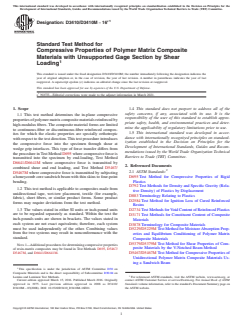
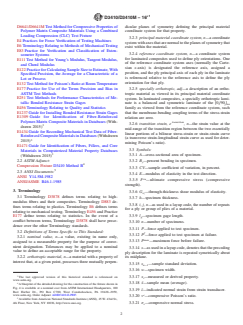
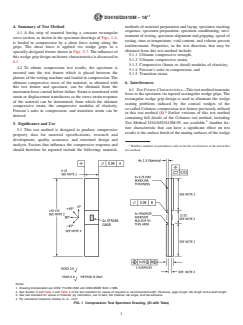
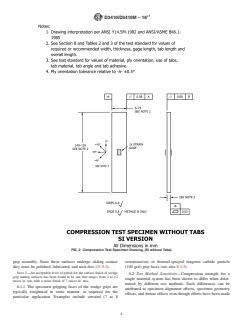
cross section, as shown in the specimen drawings of Figs. 1-4,
testing, time at temperature, void content, and volume percent
is loaded in compression by a shear force acting along the
reinforcement. Properties, in the test direction, that may be
grips. The shear force is applied via wedge grips in a
obtained from this test method include:
specially-designed fixture shown in Figs. 5-7.The influence of
5.1.1 Ultimate compressive strength,
thiswedgegripdesignonfixturecharacteristicsisdiscussedin
5.1.2 Ultimate compressive strain,
6.1.
5.1.3 Compressive (linear or chord) modulus of elasticity,
4.2 To obtain compression test results, the specimen is
5.1.4 Poisson’s ratio in compression, and
inserted into the test fixture which is placed between the
5.1.5 Transition strain.
platens of the testing machine and loaded in compression. The
ultimate compressive stress of the material, as obtained with
6. Interferences
this test fixture and specimen, can be obtained from the
6.1 TestFixtureCharacteristics—Thistestmethodtransmits
maximumforcecarriedbeforefailure.Strainismonitoredwith
forcetothespecimenviataperedrectangularwedgegrips.The
strain or displacement transducers so the stress-strain response
rectangular wedge grip design is used to eliminate the wedge
of the material can be determined, from which the ultimate
seating problems induced by the conical wedges of the
compressive strain, the compressive modulus of elasticity,
so-called Celanese compression test fixture previously utilized
Poisson’s ratio in compression, and transition strain can be
in this test method (1). Earlier versions of this test method
derived.
containing full details of the Celanese test method, including
Test Method D3410/D3410M-95, are available. Another fix-
5. Significance and Use
ture characteristic that can have a significant effect on test
5.1 This test method is designed to produce compressive
resultsisthesurfacefinishofthematingsurfacesofthewedge
property data for material specifications, research and
development, quality assurance, and structural design and
analysis. Factors that influence the compressive response and 6
Boldfacenumbersinparenthesesrefertothelistofreferencesattheendofthis
should therefore be reported include the following: material, test method.
Notes:
1. Drawing interpretation per ANSI Y14.5M-1982 and ANSI/ASME B46.1-1985.
2. See Section 8 and Table 2 and Table 3 of the test standard for values of required or recommended width, thickness, gage length, tab length and overall length.
3. See test standard for values of material, ply orientation, use of tabs, tab material, tab angle, and tab adhesive.
4. Ply orientation tolerance relative to -A- 60.5°.
FIG. 1 Compression Test Specimen Drawing, (SI with Tabs)
´1
D3410/D3410M − 16
FIG. 2 Compression Test Specimen Drawing, (SI without Tabs)
grip assembly. Since these surfaces undergo sliding contact serrations/cm) or thermal-sprayed tungsten carbide particle
they must be polished, lubricated, and nick-free (11.5.1). (100 grit) grip faces (see also 8.3.3).
NOTE 2—An acceptable level of polish for the surface finish of wedge
6.2 Test Method Sensitivity—Compression strength for a
grip mating surfaces has been found to be one that ranges from 2 to 12
single material system has been shown to differ when deter-
micro in. rms with a mean finish of 7 micro in. rms.
mined by different test methods. Such differences can be
6.1.1 The specimen gripping faces of the wedge grips are
attributed to specimen alignment effects, specimen geometry
typically roughened in some manner, as required for the
effects, and fixture effects even though efforts have been made
particular application. Examples include serrated (7 to 8
´1
D3410/D3410M − 16
Notes:
1. Drawing interpretation per ANSI Y14.5M-1982 and ANSI/ASME B46.1-1985.
2. See Section 8 and Table 2 and Table 3 of the test standard for values of required or recommended width, thickness, gage length, tab length, and overall length.
3. See test standard for values of material, ply orientation, use of tabs, tab material, tab angle and tab adhesive.
4. Ply orientation tolerance relative to -A- 60.5°.
FIG. 3 Compression Test Specimen Drawing, (Inch-Pound with Tabs)
to minimize these effects. Examples of differences in test thickness. The gage length must be short enough to be free
results between various test methods can be found in Refs from Euler (column) buckling, yet long enough to allow stress
(1,2). decay to uniaxial compression and to minimize Poisson re-
straint effects as a result of the grips. Minimum thickness
6.3 Material and Specimen Preparation—Compression
requirements are provided in 8.2.3.
modulus, and especially ultimate compressive stress, are sen-
sitive to poor material fabrication practices, damage induced
6.6 Gripping—A high percentage of grip-induced failures,
by improper specimen machining, and lack of control of fiber
especiallywhencombinedwithhighmaterialdatascatter,isan
alignment. Fiber alignment relative to the specimen coordinate
indicator of specimen gripping problems.
axisshouldbemaintainedascarefullyaspossible,althoughno
6.7 System Alignment—Excessive bending will cause pre-
standard procedure to ensure this alignment exists. Procedures
mature failure, as well as highly inaccurate modulus of
found satisfactory include the following: fracturing a cured
elasticity determination. Every effort should be made to elimi-
unidirectional laminate near one edge parallel to the fiber
nate bending from the test system. Bending may occur for the
direction to establish the 0° direction, or laying in small
followingreasons:(1)misaligned(orout-oftolerance)gripsor
filamentcounttowsofcontrastingcolorfiber(aramidincarbon
associated fixturing, (2) improper installation of specimen, or
laminates and carbon in aramid or glass laminates) parallel to
(3) poor specimen preparation.
the 0° direction either as part of the prepreg production or as
part of panel fabrication.
6.8 Edge Effects in Angle-Ply Laminates—Premature fail-
uresandlowerstiffnessesareobservedduetoedgesofteningin
6.4 Tabbing and Tolerances—The data resulting from this
laminates containing off-axis plies. Because of this, the
test method has been shown to be sensitive to the flatness and
strength and modulus for angle-ply laminates can be underes-
parallelism of the tabs, so care should be taken to ensure that
timated. For quasi-isotropic laminates and those containing
the specimen tolerance requirements are met. This usually
even higher percentages of 0° plies, the effect is less.
requires precision grinding of the tab surfaces after bonding
them to the specimen.
7. Apparatus
6.5 Thickness and Gage Length Selection—The gage sec-
tion for this test method is unsupported, resulting in a tradeoff 7.1 Micrometers and Calipers—Amicrometer with a 4 to 7
in the selection of specimen gage length and the specimen mm [0.16 to 0.28 in.] nominal diameter ball interface or a flat
´1
D3410/D3410M − 16
Notes:
1. Drawing interpretation per ANSI Y14.5M-1982 and ANSI/ASME B46.1-1985.
2. See Section 8 and Table 2 and Table 3 of the test standard for values of required or recommended width, thickness, gage length, tab length, and overall length.
3. See test standard for values of material, ply orientation, use of tabs, tab material, tab angle and tab adhesive.
4. Ply orientation tolerance relative to -A- 60.5°.
FIG. 4 Compression Test Specimen Drawing, (Inch-Pound without Tabs)
anvil interface shall be used to measure the specimen thick- 5-7. Each set of specimen wedge grips fits into a mating set of
ness. A ball interface is recommended for thickness measure-
wedges that fits into the upper and lower wedge housing block
ments when at least one surface is irregular (for example, a assemblies. By using wedges of different thicknesses, speci-
coarse peel ply surface which is neither smooth nor flat). A
mens of varying thickness can be tested in this fixture. As
micrometer or caliper with a flat anvil interface shall be used
indicated in Fig. 5, the wedge grips are sometimes provided
for measuring length, width and other machined surface
withslotsattheouterends,toaccommodateendbars.Theends
dimensions. The use of alternative measurement devices is
of the specimen can be butted against these bars during grip
permitted if specified (or agreed to) by the test requestor and
screw tightening, to ensure that an equal length of specimen is
reported by the testing laboratory. The accuracy of the instru-
gripped by each pair of wedge grips. These bars can be
ment(s) shall be suitable for reading within 1 % of the
removed prior to the test, or remain in place to provide an
specimen dimensions. For typical specimen geometries, an
(uncontrolled) degree of end-loading to the otherwise shear-
instrument with an accuracy of 60.0025 mm [60.0001 in.] is
loaded specimen. These bars also promote equal movement of
adequateforthicknessmeasurements,whileaninstrumentwith
each of the wedges of a pair during specimen loading, thus
an accuracy of 60.025 mm [60.001 in.] is adequate for
reducing induced specimen bending. Typically, the upper
measurement of length, width and other machined surface
wedge housing block assembly is attached to the upper
dimensions.
crosshead of the test machine while the lower wedge housing
block assembly rests on a lower platen.
7.2 Compression Fixture:
7.2.1 Fixture—The fixture uses rectangular wedges and 7.2.2 Specimen Alignment Jig—Compression test results
allows for variable width and thickness specimens.Asectional generated by this test method are sensitive to the alignment of
schematic and photographs of the fixture are shown in Figs. the specimen with respect to the longitudinal axis of the
´1
D3410/D3410M − 16
FIG. 7 Photograph of Compression Test Fixture
FIG. 5 Schematic of Compression Test Fixture
FIG. 6 Photograph of Compression Test Fixture
FIG. 8 Two Examples of Jigs for Specimen Alignment With
Wedge Grips Outside the Fixture Housing Blocks (for Other
Alignment Procedures see 7.2.2)
wedges in the test fixture. Specimen alignment can be accom-
7.3.1 Testing Machine Heads—The testing machine shall
plished by using an alignment jig or gage block that mechani-
have two loading heads, with at least one movable along the
cally holds the specimen captive outside the fixture housing
testing axis.
blocks (as shown in Fig. 8), or by using a custom jig or
7.3.2 Fixture Attachment—Typically the upper portion of
machinist’s square for a specimen inserted into wedge grips
thefixtureisattacheddirectlytotheuppercrosshead,andaflat
already in the fixture housing blocks. Alignment jigs and
platen attached to the lower crosshead is used to support the
procedures other than those described are acceptable provided
lower portion of the fixture. The platen should be at least 20
they perform the same function.
mm [0.75 in.] thick. The fixture may be coupled to the testing
7.3 Testing Machine—The testing machine shall be in con- machine with a joint capable of eliminating angular restraint,
formance with Practices E4, and shall satisfy the following such as a hemispherical ball on the machine that fits into a
requirements: hemispherical recess.
´1
D3410/D3410M − 16
NOTE 3—The use of a joint capable of eliminating angular restraint,
gageselectionshouldconsidertheuseofanactivegagelength
such as a hemispherical ball, and the use of rigid, parallel crossheads
which is at least as great as the characteristic repeating unit of
should both be considered for this test method (3).To determine the most
the weave. Some guidelines on the use of strain gages on
appropriate test configuration, a test fixture check-out procedure using
composites are presented below with a general discussion on
untabbed aluminum specimens with back-to-back strain gages can be
the subject in Refs (4, 5).
performed to determine the effect of attachment configuration on the
accuracy and repeatability of test results.
7.4.1.1 Surface preparation of fiber-reinforced composites
in accordance with Guide E1237 can penetrate the matrix
7.3.3 Drive Mechanism—The testing machine drive mecha-
material and cause damage to the reinforcing fibers, resulting
nism shall be capable of imparting to the movable head a
in improper specimen failures. Reinforcing fibers shall not be
controlled displacement rate with respect to the stationary
exposed or damaged during the surface preparation process.
head. The displacement rate of the movable head shall be
Consult the strain gage manufacturer regarding surface prepa-
capable of being regulated as specified in 11.3.
ration guidelines and recommended bonding agents for com-
7.3.4 Force Indicator—The testing machine force-sensing
posites.
device shall be capable of indicating the total force being
7.4.1.2 Select gages having large resistances to reduce
resisted by the test specimen. This device shall be essentially
heating effects on low-conductivity materials. Resistances of
free from inertia-lag at the specified rate of testing and shall
350 ohms or higher are preferred. Use the minimum possible
indicate the force with an accuracy over the force range(s) of
gage excitation voltage consistent with the desired accuracy (1
interest of within 61% of the indicated value, as specified by
to 2Vis recommended) to further reduce the power consumed
Practices E4. The force range(s) of interest may be fairly low
by the gage. Heating of the specimen by the gage may affect
formodulusevaluationormuchhigherforstrengthevaluation,
the performance of the material directly, or it may affect the
or both, as required.
indicated strain due to a difference between the gage tempera-
NOTE4—Obtainingprecisionforcedataoveralargerangeofinterestin
ture compensation factor and the coefficient of thermal expan-
the same test, such as when both elastic modulus and ultimate force are
ion of the specimen material.
being determined, place extreme requirements on the load cell and its
7.4.1.3 Temperature compensation is recommended when
calibration. For some equipment, a special calibration may be required.
testing at Standard LaboratoryAtmosphere.Temperature com-
For some combinations of material and load cell, simultaneous precision
pensation is required when testing in non-ambient temperature
measurementofbothelasticmodulusandultimatecompressivestressmay
not be possible, and measurement of modulus and ultimate compresssive
environments. When appropriate, use a traveler specimen
stresss may have to be performed in separate tests using a different load
(dummy calibration specimen) with identical layup and strain
cell range for each test.
gage orientations for thermal strain compensation.
7.4 Strain-Indicating Device—Longitudinal strain shall be
7.4.1.4 Consider the transverse sensitivity of the selected
simultaneously measured on opposite faces of the specimen to strain gage. Consult the strain gage manufacturer for recom-
allow for a correction as a result of any bending of the
mendations on transverse sensitivity corrections. This is par-
specimen and to enable detection of Euler (column) buckling. ticularly important for a transversely mounted gage used to
Back-to-back strain measurement shall be made for all five
determine Poisson’s ratio, as discussed in Note 15.
specimens when the minimum number of specimens allowed
7.4.2 Extensometers—Extensometers shall satisfy, at a
by this test method are tested. If more than five specimens are
minimum, Practice E83, Class B-2 requirements for the strain
to be tested, then a single strain-indicating device may be used
range of interest, and shall be calibrated over that strain range
forthenumberofspecimensgreaterthanthefive,providedthe
in accordance with Practice E83. For extremely stiff materials,
totalnumberofspecimensaretestedinasingletestfixturethat or for measurement of transverse strains, the fixed error
remainsintheloadframethroughoutthetests(seeNote5),that
allowed by Class B-2 extensometers may be too large. The
no modifications to the specimens or test procedure are made extensometer shall be essentially free of inertia lag at the
throughout the duration of the tests, and provided the bending
specified speed of testing.
requirement of 11.9.1 is met for the first five specimens. If
7.5 Conditioning Chamber—When conditioning materials
these conditions are not met, then all specimens must be
inotherthanambientlaboratoryenvironments,atemperature-/
instrumented with back-to-back devices. When Poisson’s ratio
moisture-level controlled environmental conditioning chamber
is to be determined, the specimen shall be instrumented to also
is required that shall be capable of maintaining the required
measure strain in the lateral direction. Strain gages are recom-
relative temperature to within 63°C [65°F] and the required
mended due to the short gage length of the specimen. Attach-
relative vapor level to within 65%. Chamber conditions shall
ment of the strain-indicating device to the specimen shall not
be monitored either on an automated continuous basis or on a
cause damage to the specimen surface.
manual basis at regular intervals.
NOTE 5—Portions of the test fixture may be removed from the loading
7.6 Environmental Test Chamber—An environmental test
frame as required in Section 11.
chamber is required for test environments other than ambient
7.4.1 Bonded Resistance Strain Gages—Strain gage selec- testinglaboratoryconditions.Thischambershallbecapableof
tion is a compromise based on the procedure and the type of maintainingthegagesectionofthetestspecimenwithin 63°C
material to be tested. Strain gages should have an active grid [65°F] of the required test temperature during the mechanical
length of 3 mm [0.125 in.] or less (1.5 mm [0.063 in.] is test. In addition, the chamber may have to be capable of
preferable). Gage calibration certification shall comply with maintainingenvironmentalconditionssuchasfluidexposureor
Test Methods E251. When testing woven fabric laminates, relative humidity during the test (see 11.4).
´1
D3410/D3410M − 16
8. Sampling and Test Specimens mm [0.5, 0.75, and 1.0 in.] using an assumed value of G of 4
xz
GPa [600000 psi] (G can be determined using Test Method
xz
8.1 Sampling—Test at least five specimens per test condi-
D5379/D5379M).
tionunlessvalidresultscanbegainedthroughtheuseoffewer
l
specimens, such as in the case of a designed experiment. For
g
h$ (1)
statisticallysignificantdata,theproceduresoutlinedinPractice cu c
1.2F E
0.9069 1 2
ŒS DS D
cu
E122 should be consulted. The method of sampling shall be
G F
xz
reported.
where:
NOTE 6—If specimens are to undergo environmental conditioning to c
E = longitudinal modulus of elasticity, MPa [psi],
equilibrium, and are of such type or geometry that the weight change of
cu
F = ultimate compressive stress, MPa [psi],
thematerialcannotbeproperlymeasuredbyweighingthespecimenitself
G = through-thickness shear modulus, MPa [psi],
(such as a tabbed mechanical specimen), then a traveler of the same xz
h = specimen thickness, mm [in.], and
nominal thickness and appropriate size (but without tabs) shall be used to
determine when equilibrium has been reached for the specimens being l = length of gage section, 13 mm [0.50 in.].
g
conditioned.
NOTE 7—The conservative assumption of pinned-end conditions for
column buckling in Eq 1 is based on linear elastic material response. The
8.2 Geometry—The test specimen shall have a constant
shear response of commonly used composites is highly nonlinear, and
rectangularcrosssectionwithaspecimenwidthvariationofno
inelastic buckling calculations even for clamped-end conditions may not
more than 61% and a specimen thickness variation of no
always yield higher buckling loads than for the elastic pinned-end
more than 62%. Specimen geometry requirements are listed condition. The use of back-to-back gages ensures that the thickness
selected based on Eq 1 is sufficient to prevent column buckling. Back-to-
inTable1,andspecimengeometryrecommendationsarelisted
backstrainmeasurementswillalsoindicateanysecondarybendingeffects
in Table 2. Dimensionally-toleranced specimen drawings for
because of imperfections.
both tabbed and untabbed forms are shown as examples in
Figs. 1 and 2 (SI version) and Figs. 3 and 4 (inch-pound 8.2.3 Overall Specimen Length and Gage Length—The
version). Both the specimen width and thickness shall contain overallspecimenlengthandgagelengthshallbedeterminedby
a sufficient number of fibers or yarns to be statistically the tab length and gage length chosen for the specimen. These
representative of the bulk material, or the material shall not be requirementsarelistedinTable1andalsoshowninFigs.1and
tested using this test method.
2.The choice of specimen gage length is a trade-off between a
length short enough to be free from Euler (column) buckling,
8.2.1 Specimen Width—The nominal specimen width shall
yet long enough to both allow stress decay to uniform uniaxial
be as recommended in Table 2.
compression and minimize Poisson restraint effects due to the
8.2.2 Specimen Thickness—Specimen thickness, gage
grips (6, 7). The distance required for admissible stress decay
length, and width are related by Eq 1. The lower the expected
in a shear-loaded compression specimen has been shown to
modulus and the higher the expected ultimate compressive
increase with increasing specimen thickness and increasing
stress, the greater the specimen thickness must be in order to
E /G ratio (6). For a typical carbon/epoxy specimen
prevent Euler (column) buckling in the test section. A conser- x xz
(E =138.6 GPa [20.1 Msi], G =4.6 GPa [0.67 Msi], h=2.4
vative assumption of pinned-end conditions for column buck-
x xz
mm[0.05in.]),auniformuniaxialcompressionstressstatewas
ling was used in Eq 1 to compensate for beam-column effects
achievedin2.4mm[0.094in.].Thisresultshowsagagelength
produced by the bending moments induced by specimen and
of 12 mm [0.5 in.] is sufficient to allow stress decay for this
fixture tolerances.The requirement for the use of back-to-back
material. Reference (4), also presents data suggesting admis-
strain measurements (7.4) provides the final assessment of
sible stress decay for a 12-mm [0.5-in.] gage length for both
specimen stability and quality of test results. Table 3 shows
unidirectional boron- and glass-reinforced epoxy. For matrix
calculations for minimum specimen thickness as a function of
materials that result in a composite with a high E /G ratio
expected modulus and ultimate compressive stress in the x xz
(suchasglass/PTFE, E /G =406)thisgagelengthisnotlong
directionofforceapplicationforgagelengthsof12,20,and25
x xz
enough to allow admissible stress decay. The insensitivity of
theshear-loadedtypeoftestspecimentogagelengthbelowthe
critical buckling length has also been shown experimentally in
Ref (8). Recommended specimen gage length is 12 to 25 mm
TABLE 1 Compression Specimen Geometry Requirements
[0.5 to 1.0 in.] to balance the competing requirements of stress
(Unless Otherwise Noted)
decay length and Euler buckling length. For gage lengths
Parameter Requirement
longer than 25 mm [1.0 in.], the required specimen thickness
Specimen Requirements:
shape constant rectangular cross section (8.2.3 and Table 3) may become unreasonable for typical
A
overall specimen length as needed
fixturing.Atab length of 64 mm [2.5 in.] and resulting overall
A
specimen gage length as needed
A lengths of 140 to 155 mm [5.5 to 6.0 in.] are recommended.
specimen width as needed
specimen thickness see Table 3
8.3 Use of Tabs—Tabs are not required. The key factor in
specimen width tolerance ±1 % of width
specimen thickness tolerance ±2 % of thickness
the selection of specimen tolerances and gripping methods is
Tab Requirements (if used):
the successful introduction of force into the specimen and the
specimen thickness variation at ±1 % of thickness
prevention of premature failure due to a significant disconti-
tabbed ends
A nuity. Therefore the need to use tabs, and specification of the
See Table 2 for recommendations
major tab design parameters, shall be determined by the end
´1
D3410/D3410M − 16
TABLE 2 Compression Specimen Geometry Recommendations
Fiber Orientation Width, mm [in.] Gage Length, mm [in.] Tab Length, mm [in.] Overall Length, mm [in.] Tab Thickness, mm [in.]
0°, unidirectional 10 [0.5] 10–25 [0.5–1.0] 65 [2.5] 140–155 [5.5–6.0] 1.5 [0.06]
90°, unidirectional 25 [1.0] 10–25 [0.5–1.0] 65 [2.5] 140–155 [5.5–6.0] 1.5 [0.06]
Specially orthotropic 25 [1.0] 10–25 [0.5–1.0] 65 [2.5] 140–155 [5.5–6.0] 1.5 [0.06]
TABLE 3 Minimum Required Specimen Thickness (mm [in.])
Minimum Required Thickness (mm [in.]) for 10-mm [0.5-in.] Gage Length
cu
Longitudinal Modulus, Expected Compression Strength, F , MPa [ksi]
GPa [Msi]
300 [50] 600 [100] 900 [150] 1200 [200] 1500 [250] 1800 [300]
25 [5] 1.27 [0.058] 1.89 [0.087] 2.45 [0.114] 3.02 [0.142] 3.64 [0.174] 4.36 [0.214]
50 [7] 1.00 [0.049] 1.33 [0.074] 1.73 [0.096] 2.14 [0.120] 2.58 [0.147] 3.08 [0.180]
75 [10] 1.00 [0.041] 1.09 [0.062] 1.41 [0.081] 1.74 [0.101] 2.10 [0.123] 2.52 [0.151]
100 [15] 1.00 [0.040] 1.00 [0.050] 1.22 [0.066] 1.51 [0.082] 1.82 [0.101] 2.18 [0.123]
200 [20] 1.00 [0.040] 1.00 [0.044] 1.00 [0.057] 1.07 [0.071] 1.29 [0.087] 1.54 [0.107]
300 [30] 1.00 [0.040] 1.00 [0.040] 1.00 [0.047] 1.00 [0.058] 1.05 [0.071] 1.26 [0.087]
400 [50] 1.00 [0.040] 1.00 [0.040] 1.00 [0.040] 1.00 [0.045] 1.00 [0.055] 1.09 [0.068]
500 [70] 1.00 [0.040] 1.00 [0.040] 1.00 [0.040] 1.00 [0.040] 1.00 [0.047] 1.00 [0.057]
Minimum Required Thickness (mm [in.]) for 20-mm [0.75-in.] Gage Length
cu
Longitudinal Modulus, Expected Compression Strength, F , MPa [ksi]
GPa [Msi] 300 [50] 600 [100] 900 [150] 1200 [200] 1500 [250] 1800 [300]
25 [5] 2.53 [0.087] 3.77 [0.131] 4.90 [0.171] 6.04 [0.214] 7.28 [0.262] 8.72 [0.320]
50 [7] 1.79 [0.074] 2.67 [0.111] 3.46 [0.145] 4.27 [0.180] 5.15 [0.221] 6.17 [0.271]
75 [10] 1.46 [0.062] 2.18 [0.092] 2.83 [0.121] 3.49 [0.151] 4.21 [0.185] 5.04 [0.226]
100 [15] 1.27 [0.050] 1.89 [0.075] 2.45 [0.099] 3.02 [0.123] 3.64 [0.151] 4.36 [0.185]
200 [20] 1.00 [0.044] 1.33 [0.065] 1.73 [0.086] 2.14 [0.107] 2.58 [0.131] 3.08 [0.160]
300 [30] 1.00 [0.040] 1.09 [0.053] 1.41 [0.070] 1.74 [0.087] 2.10 [0.107] 2.52 [0.131]
400 [50] 1.00 [0.040] 1.00 [0.041] 1.22 [0.054] 1.51 [0.068] 1.82 [0.083] 2.18 [0.101]
500 [70] 1.00 [0.040] 1.00 [0.040] 1.10 [0.046] 1.35 [0.057] 1.63 [0.070] 1.95 [0.086]
Minimum Required Thickness (mm [in.]) for 25-mm [1.0-in.] Gage Length.
cu
Longitudinal Modulus, Expected Compression Strength, F , MPa [ksi]
GPa [Msi] 300 [50] 600 [100] 900 [150] 1200 [200] 1500 [250] 1800 [300]
25 [5] 3.17 [0.116] 4.72 [0.174] 6.12 [0.228] 7.55 [0.285] 9.10 [0.349] 10.91 [0.427]
50 [7] 2.24 [0.098] 3.33 [0.147] 4.33 [0.193] 5.34 [0.241] 6.44 [0.295] 7.71 [0.361]
75 [10] 1.83 [0.082] 2.72 [0.123] 3.53 [0.161] 4.36 [0.201] 5.26 [0.247] 6.30 [0.302]
100 [15] 1.58 [0.067] 2.36 [0.101] 3.06 [0.132] 3.77 [0.164] 4.55 [0.201] 5.45 [0.247]
200 [20] 1.12 [0.058] 1.67 [0.087] 2.16 [0.114] 2.67 [0.142] 3.22 [0.174] 3.86 [0.214]
300 [30] 1.00 [0.047] 1.36 [0.071] 1.77 [0.093] 2.18 [0.116] 2.63 [0.142] 3.15 [0.174]
400 [50] 1.00 [0.040] 1.18 [0.055] 1.53 [0.072] 1.89 [0.090] 2.28 [0.110] 2.73 [0.135]
500 [70] 1.00 [0.040] 1.05 [0.047] 1.37 [0.061] 1.69 [0.076] 2.04 [0.093] 2.44 [0.114]
result: acceptable failure mode and location. If acceptable tions. In specific cases, lightly serrated wedge grips have been
failure modes occur with reasonable frequency (>50 % of the successfully used with only emery cloth as the interface
tests)thenthereisnoreasontochangeagivengrippingmethod between the grip and the coupon. However, the abrasive used
(see 11.10). mustbeabletowithstandsignificantcompressiveforces.Some
8.3.1 Tabs bonded to the specimen are recommended when types of emery cloth have been found ineffective in this
testing unidirectional materials in the fiber direction. However application due to disintegration of the abrasive. An alterna-
unidirectional [90] materials, [0/90] or [90/0] laminates tive is to use grip surfaces thermal-sprayed with tungsten
n i j ns i j ns
(when j ≥ i) and fabric-based materials can often be success- carbide particles (9).
fully tested without tabs. 8.3.4 Tab Material—When tabs are used, the most com-
8.3.2 TabGeometry—Thetypicaltabconfigurationisshown monly used materials are steel and continuous E-glass fiber-
in Fig. 1 and Fig. 3. A tab bevel angle of 90° (untapered, as reinforced polymer matrix materials (woven or unwoven), in a
shown) is recommended. Tab thickness may vary, but is [0/90] laminate configuration. Tabs bonded to the specimen
ns
commonly 1.5 mm [0.06 in.]. The selection of a tab configu- are recommended for unidirectional carbon fiber-reinforced
ration that can successfully produce a gage section compres- compositesthataretobetestedinthefiberdirection.Bothsteel
sionfailureisdependentuponthespecimenmaterial,specimen and E-glass fabric tabs have been shown to produce satisfac-
plyorientation,andthetypeofgripsbeingused.Foralignment tory results for unidirectional carbon fiber-reinforced compos-
purposes, it is essential that the tabs be of matched thicknesses ites (10).
and the tab surfaces be parallel. 8.3.5 Adhesive Material—Any high-elongation (tough) ad-
8.3.3 FrictionTabs—Tabsneednotalwaysbebondedtothe hesive system that meets the environmental requirements may
material under test to be effective in introducing the force into be used when bonding tabs to the material under test. A
the specimen. Friction tabs, essentially nonbonded tabs held in
place by the pressure of the grip, and often used with emery
E-Z Flex Metalite K224 cloth, grit 120-J, or 120 grit D Burtie abrasive screen,
cloth or some other light abrasive between the tab and the
both available from Norton Co., Troy, NY 12181, have been found satisfactory in
coupon, have been successfully employed in some applica- this application. Other equivalent types of abrasive should be suitable.
´1
D3410/D3410M − 16
bondline of uniform thickness is required to minimize induced thematrixdigestionproceduresofTestMethodsD3171,or,for
bending during the test. certain reinforcement materials such as glass and ceramics, by
the matrix burn-off technique of Test Method D2584. Void
8.4 Specimen Preparation:
content may be evaluated from the equations of Test Methods
8.4.1 Panel Fabrication—Control of fiber alignment is im-
D2734 and are applicable to both Test Methods D2584 and
portant. Improper fiber alignment will reduce the measured
D3171.
properties. Erratic fiber alignment will also increase the coef-
11.2.3 Condition the specimens, either before or after strain
ficient of variation. Suggested methods of maintaining fiber
gaging, as required. Condition travelers if to be used.
alignment are discussed in Section 6. The panel preparation
method used shall be reported.
NOTE 9—Gaging before conditioning may impede moisture absorption
8.4.2 Machining Methods—Specimen preparation is ex- locally underneath the strain gage or the conditioning environment may
degrade the strain gage adhesive, or both. On the other hand, gaging after
tremelyimportant.Thespecimensmaybemoldedindividually
conditioning may not be possible for other reasons, or the gaging activity
to avoid edge and cutting effects or they may be cut from
itself may cause loss of conditioning equilibrium. When to gage speci-
panels. If they are cut from panels, precautions shall be taken
mens is left to the individual application and shall be reported.
to avoid notches, undercuts, rough or uneven surfaces, or
11.2.4 Following final specimen machining and any
delaminations caused by inappropriate machining methods.
conditioning,butbeforethecompressiontesting,determinethe
Final dimensions should be obtained by precision sawing,
specimen area asA=w×h at three places in the gage section
milling, or grinding. Mold or machine edges flat and parallel
andreporttheareaastheaverageofthesethreedeterminations
within the specified tolerances.
to the accuracy in 7.1. Record the average area in units of
8.4.3 Labeling—Label the specimens so that they will be
2 2
mm (in. ).
distinctfromeachotherandtraceablebacktotherawmaterial,
11.2.5 Apply strain gages (or extensometers) to both faces
andinamannerthatwillbothbeunaffectedbythetestandnot
of the specimen (see 7.4) as shown in Figs. 1-4.
influence the test.
11.3 Loading Rate—It is desired to maintain a constant
9. Calibration
strain rate in the gage section. If strain control is not available
9.1 The accuracy of all measuring equipment shall have
on the testing machine, this may be approximated by repeated
certified calibrations that are current at the time of use of the monitoring and adjusting of the rate of force application to
equipment.
maintain a nearly constant strain rate, as measured by strain
transducer response versus time. Select the strain rate so as to
10. Conditioning
produce failure within 1 to 10 min from the beginning of force
10.1 Standard Conditioning Procedure—Condition in ac- application. If the ultimate strain of the material cannot be
cordance with Procedure C of Test Method D5229/D5229M; reasonably estimated, conduct initial trials using standard
storeandtestatstandardlaboratoryatmosphere(23 63°C[73 crosshead speeds until the ultimate strain of the material and
6 5°F] and 50 6 10% relative humidity) unless a different thecomplianceofthesystemareknown,andthestrainratecan
environment is specified as part of the experiment. be adjusted. The suggested standard rates are:
11.3.1 Strain-Controlled Tests—A standard strain rate of
−1
11. Procedure
0.01 min .
11.1 Parameters To Be Specified Before Test:
11.3.2 Constant Head-Speed Tests—A standard crosshead
11.1.1 The compression specimen sampling method, speci- displacement of 1.5 mm/min [0.05 in./min].
mentypeandgeometry,andifrequired,conditioningtravelers.
NOTE 10—Use of wedge grips can cause extreme compliance in the
11.1.2 The compressive properties and data reporting for-
system, especially when using compliant tab materials. In some such
mat desired.
cases,actualstrainrates10to50timeslowerthanestimatedbycrosshead
speeds have been observed.
NOTE 8—Determine specific material property, accuracy, and data
reportingrequirementspriortotestforproperselectionofinstrumentation
11.4 Test Environment—Condition the specimen to the de-
and data recording equipment. Estimate operating stress and strain levels
sired moisture profile and, if possibl
...