

ASTM B851-04(2020)
(Specification)Standard Specification for Automated Controlled Shot Peening of Metallic Articles Prior to Nickel, Autocatalytic Nickel, or Chromium Plating, or as Final Finish
General Information
- Abstract
ABSTRACT
This specification covers the requirements for automated, controlled shot peening of metallic articles prior to electrolytic or autocatalytic deposition of nickel or chromium, or as a final finish, using shot made of cast steel, conditioned cut wire, or ceramic media. The process is applicable to those materials on which test work has shown it to be beneficial within given intensity ranges. It is not suitable for brittle materials. Hand peening and rotary flap peening are excluded specifically. Shot peening induces residual compressive stresses in the surface and near-surface layers of metallic articles, controlling or limiting the reduction in fatigue properties that occurs from nickel or chromium plating of the article, or the fatigue properties of unplated articles. It is a process for cold working surfaces by bombarding the product with shot of a solid and spherical nature propelled at a relatively high velocity. Cast steel, cut wire, and ceramic shot shall all be spherical in shape and shall all be free of sharp edges, corners, and broken pieces. Prior to shot peening, the following operations shall be done first: heat treatment, machining, grinding, flaw test, crack test, corrosion detection, cleaning, and masking. Peened surfaces shall be uniform in appearance and completely dented so that the original surface is obliterated entirely. After shot peening, the following methods shall be done: residual shot removal, surface finishing, chemical cleaning of nonferrous metals and their alloys, thermal and heat treatments, and corrosion protection.
SIGNIFICANCE AND USE
5.1 Shot peening is a process for cold working surfaces by bombarding the product with shot of a solid and spherical nature propelled at a relatively high velocity. In general, shot peening will increase the fatigue life of a product that is subject to bending or torsional stress. It will improve resistance to stress corrosion cracking. It can be used to form parts or correct their shapes. See Appendix X1 for additional information.
5.2 It is essential that the shot peening process parameters be controlled rigidly to ensure repeatability from part to part and lot to lot.
5.3 This specification covers techniques and methods necessary for proper control of the shot peening process.
SCOPE
1.1 This specification covers the requirements for automated, controlled shot peening of metallic articles prior to electrolytic or autocatalytic deposition of nickel or chromium, or as a final finish, using shot made of cast steel, conditioned cut wire, or ceramic media. The process is applicable to those materials on which test work has shown it to be beneficial within given intensity ranges. It is not suitable for brittle materials. Hand peening and rotary flap peening are excluded specifically.
1.2 Shot peening induces residual compressive stresses in the surface and near-surface layers of metallic articles, controlling or limiting the reduction in fatigue properties that occurs from nickel or chromium plating of the article, or the fatigue properties of unplated articles.
1.3 The values stated in SI units are to be regarded as standard. No other units of measurement are included in this standard.
1.4 This standard does not purport to address all of the safety concerns, if any, associated with its use. It is the responsibility of the user of this standard to establish appropriate safety, health, and environmental practices and determine the applicability of regulatory limitations prior to use.
1.5 This international standard was developed in accordance with internationally recognized principles on standardization established in the Decision on Principles for the Development of International Standards, Guides and Recommendations issued by the World Trade Organization Technical Barriers to Trade (TBT) Committee.
- Status
- Published
- Publication Date
- 31-Oct-2020
- Technical Committee
- B08 - Metallic and Inorganic Coatings
- Drafting Committee
- B08.02 - Pre Treatment
Overview
ASTM B851-04(2020): Standard Specification for Automated Controlled Shot Peening of Metallic Articles Prior to Nickel, Autocatalytic Nickel, or Chromium Plating, or as Final Finish establishes the key requirements and procedures for the automated, controlled shot peening of metallic articles. This process is critical before electrolytic or autocatalytic deposition of nickel or chromium, or can serve as a final surface finish. The specification covers the use of cast steel, conditioned cut wire, or ceramic shot media, and provides guidance on relevant equipment and process controls. The standard is intended for industries where enhanced fatigue life, corrosion resistance, and surface integrity of metallic parts are needed. Notably, brittle materials and manual peening methods are excluded from this scope.
Key Topics
- Process Definition: Shot peening is described as a cold working process where surfaces are bombarded with spherical shot propelled at high velocity. The objective is to induce residual compressive stresses in the surface and near-surface regions of metallic parts.
- Material and Media Requirements: The standard specifies the acceptable shot materials (cast steel, cut wire, ceramic), their required shapes (spherical, without sharp edges), and minimum hardness levels. All shot media must be able to withstand the processing conditions without degrading surface quality.
- Pre- and Post-Peening Operations: Metallurgical operations such as heat treatment, machining, flaw testing, corrosion detection, cleaning, and masking must be completed prior to peening. After peening, procedures for residual shot removal, surface cleaning, and corrosion protection are detailed.
- Process Control and Verification: Strict control over process parameters (shot size/hardness, peening intensity, coverage, and machine calibration) is essential for repeatability and effectiveness. Peening intensity is verified using Almen strips and saturation curves.
- Coverage Requirements: Complete obliteration of the original surface is a minimum requirement, with coverage typically determined via visual or tracer-based inspection.
- Certification and Test Records: The standard mandates comprehensive record keeping, including details on shot media, process settings, peening intensity, and coverage achieved.
Applications
ASTM B851-04(2020) is widely used in industries requiring high-performance metallic components, such as:
- Aerospace: Shot peening enhances fatigue life of aircraft parts subject to cyclic stresses, both before and after plating processes.
- Automotive: Improves durability of components such as gears, springs, and shafts, protecting against fatigue and stress corrosion cracking.
- Industrial Manufacturing: Used for machinery parts where nickel or chromium plating might reduce fatigue life, and in producing components with demanding surface finish requirements.
- Metal Plating Preparation: Critical for conditioning surfaces prior to nickel, autocatalytic nickel, or chromium plating, ensuring optimal adhesion and mechanical properties.
- Defense and Energy: Applied to metallic parts in mission-critical environments, especially where surface integrity and fatigue strength are paramount.
Related Standards
For effective implementation of ASTM B851-04(2020), several related standards and reference documents are relevant:
- ASTM B183: Practice for Preparation of Low-Carbon Steel for Electroplating
- ASTM B322: Guide for Cleaning Metals Prior to Electroplating
- ASTM B650, B733, B689: Specifications for electrodeposited and electroless nickel and chromium coatings
- SAE J441, J827, J1830: Detailed requirements for cut wire, cast steel, and ceramic shot
- MIL-S-13165, MIL-C-26074: Military specifications covering shot peening and electroless nickel coating
- E11, E165, E709: Standards for sieve specifications and nondestructive testing of metals
By integrating ASTM B851-04(2020) with these related standards, organizations can ensure comprehensive quality control in metallic component finishing and surface enhancement processes.
Keywords: ASTM B851-04, automated shot peening, metallic articles, nickel plating, chromium plating, fatigue life, surface finish, process control, shot peening standards
Relations
- Effective Date
- 01-Nov-2023
- Effective Date
- 01-Apr-2019
- Effective Date
- 01-Jun-2018
- Effective Date
- 01-Nov-2014
- Effective Date
- 01-Nov-2014
- Effective Date
- 01-Nov-2014
- Effective Date
- 01-Nov-2014
- Effective Date
- 01-Dec-2013
- Effective Date
- 01-Dec-2013
- Effective Date
- 01-Dec-2013
- Effective Date
- 01-Oct-2013
- Effective Date
- 01-Sep-2009
- Effective Date
- 01-Sep-2009
- Effective Date
- 01-Sep-2009
- Effective Date
- 01-Sep-2009
Get Certified
Connect with accredited certification bodies for this standard

DVS-ZERT GmbH
German welding certification society.
CARES (UK Certification Authority for Reinforcing Steels)
UK certification for reinforcing steels and construction.
EWF/IIW (European/International Welding Federation)
International welding personnel certification.
Sponsored listings
Frequently Asked Questions
ASTM B851-04(2020) is a technical specification published by ASTM International. Its full title is "Standard Specification for Automated Controlled Shot Peening of Metallic Articles Prior to Nickel, Autocatalytic Nickel, or Chromium Plating, or as Final Finish". This standard covers: ABSTRACT This specification covers the requirements for automated, controlled shot peening of metallic articles prior to electrolytic or autocatalytic deposition of nickel or chromium, or as a final finish, using shot made of cast steel, conditioned cut wire, or ceramic media. The process is applicable to those materials on which test work has shown it to be beneficial within given intensity ranges. It is not suitable for brittle materials. Hand peening and rotary flap peening are excluded specifically. Shot peening induces residual compressive stresses in the surface and near-surface layers of metallic articles, controlling or limiting the reduction in fatigue properties that occurs from nickel or chromium plating of the article, or the fatigue properties of unplated articles. It is a process for cold working surfaces by bombarding the product with shot of a solid and spherical nature propelled at a relatively high velocity. Cast steel, cut wire, and ceramic shot shall all be spherical in shape and shall all be free of sharp edges, corners, and broken pieces. Prior to shot peening, the following operations shall be done first: heat treatment, machining, grinding, flaw test, crack test, corrosion detection, cleaning, and masking. Peened surfaces shall be uniform in appearance and completely dented so that the original surface is obliterated entirely. After shot peening, the following methods shall be done: residual shot removal, surface finishing, chemical cleaning of nonferrous metals and their alloys, thermal and heat treatments, and corrosion protection. SIGNIFICANCE AND USE 5.1 Shot peening is a process for cold working surfaces by bombarding the product with shot of a solid and spherical nature propelled at a relatively high velocity. In general, shot peening will increase the fatigue life of a product that is subject to bending or torsional stress. It will improve resistance to stress corrosion cracking. It can be used to form parts or correct their shapes. See Appendix X1 for additional information. 5.2 It is essential that the shot peening process parameters be controlled rigidly to ensure repeatability from part to part and lot to lot. 5.3 This specification covers techniques and methods necessary for proper control of the shot peening process. SCOPE 1.1 This specification covers the requirements for automated, controlled shot peening of metallic articles prior to electrolytic or autocatalytic deposition of nickel or chromium, or as a final finish, using shot made of cast steel, conditioned cut wire, or ceramic media. The process is applicable to those materials on which test work has shown it to be beneficial within given intensity ranges. It is not suitable for brittle materials. Hand peening and rotary flap peening are excluded specifically. 1.2 Shot peening induces residual compressive stresses in the surface and near-surface layers of metallic articles, controlling or limiting the reduction in fatigue properties that occurs from nickel or chromium plating of the article, or the fatigue properties of unplated articles. 1.3 The values stated in SI units are to be regarded as standard. No other units of measurement are included in this standard. 1.4 This standard does not purport to address all of the safety concerns, if any, associated with its use. It is the responsibility of the user of this standard to establish appropriate safety, health, and environmental practices and determine the applicability of regulatory limitations prior to use. 1.5 This international standard was developed in accordance with internationally recognized principles on standardization established in the Decision on Principles for the Development of International Standards, Guides and Recommendations issued by the World Trade Organization Technical Barriers to Trade (TBT) Committee.
ABSTRACT This specification covers the requirements for automated, controlled shot peening of metallic articles prior to electrolytic or autocatalytic deposition of nickel or chromium, or as a final finish, using shot made of cast steel, conditioned cut wire, or ceramic media. The process is applicable to those materials on which test work has shown it to be beneficial within given intensity ranges. It is not suitable for brittle materials. Hand peening and rotary flap peening are excluded specifically. Shot peening induces residual compressive stresses in the surface and near-surface layers of metallic articles, controlling or limiting the reduction in fatigue properties that occurs from nickel or chromium plating of the article, or the fatigue properties of unplated articles. It is a process for cold working surfaces by bombarding the product with shot of a solid and spherical nature propelled at a relatively high velocity. Cast steel, cut wire, and ceramic shot shall all be spherical in shape and shall all be free of sharp edges, corners, and broken pieces. Prior to shot peening, the following operations shall be done first: heat treatment, machining, grinding, flaw test, crack test, corrosion detection, cleaning, and masking. Peened surfaces shall be uniform in appearance and completely dented so that the original surface is obliterated entirely. After shot peening, the following methods shall be done: residual shot removal, surface finishing, chemical cleaning of nonferrous metals and their alloys, thermal and heat treatments, and corrosion protection. SIGNIFICANCE AND USE 5.1 Shot peening is a process for cold working surfaces by bombarding the product with shot of a solid and spherical nature propelled at a relatively high velocity. In general, shot peening will increase the fatigue life of a product that is subject to bending or torsional stress. It will improve resistance to stress corrosion cracking. It can be used to form parts or correct their shapes. See Appendix X1 for additional information. 5.2 It is essential that the shot peening process parameters be controlled rigidly to ensure repeatability from part to part and lot to lot. 5.3 This specification covers techniques and methods necessary for proper control of the shot peening process. SCOPE 1.1 This specification covers the requirements for automated, controlled shot peening of metallic articles prior to electrolytic or autocatalytic deposition of nickel or chromium, or as a final finish, using shot made of cast steel, conditioned cut wire, or ceramic media. The process is applicable to those materials on which test work has shown it to be beneficial within given intensity ranges. It is not suitable for brittle materials. Hand peening and rotary flap peening are excluded specifically. 1.2 Shot peening induces residual compressive stresses in the surface and near-surface layers of metallic articles, controlling or limiting the reduction in fatigue properties that occurs from nickel or chromium plating of the article, or the fatigue properties of unplated articles. 1.3 The values stated in SI units are to be regarded as standard. No other units of measurement are included in this standard. 1.4 This standard does not purport to address all of the safety concerns, if any, associated with its use. It is the responsibility of the user of this standard to establish appropriate safety, health, and environmental practices and determine the applicability of regulatory limitations prior to use. 1.5 This international standard was developed in accordance with internationally recognized principles on standardization established in the Decision on Principles for the Development of International Standards, Guides and Recommendations issued by the World Trade Organization Technical Barriers to Trade (TBT) Committee.
ASTM B851-04(2020) is classified under the following ICS (International Classification for Standards) categories: 25.220.40 - Metallic coatings. The ICS classification helps identify the subject area and facilitates finding related standards.
ASTM B851-04(2020) has the following relationships with other standards: It is inter standard links to ASTM B650-23, ASTM B320-60(2019), ASTM B689-97(2018), ASTM B733-04(2014), ASTM B183-79(2014), ASTM B607-91(2014), ASTM B242-99(2014), ASTM B650-95(2013), ASTM B320-60(2013), ASTM B689-97(2013), ASTM E11-13, ASTM B607-91(2009), ASTM B242-99(2009), ASTM B733-04(2009), ASTM B322-99(2009). Understanding these relationships helps ensure you are using the most current and applicable version of the standard.
ASTM B851-04(2020) is available in PDF format for immediate download after purchase. The document can be added to your cart and obtained through the secure checkout process. Digital delivery ensures instant access to the complete standard document.
Standards Content (Sample)
This international standard was developed in accordance with internationally recognized principles on standardization established in the Decision on Principles for the
Development of International Standards, Guides and Recommendations issued by the World Trade Organization Technical Barriers to Trade (TBT) Committee.
Designation:B851 −04 (Reapproved 2020)
Standard Specification for
Automated Controlled Shot Peening of Metallic Articles
Prior to Nickel, Autocatalytic Nickel, or Chromium Plating,
or as Final Finish
This standard is issued under the fixed designation B851; the number immediately following the designation indicates the year of
original adoption or, in the case of revision, the year of last revision. A number in parentheses indicates the year of last reapproval. A
superscript epsilon (´) indicates an editorial change since the last revision or reapproval.
1. Scope 2. Referenced Documents
2.1 ASTM Standards:
1.1 This specification covers the requirements for
B183 Practice for Preparation of Low-Carbon Steel for
automated, controlled shot peening of metallic articles prior to
Electroplating
electrolytic or autocatalytic deposition of nickel or chromium,
B242 Guide for Preparation of High-Carbon Steel for Elec-
or as a final finish, using shot made of cast steel, conditioned
troplating
cut wire, or ceramic media. The process is applicable to those
B320 Practice for Preparation of Iron Castings for Electro-
materials on which test work has shown it to be beneficial
plating
within given intensity ranges. It is not suitable for brittle
B322 Guide for Cleaning Metals Prior to Electroplating
materials. Hand peening and rotary flap peening are excluded
B607 Specification forAutocatalytic Nickel Boron Coatings
specifically.
for Engineering Use
1.2 Shot peening induces residual compressive stresses in
B650 Specification for Electrodeposited Engineering Chro-
the surface and near-surface layers of metallic articles, control-
mium Coatings on Ferrous Substrates
ling or limiting the reduction in fatigue properties that occurs
B656 Guide for Autocatalytic (Electroless) Nickel-
from nickel or chromium plating of the article, or the fatigue
Phosphorus Deposition on Metals for Engineering Use
properties of unplated articles.
(Discontinued 2000) (Withdrawn 2000)
B689 Specification for Electroplated Engineering Nickel
1.3 The values stated in SI units are to be regarded as
Coatings
standard. No other units of measurement are included in this
B733 Specification for Autocatalytic (Electroless) Nickel-
standard.
Phosphorus Coatings on Metal
1.4 This standard does not purport to address all of the E11 Specification for Woven Wire Test Sieve Cloth and Test
safety concerns, if any, associated with its use. It is the Sieves
responsibility of the user of this standard to establish appro- E165 Practice for Liquid Penetrant Testing for General
priate safety, health, and environmental practices and deter- Industry
mine the applicability of regulatory limitations prior to use. E709 Guide for Magnetic Particle Testing
2.2 Federal Standards:
1.5 This international standard was developed in accor-
QQ-N-290 Nickel Plating (Electrodeposited)
dance with internationally recognized principles on standard-
QQ-C-320 Chromium Plating (Electrodeposited)
ization established in the Decision on Principles for the
2.3 Military Standards:
Development of International Standards, Guides and Recom-
MIL-S-851 Steel Grit, Shot, and Cut Wire Shot, and Iron
mendations issued by the World Trade Organization Technical
Grit and Shot Blast Cleaning and Peening
Barriers to Trade (TBT) Committee.
For referenced ASTM standards, visit the ASTM website, www.astm.org, or
contact ASTM Customer Service at service@astm.org. For Annual Book of ASTM
This specification is under the jurisdiction of ASTM Committee B08 on Standards volume information, refer to the standard’s Document Summary page on
Metallic and Inorganic Coatings and is the direct responsibility of Subcommittee the ASTM website.
B08.02 on Pre Treatment. The last approved version of this historical standard is referenced on
Current edition approved Nov. 1, 2020. Published December 2020. Originally www.astm.org.
approvedin1994.Lastpreviouseditionapprovedin2014asB851 – 04(2014).DOI:
AvailablefromStandardizationDocumentsOrderDesk,Bldg.4SectionD,700
10.1520/B0851-04R20. Robbins Ave., Philadelphia, PA 19111-5094, Attn: NPODS.
Copyright © ASTM International, 100 Barr Harbor Drive, PO Box C700, West Conshohocken, PA 19428-2959. United States
B851−04 (2020)
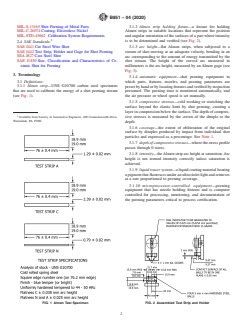
MIL-S-13165 Shot Peening of Metal Parts 3.1.2 Almen strip holding fixture—a fixture for holding
MIL-C-26074 Coating, Electroless Nickel Almen strips in suitable locations that represent the position
MIL-STD-45662 Calibration System Requirements andangularorientationofthesurfacesofapartwhereintensity
is to be determined and verified (see Fig. 2).
2.4 SAE Standards:
SAE J441 Cut Steel Wire Shot
3.1.3 arc height—flat Almen strips, when subjected to a
SAE J442 Test Strip, Holder and Gage for Shot Peening
stream of shot moving at an adequate velocity, bending in an
SEA J827 Cast Steel Shot arc corresponding to the amount of energy transmitted by the
SAE J1830 Size, Classification and Characteristics of Ce-
shot stream. The height of the curved arc measured in
ramic Shot for Peening millimeters is the arc height, measured by anAlmen gage (see
Fig. 3).
3. Terminology
3.1.4 automatic equipment—shot peening equipment in
3.1 Definitions:
which parts, fixtures, nozzles, and peening parameters are
3.1.1 Almen strip—UNS G10700 carbon steel specimens
presetbyhandorbylocatingfixturesandverifiedbyinspection
that are used to calibrate the energy of a shot peening stream
personnel. The peening time is monitored automatically, and
(see Fig. 1).
the air pressure or wheel speed is set manually.
3.1.5 compressive stresses—cold working or stretching the
surface beyond the elastic limit by shot peening, creating a
layer in compression below the surface.The depth of compres-
Available from Society of Automotive Engineers, 400 Commonwealth Drive, sive stresses is measured by the crown of the dimple to the
Warrendale, PA 15096.
depth.
3.1.6 coverage—the extent of obliteration of the original
surface by dimples produced by impact from individual shot
particles and expressed as a percentage. See Note 1.
3.1.7 depth of compressive stresses—wherethestressprofile
passes through 0 stress.
3.1.8 intensity—theAlmen strip arc height at saturation.Arc
height is not termed intensity correctly unless saturation is
achieved.
3.1.9 liquid tracer system—aliquidcoatingmaterialbearing
apigmentthatfluorescesunderanultravioletlightandremoves
at a rate proportioned to peening coverage.
3.1.10 microprocessor-controlled equipment—peening
equipment that has nozzle holding fixtures and is computer
controlled for processing, monitoring, and documentation of
the peening parameters critical to process certification.
FIG. 1 Almen Test Specimen FIG. 2 Assembled Test Strip and Holder
B851−04 (2020)
4. Ordering Information
4.1 When ordering articles to be shot peened, the purchaser
shall state the following:
4.2 ASTM designation.
4.3 Type, size, and hardness of shot to be used (see 6.1).
4.4 Number and frequency of the determinations of shot
size and uniformity required, if other than those specified in
8.1.1.
4.5 Peening intensity to be used at each location (see 8.2).
4.6 Number, frequency, and locations of Almen test speci-
mens to be provided for intensity verification and monitoring
of the process if other than those specified in 8.2, 8.2.1, and
8.2.2.
4.7 Areas on the part that are to be shot peened and those to
FIG. 3 Almen Gage
be protected from the peening (see 7.5).
4.8 Whether magnetic particle or penetrant inspection is
required before peening (see 7.2).
3.1.11 nozzle holding fixture—a fixture that holds the
4.9 Amount(percent)ofcoveragerequiredintheareastobe
nozzles at the required location, distance, and angle in a locked
peened.Acomplete coverage is the minimum requirement (see
position during the peening operation.
3.1.6 and 8.3).
3.1.12 process interrupt parameters—for critical peening
4.10 Method for measuring coverage (see 8.3.1).
operations, parameters such as shot flow, air pressure, part
r/min, oscillation rate, and cycle time that must be monitored 4.11 Type of equipment to be used, automated or computer-
within process requirements. monitored microprocessor (see 6.3 and X1.10 – X1.12).
3.1.13 saturation—the minimum duration of peening nec-
4.12 Details of any post treatment such as corrosion protec-
essary to achieve the desired Almen intensity which, when
tion (see 9.5).
doubled, does not increase theAlmen strip arc height by more
4.13 Requirements of certification and test records, as
than 10 %.
specified in Section 10.
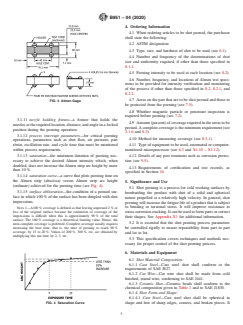
3.1.14 saturation curve—a curve that plots peening time on
the Almen strip (abscissa) versus Almen strip arc height
5. Significance and Use
(ordinate) achieved for the peening time (see Fig. 4).
5.1 Shot peening is a process for cold working surfaces by
3.1.15 surface obliteration—the condition of a peened sur-
bombarding the product with shot of a solid and spherical
face in which 100 % of the surface has been dimpled with shot
nature propelled at a relatively high velocity. In general, shot
impressions.
peeningwillincreasethefatiguelifeofaproductthatissubject
to bending or torsional stress. It will improve resistance to
NOTE 1—A100 % coverage is defined as that leaving unpeened 2 % or
stresscorrosioncracking.Itcanbeusedtoformpartsorcorrect
less of the original surface because the estimation of coverage of the
impressions is difficult when this is approximately 98 % of the total
their shapes. See Appendix X1 for additional information.
surface. The 100 % coverage is a theoretical limiting value. Hence, the
5.2 It is essential that the shot peening process parameters
term complete coverage is preferred. Complete coverage usually requires
increasing the base time, that is, the time of peening to reach 98 % be controlled rigidly to ensure repeatability from part to part
coverage, by 15 to 20 %. Values of 200 %, 300 %, etc. are obtained by
and lot to lot.
multiplying this run time by 2, 3, etc.
5.3 This specification covers techniques and methods nec-
essary for proper control of the shot peening process.
6. Materials and Equipment
6.1 Shot Material Composition:
6.1.1 Cast Steel—Cast steel shot shall conform to the
requirements of SAE J827.
6.1.2 Cut Wire—Cut wire shot shall be made from cold
finished, round wire, confirming to SAE J441.
6.1.3 Ceramic Shot—Ceramic beads shall conform to the
chemical composition given in Table 1 and to SAE J1830.
6.1.4 Shot Form and Shape:
6.1.4.1 Cast Steel—Cast steel shot shall be spherical in
FIG. 4 Saturation Curve shape and free of sharp edges, corners, and broken pieces. It
B851−04 (2020)
TABLE 1 Composition of Ceramic Shot
Specific
ZrO ,% SiO ,% Al O ,% Fe O , % Free Iron, % Gravity,
2 2 2 3 2 3
g/cm
60.0–70.0 28.0–33.0 10.0 max 0.1 max 0.1 max 3.60–3.95
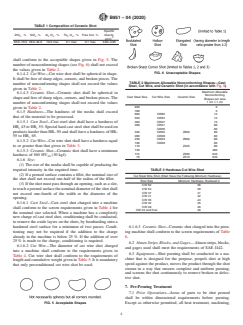
shall conform to the acceptable shapes given in Fig. 5. The
number of nonconforming shapes (see Fig. 6) shall not exceed
the values given in Table 2.
FIG. 6 Unacceptable Shapes
6.1.4.2 Cut Wire—Cut wire shot shall be spherical in shape.
It shall be free of sharp edges, corners, and broken pieces. The
TABLE 2 Maximum Allowable Nonconforming Shapes—Cast
number of nonconforming shapes shall not exceed the values
Steel, Cut Wire, and Ceramic Shot (in accordance with Fig. 6)
given in Table 2.
Maximum Allowable
6.1.4.3 Ceramic Shot—Ceramic shot shall be spherical in
Nonconforming
Cast Steel Size Cut Wire Size Ceramic Size
shape and free of sharp edges, corners, and broken pieces. The
Shapes per area
1cm×1cm
number of nonconforming shapes shall not exceed the values
930 5
given in Table 2.
780 5
6.1.5 Hardness—The hardness of the media shall exceed
660 CW62 12
that of the material to be processed.
550 CW54 12
460 CW47 15
6.1.5.1 Cast Steel—Cast steel shot shall have a hardness of
390 CW41 80
HR 45 to HR 55. Special hard cast steel shot shall be used on
c c
CW35 80
products harder than HR 50 and shall have a hardness of HR
330 CW32 Z850 80
c c
280 CW28 80
55 to HR 65.
c
230 CW23 Z600 80
6.1.5.2 Cut Wire—Cut wire shot shall have a hardness equal
190 CW20 80
to or greater than that given in Table 3.
170 Z425 80
130 480
6.1.5.3 Ceramic Shot—Ceramic shot shall have a minimum
110 Z300 640
hardness of 560 HV (30 kgf).
70 Z210 640
6.1.6 Size:
(1) The size of the media shall be capable of producing the
required intensity in the required time.
TABLE 3 Hardness Cut Wire Shot
(2) If a peened surface contains a fillet, the nominal size of
Cut Steel Wire Shot (Shall Have the Following Minimum Hardness)
the shot shall not exceed one-half of the radius of the fillet.
Shot Size Minimum Hardness, Rockwell C
(3) If the shot must pass through an opening, such as a slot,
CW 62 36
toreachapeenedsurfacethenominaldiameteroftheshotshall CW 54 39
CW 47 41
not exceed one-fourth of the width or the diameter of the
CW 41 42
opening.
CW 35 44
6.1.6.1 Cast Steel—Cast steel shot charged into a machine CW 32 45
CW 28 46
shall conform to the screen requirements given in Table 4 for
CW 23 and finer 48
the nominal size selected. When a machine has a completely
new charge of cast steel shot, conditioning shall be conducted,
to remove the oxide layers on the shots, by bombarding onto a
hardened steel surface for a minimum of two passes. Condi- 6.1.6.3 Ceramic Shot—Ceramic shot charged into the peen-
tioning may not be required if the addition to the charge
ing machine shall conform to the screen requirements of Table
already in the machine is below 25 %. If the addition of over 6.
25 % is made to the charge, conditioning is required.
6.2 AlmenStrips,Blocks,andGages—Almenstrips,blocks,
6.1.6.2 Cut Wire—The diameter of cut wire shot charged
and gages used shall meet the requirements of SAE J442.
into a machine shall conform to the requirements given in
6.3 Equipment—Shot peening shall be conducted in a ma-
Table 4. Cut wire shot shall conform to the requirements of
chine that is designed for the purpose, propels shot at high
length and cumulative weight given in Table 5. It is mandatory
speed against the product, moves the product through the shot
that only preconditioned cut wire shot be used.
stream in a way that ensures complete and uniform peening,
and screens the shot continuously to remove broken or defec-
tive shot.
7. Pre-Peening Treatment
7.1 Prior Operations—Areas of parts to be shot peened
shall be within dimensional requirements before peening.
FIG. 5 Acceptable Shapes Except as otherwise permitted, all heat treatment, machining,
B851−04 (2020)
TABLE 4 Screen Size Cast Steel Shot (in accordance with Fig. 6)
Maximum Number of
Peening All Pass Maximum 2 % on Maximum 50 % on Cumulative Min 9 % on Maximum 8 % on Deformed Shot
Shot U.S. Screen Size (mm) U.S. Screen (mm) U.S. Screen (mm) U.S. Screen (mm) U.S. Screen (mm) Acceptable per area
1cm×1cm
930 5 (4.000) 6 (3.350) 7 (2.800) 8 (2.360) 10 (2.000) 5
780 6 (3.350) 7 (2.800) 8 (2.360) 10 (2.000) 12 (1.700) 5
660 7 (2.800) 8 (2.360) 10 (2.000) 12 (1.700) 14 (1.400) 12
550 8 (2.360) 10 (2.000) 12 (1.700) 14 (1.400) 16 (1.180) 12
460 10 (2.000) 12 (1.700) 14 (1.400) 16 (1.180) 18 (1.000) 15
390 12 (1.700) 14 (1.400) 16 (1.180) 18 (1.000) 20 (0.850) 20
330 14 (1.400) 16 (1.180) 18 (1.000) 20 (0.850) 25 (0.710) 80
280 16 (1.180) 18 (1.000) 20 (0.850) 25 (0.710) 30 (0.600) 80
230 18 (1.00) 20 (0.850) 25 (0.710) 30 (0.600) 35 (0.500) 80
190 20 (0.850) 25 (0.710) 30 (0.600) 35 (0.500) 40 (0.425) 80
170 25 (0.710) 30 (0.600) 35 (0.500) 40 (0.425) 45 (0.355) 80
130 30 (0.600) 35 (0.500) 40 (0.425) 45 (0.355) 50 (0.300) 480
110 35 (0.500) 40 (0.425) 45 (0.355) 50 (0.300) 80 (0.180) 640
70 40 (0.425) 45 (0.355) 50 (0.300) 80 (0.180) 120 (0.125) 640
Sieves shall be in accordance with Specification E11.
TABLE 5 Cut Wire Shot—Size Length and Weight
face with adhesive, and when the tape is removed from the
Length of Ten Weight of Fifty surfaceitshallnotshowanyevidenceofcorrosionorleaveany
Shot Number Wire Diameter, mm
A B
Pieces, mm Pieces ,g
residue on the surface. Areas not requiring peening and not
CW-62 1.587 ± 0.051 15.75 ± 1.02 1.09 to 1.33
required to be masked shall be considered optional.
CW-54 1.372 ± 0.051 13.72 ± 1.02 0.72 to 0.88
CW-47 1.194 ± 0.051 11.94 ± 1.02 0.48 to 0.58
CW-41 1.041 ± 0.051 10.41 ± 1.02 0.31 to 0.39
8. Procedure
CW-35 0.889 ± 0.025 8.89 ± 1.02 0.20 to 0.24
CW-32 0.813 ± 0.025 8.13 ± 1.02 0.14 to 0.18
8.1 Shot—Shotchargedintothepeeningmachineshallbeas
CW-28 0.711 ± 0.025 7.11 ± 1.02 0.10 to 0.12
specified by the purchaser and meet the requirements of 6.1 for
CW-23 0.584 ± 0.025 5.84 ± 1.02 0.05 to 0.07
the particular type, size, and material required. Unless other-
CW-20 0.508 ± 0.025 5.08 ± 1.02 0.04 to 0.05
A wise specified, all shot shall be maintained in the machine so
Shot particles to be checked for length shall be mounted and ground and
polished to expose a central longitudinal section. The combined length of ten
that it conforms to the requirements of Table 7.
randomly selected particles shall be within the tolerance shown above.
8.1.1 Uniformity Determination—At least one determina-
B
Attheoptionofthecontractor,theparticlesmaybeweighedinsteadofmounted
and measured as stated in the above note. When weighed, the total weight of 50 tion for shot size and uniformity in accordance with Table 7
randomly selected particles shall be within the limits specified above.
shall be made before and after each production run and after
each8hof production on long runs, when using cast or cut
wire steel shot. Ceramic shot size distribution shall be verified
and grinding shall be completed before shot peening.All filets at least every4hof production and before and after each
shall be formed, all burrs removed, and all sharp edges and production run.
corners that require peening provided with sufficient radii prior
8.2 Peening Intensity—The peening intensity should be that
to peening, in order to result in complete coverage without any
specified by the purchaser as the arc height produced by the
distortion, chipping, or rollover.
peening process at saturation, as measured on Almen strips
7.2 Flaw and Crack Testing—When required, magnetic
placed in the required locations. Unless otherwise specified on
particle, penetrant, ultrasonic, or other flaw or crack detection
the drawing or in the contract, the intensity of peening shall be
processesshallbecompletedpriortopeening.SeeTestMethod
...