

ASTM D5798-21
(Specification)Standard Specification for Ethanol Fuel Blends for Flexible-Fuel Automotive Spark-Ignition Engines
General Information
- Abstract
ABSTRACT
This specification covers a fuel blend, nominally 51 to 83 volume % ethanol for use in ground vehicles equipped with ethanol fuel blend flexible-fuel spark-ignition engines. Ethanol fuel blends, also referred to as “Ethanol Flex Fuel” shall conform to the performance requirements prescribed. Ethanol fuel blends shall be visually free of sediment and suspended matter. The vapour pressure, acidity, pHe requirements, gum content, inorganic chloride, water requirements, copper requirements, and sulphur requirements shall be tested to meet the requirements prescribed.
SCOPE
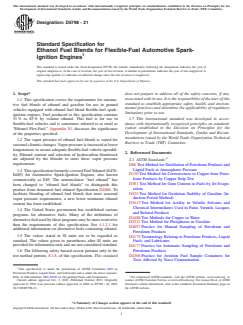
1.1 This specification covers the requirements for automotive fuel blends of ethanol and gasoline for use in ground vehicles equipped with ethanol fuel blend flexible-fuel spark-ignition engines. Fuel produced to this specification contains 51 % to 83 % by volume ethanol. This fuel is for use in flexible-fuel vehicles and is sometimes referred to at retail as “Ethanol Flex-Fuel.” Appendix X1 discusses the significance of the properties specified.
1.2 The vapor pressure of ethanol fuel blends is varied for seasonal climatic changes. Vapor pressure is increased at lower temperatures to ensure adequate flexible-fuel vehicle operability. Ethanol content and selection of hydrocarbon blendstock are adjusted by the blender to meet these vapor pressure requirements.
1.3 This specification formerly covered Fuel Ethanol (Ed70-Ed85) for Automotive Spark-Ignition Engines, also known commercially as E85. The nomenclature “fuel ethanol” has been changed to “ethanol fuel blends” to distinguish this product from denatured fuel ethanol Specification D4806. To facilitate blending of ethanol fuel blends that meet seasonal vapor pressure requirements, a new lower minimum ethanol content has been established.
1.4 The United States government has established various programs for alternative fuels. Many of the definitions of alternative fuel used by these programs may be more restrictive than the requirements of this specification. See 4.1.2.1 for additional information on alternative fuels containing ethanol.
1.5 The values stated in SI units are to be regarded as standard. The values given in parentheses after SI units are provided for information only and are not considered standard.
1.6 The following safety hazard caveat pertains only to the test method portion, 8.1.8, of this specification. This standard does not purport to address all of the safety concerns, if any, associated with its use. It is the responsibility of the user of this standard to establish appropriate safety, health, and environmental practices and determine the applicability of regulatory limitations prior to use.
1.7 This international standard was developed in accordance with internationally recognized principles on standardization established in the Decision on Principles for the Development of International Standards, Guides and Recommendations issued by the World Trade Organization Technical Barriers to Trade (TBT) Committee.
- Status
- Published
- Publication Date
- 30-Sep-2021
- Technical Committee
- D02 - Petroleum Products, Liquid Fuels, and Lubricants
- Drafting Committee
- D02.A0.02 - Oxygenated Fuels and Components
Buy Documents
ASTM D5798-21 - Standard Specification for Ethanol Fuel Blends for Flexible-Fuel Automotive Spark-Ignition Engines
REDLINE ASTM D5798-21 - Standard Specification for Ethanol Fuel Blends for Flexible-Fuel Automotive Spark-Ignition Engines
Overview
ASTM D5798-21 is the standard specification developed by ASTM International for ethanol fuel blends intended for use in flexible-fuel ground vehicles equipped with spark-ignition engines. Ethanol fuel blends, also referred to as “Ethanol Flex Fuel,” must contain 51% to 83% by volume ethanol. These blends are commonly marketed at retail as E85, although the standard permits a wider range of compositions to account for seasonal and geographic conditions. This specification establishes uniform requirements and test methods to ensure product quality, performance, and regulatory compliance for fuels used in flexible-fuel vehicles (FFVs).
Key Topics
- Ethanol Content: Ethanol fuel blends must have ethanol concentrations between 51% and 83% by volume. Adjustments in ethanol content enable the fuel to meet vapor pressure requirements for seasonal variations.
- Vapor Pressure Classes: The specification defines four volatility classes based on local climate and time of year to ensure reliable engine starting and operation in various weather conditions.
- Fuel Purity and Appearance: Ethanol blends must be clear, bright, and free of sediment or suspended matter at the point of transfer. Proper blending and handling practices are crucial to prevent phase separation or contamination.
- Performance Requirements: The specification sets limits on key properties such as water content, acidity, pHe (hydrogen ion activity in low-water environments), gum residue, inorganic chlorides, copper content, sulfur content, and methanol content. These limits are essential for preventing corrosion, deposit formation, and ensuring engine longevity.
- Component Restrictions: Only denatured fuel ethanol and suitable hydrocarbon blendstocks (such as unleaded gasoline, natural gasoline, or blendstock for oxygenate blending) are permitted. The intentional addition of lead or phosphorus compounds is not allowed.
- Sampling and Testing: The standard prescribes detailed sampling methods and approved test procedures to verify compliance with all requirements.
Applications
- Flexible-Fuel Vehicles (FFVs): Ethanol fuel blends specified by ASTM D5798-21 are designed for use in FFVs, which can operate on a wide range of mixtures of gasoline and ethanol.
- Retail Fuel Stations: The standard enables fuel providers to adjust blends seasonally to optimize vapor pressure, ensuring reliable starting and drivability in both cold and hot climates.
- Government and Fleet Programs: D5798-21 supports compliance with U.S. federal and other alternative fuel definitions, particularly under programs promoting the adoption of alternative fuels in vehicle fleets.
- Blenders and Distributors: Fuel suppliers must ensure that all blend components and final products meet the ASTM specification before distribution, using prescribed analytical test methods to confirm quality and prevent contamination.
Related Standards
- ASTM D4806: Specification for denatured fuel ethanol used in creating ethanol fuel blends.
- ASTM D4814: Specification for automotive spark-ignition engine fuel (gasoline).
- ASTM D5501: Test method for determination of ethanol and methanol content in fuel blends.
- ASTM D4953 / D5191: Test methods for measuring fuel vapor pressure.
- ASTM D7795: Test method for acidity in ethanol blends.
- ASTM D7923: Test method for water in ethanol and hydrocarbon blends.
- SAE 2007-01-4006: Reference model for estimating vapor pressures of ethanol blends.
ASTM D5798-21 is an internationally recognized standard developed in line with WTO principles, enabling consistent quality and performance for ethanol flexible-fuel blends across a diverse range of applications and geographic regions. Meeting these requirements assures compliance, supports vehicle performance, and helps advance the use of sustainable alternative fuels.
Relations
- Effective Date
- 01-Mar-2024
- Effective Date
- 01-Jan-2024
- Effective Date
- 01-Jan-2024
- Effective Date
- 01-Jan-2024
- Refers
ASTM D4175-23a - Standard Terminology Relating to Petroleum Products, Liquid Fuels, and Lubricants - Effective Date
- 15-Dec-2023
- Effective Date
- 01-Dec-2023
- Effective Date
- 01-Dec-2023
- Effective Date
- 01-Dec-2023
- Refers
ASTM D4175-23e1 - Standard Terminology Relating to Petroleum Products, Liquid Fuels, and Lubricants - Effective Date
- 01-Jul-2023
- Effective Date
- 01-May-2020
- Effective Date
- 01-Feb-2020
- Effective Date
- 01-Dec-2019
- Effective Date
- 15-Sep-2019
- Effective Date
- 01-Jul-2019
- Effective Date
- 01-Jun-2019
Buy Documents
ASTM D5798-21 - Standard Specification for Ethanol Fuel Blends for Flexible-Fuel Automotive Spark-Ignition Engines
REDLINE ASTM D5798-21 - Standard Specification for Ethanol Fuel Blends for Flexible-Fuel Automotive Spark-Ignition Engines
Get Certified
Connect with accredited certification bodies for this standard

Element Materials Technology
Materials testing and product certification.

ABS Group Brazil
ABS Group certification services in Brazil.

ABS Quality Evaluations Inc.
American Bureau of Shipping quality certification.
Sponsored listings
Frequently Asked Questions
ASTM D5798-21 is a technical specification published by ASTM International. Its full title is "Standard Specification for Ethanol Fuel Blends for Flexible-Fuel Automotive Spark-Ignition Engines". This standard covers: ABSTRACT This specification covers a fuel blend, nominally 51 to 83 volume % ethanol for use in ground vehicles equipped with ethanol fuel blend flexible-fuel spark-ignition engines. Ethanol fuel blends, also referred to as “Ethanol Flex Fuel” shall conform to the performance requirements prescribed. Ethanol fuel blends shall be visually free of sediment and suspended matter. The vapour pressure, acidity, pHe requirements, gum content, inorganic chloride, water requirements, copper requirements, and sulphur requirements shall be tested to meet the requirements prescribed. SCOPE 1.1 This specification covers the requirements for automotive fuel blends of ethanol and gasoline for use in ground vehicles equipped with ethanol fuel blend flexible-fuel spark-ignition engines. Fuel produced to this specification contains 51 % to 83 % by volume ethanol. This fuel is for use in flexible-fuel vehicles and is sometimes referred to at retail as “Ethanol Flex-Fuel.” Appendix X1 discusses the significance of the properties specified. 1.2 The vapor pressure of ethanol fuel blends is varied for seasonal climatic changes. Vapor pressure is increased at lower temperatures to ensure adequate flexible-fuel vehicle operability. Ethanol content and selection of hydrocarbon blendstock are adjusted by the blender to meet these vapor pressure requirements. 1.3 This specification formerly covered Fuel Ethanol (Ed70-Ed85) for Automotive Spark-Ignition Engines, also known commercially as E85. The nomenclature “fuel ethanol” has been changed to “ethanol fuel blends” to distinguish this product from denatured fuel ethanol Specification D4806. To facilitate blending of ethanol fuel blends that meet seasonal vapor pressure requirements, a new lower minimum ethanol content has been established. 1.4 The United States government has established various programs for alternative fuels. Many of the definitions of alternative fuel used by these programs may be more restrictive than the requirements of this specification. See 4.1.2.1 for additional information on alternative fuels containing ethanol. 1.5 The values stated in SI units are to be regarded as standard. The values given in parentheses after SI units are provided for information only and are not considered standard. 1.6 The following safety hazard caveat pertains only to the test method portion, 8.1.8, of this specification. This standard does not purport to address all of the safety concerns, if any, associated with its use. It is the responsibility of the user of this standard to establish appropriate safety, health, and environmental practices and determine the applicability of regulatory limitations prior to use. 1.7 This international standard was developed in accordance with internationally recognized principles on standardization established in the Decision on Principles for the Development of International Standards, Guides and Recommendations issued by the World Trade Organization Technical Barriers to Trade (TBT) Committee.
ABSTRACT This specification covers a fuel blend, nominally 51 to 83 volume % ethanol for use in ground vehicles equipped with ethanol fuel blend flexible-fuel spark-ignition engines. Ethanol fuel blends, also referred to as “Ethanol Flex Fuel” shall conform to the performance requirements prescribed. Ethanol fuel blends shall be visually free of sediment and suspended matter. The vapour pressure, acidity, pHe requirements, gum content, inorganic chloride, water requirements, copper requirements, and sulphur requirements shall be tested to meet the requirements prescribed. SCOPE 1.1 This specification covers the requirements for automotive fuel blends of ethanol and gasoline for use in ground vehicles equipped with ethanol fuel blend flexible-fuel spark-ignition engines. Fuel produced to this specification contains 51 % to 83 % by volume ethanol. This fuel is for use in flexible-fuel vehicles and is sometimes referred to at retail as “Ethanol Flex-Fuel.” Appendix X1 discusses the significance of the properties specified. 1.2 The vapor pressure of ethanol fuel blends is varied for seasonal climatic changes. Vapor pressure is increased at lower temperatures to ensure adequate flexible-fuel vehicle operability. Ethanol content and selection of hydrocarbon blendstock are adjusted by the blender to meet these vapor pressure requirements. 1.3 This specification formerly covered Fuel Ethanol (Ed70-Ed85) for Automotive Spark-Ignition Engines, also known commercially as E85. The nomenclature “fuel ethanol” has been changed to “ethanol fuel blends” to distinguish this product from denatured fuel ethanol Specification D4806. To facilitate blending of ethanol fuel blends that meet seasonal vapor pressure requirements, a new lower minimum ethanol content has been established. 1.4 The United States government has established various programs for alternative fuels. Many of the definitions of alternative fuel used by these programs may be more restrictive than the requirements of this specification. See 4.1.2.1 for additional information on alternative fuels containing ethanol. 1.5 The values stated in SI units are to be regarded as standard. The values given in parentheses after SI units are provided for information only and are not considered standard. 1.6 The following safety hazard caveat pertains only to the test method portion, 8.1.8, of this specification. This standard does not purport to address all of the safety concerns, if any, associated with its use. It is the responsibility of the user of this standard to establish appropriate safety, health, and environmental practices and determine the applicability of regulatory limitations prior to use. 1.7 This international standard was developed in accordance with internationally recognized principles on standardization established in the Decision on Principles for the Development of International Standards, Guides and Recommendations issued by the World Trade Organization Technical Barriers to Trade (TBT) Committee.
ASTM D5798-21 is classified under the following ICS (International Classification for Standards) categories: 75.160.20 - Liquid fuels. The ICS classification helps identify the subject area and facilitates finding related standards.
ASTM D5798-21 has the following relationships with other standards: It is inter standard links to ASTM D3231-24, ASTM D4814-24, ASTM E203-24, ASTM E1064-24, ASTM D4175-23a, ASTM D86-23a, ASTM D4814-23a, ASTM D86-23ae1, ASTM D4175-23e1, ASTM D4953-20, ASTM D4814-20, ASTM D4814-19a, ASTM D4806-19a, ASTM D5453-19a, ASTM D7923-19. Understanding these relationships helps ensure you are using the most current and applicable version of the standard.
ASTM D5798-21 is available in PDF format for immediate download after purchase. The document can be added to your cart and obtained through the secure checkout process. Digital delivery ensures instant access to the complete standard document.
Standards Content (Sample)
This international standard was developed in accordance with internationally recognized principles on standardization established in the Decision on Principles for the
Development of International Standards, Guides and Recommendations issued by the World Trade Organization Technical Barriers to Trade (TBT) Committee.
Designation:D5798 −21
Standard Specification for
Ethanol Fuel Blends for Flexible-Fuel Automotive Spark-
Ignition Engines
This standard is issued under the fixed designation D5798; the number immediately following the designation indicates the year of
original adoption or, in the case of revision, the year of last revision.Anumber in parentheses indicates the year of last reapproval.A
superscript epsilon (´) indicates an editorial change since the last revision or reapproval.
This standard has been approved for use by agencies of the U.S. Department of Defense.
1. Scope* does not purport to address all of the safety concerns, if any,
associated with its use. It is the responsibility of the user of this
1.1 This specification covers the requirements for automo-
standard to establish appropriate safety, health, and environ-
tive fuel blends of ethanol and gasoline for use in ground
mental practices and determine the applicability of regulatory
vehicles equipped with ethanol fuel blend flexible-fuel spark-
limitations prior to use.
ignition engines. Fuel produced to this specification contains
1.7 This international standard was developed in accor-
51% to 83% by volume ethanol. This fuel is for use in
dance with internationally recognized principles on standard-
flexible-fuel vehicles and is sometimes referred to at retail as
ization established in the Decision on Principles for the
“Ethanol Flex-Fuel.” Appendix X1 discusses the significance
Development of International Standards, Guides and Recom-
of the properties specified.
mendations issued by the World Trade Organization Technical
1.2 The vapor pressure of ethanol fuel blends is varied for
Barriers to Trade (TBT) Committee.
seasonalclimaticchanges.Vaporpressureisincreasedatlower
temperatures to ensure adequate flexible-fuel vehicle operabil-
2. Referenced Documents
ity. Ethanol content and selection of hydrocarbon blendstock
are adjusted by the blender to meet these vapor pressure
2.1 ASTM Standards:
requirements.
D86Test Method for Distillation of Petroleum Products and
Liquid Fuels at Atmospheric Pressure
1.3 ThisspecificationformerlycoveredFuelEthanol(Ed70-
D130Test Method for Corrosiveness to Copper from Petro-
Ed85) for Automotive Spark-Ignition Engines, also known
leum Products by Copper Strip Test
commercially as E85. The nomenclature “fuel ethanol” has
D381Test Method for Gum Content in Fuels by Jet Evapo-
been changed to “ethanol fuel blends” to distinguish this
ration
product from denatured fuel ethanol Specification D4806.To
D525Test Method for Oxidation Stability of Gasoline (In-
facilitate blending of ethanol fuel blends that meet seasonal
duction Period Method)
vapor pressure requirements, a new lower minimum ethanol
D1613Test Method for Acidity in Volatile Solvents and
content has been established.
Chemical Intermediates Used in Paint, Varnish, Lacquer,
1.4 The United States government has established various
and Related Products
programs for alternative fuels. Many of the definitions of
D1688Test Methods for Copper in Water
alternativefuelusedbytheseprogramsmaybemorerestrictive
D3231Test Method for Phosphorus in Gasoline
than the requirements of this specification. See 4.1.2.1 for
D4057Practice for Manual Sampling of Petroleum and
additional information on alternative fuels containing ethanol.
Petroleum Products
1.5 The values stated in SI units are to be regarded as
D4175Terminology Relating to Petroleum Products, Liquid
standard. The values given in parentheses after SI units are
Fuels, and Lubricants
providedforinformationonlyandarenotconsideredstandard.
D4177Practice for Automatic Sampling of Petroleum and
Petroleum Products
1.6 The following safety hazard caveat pertains only to the
D4306Practice for Aviation Fuel Sample Containers for
test method portion, 8.1.8, of this specification. This standard
Tests Affected by Trace Contamination
This specification is under the jurisdiction of ASTM Committee D02 on
Petroleum Products, Liquid Fuels, and Lubricants and is under the direct responsi-
bility of Subcommittee D02.A0.02 on Oxygenated Fuels and Components. For referenced ASTM standards, visit the ASTM website, www.astm.org, or
Current edition approved Oct. 1, 2021. Published October 2021. Originally contact ASTM Customer Service at service@astm.org. For Annual Book of ASTM
approved in 1996. Last previous edition approved in 2020 as D5798–20. DOI: Standards volume information, refer to the standard’s Document Summary page on
10.1520/D5798-21. the ASTM website.
*A Summary of Changes section appears at the end of this standard
Copyright © ASTM International, 100 Barr Harbor Drive, PO Box C700, West Conshohocken, PA 19428-2959. United States
D5798−21
D4806Specification for Denatured Fuel Ethanol for Blend- 2.3 SAE Papers:
ing with Gasolines for Use asAutomotive Spark-Ignition SAE 2007–01–4006A Model for Estimating Vapor Pres-
sures of Commingled Ethanol Fuels
Engine Fuel
D4814Specification for Automotive Spark-Ignition Engine
3. Terminology
Fuel
D4953Test Method for Vapor Pressure of Gasoline and 3.1 For general terminology, refer to Terminology D4175.
Gasoline-Oxygenate Blends (Dry Method)
3.2 Definitions:
D5191Test Method for Vapor Pressure of Petroleum Prod-
3.2.1 denaturants, n—materials added to ethanol to make it
ucts and Liquid Fuels (Mini Method)
unsuitable for beverage use under a formula approved by a
D5453Test Method for Determination of Total Sulfur in
regulatory agency to prevent the imposition of beverage
Light Hydrocarbons, Spark Ignition Engine Fuel, Diesel
alcohol tax.
Engine Fuel, and Engine Oil by Ultraviolet Fluorescence 3.2.1.1 Discussion—Denaturants are only those materials
D5501Test Method for Determination of Ethanol and added by the denaturer to comply with the approved formula;
any materials absorbed later are not denaturants. D4806
Methanol Content in Fuels Containing Greater than 20%
Ethanol by Gas Chromatography
3.2.2 denatured fuel ethanol, n—fuel ethanol made unfit for
D5854Practice for Mixing and Handling of Liquid Samples
beverage use by the addition of denaturants under formula(s)
of Petroleum and Petroleum Products
approved by the applicable regulatory agency to prevent the
D6423Test Method for Determination of pHe of Denatured imposition of beverage alcohol tax. D4806
Fuel Ethanol and Ethanol Fuel Blends
3.2.3 ethanol, n—ethyl alcohol, the chemical compound
D7039Test Method for Sulfur in Gasoline, Diesel Fuel, Jet
CH CH OH. D4806
3 2
Fuel, Kerosine, Biodiesel, Biodiesel Blends, and
3.2.4 finished fuel, n—a homogeneous mixture of blend-
Gasoline-Ethanol Blends by Monochromatic Wavelength
stocks and fuel additives meeting all specification and regula-
Dispersive X-ray Fluorescence Spectrometry
tory requirements for its intended use at the location where
D7319Test Method for Determination of Existent and Po-
sold. D4814
tential Sulfate and Inorganic Chloride in Fuel Ethanol and
3.2.5 flexible-fuel vehicle, n—a vehicle designed to operate
Butanol by Direct Injection Suppressed Ion Chromatog-
on both gasoline and ethanol fuel blends and can operate on
raphy
any mixture of both.
D7328Test Method for Determination of Existent and Po-
3.2.5.1 Discussion—In the United States, these vehicles
tential Inorganic Sulfate and Total Inorganic Chloride in
have U.S. EPAemissions certifications using gasoline comply-
Fuel Ethanol by Ion Chromatography Using Aqueous
ing with U.S. EPA requirements and ethanol fuel blends that
Sample Injection
meet the requirements of Specification D5798.
D7667Test Method for Determination of Corrosiveness to
3.2.5.2 Discussion—Flex-fuel vehicle and FFV are com-
Silver by Automotive Spark-Ignition Engine Fuel—Thin
monly used synonyms for flexible-fuel vehicle.
Silver Strip Method
3.2.5.3 Discussion—The fuels may also contain anti-
D7671Test Method for Corrosiveness to Silver byAutomo-
oxidants, corrosion inhibitors, metal deactivators, and dyes but
tive Spark–Ignition Engine Fuel–Silver Strip Method
do not contain lead additives. A jurisdiction may set limits on
D7757Test Method for Silicon in Gasoline and Related
lead content from all sources.
Products by Monochromatic Wavelength Dispersive
3.2.6 gasoline, n—a volatile mixture of liquid
X-ray Fluorescence Spectrometry
hydrocarbons, generally containing small amounts of
D7795Test Method for Acidity in Ethanol and Ethanol
additives, suitable for use as a fuel in spark-ignition, internal
Blends by Titration
combustion engines. D4814
D7923Test Method for Water in Ethanol and Hydrocarbon
3.2.7 hydrocarbon, n—a compound composed solely of
Blends by Karl Fischer Titration
hydrogen and carbon.
E203Test Method for Water Using Volumetric Karl Fischer
3.2.8 methanol, n—methyl alcohol, the chemical compound
Titration
CH OH.
E1064Test Method for Water in Organic Liquids by Coulo-
3.2.9 pHe, n—a measure of hydrogen ion activity, defined
metric Karl Fischer Titration
3 by Test Method D6423. D6423
2.2 Government Standards:
United States Code of Federal Regulations,Title 40, Part
3.2.9.1 Discussion—The traditional pH measurement of hy-
drogen ion activity is in an aqueous system but the measure-
ment done in Test Method D6423 is in a nearly anhydrous
environment. D6423
3.3 Definitions of Terms Specific to This Standard:
Aprinted copy of the Code of Federal Regulations may be purchased from the
U.S. Government Printing Office, Superintendent of Documents, 732 N. Capitol
Street, N.W., Mail Stop: SDE, Washington, DC 20401 or the online store at
http://bookstore.gpo.gov/.The Code of Federal Regulations may be browsed online AvailablefromSAEInternational(SAE),400CommonwealthDr.,Warrendale,
athttp://www.gpoaccess.gov/cfr/index.html. PA 15096-0001, http://www.sae.org.
D5798−21
3.3.1 hydrocarbon blendstock, n—a blending component 5.1.1 The components used to produce Ethanol Fuel Blends
composedofhydrocarbonswhichboilinthegasolinetempera- are limited to denatured fuel ethanol and hydrocarbon blend-
ture distillation range and trace amounts of naturally occurring stock as defined in 5.2.
compounds or additives composed of hydrogen, carbon, and 5.1.2 The intentional addition of lead or phosphorus com-
other elements such as sulfur, oxygen and nitrogen. pounds to ethanol fuel blends is not permitted.
5.2 Hydrocarbon Blendstock blended with the denatured
4. Ordering Information
fuel ethanol shall meet the requirements of Table 2.
4.1 The purchasing agency shall: 5.2.1 The hydrocarbon blendstock may be unleaded
4.1.1 Indicate the season and locality in which the fuel is to gasoline, gasoline blendstock for oxygenate blending (BOB),
be used, natural gasoline or other hydrocarbons in the gasoline boiling
4.1.2 If requested, ensure that the ethanol concentration range.
meetstherequirementsforanalternativefuelforfederalfleets. 5.2.2 In the United States, 40 CFR Part 1090.640 provides
4.1.2.1 The composition of alternative fuels in the United an exemption for use of deposit control additives for ethanol
States is regulated by various government agencies and regu-
fuel blends. The hydrocarbon blendstock (gasoline) is exempt
lations including the U.S. Department of Energy (DOE) and from the gasoline deposit control requirements in 40 CFR Part
U.S. Environmental Protection Agency (EPA). With regard to 1090.260.
fuel properties including volatility, this specification can be
5.3 Vapor pressure is varied for seasonal and climatic
moreorlessrestrictivethanDOEorEPArules,regulationsand
changes by providing four vapor pressure classes for ethanol
waivers.Toqualifyasanalternativefuelforfederalfleetusein
fuel blends.
theUnitedStates,theethanolblendisrequiredtomeettheU.S.
5.3.1 Class 1 encompasses geographical areas with 6-hour
Department of Energy’s definition of alternative fuels, enacted
tenth percentile minimum ambient temperature of greater than
under the Energy PolicyAct of 1992 (Title III, Sec. 301). For
5°C (41°F).
ethanol, the Act defines “alternative fuel” as a mixture con-
5.3.2 Class 2 encompasses geographical areas with 6-hour
taining denatured ethanol at a volume of “85 percent or more
tenth percentile minimum ambient temperature of greater
(or such other percentage, but not less than 70 percent, as
than−5°C (23°F) but less than or equal to 5°C (41°F).
determined by the Secretary, by rule.).” Correcting for dena-
5.3.3 Class 3 encompasses geographical areas with 6-hour
turant content, a blend of 70% to 85% by volume denatured
tenth percentile minimum ambient temperature greater than
fuel ethanol contains 68% to 83% by volume ethanol as
−13°C (9°F) but less than or equal to−5°C (23°F).
measured by Test Method D5501. The U.S. government has
5.3.4 Class 4 encompasses geographical areas with 6-hour
other programs and definitions for alternative fuels.
tenth percentile minimum ambient temperature less than or
4.1.2.2 Users of this specification are advised to check with
equal to −13°C (9°F).
the applicable regulatory agency for specific alternative fuel
5.3.5 There is a 10% probability that the highest tempera-
requirements.
ture of the six coldest consecutive hourly temperature readings
of a 24h day will be colder than the 6h tenth percentile
5. Ethanol Fuel Blends Performance Requirements
minimum ambient temperature.
5.1 Ethanol Fuel Blends shall conform to the requirements 5.3.6 See 5.4.4 and 5.5.2 for seasonal and geographical
of Table 1. distributions.
A
TABLE 1 Requirements for Ethanol Fuel Blends
Properties Class Class 2 Class Class 4 Test Methods
B
1 3
Vapor pressure, kPa (psi) 38–62 48–65 59–83 66–103 D4953 or D5191
(5.5–9.0) (7.0–9.5) (8.5–12.0) (9.5–15.0)
C
All Classes
Ethanol Content, volume % 51–83 D5501
Water, % by volume (% by mass), max 0.8 (1.0) D7923, E203,or E1064
Methanol Content, max, volume % 0.5 D5501
Sulfur Content, max, mg/kg 80 D5453 or D7039
Acidity, (as acetic acid CH3COOH), 0.005 (40) [50] D7795
mass % (mg/L) [mg/kg], max
Solvent-washed gum content, 5 D381
max, mg/100 mL
Unwashed gum content, max, 20 D381
mg/100 mL
pHe 6.5 to 9.0 D6423
Inorganic chloride content, max, mg/kg 1 D7319 or D7328
Copper content, max, mg/L 0.07 D1688
A
For information on alternative fuels, see 4.1.2.1.
B
See 5.3.1 for volatility class criteria.
C
Ethanol content and selection of hydrocarbon blendstock are adjusted by the blender to meet vapor pressure requirements. See X1.3.2 for additional information and
guidance for blending.
D5798−21
TABLE 2 Requirements for Hydrocarbon Blendstock
produce ethanol fuel blends is exempt from the gasoline
Properties Test Methods deposit control requirements in 40 CFR Part 1090.260.
Distillation, end point, max, °C (°F) 225 (437) D86
6.2.2 Different hydrocarbon blendstocks can also exhibit a
Oxidation stability, minimum, minutes 240 D525
broad range of chemical properties including, but not limited
Copper Strip Corrosion, max No. 1 D130
to, aromatics content, olefins content, saturates content, which
Silver Strip Corrosion, max No. 1 D7667, D7671
A
Vapor pressure Report D4953, D5191
may influence the solubility of additives in a finished ethanol
A
While not a requirement of this specification, the blender will need to know the fuel blend. Blenders or terminals should actively engage
vapor pressure of the hydrocarbon blendstock in order to choose a suitable blend
additive manufacturers to determine whether the additives will
ratio for the components to meet the vapor pressure requirement of a particular
remain soluble with various concentrations of ethanol and
volatility class.
gasoline.
6.2.3 Currently there is noASTM approved test method for
measuring DRA in ethanol fuel blends although some labora-
5.4 Regulatory and Other Requirements in the United
tories may use non-ASTM test methods.
States:
6.3 The specification defines only a basic purity for ethanol
5.4.1 Ethanol content requirements for ethanol alternative
fuel blends. The product shall be free of any adulterant or
fuel blends can be found in 4.1.2.1.
contaminant that can render the material unacceptable for its
5.4.2 The denaturant for the denatured fuel ethanol used in
commonly used applications.
making ethanol fuel blends shall meet the requirements of
6.3.1 Manufacturers and blenders of ethanol fuel blends
Section 5 in Specification D4806.
shallavoidethanol(forexample,improperlyrecycledethanol),
5.4.3 Ethanol fuel blends of any volatility class shall meet
or denaturants and hydrocarbon blend components contami-
certain U.S. Environmental Protection Agency (EPA) regula-
natedbysilicon-containingmaterials,orboth.Siliconcontami-
tions for unleaded gasoline. See Appendix X2.
nation of gasoline, denatured ethanol, and their blends has led
5.4.4 The United States seasonal and geographical distribu-
to fouled vehicle components (for example, spark plugs,
tion for the four vapor pressure classes is shown in Table 3.
exhaust oxygen sensors, catalytic converters) requiring parts
5.5 Regulatory and Other Requirements Outside the United
replacementandrepairs.TestMethodD7757isaprocedurefor
States:
determining silicon content but no specification limits have
5.5.1 Users of this specification are advised to consult with
been established for silicon.
the applicable regulatory agency for specific requirements for
their jurisdictions.
7. Sampling, Containers, and Sample Handling
5.5.2 Users of the specification in geographical areas out-
7.1 Thereaderisstronglyadvisedtoreviewallintendedtest
side the United States need to determine the 6-hour tenth
methods prior to sampling to better understand the importance
percentileminimumambienttemperaturesfortheirgeographic
and effects of sampling technique, proper containers, and
areasandtimesofyearinordertoselecttheappropriateclasses
special handling required for each test method.
of fuel.
7.2 Correct sampling procedures are critical to obtain a
6. Workmanship
sample representative of the lot intended to be tested. Use
appropriate procedures in Practice D4057 for manual method
6.1 The finished fuel blend shall be visually free of
sediment,suspendedorundissolvedmatter.Itshallbeclearand sampling and in Practice D4177 for automatic sampling, as
applicable.
brightatthefueltemperatureatthepointofcustodytransferor
atanalternativetemperatureagreeduponbythepurchaserand
7.3 The correct sample volume and appropriate container
seller.
selection are important decisions that can impact test results.
NOTE 1—Finished fuel should be resistant to phase separation or
Refer to Practice D4306 for aviation fuel container selection
undissolved matter at the lowest temperatures to which it is likely to be
for tests sensitive to trace contamination. Refer to Practice
subjected, dependent on the time and place of its intended use. See
Specification D4814, TableX7.1 for guidance.
D5854 for procedures on container selection and sample
NOTE 2—Solubility is temperature dependent. As this fuel cools some
mixing and handling. Where practical, ethanol fuel blends
high molecular weight additives can become insoluble.
should be sampled in glass containers. If samples must be
6.2 The hydrocarbon blendstock for ethanol fuel blends
collected in metal containers, do not use soldered metal
should avoid the use of materials at concentrations that can
containers. The soldering flux in the containers and the lead in
separate from solution at the expected temperatures of
the solder can contaminate the sample. Plastic containers
blending, storage, and use. If drag reducing agent (additive)
should be avoided.
(DRA) or deposit control additive is used in the hydrocarbon
7.4 A minimum sample size of about 1 L (1 U.S. qt) is
blendstock distribution system, it should not be present in the
recommended.
product delivered to be used as a hydrocarbon blendstock at a
concentration or shear condition, which can separate from the
8. Test Methods
denatured fuel ethanol under those conditions.
6.2.1 In the United States, 40 CFR Part 1090.640 provides 8.1 Determine the requirements enumerated in this specifi-
an exemption for use of deposit control additives for ethanol cation in accord
...
This document is not an ASTM standard and is intended only to provide the user of an ASTM standard an indication of what changes have been made to the previous version. Because
it may not be technically possible to adequately depict all changes accurately, ASTM recommends that users consult prior editions as appropriate. In all cases only the current version
of the standard as published by ASTM is to be considered the official document.
Designation: D5798 − 20 D5798 − 21
Standard Specification for
Ethanol Fuel Blends for Flexible-Fuel Automotive Spark-
Ignition Engines
This standard is issued under the fixed designation D5798; the number immediately following the designation indicates the year of
original adoption or, in the case of revision, the year of last revision. A number in parentheses indicates the year of last reapproval. A
superscript epsilon (´) indicates an editorial change since the last revision or reapproval.
This standard has been approved for use by agencies of the U.S. Department of Defense.
1. Scope*
1.1 This specification covers the requirements for automotive fuel blends of ethanol and gasoline for use in ground vehicles
equipped with ethanol fuel blend flexible-fuel spark-ignition engines. Fuel produced to this specification contains 51 % to 83 %
by volume ethanol. This fuel is for use in flexible-fuel vehicles and is sometimes referred to at retail as “Ethanol Flex-Fuel.”
Appendix X1 discusses the significance of the properties specified.
1.2 The vapor pressure of ethanol fuel blends is varied for seasonal climatic changes. Vapor pressure is increased at lower
temperatures to ensure adequate flexible-fuel vehicle operability. Ethanol content and selection of hydrocarbon blendstock are
adjusted by the blender to meet these vapor pressure requirements.
1.3 This specification formerly covered Fuel Ethanol (Ed70-Ed85) for Automotive Spark-Ignition Engines, also known
commercially as E85. The nomenclature “fuel ethanol” has been changed to “ethanol fuel blends” to distinguish this product from
denatured fuel ethanol Specification D4806. To facilitate blending of ethanol fuel blends that meet seasonal vapor pressure
requirements, a new lower minimum ethanol content has been established.
1.4 The United States government has established various programs for alternative fuels. Many of the definitions of alternative
fuel used by these programs may be more restrictive than the requirements of this specification. See 4.1.2.1 for additional
information on alternative fuels containing ethanol.
1.5 The values stated in SI units are to be regarded as standard. The values given in parentheses after SI units are provided for
information only and are not considered standard.
1.6 The following safety hazard caveat pertains only to the test method portion, 8.1.8, of this specification. This standard does
not purport to address all of the safety concerns, if any, associated with its use. It is the responsibility of the user of this standard
to establish appropriate safety, health, and environmental practices and determine the applicability of regulatory limitations prior
to use.
1.7 This international standard was developed in accordance with internationally recognized principles on standardization
established in the Decision on Principles for the Development of International Standards, Guides and Recommendations issued
by the World Trade Organization Technical Barriers to Trade (TBT) Committee.
This specification is under the jurisdiction of ASTM Committee D02 on Petroleum Products, Liquid Fuels, and Lubricants and is under the direct responsibility of
Subcommittee D02.A0.02 on Oxygenated Fuels and Components.
Current edition approved May 1, 2020Oct. 1, 2021. Published May 2020October 2021. Originally approved in 1996. Last previous edition approved in 20192020 as
D5798 – 19b.D5798 – 20. DOI: 10.1520/D5798-20.10.1520/D5798-21.
*A Summary of Changes section appears at the end of this standard
Copyright © ASTM International, 100 Barr Harbor Drive, PO Box C700, West Conshohocken, PA 19428-2959. United States
D5798 − 21
2. Referenced Documents
2.1 ASTM Standards:
D86 Test Method for Distillation of Petroleum Products and Liquid Fuels at Atmospheric Pressure
D130 Test Method for Corrosiveness to Copper from Petroleum Products by Copper Strip Test
D381 Test Method for Gum Content in Fuels by Jet Evaporation
D525 Test Method for Oxidation Stability of Gasoline (Induction Period Method)
D1613 Test Method for Acidity in Volatile Solvents and Chemical Intermediates Used in Paint, Varnish, Lacquer, and Related
Products
D1688 Test Methods for Copper in Water
D3231 Test Method for Phosphorus in Gasoline
D4057 Practice for Manual Sampling of Petroleum and Petroleum Products
D4175 Terminology Relating to Petroleum Products, Liquid Fuels, and Lubricants
D4177 Practice for Automatic Sampling of Petroleum and Petroleum Products
D4306 Practice for Aviation Fuel Sample Containers for Tests Affected by Trace Contamination
D4806 Specification for Denatured Fuel Ethanol for Blending with Gasolines for Use as Automotive Spark-Ignition Engine Fuel
D4814 Specification for Automotive Spark-Ignition Engine Fuel
D4953 Test Method for Vapor Pressure of Gasoline and Gasoline-Oxygenate Blends (Dry Method)
D5191 Test Method for Vapor Pressure of Petroleum Products and Liquid Fuels (Mini Method)
D5453 Test Method for Determination of Total Sulfur in Light Hydrocarbons, Spark Ignition Engine Fuel, Diesel Engine Fuel,
and Engine Oil by Ultraviolet Fluorescence
D5501 Test Method for Determination of Ethanol and Methanol Content in Fuels Containing Greater than 20 % Ethanol by Gas
Chromatography
D5854 Practice for Mixing and Handling of Liquid Samples of Petroleum and Petroleum Products
D6423 Test Method for Determination of pHe of Denatured Fuel Ethanol and Ethanol Fuel Blends
D7039 Test Method for Sulfur in Gasoline, Diesel Fuel, Jet Fuel, Kerosine, Biodiesel, Biodiesel Blends, and Gasoline-Ethanol
Blends by Monochromatic Wavelength Dispersive X-ray Fluorescence Spectrometry
D7319 Test Method for Determination of Existent and Potential Sulfate and Inorganic Chloride in Fuel Ethanol and Butanol by
Direct Injection Suppressed Ion Chromatography
D7328 Test Method for Determination of Existent and Potential Inorganic Sulfate and Total Inorganic Chloride in Fuel Ethanol
by Ion Chromatography Using Aqueous Sample Injection
D7667 Test Method for Determination of Corrosiveness to Silver by Automotive Spark-Ignition Engine Fuel—Thin Silver Strip
Method
D7671 Test Method for Corrosiveness to Silver by Automotive Spark–Ignition Engine Fuel–Silver Strip Method
D7757 Test Method for Silicon in Gasoline and Related Products by Monochromatic Wavelength Dispersive X-ray Fluorescence
Spectrometry
D7795 Test Method for Acidity in Ethanol and Ethanol Blends by Titration
D7923 Test Method for Water in Ethanol and Hydrocarbon Blends by Karl Fischer Titration
E203 Test Method for Water Using Volumetric Karl Fischer Titration
E1064 Test Method for Water in Organic Liquids by Coulometric Karl Fischer Titration
2.2 Government Standards:
United States Code of Federal Regulations, Title 40, Part 801090
2.3 SAE Papers:
SAE 2007–01–4006 A Model for Estimating Vapor Pressures of Commingled Ethanol Fuels
3. Terminology
3.1 For general terminology, refer to Terminology D4175.
3.2 Definitions:
3.2.1 denaturants, n—materials added to ethanol to make it unsuitable for beverage use under a formula approved by a regulatory
agency to prevent the imposition of beverage alcohol tax.
For referenced ASTM standards, visit the ASTM website, www.astm.org, or contact ASTM Customer Service at service@astm.org. For Annual Book of ASTM Standards
volume information, refer to the standard’s Document Summary page on the ASTM website.
A printed copy of the Code of Federal Regulations may be purchased from the U.S. Government Printing Office, Superintendent of Documents, 732 N. Capitol Street,
N.W., Mail Stop: SDE, Washington, DC 20401 or the online store at http://bookstore.gpo.gov/. The Code of Federal Regulations may be browsed online at
http://www.gpoaccess.gov/cfr/index.html.
Available from SAE International (SAE), 400 Commonwealth Dr., Warrendale, PA 15096-0001, http://www.sae.org.
D5798 − 21
3.2.1.1 Discussion—
Denaturants are only those materials added by the denaturer to comply with the approved formula; any materials absorbed later
are not denaturants. D4806
3.2.2 denatured fuel ethanol, n—fuel ethanol made unfit for beverage use by the addition of denaturants under formula(s) approved
by the applicable regulatory agency to prevent the imposition of beverage alcohol tax. D4806
3.2.3 ethanol, n—ethyl alcohol, the chemical compound CH CH OH. D4806
3 2
3.2.4 finished fuel, n—a homogeneous mixture of blendstocks and fuel additives meeting all specification and regulatory
requirements for its intended use at the location where sold. D4814
3.2.5 flexible-fuel vehicle, n—a vehicle designed to operate on both gasoline and ethanol fuel blends and can operate on any
mixture of both.
3.2.5.1 Discussion—
In the United States, these vehicles have U.S. EPA emissions certifications using gasoline complying with U.S. EPA requirements
and ethanol fuel blends that meet the requirements of Specification D5798.
3.2.5.2 Discussion—
Flex-fuel vehicle and FFV are commonly used synonyms for flexible-fuel vehicle.
3.2.5.3 Discussion—
The fuels may also contain anti-oxidants, corrosion inhibitors, metal deactivators, and dyes but do not contain lead additives. A
jurisdiction may set limits on lead content from all sources.
3.2.6 gasoline, n—a volatile mixture of liquid hydrocarbons, generally containing small amounts of additives, suitable for use as
a fuel in spark-ignition, internal combustion engines. D4814
3.2.7 hydrocarbon, n—a compound composed solely of hydrogen and carbon.
3.2.8 methanol, n—methyl alcohol, the chemical compound CH OH.
3.2.9 pHe, n—a measure of hydrogen ion activity, defined by Test Method D6423. D6423
3.2.9.1 Discussion—
The traditional pH measurement of hydrogen ion activity is in an aqueous system but the measurement done in Test Method D6423
is in a nearly anhydrous environment. D6423
3.3 Definitions of Terms Specific to This Standard:
3.3.1 hydrocarbon blendstock, n—a blending component composed of hydrocarbons which boil in the gasoline temperature
distillation range and trace amounts of naturally occurring compounds or additives composed of hydrogen, carbon, and other
elements such as sulfur, oxygen and nitrogen.
4. Ordering Information
4.1 The purchasing agency shall:
4.1.1 Indicate the season and locality in which the fuel is to be used,
4.1.2 If requested, ensure that the ethanol concentration meets the requirements for an alternative fuel for federal fleets.
4.1.2.1 The composition of alternative fuels in the United States is regulated by various government agencies and regulations
including the U.S. Department of Energy (DOE) and U.S. Environmental Protection Agency (EPA). With regard to fuel properties
including volatility, this specification can be more or less restrictive than DOE or EPA rules, regulations and waivers. To qualify
as an alternative fuel for federal fleet use in the United States, the ethanol blend is required to meet the U.S. Department of
Energy’s definition of alternative fuels, enacted under the Energy Policy Act of 1992 (Title III, Sec. 301). For ethanol, the Act
defines “alternative fuel” as a mixture containing denatured ethanol at a volume of “85 percent or more (or such other percentage,
but not less than 70 percent, as determined by the Secretary, by rule.).” Correcting for denaturant content, a blend of 70 % to 85 %
D5798 − 21
by volume denatured fuel ethanol contains 68 % to 83 % by volume ethanol as measured by Test Method D5501. The U.S.
government has other programs and definitions for alternative fuels.
4.1.2.2 Users of this specification are advised to check with the applicable regulatory agency for specific alternative fuel
requirements.
5. Ethanol Fuel Blends Performance Requirements
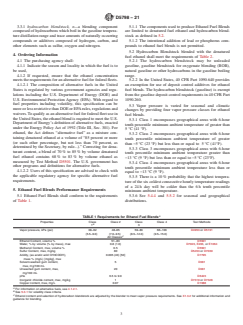
5.1 Ethanol Fuel Blends shall conform to the requirements of Table 1.
5.1.1 The components used to produce Ethanol Fuel Blends are limited to denatured fuel ethanol and hydrocarbon blendstock as
defined in 5.2.
5.1.2 The intentional addition of lead or phosphorus compounds to ethanol fuel blends is not permitted.
5.2 Hydrocarbon Blendstock blended with the denatured fuel ethanol shall meet the requirements of Table 2.
5.2.1 The hydrocarbon blendstock may be unleaded gasoline, gasoline blendstock for oxygenate blending (BOB), natural gasoline
or other hydrocarbons in the gasoline boiling range.
5.2.2 In the United States, 40 CFR Part 1090.640 provides an exemption for use of deposit control additives for ethanol fuel
blends. The hydrocarbon blendstock (gasoline) is exempt from the gasoline deposit control requirements in 40 CFR Part 1090.260.
5.3 Vapor pressure is varied for seasonal and climatic changes by providing four vapor pressure classes for ethanol fuel blends.
5.3.1 Class 1 encompasses geographical areas with 6-hour tenth percentile minimum ambient temperature of greater than 5 °C
(41 °F).
5.3.2 Class 2 encompasses geographical areas with 6-hour tenth percentile minimum ambient temperature of greater than −5 °C
(23 °F) but less than or equal to 5 °C (41°F).
5.3.3 Class 3 encompasses geographical areas with 6-hour tenth percentile minimum ambient temperature greater than −13 °C
(9 °F) but less than or equal to −5 °C (23°F).
5.3.4 Class 4 encompasses geographical areas with 6-hour tenth percentile minimum ambient temperature less than or equal to
−13 °C (9 °F).
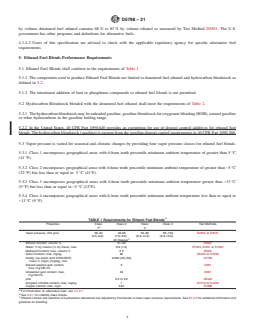
A
TABLE 1 Requirements for Ethanol Fuel Blends
Properties Class Class 2 Class Class 4 Test Methods
B
1 3
Vapor pressure, kPa (psi) 38–62 48–65 59–83 66–103 D4953 or D5191
(5.5–9.0) (7.0–9.5) (8.5–12.0) (9.5–15.0)
C
All Classes
Ethanol Content, volume % 51–83 D5501
Water, % by volume (% by mass), max 0.8 (1.0) D7923, E203, or E1064
Methanol Content, max, volume % 0.5 D5501
Sulfur Content, max, mg/kg 80 D5453 or D7039
Acidity, (as acetic acid CH3COOH), 0.005 (40) [50] D7795
mass % (mg/L) [mg/kg], max
Solvent-washed gum content, 5 D381
max, mg/100 mL
Unwashed gum content, max, 20 D381
mg/100 mL
pHe 6.5 to 9.0 D6423
Inorganic chloride content, max, mg/kg 1 D7319 or D7328
Copper content, max, mg/L 0.07 D1688
A
For information on alternative fuels, see 4.1.2.1.
B
See 5.3.1 for volatility class criteria.
C
Ethanol content and selection of hydrocarbon blendstock are adjusted by the blender to meet vapor pressure requirements. See X1.3.2 for additional information and
guidance for blending.
D5798 − 21
TABLE 2 Requirements for Hydrocarbon Blendstock
Properties Test Methods
Distillation, end point, max, °C (°F) 225 (437) D86
Oxidation stability, minimum, minutes 240 D525
Copper Strip Corrosion, max No. 1 D130
Silver Strip Corrosion, max No. 1 D7667, D7671
A
Vapor pressure Report D4953, D5191
A
While not a requirement of this specification, the blender will need to know the
vapor pressure of the hydrocarbon blendstock in order to choose a suitable blend
ratio for the components to meet the vapor pressure requirement of a particular
volatility class.
5.3.5 There is a 10 % probability that the highest temperature of the six coldest consecutive hourly temperature readings of a 24 h
day will be colder than the 6 h tenth percentile minimum ambient temperature.
5.3.6 See 5.4.4 and 5.5.2 for seasonal and geographical distributions.
5.4 Regulatory and Other Requirements in the United States:
5.4.1 Ethanol content requirements for ethanol alternative fuel blends can be found in 4.1.2.1.
5.4.2 The denaturant for the denatured fuel ethanol used in making ethanol fuel blends shall meet the requirements of Section 5
in Specification D4806.
5.4.3 Ethanol fuel blends of any volatility class shall meet certain U.S. Environmental Protection Agency (EPA) regulations for
unleaded gasoline. See Appendix X2.
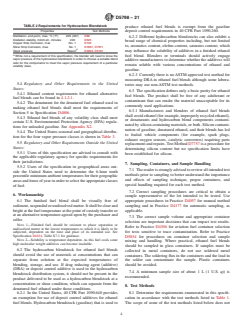
5.4.4 The United States seasonal and geographical distribution for the four vapor pressure classes is shown in Table 3.
5.5 Regulatory and Other Requirements Outside the United States:
5.5.1 Users of this specification are advised to consult with the applicable regulatory agency for specific requirements for their
jurisdictions.
5.5.2 Users of the specification in geographical areas outside the United States need to determine the 6-hour tenth percentile
minimum ambient temperatures for their geographic areas and times of year in order to select the appropriate classes of fuel.
6. Workmanship
6.1 The finished fuel blend shall be visually free of sediment, suspended or undissolved matter. It shall be clear and bright at the
fuel temperature at the point of custody transfer or at an alternative temperature agreed upon by the purchaser and seller.
NOTE 1—Finished fuel should be resistant to phase separation or undissolved matter at the lowest temperatures to which it is likely to be subjected,
dependent on the time and place of its intended use. See Specification D4814, Table X7.1 for guidance.
NOTE 2—Solubility is temperature dependent. As this fuel cools some high molecular weight additives can become insoluble.
6.2 The hydrocarbon blendstock for ethanol fuel blends should avoid the use of materials at concentrations that can separate from
solution at the expected temperatures of blending, storage, and use. If drag reducing agent (additive) (DRA) or deposit control
additive is used in the hydrocarbon blendstock distribution system, it should not be present in the product delivered to be used as
a hydrocarbon blendstock at a concentration or shear condition, which can separate from the denatured fuel ethanol under those
conditions.
6.2.1 In the United States, 40 CFR Part 1090.640 provides an exemption for use of deposit control additives for ethanol fuel
blends. Hydrocarbon blendstock (gasoline) that is used to produce ethanol fuel blends is exempt from the gasoline deposit control
requirements in 40 CFR Part 1090.260.
D5798 − 21
TABLE 3 United States Seasonal and Geographical Volatility Specifications for Ethanol Fuel Blends
NOTE 1—This schedule, subject to agreement between the purchaser and the seller, denotes the vapor pressure class of the fuel at the time and place
of bulk delivery to fuel-dispensing facilities for the end user. Shipments should anticipate this schedule.
NOTE 2—Where alternative classes are listed, either class is acceptable; the option shall be exercised by the seller.
NOTE 3—This schedule was developed using actual (versus altitude-adjusted) 6 h tenth percentile minimum ambient temperatures.
State Jan Feb March Apr May June July Aug Sep Oct Nov Dec
Alabama 2 2 2 2 2/1 1 1 1 1 1/2 2 2
Alaska
Southern Region 4 4/3 3 3/2 2 2/1 1 1/2 2/3 3 3/4 4
South Mainland 4 4 4 4 4/2 2 2/1 1/2 2/3 3/4 4 4
Arizona
N of 34° Latitude 3 3 3 3/2 2 2/1 1 1 1/2 2/3 3 3
S of 34° Latitude 2 2 2 2/1 1 1 1 1 1 1/2 2 2
Arkansas 3 3 3/2 2/1 1 1 1 1 1/2 2 2/3 3
A
California
North Coast 2 2 2 2 2/1 1 1 1 1 1/2 2 2
South Coast 2 2 2 2 2/1 1 1 1 1 1/2 2 2
Southeast 2 2 2 2 2/1 1 1 1 1 1/2 2 2
Interior 2 2 2 2 2 2/1 1 1 1 1/2 2 2
Colorado
E of 105° Longitude 4 4/3 3 3/2 2 2/1 1 1 1/2 2/3 3 3/4
W of 105° Longitude 4 4 4/3 3 3/2 2 2/1 1/2 2/3 3/4 4 4
Connecticut 4 4 4/3 3/2 2 2/1 1 1 1/2 2 2/4 4
Delaware 3 3 3/2 2 2/1 1 1 1 1/2 2 2/3 3
District of Columbia 3 3 3/2 2 2/1 1 1 1 1/2 2 2/3 3
Florida
N of 29° Latitude 2 2 2 2/1 1 1 1 1 1 1/2 2 2
S of 29° Latitude 2 2/1 1 1 1 1 1 1 1 1 1/2 2
Georgia 3 3/2 2 2/1 1 1 1 1 1 1/2 2 2/3
Hawaii 1 1 1 1 1 1 1 1 1 1 1 1
Idaho 4 4 4/3 3/2 2 2 2/1 1/2 2 2/3 3/4 4
Illinois
N of 40° Latitude 4 4 4/3 3/2 2 2/1 1 1 1/2 2/3 3/4 4
S of 40° Latitude 4 4/3 3 3/2 2/1 1 1 1 1/2 2/3 3/4 4
Indiana 4 4 4/3 3/2 2/1 1 1 1 1/2 2/3 3/4 4
Iowa 4 4 4 4/2 2 2/1 1 1 1/2 2/3 3/4 4
Kansas 4 4/3 3 3/2 2 2/1 1 1 1/2 2/3 3/4 4
Kentucky 3 3 3/2 2 2/1 1 1 1 1/2 2 2/3 3
Louisiana 2 2 2 2/1 1 1 1 1 1 1/2 2 2
Maine 4 4 4 4/2 2 2/1 1 1/2 2 2/3 3/4 4
Maryland 3 3 3/2 2 2/1 1 1 1 1/2 2 2/3 3
Massachusetts 4 4 4/3 3/2 2 2/1 1 1 1/2 2 2/4 4
Michigan
Lower Michigan 4 4 4/3 3/2 2 2/1 1 1/2 2 2/3 3/4 4
Upper Michigan 4 4 4 4/3 3/2 2/1 1 1/2 2 2/3 3/4 4
Minnesota 4 4 4 4/3 3/2 2/1 1 1/2 2 2/4 4 4
Mississippi 2 2 2 2/1 1 1 1 1 1 1/2 2 2
Missouri 4 4/3 3 3/2 2/1 1 1 1 1/2 2/3 3 3
Montana 4 4 4 4/3 3/2 2 2/1 1/2 2/3 3/4 4 4
Nebraska 4 4 4/3 3/2 2 2/1 1 1/2 2 2/3 3/4 4
Nevada
N of 38° Latitude 4 4 4/3 3/2 2 2 2/1 1/2 2 2/3 3/4 4
S of 38° Latitude 2 2 2 2/1 2/1 1 1 1 1 1/2 2 2
New Hampshire 4 4 4/3 3/2 2 2/1 1 1/2 2 2/3 3/4 4
New Jersey 3 3 3/2 2 2/1 1 1 1 1/2 2 2/3 3
New Mexico
N of 34° Latitude 4 4/3 3 3/2 2 2/1 1 1 1/2 2/3 3 3/4
S of 34° Latitude 3 3 3/2 2/1 1 1 1 1 1 1/2 2/3 3
New York
N of 42° Latitude 4 4 4 4/2 2 2/1 1 1/2 2 2/3 3/4 4
S of 42° Latitude 4 4 4/3 3/2 2/1 1 1 1 1/2 2 2/3 3/4
North Carolina 3 3 3/2 2 2/1 1 1 1 1/2 2/3 3 3
North Dakota 4 4 4 4/3 3/2 2/1 1 1/2 2 2/4 4 4
Ohio 4 4 4/3 3/2 2 2/1 1 1 1/2 2/3 3/4 4
Oklah
...