

SIST EN 300 468 V1.17.1:2023
(Main)Digital Video Broadcasting (DVB) - Specification for Service Information (SI) in DVB systems
General Information
- Abstract
The present document specifies the Service Information (SI) data which forms a part of Digital Video
Broadcasting (DVB) bitstreams, in order that the user can be provided with information to assist in selection of services
and/or events within the bitstream, and so that the Integrated Receiver Decoder (IRD) can automatically configure itself
for the selected service. SI data for automatic configuration is mostly specified within ISO/IEC 13818-1 [1] as Program
Specific Information (PSI).
The present document specifies additional data which complements the PSI by providing data to aid automatic tuning of
IRDs, and additional information intended for display to the user. The manner of presentation of the information is not
specified in the present document, and IRD manufacturers have freedom to choose appropriate presentation methods.
It is expected that Electronic Programme Guide (EPG) will be a feature of Digital TeleVision (TV) transmissions.
The definition of an EPG is outside the scope of the present document (i.e. the SI specification), but the data contained
within the SI specified in the present document may be used as the basis for an EPG.
Rules of operation for the implementation of the present document are specified in ETSI TS 101 211 [i.1].
- Status
- Published
- Public Enquiry End Date
- 30-Sep-2022
- Publication Date
- 22-Nov-2022
- Technical Committee
- MOC - Mobile Communications
- Current Stage
- 6060 - National Implementation/Publication (Adopted Project)
- Start Date
- 21-Nov-2022
- Due Date
- 26-Jan-2023
- Completion Date
- 23-Nov-2022
- Mandate
- M/331
Buy Documents
ETSI EN 300 468 V1.17.1 (2022-07) - Digital Video Broadcasting (DVB); Specification for Service Information (SI) in DVB systems
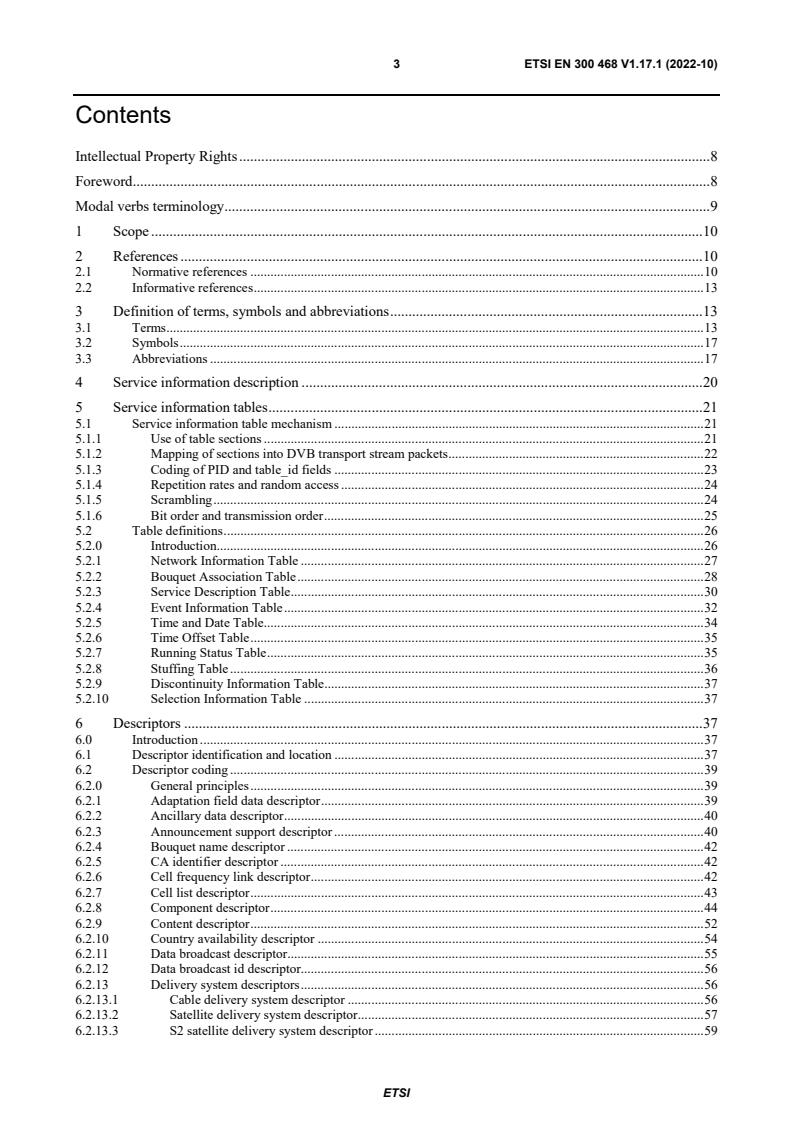
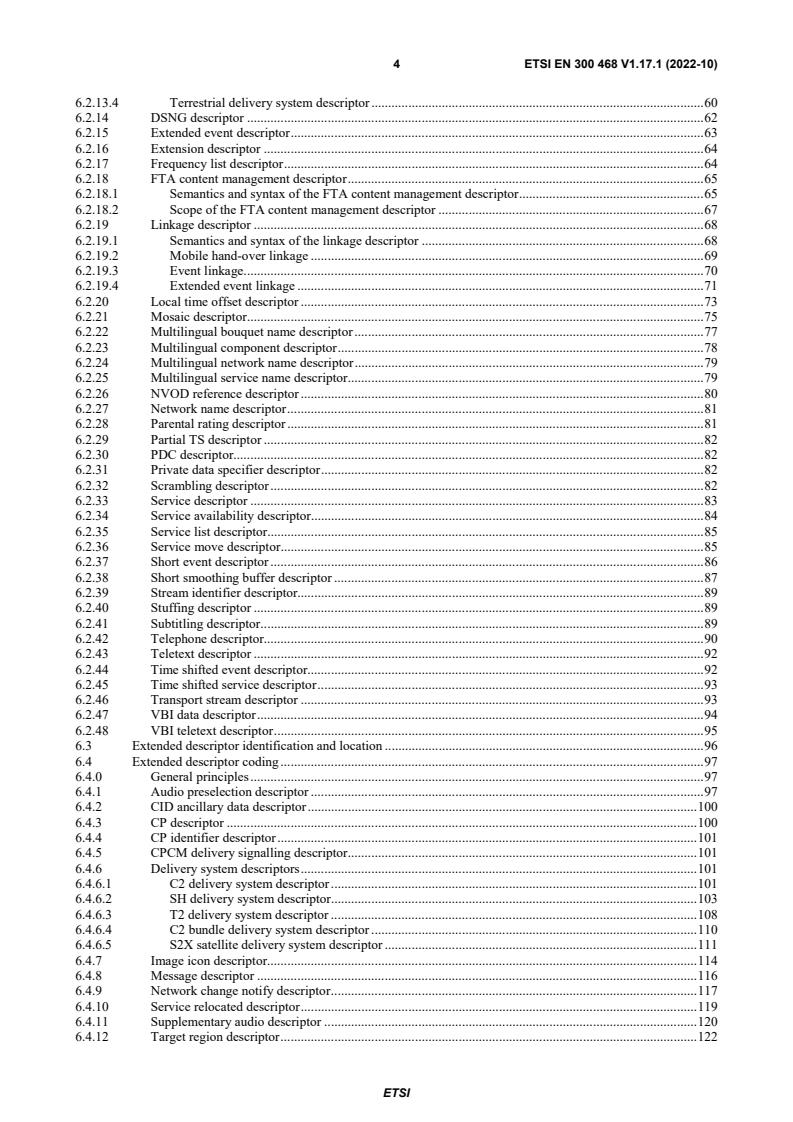
ETSI EN 300 468 V1.17.1 (2022-10) - Digital Video Broadcasting (DVB); Specification for Service Information (SI) in DVB systems

Overview
SIST EN 300 468 V1.17.1:2023 defines the specification for Service Information (SI) in Digital Video Broadcasting (DVB) systems. This international standard, aligned with ETSI EN 300 468, ensures that both end-users and receivers can effectively access, identify, and select TV and radio services within digital broadcast bitstreams. SI data provided under this specification complements Program Specific Information (PSI) detailed in ISO/IEC 13818-1, offering both automated configuration for Integrated Receiver Decoders (IRDs) and enhanced service navigation for users.
SI within DVB is essential for interoperability, user experience, and the efficient operation of broadcast receivers. Service Information supports automatic tuning, on-screen display of service details, and forms the foundation for Electronic Programme Guide (EPG) implementations.
Key Topics
- Service Information Tables: The standard outlines different SI tables such as Network Information Table (NIT), Service Description Table (SDT), Event Information Table (EIT), and others. These tables ensure the accurate delivery and retrieval of service details, program descriptions, schedule data, and tuning parameters.
- Descriptors: The document provides specifications for a wide array of descriptors that allow broadcasters to signal information such as language, content, parental ratings, component details (audio, video), service names, and delivery systems.
- Automatic Configuration: SI data enables IRDs to automatically detect, configure, and update parameters necessary for receiving services without user intervention.
- User Support: SI serves as the backbone for on-screen service selection menus and program guides, enhancing the user interface and accessibility of digital TV and radio services.
- Interoperability: By adhering to a common SI structure, equipment from different vendors can interoperate within DVB-compliant networks, supporting both present and future digital television technologies.
Applications
- Broadcast Television and Radio: Content providers and broadcasters use SI as defined in this standard to ensure seamless user experiences across all DVB-compliant devices.
- Integrated Receiver Decoders (IRDs): Manufacturers implement SI handling to allow receivers to automate service discovery, tuning, and presentation-minimizing setup complexity for end-users.
- Electronic Programme Guides (EPGs): Though EPG presentation itself is outside the standard’s scope, EPGs are typically powered by the SI content specified in this document, enabling advanced navigation through TV schedules and program information.
- Content Aggregators: Operators benefit from standardized SI by efficiently managing large bouquets of channels and associated metadata across varied platforms.
- International Markets: Compatibility with DVB SI ensures broadcasters can deliver services across borders, supporting multilingual content and regionalized service offerings.
Related Standards
- ISO/IEC 13818-1: Information technology - Generic coding of moving pictures and associated audio information: Systems (defines Program Specific Information or PSI).
- ETSI TS 101 211: Rules of operation for implementing SI in DVB systems.
- Other DVB Standards: DVB-S (satellite), DVB-T (terrestrial), and DVB-C (cable) broadcasting standards detail specific transmission requirements and how SI integrates within different delivery systems.
SIST EN 300 468 V1.17.1:2023 is crucial for ensuring a unified approach to service identification and user support across the DVB ecosystem, fostering interoperability, and enabling a consistent and rich broadcast experience for viewers around the world. For further details, reference documents are available via the ETSI standards database.
Buy Documents
ETSI EN 300 468 V1.17.1 (2022-07) - Digital Video Broadcasting (DVB); Specification for Service Information (SI) in DVB systems
ETSI EN 300 468 V1.17.1 (2022-10) - Digital Video Broadcasting (DVB); Specification for Service Information (SI) in DVB systems
Get Certified
Connect with accredited certification bodies for this standard

ANCE
Mexican certification and testing association.

Intertek Slovenia
Intertek testing, inspection, and certification services in Slovenia.

LNE (Laboratoire National de Métrologie et d'Essais)
French national laboratory for metrology and testing.
Sponsored listings
Frequently Asked Questions
SIST EN 300 468 V1.17.1:2023 is a standard published by the Slovenian Institute for Standardization (SIST). Its full title is "Digital Video Broadcasting (DVB) - Specification for Service Information (SI) in DVB systems". This standard covers: The present document specifies the Service Information (SI) data which forms a part of Digital Video Broadcasting (DVB) bitstreams, in order that the user can be provided with information to assist in selection of services and/or events within the bitstream, and so that the Integrated Receiver Decoder (IRD) can automatically configure itself for the selected service. SI data for automatic configuration is mostly specified within ISO/IEC 13818-1 [1] as Program Specific Information (PSI). The present document specifies additional data which complements the PSI by providing data to aid automatic tuning of IRDs, and additional information intended for display to the user. The manner of presentation of the information is not specified in the present document, and IRD manufacturers have freedom to choose appropriate presentation methods. It is expected that Electronic Programme Guide (EPG) will be a feature of Digital TeleVision (TV) transmissions. The definition of an EPG is outside the scope of the present document (i.e. the SI specification), but the data contained within the SI specified in the present document may be used as the basis for an EPG. Rules of operation for the implementation of the present document are specified in ETSI TS 101 211 [i.1].
The present document specifies the Service Information (SI) data which forms a part of Digital Video Broadcasting (DVB) bitstreams, in order that the user can be provided with information to assist in selection of services and/or events within the bitstream, and so that the Integrated Receiver Decoder (IRD) can automatically configure itself for the selected service. SI data for automatic configuration is mostly specified within ISO/IEC 13818-1 [1] as Program Specific Information (PSI). The present document specifies additional data which complements the PSI by providing data to aid automatic tuning of IRDs, and additional information intended for display to the user. The manner of presentation of the information is not specified in the present document, and IRD manufacturers have freedom to choose appropriate presentation methods. It is expected that Electronic Programme Guide (EPG) will be a feature of Digital TeleVision (TV) transmissions. The definition of an EPG is outside the scope of the present document (i.e. the SI specification), but the data contained within the SI specified in the present document may be used as the basis for an EPG. Rules of operation for the implementation of the present document are specified in ETSI TS 101 211 [i.1].
SIST EN 300 468 V1.17.1:2023 is classified under the following ICS (International Classification for Standards) categories: 33.170 - Television and radio broadcasting. The ICS classification helps identify the subject area and facilitates finding related standards.
SIST EN 300 468 V1.17.1:2023 is associated with the following European legislation: Standardization Mandates: M/331. When a standard is cited in the Official Journal of the European Union, products manufactured in conformity with it benefit from a presumption of conformity with the essential requirements of the corresponding EU directive or regulation.
SIST EN 300 468 V1.17.1:2023 is available in PDF format for immediate download after purchase. The document can be added to your cart and obtained through the secure checkout process. Digital delivery ensures instant access to the complete standard document.
Standards Content (Sample)
Draft ETSI EN 300 468 V1.17.1 (2022-07)
EUROPEAN STANDARD
Digital Video Broadcasting (DVB);
Specification for Service Information (SI) in DVB systems
2 Draft ETSI EN 300 468 V1.17.1 (2022-07)
Reference
REN/JTC-DVB-397
Keywords
broadcasting, digital, DVB, MPEG, service, TV,
video
ETSI
650 Route des Lucioles
F-06921 Sophia Antipolis Cedex - FRANCE
Tel.: +33 4 92 94 42 00 Fax: +33 4 93 65 47 16
Siret N° 348 623 562 00017 - APE 7112B
Association à but non lucratif enregistrée à la
Sous-Préfecture de Grasse (06) N° w061004871
Important notice
The present document can be downloaded from:
http://www.etsi.org/standards-search
The present document may be made available in electronic versions and/or in print. The content of any electronic and/or
print versions of the present document shall not be modified without the prior written authorization of ETSI. In case of any
existing or perceived difference in contents between such versions and/or in print, the prevailing version of an ETSI
deliverable is the one made publicly available in PDF format at www.etsi.org/deliver.
Users of the present document should be aware that the document may be subject to revision or change of status.
Information on the current status of this and other ETSI documents is available at
https://portal.etsi.org/TB/ETSIDeliverableStatus.aspx
If you find errors in the present document, please send your comment to one of the following services:
https://portal.etsi.org/People/CommiteeSupportStaff.aspx
If you find a security vulnerability in the present document, please report it through our
Coordinated Vulnerability Disclosure Program:
https://www.etsi.org/standards/coordinated-vulnerability-disclosure
Notice of disclaimer & limitation of liability
The information provided in the present deliverable is directed solely to professionals who have the appropriate degree of
experience to understand and interpret its content in accordance with generally accepted engineering or
other professional standard and applicable regulations.
No recommendation as to products and services or vendors is made or should be implied.
In no event shall ETSI be held liable for loss of profits or any other incidental or consequential damages.
Any software contained in this deliverable is provided "AS IS" with no warranties, express or implied, including but not
limited to, the warranties of merchantability, fitness for a particular purpose and non-infringement of intellectual property
rights and ETSI shall not be held liable in any event for any damages whatsoever (including, without limitation, damages
for loss of profits, business interruption, loss of information, or any other pecuniary loss) arising out of or related to the use
of or inability to use the software.
Copyright Notification
No part may be reproduced or utilized in any form or by any means, electronic or mechanical, including photocopying and
microfilm except as authorized by written permission of ETSI.
The content of the PDF version shall not be modified without the written authorization of ETSI.
The copyright and the foregoing restriction extend to reproduction in all media.
© ETSI 2022.
© European Broadcasting Union 2022.
All rights reserved.
ETSI
3 Draft ETSI EN 300 468 V1.17.1 (2022-07)
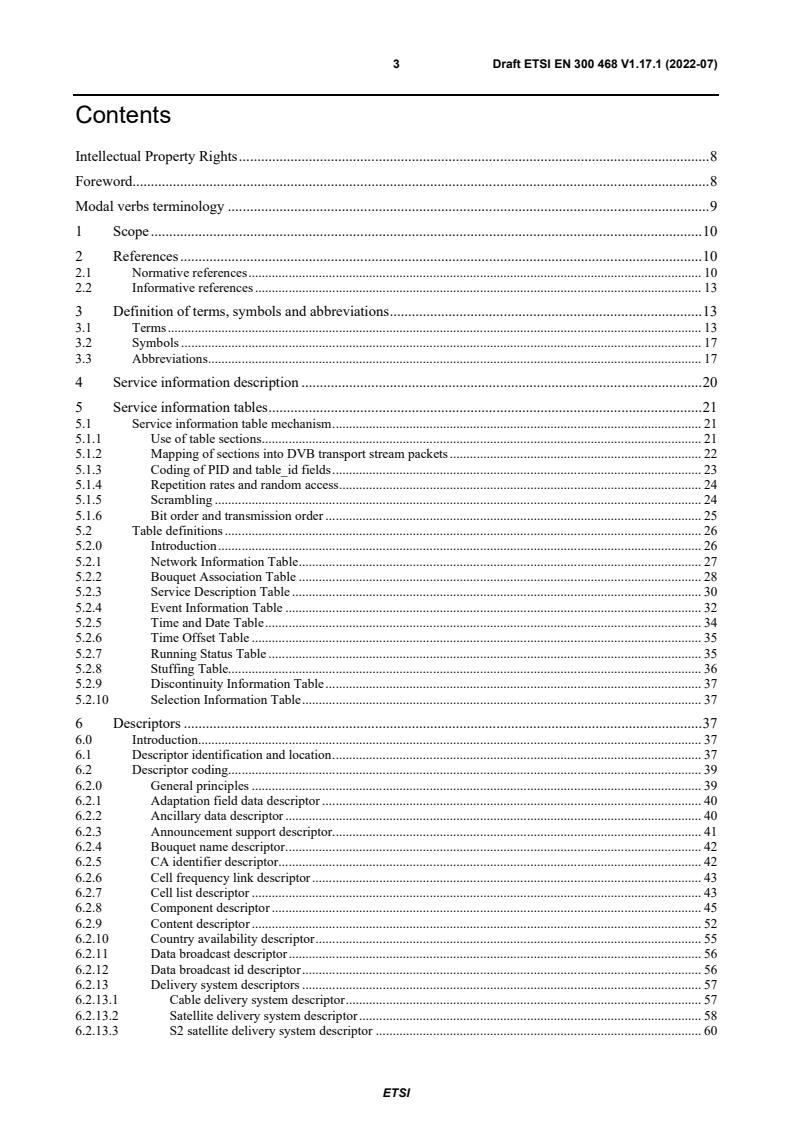
Contents
Intellectual Property Rights . 8
Foreword. 8
Modal verbs terminology . 9
1 Scope . 10
2 References . 10
2.1 Normative references . 10
2.2 Informative references . 13
3 Definition of terms, symbols and abbreviations . 13
3.1 Terms . 13
3.2 Symbols . 17
3.3 Abbreviations . 17
4 Service information description . 20
5 Service information tables . 21
5.1 Service information table mechanism . 21
5.1.1 Use of table sections . 21
5.1.2 Mapping of sections into DVB transport stream packets . 22
5.1.3 Coding of PID and table_id fields . 23
5.1.4 Repetition rates and random access . 24
5.1.5 Scrambling . 24
5.1.6 Bit order and transmission order . 25
5.2 Table definitions . 26
5.2.0 Introduction . 26
5.2.1 Network Information Table . 27
5.2.2 Bouquet Association Table . 28
5.2.3 Service Description Table . 30
5.2.4 Event Information Table . 32
5.2.5 Time and Date Table . 34
5.2.6 Time Offset Table . 35
5.2.7 Running Status Table . 35
5.2.8 Stuffing Table. 36
5.2.9 Discontinuity Information Table . 37
5.2.10 Selection Information Table . 37
6 Descriptors . 37
6.0 Introduction. 37
6.1 Descriptor identification and location . 37
6.2 Descriptor coding . 39
6.2.0 General principles . 39
6.2.1 Adaptation field data descriptor . 40
6.2.2 Ancillary data descriptor . 40
6.2.3 Announcement support descriptor . 41
6.2.4 Bouquet name descriptor . 42
6.2.5 CA identifier descriptor . 42
6.2.6 Cell frequency link descriptor . 43
6.2.7 Cell list descriptor . 43
6.2.8 Component descriptor . 45
6.2.9 Content descriptor . 52
6.2.10 Country availability descriptor . 55
6.2.11 Data broadcast descriptor . 56
6.2.12 Data broadcast id descriptor . 56
6.2.13 Delivery system descriptors . 57
6.2.13.1 Cable delivery system descriptor . 57
6.2.13.2 Satellite delivery system descriptor . 58
6.2.13.3 S2 satellite delivery system descriptor . 60
ETSI
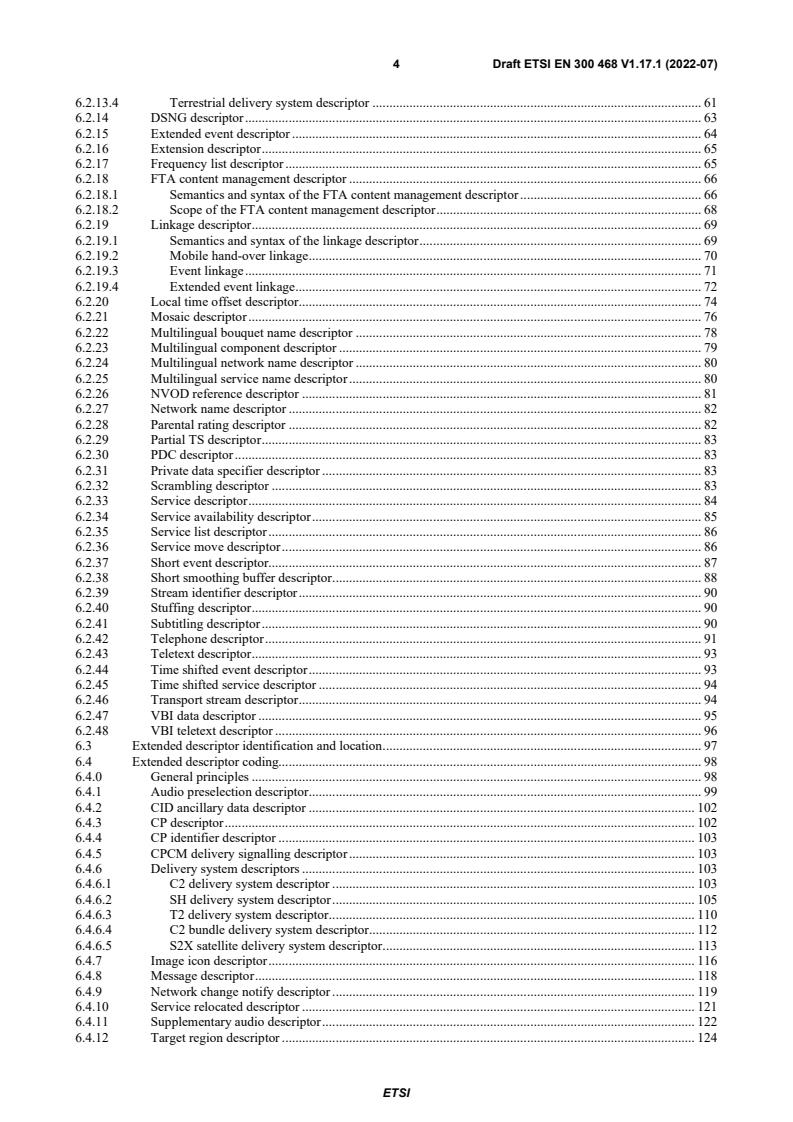
4 Draft ETSI EN 300 468 V1.17.1 (2022-07)
6.2.13.4 Terrestrial delivery system descriptor . 61
6.2.14 DSNG descriptor . 63
6.2.15 Extended event descriptor . 64
6.2.16 Extension descriptor . 65
6.2.17 Frequency list descriptor . 65
6.2.18 FTA content management descriptor . 66
6.2.18.1 Semantics and syntax of the FTA content management descriptor . 66
6.2.18.2 Scope of the FTA content management descriptor . 68
6.2.19 Linkage descriptor . 69
6.2.19.1 Semantics and syntax of the linkage descriptor . 69
6.2.19.2 Mobile hand-over linkage . 70
6.2.19.3 Event linkage . 71
6.2.19.4 Extended event linkage . 72
6.2.20 Local time offset descriptor . 74
6.2.21 Mosaic descriptor . 76
6.2.22 Multilingual bouquet name descriptor . 78
6.2.23 Multilingual component descriptor . 79
6.2.24 Multilingual network name descriptor . 80
6.2.25 Multilingual service name descriptor . 80
6.2.26 NVOD reference descriptor . 81
6.2.27 Network name descriptor . 82
6.2.28 Parental rating descriptor . 82
6.2.29 Partial TS descriptor . 83
6.2.30 PDC descriptor . 83
6.2.31 Private data specifier descriptor . 83
6.2.32 Scrambling descriptor . 83
6.2.33 Service descriptor . 84
6.2.34 Service availability descriptor . 85
6.2.35 Service list descriptor . 86
6.2.36 Service move descriptor . 86
6.2.37 Short event descriptor. 87
6.2.38 Short smoothing buffer descriptor . 88
6.2.39 Stream identifier descriptor . 90
6.2.40 Stuffing descriptor . 90
6.2.41 Subtitling descriptor . 90
6.2.42 Telephone descriptor . 91
6.2.43 Teletext descriptor . 93
6.2.44 Time shifted event descriptor . 93
6.2.45 Time shifted service descriptor . 94
6.2.46 Transport stream descriptor . 94
6.2.47 VBI data descriptor . 95
6.2.48 VBI teletext descriptor . 96
6.3 Extended descriptor identification and location . 97
6.4 Extended descriptor coding. 98
6.4.0 General principles . 98
6.4.1 Audio preselection descriptor . 99
6.4.2 CID ancillary data descriptor . 102
6.4.3 CP descriptor . 102
6.4.4 CP identifier descriptor . 103
6.4.5 CPCM delivery signalling descriptor . 103
6.4.6 Delivery system descriptors . 103
6.4.6.1 C2 delivery system descriptor . 103
6.4.6.2 SH delivery system descriptor . 105
6.4.6.3 T2 delivery system descriptor . 110
6.4.6.4 C2 bundle delivery system descriptor . 112
6.4.6.5 S2X satellite delivery system descriptor . 113
6.4.7 Image icon descriptor . 116
6.4.8 Message descriptor . 118
6.4.9 Network change notify descriptor . 119
6.4.10 Service relocated descriptor . 121
6.4.11 Supplementary audio descriptor . 122
6.4.12 Target region descriptor . 124
ETSI
5 Draft ETSI EN 300 468 V1.17.1 (2022-07)
6.4.13 Target region name descriptor . 126
6.4.14 T2-MI descriptor . 127
6.4.15 URI linkage descriptor . 128
6.4.16 Video depth range descriptor . 129
6.4.16.1 Semantics and syntax of the video depth range descriptor . 129
6.4.16.2 Production disparity hint . 130
6.5 Scoping rules for scoping descriptors . 130
7 Storage Media Interoperability measures . 131
7.0 Introduction. 131
7.1 SMI tables . 131
7.1.0 General principles . 131
7.1.1 Discontinuity Information Table . 131
7.1.2 Selection Information Table . 132
7.2 SMI descriptors . 133
7.2.0 Introduction . 133
7.2.1 Partial transport stream descriptor . 133
Annex A (normative): Coding of text characters. 135
A.0 General principles . 135
A.1 Control codes . 135
A.2 Selection of character table . 135
Annex B (informative): Void . 149
Annex C (informative): Conversion between time and date conventions . 150
Annex D (normative): Service information implementation of AC-3, Enhanced AC-3, and AC-4
audio in DVB systems . 152
D.0 Introduction . 152
D.1 AC-3 and Enhanced AC-3 component types . 152
D.2 AC-3 descriptor . 153
D.3 AC-3 descriptor syntax and semantics . 153
D.4 Enhanced AC-3 descriptor . 155
D.5 Enhanced AC-3 descriptor syntax and semantics . 155
D.6 AC-4 descriptor . 158
D.7 AC-4 descriptor syntax and semantics . 158
D.8 Use of the supplementary audio descriptor with AC-4 . 159
Annex E (normative): Usage of the scrambling descriptor . 160
Annex F (informative): ISO 639 language descriptor for "original audio" soundtrack . 161
Annex G (normative): Service information implementation of DTS coded audio in DVB systems . 162
G.0 Introduction . 162
G.1 DTS and DTS-HD descriptors . 162
G.2 DTS descriptor . 162
G.2.0 Use of the DTS descriptor . 162
G.2.1 Syntax and semantics for the DTS descriptor . 162
G.3 DTS-HD descriptor . 165
G.3.1 DTS-HD descriptor syntax . 165
G.3.2 Substream information . 166
G.3.3 Asset information . 168
ETSI
6 Draft ETSI EN 300 468 V1.17.1 (2022-07)
G.3.4 Component type . 169
G.4 Use of DTS-HD in Receiver Mixed Applications for Single PID and Multiple PID
Implementations . 170
G.5 DTS-UHD descriptors . 171
G.5.1 DTS-UHD descriptor . 171
G.5.2 DTS-UHD and the audio preselection descriptor . 172
G.5.2.1 The DTS-UHD Broadcast Chunk and audio preselections . 172
G.6 Use of the supplementary audio descriptor with DTS-UHD. 173
Annex H (normative): Service information implementation of AAC coded audio in DVB systems . 174
H.0 Introduction . 174
H.1 AAC Audio descriptor . 174
H.2 AAC descriptor . 174
H.2.0 Use of the AAC descriptor . 174
H.2.1 Syntax and semantics for the AAC descriptor . 174
Annex I (normative): Assignment and interpretation of the service_type field . 176
I.1 Background . 176
I.2 Assignment of service_type . 176
I.2.0 General principles . 176
I.2.1 service_type "digital television service" (0x01) . 176
I.2.2 service_type "H.264/AVC" (various) . 177
I.2.3 service_type "H.264/AVC frame compatible stereoscopic HD" (various) . 177
I.2.4 service_type "advanced codec digital radio sound service" (0x0A) . 178
I.2.5 service_type "HEVC digital television service" (0x1F) . 178
I.2.5.0 General principles . 178
I.2.5.1 Signalling for service frame compatible plano-stereoscopic 3DTV for HEVC coded services . 179
I.2.5.2 Signalling for HDR and/or frame rate of 100 Hz, 120 0001 001 Hz, or 120 Hz, but with a HEVC
half frame rate temporal video sub-bitstream frame rate lower than or equal to 60 Hz . 180
I.2.5.3 Spatial, temporal, and dynamic range characteristics . 181
I.2.5.4 Summary of signalling for different bitstream profiles using service_type 0x1F . 181
I.2.6 service_type HEVC UHD digital television service (0x20) . 182
I.2.6.1 General principles . 182
I.2.6.2 Summary of signalling for different bitstream profiles using service_type 0x20 . 184
I.2.7 Summary of signalling for HEVC bitstream profiles using service_type 0x1F or 0x20 . 186
Annex J (normative): Signalling of supplementary audio . 190
J.1 Overview . 190
J.2 Receiver-mix supplementary audio . 190
J.2.1 Introduction. 190
J.2.2 PSI PMT signalling . 191
J.2.3 EIT signalling . 191
J.2.3.1 General principles . 191
J.2.3.2 Visually impaired audio description . 191
J.3 Broadcast-mix supplementary audio . 192
J.3.1 Introduction. 192
J.3.2 PSI PMT signalling . 192
J.3.3 EIT signalling . 192
J.3.3.1 General principles . 192
J.3.3.2 Visually impaired audio description . 192
J.4 PSI signalling of audio purpose . 193
J.5 SAOC-DE parametric data streams . 193
J.5.1 Introduction. 193
J.5.2 PSI PMT signalling . 193
ETSI
7 Draft ETSI EN 300 468 V1.17.1 (2022-07)
J.5.3 EIT signalling . 194
Annex K (normative): Use of the extended_event_linkage_info . 195
Annex L (normative): Service information implementation of DTS Neural™ Surround coded
audio in DVB systems . 197
L.0 Introduction . 197
L.1 DTS Neural descriptor . 197
Annex M (normative): Signalling of next-generation audio . 199
M.1 Overview . 199
M.2 PSI PMT signalling . 199
M.3 Mapping of codec-specific values to the audio preselection descriptor (informative) . 199
Annex N (informative): Examples for using multiple component descriptors . 202
Annex O (informative): Bibliography . 203
Annex P (informative): Change History . 204
History . 206
ETSI
8 Draft ETSI EN 300 468 V1.17.1 (2022-07)
Intellectual Property Rights
Essential patents
IPRs essential or potentially essential to normative deliverables may have been declared to ETSI. The declarations
pertaining to these essential IPRs, if any, are publicly available for ETSI members and non-members, and can be
found in ETSI SR 000 314: "Intellectual Property Rights (IPRs); Essential, or potentially Essential, IPRs notified to
ETSI in respect of ETSI standards", which is available from the ETSI Secretariat. Latest updates are available on the
ETSI Web server (https://ipr.etsi.org/).
Pursuant to the ETSI Directives including the ETSI IPR Policy, no investigation regarding the essentiality of IPRs,
including IPR searches, has been carried out by ETSI. No guarantee can be given as to the existence of other IPRs not
referenced in ETSI SR 000 314 (or the updates on the ETSI Web server) which are, or may be, or may become,
essential to the present document.
Trademarks
The present document may include trademarks and/or tradenames which are asserted and/or registered by their owners.
ETSI claims no ownership of these except for any which are indicated as being the property of ETSI, and conveys no
right to use or reproduce any trademark and/or tradename. Mention of those trademarks in the present document does
not constitute an endorsement by ETSI of products, services or organizations associated with those trademarks.
DECT™, PLUGTESTS™, UMTS™ and the ETSI logo are trademarks of ETSI registered for the benefit of its
Members. 3GPP™ and LTE™ are trademarks of ETSI registered for the benefit of its Members and of the 3GPP
Organizational Partners. oneM2M™ logo is a trademark of ETSI registered for the benefit of its Members and of the ®
oneM2M Partners. GSM and the GSM logo are trademarks registered and owned by the GSM Association.
Foreword
This draft European Standard (EN) has been produced by Joint Technical Committee (JTC) Broadcast of the European
Broadcasting Union (EBU), Comité Européen de Normalisation ELECtrotechnique (CENELEC) and the European
Telecommunications Standards Institute (ETSI), and is now submitted for the combined Public Enquiry and Vote phase
of the ETSI standards EN Approval Procedure.
NOTE: The EBU/ETSI JTC Broadcast was established in 1990 to co-ordinate the drafting of standards in the
specific field of broadcasting and related fields. Since 1995 the JTC Broadcast became a tripartite body
by including in the Memorandum of Understanding also CENELEC, which is responsible for the
standardization of radio and television receivers. The EBU is a professional association of broadcasting
organizations whose work includes the co-ordination of its members' activities in the technical, legal,
programme-making and programme-exchange domains. The EBU has active members in about
60 countries in the European broadcasting area; its headquarters is in Geneva.
European Broadcasting Union
CH-1218 GRAND SACONNEX (Geneva)
Switzerland
Tel: +41 22 717 21 11
Fax: +41 22 717 24 81
The DVB Project is an industry-led consortium of broadcasters, manufacturers, network operators, software developers,
regulators and others from around the world committed to designing open, interoperable technical specifications for the
global delivery of digital media and broadcast services. DVB specifications cover all aspects of digital television from
transmission through interfacing, conditional access and interactivity for digital video, audio and data. The consortium
came together in 1993.
ETSI
9 Draft ETSI EN 300 468 V1.17.1 (2022-07)
Proposed national transposition dates
Date of latest announcement of this EN (doa): 3 months after ETSI publication
Date of latest publication of new National Standard
or endorsement of this EN (dop/e): 6 months after doa
Date of withdrawal of any conflicting National Standard (dow): 6 months after doa
Modal verbs terminology
In the present document "shall", "shall not", "should", "should not", "may", "need not", "will", "will not", "can" and
"cannot" are to be interpreted as described in clause 3.2 of the ETSI Drafting Rules (Verbal forms for the expression of
provisions).
"must" and "must not" are NOT allowed in ETSI deliverables except when used in direct citation.
ETSI
10 Draft ETSI EN 300 468 V1.17.1 (2022-07)
1 Scope
The present document specifies the Service Information (SI) data which forms a part of Digital Video
Broadcasting (DVB) bitstreams, in order that the user can be provided with information to assist in selection of services
and/or events within the bitstream, and so that the Integrated Receiver Decoder (IRD) can automatically configure itself
for the selected service. SI data for automatic configuration is mostly specified within ISO/IEC 13818-1 [1] as Program
Specific Information (PSI).
The present document specifies additional data which complements the PSI by providing data to aid automatic tuning of
IRDs, and additional information intended for display to the user. The manner of presentation of the information is not
specified in the present document, and IRD manufacturers have freedom to choose appropriate presentation methods.
It is expected that Electronic Programme Guide (EPG) will be a feature of Digital TeleVision (TV) transmissions.
The definition of an EPG is outside the scope of the present document (i.e. the SI specification), but the data contained
within the SI specified in the present document may be used as the basis for an EPG.
Rules of operation for the implementation of the present document are specified in ETSI TS 101 211 [i.1].
2 References
2.1 Normative references
References are either specific (identified by date of publication and/or edition number or version number) or
non-specific. For specific references, only the cited version applies. For non-specific references, the latest version of the
referenced document (including any amendments) applies.
Referenced documents which are not found to be publicly available in the expected location might be found at
https://docbox.etsi.org/Reference/.
NOTE: While any hyperlinks included in this clause were valid at the time of publication, ETSI cannot guarantee
their long term validity.
The following referenced documents are necessary for the application of the present document.
[1] ISO/IEC 13818-1: "Information technolo
...
EUROPEAN STANDARD
Digital Video Broadcasting (DVB);
Specification for Service Information (SI) in DVB systems
2 ETSI EN 300 468 V1.17.1 (2022-10)
Reference
REN/JTC-DVB-397
Keywords
broadcasting, digital, DVB, MPEG, service, TV,
video
ETSI
650 Route des Lucioles
F-06921 Sophia Antipolis Cedex - FRANCE
Tel.: +33 4 92 94 42 00 Fax: +33 4 93 65 47 16
Siret N° 348 623 562 00017 - APE 7112B
Association à but non lucratif enregistrée à la
Sous-Préfecture de Grasse (06) N° w061004871
Important notice
The present document can be downloaded from:
http://www.etsi.org/standards-search
The present document may be made available in electronic versions and/or in print. The content of any electronic and/or
print versions of the present document shall not be modified without the prior written authorization of ETSI. In case of any
existing or perceived difference in contents between such versions and/or in print, the prevailing version of an ETSI
deliverable is the one made publicly available in PDF format at www.etsi.org/deliver.
Users of the present document should be aware that the document may be subject to revision or change of status.
Information on the current status of this and other ETSI documents is available at
https://portal.etsi.org/TB/ETSIDeliverableStatus.aspx
If you find errors in the present document, please send your comment to one of the following services:
https://portal.etsi.org/People/CommiteeSupportStaff.aspx
If you find a security vulnerability in the present document, please report it through our
Coordinated Vulnerability Disclosure Program:
https://www.etsi.org/standards/coordinated-vulnerability-disclosure
Notice of disclaimer & limitation of liability
The information provided in the present deliverable is directed solely to professionals who have the appropriate degree of
experience to understand and interpret its content in accordance with generally accepted engineering or
other professional standard and applicable regulations.
No recommendation as to products and services or vendors is made or should be implied.
In no event shall ETSI be held liable for loss of profits or any other incidental or consequential damages.
Any software contained in this deliverable is provided "AS IS" with no warranties, express or implied, including but not
limited to, the warranties of merchantability, fitness for a particular purpose and non-infringement of intellectual property
rights and ETSI shall not be held liable in any event for any damages whatsoever (including, without limitation, damages
for loss of profits, business interruption, loss of information, or any other pecuniary loss) arising out of or related to the use
of or inability to use the software.
Copyright Notification
No part may be reproduced or utilized in any form or by any means, electronic or mechanical, including photocopying and
microfilm except as authorized by written permission of ETSI.
The content of the PDF version shall not be modified without the written authorization of ETSI.
The copyright and the foregoing restriction extend to reproduction in all media.
© ETSI 2022.
© European Broadcasting Union 2022.
All rights reserved.
ETSI
3 ETSI EN 300 468 V1.17.1 (2022-10)
Contents
Intellectual Property Rights . 8
Foreword . 8
Modal verbs terminology . 9
1 Scope . 10
2 References . 10
2.1 Normative references . 10
2.2 Informative references . 13
3 Definition of terms, symbols and abbreviations . 13
3.1 Terms . 13
3.2 Symbols . 17
3.3 Abbreviations . 17
4 Service information description . 20
5 Service information tables . 21
5.1 Service information table mechanism . 21
5.1.1 Use of table sections . 21
5.1.2 Mapping of sections into DVB transport stream packets . 22
5.1.3 Coding of PID and table_id fields . 23
5.1.4 Repetition rates and random access . 24
5.1.5 Scrambling . 24
5.1.6 Bit order and transmission order . 25
5.2 Table definitions . 26
5.2.0 Introduction. 26
5.2.1 Network Information Table . 27
5.2.2 Bouquet Association Table . 28
5.2.3 Service Description Table . 30
5.2.4 Event Information Table . 32
5.2.5 Time and Date Table. 34
5.2.6 Time Offset Table . 35
5.2.7 Running Status Table . 35
5.2.8 Stuffing Table . 36
5.2.9 Discontinuity Information Table . 37
5.2.10 Selection Information Table . 37
6 Descriptors . 37
6.0 Introduction . 37
6.1 Descriptor identification and location . 37
6.2 Descriptor coding . 39
6.2.0 General principles . 39
6.2.1 Adaptation field data descriptor . 39
6.2.2 Ancillary data descriptor . 40
6.2.3 Announcement support descriptor . 40
6.2.4 Bouquet name descriptor . 42
6.2.5 CA identifier descriptor . 42
6.2.6 Cell frequency link descriptor . 42
6.2.7 Cell list descriptor . 43
6.2.8 Component descriptor . 44
6.2.9 Content descriptor . 52
6.2.10 Country availability descriptor . 54
6.2.11 Data broadcast descriptor . 55
6.2.12 Data broadcast id descriptor. 56
6.2.13 Delivery system descriptors . 56
6.2.13.1 Cable delivery system descriptor . 56
6.2.13.2 Satellite delivery system descriptor . 57
6.2.13.3 S2 satellite delivery system descriptor . 59
ETSI
4 ETSI EN 300 468 V1.17.1 (2022-10)
6.2.13.4 Terrestrial delivery system descriptor . 60
6.2.14 DSNG descriptor . 62
6.2.15 Extended event descriptor . 63
6.2.16 Extension descriptor . 64
6.2.17 Frequency list descriptor . 64
6.2.18 FTA content management descriptor . 65
6.2.18.1 Semantics and syntax of the FTA content management descriptor . 65
6.2.18.2 Scope of the FTA content management descriptor . 67
6.2.19 Linkage descriptor . 68
6.2.19.1 Semantics and syntax of the linkage descriptor . 68
6.2.19.2 Mobile hand-over linkage . 69
6.2.19.3 Event linkage. 70
6.2.19.4 Extended event linkage . 71
6.2.20 Local time offset descriptor . 73
6.2.21 Mosaic descriptor . 75
6.2.22 Multilingual bouquet name descriptor . 77
6.2.23 Multilingual component descriptor . 78
6.2.24 Multilingual network name descriptor . 79
6.2.25 Multilingual service name descriptor . 79
6.2.26 NVOD reference descriptor . 80
6.2.27 Network name descriptor . 81
6.2.28 Parental rating descriptor . 81
6.2.29 Partial TS descriptor . 82
6.2.30 PDC descriptor . 82
6.2.31 Private data specifier descriptor . 82
6.2.32 Scrambling descriptor . 82
6.2.33 Service descriptor . 83
6.2.34 Service availability descriptor. 84
6.2.35 Service list descriptor. 85
6.2.36 Service move descriptor . 85
6.2.37 Short event descriptor . 86
6.2.38 Short smoothing buffer descriptor . 87
6.2.39 Stream identifier descriptor. 89
6.2.40 Stuffing descriptor . 89
6.2.41 Subtitling descriptor . 89
6.2.42 Telephone descriptor. 90
6.2.43 Teletext descriptor . 92
6.2.44 Time shifted event descriptor. 92
6.2.45 Time shifted service descriptor . 93
6.2.46 Transport stream descriptor . 93
6.2.47 VBI data descriptor . 94
6.2.48 VBI teletext descriptor . 95
6.3 Extended descriptor identification and location . 96
6.4 Extended descriptor coding . 97
6.4.0 General principles . 97
6.4.1 Audio preselection descriptor . 97
6.4.2 CID ancillary data descriptor . 100
6.4.3 CP descriptor . 100
6.4.4 CP identifier descriptor . 101
6.4.5 CPCM delivery signalling descriptor . 101
6.4.6 Delivery system descriptors . 101
6.4.6.1 C2 delivery system descriptor . 101
6.4.6.2 SH delivery system descriptor. 103
6.4.6.3 T2 delivery system descriptor . 108
6.4.6.4 C2 bundle delivery system descriptor . 110
6.4.6.5 S2X satellite delivery system descriptor . 111
6.4.7 Image icon descriptor. 114
6.4.8 Message descriptor . 116
6.4.9 Network change notify descriptor . 117
6.4.10 Service relocated descriptor . 119
6.4.11 Supplementary audio descriptor . 120
6.4.12 Target region descriptor . 122
ETSI
5 ETSI EN 300 468 V1.17.1 (2022-10)
6.4.13 Target region name descriptor . 124
6.4.14 T2-MI descriptor . 125
6.4.15 URI linkage descriptor . 126
6.4.16 Video depth range descriptor . 127
6.4.16.1 Semantics and syntax of the video depth range descriptor . 127
6.4.16.2 Production disparity hint . 128
6.5 Scoping rules for scoping descriptors . 128
7 Storage Media Interoperability measures . 129
7.0 Introduction . 129
7.1 SMI tables . 129
7.1.0 General principles . 129
7.1.1 Discontinuity Information Table . 129
7.1.2 Selection Information Table . 130
7.2 SMI descriptors . 131
7.2.0 Introduction. 131
7.2.1 Partial transport stream descriptor . 131
Annex A (normative): Coding of text characters . 133
A.0 General principles . 133
A.1 Control codes . 133
A.2 Selection of character table . 133
Annex B (informative): Void . 147
Annex C (informative): Conversion between time and date conventions . 148
Annex D (normative): Service information implementation of AC-3, Enhanced AC-3, and
AC-4 audio in DVB systems . 150
D.0 Introduction . 150
D.1 AC-3 and Enhanced AC-3 component types. 150
D.2 AC-3 descriptor . 151
D.3 AC-3 descriptor syntax and semantics . 151
D.4 Enhanced AC-3 descriptor . 153
D.5 Enhanced AC-3 descriptor syntax and semantics . 153
D.6 AC-4 descriptor . 156
D.7 AC-4 descriptor syntax and semantics . 156
D.8 Use of the supplementary audio descriptor with AC-4 . 157
Annex E (normative): Usage of the scrambling descriptor . 158
Annex F (informative): ISO 639 language descriptor for "original audio" soundtrack . 159
Annex G (normative): Service information implementation of DTS coded audio in DVB
systems . 160
G.0 Introduction . 160
G.1 DTS and DTS-HD descriptors . . 160
G.2 DTS descriptor . 160
G.2.0 Use of the DTS descriptor . 160
G.2.1 Syntax and semantics for the DTS descriptor . 160
G.3 DTS-HD descriptor . 163
G.3.1 DTS-HD descriptor syntax . 163
G.3.2 Substream information . 164
ETSI
6 ETSI EN 300 468 V1.17.1 (2022-10)
G.3.3 Asset information . 166
G.3.4 Component type . 167
G.4 Use of DTS-HD in Receiver Mixed Applications for Single PID and Multiple PID
Implementations . 168
G.5 DTS-UHD descriptors . 169
G.5.1 DTS-UHD descriptor . 169
G.5.2 DTS-UHD and the audio preselection descriptor . 170
G.5.2.1 The DTS-UHD Broadcast Chunk and audio preselections . 170
G.6 Use of the supplementary audio descriptor with DTS-UHD . 171
Annex H (normative): Service information implementation of AAC coded audio in DVB
systems . 172
H.0 Introduction . 172
H.1 AAC Audio descriptor. 172
H.2 AAC descriptor . 172
H.2.0 Use of the AAC descriptor . 172
H.2.1 Syntax and semantics for the AAC descriptor . 172
Annex I (normative): Assignment and interpretation of the service_type field . 174
I.1 Background . 174
I.2 Assignment of service_type . 174
I.2.0 General principles. 174
I.2.1 service_type "digital television service" (0x01) . 174
I.2.2 service_type "H.264/AVC" (various) . 175
I.2.3 service_type "H.264/AVC frame compatible stereoscopic HD" (various) . 175
I.2.4 service_type "advanced codec digital radio sound service" (0x0A) . 176
I.2.5 service_type "HEVC digital television service" (0x1F) . 176
I.2.5.0 General principles . 176
I.2.5.1 Signalling for service frame compatible plano-stereoscopic 3DTV for HEVC coded services . 177
I.2.5.2 Signalling for HDR and/or frame rate of 100 Hz, 120 0001 001 Hz, or 120 Hz, but with a HEVC
half frame rate temporal video sub-bitstream frame rate lower than or equal to 60 Hz . 178
I.2.5.3 Spatial, temporal, and dynamic range characteristics . 179
I.2.5.4 Summary of signalling for different bitstream profiles using service_type 0x1F . 179
I.2.6 service_type HEVC UHD digital television service (0x20) . 180
I.2.6.1 General principles . 180
I.2.6.2 Summary of signalling for different bitstream profiles using service_type 0x20 . 182
I.2.7 Summary of signalling for HEVC bitstream profiles using service_type 0x1F or 0x20 . 184
Annex J (normative): Signalling of supplementary audio . 188
J.1 Overview . 188
J.2 Receiver-mix supplementary audio . 188
J.2.1 Introduction . 188
J.2.2 PSI PMT signalling . 189
J.2.3 EIT signalling . 189
J.2.3.1 General principles . 189
J.2.3.2 Visually impaired audio description . 189
J.3 Broadcast-mix supplementary audio . 190
J.3.1 Introduction . 190
J.3.2 PSI PMT signalling . 190
J.3.3 EIT signalling . 190
J.3.3.1 General principles . 190
J.3.3.2 Visually impaired audio description . 190
J.4 PSI signalling of audio purpose . 191
J.5 SAOC-DE parametric data streams . 191
ETSI
7 ETSI EN 300 468 V1.17.1 (2022-10)
J.5.1 Introduction . 191
J.5.2 PSI PMT signalling . 191
J.5.3 EIT signalling . 192
Annex K (normative): Use of the extended_event_linkage_info . 193
Annex L (normative): Service information implementation of DTS Neural™ Surround
coded audio in DVB systems . 195
L.0 Introduction . 195
L.1 DTS Neural descriptor. 195
Annex M (normative): Signalling of next-generation audio . 197
M.1 Overview . 197
M.2 PSI PMT signalling . 197
M.3 Mapping of codec-specific values to the audio preselection descriptor (informative) . 197
Annex N (informative): Examples for using multiple component descriptors . 200
Annex O (informative): Bibliography . 201
Annex P (informative): Change History . 202
History . 204
ETSI
8 ETSI EN 300 468 V1.17.1 (2022-10)
Intellectual Property Rights
Essential patents
IPRs essential or potentially essential to normative deliverables may have been declared to ETSI. The declarations
pertaining to these essential IPRs, if any, are publicly available for ETSI members and non-members, and can be
found in ETSI SR 000 314: "Intellectual Property Rights (IPRs); Essential, or potentially Essential, IPRs notified to
ETSI in respect of ETSI standards", which is available from the ETSI Secretariat. Latest updates are available on the
ETSI Web server (https://ipr.etsi.org/).
Pursuant to the ETSI Directives including the ETSI IPR Policy, no investigation regarding the essentiality of IPRs,
including IPR searches, has been carried out by ETSI. No guarantee can be given as to the existence of other IPRs not
referenced in ETSI SR 000 314 (or the updates on the ETSI Web server) which are, or may be, or may become,
essential to the present document.
Trademarks
The present document may include trademarks and/or tradenames which are asserted and/or registered by their owners.
ETSI claims no ownership of these except for any which are indicated as being the property of ETSI, and conveys no
right to use or reproduce any trademark and/or tradename. Mention of those trademarks in the present document does
not constitute an endorsement by ETSI of products, services or organizations associated with those trademarks.
DECT™, PLUGTESTS™, UMTS™ and the ETSI logo are trademarks of ETSI registered for the benefit of its
Members. 3GPP™ and LTE™ are trademarks of ETSI registered for the benefit of its Members and of the 3GPP
Organizational Partners. oneM2M™ logo is a trademark of ETSI registered for the benefit of its Members and of the ®
oneM2M Partners. GSM and the GSM logo are trademarks registered and owned by the GSM Association.
Foreword
This European Standard (EN) has been produced by Joint Technical Committee (JTC) Broadcast of the European
Broadcasting Union (EBU), Comité Européen de Normalisation ELECtrotechnique (CENELEC) and the European
Telecommunications Standards Institute (ETSI).
NOTE: The EBU/ETSI JTC Broadcast was established in 1990 to co-ordinate the drafting of standards in the
specific field of broadcasting and related fields. Since 1995 the JTC Broadcast became a tripartite body
by including in the Memorandum of Understanding also CENELEC, which is responsible for the
standardization of radio and television receivers. The EBU is a professional association of broadcasting
organizations whose work includes the co-ordination of its members' activities in the technical, legal,
programme-making and programme-exchange domains. The EBU has active members in about
60 countries in the European broadcasting area; its headquarters is in Geneva.
European Broadcasting Union
CH-1218 GRAND SACONNEX (Geneva)
Switzerland
Tel: +41 22 717 21 11
Fax: +41 22 717 24 81
The DVB Project is an industry-led consortium of broadcasters, manufacturers, network operators, software developers,
regulators and others from around the world committed to designing open, interoperable technical specifications for the
global delivery of digital media and broadcast services. DVB specifications cover all aspects of digital television from
transmission through interfacing, conditional access and interactivity for digital video, audio and data. The consortium
came together in 1993.
ETSI
9 ETSI EN 300 468 V1.17.1 (2022-10)
National transposition dates
Date of adoption of this EN: 10 October 2022
Date of latest announcement of this EN (doa): 31 January 2023
Date of latest publication of new National Standard
or endorsement of this EN (dop/e): 31 July 2023
Date of withdrawal of any conflicting National Standard (dow): 31 July 2023
Modal verbs terminology
In the present document "shall", "shall not", "should", "should not", "may", "need not", "will", "will not", "can" and
"cannot" are to be interpreted as described in clause 3.2 of the ETSI Drafting Rules (Verbal forms for the expression of
provisions).
"must" and "must not" are NOT allowed in ETSI deliverables except when used in direct citation.
ETSI
10 ETSI EN 300 468 V1.17.1 (2022-10)
1 Scope
The present document specifies the Service Information (SI) data which forms a part of Digital Video
Broadcasting (DVB) bitstreams, in order that the user can be provided with information to assist in selection of services
and/or events within the bitstream, and so that the Integrated Receiver Decoder (IRD) can automatically configure itself
for the selected service. SI data for automatic configuration is mostly specified within ISO/IEC 13818-1 [1] as Program
Specific Information (PSI).
The present document specifies additional data which complements the PSI by providing data to aid automatic tuning of
IRDs, and additional information intended for display to the user. The manner of presentation of the information is not
specified in the present document, and IRD manufacturers have freedom to choose appropriate presentation methods.
It is expected that Electronic Programme Guide (EPG) will be a feature of Digital TeleVision (TV) transmissions.
The definition of an EPG is outside the scope of the present document (i.e. the SI specification), but the data contained
within the SI specified in the present document may be used as the basis for an EPG.
Rules of operation for the implementation of the present document are specified in ETSI TS 101 211 [i.1].
2 References
2.1 Normative references
References are either specific (identified by date of publication and/or edition number or version number) or
non-specific. For specific references, only the cited version applies. For non-specific references, the latest version of the
referenced document (including any amendments) applies.
Referenced documents which are not found to be publicly available in the expected location might be found at
https://docbox.etsi.org/Reference/.
NOTE: While any hyperlinks included in this clause were valid at the time of publication, ETSI cannot guarantee
their long term validity.
The following referenced documents are necessary for the application of the present document.
[1] ISO/IEC 13818-1: "Information technology
...
SLOVENSKI STANDARD
01-januar-2023
Digitalna videoradiodifuzija (DVB) - Specifikacija za servisne informacije (SI) v
sistemih DVB
Digital Video Broadcasting (DVB) - Specification for Service Information (SI) in DVB
systems
Ta slovenski standard je istoveten z: ETSI EN 300 468 V1.17.1 (2022-10)
ICS:
33.170 Televizijska in radijska Television and radio
difuzija broadcasting
2003-01.Slovenski inštitut za standardizacijo. Razmnoževanje celote ali delov tega standarda ni dovoljeno.
EUROPEAN STANDARD
Digital Video Broadcasting (DVB);
Specification for Service Information (SI) in DVB systems
2 ETSI EN 300 468 V1.17.1 (2022-10)
Reference
REN/JTC-DVB-397
Keywords
broadcasting, digital, DVB, MPEG, service, TV,
video
ETSI
650 Route des Lucioles
F-06921 Sophia Antipolis Cedex - FRANCE
Tel.: +33 4 92 94 42 00 Fax: +33 4 93 65 47 16
Siret N° 348 623 562 00017 - APE 7112B
Association à but non lucratif enregistrée à la
Sous-Préfecture de Grasse (06) N° w061004871
Important notice
The present document can be downloaded from:
http://www.etsi.org/standards-search
The present document may be made available in electronic versions and/or in print. The content of any electronic and/or
print versions of the present document shall not be modified without the prior written authorization of ETSI. In case of any
existing or perceived difference in contents between such versions and/or in print, the prevailing version of an ETSI
deliverable is the one made publicly available in PDF format at www.etsi.org/deliver.
Users of the present document should be aware that the document may be subject to revision or change of status.
Information on the current status of this and other ETSI documents is available at
https://portal.etsi.org/TB/ETSIDeliverableStatus.aspx
If you find errors in the present document, please send your comment to one of the following services:
https://portal.etsi.org/People/CommiteeSupportStaff.aspx
If you find a security vulnerability in the present document, please report it through our
Coordinated Vulnerability Disclosure Program:
https://www.etsi.org/standards/coordinated-vulnerability-disclosure
Notice of disclaimer & limitation of liability
The information provided in the present deliverable is directed solely to professionals who have the appropriate degree of
experience to understand and interpret its content in accordance with generally accepted engineering or
other professional standard and applicable regulations.
No recommendation as to products and services or vendors is made or should be implied.
In no event shall ETSI be held liable for loss of profits or any other incidental or consequential damages.
Any software contained in this deliverable is provided "AS IS" with no warranties, express or implied, including but not
limited to, the warranties of merchantability, fitness for a particular purpose and non-infringement of intellectual property
rights and ETSI shall not be held liable in any event for any damages whatsoever (including, without limitation, damages
for loss of profits, business interruption, loss of information, or any other pecuniary loss) arising out of or related to the use
of or inability to use the software.
Copyright Notification
No part may be reproduced or utilized in any form or by any means, electronic or mechanical, including photocopying and
microfilm except as authorized by written permission of ETSI.
The content of the PDF version shall not be modified without the written authorization of ETSI.
The copyright and the foregoing restriction extend to reproduction in all media.
© ETSI 2022.
© European Broadcasting Union 2022.
All rights reserved.
ETSI
3 ETSI EN 300 468 V1.17.1 (2022-10)
Contents
Intellectual Property Rights . 8
Foreword . 8
Modal verbs terminology . 9
1 Scope . 10
2 References . 10
2.1 Normative references . 10
2.2 Informative references . 13
3 Definition of terms, symbols and abbreviations . 13
3.1 Terms . 13
3.2 Symbols . 17
3.3 Abbreviations . 17
4 Service information description . 20
5 Service information tables . 21
5.1 Service information table mechanism . 21
5.1.1 Use of table sections . 21
5.1.2 Mapping of sections into DVB transport stream packets . 22
5.1.3 Coding of PID and table_id fields . 23
5.1.4 Repetition rates and random access . 24
5.1.5 Scrambling . 24
5.1.6 Bit order and transmission order . 25
5.2 Table definitions . 26
5.2.0 Introduction. 26
5.2.1 Network Information Table . 27
5.2.2 Bouquet Association Table . 28
5.2.3 Service Description Table . 30
5.2.4 Event Information Table . 32
5.2.5 Time and Date Table. 34
5.2.6 Time Offset Table . 35
5.2.7 Running Status Table . 35
5.2.8 Stuffing Table . 36
5.2.9 Discontinuity Information Table . 37
5.2.10 Selection Information Table . 37
6 Descriptors . 37
6.0 Introduction . 37
6.1 Descriptor identification and location . 37
6.2 Descriptor coding . 39
6.2.0 General principles . 39
6.2.1 Adaptation field data descriptor . 39
6.2.2 Ancillary data descriptor . 40
6.2.3 Announcement support descriptor . 40
6.2.4 Bouquet name descriptor . 42
6.2.5 CA identifier descriptor . 42
6.2.6 Cell frequency link descriptor . 42
6.2.7 Cell list descriptor . 43
6.2.8 Component descriptor . 44
6.2.9 Content descriptor . 52
6.2.10 Country availability descriptor . 54
6.2.11 Data broadcast descriptor . 55
6.2.12 Data broadcast id descriptor. 56
6.2.13 Delivery system descriptors . 56
6.2.13.1 Cable delivery system descriptor . 56
6.2.13.2 Satellite delivery system descriptor . 57
6.2.13.3 S2 satellite delivery system descriptor . 59
ETSI
4 ETSI EN 300 468 V1.17.1 (2022-10)
6.2.13.4 Terrestrial delivery system descriptor . 60
6.2.14 DSNG descriptor . 62
6.2.15 Extended event descriptor . 63
6.2.16 Extension descriptor . 64
6.2.17 Frequency list descriptor . 64
6.2.18 FTA content management descriptor . 65
6.2.18.1 Semantics and syntax of the FTA content management descriptor . 65
6.2.18.2 Scope of the FTA content management descriptor . 67
6.2.19 Linkage descriptor . 68
6.2.19.1 Semantics and syntax of the linkage descriptor . 68
6.2.19.2 Mobile hand-over linkage . 69
6.2.19.3 Event linkage. 70
6.2.19.4 Extended event linkage . 71
6.2.20 Local time offset descriptor . 73
6.2.21 Mosaic descriptor . 75
6.2.22 Multilingual bouquet name descriptor . 77
6.2.23 Multilingual component descriptor . 78
6.2.24 Multilingual network name descriptor . 79
6.2.25 Multilingual service name descriptor . 79
6.2.26 NVOD reference descriptor . 80
6.2.27 Network name descriptor . 81
6.2.28 Parental rating descriptor . 81
6.2.29 Partial TS descriptor . 82
6.2.30 PDC descriptor . 82
6.2.31 Private data specifier descriptor . 82
6.2.32 Scrambling descriptor . 82
6.2.33 Service descriptor . 83
6.2.34 Service availability descriptor. 84
6.2.35 Service list descriptor. 85
6.2.36 Service move descriptor . 85
6.2.37 Short event descriptor . 86
6.2.38 Short smoothing buffer descriptor . 87
6.2.39 Stream identifier descriptor. 89
6.2.40 Stuffing descriptor . 89
6.2.41 Subtitling descriptor . 89
6.2.42 Telephone descriptor. 90
6.2.43 Teletext descriptor . 92
6.2.44 Time shifted event descriptor. 92
6.2.45 Time shifted service descriptor . 93
6.2.46 Transport stream descriptor . 93
6.2.47 VBI data descriptor . 94
6.2.48 VBI teletext descriptor . 95
6.3 Extended descriptor identification and location . 96
6.4 Extended descriptor coding . 97
6.4.0 General principles . 97
6.4.1 Audio preselection descriptor . 97
6.4.2 CID ancillary data descriptor . 100
6.4.3 CP descriptor . 100
6.4.4 CP identifier descriptor . 101
6.4.5 CPCM delivery signalling descriptor . 101
6.4.6 Delivery system descriptors . 101
6.4.6.1 C2 delivery system descriptor . 101
6.4.6.2 SH delivery system descriptor. 103
6.4.6.3 T2 delivery system descriptor . 108
6.4.6.4 C2 bundle delivery system descriptor . 110
6.4.6.5 S2X satellite delivery system descriptor . 111
6.4.7 Image icon descriptor. 114
6.4.8 Message descriptor . 116
6.4.9 Network change notify descriptor . 117
6.4.10 Service relocated descriptor . 119
6.4.11 Supplementary audio descriptor . 120
6.4.12 Target region descriptor . 122
ETSI
5 ETSI EN 300 468 V1.17.1 (2022-10)
6.4.13 Target region name descriptor . 124
6.4.14 T2-MI descriptor . 125
6.4.15 URI linkage descriptor . 126
6.4.16 Video depth range descriptor . 127
6.4.16.1 Semantics and syntax of the video depth range descriptor . 127
6.4.16.2 Production disparity hint . 128
6.5 Scoping rules for scoping descriptors . 128
7 Storage Media Interoperability measures . 129
7.0 Introduction . 129
7.1 SMI tables . 129
7.1.0 General principles . 129
7.1.1 Discontinuity Information Table . 129
7.1.2 Selection Information Table . 130
7.2 SMI descriptors . 131
7.2.0 Introduction. 131
7.2.1 Partial transport stream descriptor . 131
Annex A (normative): Coding of text characters . 133
A.0 General principles . 133
A.1 Control codes . 133
A.2 Selection of character table . 133
Annex B (informative): Void . 147
Annex C (informative): Conversion between time and date conventions . 148
Annex D (normative): Service information implementation of AC-3, Enhanced AC-3, and
AC-4 audio in DVB systems . 150
D.0 Introduction . 150
D.1 AC-3 and Enhanced AC-3 component types. 150
D.2 AC-3 descriptor . 151
D.3 AC-3 descriptor syntax and semantics . 151
D.4 Enhanced AC-3 descriptor . 153
D.5 Enhanced AC-3 descriptor syntax and semantics . 153
D.6 AC-4 descriptor . 156
D.7 AC-4 descriptor syntax and semantics . 156
D.8 Use of the supplementary audio descriptor with AC-4 . 157
Annex E (normative): Usage of the scrambling descriptor . 158
Annex F (informative): ISO 639 language descriptor for "original audio" soundtrack . 159
Annex G (normative): Service information implementation of DTS coded audio in DVB
systems . 160
G.0 Introduction . 160
G.1 DTS and DTS-HD descriptors . . 160
G.2 DTS descriptor . 160
G.2.0 Use of the DTS descriptor . 160
G.2.1 Syntax and semantics for the DTS descriptor . 160
G.3 DTS-HD descriptor . 163
G.3.1 DTS-HD descriptor syntax . 163
G.3.2 Substream information . 164
ETSI
6 ETSI EN 300 468 V1.17.1 (2022-10)
G.3.3 Asset information . 166
G.3.4 Component type . 167
G.4 Use of DTS-HD in Receiver Mixed Applications for Single PID and Multiple PID
Implementations . 168
G.5 DTS-UHD descriptors . 169
G.5.1 DTS-UHD descriptor . 169
G.5.2 DTS-UHD and the audio preselection descriptor . 170
G.5.2.1 The DTS-UHD Broadcast Chunk and audio preselections . 170
G.6 Use of the supplementary audio descriptor with DTS-UHD . 171
Annex H (normative): Service information implementation of AAC coded audio in DVB
systems . 172
H.0 Introduction . 172
H.1 AAC Audio descriptor. 172
H.2 AAC descriptor . 172
H.2.0 Use of the AAC descriptor . 172
H.2.1 Syntax and semantics for the AAC descriptor . 172
Annex I (normative): Assignment and interpretation of the service_type field . 174
I.1 Background . 174
I.2 Assignment of service_type . 174
I.2.0 General principles. 174
I.2.1 service_type "digital television service" (0x01) . 174
I.2.2 service_type "H.264/AVC" (various) . 175
I.2.3 service_type "H.264/AVC frame compatible stereoscopic HD" (various) . 175
I.2.4 service_type "advanced codec digital radio sound service" (0x0A) . 176
I.2.5 service_type "HEVC digital television service" (0x1F) . 176
I.2.5.0 General principles . 176
I.2.5.1 Signalling for service frame compatible plano-stereoscopic 3DTV for HEVC coded services . 177
I.2.5.2 Signalling for HDR and/or frame rate of 100 Hz, 120 0001 001 Hz, or 120 Hz, but with a HEVC
half frame rate temporal video sub-bitstream frame rate lower than or equal to 60 Hz . 178
I.2.5.3 Spatial, temporal, and dynamic range characteristics . 179
I.2.5.4 Summary of signalling for different bitstream profiles using service_type 0x1F . 179
I.2.6 service_type HEVC UHD digital television service (0x20) . 180
I.2.6.1 General principles . 180
I.2.6.2 Summary of signalling for different bitstream profiles using service_type 0x20 . 182
I.2.7 Summary of signalling for HEVC bitstream profiles using service_type 0x1F or 0x20 . 184
Annex J (normative): Signalling of supplementary audio . 188
J.1 Overview . 188
J.2 Receiver-mix supplementary audio . 188
J.2.1 Introduction . 188
J.2.2 PSI PMT signalling . 189
J.2.3 EIT signalling . 189
J.2.3.1 General principles . 189
J.2.3.2 Visually impaired audio description . 189
J.3 Broadcast-mix supplementary audio . 190
J.3.1 Introduction . 190
J.3.2 PSI PMT signalling . 190
J.3.3 EIT signalling . 190
J.3.3.1 General principles . 190
J.3.3.2 Visually impaired audio description . 190
J.4 PSI signalling of audio purpose . 191
J.5 SAOC-DE parametric data streams . 191
ETSI
7 ETSI EN 300 468 V1.17.1 (2022-10)
J.5.1 Introduction . 191
J.5.2 PSI PMT signalling . 191
J.5.3 EIT signalling . 192
Annex K (normative): Use of the extended_event_linkage_info . 193
Annex L (normative): Service information implementation of DTS Neural™ Surround
coded audio in DVB systems . 195
L.0 Introduction . 195
L.1 DTS Neural descriptor. 195
Annex M (normative): Signalling of next-generation audio . 197
M.1 Overview . 197
M.2 PSI PMT signalling . 197
M.3 Mapping of codec-specific values to the audio preselection descriptor (informative) . 197
Annex N (informative): Examples for using multiple component descriptors . 200
Annex O (informative): Bibliography . 201
Annex P (informative): Change History . 202
History . 204
ETSI
8 ETSI EN 300 468 V1.17.1 (2022-10)
Intellectual Property Rights
Essential patents
IPRs essential or potentially essential to normative deliverables may have been declared to ETSI. The declarations
pertaining to these essential IPRs, if any, are publicly available for ETSI members and non-members, and can be
found in ETSI SR 000 314: "Intellectual Property Rights (IPRs); Essential, or potentially Essential, IPRs notified to
ETSI in respect of ETSI standards", which is available from the ETSI Secretariat. Latest updates are available on the
ETSI Web server (https://ipr.etsi.org/).
Pursuant to the ETSI Directives including the ETSI IPR Policy, no investigation regarding the essentiality of IPRs,
including IPR searches, has been carried out by ETSI. No guarantee can be given as to the existence of other IPRs not
referenced in ETSI SR 000 314 (or the updates on the ETSI Web server) which are, or may be, or may become,
essential to the present document.
Trademarks
The present document may include trademarks and/or tradenames which are asserted and/or registered by their owners.
ETSI claims no ownership of these except for any which are indicated as being the property of ETSI, and conveys no
right to use or reproduce any trademark and/or tradename. Mention of those trademarks in the present document does
not constitute an endorsement by ETSI of products, services or organizations associated with those trademarks.
DECT™, PLUGTESTS™, UMTS™ and the ETSI logo are trademarks of ETSI registered for the benefit of its
Members. 3GPP™ and LTE™ are trademarks of ETSI registered for the benefit of its Members and of the 3GPP
Organizational Partners. oneM2M™ logo is a trademark of ETSI registered for the benefit of its Members and of the ®
oneM2M Partners. GSM and the GSM logo are trademarks registered and owned by the GSM Association.
Foreword
This European Standard (EN) has been produced by Joint Technical Committee (JTC) Broadcast of the European
Broadcasting Union (EBU), Comité Européen de Normalisation ELECtrotechnique (CENELEC) and the European
Telecommunications Standards Institute (ETSI).
NOTE: The EBU/ETSI JTC Broadcast was established in 1990 to co-ordinate the drafting of standards in the
specific field of broadcasting and related fields. Since 1995 the JTC Broadcast became a tripartite body
by including in the Memorandum of Understanding also CENELEC, which is responsible for the
standardization of radio and television receivers. The EBU is a professional association of broadcasting
organizations whose work includes the co-ordination of its members' activities in the technical, legal,
programme-making and programme-exchange domains. The EBU has active members in about
60 countries in the European broadcasting area; its headquarters is in Geneva.
European Broadcasting Union
CH-1218 GRAND SACONNEX (Geneva)
Switzerland
Tel: +41 22 717 21 11
Fax: +41 22 717 24 81
The DVB Project is an industry-led consortium of broadcasters, manufacturers, network operators, software developers,
regulators and others from around the world committed to designing open, interoperable technical specifications for the
global delivery of digital media and broadcast services. DVB specifications cover all aspects of digital television from
transmission through interfacing, conditional access and interactivity for digital video, audio and data. The consortium
came together in 1993.
ETSI
9 ETSI EN 300 468 V1.17.1 (2022-10)
National transposition dates
Date of adoption of this EN: 10 October 2022
Date of latest announcement of this EN (doa): 31 January 2023
Date of latest publication of new National Standard
or endorsement of this EN (dop/e): 31 July 2023
Date of withdrawal of any conflicting National Standard (dow): 31 July 2023
Modal verbs terminology
In the present document "shall", "shall not", "should", "should not", "may", "need not", "will", "will not", "can" and
"cannot" are to be interpreted as described in clause 3.2 of the ETSI Drafting Rules (Verbal forms for the expression of
provisions).
"must" and "must not" are NOT allowed in ETSI deliverables except when used in direct citation.
ETSI
10 ETSI EN 300 468 V1.17.1 (2022-10)
1 Scope
The present document specifies the Service Information (SI) data which forms a part of Digital Video
Broadcasting (DVB) bitstreams, in order that the user can be provided with information to assist in selection of services
and/or events within the bitstream, and so that the Integrated Receiver Decoder (IRD) can automatically configure itself
for the selected service. SI data for automatic configuration is mostly specified within ISO/IEC 13818-1 [1] as Program
Specific Information (PSI).
The present document specifies additional data which complements the PSI by providing data to aid automatic tuning of
IRDs, and additional information intended for display to the user. The manner of presentation of the information is not
specified in the present document, and IRD manufacturers have freedom to choose appropriate presentation methods.
It is expected that Electronic Programme Guide (EPG) will be a feature of Digital TeleVision (TV) transmissions.
The definition of an EPG is outside the scope of the present document (i.e.
...