

SIST EN 302 498-1 V1.1.1:2010
(Main)Electromagnetic compatibility and Radio spectrum Matters (ERM) - Short Range Devices (SRD) - Technical characteristics for SRD equipment using Ultra WideBand technology (UWB) - Object Discrimination and Characterization Applications for power tool devices operating in the frequency band from 2,2 GHz to 8,5 GHz - Part 1: Technical characteristics and test methods
- Abstract
Create harmonised Standards for UWB Sensors Object classification in the range of 2,2 GHz to 8,5 GHz.
The present document specifies the requirements for Object Discrimination and Characterization Applications (ODC) for power tool devices using UWB technology operating in all or part of the frequency band from 2,2 GHz to 8,5 GHz. Additionally, it specifies reduced emissions in the ranges from 0,96 GHz to 2,2 GHz and 8,5 GHz to 10,6 GHz. The present document applies to:
a) UWB object discrimination and characterisation equipment for imaging and object detection applications;
b) equipment fitted with an integral antenna;
c) Two main categories:
1) Category A: user protection in bentchtop tools/table saws (quasi fixed sawing equipment).
2) Category B: breakthrough protection in drilling devices.
The present document does not apply to:
- UWB communication devices; and
- Ground penetrating radar devices; and
- through-wall radar imaging devices;
- building material devices;
as defined in ITU-R Recommendation SM.1754 [i.1] and EN 302 435-1 [i.6]. The present document specifies the equipment which is designed to not radiate into the free space. It is designed to function only when positioned such that it radiates directly into:
a) free space (for category A equipment); or
b) to the absorptive material such as walls and other building materials which absorb emissions for category B. The present document does not necessarily include all the characteristics which may be required by a user, nor does it necessarily represent the optimum performance achievable.
- Status
- Published
- Public Enquiry End Date
- 31-Oct-2009
- Publication Date
- 07-Sep-2010
- Technical Committee
- MOC - Mobile Communications
- Current Stage
- 6060 - National Implementation/Publication (Adopted Project)
- Start Date
- 11-Aug-2010
- Due Date
- 16-Oct-2010
- Completion Date
- 08-Sep-2010
- Mandate
- M/329
Buy Documents
ETSI EN 302 498-1 V1.1.1 (2009-08) - Electromagnetic compatibility and Radio spectrum Matters (ERM); Short Range Devices (SRD); Technical characteristics for SRD equipment using Ultra WideBand technology (UWB); Object Discrimination and Characterization Applications for power tool devices operating in the frequency band from 2,2 GHz to 8,5 GHz; Part 1: Technical characteristics and test methods
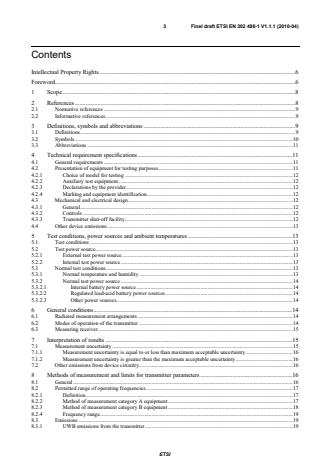
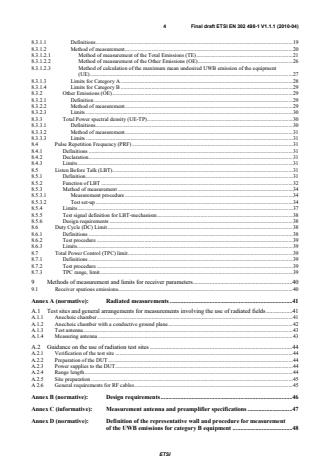
ETSI EN 302 498-1 V1.1.1 (2010-04) - Electromagnetic compatibility and Radio spectrum Matters (ERM); Short Range Devices (SRD); Technical characteristics for SRD equipment using Ultra WideBand technology (UWB); Object Discrimination and Characterization Applications for power tool devices operating in the frequency band from 2,2 GHz to 8,5 GHz; Part 1: Technical characteristics and test methods
ETSI EN 302 498-1 V1.1.1 (2010-06) - Electromagnetic compatibility and Radio spectrum Matters (ERM); Short Range Devices (SRD); Technical characteristics for SRD equipment using Ultra WideBand technology (UWB); Object Discrimination and Characterization Applications for power tool devices operating in the frequency band from 2,2 GHz to 8,5 GHz; Part 1: Technical characteristics and test methods

SIST EN 302 498-1 V1.1.1:2010 is the Slovenian adoption of ETSI EN 302 498-1 V1.1.1 for electromagnetic compatibility and radio spectrum matters. It specifies technical characteristics and test methods for Ultra WideBand (UWB) Short Range Devices (SRD) used for Object Discrimination and Characterization Applications (ODC) in power tool devices in the 2,2 GHz to 8,5 GHz band, with reduced emissions in adjacent lower and upper ranges. It is meant for manufacturers, test laboratories, and compliance teams that need to design, measure, or assess these sensors.
What does SIST EN 302 498-1 V1.1.1:2010 specify?
SIST EN 302 498-1 V1.1.1:2010 specifies the radio and EMC requirements for UWB ODC equipment fitted with an integral antenna. It covers two application categories: Category A for user protection in quasi fixed benchtop tools and table saws, and Category B for breakthrough protection in drilling devices.
The scope also sets out what the equipment is expected to do in practice. Category A devices are intended to radiate towards free space, while Category B devices are intended to operate against absorptive material such as walls and other building materials. The document focuses on spectrum use, emissions, and test methods rather than full product performance.
| Annex | What it covers |
|---|---|
| Annex A | Radiated measurements, test sites, antennas, and RF cable conditions |
| Annex B | Design requirements |
| Annex C | Measurement antenna and preamplifier specifications |
| Annex D | Representative wall definition and the procedure for Category B emission and LBT measurements |
| Annex E | Bibliography |
What are the key requirements of SIST EN 302 498-1 V1.1.1:2010?
SIST EN 302 498-1 V1.1.1:2010 requires the equipment to be presented for test in a controlled, repeatable way. Clause 4 calls for an integral antenna, representative samples, technical documentation, visible marking, and the ancillary equipment needed for testing. In practice, the provider has to supply enough information and hardware for the lab to recreate normal use.
Clause 5 sets the test conditions and power sources. The equipment is tested under normal conditions, with attention to external or internal power supply as appropriate, and with temperature and humidity kept within normal test ranges. This matters because emissions can shift with supply voltage and environment.
Clause 6 and Clause 7 set the measurement approach. Radiated measurements are based on a spectrum analyser, with stated bandwidths, far-field arrangements where practicable, and a reported measurement uncertainty for each parameter. This is important because compliance is decided from the measured value against the limit, together with the stated uncertainty.
Clause 8 separates the transmitter checks into operating frequency, emissions, and control functions. The permitted operating range is 2,2 GHz to 8 GHz, with reduced emissions below and above that band. For practical testing, the lab must record the measured frequency range and the digital datasets used for the evaluation.
The emissions clauses distinguish Total Emissions (TE), Other Emissions (OE), and undesired UWB emissions (UE). TE includes the UWB signal plus spurious and other emissions, while OE is measured with the UWB transmitter disabled or the antenna switched off. This distinction matters because very low UWB levels can be hard to separate from circuitry emissions.
The control-function clauses add operating safeguards. Pulse Repetition Frequency (PRF) has to be declared and must not be below 5 MHz. Listen Before Talk (LBT) is used to avoid transmission when protected services are present, Duty Cycle (DC) is limited, and Category A equipment must implement Total Power Control (TPC) with a 10 dB dynamic range.
What terms does SIST EN 302 498-1 V1.1.1:2010 define?
- Ultra WideBand (UWB) - Radio technology used here for very low power sensing transmissions over a wide frequency range.
- Object Discrimination and Characterization Applications (ODC) - UWB sensor applications that detect, distinguish, or characterize objects or materials.
- Listen Before Talk (LBT) - A mechanism that checks for other signals before allowing transmission.
- Pulse Repetition Frequency (PRF) - The number of UWB pulses transmitted per second in continuous operation.
- Total Emissions (TE) - The measured combination of UWB emissions and other emissions from the equipment.
- Other Emissions (OE) - Unwanted emissions from transmitter, receiver, or other circuitry outside the intended UWB signal.
- Total Power Control (TPC) - A transmitter power control function used for Category A equipment.
Who uses SIST EN 302 498-1 V1.1.1:2010?
SIST EN 302 498-1 V1.1.1:2010 is used by UWB sensor manufacturers, especially those integrating sensing into power tools. EMC and RF test laboratories use it to set up radiated measurements, check emission limits, and document uncertainty.
It is also used by regulatory and compliance teams, quality managers, and buyers who need to verify that a power tool device falls within the intended ODC application and has the required control functions such as LBT, DC, or TPC.
Which standards are used with SIST EN 302 498-1 V1.1.1:2010?
The standard relies on CISPR 16-1 for radio disturbance and immunity measuring apparatus, ETSI TR 100 028 for measurement uncertainty, and ETSI TR 102 273 for radiated measurement methods and uncertainty evaluation. It also references ANSI C63.5 for antenna calibration and the ECC Decision of 30 March 2007 on UWB material sensing devices as the regulatory context.
For exclusion and context, it points to ITU-R Recommendation SM.1754 on UWB measurement techniques and ETSI EN 302 435-1 for building material analysis and classification equipment.
What does the SIST EN 302 498-1 V1.1.1:2010 document contain?
The document contains clause-by-clause technical requirements, test conditions, interpretation rules, and transmitter and receiver measurement methods. It includes detailed measurement setups for Category A and Category B devices, including the operating-frequency tests, emissions measurements, LBT verification, duty-cycle checks, and TPC checks.
Annex A gives radiated test-site guidance, antenna arrangements, and cable requirements. Annex D defines the representative wall and the procedure used for Category B wall-facing measurements and LBT testing. The document also includes formulas, figures, and tables that support design verification, pre-compliance testing, and formal conformity assessment.
Buy Documents
ETSI EN 302 498-1 V1.1.1 (2009-08) - Electromagnetic compatibility and Radio spectrum Matters (ERM); Short Range Devices (SRD); Technical characteristics for SRD equipment using Ultra WideBand technology (UWB); Object Discrimination and Characterization Applications for power tool devices operating in the frequency band from 2,2 GHz to 8,5 GHz; Part 1: Technical characteristics and test methods
ETSI EN 302 498-1 V1.1.1 (2010-04) - Electromagnetic compatibility and Radio spectrum Matters (ERM); Short Range Devices (SRD); Technical characteristics for SRD equipment using Ultra WideBand technology (UWB); Object Discrimination and Characterization Applications for power tool devices operating in the frequency band from 2,2 GHz to 8,5 GHz; Part 1: Technical characteristics and test methods
ETSI EN 302 498-1 V1.1.1 (2010-06) - Electromagnetic compatibility and Radio spectrum Matters (ERM); Short Range Devices (SRD); Technical characteristics for SRD equipment using Ultra WideBand technology (UWB); Object Discrimination and Characterization Applications for power tool devices operating in the frequency band from 2,2 GHz to 8,5 GHz; Part 1: Technical characteristics and test methods
Get Certified
Connect with accredited certification bodies for this standard

ANCE
Mexican certification and testing association.

Intertek Slovenia
Intertek testing, inspection, and certification services in Slovenia.

LNE (Laboratoire National de Métrologie et d'Essais)
French national laboratory for metrology and testing.
Sponsored listings
Frequently Asked Questions
SIST EN 302 498-1 V1.1.1:2010 is a standard published by the Slovenian Institute for Standardization (SIST). Its full title is "Electromagnetic compatibility and Radio spectrum Matters (ERM) - Short Range Devices (SRD) - Technical characteristics for SRD equipment using Ultra WideBand technology (UWB) - Object Discrimination and Characterization Applications for power tool devices operating in the frequency band from 2,2 GHz to 8,5 GHz - Part 1: Technical characteristics and test methods". This standard covers: Create harmonised Standards for UWB Sensors Object classification in the range of 2,2 GHz to 8,5 GHz. The present document specifies the requirements for Object Discrimination and Characterization Applications (ODC) for power tool devices using UWB technology operating in all or part of the frequency band from 2,2 GHz to 8,5 GHz. Additionally, it specifies reduced emissions in the ranges from 0,96 GHz to 2,2 GHz and 8,5 GHz to 10,6 GHz. The present document applies to: a) UWB object discrimination and characterisation equipment for imaging and object detection applications; b) equipment fitted with an integral antenna; c) Two main categories: 1) Category A: user protection in bentchtop tools/table saws (quasi fixed sawing equipment). 2) Category B: breakthrough protection in drilling devices. The present document does not apply to: - UWB communication devices; and - Ground penetrating radar devices; and - through-wall radar imaging devices; - building material devices; as defined in ITU-R Recommendation SM.1754 [i.1] and EN 302 435-1 [i.6]. The present document specifies the equipment which is designed to not radiate into the free space. It is designed to function only when positioned such that it radiates directly into: a) free space (for category A equipment); or b) to the absorptive material such as walls and other building materials which absorb emissions for category B. The present document does not necessarily include all the characteristics which may be required by a user, nor does it necessarily represent the optimum performance achievable.
Create harmonised Standards for UWB Sensors Object classification in the range of 2,2 GHz to 8,5 GHz. The present document specifies the requirements for Object Discrimination and Characterization Applications (ODC) for power tool devices using UWB technology operating in all or part of the frequency band from 2,2 GHz to 8,5 GHz. Additionally, it specifies reduced emissions in the ranges from 0,96 GHz to 2,2 GHz and 8,5 GHz to 10,6 GHz. The present document applies to: a) UWB object discrimination and characterisation equipment for imaging and object detection applications; b) equipment fitted with an integral antenna; c) Two main categories: 1) Category A: user protection in bentchtop tools/table saws (quasi fixed sawing equipment). 2) Category B: breakthrough protection in drilling devices. The present document does not apply to: - UWB communication devices; and - Ground penetrating radar devices; and - through-wall radar imaging devices; - building material devices; as defined in ITU-R Recommendation SM.1754 [i.1] and EN 302 435-1 [i.6]. The present document specifies the equipment which is designed to not radiate into the free space. It is designed to function only when positioned such that it radiates directly into: a) free space (for category A equipment); or b) to the absorptive material such as walls and other building materials which absorb emissions for category B. The present document does not necessarily include all the characteristics which may be required by a user, nor does it necessarily represent the optimum performance achievable.
SIST EN 302 498-1 V1.1.1:2010 is classified under the following ICS (International Classification for Standards) categories: 33.060.99 - Other equipment for radiocommunications; 33.100.01 - Electromagnetic compatibility in general. The ICS classification helps identify the subject area and facilitates finding related standards.
SIST EN 302 498-1 V1.1.1:2010 is associated with the following European legislation: Standardization Mandates: M/329. When a standard is cited in the Official Journal of the European Union, products manufactured in conformity with it benefit from a presumption of conformity with the essential requirements of the corresponding EU directive or regulation.
SIST EN 302 498-1 V1.1.1:2010 is available in PDF format for immediate download after purchase. The document can be added to your cart and obtained through the secure checkout process. Digital delivery ensures instant access to the complete standard document.
Standards Content (Sample)
Draft ETSI EN 302 498-1 V1.1.1 (2009-08)
European Standard (Telecommunications series)
Electromagnetic compatibility
and Radio spectrum Matters (ERM);
Short Range Devices (SRD);
Technical characteristics for SRD equipment
using Ultra WideBand technology (UWB);
Object Discrimination and Characterization Applications
for power tool devices operating in the frequency band
from 2,2 GHz to 8,5 GHz;
Part 1: Technical characteristics and test methods
2 Draft ETSI EN 302 498-1 V1.1.1 (2009-08)
Reference
DEN/ERM-TGUWB-002-1
Keywords
Radar, radio, regulation, SRD, testing, UWB
ETSI
650 Route des Lucioles
F-06921 Sophia Antipolis Cedex - FRANCE
Tel.: +33 4 92 94 42 00 Fax: +33 4 93 65 47 16
Siret N° 348 623 562 00017 - NAF 742 C
Association à but non lucratif enregistrée à la
Sous-Préfecture de Grasse (06) N° 7803/88
Important notice
Individual copies of the present document can be downloaded from:
http://www.etsi.org
The present document may be made available in more than one electronic version or in print. In any case of existing or
perceived difference in contents between such versions, the reference version is the Portable Document Format (PDF).
In case of dispute, the reference shall be the printing on ETSI printers of the PDF version kept on a specific network drive
within ETSI Secretariat.
Users of the present document should be aware that the document may be subject to revision or change of status.
Information on the current status of this and other ETSI documents is available at
http://portal.etsi.org/tb/status/status.asp
If you find errors in the present document, please send your comment to one of the following services:
http://portal.etsi.org/chaircor/ETSI_support.asp
Copyright Notification
No part may be reproduced except as authorized by written permission.
The copyright and the foregoing restriction extend to reproduction in all media.
© European Telecommunications Standards Institute 2009.
All rights reserved.
TM TM TM TM
DECT , PLUGTESTS , UMTS , TIPHON , the TIPHON logo and the ETSI logo are Trade Marks of ETSI registered
for the benefit of its Members.
TM
3GPP is a Trade Mark of ETSI registered for the benefit of its Members and of the 3GPP Organizational Partners.
LTE™ is a Trade Mark of ETSI currently being registered
for the benefit of its Members and of the 3GPP Organizational Partners.
GSM® and the GSM logo are Trade Marks registered and owned by the GSM Association.
ETSI
3 Draft ETSI EN 302 498-1 V1.1.1 (2009-08)
Contents
Intellectual Property Rights.6
Foreword.6
1 Scope.8
2 References.8
2.1 Normative references.9
2.2 Informative references.9
3 Definitions, symbols and abbreviations .9
3.1 Definitions.9
3.2 Symbols.10
3.3 Abbreviations.11
4 Technical requirement specifications.11
4.1 General requirements.11
4.2 Presentation of equipment for testing purposes.11
4.2.1 Choice of model for testing .12
4.2.2 Auxiliary test equipment.12
4.2.3 Declarations by the provider.12
4.2.4 Marking and equipment identification.12
4.3 Mechanical and electrical design.12
4.3.1 General.12
4.3.2 Controls.12
4.3.3 Transmitter shut-off facility.12
4.4 Other device emissions.13
5 Test conditions, power sources and ambient temperatures .13
5.1 Test conditions.13
5.2 Test power source.13
5.2.1 External test power source.13
5.2.2 Internal test power source .13
5.3 Normal test conditions.13
5.3.1 Normal temperature and humidity.13
5.3.2 Normal test power source .14
5.3.2.1 Internal battery power source.14
5.3.2.2 Regulated lead-acid battery power sources .14
5.3.2.3 Other power sources.14
6 General conditions.14
6.1 Radiated measurement arrangements.14
6.2 Modes of operation of the transmitter .14
6.3 Measuring receiver.15
7 Interpretation of results .15
7.1 Measurement uncertainty.15
7.1.1 Measurement uncertainty is equal to or less than maximum acceptable uncertainty.16
7.1.2 Measurement uncertainty is greater than the maximum acceptable uncertainty.16
7.2 Other emissions from device circuitry.16
8 Methods of measurement and limits for transmitter parameters .16
8.1 General.16
8.2 Permitted range of operating frequencies.17
8.2.1 Definition.17
8.2.2 Method of measurement category A equipment .17
8.2.3 Method of measurement category B equipment .18
8.2.4 Frequency range.19
8.3 Emissions.19
8.3.1 UWB emissions from the transmitter.19
ETSI
4 Draft ETSI EN 302 498-1 V1.1.1 (2009-08)
8.3.1.1 Definitions.19
8.3.1.2 Method of measurement.19
8.3.1.2.1 Method of measurement of the Total Emissions (TE).21
8.3.1.2.2 Method of measurement of the Other Emissions (OE).26
8.3.1.2.3 Method of calculation of the maximum mean undesired UWB emission of the equipment
(UE).27
8.3.1.3 Limits for Category A .28
8.3.1.4 Limits for Category B .28
8.3.2 Other Emissions (OE).29
8.3.2.1 Definition.29
8.3.2.2 Method of measurement.29
8.3.2.3 Limits.29
8.3.3 Total Power spectral density (UE-TP).30
8.3.3.1 Definitions.30
8.3.3.2 Method of measurement.30
8.3.3.3 Limits.31
8.4 Pulse Repetition Frequency (PRF) .31
8.4.1 Definitions.31
8.4.2 Declaration.31
8.4.3 Limits.31
8.5 Listen Before Talk (LBT).31
8.5.1 Definition.31
8.5.2 Function of LBT .31
8.5.3 Method of measurement.34
8.5.3.1 Measurement procedure.34
8.5.3.2 Test set-up.34
8.5.4 Limits.37
8.5.5 Test signal definition for LBT-mechanism.38
8.5.6 Design requirements.38
8.6 Duty Cycle (DC) Limit.38
8.6.1 Definitions.38
8.6.2 Test procedure.39
8.6.3 Limits.39
8.7 Total Power Control (TPC) limit.39
8.7.1 Definitions.39
8.7.2 Test procedure.39
8.7.3 TPC range, limit.39
9 Methods of measurement and limits for receiver parameters.40
9.1 Receiver spurious emissions.40
Annex A (normative): Radiated measurements .41
A.1 Test sites and general arrangements for measurements involving the use of radiated fields .41
A.1.1 Anechoic chamber.41
A.1.2 Anechoic chamber with a conductive ground plane.42
A.1.3 Test antenna.43
A.1.4 Measuring antenna.43
A.2 Guidance on the use of radiation test sites .44
A.2.1 Verification of the test site .44
A.2.2 Preparation of the DUT .44
A.2.3 Power supplies to the DUT.44
A.2.4 Range length.44
A.2.5 Site preparation.45
A 2.6 General requirements for RF cables .45
Annex B (normative): Design requirements.46
Annex C (informative): Measurement antenna and preamplifier specifications .47
Annex D (normative): Definition of the representative wall and procedure for measurement
of the UWB emissions for category B equipment .48
ETSI
5 Draft ETSI EN 302 498-1 V1.1.1 (2009-08)
D.1 Representative wall definition for measuring the UWB emissions and LBT function .48
D.2 Procedure for measurement the wall attenuation .48
D.3 Typical representative wall measurement result .50
Annex E (informative): Bibliography.51
History .52
ETSI
6 Draft ETSI EN 302 498-1 V1.1.1 (2009-08)
Intellectual Property Rights
IPRs essential or potentially essential to the present document may have been declared to ETSI. The information
pertaining to these essential IPRs, if any, is publicly available for ETSI members and non-members, and can be found
in ETSI SR 000 314: "Intellectual Property Rights (IPRs); Essential, or potentially Essential, IPRs notified to ETSI in
respect of ETSI standards", which is available from the ETSI Secretariat. Latest updates are available on the ETSI Web
server (http://webapp.etsi.org/IPR/home.asp).
Pursuant to the ETSI IPR Policy, no investigation, including IPR searches, has been carried out by ETSI. No guarantee
can be given as to the existence of other IPRs not referenced in ETSI SR 000 314 (or the updates on the ETSI Web
server) which are, or may be, or may become, essential to the present document.
Foreword
This European Standard (Telecommunications series) has been produced by ETSI Technical Committee
Electromagnetic compatibility and Radio spectrum Matters (ERM), and is now submitted for the Public Enquiry phase
of the ETSI standards Two-step Approval Procedure.
Equipment covered by the present document operates in accordance with amended ECC Decision of 30 March 2007 on
specific Material Sensing devices using Ultra-Wideband (UWB) technology (ECC/DEC/(07)01), amended 26 June
2009 (ECC/DEC/(07)01 [5]).
For non EU countries the present document may be used for regulatory (Type Approval) purposes.
The present document is part 1 of a multi-part deliverable covering Ultra WideBand (UWB); Discrimination and
Characterization Applications for power tool devices operating in the frequency band from 2,2 GHz to 8,5 GHz; as
identified below:
Part 1: "Technical characteristics and test methods";
Part 2: "Harmonized EN covering the essential requirements of article 3.2 of the R&TTE Directive".
Clauses 1 and 3 provide a general description on the types of equipment covered by the present document and the
definitions and abbreviations used.
Clauses 4 and 5 provide the technical requirements for the conduction of the tests and information for equipment to be
presented.
Clauses 6 and 7 give guidance on the general conditions for testing of the device and the interpretation of results and
maximum measurement uncertainty values.
Clause 8 specifies the transmitter spectrum utilization parameters. The clause provides details on how the equipment
should be tested and the conditions which should be applied.
Annex A (normative) provides specifications concerning radiated measurements.
Annex B (normative) provides specifications concerning the design requirements.
Annex C (informative) gives information for the measurement antenna and the preamplifier specifications.
Annex D (normative) provides a representative wall definition for emission measurements and the LBT function.
Annex E (informative) Bibliography covers other supplementary information.
ETSI
7 Draft ETSI EN 302 498-1 V1.1.1 (2009-08)
Proposed national transposition dates
Date of latest announcement of this EN (doa): 3 months after ETSI publication
Date of latest publication of new National Standard
or endorsement of this EN (dop/e): 6 months after doa
Date of withdrawal of any conflicting National Standard (dow): 6 months after doa
ETSI
8 Draft ETSI EN 302 498-1 V1.1.1 (2009-08)
1 Scope
The present document specifies the requirements for Object Discrimination and Characterization Applications (ODC)
for power tool devices using UWB technology operating in all or part of the frequency band from 2,2 GHz to 8,5 GHz.
Additionally, it specifies reduced emissions in the ranges from 0,96 GHz to 2,2 GHz and 8,5 GHz to 10,6 GHz.
The present document applies to:
a) UWB object discrimination and characterisation equipment for imaging and object detection applications;
b) equipment fitted with an integral antenna;
c) Two main categories:
1) Category A: user protection in bentchtop tools/table saws (quasi fixed sawing equipment).
2) Category B: breakthrough protection in drilling devices.
The present document does not apply to:
• UWB communication devices; and
• Ground penetrating radar devices; and
• through-wall radar imaging devices;
• building material devices;
as defined in ITU-R Recommendation SM.1754 [i.1] and EN 302 435-1 [i.6].
The present document specifies the equipment which is designed to not radiate into the free space. It is designed to
function only when positioned such that it radiates directly into:
a) free space (for category A equipment); or
b) to the absorptive material such as walls and other building materials which absorb emissions for category B.
The present document does not necessarily include all the characteristics which may be required by a user, nor does it
necessarily represent the optimum performance achievable.
2 References
References are either specific (identified by date of publication and/or edition number or version number) or
non-specific.
• For a specific reference, subsequent revisions do not apply.
• Non-specific reference may be made only to a complete document or a part thereof and only in the following
cases:
- if it is accepted that it will be possible to use all future changes of the referenced document for the
purposes of the referring document;
- for informative references.
Referenced documents which are not found to be publicly available in the expected location might be found at
http://docbox.etsi.org/Reference.
NOTE: While any hyperlinks included in this clause were valid at the time of publication ETSI cannot guarantee
their long term validity.
ETSI
9 Draft ETSI EN 302 498-1 V1.1.1 (2009-08)
2.1 Normative references
The following referenced documents are indispensable for the application of the present document. For dated
references, only the edition cited applies. For non-specific references, the latest edition of the referenced document
(including any amendments) applies.
[1] CISPR 16-1 (2003): "Specification for radio disturbance and immunity measuring apparatus and
methods - Part 1: Radio disturbance and immunity measuring apparatus".
[2] ETSI TR 100 028 (all parts) (V1.4.1): " Electromagnetic compatibility and Radio spectrum
Matters (ERM); Uncertainties in the measurement of mobile radio equipment characteristics".
[3] ETSI TR 102 273 (all parts) (V1.2.1): "Electromagnetic compatibility and Radio spectrum Matters
(ERM); Improvement on Radiated Methods of Measurement (using test site) and evaluation of the
corresponding measurement uncertainties".
[4] ANSI C63.5 (2006): "American National Standard for Calibration of Antennas Used for Radiated
Emission Measurements in Electromagnetic Interference (EMI)".
[5] ECC Decision of 30 March 2007on specific Material Sensing devices using Ultra-
Wideband (UWB) technology (ECC/DEC/(07)01), amended 26 June 2009.
2.2 Informative references
The following referenced documents are not essential to the use of the present document but they assist the user with
regard to a particular subject area. For non-specific references, the latest version of the referenced document (including
any amendments) applies.
[i.1] ITU-R Recommendation SM.1754: "Measurement techniques of ultra-wideband transmissions".
[i.2] ITU-R Recommendation SM 1538: "Technical and operating parameters and spectrum
requirements for short-range radiocommunication devices".
[i.3] ETSI TR 102 070-2: "Electromagnetic compatibility and Radio spectrum Matters (ERM); Guide to
the application of harmonized standards to multi-radio and combined radio and non-radio
equipment; Part 2: Effective use of the radio frequency spectrum".
[i.4] CEPT/ERC/REC 74-01E (2005): "Unwanted emissions in the spurious domain".
[i.5] CENELEC EN 55022: "Information technology equipment - Radio disturbance characteristics -
Limits and methods of measurement".
[i.6] ETSI EN 302 435-1: "Electromagnetic compatibility and Radio spectrum Matters (ERM); Short
Range Devices (SRD); Technical characteristics for SRD equipment using Ultra WideBand
technology (UWB); Building Material Analysis and Classification equipment applications
operating in the frequency band from 2,2 GHz to 8 GHz; Part 1: Technical characteristics and test
methods".
[i.7] "Antenna Pattern Measurement, Theory and Equations", Michael D. Foegelle, ETS Lindgreen,
Compliance Engineering, Annual Reference Guide 2002.
3 Definitions, symbols and abbreviations
3.1 Definitions
For the purposes of the present document, the following terms and definitions apply:
activity factor: effective transmission time ratio, actual on-the-air time divided by active session time or actual
on-the-air emission time within a given time window
ETSI
10 Draft ETSI EN 302 498-1 V1.1.1 (2009-08)
clutter: undesired radar reflections (echoes) e.g. from inhomogenities, interfaces, gravel stones, cavities in building
material structures
integral antenna: permanent fixed antenna, which may be built-in, designed as an indispensable part of the equipment
Listen Before Talk (LBT): mechanism to avoid signal transmission in the presence of other radio service signals
Pulse Repetition Frequency (PRF): inverse of the Pulse Repetition Interval, averaged over a sufficiently long time to
cover all PRI variations
quasi fixed: UWB sensor is fixed mounted on a device which can not moved very quick (stationary)
radiated measurements: measurements which involve the absolute measurement of a radiated field
spatial resolution: ability to discriminate between two adjacent targets
SRD: equipment defined to operate on a non-interference, no protection from interference basis (as also defined in ITU-
R Recommendation SM.1538 [i.2])
Total Power (TP): integration of the undesired emissions in the whole area around the BM&A-scenario
NOTE: The integration is over a sphere (same procedure as for Total Radiated Power (TRP)). This value is
comparable to an equivalent isotropic radiator.
undesired emissions: any emissions into free space during operation of the equipment when equipment is faced to a
wall or other absorptive material to be investigated
NOTE: Undesired emissions are:
leaked emissions from the side or backside of the antenna; and/or
scattered/reflected emissions from the building material to be investigated; and/or
residual emissions through the building material.
3.2 Symbols
For the purposes of the present document, the following symbols apply:
cl1 cable loss 1
cl2 cable loss 2
dB deciBel
dBi gain in deciBel relative to an isotropic antenna
dBm deciBel reference to 1 mW
E Electrical field strength
E relative dielectric constant of earth materials
R
E
rms Average electrical field strength measured as root mean square
f frequency
f frequency at which the emission is the peak power at maximum
c
Gain of the measurement LNA
GLNA
Gain of the measurement antenna
GA
G(f) Antenna gain over frequency
f Highest frequency of the frequency band of operation
H
f Lowest frequency of the frequency band of operation
L
P Power
P spectral power density
e.i.r.p.
P measured spectral power
m
P undesired spectral power density
wall, e.i.r.p.
P power of a different device at the BMA
victim
R Distance
rms Root mean square
ETSI
11 Draft ETSI EN 302 498-1 V1.1.1 (2009-08)
t time
T pulse rise time
P
Z Free space wave impedance
F0
λ wavelength
c velocity of light in a vacuum
δR range resolution
δt time interval between the arrivals of two signals from targets separated in range by δR
3.3 Abbreviations
For the purposes of the present document, the following abbreviations apply:
BMA Building Material Analysis
CEPT Conférence Européenne des administrations de Postes et des Télécommunications
CW Continuous Wave
DUT Device Under Test
e.i.r.p. equivalent isotropically radiated power
ECC Electronic Communications Committee
EMC Electro-Magnetic Compatibility
ERC European Radiocommunication Committee
IT Information Technology
LBT Listen Before Talk
LNA Low Noise Amplifier
MSS Mobile Satellite Service
OE Other Emissions
PRF Pulse Repetition Frequency
PRI Pulse Repetition Interval
PSD Power Spectral Density
R&TTE Radio and Telecommunications Terminal Equipment
RBW Resolution BandWidth
RF Radio Frequency
SRD Short Range Device
TE Total maximum Emissions
TH ThresHold
TP Total Power
TPC Total Power Control
TP-UE Total Power of Undesired (UWB) Emissions
TRP Total Radiated Power
UE Undesired (UWB) Emissions
UMTS Universal Mobile Telecommunication System
UWB Ultra WideBand
VBW Video BandWidth
VSWR Voltage Standing Wave Ratio
4 Technical requirement specifications
4.1 General requirements
Equipment to be tested against the present document shall be fitted with an integral antenna.
4.2 Presentation of equipment for testing purposes
Each equipment to be tested shall fulfil the requirements of the present document on all frequencies over which it is
intended to operate.
The provider shall provide one or more samples of the equipment, as appropriate for testing.
ETSI
12 Draft ETSI EN 302 498-1 V1.1.1 (2009-08)
Additionally, technical documentation and operating manuals, sufficient to allow testing to be performed, shall be
supplied.
The performance of the equipment to be tested shall be representative of the performance of the corresponding
production model. In order to avoid any ambiguity, the present document contains instructions for the preparation of
equipment for testing purposes, conditions of testing (see clause 5) and the measurement methods (see clause 8).
Equipment shall be offered by the provider complete with any ancillary equipment needed for testing. The provider
shall declare the frequency range(s), the range of operation conditions and power requirements, as applicable, in order
to establish the appropriate test conditions.
4.2.1 Choice of model for testing
If an equipment has several optional features, considered not to affect the RF parameters then the tests need only to be
performed on the equipment configured with that combination of features considered to be the most complex, as
proposed by the provider and agreed by the test laboratory.
4.2.2 Auxiliary test equipment
All necessary set-up information, means for activation and hardware necessary (e.g. standardized wall structure for
testing, see annex D) shall accompany the equipment when it is submitted for testing.
4.2.3 Declarations by the provider
The provider shall submit the necessary information regarding the equipment with respect to all technical requirements
set by the present document.
4.2.4 Marking and equipment identification
The equipment shall be marked in a visible place. This marking shall be legible and durable.
The marking shall include as a minimum:
- the name of the manufacturer or his trademark;
- the type designation. This is the manufacturer's numeric or alphanumeric code or name that is specific to
particular equipment.
4.3 Mechanical and electrical design
4.3.1 General
The equipment submitted by the provider shall be designed, constructed and manufactured in accordance with good
engineering practice and with the aim of minimizing harmful interference to other equipment and services.
4.3.2 Controls
The equipment shall be equipped with controls as defined in annex B.
4.3.3 Transmitter shut-off facility
For the automatic transmitter shut-off facility it shall be possible to disable this feature for the purposes of testing.
Controls for testing purposes, which, if maladjusted, may increase the interfering potential of the equipment, shall not
be easily accessible to the user.
ETSI
13 Draft ETSI EN 302 498-1 V1.1.1 (2009-08)
4.4 Other device emissions
The equipment may contain digital circuit elements, radio circuit elements and other elements whose performance is not
covered by the present document. These elements of the equipment shall meet the appropriate performance
requirements for those components, as specified in other standards (EN 55022 [i.5]).
NOTE: For further information on this topic, see TR 102 070-2 [i.3].
5 Test conditions, power sources and ambient
temperatures
5.1 Test conditions
Testing shall be performed under normal test conditions. The test conditions and procedures shall be as specified in
clauses 5.2 to 5.3.
5.2 Test power source
The equipment shall be tested using the appropriate test power source as specified in clauses 5.2.1 or 5.2.2. Where
equipment can be powered using either external or internal power sources, then equipment shall be tested using the
external test power source as specified in clause 5.2.1 then repeated using the internal power source as specified in
clause 5.2.2.
The test power source used shall be recorded and stated.
5.2.1 External test power source
During tests, the power source of the equipment shall be replaced by an external test power source capable of producing
normal test voltages as specified in clause 5.3.2. The internal impedance of the external test power source shall be low
enough for its effect on the test results to be negligible. For the purpose of the tests, the voltage of the external test
power source shall be measured at the input terminals of the equipment. The external test power source shall be suitably
de-coupled and applied as close to the equipment battery terminals as practicable. For radiated measurements any
external power leads should be so arranged so as not to affect the measurements.
During tests, the external test power source voltages shall be within a tolerance < ±1 % relative to the voltage at the
beginning of each test.
5.2.2 Internal test power source
For radiated measurements on portable equipment with integral antenna, fully charged internal batteries shall be used.
The batteries used should be as supplied or recommended by the provider. If internal batteries are used, at the end of
each test the voltage shall be within a tolerance of < ±5 % relative to the voltage at the beginning of each test.
If appropriate, the external test power source may replace the supplied or recommended internal batteries at the required
voltage - this shall be recorded and stated. In this case, the battery should remain present, electrically isolated from the
rest of the equipment, possibly by putting tape over its contacts.
5.3 Normal test conditions
5.3.1 Normal temperature and humidity
The normal temperature and humidity conditions for tests shall be any convenient combination of temperature and
humidity within the following ranges:
- temperature: +15 °C to +35 °C;
ETSI
14 Draft ETSI EN 302 498-1 V1.1.1 (2009-08)
- relative humidity: 20 % to 75 %.
When it is impracticable to carry out tests under these conditions, a note to this effect stating the ambient temperature
and relative humidity during the tests, shall be recorded and stated.
5.3.2 Normal test power source
5.3.2.1 Internal battery power source
The normal test voltage for equipment shall be a regulated battery power source. For the purpose of the present
document, the nominal voltage shall be the declared voltage, or any of the declared voltages, for which the equipment
was designed.
When the radio equipment is intended for operation with the usual types of regulated battery power source, the normal
test voltage shall be 1,1 multiplied by the nominal voltage of the battery (e.g. 6 V, 12 V, etc.).
5.3.2.2 Regulated lead-acid battery power sources
When the radio equipment is intended for operation from the usual types of regulated lead-acid battery power source,
the normal test voltage shall be 1,1 multiplied by the nominal voltage of the battery (6 V, 12 V, etc.).
5.3.2.3 Other power sources
For operation from other power sources or types of battery (primary or secondary), the normal test voltage shall be the
one declared by the equipment provider. Such values shall be recorded and stated.
6 General conditions
6.1 Radiated measurement arrangements
For guidance on radiation test sites and general arrangements for radiated measurements, see annex A.
Detailed descriptions of radiated measurement arrangements for UWB devices can be found in ITU-R
Recommendation SM.1754 [i.1].
All reasonable efforts should be made to clearly demonstrate that emissions from the UWB transmitter do not exceed
the specified levels, with the transmitter in the far field. To the extent practicable, the device under test should be
measured with a measurement setup up as specified in clause 8 and annex A (with the DUT under "far field conditions,
additional Low Noise Amplifier (LNA) in front of the measurement receiver and with the specified measurement
bandwidths. However, in order to obtain an adequate signal-to-noise ratio in the measurement system, radiated
measurements may have to be made at distances less than those specified annex A and/or with reduced measurement
bandwidths. The revised measurement configuration should be stated on the test report, together with an explanation of
why the signal levels involved necessitated measurement at the distance employed or with the measurement bandwidth
or with a special set up for the LNA (e.g. cooled LNA) used in order to be accurately detected by the measurement
equipment, and calculations demonstrating compliance.
Where it is not practical to further reduce the measurement bandwidth (either because of limitations of
commonly-available test equipment or difficulties in converting readings taken using one measurement bandwidth to
those used by the limits in tables 3 and 5), and the required measurement distance would be so short that the device
would not clearly be within the far field, the test report shall state this fact, the measurement distance and bandwidth
used, the near field/far field distance for the measurement setup (see clause A.2.4), the measured device emissions, the
achievable measurement noise floor and the frequency range(s) involved.
6.2 Modes of operation of the transmitter
For the purpose of the measurements according to the present document, there shall be a facility to operate the
transmitter in a continuous state, whereby the signal with modulation is transmitted repeatedly.
ETSI
15 Draft ETSI EN 302 498-1 V1.1.1 (2009-08)
If pulse gating is employed where the transmitter is quiescent for intervals that are long compared to the nominal pulse
repetition interval, measurements shall be made with the pulse train gated on.
6.3 Measuring receiver
The term measuring receiver refers to a spectrum analyser. The reference bandwidth of the measuring receiver as
defined in CISPR 16-1 [1] shall be as given in table 1.
Table 1: Reference bandwidth of measuring receiver
Frequency being measured: f Spectrum analyser bandwidth (3 dB)
100 kHz
30 MHz ≤ f < 1 000 MHz
1 MHz
1 000 MHz ≤ f
7 Interpretation of results
7.1 Measurement uncertainty
Interpretation of the results recorded in the test report for the measurements described in the present document shall be
as follows:
• the measured value related to the corresponding limit shall be used to decide whether an equipment meets the
requirements of the present document;
• the value of the measurement uncertainty for the measurement of each parameter shall be separately included
in the test report;
• the value of the measurement uncertainty shall be wherever possible equal for each measurement, equal to or
lower than the figures in table 2, and the interpretation procedure specified in clause 7.1.1 shall be used.
Table 2: Measurement uncertainty
Parameter Uncertainty
-7
RF frequency
±1 × 10
RF power, radiated ±6 dB
Temperature ±1 K
Humidity
±5 %
°
Azimuth and elevation during TRP measurement
±5
NOTE: For radiated emissions measurements below 2,2 GHz and above
8 GHz it may not be possible to reduce measurement uncertainty to
the levels specified in table 2 (due to the very low signal level limits
and the consequent requirement for high levels of amplification
across wide bandwidths). In these cases alone it is acceptable to
employ the alternative interpretation procedure specified in
clause 7.1.2.
For the test methods, according to th
...
Final draft ETSI EN 302 498-1 V1.1.1 (2010-04)
European Standard (Telecommunications series)
Electromagnetic compatibility
and Radio spectrum Matters (ERM);
Short Range Devices (SRD);
Technical characteristics for SRD equipment
using Ultra WideBand technology (UWB);
Object Discrimination and Characterization Applications
for power tool devices operating in the frequency band
from 2,2 GHz to 8,5 GHz;
Part 1: Technical characteristics and test methods
2 Final draft ETSI EN 302 498-1 V1.1.1 (2010-04)
Reference
DEN/ERM-TGUWB-002-1
Keywords
radar, radio, regulation, SRD, testing, UWB
ETSI
650 Route des Lucioles
F-06921 Sophia Antipolis Cedex - FRANCE
Tel.: +33 4 92 94 42 00 Fax: +33 4 93 65 47 16
Siret N° 348 623 562 00017 - NAF 742 C
Association à but non lucratif enregistrée à la
Sous-Préfecture de Grasse (06) N° 7803/88
Important notice
Individual copies of the present document can be downloaded from:
http://www.etsi.org
The present document may be made available in more than one electronic version or in print. In any case of existing or
perceived difference in contents between such versions, the reference version is the Portable Document Format (PDF).
In case of dispute, the reference shall be the printing on ETSI printers of the PDF version kept on a specific network drive
within ETSI Secretariat.
Users of the present document should be aware that the document may be subject to revision or change of status.
Information on the current status of this and other ETSI documents is available at
http://portal.etsi.org/tb/status/status.asp
If you find errors in the present document, please send your comment to one of the following services:
http://portal.etsi.org/chaircor/ETSI_support.asp
Copyright Notification
No part may be reproduced except as authorized by written permission.
The copyright and the foregoing restriction extend to reproduction in all media.
© European Telecommunications Standards Institute 2010.
All rights reserved.
TM TM TM TM
DECT , PLUGTESTS , UMTS , TIPHON , the TIPHON logo and the ETSI logo are Trade Marks of ETSI registered
for the benefit of its Members.
TM
3GPP is a Trade Mark of ETSI registered for the benefit of its Members and of the 3GPP Organizational Partners.
LTE™ is a Trade Mark of ETSI currently being registered
for the benefit of its Members and of the 3GPP Organizational Partners.
GSM® and the GSM logo are Trade Marks registered and owned by the GSM Association.
ETSI
3 Final draft ETSI EN 302 498-1 V1.1.1 (2010-04)
Contents
Intellectual Property Rights . 6
Foreword . 6
1 Scope . 8
2 References . 8
2.1 Normative references . 9
2.2 Informative references . 9
3 Definitions, symbols and abbreviations . 9
3.1 Definitions . 9
3.2 Symbols . 10
3.3 Abbreviations . 11
4 Technical requirement specifications . 11
4.1 General requirements . 11
4.2 Presentation of equipment for testing purposes . 11
4.2.1 Choice of model for testing . 12
4.2.2 Auxiliary test equipment . 12
4.2.3 Declarations by the provider . 12
4.2.4 Marking and equipment identification . 12
4.3 Mechanical and electrical design . 12
4.3.1 General . 12
4.3.2 Controls . 12
4.3.3 Transmitter shut-off facility . 12
4.4 Other device emissions . 13
5 Test conditions, power sources and ambient temperatures . 13
5.1 Test conditions . 13
5.2 Test power source . 13
5.2.1 External test power source . 13
5.2.2 Internal test power source . 13
5.3 Normal test conditions . 13
5.3.1 Normal temperature and humidity . 13
5.3.2 Normal test power source . 14
5.3.2.1 Internal battery power source . 14
5.3.2.2 Regulated lead-acid battery power sources . 14
5.3.2.3 Other power sources . 14
6 General conditions . 14
6.1 Radiated measurement arrangements . 14
6.2 Modes of operation of the transmitter . 14
6.3 Measuring receiver . 15
7 Interpretation of results . 15
7.1 Measurement uncertainty . 15
7.1.1 Measurement uncertainty is equal to or less than maximum acceptable uncertainty . 16
7.1.2 Measurement uncertainty is greater than the maximum acceptable uncertainty . 16
7.2 Other emissions from device circuitry . 16
8 Methods of measurement and limits for transmitter parameters . 16
8.1 General . 16
8.2 Permitted range of operating frequencies . 17
8.2.1 Definition . 17
8.2.2 Method of measurement category A equipment . 17
8.2.3 Method of measurement category B equipment . 18
8.2.4 Frequency range . 19
8.3 Emissions . 19
8.3.1 UWB emissions from the transmitter. 19
ETSI
4 Final draft ETSI EN 302 498-1 V1.1.1 (2010-04)
8.3.1.1 Definitions . 19
8.3.1.2 Method of measurement . 20
8.3.1.2.1 Method of measurement of the Total Emissions (TE) . 21
8.3.1.2.2 Method of measurement of the Other Emissions (OE) . 26
8.3.1.2.3 Method of calculation of the maximum mean undesired UWB emission of the equipment
(UE) . 27
8.3.1.3 Limits for Category A . 28
8.3.1.4 Limits for Category B . 29
8.3.2 Other Emissions (OE) . 29
8.3.2.1 Definition . 29
8.3.2.2 Method of measurement . 29
8.3.2.3 Limits . 30
8.3.3 Total Power spectral density (UE-TP) . 30
8.3.3.1 Definitions . 30
8.3.3.2 Method of measurement . 31
8.3.3.3 Limits . 31
8.4 Pulse Repetition Frequency (PRF) . 31
8.4.1 Definitions . 31
8.4.2 Declaration . 31
8.4.3 Limits . 31
8.5 Listen Before Talk (LBT) . 31
8.5.1 Definition . 31
8.5.2 Function of LBT . 32
8.5.3 Method of measurement . 34
8.5.3.1 Measurement procedure . 34
8.5.3.2 Test set-up . 34
8.5.4 Limits . 37
8.5.5 Test signal definition for LBT-mechanism . 38
8.5.6 Design requirements . 38
8.6 Duty Cycle (DC) Limit . 38
8.6.1 Definitions . 38
8.6.2 Test procedure . 39
8.6.3 Limits . 39
8.7 Total Power Control (TPC) limit . 39
8.7.1 Definitions . 39
8.7.2 Test procedure . 39
8.7.3 TPC range, limit . 39
9 Methods of measurement and limits for receiver parameters . 40
9.1 Receiver spurious emissions. 40
Annex A (normative): Radiated measurements . 41
A.1 Test sites and general arrangements for measurements involving the use of radiated fields . 41
A.1.1 Anechoic chamber . 41
A.1.2 Anechoic chamber with a conductive ground plane . 42
A.1.3 Test antenna . 43
A.1.4 Measuring antenna . 43
A.2 Guidance on the use of radiation test sites . 44
A.2.1 Verification of the test site . 44
A.2.2 Preparation of the DUT . 44
A.2.3 Power supplies to the DUT. 44
A.2.4 Range length . 44
A.2.5 Site preparation . 45
A 2.6 General requirements for RF cables . 45
Annex B (normative): Design requirements . 46
Annex C (informative): Measurement antenna and preamplifier specifications . 47
Annex D (normative): Definition of the representative wall and procedure for measurement
of the UWB emissions for category B equipment . 48
ETSI
5 Final draft ETSI EN 302 498-1 V1.1.1 (2010-04)
D.1 Representative wall definition for measuring the UWB emissions and LBT function . 48
D.2 Procedure for measurement the wall attenuation . 48
D.3 Typical representative wall measurement result . 50
Annex E (informative): Bibliography . 51
History . 52
ETSI
6 Final draft ETSI EN 302 498-1 V1.1.1 (2010-04)
Intellectual Property Rights
IPRs essential or potentially essential to the present document may have been declared to ETSI. The information
pertaining to these essential IPRs, if any, is publicly available for ETSI members and non-members, and can be found
in ETSI SR 000 314: "Intellectual Property Rights (IPRs); Essential, or potentially Essential, IPRs notified to ETSI in
respect of ETSI standards", which is available from the ETSI Secretariat. Latest updates are available on the ETSI Web
server (http://webapp.etsi.org/IPR/home.asp).
Pursuant to the ETSI IPR Policy, no investigation, including IPR searches, has been carried out by ETSI. No guarantee
can be given as to the existence of other IPRs not referenced in ETSI SR 000 314 (or the updates on the ETSI Web
server) which are, or may be, or may become, essential to the present document.
Foreword
This European Standard (Telecommunications series) has been produced by ETSI Technical Committee
Electromagnetic compatibility and Radio spectrum Matters (ERM), and is now submitted for the Vote phase of the
ETSI standards Two-step Approval Procedure.
Equipment covered by the present document operates in accordance with amended ECC Decision of 30 March 2007 on
specific Material Sensing devices using Ultra-Wideband (UWB); technology (ECC/DEC/(07)01), amended 26 June
2009 (ECC/DEC/(07)01 [5]).
For non EU countries the present document may be used for regulatory (Type Approval) purposes.
The present document is part 1 of a multi-part deliverable covering Ultra WideBand (UWB) Discrimination and
Characterization Applications for power tool devices operating in the frequency band from 2,2 GHz to 8,5 GHz; as
identified below:
Part 1: "Technical characteristics and test methods";
Part 2: "Harmonized EN covering the essential requirements of article 3.2 of the R&TTE Directive".
Clauses 1 and 3 provide a general description on the types of equipment covered by the present document and the
definitions and abbreviations used.
Clauses 4 and 5 provide the technical requirements for the conduction of the tests and information for equipment to be
presented.
Clauses 6 and 7 give guidance on the general conditions for testing of the device and the interpretation of results and
maximum measurement uncertainty values.
Clause 8 specifies the transmitter spectrum utilization parameters. The clause provides details on how the equipment
should be tested and the conditions which should be applied.
Annex A (normative) provides specifications concerning radiated measurements.
Annex B (normative) provides specifications concerning the design requirements.
Annex C (informative) gives information for the measurement antenna and the preamplifier specifications.
Annex D (normative) provides a representative wall definition for emission measurements and the LBT function.
Annex E (informative) Bibliography covers other supplementary information.
ETSI
7 Final draft ETSI EN 302 498-1 V1.1.1 (2010-04)
Proposed national transposition dates
Date of latest announcement of this EN (doa): 3 months after ETSI publication
Date of latest publication of new National Standard
or endorsement of this EN (dop/e): 6 months after doa
Date of withdrawal of any conflicting National Standard (dow): 6 months after doa
ETSI
8 Final draft ETSI EN 302 498-1 V1.1.1 (2010-04)
1 Scope
The present document specifies the requirements for Object Discrimination and Characterization Applications (ODC)
for power tool devices using UWB technology operating in all or part of the frequency band from 2,2 GHz to 8,5 GHz.
Additionally, it specifies reduced emissions in the ranges from 0,96 GHz to 2,2 GHz and 8,5 GHz to 10,6 GHz.
The present document applies to:
a) UWB object discrimination and characterisation equipment for imaging and object detection applications;
b) equipment fitted with an integral antenna;
c) Two main categories:
1) Category A: user protection in bentchtop tools/table saws (quasi fixed sawing equipment).
2) Category B: breakthrough protection in drilling devices.
The present document does not apply to:
• UWB communication devices; and
• Ground penetrating radar devices; and
• through-wall radar imaging devices;
• building material devices;
as defined in ITU-R Recommendation SM.1754 [i.1] and EN 302 435-1 [i.6].
The present document specifies the equipment which is designed to not radiate into the free space. It is designed to
function only when positioned such that it radiates directly into:
a) free space (for category A equipment); or
b) to the absorptive material such as walls and other building materials which absorb emissions for category B.
The present document does not necessarily include all the characteristics which may be required by a user, nor does it
necessarily represent the optimum performance achievable.
2 References
References are either specific (identified by date of publication and/or edition number or version number) or
non-specific.
• For a specific reference, subsequent revisions do not apply.
• Non-specific reference may be made only to a complete document or a part thereof and only in the following
cases:
- if it is accepted that it will be possible to use all future changes of the referenced document for the
purposes of the referring document;
- for informative references.
Referenced documents which are not found to be publicly available in the expected location might be found at
http://docbox.etsi.org/Reference.
NOTE: While any hyperlinks included in this clause were valid at the time of publication ETSI cannot guarantee
their long term validity.
ETSI
9 Final draft ETSI EN 302 498-1 V1.1.1 (2010-04)
2.1 Normative references
The following referenced documents are indispensable for the application of the present document. For dated
references, only the edition cited applies. For non-specific references, the latest edition of the referenced document
(including any amendments) applies.
[1] CISPR 16-1 (2003): "Specification for radio disturbance and immunity measuring apparatus and
methods - Part 1: Radio disturbance and immunity measuring apparatus".
[2] ETSI TR 100 028 (all parts) (V1.4.1): "Electromagnetic compatibility and Radio spectrum Matters
(ERM); Uncertainties in the measurement of mobile radio equipment characteristics".
[3] ETSI TR 102 273 (all parts) (V1.2.1): "Electromagnetic compatibility and Radio spectrum Matters
(ERM); Improvement on Radiated Methods of Measurement (using test site) and evaluation of the
corresponding measurement uncertainties".
[4] ANSI C63.5 (2006): "American National Standard for Calibration of Antennas Used for Radiated
Emission Measurements in Electromagnetic Interference (EMI)".
[5] ECC Decision of 30 March 2007on specific Material Sensing devices using Ultra-Wideband
(UWB) technology (ECC/DEC/(07)01), amended 26 June 2009.
2.2 Informative references
The following referenced documents are not essential to the use of the present document but they assist the user with
regard to a particular subject area. For non-specific references, the latest version of the referenced document (including
any amendments) applies.
[i.1] ITU-R Recommendation SM.1754: "Measurement techniques of ultra-wideband transmissions".
[i.2] ITU-R Recommendation SM.1538: "Technical and operating parameters and spectrum
requirements for short-range radiocommunication devices".
[i.3] ETSI TR 102 070-2: "Electromagnetic compatibility and Radio spectrum Matters (ERM); Guide to
the application of harmonized standards to multi-radio and combined radio and non-radio
equipment; Part 2: Effective use of the radio frequency spectrum".
[i.4] CEPT/ERC/REC 74-01E (2005): "Unwanted emissions in the spurious domain".
[i.5] CENELEC EN 55022: "Information technology equipment - Radio disturbance characteristics -
Limits and methods of measurement".
[i.6] ETSI EN 302 435-1: "Electromagnetic compatibility and Radio spectrum Matters (ERM); Short
Range Devices (SRD); Technical characteristics for SRD equipment using Ultra WideBand
technology (UWB); Building Material Analysis and Classification equipment applications
operating in the frequency band from 2,2 GHz to 8,5 GHz; Part 1: Technical characteristics and
test methods".
[i.7] "Antenna Pattern Measurement, Theory and Equations", Michael D. Foegelle, ETS Lindgreen,
Compliance Engineering, Annual Reference Guide 2002.
3 Definitions, symbols and abbreviations
3.1 Definitions
For the purposes of the present document, the following terms and definitions apply:
activity factor: effective transmission time ratio, actual on-the-air time divided by active session time or actual
on-the-air emission time within a given time window
ETSI
10 Final draft ETSI EN 302 498-1 V1.1.1 (2010-04)
clutter: undesired radar reflections (echoes) e.g. from inhomogenities, interfaces, gravel stones, cavities in building
material structures
integral antenna: permanent fixed antenna, which may be built-in, designed as an indispensable part of the equipment
Listen Before Talk (LBT): mechanism to avoid signal transmission in the presence of other radio service signals
Pulse Repetition Frequency (PRF): inverse of the Pulse Repetition Interval, averaged over a sufficiently long time to
cover all PRI variations
quasi fixed: UWB sensor is fixed mounted on a device which cannot moved very quick (stationary)
radiated measurements: measurements which involve the absolute measurement of a radiated field
spatial resolution: ability to discriminate between two adjacent targets
SRD: equipment defined to operate on a non-interference, no protection from interference basis (as also defined in
ITU-R Recommendation SM.1538 [i.2])
Total Power (TP): integration of the undesired emissions in the whole area around the BM&A-scenario
NOTE: The integration is over a sphere (same procedure as for Total Radiated Power (TRP)). This value is
comparable to an equivalent isotropic radiator.
undesired emissions: any emissions into free space during operation of the equipment when equipment is faced to a
wall or other absorptive material to be investigated
NOTE: Undesired emissions are:
leaked emissions from the side or backside of the antenna; and/or
scattered/reflected emissions from the building material to be investigated; and/or
residual emissions through the building material.
3.2 Symbols
For the purposes of the present document, the following symbols apply:
cl1 cable loss 1
cl2 cable loss 2
dB deciBel
dBi gain in deciBel relative to an isotropic antenna
dBm deciBel reference to 1 mW
E Electrical field strength
E relative dielectric constant of earth materials
R
E
rms Average electrical field strength measured as root mean square
f frequency
f frequency at which the emission is the peak power at maximum
c
Gain of the measurement LNA
GLNA
Gain of the measurement antenna
GA
G(f) Antenna gain over frequency
f Highest frequency of the frequency band of operation
H
f Lowest frequency of the frequency band of operation
L
P Power
P spectral power density
e.i.r.p.
P measured spectral power
m
P undesired spectral power density
wall, e.i.r.p.
P power of a different device at the BMA
victim
R Distance
rms Root mean square
ETSI
11 Final draft ETSI EN 302 498-1 V1.1.1 (2010-04)
t time
T pulse rise time
P
Z Free space wave impedance
F0
λ wavelength
c velocity of light in a vacuum
δR range resolution
δt time interval between the arrivals of two signals from targets separated in range by δR
3.3 Abbreviations
For the purposes of the present document, the following abbreviations apply:
BMA Building Material Analysis
CEPT Conférence Européenne des administrations de Postes et des Télécommunications
CW Continuous Wave
DUT Device Under Test
e.i.r.p. equivalent isotropically radiated power
ECC Electronic Communications Committee
EMC Electro-Magnetic Compatibility
ERC European Radiocommunication Committee
IT Information Technology
LBT Listen Before Talk
LNA Low Noise Amplifier
MSS Mobile Satellite Service
OE Other Emissions
PRF Pulse Repetition Frequency
PRI Pulse Repetition Interval
PSD Power Spectral Density
R&TTE Radio and Telecommunications Terminal Equipment
RBW Resolution BandWidth
RF Radio Frequency
SRD Short Range Device
TE Total maximum Emissions
TH ThresHold
TP Total Power
TPC Total Power Control
TP-UE Total Power of Undesired (UWB) Emissions
TRP Total Radiated Power
UE Undesired (UWB) Emissions
UMTS Universal Mobile Telecommunication System
UWB Ultra WideBand
VBW Video BandWidth
VSWR Voltage Standing Wave Ratio
4 Technical requirement specifications
4.1 General requirements
Equipment to be tested against the present document shall be fitted with an integral antenna.
4.2 Presentation of equipment for testing purposes
Each equipment to be tested shall fulfil the requirements of the present document on all frequencies over which it is
intended to operate.
The provider shall provide one or more samples of the equipment, as appropriate for testing.
ETSI
12 Final draft ETSI EN 302 498-1 V1.1.1 (2010-04)
Additionally, technical documentation and operating manuals, sufficient to allow testing to be performed, shall be
supplied.
The performance of the equipment to be tested shall be representative of the performance of the corresponding
production model. In order to avoid any ambiguity, the present document contains instructions for the preparation of
equipment for testing purposes, conditions of testing (see clause 5) and the measurement methods (see clause 8).
Equipment shall be offered by the provider complete with any ancillary equipment needed for testing. The provider
shall declare the frequency range(s), the range of operation conditions and power requirements, as applicable, in order
to establish the appropriate test conditions.
4.2.1 Choice of model for testing
If an equipment has several optional features, considered not to affect the RF parameters then the tests need only to be
performed on the equipment configured with that combination of features considered to be the most complex, as
proposed by the provider and agreed by the test laboratory.
4.2.2 Auxiliary test equipment
All necessary set-up information, means for activation and hardware necessary (e.g. standardized wall structure for
testing, see annex D) shall accompany the equipment when it is submitted for testing.
4.2.3 Declarations by the provider
The provider shall submit the necessary information regarding the equipment with respect to all technical requirements
set by the present document.
4.2.4 Marking and equipment identification
The equipment shall be marked in a visible place. This marking shall be legible and durable.
The marking shall include as a minimum:
• the name of the manufacturer or his trademark;
• the type designation. This is the manufacturer's numeric or alphanumeric code or name that is specific to
particular equipment.
4.3 Mechanical and electrical design
4.3.1 General
The equipment submitted by the provider shall be designed, constructed and manufactured in accordance with good
engineering practice and with the aim of minimizing harmful interference to other equipment and services.
4.3.2 Controls
The equipment shall be equipped with controls as defined in annex B.
4.3.3 Transmitter shut-off facility
For the automatic transmitter shut-off facility it shall be possible to disable this feature for the purposes of testing.
Controls for testing purposes, which, if maladjusted, may increase the interfering potential of the equipment, shall not
be easily accessible to the user.
ETSI
13 Final draft ETSI EN 302 498-1 V1.1.1 (2010-04)
4.4 Other device emissions
The equipment may contain digital circuit elements, radio circuit elements and other elements whose performance is not
covered by the present document. These elements of the equipment shall meet the appropriate performance
requirements for those components, as specified in other standards (EN 55022 [i.5]).
NOTE: For further information on this topic, see TR 102 070-2 [i.3].
5 Test conditions, power sources and ambient
temperatures
5.1 Test conditions
Testing shall be performed under normal test conditions. The test conditions and procedures shall be as specified in
clauses 5.2 to 5.3.
5.2 Test power source
The equipment shall be tested using the appropriate test power source as specified in clauses 5.2.1 or 5.2.2. Where
equipment can be powered using either external or internal power sources, then equipment shall be tested using the
external test power source as specified in clause 5.2.1 then repeated using the internal power source as specified in
clause 5.2.2.
The test power source used shall be recorded and stated.
5.2.1 External test power source
During tests, the power source of the equipment shall be replaced by an external test power source capable of producing
normal test voltages as specified in clause 5.3.2. The internal impedance of the external test power source shall be low
enough for its effect on the test results to be negligible. For the purpose of the tests, the voltage of the external test
power source shall be measured at the input terminals of the equipment. The external test power source shall be suitably
de-coupled and applied as close to the equipment battery terminals as practicable. For radiated measurements any
external power leads should be so arranged so as not to affect the measurements.
During tests, the external test power source voltages shall be within a tolerance < ±1 % relative to the voltage at the
beginning of each test.
5.2.2 Internal test power source
For radiated measurements on portable equipment with integral antenna, fully charged internal batteries shall be used.
The batteries used should be as supplied or recommended by the provider. If internal batteries are used, at the end of
each test the voltage shall be within a tolerance of < ±5 % relative to the voltage at the beginning of each test.
If appropriate, the external test power source may replace the supplied or recommended internal batteries at the required
voltage - this shall be recorded and stated. In this case, the battery should remain present, electrically isolated from the
rest of the equipment, possibly by putting tape over its contacts.
5.3 Normal test conditions
5.3.1 Normal temperature and humidity
The normal temperature and humidity conditions for tests shall be any convenient combination of temperature and
humidity within the following ranges:
• temperature: +15 °C to +35 °C;
ETSI
14 Final draft ETSI EN 302 498-1 V1.1.1 (2010-04)
• relative humidity: 20 % to 75 %.
When it is impracticable to carry out tests under these conditions, a note to this effect stating the ambient temperature
and relative humidity during the tests, shall be recorded and stated.
5.3.2 Normal test power source
5.3.2.1 Internal battery power source
The normal test voltage for equipment shall be a regulated battery power source. For the purpose of the present
document, the nominal voltage shall be the declared voltage, or any of the declared voltages, for which the equipment
was designed.
When the radio equipment is intended for operation with the usual types of regulated battery power source, the normal
test voltage shall be 1,1 multiplied by the nominal voltage of the battery (e.g. 6 V, 12 V, etc.).
5.3.2.2 Regulated lead-acid battery power sources
When the radio equipment is intended for operation from the usual types of regulated lead-acid battery power source,
the normal test voltage shall be 1,1 multiplied by the nominal voltage of the battery (6 V, 12 V, etc.).
5.3.2.3 Other power sources
For operation from other power sources or types of battery (primary or secondary), the normal test voltage shall be the
one declared by the equipment provider. Such values shall be recorded and stated.
6 General conditions
6.1 Radiated measurement arrangements
For guidance on radiation test sites and general arrangements for radiated measurements, see annex A.
Detailed descriptions of radiated measurement arrangements for UWB devices can be found in ITU-R
Recommendation SM.1754 [i.1].
All reasonable efforts should be made to clearly demonstrate that emissions from the UWB transmitter do not exceed
the specified levels, with the transmitter in the far field. To the extent practicable, the device under test should be
measured with a measurement setup up as specified in clause 8 and annex A (with the DUT under "far field conditions,
additional Low Noise Amplifier (LNA) in front of the measurement receiver and with the specified measurement
bandwidths. However, in order to obtain an adequate signal-to-noise ratio in the measurement system, radiated
measurements may have to be made at distances less than those specified annex A and/or with reduced measurement
bandwidths. The revised measurement configuration should be stated on the test report, together with an explanation of
why the signal levels involved necessitated measurement at the distance employed or with the measurement bandwidth
or with a special set up for the LNA (e.g. cooled LNA) used in order to be accurately detected by the measurement
equipment, and calculations demonstrating compliance.
Where it is not practical to further reduce the measurement bandwidth (either because of limitations of
commonly-available test equipment or difficulties in converting readings taken using one measurement bandwidth to
those used by the limits in tables 3 and 5), and the required measurement distance would be so short that the device
would not clearly be within the far field, the test report shall state this fact, the measurement distance and bandwidth
used, the near field/far field distance for the measurement setup (see clause A.2.4), the measured device emissions, the
achievable measurement noise floor and the frequency range(s) involved.
6.2 Modes of operation of the transmitter
For the purpose of the measurements according to the present document, there shall be a facility to operate the
transmitter in a continuous state, whereby the signal with modulation is transmitted repeatedly.
ETSI
15 Final draft ETSI EN 302 498-1 V1.1.1 (2010-04)
If pulse gating is employed where the transmitter is quiescent for intervals that are long compared to the nominal pulse
repetition interval, measurements shall be made with the pulse train gated on.
6.3 Measuring receiver
The term measuring receiver refers to a spectrum analyser. The reference bandwidth of the measuring receiver as
defined in CISPR 16-1 [1] shall be as given in table 1.
Table 1: Reference bandwidth of measuring receiver
Frequency being measured: f Spectrum analyser bandwidth (3 dB)
30 MHz ≤ f < 1 000 MHz 100 kHz
1 MHz
1 000 MHz ≤ f
7 Interpretation of results
7.1 Measurement uncertainty
Interpretation of the results recorded in the test report for the measurements described in the present document shall be
as follows:
• the measured value related to the corresponding limit shall be used to decide whether an equipment meets the
requirements of the present document;
• the value of the measurement uncertainty for the measurement of each parameter shall be separately included
in the test report;
• the value of the measurement uncertainty shall be wherever possible equal for each measurement, equal to or
lower than the figures in table 2, and the interpretation procedure specified in clause 7.1.1 shall be used.
Table 2: Measurement uncertainty
Parameter Uncertainty
-7
RF frequency
±1 × 10
RF power, radiated ±6 dB
Temperature ±1 K
Humidity
±5 %
°
Azimuth and elevation during TRP measurement
±5
NOTE: For radiated emissions measurements below 2,2 GHz and above 8 GHz it may
not be possible to reduce measurement uncertainty to the levels specified in
table 2 (due to the very low signal level limits and the conseque
...
European Standard (Telecommunications series)
Electromagnetic compatibility
and Radio spectrum Matters (ERM);
Short Range Devices (SRD);
Technical characteristics for SRD equipment
using Ultra WideBand technology (UWB);
Object Discrimination and Characterization Applications
for power tool devices operating in the frequency band
from 2,2 GHz to 8,5 GHz;
Part 1: Technical characteristics and test methods
2 ETSI EN 302 498-1 V1.1.1 (2010-06)
Reference
DEN/ERM-TGUWB-002-1
Keywords
radar, radio, regulation, SRD, testing, UWB
ETSI
650 Route des Lucioles
F-06921 Sophia Antipolis Cedex - FRANCE
Tel.: +33 4 92 94 42 00 Fax: +33 4 93 65 47 16
Siret N° 348 623 562 00017 - NAF 742 C
Association à but non lucratif enregistrée à la
Sous-Préfecture de Grasse (06) N° 7803/88
Important notice
Individual copies of the present document can be downloaded from:
http://www.etsi.org
The present document may be made available in more than one electronic version or in print. In any case of existing or
perceived difference in contents between such versions, the reference version is the Portable Document Format (PDF).
In case of dispute, the reference shall be the printing on ETSI printers of the PDF version kept on a specific network drive
within ETSI Secretariat.
Users of the present document should be aware that the document may be subject to revision or change of status.
Information on the current status of this and other ETSI documents is available at
http://portal.etsi.org/tb/status/status.asp
If you find errors in the present document, please send your comment to one of the following services:
http://portal.etsi.org/chaircor/ETSI_support.asp
Copyright Notification
No part may be reproduced except as authorized by written permission.
The copyright and the foregoing restriction extend to reproduction in all media.
© European Telecommunications Standards Institute 2010.
All rights reserved.
TM TM TM TM
DECT , PLUGTESTS , UMTS , TIPHON , the TIPHON logo and the ETSI logo are Trade Marks of ETSI registered
for the benefit of its Members.
TM
3GPP is a Trade Mark of ETSI registered for the benefit of its Members and of the 3GPP Organizational Partners.
LTE™ is a Trade Mark of ETSI currently being registered
for the benefit of its Members and of the 3GPP Organizational Partners.
GSM® and the GSM logo are Trade Marks registered and owned by the GSM Association.
ETSI
3 ETSI EN 302 498-1 V1.1.1 (2010-06)
Contents
Intellectual Property Rights . 6
Foreword . 6
1 Scope . 8
2 References . 8
2.1 Normative references . 8
2.2 Informative references . 9
3 Definitions, symbols and abbreviations . 9
3.1 Definitions . 9
3.2 Symbols . 10
3.3 Abbreviations . 11
4 Technical requirement specifications . 11
4.1 General requirements . 11
4.2 Presentation of equipment for testing purposes . 11
4.2.1 Choice of model for testing . 12
4.2.2 Auxiliary test equipment . 12
4.2.3 Declarations by the provider . 12
4.2.4 Marking and equipment identification . 12
4.3 Mechanical and electrical design . 12
4.3.1 General . 12
4.3.2 Controls . 12
4.3.3 Transmitter shut-off facility . 12
4.4 Other device emissions . 12
5 Test conditions, power sources and ambient temperatures . 13
5.1 Test conditions . 13
5.2 Test power source . 13
5.2.1 External test power source . 13
5.2.2 Internal test power source . 13
5.3 Normal test conditions . 13
5.3.1 Normal temperature and humidity . 13
5.3.2 Normal test power source . 14
5.3.2.1 Internal battery power source . 14
5.3.2.2 Regulated lead-acid battery power sources . 14
5.3.2.3 Other power sources . 14
6 General conditions . 14
6.1 Radiated measurement arrangements . 14
6.2 Modes of operation of the transmitter . 14
6.3 Measuring receiver . 15
7 Interpretation of results . 15
7.1 Measurement uncertainty . 15
7.1.1 Measurement uncertainty is equal to or less than maximum acceptable uncertainty . 16
7.1.2 Measurement uncertainty is greater than the maximum acceptable uncertainty . 16
7.2 Other emissions from device circuitry . 16
8 Methods of measurement and limits for transmitter parameters . 16
8.1 General . 16
8.2 Permitted range of operating frequencies . 17
8.2.1 Definition . 17
8.2.2 Method of measurement category A equipment . 17
8.2.3 Method of measurement category B equipment . 18
8.2.4 Frequency range . 19
8.3 Emissions . 19
8.3.1 UWB emissions from the transmitter. 19
ETSI
4 ETSI EN 302 498-1 V1.1.1 (2010-06)
8.3.1.1 Definitions . 19
8.3.1.2 Method of measurement . 20
8.3.1.2.1 Method of measurement of the Total Emissions (TE) . 21
8.3.1.2.2 Method of measurement of the Other Emissions (OE) . 26
8.3.1.2.3 Method of calculation of the maximum mean undesired UWB emission of the equipment
(UE) . 27
8.3.1.3 Limits for Category A . 28
8.3.1.4 Limits for Category B . 29
8.3.2 Other Emissions (OE) . 29
8.3.2.1 Definition . 29
8.3.2.2 Method of measurement . 29
8.3.2.3 Limits . 30
8.3.3 Total Power spectral density (UE-TP) . 30
8.3.3.1 Definitions . 30
8.3.3.2 Method of measurement . 31
8.3.3.3 Limits . 31
8.4 Pulse Repetition Frequency (PRF) . 31
8.4.1 Definitions . 31
8.4.2 Declaration . 31
8.4.3 Limits . 31
8.5 Listen Before Talk (LBT) . 31
8.5.1 Definition . 31
8.5.2 Function of LBT . 32
8.5.3 Method of measurement . 34
8.5.3.1 Measurement procedure . 34
8.5.3.2 Test set-up . 34
8.5.4 Limits . 37
8.5.5 Test signal definition for LBT-mechanism . 38
8.5.6 Design requirements . 38
8.6 Duty Cycle (DC) Limit . 38
8.6.1 Definitions . 38
8.6.2 Test procedure . 39
8.6.3 Limits . 39
8.7 Total Power Control (TPC) limit . 39
8.7.1 Definitions . 39
8.7.2 Test procedure . 39
8.7.3 TPC range, limit . 39
9 Methods of measurement and limits for receiver parameters . 40
9.1 Receiver spurious emissions. 40
Annex A (normative): Radiated measurements . 41
A.1 Test sites and general arrangements for measurements involving the use of radiated fields . 41
A.1.1 Anechoic chamber . 41
A.1.2 Anechoic chamber with a conductive ground plane . 42
A.1.3 Test antenna . 43
A.1.4 Measuring antenna . 43
A.2 Guidance on the use of radiation test sites . 44
A.2.1 Verification of the test site . 44
A.2.2 Preparation of the DUT . 44
A.2.3 Power supplies to the DUT. 44
A.2.4 Range length . 44
A.2.5 Site preparation . 45
A 2.6 General requirements for RF cables . 45
Annex B (normative): Design requirements . 46
Annex C (informative): Measurement antenna and preamplifier specifications . 47
Annex D (normative): Definition of the representative wall and procedure for measurement
of the UWB emissions for category B equipment . 48
ETSI
5 ETSI EN 302 498-1 V1.1.1 (2010-06)
D.1 Representative wall definition for measuring the UWB emissions and LBT function . 48
D.2 Procedure for measurement the wall attenuation . 48
D.3 Typical representative wall measurement result . 50
Annex E (informative): Bibliography . 51
History . 52
ETSI
6 ETSI EN 302 498-1 V1.1.1 (2010-06)
Intellectual Property Rights
IPRs essential or potentially essential to the present document may have been declared to ETSI. The information
pertaining to these essential IPRs, if any, is publicly available for ETSI members and non-members, and can be found
in ETSI SR 000 314: "Intellectual Property Rights (IPRs); Essential, or potentially Essential, IPRs notified to ETSI in
respect of ETSI standards", which is available from the ETSI Secretariat. Latest updates are available on the ETSI Web
server (http://webapp.etsi.org/IPR/home.asp).
Pursuant to the ETSI IPR Policy, no investigation, including IPR searches, has been carried out by ETSI. No guarantee
can be given as to the existence of other IPRs not referenced in ETSI SR 000 314 (or the updates on the ETSI Web
server) which are, or may be, or may become, essential to the present document.
Foreword
This European Standard (Telecommunications series) has been produced by ETSI Technical Committee
Electromagnetic compatibility and Radio spectrum Matters (ERM).
Equipment covered by the present document operates in accordance with amended ECC Decision of 30 March 2007 on
specific Material Sensing devices using Ultra-Wideband (UWB); technology (ECC/DEC/(07)01), amended 26 June
2009 (ECC/DEC/(07)01 [5]).
For non EU countries the present document may be used for regulatory (Type Approval) purposes.
The present document is part 1 of a multi-part deliverable covering Ultra WideBand (UWB) Discrimination and
Characterization Applications for power tool devices operating in the frequency band from 2,2 GHz to 8,5 GHz; as
identified below:
Part 1: "Technical characteristics and test methods";
Part 2: "Harmonized EN covering the essential requirements of article 3.2 of the R&TTE Directive".
Clauses 1 and 3 provide a general description on the types of equipment covered by the present document and the
definitions and abbreviations used.
Clauses 4 and 5 provide the technical requirements for the conduction of the tests and information for equipment to be
presented.
Clauses 6 and 7 give guidance on the general conditions for testing of the device and the interpretation of results and
maximum measurement uncertainty values.
Clause 8 specifies the transmitter spectrum utilization parameters. The clause provides details on how the equipment
should be tested and the conditions which should be applied.
Annex A (normative) provides specifications concerning radiated measurements.
Annex B (normative) provides specifications concerning the design requirements.
Annex C (informative) gives information for the measurement antenna and the preamplifier specifications.
Annex D (normative) provides a representative wall definition for emission measurements and the LBT function.
Annex E (informative) Bibliography covers other supplementary information.
ETSI
7 ETSI EN 302 498-1 V1.1.1 (2010-06)
National transposition dates
Date of adoption of this EN: 15 June 2010
Date of latest announcement of this EN (doa): 30 September 2010
Date of latest publication of new National Standard
or endorsement of this EN (dop/e): 31 March 2011
Date of withdrawal of any conflicting National Standard (dow): 31 March 2011
ETSI
8 ETSI EN 302 498-1 V1.1.1 (2010-06)
1 Scope
The present document specifies the requirements for Object Discrimination and Characterization Applications (ODC)
for power tool devices using UWB technology operating in all or part of the frequency band from 2,2 GHz to 8,5 GHz.
Additionally, it specifies reduced emissions in the ranges from 0,96 GHz to 2,2 GHz and 8,5 GHz to 10,6 GHz.
The present document applies to:
a) UWB object discrimination and characterisation equipment for imaging and object detection applications;
b) equipment fitted with an integral antenna;
c) Two main categories:
1) Category A: user protection in bentchtop tools/table saws (quasi fixed sawing equipment).
2) Category B: breakthrough protection in drilling devices.
The present document does not apply to:
• UWB communication devices; and
• Ground penetrating radar devices; and
• through-wall radar imaging devices;
• building material devices;
as defined in ITU-R Recommendation SM.1754 [i.1] and EN 302 435-1 [i.6].
The present document specifies the equipment which is designed to not radiate into the free space. It is designed to
function only when positioned such that it radiates directly into:
a) free space (for category A equipment); or
b) to the absorptive material such as walls and other building materials which absorb emissions for category B.
The present document does not necessarily include all the characteristics which may be required by a user, nor does it
necessarily represent the optimum performance achievable.
2 References
References are either specific (identified by date of publication and/or edition number or version number) or
non-specific. For specific references, only the cited version applies. For non-specific references, the latest version of the
reference document (including any amendments) applies.
Referenced documents which are not found to be publicly available in the expected location might be found at
http://docbox.etsi.org/Reference.
NOTE: While any hyperlinks included in this clause were valid at the time of publication ETSI cannot guarantee
their long term validity.
2.1 Normative references
The following referenced documents are necessary for the application of the present document.
[1] CISPR 16-1 (2003): "Specification for radio disturbance and immunity measuring apparatus and
methods - Part 1: Radio disturbance and immunity measuring apparatus".
[2] ETSI TR 100 028 (all parts) (V1.4.1): "Electromagnetic compatibility and Radio spectrum Matters
(ERM); Uncertainties in the measurement of mobile radio equipment characteristics".
ETSI
9 ETSI EN 302 498-1 V1.1.1 (2010-06)
[3] ETSI TR 102 273 (all parts) (V1.2.1): "Electromagnetic compatibility and Radio spectrum Matters
(ERM); Improvement on Radiated Methods of Measurement (using test site) and evaluation of the
corresponding measurement uncertainties".
[4] ANSI C63.5 (2006): "American National Standard for Calibration of Antennas Used for Radiated
Emission Measurements in Electromagnetic Interference (EMI)".
[5] ECC Decision of 30 March 2007on specific Material Sensing devices using Ultra-Wideband
(UWB) technology (ECC/DEC/(07)01), amended 26 June 2009.
2.2 Informative references
The following referenced documents are not necessary for the application of the present document but they assist the
user with regard to a particular subject area.
[i.1] ITU-R Recommendation SM.1754: "Measurement techniques of ultra-wideband transmissions".
[i.2] ITU-R Recommendation SM.1538: "Technical and operating parameters and spectrum
requirements for short-range radiocommunication devices".
[i.3] ETSI TR 102 070-2: "Electromagnetic compatibility and Radio spectrum Matters (ERM); Guide to
the application of harmonized standards to multi-radio and combined radio and non-radio
equipment; Part 2: Effective use of the radio frequency spectrum".
[i.4] CEPT/ERC/REC 74-01E (2005): "Unwanted emissions in the spurious domain".
[i.5] CENELEC EN 55022: "Information technology equipment - Radio disturbance characteristics -
Limits and methods of measurement".
[i.6] ETSI EN 302 435-1: "Electromagnetic compatibility and Radio spectrum Matters (ERM); Short
Range Devices (SRD); Technical characteristics for SRD equipment using Ultra WideBand
technology (UWB); Building Material Analysis and Classification equipment applications
operating in the frequency band from 2,2 GHz to 8,5 GHz; Part 1: Technical characteristics and
test methods".
[i.7] "Antenna Pattern Measurement, Theory and Equations", Michael D. Foegelle, ETS Lindgreen,
Compliance Engineering, Annual Reference Guide 2002.
3 Definitions, symbols and abbreviations
3.1 Definitions
For the purposes of the present document, the following terms and definitions apply:
activity factor: effective transmission time ratio, actual on-the-air time divided by active session time or actual
on-the-air emission time within a given time window
clutter: undesired radar reflections (echoes) e.g. from inhomogenities, interfaces, gravel stones, cavities in building
material structures
integral antenna: permanent fixed antenna, which may be built-in, designed as an indispensable part of the equipment
Listen Before Talk (LBT): mechanism to avoid signal transmission in the presence of other radio service signals
Pulse Repetition Frequency (PRF): inverse of the Pulse Repetition Interval, averaged over a sufficiently long time to
cover all PRI variations
quasi fixed: UWB sensor is fixed mounted on a device which cannot moved very quick (stationary)
radiated measurements: measurements which involve the absolute measurement of a radiated field
ETSI
10 ETSI EN 302 498-1 V1.1.1 (2010-06)
spatial resolution: ability to discriminate between two adjacent targets
SRD: equipment defined to operate on a non-interference, no protection from interference basis (as also defined in
ITU-R Recommendation SM.1538 [i.2])
Total Power (TP): integration of the undesired emissions in the whole area around the BM&A-scenario
NOTE: The integration is over a sphere (same procedure as for Total Radiated Power (TRP)). This value is
comparable to an equivalent isotropic radiator.
undesired emissions: any emissions into free space during operation of the equipment when equipment is faced to a
wall or other absorptive material to be investigated
NOTE: Undesired emissions are:
leaked emissions from the side or backside of the antenna; and/or
scattered/reflected emissions from the building material to be investigated; and/or
residual emissions through the building material.
3.2 Symbols
For the purposes of the present document, the following symbols apply:
cl1 cable loss 1
cl2 cable loss 2
dB deciBel
dBi gain in deciBel relative to an isotropic antenna
dBm deciBel reference to 1 mW
E Electrical field strength
E relative dielectric constant of earth materials
R
E
rms Average electrical field strength measured as root mean square
f frequency
f frequency at which the emission is the peak power at maximum
c
Gain of the measurement LNA
GLNA
Gain of the measurement antenna
GA
G(f) Antenna gain over frequency
f Highest frequency of the frequency band of operation
H
f Lowest frequency of the frequency band of operation
L
P Power
P spectral power density
e.i.r.p.
P measured spectral power
m
P undesired spectral power density
wall, e.i.r.p.
P power of a different device at the BMA
victim
R Distance
rms Root mean square
t time
T pulse rise time
P
Z Free space wave impedance
F0
λ wavelength
c velocity of light in a vacuum
δR range resolution
δt time interval between the arrivals of two signals from targets separated in range by δR
ETSI
11 ETSI EN 302 498-1 V1.1.1 (2010-06)
3.3 Abbreviations
For the purposes of the present document, the following abbreviations apply:
BMA Building Material Analysis
CEPT Conférence Européenne des administrations de Postes et des Télécommunications
CW Continuous Wave
DUT Device Under Test
e.i.r.p. equivalent isotropically radiated power
ECC Electronic Communications Committee
EMC Electro-Magnetic Compatibility
ERC European Radiocommunication Committee
LBT Listen Before Talk
LNA Low Noise Amplifier
OE Other Emissions
PRF Pulse Repetition Frequency
PRI Pulse Repetition Interval
PSD Power Spectral Density
R&TTE Radio and Telecommunications Terminal Equipment
RBW Resolution BandWidth
RF Radio Frequency
SRD Short Range Device
TE Total maximum Emissions
TH ThresHold
TP Total Power
TPC Total Power Control
TP-UE Total Power of Undesired (UWB) Emissions
TRP Total Radiated Power
UE Undesired (UWB) Emissions
UMTS Universal Mobile Telecommunication System
UWB Ultra WideBand
VBW Video BandWidth
VSWR Voltage Standing Wave Ratio
4 Technical requirement specifications
4.1 General requirements
Equipment to be tested against the present document shall be fitted with an integral antenna.
4.2 Presentation of equipment for testing purposes
Each equipment to be tested shall fulfil the requirements of the present document on all frequencies over which it is
intended to operate.
The provider shall provide one or more samples of the equipment, as appropriate for testing.
Additionally, technical documentation and operating manuals, sufficient to allow testing to be performed, shall be
supplied.
The performance of the equipment to be tested shall be representative of the performance of the corresponding
production model. In order to avoid any ambiguity, the present document contains instructions for the preparation of
equipment for testing purposes, conditions of testing (see clause 5) and the measurement methods (see clause 8).
Equipment shall be offered by the provider complete with any ancillary equipment needed for testing. The provider
shall declare the frequency range(s), the range of operation conditions and power requirements, as applicable, in order
to establish the appropriate test conditions.
ETSI
12 ETSI EN 302 498-1 V1.1.1 (2010-06)
4.2.1 Choice of model for testing
If an equipment has several optional features, considered not to affect the RF parameters then the tests need only to be
performed on the equipment configured with that combination of features considered to be the most complex, as
proposed by the provider and agreed by the test laboratory.
4.2.2 Auxiliary test equipment
All necessary set-up information, means for activation and hardware necessary (e.g. standardized wall structure for
testing, see annex D) shall accompany the equipment when it is submitted for testing.
4.2.3 Declarations by the provider
The provider shall submit the necessary information regarding the equipment with respect to all technical requirements
set by the present document.
4.2.4 Marking and equipment identification
The equipment shall be marked in a visible place. This marking shall be legible and durable.
The marking shall include as a minimum:
• the name of the manufacturer or his trademark;
• the type designation. This is the manufacturer's numeric or alphanumeric code or name that is specific to
particular equipment.
4.3 Mechanical and electrical design
4.3.1 General
The equipment submitted by the provider shall be designed, constructed and manufactured in accordance with good
engineering practice and with the aim of minimizing harmful interference to other equipment and services.
4.3.2 Controls
The equipment shall be equipped with controls as defined in annex B.
4.3.3 Transmitter shut-off facility
For the automatic transmitter shut-off facility it shall be possible to disable this feature for the purposes of testing.
Controls for testing purposes, which, if maladjusted, may increase the interfering potential of the equipment, shall not
be easily accessible to the user.
4.4 Other device emissions
The equipment may contain digital circuit elements, radio circuit elements and other elements whose performance is not
covered by the present document. These elements of the equipment shall meet the appropriate performance
requirements for those components, as specified in other standards (EN 55022 [i.5]).
NOTE: For further information on this topic, see TR 102 070-2 [i.3].
ETSI
13 ETSI EN 302 498-1 V1.1.1 (2010-06)
5 Test conditions, power sources and ambient
temperatures
5.1 Test conditions
Testing shall be performed under normal test conditions. The test conditions and procedures shall be as specified in
clauses 5.2 to 5.3.
5.2 Test power source
The equipment shall be tested using the appropriate test power source as specified in clauses 5.2.1 or 5.2.2. Where
equipment can be powered using either external or internal power sources, then equipment shall be tested using the
external test power source as specified in clause 5.2.1 then repeated using the internal power source as specified in
clause 5.2.2.
The test power source used shall be recorded and stated.
5.2.1 External test power source
During tests, the power source of the equipment shall be replaced by an external test power source capable of producing
normal test voltages as specified in clause 5.3.2. The internal impedance of the external test power source shall be low
enough for its effect on the test results to be negligible. For the purpose of the tests, the voltage of the external test
power source shall be measured at the input terminals of the equipment. The external test power source shall be suitably
de-coupled and applied as close to the equipment battery terminals as practicable. For radiated measurements any
external power leads should be so arranged so as not to affect the measurements.
During tests, the external test power source voltages shall be within a tolerance < ±1 % relative to the voltage at the
beginning of each test.
5.2.2 Internal test power source
For radiated measurements on portable equipment with integral antenna, fully charged internal batteries shall be used.
The batteries used should be as supplied or recommended by the provider. If internal batteries are used, at the end of
each test the voltage shall be within a tolerance of < ±5 % relative to the voltage at the beginning of each test.
If appropriate, the external test power source may replace the supplied or recommended internal batteries at the required
voltage - this shall be recorded and stated. In this case, the battery should remain present, electrically isolated from the
rest of the equipment, possibly by putting tape over its contacts.
5.3 Normal test conditions
5.3.1 Normal temperature and humidity
The normal temperature and humidity conditions for tests shall be any convenient combination of temperature and
humidity within the following ranges:
• temperature: +15 °C to +35 °C;
• relative humidity: 20 % to 75 %.
When it is impracticable to carry out tests under these conditions, a note to this effect stating the ambient temperature
and relative humidity during the tests, shall be recorded and stated.
ETSI
14 ETSI EN 302 498-1 V1.1.1 (2010-06)
5.3.2 Normal test power source
5.3.2.1 Internal battery power source
The normal test voltage for equipment shall be a regulated battery power source. For the purpose of the present
document, the nominal voltage shall be the declared voltage, or any of the declared voltages, for which the equipment
was designed.
When the radio equipment is intended for operation with the usual types of regulated battery power source, the normal
test voltage shall be 1,1 multiplied by the nominal voltage of the battery (e.g. 6 V, 12 V, etc.).
5.3.2.2 Regulated lead-acid battery power sources
When the radio equipment is intended for operation from the usual types of regulated lead-acid battery power source,
the normal test voltage shall be 1,1 multiplied by the nominal voltage of the battery (6 V, 12 V, etc.).
5.3.2.3 Other power sources
For operation from other power sources or types of battery (primary or secondary), the normal test voltage shall be the
one declared by the equipment provider. Such values shall be recorded and stated.
6 General conditions
6.1 Radiated measurement arrangements
For guidance on radiation test sites and general arrangements for radiated measurements, see annex A.
Detailed descriptions of radiated measurement arrangements for UWB devices can be found in ITU-R
Recommendation SM.1754 [i.1].
All reasonable efforts should be made to clearly demonstrate that emissions from the UWB transmitter do not exceed
the specified levels, with the transmitter in the far field. To the extent practicable, the device under test should be
measured with a measurement setup up as specified in clause 8 and annex A (with the DUT under "far field conditions,
additional Low Noise Amplifier (LNA) in front of the measurement receiver and with the specified measurement
bandwidths. However, in order to obtain an adequate signal-to-noise ratio in the measurement system, radiated
measurements may have to be made at distances less than those specified annex A and/or with reduced measurement
bandwidths. The revised measurement configuration should be stated on the test report, together with an explanation of
why the signal levels involved necessitated measurement at the distance employed or with the measurement bandwidth
or with a special set up for the LNA (e.g. cooled LNA) used in order to be accurately detected by the measurement
equipment, and calculations demonstrating compliance.
Where it is not practical to further reduce the measurement bandwidth (either because of limitations of
commonly-available test equipment or difficulties in converting readings taken using one measurement bandwidth to
those used by the limits in tables 3 and 5), and the required measurement distance would be so short that the device
would not clearly be within the far field, the test report shall state this fact, the measurement distance and bandwidth
used, the near field/far field distance for the measurement setup (see clause A.2.4), the measured device emissions, the
achievable measurement noise floor and the frequency range(s) involved.
6.2 Modes of operation of the transmitter
For the purpose of the measurements according to the present document, there shall be a facility to operate the
transmitter in a continuous state, whereby the signal with modulation is transmitted repeatedly.
If pulse gating is employed where the transmitter is quiescent for intervals that are long compared to the nominal pulse
repetition interval, measurements shall be made with the pulse train gated on.
ETSI
15 ETSI EN 302 498-1 V1.1.1 (2010-06)
6.3 Measuring receiver
The term measuring receiver refers to a spectrum analyser. The reference bandwidth of the measuring receiver as
defined in CISPR 16-1 [1] shall be as given in table 1.
Table 1: Reference bandwidth of measuring receiver
Frequency being measured: f Spectrum analyser bandwidth (3 dB)
30 MHz ≤ f < 1 000 MHz 100 kHz
1 MHz
1 000 MHz ≤ f
7 Interpretation of results
7.1 Measurement uncertainty
Interpretation of the results recorded in the test report for the measurements described in the present document shall be
as follows:
• the measured value related to the corresponding limit shall be used to decide whether an equipment meets the
requirements of the present document;
• the value of the measurement uncertainty for the measurement of each parameter shall be separately included
in the test report;
• the value of the measurement uncertainty shall be wherever possible equal for each measurement, equal to or
lower than the figures in table 2, and the interpretation procedure specified in clause 7.1.1 shall be used.
Table 2: Measurement uncertainty
Parameter Uncertainty
-7
RF frequency
±1 × 10
RF power, radiated ±6 dB
Temperature ±1 K
Humidity
±5 %
Azimuth and elevation during TRP measurement
±5 °
NOTE: For radiated emissions measurements below 2,2 GHz and above 8 GHz it may
not be possible to reduce measurement uncertainty to the levels specified in
table 2 (due to the very low signal level limits and the consequent requirement
for high levels of amplification across wide bandwidths). In these cases alone it
is acceptable to employ the alternative interpretation procedure specified in
clause 7.1.2.
For the test methods, according to the present document the uncertainty figures shall be calculated according to the
methods described in TR 100 028 [2] and shall correspond to an expansion factor (coverage factor) k = 1,96 or k = 2
(which provide confidence levels of respectively 95 % and 95,45 % in cases where the distributions characterizing the
actual measurement uncertainties are normal (Gaussian)).
Table 2 is based on such expansion factors.
The particular expansion factor used for the evaluation of the measurement uncertainty shall be stated.
NOTE: Informat
...
2003-01.Slovenski inštitut za standardizacijo. Razmnoževanje celote ali delov tega standarda ni dovoljeno.RGHElectromagnetic compatibility and Radio spectrum Matters (ERM) - Short Range Devices (SRD) - Technical characteristics for SRD equipment using Ultra WideBand technology (UWB) - Object Discrimination and Characterization Applications for power tool devices operating in the frequency band from 2,2 GHz to 8,5 GHz - Part 1: Technical characteristics and test methods33.100.01Elektromagnetna združljivost na splošnoElectromagnetic compatibility in general33.060.99Druga oprema za radijske komunikacijeOther equipment for radiocommunicationsICS:Ta slovenski standard je istoveten z:EN 302 498-1 Version 1.1.1SIST EN 302 498-1 V1.1.1:2010en01-oktober-2010SIST EN 302 498-1 V1.1.1:2010SLOVENSKI
STANDARD
ETSI ETSI EN 302 498-1 V1.1.1 (2010-06) 2
Reference DEN/ERM-TGUWB-002-1 Keywords radar, radio, regulation, SRD, testing, UWB ETSI 650 Route des Lucioles F-06921 Sophia Antipolis Cedex - FRANCE
Tel.: +33 4 92 94 42 00
Fax: +33 4 93 65 47 16
Siret N° 348 623 562 00017 - NAF 742 C Association à but non lucratif enregistrée à la Sous-Préfecture de Grasse (06) N° 7803/88
Important notice Individual copies of the present document can be downloaded from: http://www.etsi.org The present document may be made available in more than one electronic version or in print. In any case of existing or perceived difference in contents between such versions, the reference version is the Portable Document Format (PDF). In case of dispute, the reference shall be the printing on ETSI printers of the PDF version kept on a specific network drive within ETSI Secretariat. Users of the present document should be aware that the document may be subject to revision or change of status. Information on the current status of this and other ETSI documents is available at http://portal.etsi.org/tb/status/status.asp If you find errors in the present document, please send your comment to one of the following services: http://portal.etsi.org/chaircor/ETSI_support.asp Copyright Notification No part may be reproduced except as authorized by written permission. The copyright and the foregoing restriction extend to reproduction in all media.
© European Telecommunications Standards Institute 2010. All rights reserved.
DECTTM, PLUGTESTSTM, UMTSTM, TIPHONTM, the TIPHON logo and the ETSI logo are Trade Marks of ETSI registered for the benefit of its Members. 3GPPTM is a Trade Mark of ETSI registered for the benefit of its Members and of the 3GPP Organizational Partners. LTE™ is a Trade Mark of ETSI currently being registered for the benefit of its Members and of the 3GPP Organizational Partners. GSM® and the GSM logo are Trade Marks registered and owned by the GSM Association. SIST EN 302 498-1 V1.1.1:2010
ETSI ETSI EN 302 498-1 V1.1.1 (2010-06) 3 Contents Intellectual Property Rights . 6 Foreword . 6 1 Scope . 8 2 References . 8 2.1 Normative references . 8 2.2 Informative references . 9 3 Definitions, symbols and abbreviations . 9 3.1 Definitions . 9 3.2 Symbols . 10 3.3 Abbreviations . 11 4 Technical requirement specifications . 11 4.1 General requirements . 11 4.2 Presentation of equipment for testing purposes . 11 4.2.1 Choice of model for testing . 12 4.2.2 Auxiliary test equipment . 12 4.2.3 Declarations by the provider . 12 4.2.4 Marking and equipment identification . 12 4.3 Mechanical and electrical design . 12 4.3.1 General . 12 4.3.2 Controls . 12 4.3.3 Transmitter shut-off facility . 12 4.4 Other device emissions . 12 5 Test conditions, power sources and ambient temperatures . 13 5.1 Test conditions . 13 5.2 Test power source . 13 5.2.1 External test power source . 13 5.2.2 Internal test power source . 13 5.3 Normal test conditions . 13 5.3.1 Normal temperature and humidity . 13 5.3.2 Normal test power source . 14 5.3.2.1 Internal battery power source . 14 5.3.2.2 Regulated lead-acid battery power sources . 14 5.3.2.3 Other power sources . 14 6 General conditions . 14 6.1 Radiated measurement arrangements . 14 6.2 Modes of operation of the transmitter . 14 6.3 Measuring receiver . 15 7 Interpretation of results . 15 7.1 Measurement uncertainty . 15 7.1.1 Measurement uncertainty is equal to or less than maximum acceptable uncertainty . 16 7.1.2 Measurement uncertainty is greater than the maximum acceptable uncertainty . 16 7.2 Other emissions from device circuitry . 16 8 Methods of measurement and limits for transmitter parameters . 16 8.1 General . 16 8.2 Permitted range of operating frequencies . 17 8.2.1 Definition . 17 8.2.2 Method of measurement category A equipment . 17 8.2.3 Method of measurement category B equipment . 18 8.2.4 Frequency range . 19 8.3 Emissions . 19 8.3.1 UWB emissions from the transmitter. 19 SIST EN 302 498-1 V1.1.1:2010
ETSI ETSI EN 302 498-1 V1.1.1 (2010-06) 4 8.3.1.1 Definitions . 19 8.3.1.2 Method of measurement . 20 8.3.1.2.1 Method of measurement of the Total Emissions (TE) . 21 8.3.1.2.2 Method of measurement of the Other Emissions (OE) . 26 8.3.1.2.3 Method of calculation of the maximum mean undesired UWB emission of the equipment (UE) . 27 8.3.1.3 Limits for Category A . 28 8.3.1.4 Limits for Category B . 29 8.3.2 Other Emissions (OE) . 29 8.3.2.1 Definition . 29 8.3.2.2 Method of measurement . 29 8.3.2.3 Limits . 30 8.3.3 Total Power spectral density (UE-TP) . 30 8.3.3.1 Definitions . 30 8.3.3.2 Method of measurement . 31 8.3.3.3 Limits . 31 8.4 Pulse Repetition Frequency (PRF) . 31 8.4.1 Definitions . 31 8.4.2 Declaration . 31 8.4.3 Limits . 31 8.5 Listen Before Talk (LBT) . 31 8.5.1 Definition . 31 8.5.2 Function of LBT . 32 8.5.3 Method of measurement . 34 8.5.3.1 Measurement procedure . 34 8.5.3.2 Test set-up . 34 8.5.4 Limits . 37 8.5.5 Test signal definition for LBT-mechanism . 38 8.5.6 Design requirements . 38 8.6 Duty Cycle (DC) Limit . 38 8.6.1 Definitions . 38 8.6.2 Test procedure . 39 8.6.3 Limits . 39 8.7 Total Power Control (TPC) limit . 39 8.7.1 Definitions . 39 8.7.2 Test procedure . 39 8.7.3 TPC range, limit . 39 9 Methods of measurement and limits for receiver parameters . 40 9.1 Receiver spurious emissions. 40 Annex A (normative): Radiated measurements . 41 A.1 Test sites and general arrangements for measurements involving the use of radiated fields . 41 A.1.1 Anechoic chamber . 41 A.1.2 Anechoic chamber with a conductive ground plane . 42 A.1.3 Test antenna . 43 A.1.4 Measuring antenna . 43 A.2 Guidance on the use of radiation test sites . 44 A.2.1 Verification of the test site . 44 A.2.2 Preparation of the DUT . 44 A.2.3 Power supplies to the DUT. 44 A.2.4 Range length . 44 A.2.5 Site preparation . 45 A 2.6 General requirements for RF cables . 45 Annex B (normative): Design requirements . 46 Annex C (informative): Measurement antenna and preamplifier specifications . 47 Annex D (normative): Definition of the representative wall and procedure for measurement of the UWB emissions for category B equipment . 48 SIST EN 302 498-1 V1.1.1:2010
ETSI ETSI EN 302 498-1 V1.1.1 (2010-06) 5 D.1 Representative wall definition for measuring the UWB emissions and LBT function . 48 D.2 Procedure for measurement the wall attenuation . 48 D.3 Typical representative wall measurement result . 50 Annex E (informative): Bibliography . 51 History . 52
ETSI ETSI EN 302 498-1 V1.1.1 (2010-06) 6 Intellectual Property Rights IPRs essential or potentially essential to the present document may have been declared to ETSI. The information pertaining to these essential IPRs, if any, is publicly available for ETSI members and non-members, and can be found in ETSI SR 000 314: "Intellectual Property Rights (IPRs); Essential, or potentially Essential, IPRs notified to ETSI in respect of ETSI standards", which is available from the ETSI Secretariat. Latest updates are available on the ETSI Web server (http://webapp.etsi.org/IPR/home.asp). Pursuant to the ETSI IPR Policy, no investigation, including IPR searches, has been carried out by ETSI. No guarantee can be given as to the existence of other IPRs not referenced in ETSI SR 000 314 (or the updates on the ETSI Web server) which are, or may be, or may become, essential to the present document. Foreword This European Standard (Telecommunications series) has been produced by ETSI Technical Committee Electromagnetic compatibility and Radio spectrum Matters (ERM). Equipment covered by the present document operates in accordance with amended ECC Decision of 30 March 2007 on specific Material Sensing devices using Ultra-Wideband (UWB); technology (ECC/DEC/(07)01), amended 26 June 2009 (ECC/DEC/(07)01 [5]). For non EU countries the present document may be used for regulatory (Type Approval) purposes. The present document is part 1 of a multi-part deliverable covering Ultra WideBand (UWB) Discrimination and Characterization Applications for power tool devices operating in the frequency band from 2,2 GHz to 8,5 GHz; as identified below: Part 1: "Technical characteristics and test methods"; Part 2: "Harmonized EN covering the essential requirements of article 3.2 of the R&TTE Directive". Clauses 1 and 3 provide a general description on the types of equipment covered by the present document and the definitions and abbreviations used. Clauses 4 and 5 provide the technical requirements for the conduction of the tests and information for equipment to be presented. Clauses 6 and 7 give guidance on the general conditions for testing of the device and the interpretation of results and maximum measurement uncertainty values. Clause 8 specifies the transmitter spectrum utilization parameters. The clause provides details on how the equipment should be tested and the conditions which should be applied. Annex A (normative) provides specifications concerning radiated measurements. Annex B (normative) provides specifications concerning the design requirements. Annex C (informative) gives information for the measurement antenna and the preamplifier specifications. Annex D (normative) provides a representative wall definition for emission measurements and the LBT function. Annex E (informative) Bibliography covers other supplementary information.
ETSI ETSI EN 302 498-1 V1.1.1 (2010-06) 7 National transposition dates Date of adoption of this EN: 15 June 2010 Date of latest announcement of this EN (doa): 30 September 2010 Date of latest publication of new National Standard or endorsement of this EN (dop/e):
31 March 2011 Date of withdrawal of any conflicting National Standard (dow): 31 March 2011
ETSI ETSI EN 302 498-1 V1.1.1 (2010-06) 8 1 Scope The present document specifies the requirements for Object Discrimination and Characterization Applications (ODC) for power tool devices using UWB technology operating in all or part of the frequency band from 2,2 GHz to 8,5 GHz. Additionally, it specifies reduced emissions in the ranges from 0,96 GHz to 2,2 GHz and 8,5 GHz to 10,6 GHz.
The present document applies to: a) UWB object discrimination and characterisation equipment for imaging and object detection applications; b) equipment fitted with an integral antenna; c) Two main categories: 1) Category A: user protection in bentchtop tools/table saws (quasi fixed sawing equipment). 2) Category B: breakthrough protection in drilling devices. The present document does not apply to: • UWB communication devices; and • Ground penetrating radar devices; and • through-wall radar imaging devices; • building material devices; as defined in ITU-R Recommendation SM.1754 [i.1] and EN 302 435-1 [i.6]. The present document specifies the equipment which is designed to not radiate into the free space. It is designed to function only when positioned such that it radiates directly into:
a) free space (for category A equipment); or
b) to the absorptive material such as walls and other building materials which absorb emissions for category B.
The present document does not necessarily include all the characteristics which may be required by a user, nor does it necessarily represent the optimum performance achievable. 2 References References are either specific (identified by date of publication and/or edition number or version number) or non-specific. For specific references, only the cited version applies. For non-specific references, the latest version of the reference document (including any amendments) applies. Referenced documents which are not found to be publicly available in the expected location might be found at http://docbox.etsi.org/Reference. NOTE: While any hyperlinks included in this clause were valid at the time of publication ETSI cannot guarantee their long term validity. 2.1 Normative references The following referenced documents are necessary for the application of the present document. [1] CISPR 16-1 (2003): "Specification for radio disturbance and immunity measuring apparatus and methods - Part 1: Radio disturbance and immunity measuring apparatus". [2] ETSI TR 100 028 (all parts) (V1.4.1): "Electromagnetic compatibility and Radio spectrum Matters (ERM); Uncertainties in the measurement of mobile radio equipment characteristics". SIST EN 302 498-1 V1.1.1:2010
ETSI ETSI EN 302 498-1 V1.1.1 (2010-06) 9 [3] ETSI TR 102 273 (all parts) (V1.2.1): "Electromagnetic compatibility and Radio spectrum Matters (ERM); Improvement on Radiated Methods of Measurement (using test site) and evaluation of the corresponding measurement uncertainties". [4] ANSI C63.5 (2006): "American National Standard for Calibration of Antennas Used for Radiated Emission Measurements in Electromagnetic Interference (EMI)". [5] ECC Decision of 30 March 2007on specific Material Sensing devices using Ultra-Wideband (UWB) technology (ECC/DEC/(07)01), amended 26 June 2009. 2.2 Informative references The following referenced documents are not necessary for the application of the present document but they assist the user with regard to a particular subject area. [i.1] ITU-R Recommendation SM.1754: "Measurement techniques of ultra-wideband transmissions". [i.2] ITU-R Recommendation SM.1538: "Technical and operating parameters and spectrum requirements for short-range radiocommunication devices". [i.3] ETSI TR 102 070-2: "Electromagnetic compatibility and Radio spectrum Matters (ERM); Guide to the application of harmonized standards to multi-radio and combined radio and non-radio equipment; Part 2: Effective use of the radio frequency spectrum". [i.4] CEPT/ERC/REC 74-01E (2005): "Unwanted emissions in the spurious domain". [i.5] CENELEC EN 55022: "Information technology equipment - Radio disturbance characteristics - Limits and methods of measurement". [i.6] ETSI EN 302 435-1: "Electromagnetic compatibility and Radio spectrum Matters (ERM); Short Range Devices (SRD); Technical characteristics for SRD equipment using Ultra WideBand technology (UWB); Building Material Analysis and Classification equipment applications operating in the frequency band from 2,2 GHz to 8,5 GHz; Part 1: Technical characteristics and test methods". [i.7] "Antenna Pattern Measurement, Theory and Equations", Michael D. Foegelle, ETS Lindgreen, Compliance Engineering, Annual Reference Guide 2002. 3 Definitions, symbols and abbreviations 3.1 Definitions For the purposes of the present document, the following terms and definitions apply: activity factor: effective transmission time ratio, actual on-the-air time divided by active session time or actual on-the-air emission time within a given time window clutter: undesired radar reflections (echoes) e.g. from inhomogenities, interfaces, gravel stones, cavities in building material structures integral antenna: permanent fixed antenna, which may be built-in, designed as an indispensable part of the equipment Listen Before Talk (LBT): mechanism to avoid signal transmission in the presence of other radio service signals Pulse Repetition Frequency (PRF): inverse of the Pulse Repetition Interval, averaged over a sufficiently long time to cover all PRI variations quasi fixed: UWB sensor is fixed mounted on a device which cannot moved very quick (stationary) radiated measurements: measurements which involve the absolute measurement of a radiated field SIST EN 302 498-1 V1.1.1:2010
ETSI ETSI EN 302 498-1 V1.1.1 (2010-06) 10 spatial resolution: ability to discriminate between two adjacent targets SRD: equipment defined to operate on a non-interference, no protection from interference basis (as also defined in ITU-R Recommendation SM.1538 [i.2]) Total Power (TP): integration of the undesired emissions in the whole area around the BM&A-scenario NOTE: The integration is over a sphere (same procedure as for Total Radiated Power (TRP)). This value is comparable to an equivalent isotropic radiator. undesired emissions: any emissions into free space during operation of the equipment when equipment is faced to a wall or other absorptive material to be investigated NOTE: Undesired emissions are:
leaked emissions from the side or backside of the antenna; and/or
scattered/reflected emissions from the building material to be investigated; and/or
residual emissions through the building material. 3.2 Symbols
For the purposes of the present document, the following symbols apply: cl1 cable loss 1 cl2 cable loss 2 dB deciBel dBi gain in deciBel relative to an isotropic antenna dBm deciBel reference to 1 mW E Electrical field strength ER relative dielectric constant of earth materials Erms Average electrical field strength measured as root mean square f frequency fc frequency at which the emission is the peak power at maximum GLNA Gain of the measurement LNA GA Gain of the measurement antenna G(f) Antenna gain over frequency fH Highest frequency of the frequency band of operation fL Lowest frequency of the frequency band of operation P Power Pe.i.r.p. spectral power density Pm measured spectral power Pwall, e.i.r.p. undesired spectral power density Pvictim power of a different device at the BMA R Distance rms Root mean square t time TP pulse rise time ZF0 Free space wave impedance λ wavelength c velocity of light in a vacuum δR range resolution δt time interval between the arrivals of two signals from targets separated in range by δR SIST EN 302 498-1 V1.1.1:2010
ETSI ETSI EN 302 498-1 V1.1.1 (2010-06) 11 3.3 Abbreviations For the purposes of the present document, the following abbreviations apply: BMA Building Material Analysis CEPT Conférence Européenne des administrations de Postes et des Télécommunications CW Continuous Wave
DUT Device Under Test e.i.r.p. equivalent isotropically radiated power ECC Electronic Communications Committee EMC Electro-Magnetic Compatibility ERC European Radiocommunication Committee LBT Listen Before Talk LNA Low Noise Amplifier OE Other Emissions PRF Pulse Repetition Frequency PRI Pulse Repetition Interval PSD Power Spectral Density R&TTE Radio and Telecommunications Terminal Equipment RBW Resolution BandWidth RF Radio Frequency SRD Short Range Device TE Total maximum Emissions TH ThresHold TP Total Power TPC Total Power Control TP-UE Total Power of Undesired (UWB) Emissions TRP Total Radiated Power UE Undesired (UWB) Emissions UMTS Universal Mobile Telecommunication System UWB Ultra WideBand VBW Video BandWidth VSWR Voltage Standing Wave Ratio 4 Technical requirement specifications 4.1 General requirements Equipment to be tested against the present document shall be fitted with an integral antenna. 4.2 Presentation of equipment for testing purposes Each equipment to be tested shall fulfil the requirements of the present document on all frequencies over which it is intended to operate. The provider shall provide one or more samples of the equipment, as appropriate for testing. Additionally, technical documentation and operating manuals, sufficient to allow testing to be performed, shall be supplied. The performance of the equipment to be tested shall be representative of the performance of the corresponding production model. In order to avoid any ambiguity, the present document contains instructions for the preparation of equipment for testing purposes, conditions of testing (see clause 5) and the measurement methods (see clause 8). Equipment shall be offered by the provider complete with any ancillary equipment needed for testing. The provider shall declare the frequency range(s), the range of operation conditions and power requirements, as applicable, in order to establish the appropriate test conditions. SIST EN 302 498-1 V1.1.1:2010
ETSI ETSI EN 302 498-1 V1.1.1 (2010-06) 12 4.2.1 Choice of model for testing If an equipment has several optional features, considered not to affect the RF parameters then the tests need only to be performed on the equipment configured with that combination of features considered to be the most complex, as proposed by the provider and agreed by the test laboratory. 4.2.2 Auxiliary test equipment All necessary set-up information, means for activation and hardware necessary (e.g. standardized wall structure for testing, see annex D) shall accompany the equipment when it is submitted for testing. 4.2.3 Declarations by the provider The provider shall submit the necessary information regarding the equipment with respect to all technical requirements set by the present document. 4.2.4 Marking and equipment identification The equipment shall be marked in a visible place. This marking shall be legible and durable. The marking shall include as a minimum: • the name of the manufacturer or his trademark; • the type designation. This is the manufacturer's numeric or alphanumeric code or name that is specific to particular equipment. 4.3 Mechanical and electrical design 4.3.1 General The equipment submitted by the provider shall be designed, constructed and manufactured in accordance with good engineering practice and with the aim of minimizing harmful interference to other equipment and services. 4.3.2 Controls The equipment shall be equipped with controls as defined in annex B. 4.3.3 Transmitter shut-off facility For the automatic transmitter shut-off facility it shall be possible to disable this feature for the purposes of testing. Controls for testing purposes, which, if maladjusted, may increase the interfering potential of the equipment, shall not be easily accessible to the user. 4.4 Other device emissions The equipment may contain digital circuit elements, radio circuit elements and other elements whose performance is not covered by the present document. These elements of the equipment shall meet the appropriate performance requirements for those components, as specified in other standards (EN 55022 [i.5]). NOTE: For further information on this topic, see TR 102 070-2 [i.3]. SIST EN 302 498-1 V1.1.1:2010
ETSI ETSI EN 302 498-1 V1.1.1 (2010-06) 13 5 Test conditions, power sources and ambient temperatures 5.1 Test conditions Testing shall be performed under normal test conditions. The test conditions and procedures shall be as specified in clauses 5.2 to 5.3. 5.2 Test power source The equipment shall be tested using the appropriate test power source as specified in clauses 5.2.1 or 5.2.2. Where equipment can be powered using either external or internal power sources, then equipment shall be tested using the external test power source as specified in clause 5.2.1 then repeated using the internal power source as specified in clause 5.2.2. The test power source used shall be recorded and stated. 5.2.1 External test power source During tests, the power source of the equipment shall be replaced by an external test power source capable of producing normal test voltages as specified in clause 5.3.2. The internal impedance of the external test power source shall be low enough for its effect on the test results to be negligible. For the purpose of the tests, the voltage of the external test power source shall be measured at the input terminals of the equipment. The external test power source shall be suitably de-coupled and applied as close to the equipment battery terminals as practicable. For radiated measurements any external power leads should be so arranged so as not to affect the measurements. During tests, the external test power source voltages shall be within a tolerance < ±1 % relative to the voltage at the beginning of each test. 5.2.2 Internal test power source For radiated measurements on portable equipment with integral antenna, fully charged internal batteries shall be used. The batteries used should be as supplied or recommended by the provider. If internal batteries are used, at the end of each test the voltage shall be within a tolerance of < ±5 % relative to the voltage at the beginning of each test.
If appropriate, the external test power source may replace the supplied or recommended internal batteries at the required voltage - this shall be recorded and stated. In this case, the battery should remain present, electrically isolated from the rest of the equipment, possibly by putting tape over its contacts. 5.3 Normal test conditions 5.3.1 Normal temperature and humidity The normal temperature and humidity conditions for tests shall be any convenient combination of temperature and humidity within the following ranges: • temperature: +15 °C to +35 °C; • relative humidity: 20 % to 75 %. When it is impracticable to carry out tests under these conditions, a note to this effect stating the ambient temperature and relative humidity during the tests, shall be recorded and stated. SIST EN 302 498-1 V1.1.1:2010
ETSI ETSI EN 302 498-1 V1.1.1 (2010-06) 14 5.3.2 Normal test power source 5.3.2.1 Internal battery power source The normal test voltage for equipment shall be a regulated battery power source. For the purpose of the present document, the nominal voltage shall be the declared voltage, or any of the declared voltages, for which the equipment was designed. When the radio equipment is intended for operation with the usual types of regulated battery power source, the normal test voltage shall be 1,1 multiplied by the nominal voltage of the battery (e.g. 6 V, 12 V, etc.). 5.3.2.2 Regulated lead-acid battery power sources When the radio equipment is intended for operation from the usual types of regulated lead-acid battery power source, the normal test voltage shall be 1,1 multiplied by the nominal voltage of the battery (6 V, 12 V, etc.). 5.3.2.3 Other power sources For operation from other power sources or types of battery (primary or secondary), the normal test voltage shall be the one declared by the equipment provider. Such values shall be recorded and stated. 6 General conditions 6.1 Radiated measurement arrangements For guidance on radiation test sites and general arrangements for radiated measurements, see annex A. Detailed descriptions of radiated measurement arrangements for UWB devices can be found in ITU-R Recommendation SM.1754 [i.1]. All reasonable efforts should be made to clearly demonstrate that emissions from the UWB transmitter do not exceed the specified levels, with the transmitter in the far field. To the extent practicable, the device under test should be measured with a measurement setup up as specified in clause 8 and annex A (with the DUT under "far field conditions, additional Low Noise Amplifier (LNA) in front of the measurement receiver and with the specified measurement bandwidths. However, in order to obtain an adequate signal-to-noise ratio in the measurement system, radiated measurements may have to be made at distances less than those specified annex A and/or with reduced measurement bandwidths. The revised measurement configuration should be stated on the test report, together with an explanation of why the signal levels involved necessitated measurement at the distance employed or with the measurement bandwidth or with a special set up for the LNA (e.g. cooled LNA) used in order to be accurately detected by the measurement equipment, and calculations demonstrating compliance. Where it is not practical to further reduce the measurement bandwidth (either because of limitations of commonly-available test equipment or difficulties in converting readings taken using one measurement bandwidth to those used by the limits in tables 3 and 5), and the required measurement distance would be so short that the device would not clearly be within the far field, the test report shall state this fact, the measurement distance and bandwidth used, the near field/far field distance for the measurement setup (see clause A.2.4), the measured device emissions, the achievable measurement noise floor and the frequency range(s) involved. 6.2 Modes of operation of the transmitter For the purpose of the measurements according to the present document, there shall be a facility to operate the transmitter in a continuous state, whereby the signal with modulation is transmitted repeatedly. If pulse gating is employed where the transmitter is quiescent for intervals that are long compared to the nominal pulse repetition interval, measurements shall be made with the pulse train gated on. SIST EN 302 498-1 V1.1.1:2010
ETSI ETSI EN 302 498-1 V1.1.1 (2010-06) 15 6.3 Measuring receiver The term measuring receiver refers to a spectrum analyser. The reference bandwidth of the measuring receiver as defined in CISPR 16-1 [1] shall be as given in table 1. Table 1: Reference bandwidth of measuring receiver Frequency being measured: f
Spectrum analyser bandwidth (3 dB) 30 MHz ≤ f < 1 000 MHz 100 kHz 1 000 MHz ≤ f 1 MHz
7 Interpretation of results 7.1 Measurement uncertainty Interpretation of the results recorded in the test report for the measurements described in the present document shall be as follows: • the measured value related to the corresponding limit shall be used to decide whether an equipment meets the requirements of the present document; • the value of the measurement uncertainty for the measurement of each parameter shall be separately included in the test report; • the value of the measurement uncertainty shall be wherever possible equal for each measurement, equal to or lower than the figures in table 2, and the interpretation procedure specified in clause 7.1.1 shall be used. Table 2: Measurement uncertainty Parameter Uncertainty RF frequency ±1 × 10⁻⁷ RF power, radiated ±6 dB Temperature ±1 K
Humidity ±5 % Azimuth and elevation during TRP measurement ±5 ° NOTE: For radiated emissions measurements below 2,2 GHz and above 8 GHz it may not be possible to reduce measurement uncertainty to the levels specified in table 2 (due to the very low signal level limits and the consequent requirement for high levels of amplification across wide bandwidths). In these cases alone it is acceptable to employ the alternative interpretation procedure specified in clause 7.1.2.
For the test methods, according to the present document the uncertainty figures shall be calculated according to the methods described in TR 100 028 [2] and shall correspond to an expansion factor (coverage factor) k = 1,96 or k = 2 (which provide confidence levels of respectively 95 % and 95,45 % in cases where the distributions characterizing the actual measurement uncertainties are normal (Gaussian)). Table 2 is based on such expansion factors. The particular expansion factor used for the evaluation of the measurement uncertainty shall be stated. NOTE: Information on uncertainty contributions, and verification procedures are detailed in TR 102 273 [3]. SIST EN 302
...