


SIST EN 45502-2-1:2004
(Main)Active implantable medical devices - Part 2-1: Particular requirements for active implantable medical devices intended to treat bradyarrhythmia (cardiac pacemakers)
Active implantable medical devices - Part 2-1: Particular requirements for active implantable medical devices intended to treat bradyarrhythmia (cardiac pacemakers)
EN 45502-2-1:2003 & EN 45502-2-2 will supersede EN 50061:1988 + A1:1995
Aktive implantierbare medizinische Geräte - Teil 2-1: Besondere Festlegungen für aktive implantierbare medizinische Geräte zur Behandlung von Bradyarrhythmie (Herzschrittmacher)
Dispositifs médicaux implantables actifs - Partie 2-1: Règles particulières pour les dispositifs médicaux implantables actifs destinés à traiter la bradyarythmie (stimulateurs cardiaques)
Aktivni medicinski pripomočki za vsaditev - 2-1. del: Posebne zahteve za vsadke, namenjene zdravljenju bradiaritmij (srčni spodbujevalniki)
General Information
- Status
- Published
- Publication Date
- 30-Apr-2004
- Technical Committee
- VAZ - Healthcare
- Current Stage
- 6060 - National Implementation/Publication (Adopted Project)
- Start Date
- 01-May-2004
- Due Date
- 01-May-2004
- Completion Date
- 01-May-2004
- Mandate
- BC/CLC/02-89 - BC/CLC/02-89
Relations
- Effective Date
- 01-Dec-2015
- Effective Date
- 01-Dec-2015
Overview
EN 45502-2-1:2003 - Active implantable medical devices, Part 2‑1 - defines the particular requirements for cardiac pacemakers (active implantable medical devices intended to treat bradyarrhythmia). Published by CEN/CENELEC (CLC), this European Standard specifies type-test procedures and methods to demonstrate safety and performance of implantable pulse generators and leads, and of non‑implantable parts or accessories that could affect implant behavior. The standard supports the essential requirements of Directive 90/385/EEC and is used to verify device conformity through standardized measurements and tests.
Key Topics
The standard covers technical and safety topics including:
- Measurement methods for pulse parameters (amplitude, duration, rate), sensing thresholds, escape and refractory intervals, AV intervals and lead impedances.
- Type testing protocols: tests are carried out on representative samples to show compliance.
- Packaging and markings: requirements for sales and sterile packaging, labelling and device markings to ensure traceability and correct use.
- Protection and safety against biological, electrical and thermal hazards, including:
- protection from unintended electrical effects and heating,
- ionizing and non‑ionizing radiation considerations,
- electrostatic discharge (ESD), atmospheric pressure and temperature change effects.
- Electromagnetic compatibility (EMC) and immunity: tests for interference from surgical equipment, high‑power fields, and magnetic fields (including effects of external defibrillators).
- Mechanical robustness: lead and connector flex tests, resistance to mechanical forces, and device integrity under expected stresses.
- Documentation and symbols: required accompanying documentation, mode codes, and standard symbols.
- Normative and informative annexes: pulse forms, interface circuits, calibration and test circuit details referenced for precise measurement procedures.
Applications
EN 45502-2-1:2003 is essential for:
- Pacemaker manufacturers during product design, verification and production release to demonstrate compliance with recognized European test methods.
- Test laboratories and conformity assessment bodies performing type tests and reporting results.
- Regulatory and notified bodies assessing conformity with Directive 90/385/EEC.
- Design and QA engineers responsible for leads, implantable pulse generators, accessories and packaging.
- Procurement and clinical engineering teams who require evidence of standardized safety and performance testing.
Related Standards
- EN 45502 series (general requirements and other device‑specific parts)
- EN 45502-2-2 (particular requirements for devices intended to treat tachyarrhythmias)
- Historical reference: EN 50061 (partly superseded)
This standard provides a practical, test‑centric framework to ensure cardiac pacemakers meet European safety and performance expectations through defined measurement methods and protection requirements.



Frequently Asked Questions
SIST EN 45502-2-1:2004 is a standard published by the Slovenian Institute for Standardization (SIST). Its full title is "Active implantable medical devices - Part 2-1: Particular requirements for active implantable medical devices intended to treat bradyarrhythmia (cardiac pacemakers)". This standard covers: EN 45502-2-1:2003 & EN 45502-2-2 will supersede EN 50061:1988 + A1:1995
EN 45502-2-1:2003 & EN 45502-2-2 will supersede EN 50061:1988 + A1:1995
SIST EN 45502-2-1:2004 is classified under the following ICS (International Classification for Standards) categories: 11.040.40 - Implants for surgery, prosthetics and orthotics. The ICS classification helps identify the subject area and facilitates finding related standards.
SIST EN 45502-2-1:2004 has the following relationships with other standards: It is inter standard links to SIST EN 50061:1995, SIST EN 50061:1995/A1:1998. Understanding these relationships helps ensure you are using the most current and applicable version of the standard.
SIST EN 45502-2-1:2004 is associated with the following European legislation: EU Directives/Regulations: 90/385/EEC; Standardization Mandates: BC/CLC/02-89. When a standard is cited in the Official Journal of the European Union, products manufactured in conformity with it benefit from a presumption of conformity with the essential requirements of the corresponding EU directive or regulation.
SIST EN 45502-2-1:2004 is available in PDF format for immediate download after purchase. The document can be added to your cart and obtained through the secure checkout process. Digital delivery ensures instant access to the complete standard document.
Standards Content (Sample)
2003-01.Slovenski inštitut za standardizacijo. Razmnoževanje celote ali delov tega standarda ni dovoljeno.Aktive implantierbare medizinische Geräte - Teil 2-1: Besondere Festlegungen für aktive implantierbare medizinische Geräte zur Behandlung von Bradyarrhythmie (Herzschrittmacher)Dispositifs médicaux implantables actifs - Partie 2-1: Règles particulières pour les dispositifs médicaux implantables actifs destinés à traiter la bradyarythmie (stimulateurs cardiaques)Active implantable medical devices - Part 2-1: Particular requirements for active implantable medical devices intended to treat bradyarrhythmia (cardiac pacemakers)11.040.40Implantanti za kirurgijo, protetiko in ortetikoImplants for surgery, prosthetics and orthoticsICS:Ta slovenski standard je istoveten z:EN 45502-2-1:2003SIST EN 45502-2-1:2004en01-maj-2004SIST EN 45502-2-1:2004SLOVENSKI
STANDARDkSIST EN 45502-2-1:20041DGRPHãþD
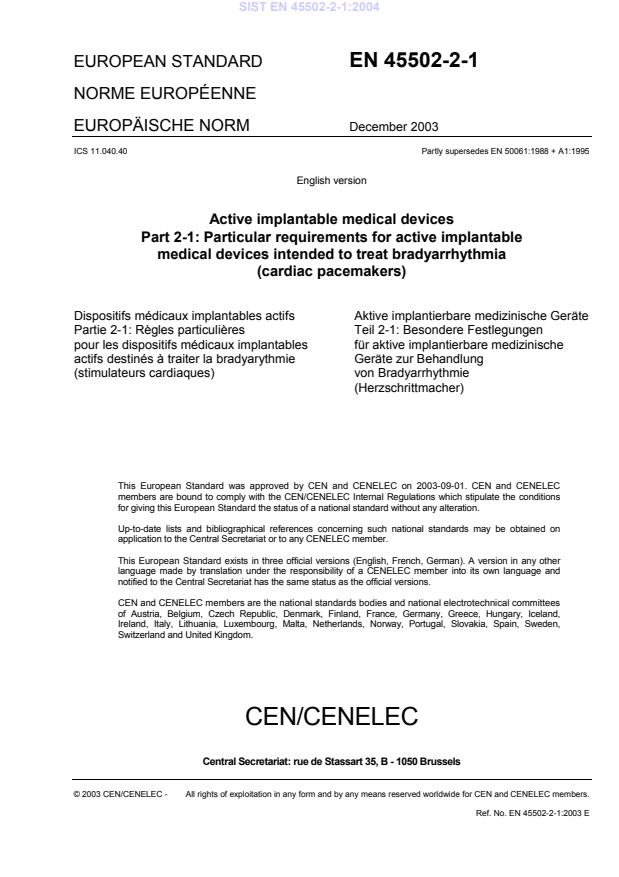
EUROPEAN STANDARD
EN 45502-2-1 NORME EUROPÉENNE EUROPÄISCHE NORM
December 2003 CEN/CENELEC
Central Secretariat: rue de Stassart 35, B - 1050 Brussels
© 2003 CEN/CENELEC - All rights of exploitation in any form and by any means reserved worldwide for CEN and CENELEC members.
Ref. No. EN 45502-2-1:2003 E
ICS 11.040.40 Partly supersedes EN 50061:1988 + A1:1995
English version
Active implantable medical devices Part 2-1: Particular requirements for active implantable
medical devices intended to treat bradyarrhythmia
(cardiac pacemakers)
Dispositifs médicaux implantables actifs Partie 2-1: Règles particulières
pour les dispositifs médicaux implantables actifs destinés à traiter la bradyarythmie (stimulateurs cardiaques)
Aktive implantierbare medizinische GeräteTeil 2-1: Besondere Festlegungen
für aktive implantierbare medizinische Geräte zur Behandlung
von Bradyarrhythmie
(Herzschrittmacher)
This European Standard was approved by CEN and CENELEC on 2003-09-01. CEN and CENELEC members are bound to comply with the CEN/CENELEC Internal Regulations which stipulate the conditions for giving this European Standard the status of a national standard without any alteration.
Up-to-date lists and bibliographical references concerning such national standards may be obtained on application to the Central Secretariat or to any CENELEC member.
This European Standard exists in three official versions (English, French, German). A version in any other language made by translation under the responsibility of a CENELEC member into its own language and notified to the Central Secretariat has the same status as the official versions.
CEN and CENELEC members are the national standards bodies and national electrotechnical committees of Austria, Belgium, Czech Republic, Denmark, Finland, France, Germany, Greece, Hungary, Iceland, Ireland, Italy, Lithuania, Luxembourg, Malta, Netherlands, Norway, Portugal, Slovakia, Spain, Sweden, Switzerland and United Kingdom.
– 3 – EN 45502-2-1:2003 Contents Page Introduction.7 1 Scope.8 2 Normative references.8 3 Definitions.9 4 Symbols and abbreviations (optional).13 5 General requirements for non-implantable parts.13 6 Measurement of implantable pulse generator and lead characteristics.13 7 General arrangement of the packaging.28 8 General markings for active implantable medical devices.28 9 Markings on the sales packaging.28 10 Construction of the sales packaging.29 11 Markings on the sterile pack.29 12 Construction of the non-reusable pack.30 13 Markings on the active implantable medical device.31 14 Protection from unintentional biological effects being caused by the active implantable
medical device.32 15 Protection from harm to the patient or user caused by external physical features of the
active implantable medical device.32 16 Protection from harm to the patient caused by electricity.32 17 Protection from harm to the patient caused by heat.33 18 Protection from ionizing radiation released or emitted from the active implantable medical
device.33 19 Protection from unintended effects caused by the device.34 20 Protection of the device from damage caused by external defibrillators.35 21 Protection of the device from changes caused by high power electrical fields applied
directly to the patient.35 22 Protection of the active implantable medical device from changes caused by miscellaneous
medical treatments.35 23 Protection of the active implantable medical device from mechanical forces.36 24 Protection of the active implantable medical device from damage caused by electrostatic
discharge.40 25 Protection of the active implantable medical device from damage caused by atmospheric
pressure changes.40 26 Protection of the active implantable medical device from damage caused by temperature
changes.40 SIST EN 45502-2-1:2004
radiation.40 28 Accompanying documentation.56
Annex AA (informative) Table of cross-references from 90/385/EEC to EN 45502-2-1.61 Annex BB (informative) Relationship between the clauses of EN 45502−2-1 and the essential
requirements of 90/385/EEC listed in Annex AA.72 Annex CC (informative) Notes on EN 45502-2-1.74 Annex DD (informative) Code for describing modes of implantable pulse generators.84 Annex EE (informative) Symbols.88 AnnexFF (normative) Pulse forms.89 Annex GG (normative) Interface circuits.90 Annex HH (informative) Selection of capacitor CX.93 Annex II (normative) Calibration of the injection network, Figure GG.104.94 Figures Figure 101 - Measurement of pulse amplitude, pulse duration, pulse interval and pulse rate.15 Figure 102 - Sensitivity measurement.16 Figure 103 - Input impedance measurement.16 Figure 104 - Escape interval measurement.17 Figure 105 - Initial oscilloscope display, when measuring the escape interval.18 Figure 106 - Measurement of escape interval (te) in inhibited mode.18 Figure 107 - Measurements of escape interval (te) in triggered (synchronised) mode.18 Figure 108 - Refractory period measurement.19 Figure 109 - Initial oscilloscope display when measuring sensing and pacing refractory period.19 Figure 110 - Measurement of sensing refractory period in inhibited mode - A.20 Figure 111 - Measurement of sensing refractory period in Inhibited mode - B.20 Figure 112 - Measurement of sensing refractory period in triggered
(synchronous) mode - A.20 Figure 113 - Measurement of sensing refractory period in triggered (synchronous) mode - B.21 Figure 114 - Measurement of pacing refractory period in inhibited mode.21 Figure 115 - Oscilloscope display when measuring AV interval.22 Figure 116 - Post ventricular atrial refractory period (PVARP) measurement.23 Figure 117 - Initial oscilloscope display when measuring PVARP.23 Figure 118 - Oscilloscope display when measuring PVARP.23 Figure 119 - AV INTERVAL after sensing measurement.24 Figure 120 - Oscilloscope display when measuring the AV interval after sensing.24 SIST EN 45502-2-1:2004
– 5 – EN 45502-2-1:2003 Figure 121 - Determination of the lead pacing impedance of a unipolar lead.25 Figure 122 - Determination of the lead pacing impedance of a bipolar lead.26 Figure 123 - Determination of the lead sensing impedance of a unipolar lead.27 Figure 124 - Determination of the lead sensing impedance of a bipolar lead.27 Figure 125 - Test set-up for measurement of electrical neutrality.33 Figure 126 - Test set-up for proof protection from high frequency currents
caused by surgical equipment.35 Figure 127 - Conductor flex test fixture.38 Figure 128 - Connector flex test fixture.39 Figure 129 - Test signal 2.42 Figure 130 - Test set-up for measurement of induced current flow.42 Figure 131 - Connection to a single channel unipolar pulse generator.43 Figure 132 - Connection to a multichannel unipolar pulse generator.43 Figure 133 - Common mode connection to single channel bipolar pulse generator.43 Figure 134 - Differential mode connection to single channel bipolar pulse generator.43 Figure 135 - Common mode connection to multichannel bipolar pulse generator.44 Figure 136 - Differential mode connection to multichannel bipolar pulse generator.44 Figure 137 - Test set-up to check for induced malfunction.45 Figure 138 - Connection to a single channel unipolar pulse generator.45 Figure 139 - Connection to a multichannel unipolar pulse generator.46 Figure 140 - Common mode connection to a single channel bipolar pulse generator.46 Figure 141 - Differential mode connection to a single channel bipolar pulse generator.46 Figure 142 - Common mode connection to a multi channel bipolar pulse generator.47 Figure 143 - Differential mode connection to a multi channel bipolar pulse generator.47 Figure 144 - Test set-up to characterise performance while subject to interference.48 Figure 145 - Test signal for frequencies in the range 16,6 Hz - 150 kHz.49 Figure 146 - Test signal for frequencies 150 kHz - 450 MHz.51 Figure 147 – Test set-up to check for malfunction at high frequency.52 Figure 148 - Connection to a unipolar pulse generator.52 Figure 149 - Connection to a bipolar pulse generator.53 Figure 150 - Test set-up for magnetostatic measurements.54 Figure 151 - Loop configuration for varying magnetic field test.55 Figure CC.101 - Measurement of x.74 Figure CC.102 - Reference test coil.78 Figure FF.101 - Measurement of pulse duration.89 SIST EN 45502-2-1:2004
the exact determination of
sensitivity (sensing threshold).89 Figure GG.101 - Tissue equivalent interface circuit for current measurements.90 Figure GG.102 - Tissue equivalent interface circuit to check for malfunction.90 Figure GG.103 - Low pass filter used to attenuate the 500 kHz component of the test signal.91 Figure GG.104 - Injection network.91 Figure HH.101 - Test to check for spurious low frequency
noise and to determine the value of CX.93 Tables Table 101 - Overall measurement accuracy limits.14 Table 102 - Overall measurement accuracy limits.25 Table 103 - Settings for determining the projected service life.34 Table 104 - Spurious injection current limits.44 Table 105 - Peak to peak amplitudes Vpp in the range 16,6 Hz to 150 kHz.50 Table 106 - Peak to peak amplitudes Vpp in the range 150 kHz to 10 MHz.51 Table 107 - Sinusoidally modulated magnetic field strengths.55 Table AA.1 .61 Table BB.1 .72 Table DD.101 - Basic mode code scheme.84 Table DD.102 - Examples of mode code.85 Table EE.101 - Conventional symbols.88 Table GG.101 - Component values for Figure GG.101.92 Table GG.102 - Component values for Figure GG.102.92 Table GG.103 - Component values for Figure GG.103.92 Table GG.104 - Component values for Figure GG.104.92 Table II.101 – Calibration signal amplitude.95
– 7 – EN 45502-2-1:2003 Introduction This Part 2-1 specifies particular requirements for those ACTIVE IMPLANTABLE MEDICAL DEVICES intended to treat bradyarrhythmias (PACEMAKERS), to provide basic assurance of safety to both patients and users. An implantable cardiac PACEMAKER is essentially a powered electronic device within a sealed, encapsulating enclosure (an IMPLANTABLE PULSE GENERATOR). The device can stimulate heart beats by generating electrical impulses which are transmitted to the heart along implanted, insulated conductors with ELECTRODES (LEADS). The PACEMAKER may be adjusted non-invasively by an electronic device, known as a programmer. This Part 2-1 is relevant to all parts of implantable PACEMAKERS, including all accessories. Typical examples are IMPLANTABLE PULSE GENERATORS, LEADS, ADAPTORS, pro-grammers and the related software. The requirements of this Part 2-1 supplement or modify those of EN 45502-1:1997, Active implantable medical devices—Part 1: General requirements for safety, marking and information to be provided by the manufacturer, hereinafter referred to as Part 1. The requirements of this Part 2-1 take priority over those of Part 1. Figures or tables that are additional to those of Part 1 are numbered starting from 101; additional annexes are lettered AA, BB, etc. Although both this Part 2-1 and the Directive 90/385/EEC deal with the same products, the structure and purpose of the two documents are different. Annex AA of this Part 2-1 correlates the requirements of the Directive with the subclauses of EN 45502-1:1997 and this Part 2-1. Annex BB provides reference in the other direction, from this European Standard to the Directive. Annex CC is a rationale providing further explanation of the subclauses of this Part 2-1. Annex DD describes a coding system that may be used to designate bradyarrhythmia pacing modes. Annex EE provides optional symbols that may be used to reduce the need for translation of MARKINGS and information in the accompanying documentation in multiple languages. Annex FF defines reference points for measurements of PULSE AMPLITUDE and PULSE DURATION, and the form of test signal used to determine SENSITIVITY. Annex GG defines the tissue equivalent interface circuits, signal injection network and low pass filter required for some compliance tests. Annex HH describes a method for selecting the filter capacitor used in the tissue equivalent interface circuits defined by Annex GG. Annex II defines the method of calibrating the injection network defined by Annex GG.
All annexes except Annex FF, GG and II are informative. SIST EN 45502-2-1:2004
The tests that are specified in EN 45502 are type tests, and are to be carried out on samples of a device to show compliance. This Part 2-1 is also applicable to some non-implantable parts and accessories of the devices (see Note 1).
The characteristics of the IMPLANTABLE PULSE GENERATOR or LEAD shall be determined by either the appropriate method detailed in this Part 2-1 or by any other method demonstrated to have an accuracy equal to, or better than, the method specified. In the case of dispute, the method detailed in this Part 2-1 shall apply. Any features of an ACTIVE IMPLANTABLE MEDICAL DEVICE intended to treat tachyarrhythmias are covered by EN 45502–2-2. NOTE 1 The device that is commonly referred to as an active implantable medical device may in fact be a single device, a combination of devices, or a combination of a device or devices and one or more accessories. Not all of these parts are required to be either partially or totally implantable, but there is a need to specify some requirements of non-implantable parts and accessories if they could affect the safety or performance of the implantable device. NOTE 2 The terminology used in this European Standard is intended to be consistent with the terminology of Directive 90/385/EEC. NOTE 3 In this European Standard, terms printed in small capital letters are used as defined in Clause 3. Where a defined term is used as a qualifier in another term, it is not printed in small capital letters unless the concept thus qualified is also defined. 2 Normative references This clause of Part 1 applies except as follows. Additional references: EN 28601:1992 Data elements and interchange formats – Information interchange –Representation of dates and times (ISO 8601:1988 + technical corrigendum 1:1991) EN 45502-1:1997 Active implantable medical devices - Part 1: General requirements for safety, marking and information to be provided by the manufacturer
EN 45502-2-2 1) Active implantable medical devices – Part 2-2: Particular requirements for active implantable medical devices intended to treat tachyarrhythmia (includes implantable defibrillators) EN 60068–2–27:1993 Basic environmental testing procedures – Part 2: Tests – Test Ea and guidance: Shock (IEC 60068–2–27:1987)
1) At draft stage. SIST EN 45502-2-1:2004
– 9 – EN 45502-2-1:2003 EN 60068–2–47:1999 Environmental testing – Part 2-47: Test methods – Mounting of components, equipment and other articles for vibration, impact and similar dynamic tests (IEC 60068-2-47:1999) EN 60068–2–64:1994 Environmental testing – Part 2: Test methods – Test Fh: Vibration, broad-band random (digital control) and guidance
(IEC 60068-2-64:1993 + corr. Oct. 1993)
ISO 5841-3:1992 Low profile connectors (IS1) for implantable pacemakers
ISO 11318:1993 Cardiac defibrillators – Connector assembly DF-1 for implantable defibrillators – Dimensions and test requirements
ANSI/AAMI PC69-2000 Active implantable medical devices – Electromagnetic compatibility – EMC test protocols for implantable cardiac pacemakers and implantable cardioverter defibrillators 3 Definitions
This clause of Part 1 applies.
Additional definitions:
3.3.1 implantable pulse generator (IPG) part of the ACTIVE IMPLANTABLE MEDICAL DEVICE, including the power supply and electronic circuit, that produces an electrical output NOTE For purposes of this Part 2-1, the term implantable pulse generator describes any ACTIVE IMPLANTABLE MEDICAL DEVICE that incorporates functions intended to treat bradyarrhythmias. 3.3.2 pacemaker ACTIVE IMPLANTABLE MEDICAL DEVICE intended to treat bradyarrhythmias, comprising an IMPLANTABLE PULSE GENERATOR and LEAD(S) 3.3.3 sensor special part of a PACEMAKER that is designed to detect signals for the purpose of RATE MODULATION or other control purposes 3.3.4 terminal electrically separate conductive device connection 3.3.5 adaptor special connector used between an otherwise incompatible IMPLANTABLE PULSE GENERATOR and a LEAD 3.3.6 pulse electrical output of an IMPLANTABLE PULSE GENERATOR intended to stimulate the myocardium SIST EN 45502-2-1:2004
– 11 – EN 45502-2-1:2003 3.3.19 rate modulation altering of the PULSE RATE as a function of a control parameter other than a sensed BEAT 3.3.20 test pulse rate PULSE RATE of an IMPLANTABLE PULSE GENERATOR when directly influenced by a testing device 3.3.21 input impedance; Zin (of an IMPLANTABLE PULSE GENERATOR) electrical impedance presented at an input TERMINAL [see 6.1.3] and taken as equal to the electrical loading presented to a sensed BEAT 3.3.22 sensitivity; sensing threshold minimum signal required to control consistently the function of the IMPLANTABLE PULSE GENERATOR [see 6.1.2] 3.3.23 refractory period period during which an IMPLANTABLE PULSE GENERATOR will not respond to a BEAT [see 6.1.5 and 6.1.6] 3.5.1 electrode electrically conducting part (usually the termination of a LEAD) which is designed to form an interface with body tissue or body fluid 3.5.2 unipolar lead LEAD with one ELECTRODE 3.5.3 bipolar lead LEAD with two ELECTRODES that are electrically isolated from each other 3.5.4 endocardial lead LEAD with an ELECTRODE designed to make a contact with the endocardium, or inner surface of the heart. [cf. epicardial lead, a LEAD with an ELECTRODE designed to make a contact with the epicardium, or outer surface of the heart.] 3.5.5 insertion diameter (of a lead) minimum bore of a rigid cylindrical tube into which the LEAD (not including the connector) may be inserted 3.5.6 lead conductor resistance, Rc ohmic resistance between the ELECTRODE and the corresponding lead connector TERMINAL [see 6.2.1] 3.5.7 lead pacing impedance; Zp impedance that is formed by the ratio of a voltage PULSE to the resulting current [see 6.2.2]. The impedance is composed of the ELECTRODE/tissue interface and the LEAD CONDUCTOR RESISTANCE 3.5.8 lead sensing impedance; Zs source impedance of a LEAD as seen by an IMPLANTABLE PULSE GENERATOR [see 6.2.3] SIST EN 45502-2-1:2004
– 13 – EN 45502-2-1:2003 3.21.2 transvenous approach to the heart through the venous system. 3.21.3 dual-chamber (adj.) relating both to the atrium and ventricle 4 Symbols and abbreviations (optional) This clause of Part 1 applies. Additional note:
NOTE See informative Annex EE for optional symbols for use in expressing information so as to reduce the need for the use of multiple languages on packaging and manuals. 5 General requirements for non-implantable parts This clause of Part 1 applies.
6 (Vacant)
Delete and replace as follows: 6 Measurement of IMPLANTABLE PULSE GENERATOR and LEAD characteristics 6.1 Measurement of IMPLANTABLE PULSE GENERATOR characteristics The values of the electrical characteristics for the IMPLANTABLE PULSE GENERATOR measured in accordance with the methods described in this clause shall be within the range of values stated by the manufacturer in the accompanying documentation [see 28.8] The procedures shall be performed with the IMPLANTABLE PULSE GENERATOR at a temperature of 37 ºC ± 2 ºC, connected to a load of 500 Ω ± 1 % and set to the nominal settings recommended by the manufacturer (the factory recommended settings), unless otherwise stated. SIST EN 45502-2-1:2004
PULSE AMPLITUDE (6.1.1) ± 5 %
PULSE DURATION (6.1.1) ± 5 %
PULSE INTERVAL/TEST PULSE INTERVAL (6.1.1) ± 0,2 %
PULSE RATE/TEST PULSE RATE (6.1.1) ± 0,5 %
SENSITIVITY (6.1.2) ± 10 %
INPUT IMPEDANCE (6.1.3) if < 1 MΩ ± 10 %
ESCAPE INTERVAL (6.1.4) ± 10 %
REFRACTORY PERIOD (6.1.5, 6.1.6, and 6.1.8) ± 10 %
AV INTERVAL (6.1.7 and 6.1.9) ± 5 % NOTE Information about INPUT IMPEDANCE is always required. However above 1 MΩ, the 10 % accuracy tolerance is relaxed because the INPUT IMPEDANCE will be much greater than the source impedance presented by the LEAD. If the IMPLANTABLE PULSE GENERATOR has DUAL-CHAMBER functions, the atrial and ventricular characteristics shall be determined separately. For simplicity, all the measurement procedures shown show bipolar IMPLANTABLE PULSE GENERATORS. For unipolar IMPLANTABLE PULSE GENERATORS, the case is properly incorporated in the setup as the indifferent TERMINAL 6.1.1 Measurement of pulse amplitude, pulse duration, pulse rate, and pulse interval Procedure:
Use an interval counter and an oscilloscope.
The IMPLANTABLE PULSE GENERATOR shall be connected to a 500 Ω ± 1 % load resistor (RL) and the test equipment as shown in Figure 101. The oscilloscope shall be adjusted to display one PULSE in full. The PULSE DURATION (D) shall be measured between the points on the PULSE equal to one-third of the peak PULSE AMPLITUDE (Amax) [see Figure FF.101]. The PULSE AMPLITUDE (A) shall be calculated from the time integral over current or voltage, as appropriate, divided by the PULSE DURATION [see Figure FF.102]. The PULSE RATE shall be calculated from the mean interval over at least 20 PULSES. SIST EN 45502-2-1:2004
– 15 – EN 45502-2-1:2003
OscilloscopeChannel 1 Channel 2 Trigger B A RLInterval counter Pulse generator
Figure 101 - Measurement of PULSE AMPLITUDE, PULSE DURATION,
PULSE INTERVAL and PULSE RATE
The PULSE INTERVAL (tp) shall be recorded from the display on the interval counter when set to trigger on the leading edge of each PULSE.
The procedures shall be repeated with load resistors RL of 240 Ω ± 1 % and 1 kΩ ± 1 % to determine any changes in the values as functions of load resistance. The results shall be expressed in the following units:
• PULSE DURATION: milliseconds (ms);
• PULSE AMPLITUDE: volts or milliamperes (V or mA);
• PULSE INTERVAL: milliseconds (ms);
• PULSE RATE: reciprocal minutes (min-1 ). s NOTE Whenever the result is recorded, the operating settings of the IMPLANTABLE PULSE GENERATOR (e.g., programmed pulse rate, etc.) shall also be noted. 6.1.2 Measurement of sensitivity (sensing threshold) (epos and eneg) Procedure:
Use an oscilloscope, nominal input impedance 1 MΩ, and a test signal generator, output impedance ≤ 1 kΩ, that provides a signal in the form defined by Figure FF.103. The IMPLANTABLE PULSE GENERATOR shall be connected to a 500 Ω ± 1 % load resistor (RL) and the test equipment as shown in Figure 102. Apply positive polarity test signals from the test signal generator to point A through a 100 kΩ ± 1 % feed resistor (RF). Adjust the PULSE INTERVAL of the test signal generator so that it is at least 50 ms less than the BASIC PULSE INTERVAL of the IMPLANTABLE PULSE GENERATOR. The test signal amplitude shall be adjusted to zero, and the oscilloscope shall be adjusted to display several PULSEs. The test signal amplitude shall be slowly increased until either: for an inhibited mode IMPLANTABLE PULSE GENERATOR, the PULSE shall be consistently suppressed; or, for a triggered mode IMPLANTABLE PULSE GENERATOR, the PULSE always occurs synchronously with the test signal. The test signal amplitude shall then be measured. The positive SENSITIVITY (epos) shall be calculated by dividing the measured test signal voltage by 201. SIST EN 45502-2-1:2004
OscilloscopeChannel 1 Channel 2 Trigger RFB A signal Test generator RLPulse generator
Figure 102 - Sensitivity measurement The procedure shall be repeated with negative polarity test signals applied at point A and the negative SENSITIVITY (eneg) shall be similarly calculated. 6.1.3 Measurement of input impedance (Zin)
Procedure:
Use an oscilloscope, nominal input impedance 1 MΩ, and a test signal generator, output impedance ≤ 1 kΩ, that provides a signal in the form defined by Figure FF.103.
OscilloscopeChannel 1 Channel 2 Trigger RFS R1RLPulse generator A signal Test generator B
Figure 103 - Input impedance measurement
The IMPLANTABLE PULSE GENERATOR shall be connected to 500 Ω ± 1 % load resistors (RL) and the test equipment as shown in Figure 103. Apply test signals of either polarity from the test signal generator through series feed resistors R1 and RF to point A. R1 shall be chosen to have a resistance of the same order of magnitude as the expected INPUT IMPEDANCE of the IMPLANTABLE PULSE GENERATOR (e.g. 10 kΩ, 100 kΩ etc.), and R1 shall be known to within ± 1 %. RF shall be 100 kΩ ± 1 %. Adjust the PULSE INTERVAL of the test signal generator so that it is at least 50 ms less than the BASIC PULSE INTERVAL of the IMPLANTABLE PULSE GENERATOR. The test signal amplitude shall be adjusted to zero, and the oscilloscope shall be adjusted to display several PULSES. The switch, S, shall be closed, bypassing R1, and the test signal amplitude adjusted from zero up to that value at which the IMPLANTABLE PULSE GENERATOR consistently either just inhibits or triggers, whichever is appropriate. The test signal amplitude shall be measured and designated V1. SIST EN 45502-2-1:2004
– 17 – EN 45502-2-1:2003 The switch, S, shall be opened and the test signal amplitude shall be re-adjusted until the IMPLANTABLE PULSE GENERATOR again just consistently either inhibits or triggers, as before.
The test signal amplitude shall be measured again and designated V2. The INPUT IMPEDANCE, Zin , of the IMPLANTABLE PULSE GENERATOR shall be calculated according to the equations: ZRVVVZRZRZinSS=−−=−1121∗,∗05 where RS is the input impedance of channel 2 of the oscilloscope. The result shall be expressed in kilo-ohms (kΩ). 6.1.4 Measurement of ESCAPE INTERVAL (te) Procedure:
Use an oscilloscope and a triggerable test PULSE signal generator. The IMPLANTABLE PULSE GENERATOR shall be connected to a 500 Ω ± 1 % load resistor (RL) and the test equipment as shown in Figure 104. Apply the test signal through the series feed resistor (RF) to point A. RF shall be 100 kΩ ± 1 %.
OscilloscopeChannel 1 Channel 2 Trigger Trigger input Test pulse signal generator RRLPulse generator B A
Figure 104 - ESCAPE INTERVAL measurement The test signal generator shall be adjusted until the amplitude of the test signal is approximately twice the positive SENSITIVITY as determined according to 6.1.2. The test signal generator shall be adjusted to provide a single PULSE with delay t between being triggered and generating the PULSE, where t is between 5 % and 10 % greater than the BASIC PULSE INTERVAL (tp) of the IMPLANTABLE PULSE GENERATOR. SIST EN 45502-2-1:2004
PULSES fromIMPLANTABLEPULSEGENERATORChannel 1Channel 2Test signaltteREFRACTORYPERIOD Figure 107 - Measurements of ESCAPE INTERVAL (te) in triggered (synchronised) mode Measure the time between the test signal (or the output that is triggered by the test signal) and the next output PULSE. This is the ESCAPE INTERVAL (te).
The result shall be expressed in milliseconds (ms).
– 19 – EN 45502-2-1:2003 6.1.5 Measurement of sensing refractory period (tsr)
Procedure:
Use an oscilloscope and a triggerable double PULSE test signal generator. The IMPLANTABLE PULSE GENERATOR shall be connected to a 500 Ω ± 1 % load resistor(RL) and the test equipment as shown in Figure 108. Apply the test signal through the series feed resistor (RF) to point A. RF shall be 100 kΩ ± 1 %.
OscilloscopeChannel 1 Channel 2 Trigger Double test signal generator RFRLTrigger input Pulse generator B A
Figure 108 - REFRACTORY PERIOD measurement The test signal generator shall be adjusted until the amplitude of the test signal is approximately twice the positive SENSITIVITY as determined in 6.1.2. The test signal generator shall be adjusted to provide a delay t1 between being triggered and generating the test signal, where t1 is between 5 % and 10 % greater than the BASIC PULSE INTERVAL of the IMPLANTABLE PULSE GENERATOR.
The test signal generator shall be set so that the test signal is in the form of a double-PULSE with a small separation s between the leading edges of the two components of the test signal [see Figure 109].
tpPULSES fromIMPLANTABLEPULSEGENERATORChannel 1Channel 2Test signal 1Test signal 2t1REFRACTORYPERIODt2s Figure 109 - Initial oscilloscope display when measuring sensing and pacing REFRACTORY PERIOD
The delay t1 of the test signal shall be reduced (keeping s constant) until test signal 1 is sensed by the IMPLANTABLE PULSE GENERATOR.
Then, in the case of an inhibited IMPLANTABLE PULSE GENERATOR, test signal 1 causes inhibition of one PULSE from the IMPLANTABLE PULSE GENERATOR [see Figure 110]. Then keeping t1 constant, t2 shall be increased until test signal 2 in Figure 110 is delayed as shown in Figure 111. The second PULSE in Figure 111 is displaced from test signal 2 by the ESCAPE INTERVAL (te).
PULSES fromIMPLANTABLEPULSEGENERATORChannel 1Channel 2Test signal 1Test signal 2tsrt2t1teREFRACTORYPERIODtp Figure 111 - Measurement of sensing REFRACTORY PERIOD in Inhibited mode - B In the case of a triggered IMPLANTABLE PULSE GENERATOR, sensin
...
Questions, Comments and Discussion
Ask us and Technical Secretary will try to provide an answer. You can facilitate discussion about the standard in here.
Loading comments...