

SIST EN 60371-3-6:1998
(Main)Specification for insulating materials based on mica -- Part 3: Specifications for individual materials -- Sheet 6: Glass-backed mica paper with a B-stage epoxy resin binder
- Abstract
Gives requirements for materials made by combining mica paper with glass fabric and impregnating the mica paper with an epoxy resin. The material is supplied in a flexible state for final cure after application in the form of sheets or rolls.
- Status
- Published
- Publication Date
- 31-May-1998
- Technical Committee
- IZO - Insulating materials
- Current Stage
- 6060 - National Implementation/Publication (Adopted Project)
- Start Date
- 01-Jun-1998
- Due Date
- 01-Jun-1998
- Completion Date
- 01-Jun-1998

SIST EN 60371-3-6:1998 is a SIST standard for glass-backed mica paper with a B-stage epoxy resin binder, within the IEC series on mica-based insulating materials. It specifies the material’s composition, delivery condition, cured properties and packing for electrical insulating use. Engineers, quality managers and buyers use it to define and check sheet or roll material before and after final cure.
What does SIST EN 60371-3-6:1998 specify?
SIST EN 60371-3-6:1998 specifies electrical insulating materials made by combining mica paper with glass fabric and impregnating the mica paper with epoxy resin. The material is supplied flexible, with the resin in B-stage, so it can be finally cured after application.
The standard is organized into clauses 1 to 8. These cover scope, normative references, designation, raw materials, composition and tolerances, requirements for the material as received, requirements after curing, and packing.
What are the key requirements of SIST EN 60371-3-6:1998?
Clause 3 gives the ordering designation. A purchaser needs only the specification number and the type number, which is built from the sheet number, table number and product number. In practice, this gives a compact code for ordering and traceability.
Raw materials and composition
Clause 4 sets the starting materials. The mica paper shall meet IEC 371-3-2, the glass fabric is normally in the loom state unless buyer and seller agree otherwise, and the epoxy resin system may be any system that enables the finished material to meet the specification. Clause 5 then ties the finished composition to the limits in tables 1 and 2 for the correct mica-paper grade. This matters because the build-up of glass, mica and resin is part of the product definition, not just the finished appearance.
Material as received
Clause 6 describes the delivery condition. Materials in one consignment shall be uniform throughout the roll, with surfaces free from bubbles, pin-holes, creases and similar flaws. Rolls shall unwind continuously without damage, and any interleaving must not harm the material. For buyers, this is the incoming quality check for handling, appearance and usability.
Clause 6 also controls practical delivery details such as width, thickness, length, cores and joins. The standard points to preferred delivery formats and gives width tolerances in table 3. It also limits joins and expects their method to be agreed in the purchase contract. This matters because the material must run and process reliably in production.
Clause 6 further specifies tensile strength, stiffness and resin flow. Tensile strength is checked in warp and weft directions, stiffness is by agreement, and resin flow is measured at elevated temperature. These properties tell the user whether the material will withstand handling and behave properly during curing.
Material after curing
Clause 7 covers the properties of the cured material. When the purchaser asks for it, the supplier shall provide evidence of compliance. Test pieces are prepared using method 1 of IEC 371-2, with the number of layers chosen to give the required final thickness.
After curing, the material is checked for density, flexural strength at room and elevated temperature, elastic modulus, electric strength, dissipation factor at 48-62 Hz, and thermal endurance. In practice, this is the qualification section: it shows whether the cured insulation has the mechanical, dielectric and thermal performance needed in service.
Packing and marking
Clause 8 requires packaging that protects the material in transport, handling and storage. Packages and rolls must be marked with the material description, specification number, dimensions or quantity, date of manufacture, shelf-life and storage conditions, plus manufacturer and batch identification. That supports traceability and shelf management.
What terms does SIST EN 60371-3-6:1998 define?
- B-stage - A partially cured resin state that keeps the material flexible until the final cure after application.
- Mica paper - The mica-based sheet material used as the insulating core in this product.
- Glass fabric - The glass reinforcement combined with the mica paper to improve mechanical support.
- Type number - The ordering code that identifies a specific product build within the sheet.
- Resin flow - The measured movement of the resin under the specified hot test, used to judge curing behavior.
- Dissipation factor - The dielectric loss characteristic measured after curing at 48-62 Hz.
- Thermal endurance - The temperature index based on retention of flexural strength during aging.
Who uses SIST EN 60371-3-6:1998?
Manufacturers of mica-based insulating materials use SIST EN 60371-3-6:1998 to design the product build and control production. Buyers and procurement teams use it to specify the exact sheet or roll type they want. Quality managers and test laboratories use it for incoming inspection, type testing and cured-property verification. It is relevant wherever a flexible mica-glass insulating material is supplied for final cure after application.
What changed in SIST EN 60371-3-6:1998 from the previous edition?
SIST EN 60371-3-6:1998 is identical to EN 60371-3-6:1995 and corresponds to IEC 60371-3-6:1992.
Which standards are used with SIST EN 60371-3-6:1998?
- IEC 243-1 - Provides the electrode arrangement used for electric strength testing.
- IEC 371-2 - Provides the test methods for thickness, tensile strength, stiffness, resin flow, density, flexural strength, electric strength, dissipation factor and thermal endurance.
- IEC 371-3-2 - Defines the mica paper grades used for the composition requirements.
What does the SIST EN 60371-3-6:1998 document contain?
The document contains composition tables for different mica-paper grades, a width tolerance table, a tensile strength table and dissipation-factor limits by temperature. It also gives the designation system for ordering, the delivery-condition checks, the cured-property test framework and the packing and marking instructions. For users, the most practical parts are the tables and test clauses, because they link procurement, inspection and qualification to one material specification.
Relations
- Effective Date
- 03-Feb-2026
- Effective Date
- 03-Feb-2026
- Effective Date
- 03-Feb-2026
- Effective Date
- 01-Nov-2007
Get Certified
Connect with accredited certification bodies for this standard

IMQ S.p.A. (Certification)
Italian electrical product certification.

SLG Prüf- und Zertifizierungs GmbH
German testing and certification body.

UL Solutions
Global safety science company with testing, inspection and certification.
Sponsored listings
Frequently Asked Questions
SIST EN 60371-3-6:1998 is a standard published by the Slovenian Institute for Standardization (SIST). Its full title is "Specification for insulating materials based on mica -- Part 3: Specifications for individual materials -- Sheet 6: Glass-backed mica paper with a B-stage epoxy resin binder". This standard covers: Gives requirements for materials made by combining mica paper with glass fabric and impregnating the mica paper with an epoxy resin. The material is supplied in a flexible state for final cure after application in the form of sheets or rolls.
Gives requirements for materials made by combining mica paper with glass fabric and impregnating the mica paper with an epoxy resin. The material is supplied in a flexible state for final cure after application in the form of sheets or rolls.
SIST EN 60371-3-6:1998 is classified under the following ICS (International Classification for Standards) categories: 29.035.50 - Mica based materials. The ICS classification helps identify the subject area and facilitates finding related standards.
SIST EN 60371-3-6:1998 has the following relationships with other standards: It is inter standard links to SIST EN 60371-2:1998, SIST EN 60371-3-2:1998, SIST EN IEC 60626-1:2024, SIST EN 60371-3-6:1998/A1:2007. Understanding these relationships helps ensure you are using the most current and applicable version of the standard.
SIST EN 60371-3-6:1998 is available in PDF format for immediate download after purchase. The document can be added to your cart and obtained through the secure checkout process. Digital delivery ensures instant access to the complete standard document.
Standards Content (Sample)
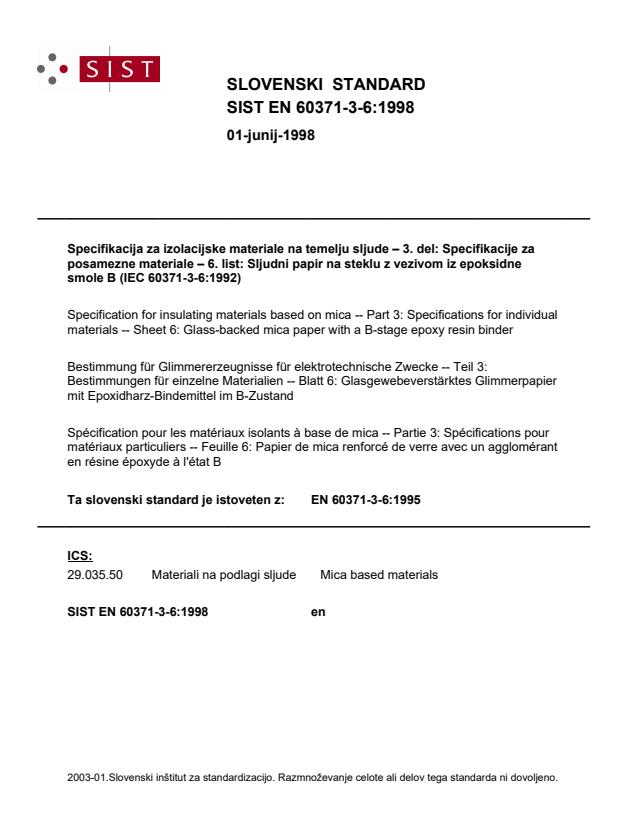
2003-01.Slovenski inštitut za standardizacijo. Razmnoževanje celote ali delov tega standarda ni dovoljeno.Specifikacija za izolacijske materiale na temelju sljude – 3. del: Specifikacije za posamezne materiale – 6. list: Sljudni papir na steklu z vezivom iz epoksidne smole B (IEC 60371-3-6:1992)Bestimmung für Glimmererzeugnisse für elektrotechnische Zwecke -- Teil 3: Bestimmungen für einzelne Materialien -- Blatt 6: Glasgewebeverstärktes Glimmerpapier mit Epoxidharz-Bindemittel im B-ZustandSpécification pour les matériaux isolants à base de mica -- Partie 3: Spécifications pour matériaux particuliers -- Feuille 6: Papier de mica renforcé de verre avec un agglomérant en résine époxyde à l'état BSpecification for insulating materials based on mica -- Part 3: Specifications for individual materials -- Sheet 6: Glass-backed mica paper with a B-stage epoxy resin binder29.035.50Materiali na podlagi sljudeMica based materialsICS:Ta slovenski standard je istoveten z:EN 60371-3-6:1995SIST EN 60371-3-6:1998en01-junij-1998SIST EN 60371-3-6:1998SLOVENSKI
STANDARD
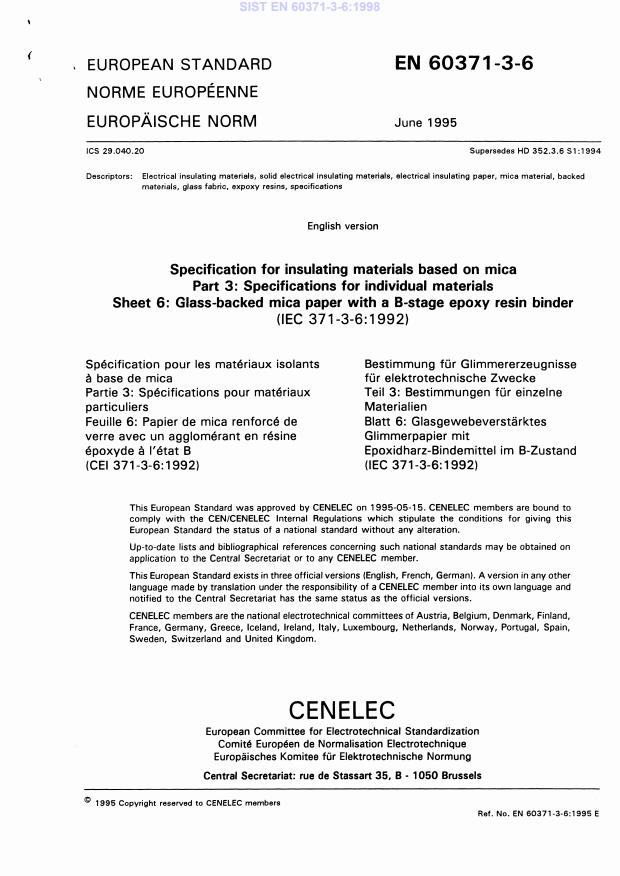
CODE PRIXPRICE CODELNORMECEIINTERNATIONALEIECINTERNATIONAL60371-3-6STAN DARDPremière éditionFirst edition1992-11Spécification pour les matériaux isolantsà base de micaTroisième partie:Spécifications pour matériaux particuliersFeuille 6: Papier de mica renforcé de verre avecun agglomérant en résine époxyde à l'état BSpecification for insulating materialsbased on micaPart 3:Specifications for individual materialsSheet 6: Glass-backed mica paper witha B-stage epoxy resin binder© IEC 1992 Droits de reproduction réservés — Copyright - all rights reservedAucune partie de cette publication ne peut être reproduite niNo part of this publication may be reproduced or utilized inutilisée sous quelque forme que ce soit et par aucunany form or by any means, electronic or mechanical,procédé, électronique ou mécanique, y compris la photo-including photocopying and microfilm, without permission incopie et les microfilms, sans l'accord écrit de l'éditeur.writing from the publisher.International Electrotechnical Commission3, rue de Varembé Geneva, SwitzerlandTelefax: +41 22 919 0300e-mail: inmail@iec.chIEC web site http: //www.iec.chCommission Electrotechnique InternationaleInternational Electrotechnical CommissionMemigyHapoiniaR 311eKTp0TexHH4eCHÜH KOMHCCHAPour prix, voir catalogue en vigueur•For price, see current catalogueIEC•SIST EN 60371-3-6:1998
371-3-6 ©I EC– 3 –CONTENTSPageFOREWORD 5INTRODUCTION 7Clause1Scope 92Normative references 93Designation 94Requirements: raw materials 135Requirements: composition and tolerances 136Requirements for material (as received)
157Requirements for material after curing 178Packing
21SIST EN 60371-3-6:1998
371-3-6 ©IEC– 5 –INTERNATIONAL ELECTROTECHNICAL COMMISSIONSPECIFICATION FOR INSULATING MATERIALS BASED ON MICAPart 3: Specifications for individual materialsSheet 6: Glass-backed mica paperwith a B-stage epoxy resin binderFOREWORD1)The formal decisions or agreements of the IEC on technical matters, prepared by Technical Committees onwhich all the National Committees having a special interest therein are represented, express, as nearly aspossible, an international consensus of opinion on the subjects dealt with.2)They have the form of recommendations for international use and they are accepted by the NationalCommittees in that sense.3)In order to promote international unification, the IEC expresses the wish that all National Committeesshould adopt the text of the IEC recommendation for their national rules in so far as national conditions willpermit. Any divergence between the IEC recommendation and the corresponding national rules should, asfar as possible, be clearly indicated in the latter.4)The IEC has not laid down any procedure concerning marking as an indication of approval and has noresponsibility when an item of equipment is declared to comply with one of its recommendations.This International Standard has been prepared by Sub-Committee 15C: Specifications, ofIEC Technical Committee No. 15: Insulating materials.The text of this standard is based on the following documents:DISReport on Voting
15C(CO)29315C(CO)318Full information on the voting for the approval of this standard can be found in the VotingReport indicated in the above table.SIST EN 60371-3-6:1998
371-3-6 ©IEC– 7 –INTRODUCTIONThis International Standard is one of a series which deals with insulating materials built upfrom mica splittings or mica paper.The series consists of three parts:Part 1: Definitions and general requirements (IEC 371-1).Part 2: Methods of test (IEC 371-2).Part 3: Specifications for individual materials (IEC 371-3).This standard contains one of the sheets comprising part 3, as follows:Sheet 6: Glass-backed mica paper with a B-stage epoxy resin binder.SIST EN 60371-3-6:1998
371-3-6 ©IEC– 9 –SPECIFICATION FOR INSULATING MATERIALS BASED ON MICAPart 3: Specifications for individual materialsSheet 6: Glass-backed mica paperwith a B-stage epoxy resin binder1 ScopeThis International Standard gives requirements for electrical insulating materials made bycombining mica paper with glass fabric and impregnating the mica paper with an epoxyresin. The material is supplied in a flexible state with the resin in the B-stage for final cureafter application. It may be supplied in the form of sheets or rolls.The specification covers material having nominal thickness from 0,09 mm to 0,28 mm.2 Normative referencesThe following normative documents contain provisions which, through reference in thistext, constitute provisions of this International Standard. At the time of publication, theeditions indicated were valid. All normative documents are subject to revision, and partiesto agreements based on this International Standard are encouraged to investigate thepossibility of applying the most recent editions of the normative documents indicatedbelow. Members of IEC and ISO maintain registers of currently valid InternationalStandards.!EC 243-1: 1988, Methods of test for electric strength of solid insulating materials - Part 1:Tests at power frequencies.IEC 371-2: 1987, Specification for insulating materials based on mica. Part 2: Methods oftest.IEC 371-3-2: 1991, Specification for insulating materials based on mica - Part 3: Specifi-cations for individual materials - Sheet 2: Mica paper.3 DesignationWhen ordering materials to this specification only the specification and type numbers needbe quoted (see tables 1 and 2).Example: IEC 371-3-6: type 6.1.01SIST EN 60371-3-6:1998
371-3-6 © I EC-11 -The type number is derived from:-the specification sheet number6-plus the sheet table number6.1plus the number of the product in the sheet table6.1.01.The descriptive code quoted in tables 1 and 2, for example G32/M75/R71 for type 6.1.01,table 1 is derived from:-glass content (G) 32 g/m2-muscovite mica content (M) 75 g/m2resin content (R) 71 g/m2.NOTE - For phiogopite mica paper the letter "M" is replaced by the letter "P" (table 2 only).Table 1 - Composition for calcinated muscovite mica paper(IEC 371-3-2, classes 1 and 2)GlassMicaResinMass/PermissibleDescriptivecontentcontentcontentunit areathickness rangeVolatilecontentTypecodeg/m2g/m2g/m2g/m2mmNom.Tol.Nom.Tol.Nom.Tol.Nom.Tol.MeanIndividualMax. %±±±±6.1.01G32/M75/R71323756719178190,12-0,150,11-0,161,06.1.02G32/M80/R71323807719183190,12-0,150,11-0,161,06.1.03G32/M90/R813239088110203210,15-0,180,14-0,191,06.1.04G32/M120/R1053231201010513257260,18-0,220,17-0,231,06.1.05G32/M150/R1203231501212015302300,20-0,240,19-0,251,06.1.06G32/M160/R1303231601313016322320,20-0,240,19-0,251,06.1.07G32/M180/R1503231801515019362370,22-0,260,21-0,271,06.1.08G32/M240/R1803232402018023452450,26-0,300,25-0,311,06.1.09G32/M250/R190323250211
...