


oSIST prEN IEC 60794-1-108:2026
(Main)Optical fibre cables - Part 1-108: Generic specification - Basic optical cable test procedures - Mechanical tests methods - Flexing, method E8
Lichtwellenleiterkabel – Teil 1-108: Fachgrundspezifikation - Grundlegende Prüfverfahren für Lichtwellenleiterkabel - Mechanische Prüfverfahren - Wechselbiegefestigkeit, Verfahren E8
Optični kabli - 1-108. del: Splošne specifikacije - Osnovni preskusni postopki za optične kable - Mehanske preskusne metode - Upogibanje, metoda E8
General Information
- Status
- Not Published
- Public Enquiry End Date
- 30-Jun-2026
- Technical Committee
- MOC - Mobile Communications
- Current Stage
- 4020 - Public enquire (PE) (Adopted Project)
- Start Date
- 15-Apr-2026
- Due Date
- 02-Sep-2026

Relations
- Effective Date
- 09-Sep-2025
- Effective Date
- 09-Sep-2025
Overview
oSIST prEN IEC 60794-1-108:2026 is an international standard developed by CLC and IEC for optical fibre cables. Specifically, it outlines basic optical cable test procedures with a focus on mechanical testing methods. This document introduces the flexing test (Method E8) to assess the durability and reliability of optical fibre cables under repeated flexing conditions.
Flexibility and mechanical endurance are essential for optical cables, especially in environments requiring repeated movement, such as elevator systems and other dynamic cable installations. The standard contributes to the uniform evaluation and comparison of different optical cable designs by providing a consistent testing framework.
Key Topics
- Scope and Application: The standard applies to optical fibre cables used in telecommunications and similar devices, including hybrid cables with both optical fibres and electrical conductors.
- Test Objective: Method E8 evaluates the ability of an optical fibre cable to withstand repeated flexing, ensuring long-term performance without structural or signal degradation.
- Apparatus and Setup: The test uses a defined setup involving pulleys, restraining clamps, weights, and (where needed) optical monitoring equipment. The configuration ensures realistic flexing forces and conditions.
- Testing Procedure:
- The cable sample is routed over specified pulleys with both ends weighted to simulate operational stress.
- The flexing process consists of a defined number of cycles at specific speeds and temperatures, with requirements detailed in the relevant specification.
- Acceptance criteria include no loss of optical continuity, no excessive attenuation, and no visible physical damage.
- Reporting Requirements: A comprehensive test report must detail the test setup, conditions, observed performance, as well as any deviations from procedures or physical damages.
Applications
The flexing test (Method E8) described in oSIST prEN IEC 60794-1-108:2026 is critical in the quality assurance process for optical fibre cables, particularly for products intended for environments involving dynamic movement, such as:
- Elevator and Lifting Systems: Where cables experience frequent flexing due to continuous vertical motion.
- Robotic and Industrial Automation: Applications with continuously moving cable tracks or articulated robotic arms.
- Transport Systems: Installations within trains, subways, or buses where cables must endure vibration and movement.
- Building Automation and Smart Infrastructure: Flexible optical cables for smart building solutions requiring repeated movement or repositioning.
Ensuring reliability in these environments reduces maintenance costs, guarantees network stability, and prevents costly downtimes due to cable failure.
Related Standards
For a comprehensive approach to optical fibre cable testing and performance, reference the following related standards:
- IEC 60793-1-46: Outlines measurement methods and test procedures for monitoring changes in attenuation, crucial during and after flex testing.
- IEC 60794-1-1: Provides the generic specifications and general definitions for optical fibres and cables.
- IEC 60794-1-2: Offers a complete reference guide and general guidance on basic optical cable test procedures.
- IEC 60794-1-21: The previous edition where Method E8 was included, now replaced by this standalone document.
Adhering to these standards ensures a harmonized approach to optical fibre cable testing, increasing confidence in mechanical performance and long-term cable reliability across global infrastructure projects.
Keywords: optical fibre cable, mechanical testing, flexing method E8, IEC 60794-1-108, cable durability, telecommunication cables, cable test procedures, optical cable reliability, cable flexibility, international standards.
Get Certified
Connect with accredited certification bodies for this standard

ANCE
Mexican certification and testing association.

Intertek Slovenia
Intertek testing, inspection, and certification services in Slovenia.

LNE (Laboratoire National de Métrologie et d'Essais)
French national laboratory for metrology and testing.
Sponsored listings
Frequently Asked Questions
oSIST prEN IEC 60794-1-108:2026 is a draft published by the Slovenian Institute for Standardization (SIST). Its full title is "Optical fibre cables - Part 1-108: Generic specification - Basic optical cable test procedures - Mechanical tests methods - Flexing, method E8". This standard covers: Optical fibre cables - Part 1-108: Generic specification - Basic optical cable test procedures - Mechanical tests methods - Flexing, method E8
Optical fibre cables - Part 1-108: Generic specification - Basic optical cable test procedures - Mechanical tests methods - Flexing, method E8
oSIST prEN IEC 60794-1-108:2026 is classified under the following ICS (International Classification for Standards) categories: 33.180.10 - Fibres and cables. The ICS classification helps identify the subject area and facilitates finding related standards.
oSIST prEN IEC 60794-1-108:2026 has the following relationships with other standards: It is inter standard links to SIST EN 60794-1-21:2015/A1:2020, SIST EN 60794-1-21:2015. Understanding these relationships helps ensure you are using the most current and applicable version of the standard.
oSIST prEN IEC 60794-1-108:2026 is available in PDF format for immediate download after purchase. The document can be added to your cart and obtained through the secure checkout process. Digital delivery ensures instant access to the complete standard document.
Standards Content (Sample)
SLOVENSKI STANDARD
01-junij-2026
Optični kabli - 1-108. del: Splošne specifikacije - Osnovni preskusni postopki za
optične kable - Mehanske preskusne metode - Upogibanje, metoda E8
Optical fibre cables - Part 1-108: Generic specification - Basic optical cable test
procedures - Mechanical tests methods - Flexing, method E8
Ta slovenski standard je istoveten z: prEN IEC 60794-1-108:2026
ICS:
33.180.10 (Optična) vlakna in kabli Fibres and cables
2003-01.Slovenski inštitut za standardizacijo. Razmnoževanje celote ali delov tega standarda ni dovoljeno.
86A/2680/CDV
COMMITTEE DRAFT FOR VOTE (CDV)
PROJECT NUMBER:
IEC 60794-1-108 ED1
DATE OF CIRCULATION: CLOSING DATE FOR VOTING:
2026-04-10 2026-07-03
SUPERSEDES DOCUMENTS:
86A/2508/CD, 86A/2676/CC
IEC SC 86A : FIBRES AND CABLES
SECRETARIAT: SECRETARY:
France Mr Laurent Gasca
OF INTEREST TO THE FOLLOWING COMMITTEES: HORIZONTAL FUNCTION(S):
ASPECTS CONCERNED:
SUBMITTED FOR CENELEC PARALLEL VOTING NOT SUBMITTED FOR CENELEC PARALLEL VOTING
Attention IEC-CENELEC parallel voting
The attention of IEC National Committees, members of
CENELEC, is drawn to the fact that this Committee Draft
for Vote (CDV) is submitted for parallel voting.
The CENELEC members are invited to vote through the
CENELEC online voting system.
This document is still under study and subject to change. It should not be used for reference purposes.
Recipients of this document are invited to submit, with their comments, notification of any relevant patent rights of
which they are aware and to provide supporting documentation.
Recipients of this document are invited to submit, with their comments, notification of any relevant “In Some Countries”
clauses to be included should this proposal proceed. Recipients are reminded that the CDV stage is the final stage for
submitting ISC clauses. (SEE AC/22/2007 OR NEW GUIDANCE DOC).
TITLE:
Optical fibre cables - Part 1-108: Generic specification - Basic optical cable test procedures -
Mechanical tests methods - Flexing, Method E8
PROPOSED STABILITY DATE: 2029
NOTE FROM TC/SC OFFICERS:
this electronic file, to make a copy and to print out the content for the sole purpose of preparing National Committee
positions. You may not copy or "mirror" the file or printed version of the document, o r any part of it, for any other
purpose without permission in writing from IEC.
IEC CDV 60794-1-108 © IEC 2026
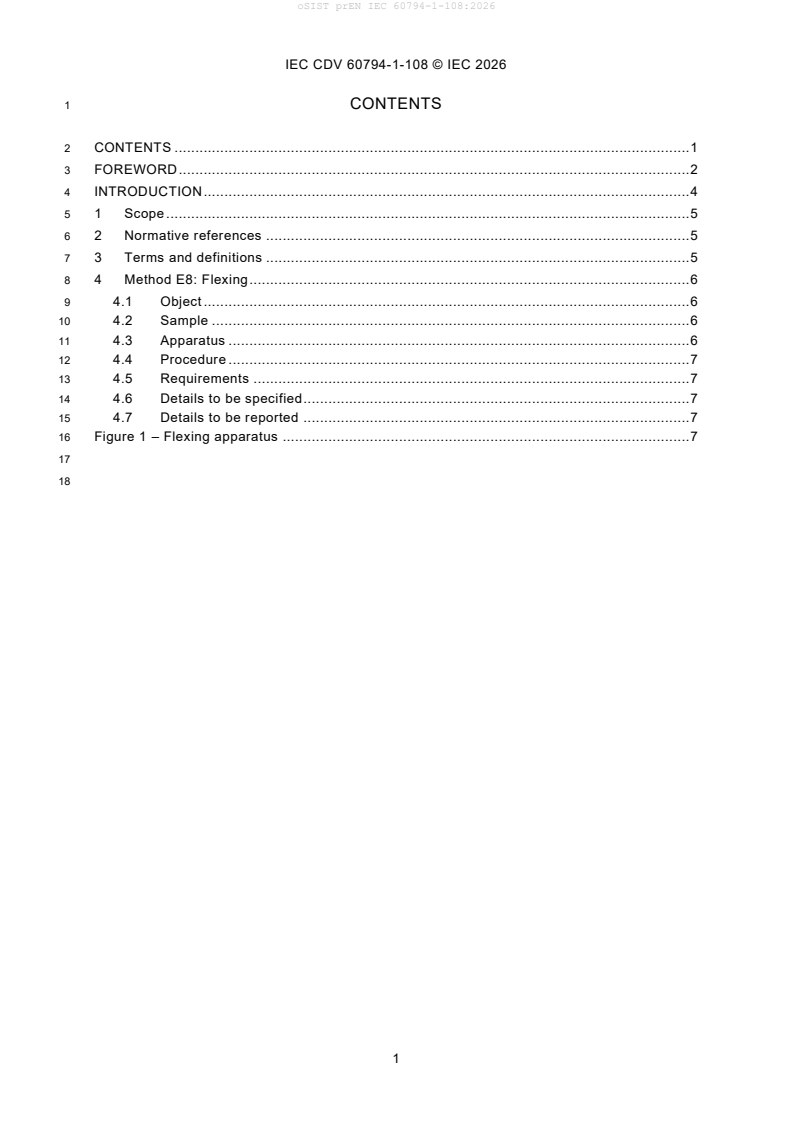
1 CONTENTS
2 CONTENTS . 1
3 FOREWORD . 2
4 INTRODUCTION . 4
5 1 Scope . 5
6 2 Normative references . 5
7 3 Terms and definitions . 5
8 4 Method E8: Flexing . 6
9 4.1 Object . 6
10 4.2 Sample . 6
11 4.3 Apparatus . 6
12 4.4 Procedure . 7
13 4.5 Requirements . 7
14 4.6 Details to be specified . 7
15 4.7 Details to be reported . 7
16 Figure 1 – Flexing apparatus . 7
IEC CDV 60794-1-108 © IEC 2026
19 INTERNATIONAL ELECTROTECHNICAL COMMISSION
20 ____________
22 OPTICAL FIBRE CABLES –
24 Part 1-108: Generic specification –
25 Basic optical cable test procedures –
26 Mechanical test method – Flexing, method E8
28 FOREWORD
29 1) The International Electrotechnical Commission (IEC) is a worldwide organization for standardization comprising
30 all national electrotechnical committees (IEC National Committees). The object of IEC is to promote international
31 co-operation on all questions concerning standardization in the electrical and electronic fields. To this end and
32 in addition to other activities, IEC publishes International Standards, Technical Specifications, Technical Reports,
33 Publicly Available Specifications (PAS) and Guides (hereafter referred to as “IEC Publication(s)”). Their
34 preparation is entrusted to technical committees; any IEC National Committee interested in the subject dealt with
35 may participate in this preparatory work. International, governmental and non-governmental organizations liaising
36 with the IEC also participate in this preparation. IEC collaborates closely with the International Organization for
37 Standardization (ISO) in accordance with conditions determined by agreement between the two organizations.
38 2) The formal decisions or agreements of IEC on technical matters express, as nearly as possible, an international
39 consensus of opinion on the relevant subjects since each technical committee has representation from all
40 interested IEC National Committees.
41 3) IEC Publications have the form of recommendations for international use and are accepted by IEC National
42 Committees in that sense. While all reasonable efforts are made to ensure that the technical content of IEC
43 Publications is accurate, IEC cannot be held responsible for the way in which they are used or for any
44 misinterpretation by any end user.
45 4) In order to promote international uniformity, IEC National Committees undertake to apply IEC Publications
46 transparently to the maximum extent possible in their national and regional publications. Any divergence between
47 any IEC Publication and the corresponding national or regional publication shall be clearly indicated in the latter.
48 5) IEC itself does not provide any attestation of conformity. Independent certification bodies provide conformity
49 assessment services and, in some areas, access to IEC marks of conformity. IEC is not responsible for any
50 services carried out by independent certification bodies.
51 6) All users should ensure that they have the latest edition of this publication.
52 7) No liability shall attach to IEC or its directors, employees, servants or agents including individual experts and
53 members of its technical committees and IEC National Committees for any personal injury, property damage or
54 other damage of any nature whatsoever, whether direct or indirect, or for costs (including legal fees) and
55 expenses arising out of the publication, use of, or reliance upon, this IEC Publication or any other IEC Publications.
56 8) Attention is drawn to the Normative references cited in this publication. Use of the referenced publications is
57 indispensable for the correct application of this publication.
58 9) Attention is drawn to the possibility that some of the elements of this IEC Publication may be the subject of paten
...