

SIST EN 10080:2005
(Main)Steel for the reinforcement of concrete - Weldable reinforcing steel - General
General Information
- Abstract
This document specifies general requirements and definitions for the performance characteristics of weldable reinforcing steel used for the reinforcement of concrete structures, delivered as finished products in the form of:
- bars, coils (rod, wire) and de-coiled products;
- sheets of factory-made machine-welded fabric;
- lattice girders.
1.2 Steels according to this document have a ribbed, indented or smooth surface.
1.3 This document does not apply to:
- non-weldable reinforcing steel;
- galvanized reinforcing steel;
- epoxy-coated reinforcing steel;
- corrosion resistant reinforcing steel;
- prestressing steels (see prEN 10138-1 to -4);
- indented strip;
- further processing, e.g. cutting or cutting and bending.
- Status
- Published
- Publication Date
- 31-Aug-2005
- Technical Committee
- IFEK - Ferrous metals
- Current Stage
- 6060 - National Implementation/Publication (Adopted Project)
- Start Date
- 01-Sep-2005
- Due Date
- 01-Sep-2005
- Completion Date
- 01-Sep-2005



Overview
EN 10080:2005 - "Steel for the reinforcement of concrete - Weldable reinforcing steel - General" is a CEN European Standard that defines general requirements, definitions and performance characteristics for weldable reinforcing steel used in reinforced concrete. It covers products delivered as bars, coils (rod, wire) and de‑coiled products, factory-made machine‑welded fabric sheets, and lattice girders with ribbed, indented or smooth surfaces. The standard describes what weldable reinforcing steel must satisfy in terms of mechanical behaviour, weldability, bond and dimensional tolerances while also listing explicit exclusions (for example, non‑weldable, galvanized, epoxy‑coated or corrosion‑resistant steels, prestressing steels and indented strip).
Key topics and requirements
EN 10080:2005 focuses on practical, verifiable performance characteristics rather than prescribing a single manufacturing route. Key technical topics include:
- Weldability and chemical composition - requirements and test criteria for steel suitable for resistance welding in welded fabric and lattice girders.
- Mechanical properties - yield strength, tensile strength, elongation and relationships such as Rm/Re and Re,act/Re,nom that define technical classes.
- Dimensions, mass and tolerances - nominal diameters, cross‑sectional areas, coil/ sheet sizes and permitted deviations.
- Bond strength and surface geometry - rib/indentation designations, rib height, spacing and relative rib area affecting concrete bond (with beam and pull‑out test procedures referenced in annexes).
- Verification and conformity - factory production control (FPC), initial type testing, continuous surveillance, audit testing and reporting procedures to demonstrate compliance.
- Test methods and identification - reference test methods (EN ISO 15630 series, Annexes C–D for bond tests, Annex B for lattice girders) and marking/identification rules for bars, coils, welded fabric and girders.
Applications
EN 10080 is used to specify and verify reinforcement products for concrete structures including:
- Reinforced concrete beams, slabs and columns using welded fabric or prefabricated lattice girders.
- Supply and acceptance of bars, coils and de‑coiled reinforcing steel for on‑site bending and placement.
- Factory quality control, production certification and procurement specifications where weldable reinforcement is required.
Who uses this standard
- Structural and civil engineers (design and specification)
- Steel manufacturers and fabricators (production, testing and marking)
- Construction contractors and precast manufacturers (procurement and inspection)
- Testing laboratories and conformity assessment bodies
Related standards
- EN ISO 15630‑1 / ‑2 (test methods for bars, wire and welded fabric)
- EN 10020, EN 10079 (definitions/classification of steel products)
- prEN 10138‑1 to ‑4 (prestressing steels) - noted as excluded from EN 10080 scope
- EN 1992 (Eurocode 2) - for design correlation (see Annex E for symbol comparisons)
Using EN 10080:2005 in specifications ensures consistent, auditable requirements for weldable reinforcing steel, improving compatibility between suppliers, fabricators and designers across Europe.
Relations
- Effective Date
- 01-Sep-2005
- Effective Date
- 26-Jan-2022
- Effective Date
- 28-Jan-2026
- Effective Date
- 28-Jan-2026
- Effective Date
- 28-Jan-2026
- Effective Date
- 28-Jan-2026
- Effective Date
- 28-Jan-2026
- Effective Date
- 28-Jan-2026
- Effective Date
- 28-Jan-2026
- Referred By
SIST-TS CEN/TS 1992-4-2:2009 - Design of fastenings for use in concrete - Part 4-2: Headed Fasteners - Effective Date
- 28-Jan-2026
- Effective Date
- 28-Jan-2026
- Effective Date
- 28-Jan-2026
- Effective Date
- 28-Jan-2026
- Effective Date
- 28-Jan-2026
- Effective Date
- 28-Jan-2026
Get Certified
Connect with accredited certification bodies for this standard

Element Materials Technology
Materials testing and product certification.

Inštitut za kovinske materiale in tehnologije
Institute of Metals and Technology. Materials testing, metallurgical analysis, NDT.
Sponsored listings
Frequently Asked Questions
SIST EN 10080:2005 is a standard published by the Slovenian Institute for Standardization (SIST). Its full title is "Steel for the reinforcement of concrete - Weldable reinforcing steel - General". This standard covers: This document specifies general requirements and definitions for the performance characteristics of weldable reinforcing steel used for the reinforcement of concrete structures, delivered as finished products in the form of: - bars, coils (rod, wire) and de-coiled products; - sheets of factory-made machine-welded fabric; - lattice girders. 1.2 Steels according to this document have a ribbed, indented or smooth surface. 1.3 This document does not apply to: - non-weldable reinforcing steel; - galvanized reinforcing steel; - epoxy-coated reinforcing steel; - corrosion resistant reinforcing steel; - prestressing steels (see prEN 10138-1 to -4); - indented strip; - further processing, e.g. cutting or cutting and bending.
This document specifies general requirements and definitions for the performance characteristics of weldable reinforcing steel used for the reinforcement of concrete structures, delivered as finished products in the form of: - bars, coils (rod, wire) and de-coiled products; - sheets of factory-made machine-welded fabric; - lattice girders. 1.2 Steels according to this document have a ribbed, indented or smooth surface. 1.3 This document does not apply to: - non-weldable reinforcing steel; - galvanized reinforcing steel; - epoxy-coated reinforcing steel; - corrosion resistant reinforcing steel; - prestressing steels (see prEN 10138-1 to -4); - indented strip; - further processing, e.g. cutting or cutting and bending.
SIST EN 10080:2005 is classified under the following ICS (International Classification for Standards) categories: 77.140.15 - Steels for reinforcement of concrete. The ICS classification helps identify the subject area and facilitates finding related standards.
SIST EN 10080:2005 has the following relationships with other standards: It is inter standard links to SIST ENV 10080:1997, oSIST prEN 10080:2023, SIST EN 10079:1995, SIST EN ISO 15630-2:2019, SIST EN ISO 377:2017, SIST EN ISO 15630-1:2019, SIST EN ISO 7500-1:2018, SIST EN 10020:2000, SIST EN ISO 21809-5:2017, SIST-TS CEN/TS 1992-4-2:2009, SIST EN 13877-1:2013, SIST EN 13369:2013, SIST EN 1992-1-2:2005, SIST EN 1537:2013, SIST EN 13369:2018. Understanding these relationships helps ensure you are using the most current and applicable version of the standard.
SIST EN 10080:2005 is associated with the following European legislation: EU Directives/Regulations: 305/2011, 89/106/EEC; Standardization Mandates: M/115. When a standard is cited in the Official Journal of the European Union, products manufactured in conformity with it benefit from a presumption of conformity with the essential requirements of the corresponding EU directive or regulation.
SIST EN 10080:2005 is available in PDF format for immediate download after purchase. The document can be added to your cart and obtained through the secure checkout process. Digital delivery ensures instant access to the complete standard document.
Standards Content (Sample)
2003-01.Slovenski inštitut za standardizacijo. Razmnoževanje celote ali delov tega standarda ni dovoljeno.Jeklo za armiranje betona – Varivo armaturno jeklo - SplošnoStahl für die Bewehrung von Beton - Schweißgeeigneter Betonstahl - AllgemeinesAciers pour l'armature du béton - Aciers soudables pour béton armé - GénéralitésSteel for the reinforcement of concrete - Weldable reinforcing steel - General77.140.15Jekla za armiranje betonaSteels for reinforcement of concreteICS:Ta slovenski standard je istoveten z:EN 10080:2005SIST EN 10080:2005en01-september-2005SIST EN 10080:2005SLOVENSKI
STANDARDSIST ENV 10080:19971DGRPHãþD
EUROPEAN STANDARD NORME EUROPÉENNE EUROPÄISCHE NORM
EN 10080
May 2005 ICS 77.140.15; 77.140.60; 77.140.65 Supersedes ENV 10080:1995 English version
Steel for the reinforcement of concrete - Weldable reinforcing steel - General
Aciers pour l'armature du béton - Aciers soudables pour béton armé - Généralités
Stahl für die Bewehrung von Beton - Schweißgeeigneter Betonstahl - Allgemeines This European Standard was approved by CEN on 21 April 2005.
CEN members are bound to comply with the CEN/CENELEC Internal Regulations which stipulate the conditions for giving this European Standard the status of a national standard without any alteration. Up-to-date lists and bibliographical references concerning such national standards may be obtained on application to the Central Secretariat or to any CEN member.
This European Standard exists in three official versions (English, French, German). A version in any other language made by translation under the responsibility of a CEN member into its own language and notified to the Central Secretariat has the same status as the official versions.
CEN members are the national standards bodies of Austria, Belgium, Cyprus, Czech Republic, Denmark, Estonia, Finland, France, Germany, Greece, Hungary, Iceland, Ireland, Italy, Latvia, Lithuania, Luxembourg, Malta, Netherlands, Norway, Poland, Portugal, Slovakia, Slovenia, Spain, Sweden, Switzerland and United Kingdom.
EUROPEAN COMMITTEE FOR STANDARDIZATION
COMITÉ EUROPÉEN DE NORMALISATION EUROPÄISCHES KOMITEE FÜR NORMUNG
Management Centre: rue de Stassart, 36
B-1050 Brussels © 2005 CEN All rights of exploitation in any form and by any means reserved worldwide for CEN national Members. Ref. No. EN 10080:2005: ESIST EN 10080:2005
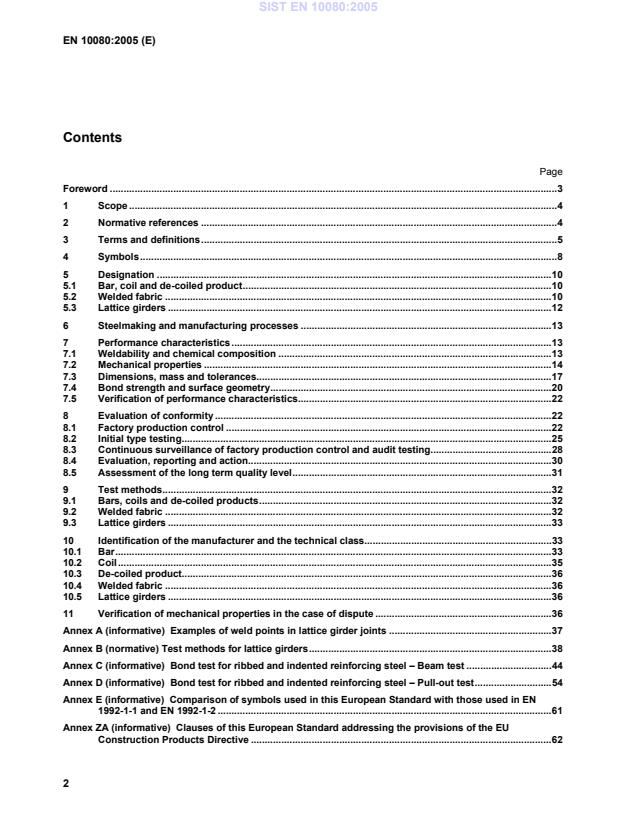
Examples of weld points in lattice girder joints.37 Annex B (normative) Test methods for lattice girders.38 Annex C (informative)
Bond test for ribbed and indented reinforcing steel – Beam test.44 Annex D (informative)
Bond test for ribbed and indented reinforcing steel – Pull-out test.54 Annex E (informative)
Comparison of symbols used in this European Standard with those used in EN 1992-1-1 and EN 1992-1-2.61 Annex ZA (informative)
Clauses of this European Standard addressing the provisions of the EU Construction Products Directive.62
Foreword This document (EN 10080:2005) has been prepared by Technical Committee ECISS/TC 19 “Concrete reinforcing and pre-stressing steels - Properties, dimensions, tolerances and specific tests”, the secretariat of which is held by DIN. This European Standard shall be given the status of a national standard, either by publication of an identical text or by endorsement, at the latest by November 2005, and conflicting national standards shall be withdrawn at the latest by May 2007. This document has been prepared under Mandate M/115 given to CEN by the European Commission and the European Free Trade Association and supports essential requirements of the EU Construction Products Directive (89/106/EEC). For relationship with the EU Construction Products Directive, see informative Annex ZA, which is an integral part of this document. This document does not apply to non-weldable reinforcing steel. This document does not define technical classes. Technical classes should be defined in accordance with this document by specified values for Re, Agt, Rm/Re, Re,act./Re,nom. (if applicable), fatigue strength (if required), bendability, weldability, bond strength, strength of welded or clamped joints (for welded fabric or lattice girders) and tolerances on dimensions. According to the CEN/CENELEC Internal Regulations, the national standards organizations of the following countries are bound to implement this European Standard: Austria, Belgium, Cyprus, Czech Republic, Denmark, Estonia, Finland, France, Germany, Greece, Hungary, Iceland, Ireland, Italy, Latvia, Lithuania, Luxembourg, Malta, Netherlands, Norway, Poland, Portugal, Slovakia, Slovenia, Spain, Sweden, Switzerland and United Kingdom.
NOTE
See also C.2 and D.2. SIST EN 10080:2005
reinforcing steel steel product with a circular or practically circular cross-section which is suitable for the reinforcement of concrete 3.2
ribbed reinforcing steel reinforcing steel with at least two rows of transverse ribs, which are uniformly distributed over the entire length 3.3
longitudinal rib uniform continuous protrusion parallel to the axis of the bar, rod or wire 3.4
transverse rib any rib on the surface of the bar, rod or wire other than a longitudinal rib 3.5
rib height, h distance from the highest point of the rib (transverse or longitudinal) to the surface of the core, to be measured normal to the axis of the bar, rod or wire 3.6
rib or indentation spacing, c distance between the centres of two consecutive transverse ribs or two consecutive indentations measured parallel to the axis of the bar, rod or wire 3.7
angle of transverse rib or indentation inclination, ß angle between the axis of the transverse rib or indentation and the longitudinal axis of the bar, rod or wire 3.8
transverse rib flank inclination, αααα angle of the rib flank measured perpendicular to the longitudinal axis of the rib 3.9
relative rib area, fR area of the projection of all ribs on a plane perpendicular to the longitudinal axis of the bar, rod or wire, divided by the rib spacing and the nominal circumference 3.10
indented reinforcing steel reinforcing steel with defined indentations uniformly distributed over the entire length 3.11
indentation depth, t distance between the surface of the wire and the deepest point of the indentation 3.12
indentation width, b width of the indention to be measured parallel to the axis of the bar, rod or wire 3.13
plain reinforcing steel reinforcing steel with a smooth surface SIST EN 10080:2005
coil single length of reinforcing steel (usually rod or wire) wound in concentric rings 3.15
de-coiled product reinforcing steel manufactured in coils and subsequently straightened for further processing 3.16
nominal cross-sectional area, An cross-sectional area equivalent to the area of a circular plain bar of the same nominal diameter, d (i.e.42dπ) 3.17
welded fabric arrangement of longitudinal and transverse bars, rods or wires of the same or different nominal diameter and length that are arranged substantially at right angles to each other and factory electrical resistance welded together by automatic machines at all points of intersection 3.18
lattice girder two or three-dimensional metallic structure comprising an upper chord, one or more lower chords and continuous or discontinuous diagonals which are welded or mechanically assembled to the chords 3.19
characteristic value value of a material or product property having a prescribed probability of not being attained in a hypothetical unlimited test series NOTE
This value generally corresponds to a specific fractile of the assumed statistical distribution of the particular property of the material or product. 3.20
minimum value value below which no test result shall fall 3.21
maximum value value which no test result shall exceed 3.22
batch quantity of bars, rods, wires or decoiled products of one nominal diameter and one cast either in coils or bars or any quantity of welded fabric or lattice girders of one type produced by one manufacturer and presented for examination at any one time 3.23
factory production control permanent internal control of production performed by the manufacturer 3.24
semi-finished product product which requires further processing in order to achieve the standard and special properties specified in this document for reinforcing steels 3.25
standard property property which is contained in this document as part of the factory production control requirements for every test unit SIST EN 10080:2005
special property property contained in this document which is not determined as part of the factory production control requirements for every test unit 3.27
standard welded fabric welded fabric manufactured according to specified delivery conditions and available from stock 3.28
purpose made welded fabric welded fabric manufactured according to user's specific requirements 3.29
longitudinal wire reinforcing steel in the manufacturing direction of the welded fabric 3.30
transverse wire reinforcing steel perpendicular to the manufacturing direction of the welded fabric 3.31
twin wires two wires of the same technical class and nominal diameter placed adjacent to each other as a pair in welded fabrics 3.32
pitch of welded fabric centre-to-centre distance of wires in a sheet of welded fabric NOTE
For twin wire fabric the pitch is measured between the tangents of the adjacent wires. 3.33
overhang of welded fabric, u1, u2, u3, u4 length of longitudinal or transverse wires projecting beyond the centre of the outer crossing wire in a sheet of welded fabric NOTE
For twin wire welded fabric the overhang is measured from the tangent line of the adjacent wires. 3.34
length of a welded fabric sheet, L dimension of the longest side of a sheet of welded fabric, irrespective of the manufacturing direction 3.35
width of a welded fabric sheet, B dimension of the shortest side of the sheet of welded fabric, irrespective of the manufacturing direction 3.36
standard lattice girder lattice girder manufactured according to specified delivery conditions and available from stock 3.37
purpose made lattice girder lattice girder manufactured according to user's specific requirements 3.38
lower chord set of longitudinal reinforcing steels placed in the lower part of a lattice girder NOTE
The constituent longitudinal reinforcing steels of the lower chord can be interlinked or not. SIST EN 10080:2005
upper chord longitudinal reinforcement placed in the upper part of a lattice girder, of which the base steel is either a reinforcing steel or a steel strip 3.40
diagonals reinforcing steels linking the upper and lower chord of a lattice girder NOTE
They form harmonic curves in the case of continuous diagonals or are independent elements in the case of discontinuous diagonals. 3.41
lattice girder length, L overall length of a lattice girder 3.42
design height of a lattice girder, H1 distance between the lowest point of the lower chord and the highest point of the upper chord 3.43
overall height of a lattice girder, H2 distance between the lowest point and the highest point of a lattice girder 3.44
lattice girder overhang, u1,u2 length of the diagonals beyond either the upper chord (u1) or the lower chord (u2) 3.45
design width of a lattice girder, B1 distance between the outlying points of the lower chords 3.46
overall width of a lattice girder, B2 distance between the outlying points of a lattice girder 3.47
pitch of diagonals, Ps distance between equivalent consecutive junction points of the diagonals with the chords 3.48
angle of inclination of diagonals, ϑϑϑϑ angle between the axis of a diagonal and the longitudinal axis of a lattice girder in the plane of the diagonal in the middle of the height of a lattice girder 3.49
technical class type of reinforcing steel defined by its performance characteristics, identified by a unique product number 3.50
reinforcing steel grade steel grade defined by its characteristic yield strength and ductility requirements 4 Symbols Symbols used in this European Standard are listed in Table 1. NOTE
For comparison of symbols used in this European Standard with those used in EN 1992-1-1 and EN 1992-1-2 (see Annex E). SIST EN 10080:2005
kN Re,act. Actual value of yield strength MPa b Re,nom. Specified value of yield strength MPa b Re, act./Re,nom. Ratio actual value of yield strength / specified value of yield strength - a1, a2, a3, a4 Increment (specified in the product specification) a u1, u2 Overhang of the longitudinal wires in welded fabric or length of the diagonals beyond the upper or lower chord of a lattice girder mm u3, u4 Overhang of the transverse wires in welded fabric mm ACh Cross-sectional area of chord mm2 ADi Cross-sectional area of diagonal mm2 B1 Design width of lattice girder mm B2 Overall width of lattice girder mm Fd Shear force of a clamped joint in lattice girder kN Fw Shear force of a single weld in lattice girder kN H1 Design height of lattice girder mm H2 Overall height of lattice girder mm Ps Pitch of diagonals of lattice girder mm Re,Ch Yield strength of the chord in lattice girder MPa b Re,Di Yield strength of the diagonal in lattice girder MPa b t Depth of indentation mm ts Thickness of metal strip in lattice girder mm ϑ Inclination of the diagonals in lattice girder o (to be continued) SIST EN 10080:2005
Key NL number of longitudinal wires PL pitch of longitudinal wires dL diameter of longitudinal wires NC number of transverse wires PC pitch of transverse wires dC diameter of transverse wires L length of longitudinal wire B length of transverse wire u1 overhang of the longitudinal wires u2
overhang of the longitudinal wires u3 overhang of the transverse wires u4 overhang of the transverse wires Figure 1 — Geometrical characteristics of purpose made welded fabric SIST EN 10080:2005
Figure 2a)
Figure 2b) SIST EN 10080:2005
Figure 2c) Key 1 upper chord 2 diagonal 3 lower chord Figure 2 — Height (H1, H2), width (B1, B2), overhang (u1, u2) and pitch of
diagonals (Ps) of a lattice girder 6 Steelmaking and manufacturing processes 6.1 The melting process and type of de-oxidation of the steel is at the discretion of the steel producer. 6.2 The manufacturing process for the production of coils and bars is at the discretion of the manufacturer. It shall be reported to the purchaser if requested. 6.3 De-coiling of coil material shall be done by a machine made for this purpose. 6.4 The manufacture of reinforcing steel by re-rolling finished products (e.g. sheets or rails) is not permitted. 6.5 All welded fabric shall be factory made and machine welded. The joints, at the intersection of the longitudinal wires and the transverse wires, shall be made by electrical resistance welding, to provide a specified shear resistance. Welded fabric may be composed of a different technical class in each direction. Twin wire welded fabric shall be composed of twin wires in only one direction. 6.6 All lattice girders shall be factory made, and may be made from bars and coils or strip (for upper chords only). The joints between chords and diagonals shall be made by electrical resistance welding, or by mechanical clamping, to provide a specified shear resistance. 7 Performance characteristics 7.1 Weldability and chemical composition 7.1.1 Weldability is determined by two characteristics: carbon equivalent; SIST EN 10080:2005
Ceq = C + Mn/6 + (Cr+Mo+V)/5 + (Ni+Cu)/15
(1) Where
the symbols of the chemical elements indicate their content in % by mass. NOTE
For guidance on welding of reinforcing steels see prEN ISO 17660. Table 2 — Chemical composition (% by mass)
Carbon a
max. Sulphur
max. Phosphorus
max. Nitrogen b
max. Copper
max. Carbon equivalent value a max. Cast analysis 0,22 0,050 0,050 0,012 0,80 0,50 Product analysis 0,24 0,055 0,055 0,014 0,85 0,52 a It is permitted to exceed the maximum values for carbon by 0,03 % by mass, provided that the carbon equivalent value is decreased by
0,02 % by mass. b Higher nitrogen contents are permissible if sufficient quantities of nitrogen binding elements are present. 7.1.4 Durability of products according to this European Standard is provided by the chemical composition specified in Table 2. 7.2 Mechanical properties 7.2.1 General In the context of this European Standard the characteristic value is (unless otherwise indicated) the lower or upper limit of the statistical tolerance interval at which there is a 90 % probability (1 - α = 0,90) that 95 %
(p = 0,95) or 90 % (p = 0,90) of the values are at or above this lower limit, or are at or below this upper limit respectively (see Table 16 and Table 17). This definition refers to the long term quality level of production. 7.2.2 Conditions of testing The conditions of testing shall be as specified in Table 3. SIST EN 10080:2005
± 10 °C for a period of 1 h 015+min and then cooling in still air to room temperature. The method of heating is left to the discretion of the manufacturer. c Or as delivered when the constituents are produced in straight lengths by hot rolling. 7.2.3 Tensile properties 7.2.3.1 The specified values for the tensile properties (Re, Rm/Re, Agt, and where relevant Re,act./Re,nom.) shall be the corresponding specified characteristic value with p = 0,95 for Re, and p = 0,90 for Agt, Rm/Re, and Re,act./Re,nom. 7.2.3.2 The values Re and Rm shall be calculated using the nominal cross-sectional area of the product. 7.2.3.3 For yield strength (Re) the upper yield strength (ReH) shall apply. If a yield phenomenon is not present, the 0,2 % proof strength (Rp0,2) shall be determined. 7.2.4 Shear force of welded or clamped joints 7.2.4.1 Welded fabric The specified value of the shear force of welded joints in welded fabric, Fs, shall be a minimum value. The specified minimum value of Fs shall not be less than 0,25 × Re × An, where Re is the specified characteristic yield strength, and An is the nominal cross-sectional area of either: a) the larger wire at the joint in a single wire welded fabric, b) one of the twin wires in a twin wire welded fabric (twin wires in one direction). 7.2.4.2 Lattice girders 7.2.4.2.1 Welded joints The specified value for the shear force of a weld point in a lattice girder, Fw, shall be a minimum value. The specified minimum value of Fw shall not be less than Fw ≥ 0,25 × Re,Ch × ACh
(2) or Fw ≥ 0,6 × Re,Di × ADi
(3) whichever is the lower. For the evaluation of the test result for the shear force it is necessary to record how many weld points have been loaded and failed in the same moment. SIST EN 10080:2005
Annex A gives examples of weld points in a joint. 7.2.4.2.2 Clamped joints Clamped joints are only used for joining the lower chord and the diagonals. The specified value for the shear force of a clamped joint in lattice girders, Fd, shall be a minimum value. The specified minimum value of Fd shall not be less than Fd ≥ 0,25 × Re,Di × ADi
(4) 7.2.5 Fatigue strength If submitted to axial force controlled fatigue testing in the fluctuating tension range, the product shall withstand the specified number(s) of stress cycles. The stress shall vary sinusoidally, over the specified range of stress 2σa, from the specified σmax. NOTE
2 σa and σmax should be expressed on the basis of the nominal cross-sectional area of the bar, rod or wire. 7.2.6 Suitability for bending 7.2.6.1 Suitability for bending shall be determined by the bend and/or rebend test. 7.2.6.2 The bend test, if required, shall be performed according to EN ISO 15630-1, with a minimum angle of bend of 180°. After testing the products shall show neither rupture nor cracks visible to a person of normal or corrected vision. The mandrel diameter specified for the bend test shall not exceed the relevant maximum diameter specified in Table 4. Table 4 — Mandrel diameter for the bend test Nominal diameter d mm Mandrel diameter max. ≤ 16 3 d > 16
6 d
7.2.6.3 The re-bend test, if required, shall be performed according to EN ISO 15630-1. Test pieces shall be bent through a minimum angle of 90° around a mandrel having a diameter not exceeding the relevant maximum diameter specified in Table 5, aged and then bent back by at least 20°. After the test the specimen shall show no sign of fracture or cracks visible to a person of normal or corrected vision. Table 5 — Mandrel diameter for the re-bend test Nominal diameter d mm Mandrel diameter max. ≤ 16 > 16 ≤ 25 > 25 5 d 8 d 10 d SIST EN 10080:2005
(5) where
dmax. is the nominal diameter of the thickest wire,
dmin. is the nominal diameter of the crossing wire. Other requirements may be agreed at the time of enquiry and order. 7.3.5.1.2.2 For welded fabric with twin wires in one direction, the nominal diameters of the wires shall meet the following requirement 0,7 ds ≤ dT ≤ 1,25 ds
(6) where ds is the nominal diameter of the single wires, dT is the nominal diameter of the twin wires. SIST EN 10080:2005
The overhang should not be less than 25 mm. 7.3.5.2 Dimensions and tolerances on dimensions The nominal length, width, pitch and overhangs of welded fabric shall be agreed at the time of enquiry and order. The permitted deviations for welded fabric are: Length and width of the welded fabric: ± 25 mm or ± 0,5 % whichever is greater; wire pitch:
± 15 mm or ± 7,5 % whichever is greater; overhangs:
to be agreed at the time of enquiry and order. Special tolerance requirements may be agreed between the manufacturer and the purchaser. 7.3.6 Dimensions of lattice girders 7.3.6.1 Configurations Where wires are welded together, they shall meet the requirement that dmin. / dmax. is greater than 0,3. If metal strips are welded to wires, the following limitation shall apply: ts ≥ 0,15 d
(7) where d is the nominal diameter of the diagonal, ts is the thickness of the metal strip. 7.3.6.2 Dimensions and tolerances on dimensions The nominal length, height, width and pitch of lattice girders shall be agreed at the time of enquiry and order. Maximum manufacturing tolerances shall be as follows:
length (L)
: ± 40 mm if L ≤ 5,0 m;
: ± 0,8 %, if L > 5,0 m;
height (H1, H2) : 13+− mm;
width (B1, B2)
: ± 7,5 mm;
pitch (Ps)
: ± 2,5 mm; maximum overhang:
may be agreed at the time of enquiry and order. SIST EN 10080:2005
X
X 12,6 0,099 4,5
X
X 15,9 0,125 5,0
X X X 19,6 0,154 5,5
X X X 23,8 0,187 6,0 X X X X 28,3 0,222 6,5
X X X 33,2 0,260 7,0
X X X 38,5 0,302 7,5
X X X 44,2 0,347 8,0 X X X X 50,3 0,395 8,5
X X X 56,7 0,445 9,0
X X X 63,6 0,499 9,5
X X X 70,9 0,556 10,0 X X X X 78,5 0,617 11,0
X X X 95,0 0,746 12,0 X X X X 113 0,888 14,0 X X X X 154 1,21 16,0 X X X X 201 1,58 20,0 X
314 2,47 25,0 X
491 3,85 28,0 X
616 4,83 32,0 X
804 6,31 40,0 X
1257 9,86 50,0 X
1963 15,4
NOTE Figure illustrates example of two rows of transverse ribs Figure 3 — Rib geometry SIST EN 10080:2005
Table 7 — Ranges for the rib parameters Rib height h Rib spacing c Rib inclination β 0,03 d to 0,15 d 0,4 d to 1,2 d 35° to 75° 7.4.2.2.2 Transverse ribs shall have a crescent shape and shall merge smoothly into the core of the product. 7.4.2.2.3 The projection of the transverse ribs shall extend over at least 75 % of the circumference of the product, which shall be calculated from the nominal diameter. 7.4.2.2.4 The transverse rib flank inclination (α) shall be ≥ 45° and the transition from the rib to the core of the product shall be radiused. 7.4.2.3 Longitudinal ribs Where longitudinal ribs are present, their height shall not exceed 0,15 d, where d is the nominal diameter of the product. 7.4.3 Surface geometry of indented steel 7.4.3.1 General Indented steels are characterized by the dimensions, number and configuration of indentations. Indented steels shall have at least two equally distributed rows of indentations. The indentations form an angle of inclination with the bar, rod or wire axis. An example of an indented steel is shown in Figure 4.
NOTE Figure illustrates example of three rows of indentations Figure 4 – Indentation geometry
Indented steel according to this European Standard shall satisfy the requirements given in 7.4.3.2. The indentation parameters may be specified either by the relative indentation area fP, or by a combination of the indentation parameters specified in Table 8, or by both criteria. SIST EN 10080:2005
Width b
Spacing c
Sum of gaps Σe max.
0,02 d to 0,1 d
0,2 d to 1,0 d
0,4 d to 1,5 d
0,75 d 7.5 Verification of performance characteristics For verification of performance characteristics, test methods in accordance with Clause 9 shall be applied. 8 Evaluation of conformity 8.1 Factory production control 8.1.1 General Reinforcing steels according to this European Standard shall be produced under a permanent system of factory production control, which shall ensure the same level of confidence in the conformity of the finished product, whatever the manufacturing process. The system of factory production control shall include evaluation of specified properties, as described in 8.1.2 and 8.1.3. Manufacturers having a factory production control system which complies with EN ISO 9001 and which addresses the requirements of this European Standard are recognised as satisfying the factory production control requirements of this European Standard. 8.1.2 Sampling and testing of finished products 8.1.2.1 Verification of standard properties For the verification of standard properties, sampling and testing shall be as specified in 8.1.2.1.1 to 8.1.2.1.4. 8.1.2.1.1 Bars and coils The test unit shall be the cast or part quantity of the cast. The rate of testing shall be as follows: a) for chemical composition, one analysis per test unit. The chemical composition (cast analysis) of the steel shall have been determined by the steel producer; b) for bend and/or re-bend tests, mass per metre and surface geometry, one test piece per test unit and nominal diameter; SIST EN 10080:2005
Testing may be carried out either by the processor using his own resources (internal or external) or by the processor in co-operation with the coil manufacturer. The tests are not to be seen as release tests, but as the basis for the assessment of the long term quality level (LTQL) as described in 8.5. 8.1.2.1.3 Welded fabric The test unit is composed of sheets of the same combination of reinforcing technical classes and diameters produced on the same welding machine of a maximum mass of 50 t. For the verification of properties, samples shall be taken in accordance with Table 9. These samples may be taken according to the producer's choice, either on one sheet or on different sheets, provided that different wires are tested. All specified welded fabric dimensions (length, width, pitch, overhang) (see 7.3.5) shall be measured. The chemical composition (cast analysis) of the material shall have been determined by the steel producer. Compliance shall be confirmed to the welded fabric manufacturer, which shall include a statement of the chemical composition, if required by the purchaser. Table 9 — Sampling plan for welded fabric Property Number of samples per test unit Re ≥ 2 a Rm/Re ≥ 2 a Re,act./Re,nom. b ≥ 2 a Agt ≥ 2 a Dimensions ≥ 1 Shear force ≥ 2 c Mass per metre d ≥ 2 a Bendability e ≥ 2 a Surface geometry ≥ 2 a a 1 for the longitudinal direction, 1 for the transverse direction. b Where relevant. c See 7.2.4.1. d This may be measured before welding. e This may be evaluated on constituent wires, by a bend and/or re-bend test. SIST EN 10080:2005
...