

kSIST prES 202 336-5 V1.1.1:2010
(Main)Environmental Engineering (EE) - Monitoring and Control Interface for Infrastructure Equipment (Power, Cooling and Building Environment Systems used in Telecommunication Networks) - Part 5: AC diesel back-up generator system control and monitoring information model
- Abstract
The present document applies to monitoring of power and cooling systems for telecommunication installations and equipment. This part 5 is the data description of AC diesel back-up generator system. It provides the information tables, the DTD description and XML files. This description is based on generic recommendation of part 1 core document.
- Status
- Not Published
- Technical Committee
- SPN - Services and Protocols for Networks
- Current Stage
- 5020 - Formal vote (FV) (Adopted Project)
- Start Date
- 09-Mar-2010
- Due Date
- 27-Apr-2010
- Completion Date
- 17-May-2010
Buy Documents

ETSI ES 202 336-5 V1.1.1 (2010-01) - Environmental Engineering (EE); Monitoring and Control Interface for Infrastructure Equipment (Power, Cooling and Building Environment Systems used in Telecommunication Networks); Part 5: AC diesel back-up generator system control and monitoring information model

ETSI ES 202 336-5 V1.1.1 (2010-04) - Environmental Engineering (EE); Monitoring and Control Interface for Infrastructure Equipment (Power, Cooling and Building Environment Systems used in Telecommunication Networks); Part 5: AC diesel back-up generator system control and monitoring information model
kSIST prES 202 336-5 V1.1.1:2010 is the SIST publication of the ETSI Environmental Engineering (EE) standard for AC diesel back-up generator system control and monitoring in telecommunication networks. It specifies the information model, XML tags, and data tables used to exchange alarms, measurements, events, configuration, and control information for these systems.
What does kSIST prES 202 336-5 V1.1.1:2010 specify?
kSIST prES 202 336-5 V1.1.1:2010 specifies the monitoring and control interface for AC diesel back-up generator systems used in telecommunication installations and equipment. The document defines the monitored and controlled architectures, the minimum information exchanged at the interface, and the XML tags and variables that represent that data.
The standard is organized into four clauses and three annexes.
| Part | What it covers |
|---|---|
| Clause 1 | Scope |
| Clause 2 | References |
| Clause 3 | Definitions and abbreviations |
| Clause 4 | Back-up generator system control and monitoring presentation |
| Annex A | Mandatory monitoring and supervision information and functions |
| Annex B | Mandatory XML structure and elements |
| Annex C | Non-mandatory monitoring and supervision information and functions |
What are the key requirements of kSIST prES 202 336-5 V1.1.1:2010?
kSIST prES 202 336-5 V1.1.1:2010 requires a common data model for diesel back-up generator supervision, with mandatory information in Annex A and additional optional information in Annex C. In practice, that means implementers need to map generator status, alarms, measurements, events, and control functions into the defined XML structure.
- Clause 4 describes a generator made up of engine, alternator, fuel, cooling, oil, starting, auxiliary electrical, and monitoring/control functions. This matters because the interface is built around those subsystems, not just the generator as a single device.
- Clause 4 says the system should support permanent monitoring even when the engine is stopped, plus periodic or on-demand tests. In practice, operators use this for faster fault detection, maintenance planning, and training checks.
- Annex A defines the mandatory monitored information. It includes device description, fuel and coolant level alarms, start failure, safety stop, undetermined stop, voltage or frequency out of range, fuel leakage, battery starter charger failure, protection trips, manual/maintenance mode, engine start inhibited, and link failure between control systems.
- Annex A also covers mandatory event and configuration items such as generator or auxiliary status changes, starting reason, running/stop status, default value resetting, software download with rollback to the previous release, and time counters. This tells the integrator what must be reportable for supervision and maintenance records.
- Annex B defines the XML document structure. A diesel back-up generator system appears as a child of a site energy system, and the file contains grouped sections such as description, alarm, event, data, data record, config, control, and subsystem elements.
- Annex B also lists the main circuit elements as separate XML children: starting_circuit, fuel_circuit, oil_circuit, cooling_circuit, air_circuit, power_circuit, and auxiliary_power_circuit. That makes the data model usable for software that needs to address each subsystem separately.
- Annex C adds non-mandatory alarms, measurements, events, and control functions such as starting test failure, running test failure, fuel gauge, oil gauge, ac voltage, ac current, temperature measurements, running time statistics, and power capacity management. These support preventive maintenance and performance tracking, but are not part of the minimum set.
What terms does kSIST prES 202 336-5 V1.1.1:2010 define?
kSIST prES 202 336-5 V1.1.1:2010 defines several operational terms used by the interface model.
- Alarm - information that signals an abnormal state and should include a severity indication.
- Event - information that signals a state change that is not an alarm, such as a battery test or a mode change.
- Control Unit (CU) - an integrated unit that monitors and controls equipment through sensors and actuators.
- Data Gathering Unit (DGU) - a unit that collects data, can send commands, and forwards information using agreed protocols.
- XCU - a CU enabled to communicate using the XML interface defined by the standard.
- XML - eXtensible Markup Language, used here to structure the monitored and controlled data.
Who uses kSIST prES 202 336-5 V1.1.1:2010?
kSIST prES 202 336-5 V1.1.1:2010 is used by telecom site engineers, power-system integrators, equipment manufacturers, and maintenance teams that need a common way to supervise diesel back-up generators. It is also relevant for operators of telecom sites and datacenters who need remote alarms, measurements, test reports, and control commands in a structured XML format.
Which standards are used with kSIST prES 202 336-5 V1.1.1:2010?
kSIST prES 202 336-5 V1.1.1:2010 depends on the following named standards and companion documents:
| Reference | Role in this standard |
|---|---|
| ETSI ES 202 336-1 | Generic interface rules, element types, and XML parameter handling |
| ETSI ES 202 336-2 | Common interface model for DC power systems and XML coding structure guidance |
| ETSI EN 300 132-2 | Power supply interface for telecommunication equipment operated by direct current |
| ETSI EN 300 132-3 | Power supply interface for telecommunication equipment operated by rectified current source, alternating current source, or direct current source up to 400 V |
| ISO/IEC 10164 | Systems management concepts used for management information |
| ISO/IEC 8879 | SGML basis underlying XML |
Informative companions include ETSI TR 102 336, ETSI TR 102 121, IEEE 802.1 to 11, and ETSI ES 202 336-4. These give guidance on power and cooling supervision, site power distribution, LAN protocol context, and the AC distribution power system model.
What does the kSIST prES 202 336-5 V1.1.1:2010 document contain?
kSIST prES 202 336-5 V1.1.1:2010 contains text tables for mandatory and optional data, plus the XML structure needed to encode them. It also includes a figure showing a typical water-cooled diesel generator architecture under XML control-monitoring.
The annexes provide the practical implementation material: Annex A gives the required monitoring and supervision items, Annex B gives the XML document layout and subsystem elements, and Annex C adds optional monitoring, test, and control information.
Buy Documents
ETSI ES 202 336-5 V1.1.1 (2010-01) - Environmental Engineering (EE); Monitoring and Control Interface for Infrastructure Equipment (Power, Cooling and Building Environment Systems used in Telecommunication Networks); Part 5: AC diesel back-up generator system control and monitoring information model
ETSI ES 202 336-5 V1.1.1 (2010-04) - Environmental Engineering (EE); Monitoring and Control Interface for Infrastructure Equipment (Power, Cooling and Building Environment Systems used in Telecommunication Networks); Part 5: AC diesel back-up generator system control and monitoring information model
Get Certified
Connect with accredited certification bodies for this standard

ANCE
Mexican certification and testing association.

IMP NDT d.o.o.
Non-destructive testing services. Radiography, ultrasonic, magnetic particle, penetrant, visual inspection.
Inštitut za kovinske materiale in tehnologije
Institute of Metals and Technology. Materials testing, metallurgical analysis, NDT.
Sponsored listings
Frequently Asked Questions
kSIST prES 202 336-5 V1.1.1:2010 is a standard published by the Slovenian Institute for Standardization (SIST). Its full title is "Environmental Engineering (EE) - Monitoring and Control Interface for Infrastructure Equipment (Power, Cooling and Building Environment Systems used in Telecommunication Networks) - Part 5: AC diesel back-up generator system control and monitoring information model". This standard covers: The present document applies to monitoring of power and cooling systems for telecommunication installations and equipment. This part 5 is the data description of AC diesel back-up generator system. It provides the information tables, the DTD description and XML files. This description is based on generic recommendation of part 1 core document.
The present document applies to monitoring of power and cooling systems for telecommunication installations and equipment. This part 5 is the data description of AC diesel back-up generator system. It provides the information tables, the DTD description and XML files. This description is based on generic recommendation of part 1 core document.
kSIST prES 202 336-5 V1.1.1:2010 is classified under the following ICS (International Classification for Standards) categories: 19.040 - Environmental testing; 33.050.01 - Telecommunication terminal equipment in general. The ICS classification helps identify the subject area and facilitates finding related standards.
kSIST prES 202 336-5 V1.1.1:2010 is available in PDF format for immediate download after purchase. The document can be added to your cart and obtained through the secure checkout process. Digital delivery ensures instant access to the complete standard document.
Standards Content (Sample)
Final draft ETSI ES 202 336-5 V1.1.1 (2010-01)
ETSI Standard
Environmental Engineering (EE);
Monitoring and Control Interface for Infrastructure Equipment
(Power, Cooling and Building Environment Systems
used in Telecommunication Networks);
Part 5: AC diesel back-up generator system control and
monitoring information model
2 Final draft ETSI ES 202 336-5 V1.1.1 (2010-01)
Reference
DES/EE-02037-5
Keywords
control, interface, management, power, system
ETSI
650 Route des Lucioles
F-06921 Sophia Antipolis Cedex - FRANCE
Tel.: +33 4 92 94 42 00 Fax: +33 4 93 65 47 16
Siret N° 348 623 562 00017 - NAF 742 C
Association à but non lucratif enregistrée à la
Sous-Préfecture de Grasse (06) N° 7803/88
Important notice
Individual copies of the present document can be downloaded from:
http://www.etsi.org
The present document may be made available in more than one electronic version or in print. In any case of existing or
perceived difference in contents between such versions, the reference version is the Portable Document Format (PDF).
In case of dispute, the reference shall be the printing on ETSI printers of the PDF version kept on a specific network drive
within ETSI Secretariat.
Users of the present document should be aware that the document may be subject to revision or change of status.
Information on the current status of this and other ETSI documents is available at
http://portal.etsi.org/tb/status/status.asp
If you find errors in the present document, please send your comment to one of the following services:
http://portal.etsi.org/chaircor/ETSI_support.asp
Copyright Notification
No part may be reproduced except as authorized by written permission.
The copyright and the foregoing restriction extend to reproduction in all media.
© European Telecommunications Standards Institute 2010.
All rights reserved.
TM TM TM TM
DECT , PLUGTESTS , UMTS , TIPHON , the TIPHON logo and the ETSI logo are Trade Marks of ETSI registered
for the benefit of its Members.
TM
3GPP is a Trade Mark of ETSI registered for the benefit of its Members and of the 3GPP Organizational Partners.
LTE™ is a Trade Mark of ETSI currently being registered
for the benefit of its Members and of the 3GPP Organizational Partners.
GSM® and the GSM logo are Trade Marks registered and owned by the GSM Association.
ETSI
3 Final draft ETSI ES 202 336-5 V1.1.1 (2010-01)
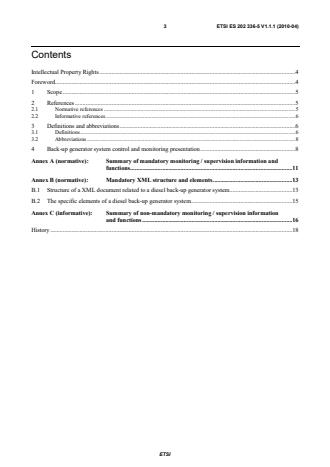
Contents
Intellectual Property Rights . 4
Foreword . 4
1 Scope . 5
2 References . 5
2.1 Normative references . 5
2.2 Informative references . 6
3 Definitions and abbreviations . 6
3.1 Definitions . 6
3.2 Abbreviations . 8
4 Back-up generator system control and monitoring presentation . 8
Annex A (normative): Summary of mandatory monitoring / supervision information and
f unctions . 11
Annex B (normative): Mandatory XML structure and elements . 13
B.1 Structure of a XML document related to a diesel back-up generator system . 13
B.2 The specific elements of a diesel back-up generator system . 15
Annex C (informative): Summary of non-mandatory monitoring / supervision information
and functions . 16
History . 18
ETSI
4 Final draft ETSI ES 202 336-5 V1.1.1 (2010-01)
Intellectual Property Rights
IPRs essential or potentially essential to the present document may have been declared to ETSI. The information
pertaining to these essential IPRs, if any, is publicly available for ETSI members and non-members, and can be found
in ETSI SR 000 314: "Intellectual Property Rights (IPRs); Essential, or potentially Essential, IPRs notified to ETSI in
respect of ETSI standards", which is available from the ETSI Secretariat. Latest updates are available on the ETSI Web
server (http://webapp.etsi.org/IPR/home.asp).
Pursuant to the ETSI IPR Policy, no investigation, including IPR searches, has been carried out by ETSI. No guarantee
can be given as to the existence of other IPRs not referenced in ETSI SR 000 314 (or the updates on the ETSI Web
server) which are, or may be, or may become, essential to the present document.
Foreword
This ETSI Standard (ES) has been produced by ETSI Technical Committee Environmental Engineering (EE), and is
now submitted for the ETSI standards Membership Approval Procedure.
The present document is part 5 of a multi-part deliverable covering Monitoring and Control Interface for Infrastructure
Equipment (Power, Cooling and Building Environment Systems used in Telecommunication Networks), as identified
below:
Part 1: "Generic Interface";
Part 2: "DC power system control and monitoring information model";
Part 3: "AC UPS power system control and monitoring information model";
Part 4: "AC distribution power system control and monitoring information model";
Part 5: "AC diesel back-up generator system control and monitoring information model";
Part 6: "Air conditioning system control and monitoring information model";
Part 7: "Other utilities system control and monitoring information model";
Part 8: "Remote Power Feeding System control and monitoring information model".
ETSI
5 Final draft ETSI ES 202 336-5 V1.1.1 (2010-01)
1 Scope
The present document applies to monitoring and control of AC diesel back-up generator system for telecommunication
equipment.
The document defines:
• The monitored and controlled back-up generator system architectures.
• The minimum set of exchanged information required at the interface, described in "natural language" in text
tables.
• The XML tags and variables corresponding to the data in the tables.
2 References
References are either specific (identified by date of publication and/or edition number or version number) or
non-specific.
• For a specific reference, subsequent revisions do not apply.
• Non-specific reference may be made only to a complete document or a part thereof and only in the following
cases:
- if it is accepted that it will be possible to use all future changes of the referenced document for the
purposes of the referring document;
- for informative references.
Referenced documents which are not found to be publicly available in the expected location might be found at
http://docbox.etsi.org/Reference.
NOTE: While any hyperlinks included in this clause were valid at the time of publication ETSI cannot guarantee
their long term validity.
2.1 Normative references
The following referenced documents are indispensable for the application of the present document. For dated
references, only the edition cited applies. For non-specific references, the latest edition of the referenced document
(including any amendments) applies.
[1] ETSI ES 202 336-1: "Environmental Engineering (EE); Monitoring and Control Interface for
Infrastructure Equipment (Power, Cooling and Building Environment Systems used in
Telecommunication Networks) Part 1: Generic Interface".
[2] ETSI ES 202 336-2: "Environmental Engineering (EE); Monitoring and control interface for
infrastructure equipment (Power, Cooling and environment systems used in telecommunication
networks); Part 2: DC power system control and monitoring information model".
[3] ETSI EN 300 132-2: "Environmental Engineering (EE); Power supply interface at the input to
telecommunications equipment; Part 2: Operated by direct current (dc)".
[4] ETSI EN 300 132-3: "Environmental Engineering (EE); Power supply interface at the input to
telecommunications equipment; Part 3: Operated by rectified current source, alternating current
source or direct current source up to 400 V".
[5] ISO/IEC 10164: "Information technology -- Open Systems Interconnection -- Systems
Management".
ETSI
6 Final draft ETSI ES 202 336-5 V1.1.1 (2010-01)
[6] ISO/IEC 8879: "Information processing -- Text and office systems -- Standard Generalized
Markup Language (SGML)".
2.2 Informative references
The following referenced documents are not essential to the use of the present document but they assist the user with
regard to a particular subject area. For non-specific references, the latest version of the referenced document (including
any amendments) applies.
[i.1] ETSI TR 102 336: "Environmental Engineering (EE); Power and cooling system control and
monitoring guidance".
[i.2] ETSI TR 102 121: "Environmental Engineering (EE); Guidance for power distribution to
telecommunication and datacom equipment".
[i.3] IEEE 802.1 to 11: "LAN/MAN Standards".
[i.4] ETSI ES 202 336-4: "Environmental Engineering (EE); Monitoring and Control Interface for
Infrastructure Equipment (Power, Cooling and Building Environment Systems used in
Telecommunication Networks); Part 4: AC distribution power system control and monitoring
information model".
3 Definitions and abbreviations
3.1 Definitions
For the purposes of the present document, the following terms and definitions apply:
NOTE: Terms referring to energy interface, equipment and distribution are described in power distribution
standards EN 300 132-2 [3] for 48 Vdc and EN 300 132-3 [4] for ac and dc lower than 400 V.
alarm: any information signalling abnormal state, i.e. different to specified normal state of hardware, software,
environment condition (temperature, humidity, etc.)
NOTE: The alarm signal should be understood by itself by an operator and should always have at least one
severity qualification or codification (colour, level, etc.).
EXAMPLE: Rectifier failure, battery low voltage, etc.
alarm loop: electrical loop which open or closed state correspond to alarm start (set) or end (clear) state
alarm message: text parts of the alarm structure
alarm structure: organized set of information fields in an alarm data frame (time stamp, set/clear, text, etc.)
client post: any device (laptop, PDA, console, etc.) connected to servers via the operation system networks to perform
maintenance or supervision operations
Control form Style Sheet (CSS): simple mechanism for adding style (e.g. fonts, colours, spacing) to Web documents
NOTE: Tutorials, books, mailing lists for users, etc.
Control Unit (CU): integrated unit in an equipment to monitor and control this equipment through sensors and
actuators
Data Gathering Unit (DGU): functional unit used for several functions:
• collect serial, digital, and analog data from several equipment;
• option to send (output) serial or digital commands;
• forward/receive information to/from the Local/Remote Management Application via agreed protocols;
ETSI
7 Final draft ETSI ES 202 336-5 V1.1.1 (2010-01)
• mediation between interfaces and protocols.
NOTE: This function may be integrated as part of specific equipment.
Dynamic Host Control Protocol (DHCP): protocol used for self configuration of TCP/IP parameters of a workstation
assigning IP address and a subnetwork mask
NOTE: DHCP may also configure DNS.
Dynamic Name Server (DNS): associates a single domain name to an IP address
dynamic synoptic: dynamic display of geographical maps, networks, installations and equipment
ethernet: LAN protocol
NOTE: Equivalent to IEEE 802.1 to 11 [i.3].
event: any information signalling a change of state which is not an alarm: e.g. battery test, change of state of battery
charge
NOTE: The event signal should be understood by itself by an operator and should always have at least one
severity qualification or codification (colour, level, etc.). It should be transmitted in a formatted structure
with text message and other fields like for alarm, e.g. an event can be coded as an alarm with severity "0".
infrastructure equipment: power, cooling and building environment systems used in telecommunications centres and
Access Networks locations
EXAMPLE: Cabinets, shelters, underground locations, etc.
intranet: internal company network generally using Ethernet protocol and extended IP addresses
logbook: chronological file that contains alarm and event messages may be paper or electronic
Management Information Base (MIB): dynamic data base that gathers all objects and should evolve to include
automatic and manual configuration tools with self coherence tests
menu: list of possible input command choices that may be presented in different ways on a display
NOTE: Selection is normally made by a keyboard, a pointing device, a mouse or directly by finger on a sensitive
screen.
object: class description of items that accept a set of properties or functions
NOTE: Generic objects can include more specific items and inherit from their properties. If correctly structured,
object programming can allow the system to evolve, i.e. be more future-proof. The code should
intrinsically be open and structured.
PHP: powerful tool for making dynamic and interactive Web pages
pop-up: information or command screen that appears when a menu choice is selected
EXAMPLE: This may be a pop-up menu when the pointer is on a title button.
REpresentational State Transfer (REST): way to build an application for distributed system as www
Simple Object Access Protocol (SOAP): way to communicate between applications running on different operating
systems, with different technologies and programming languages
NOTE: SOAP communicates over HTTP, because HTTP is supported by all Internet browsers and servers, SOAP
traffic is not blocked by firewalls and proxy servers (see W3C).
Systems Management Function (SMF): object properties or classes with projection on CMIS application context
communication
NOTE: Set of ISO system management functions according to ISO/IEC 10164 [5].
warning: low severity alarm
ETSI
8 Final draft ETSI ES 202 336-5 V1.1.1 (2010-01)
Web: common name for the Internet or Intranet
Windows: virtual area on the display that corresponds to a specific application
World Wide Web Consortium (W3C): consortium founded in October 1994 to develop common interoperable
protocols and promote World Wide Web
NOTE: See http://www.w3c.org.
XCU: CU enabled to communicate using XML interface as defined in the present document
XHTML: stricter and cleaner version of HTML. XHTML consists of all the elements in HTML 4.01 combined with
the syntax of XML. It can be read by all XML browser (see W3C)
eXtensible Mark-up Language (XML): application profile or restricted form of SGML
NOTE: By construction, XML documents are conforming SGML the Standard Generalized Markup Language
(ISO/IEC 8879 [6]). documents.XML is designed to describe data and focus on what data is. XML must
be discerned from the well known Hypertext Transfer Mark-up Language (HTML) which was designed
to display data and to focus on how data looks.
XML Schema Definition (XSD): new more detailed XML description compared to the previous one, the DTD
Extensible Style sheet Language (XSL): language for expressing style sheets
NOTE: It consists of two parts, a language for transforming XML documents, and an XML vocabulary for
specifying formatting semantics. An XSL style sheet specifies the presentation of a class of XML
documents by describing how an instance of the class is transformed into an XML document that uses the
formatting vocabulary.
3.2 Abbreviations
For the purposes of the present document, the following abbreviations apply:
AC Alternating Current
CU Control Unit of an equipment
DGU Data Gathering Unit
HTML Hypertex Transfer Make-up Language
HTTP Hypertex Transfer Protocol
IP Internet Protocol
LAN Local Array Network
MTTR Mean Time To Repair
PLC Programmable Logic Controller
RMA Remote Management Application
TCP Transmission Control Protocol for IP
XCU XML enabled CU
XML eXtensible Markup Language (see W3C)
4 Back-up generator system control and monitoring
presentation
Some telecom or datacom site (datacenters) are powered by the public AC mains and are often backed-up by one or
several generators when the mains voltage is either interrupted or out of predefined ranges of voltage, frequency or
distortion.
The starting order may also come from the permanent power subsystem when a persistent battery discharge is observed.
The back-up generator described in ES 202 036-1 [1] is generally of diesel
...
ETSI Standard
Environmental Engineering (EE);
Monitoring and Control Interface for Infrastructure Equipment
(Power, Cooling and Building Environment Systems
used in Telecommunication Networks);
Part 5: AC diesel back-up generator system control and
monitoring information model
2 ETSI ES 202 336-5 V1.1.1 (2010-04)
Reference
DES/EE-02037-5
Keywords
control, interface, management, power, system
ETSI
650 Route des Lucioles
F-06921 Sophia Antipolis Cedex - FRANCE
Tel.: +33 4 92 94 42 00 Fax: +33 4 93 65 47 16
Siret N° 348 623 562 00017 - NAF 742 C
Association à but non lucratif enregistrée à la
Sous-Préfecture de Grasse (06) N° 7803/88
Important notice
Individual copies of the present document can be downloaded from:
http://www.etsi.org
The present document may be made available in more than one electronic version or in print. In any case of existing or
perceived difference in contents between such versions, the reference version is the Portable Document Format (PDF).
In case of dispute, the reference shall be the printing on ETSI printers of the PDF version kept on a specific network drive
within ETSI Secretariat.
Users of the present document should be aware that the document may be subject to revision or change of status.
Information on the current status of this and other ETSI documents is available at
http://portal.etsi.org/tb/status/status.asp
If you find errors in the present document, please send your comment to one of the following services:
http://portal.etsi.org/chaircor/ETSI_support.asp
Copyright Notification
No part may be reproduced except as authorized by written permission.
The copyright and the foregoing restriction extend to reproduction in all media.
© European Telecommunications Standards Institute 2010.
All rights reserved.
TM TM TM TM
DECT , PLUGTESTS , UMTS , TIPHON , the TIPHON logo and the ETSI logo are Trade Marks of ETSI registered
for the benefit of its Members.
TM
3GPP is a Trade Mark of ETSI registered for the benefit of its Members and of the 3GPP Organizational Partners.
LTE™ is a Trade Mark of ETSI currently being registered
for the benefit of its Members and of the 3GPP Organizational Partners.
GSM® and the GSM logo are Trade Marks registered and owned by the GSM Association.
ETSI
3 ETSI ES 202 336-5 V1.1.1 (2010-04)
Contents
Intellectual Property Rights . 4
Foreword . 4
1 Scope . 5
2 References . 5
2.1 Normative references . 5
2.2 Informative references . 6
3 Definitions and abbreviations . 6
3.1 Definitions . 6
3.2 Abbreviations . 8
4 Back-up generator system control and monitoring presentation . 8
Annex A (normative): Summary of mandatory monitoring / supervision information and
f unctions . 11
Annex B (normative): Mandatory XML structure and elements . 13
B.1 Structure of a XML document related to a diesel back-up generator system . 13
B.2 The specific elements of a diesel back-up generator system . 15
Annex C (informative): Summary of non-mandatory monitoring / supervision information
and functions . 16
History . 18
ETSI
4 ETSI ES 202 336-5 V1.1.1 (2010-04)
Intellectual Property Rights
IPRs essential or potentially essential to the present document may have been declared to ETSI. The information
pertaining to these essential IPRs, if any, is publicly available for ETSI members and non-members, and can be found
in ETSI SR 000 314: "Intellectual Property Rights (IPRs); Essential, or potentially Essential, IPRs notified to ETSI in
respect of ETSI standards", which is available from the ETSI Secretariat. Latest updates are available on the ETSI Web
server (http://webapp.etsi.org/IPR/home.asp).
Pursuant to the ETSI IPR Policy, no investigation, including IPR searches, has been carried out by ETSI. No guarantee
can be given as to the existence of other IPRs not referenced in ETSI SR 000 314 (or the updates on the ETSI Web
server) which are, or may be, or may become, essential to the present document.
Foreword
This ETSI Standard (ES) has been produced by ETSI Technical Committee Environmental Engineering (EE).
The present document is part 5 of a multi-part deliverable covering Monitoring and Control Interface for Infrastructure
Equipment (Power, Cooling and Building Environment Systems used in Telecommunication Networks), as identified
below:
Part 1: "Generic Interface";
Part 2: "DC power system control and monitoring information model";
Part 3: "AC UPS power system control and monitoring information model";
Part 4: "AC distribution power system control and monitoring information model";
Part 5: "AC diesel back-up generator system control and monitoring information model";
Part 6: "Air conditioning system control and monitoring information model";
Part 7: "Other utilities system control and monitoring information model";
Part 8: "Remote Power Feeding System control and monitoring information model".
ETSI
5 ETSI ES 202 336-5 V1.1.1 (2010-04)
1 Scope
The present document applies to monitoring and control of AC diesel back-up generator system for telecommunication
equipment.
The document defines:
• The monitored and controlled back-up generator system architectures.
• The minimum set of exchanged information required at the interface, described in "natural language" in text
tables.
• The XML tags and variables corresponding to the data in the tables.
2 References
References are either specific (identified by date of publication and/or edition number or version number) or
non-specific.
• For a specific reference, subsequent revisions do not apply.
• Non-specific reference may be made only to a complete document or a part thereof and only in the following
cases:
- if it is accepted that it will be possible to use all future changes of the referenced document for the
purposes of the referring document;
- for informative references.
Referenced documents which are not found to be publicly available in the expected location might be found at
http://docbox.etsi.org/Reference.
NOTE: While any hyperlinks included in this clause were valid at the time of publication ETSI cannot guarantee
their long term validity.
2.1 Normative references
The following referenced documents are indispensable for the application of the present document. For dated
references, only the edition cited applies. For non-specific references, the latest edition of the referenced document
(including any amendments) applies.
[1] ETSI ES 202 336-1: "Environmental Engineering (EE); Monitoring and Control Interface for
Infrastructure Equipment (Power, Cooling and Building Environment Systems used in
Telecommunication Networks) Part 1: Generic Interface".
[2] ETSI ES 202 336-2: "Environmental Engineering (EE); Monitoring and control interface for
infrastructure equipment (Power, Cooling and environment systems used in telecommunication
networks); Part 2: DC power system control and monitoring information model".
[3] ETSI EN 300 132-2: "Environmental Engineering (EE); Power supply interface at the input to
telecommunications equipment; Part 2: Operated by direct current (dc)".
[4] ETSI EN 300 132-3: "Environmental Engineering (EE); Power supply interface at the input to
telecommunications equipment; Part 3: Operated by rectified current source, alternating current
source or direct current source up to 400 V".
[5] ISO/IEC 10164: "Information technology -- Open Systems Interconnection -- Systems
Management".
ETSI
6 ETSI ES 202 336-5 V1.1.1 (2010-04)
[6] ISO/IEC 8879: "Information processing -- Text and office systems -- Standard Generalized
Markup Language (SGML)".
2.2 Informative references
The following referenced documents are not essential to the use of the present document but they assist the user with
regard to a particular subject area. For non-specific references, the latest version of the referenced document (including
any amendments) applies.
[i.1] ETSI TR 102 336: "Environmental Engineering (EE); Power and cooling system control and
monitoring guidance".
[i.2] ETSI TR 102 121: "Environmental Engineering (EE); Guidance for power distribution to
telecommunication and datacom equipment".
[i.3] IEEE 802.1 to 11: "LAN/MAN Standards".
[i.4] ETSI ES 202 336-4: "Environmental Engineering (EE); Monitoring and Control Interface for
Infrastructure Equipment (Power, Cooling and Building Environment Systems used in
Telecommunication Networks); Part 4: AC distribution power system control and monitoring
information model".
3 Definitions and abbreviations
3.1 Definitions
For the purposes of the present document, the following terms and definitions apply:
NOTE: Terms referring to energy interface, equipment and distribution are described in power distribution
standards EN 300 132-2 [3] for 48 Vdc and EN 300 132-3 [4] for ac and dc lower than 400 V.
alarm: any information signalling abnormal state, i.e. different to specified normal state of hardware, software,
environment condition (temperature, humidity, etc.)
NOTE: The alarm signal should be understood by itself by an operator and should always have at least one
severity qualification or codification (colour, level, etc.).
EXAMPLE: Rectifier failure, battery low voltage, etc.
alarm loop: electrical loop which open or closed state correspond to alarm start (set) or end (clear) state
alarm message: text parts of the alarm structure
alarm structure: organized set of information fields in an alarm data frame (time stamp, set/clear, text, etc.)
client post: any device (laptop, PDA, console, etc.) connected to servers via the operation system networks to perform
maintenance or supervision operations
Control form Style Sheet (CSS): simple mechanism for adding style (e.g. fonts, colours, spacing) to Web documents
NOTE: Tutorials, books, mailing lists for users, etc.
Control Unit (CU): integrated unit in an equipment to monitor and control this equipment through sensors and
actuators
Data Gathering Unit (DGU): functional unit used for several functions:
• collect serial, digital, and analog data from several equipment;
• option to send (output) serial or digital commands;
• forward/receive information to/from the Local/Remote Management Application via agreed protocols;
ETSI
7 ETSI ES 202 336-5 V1.1.1 (2010-04)
• mediation between interfaces and protocols.
NOTE: This function may be integrated as part of specific equipment.
Dynamic Host Control Protocol (DHCP): protocol used for self configuration of TCP/IP parameters of a workstation
assigning IP address and a subnetwork mask
NOTE: DHCP may also configure DNS.
Dynamic Name Server (DNS): associates a single domain name to an IP address
dynamic synoptic: dynamic display of geographical maps, networks, installations and equipment
ethernet: LAN protocol
NOTE: Equivalent to IEEE 802.1 to 11 [i.3].
event: any information signalling a change of state which is not an alarm: e.g. battery test, change of state of battery
charge
NOTE: The event signal should be understood by itself by an operator and should always have at least one
severity qualification or codification (colour, level, etc.). It should be transmitted in a formatted structure
with text message and other fields like for alarm, e.g. an event can be coded as an alarm with severity "0".
infrastructure equipment: power, cooling and building environment systems used in telecommunications centres and
Access Networks locations
EXAMPLE: Cabinets, shelters, underground locations, etc.
intranet: internal company network generally using Ethernet protocol and extended IP addresses
logbook: chronological file that contains alarm and event messages may be paper or electronic
Management Information Base (MIB): dynamic data base that gathers all objects and should evolve to include
automatic and manual configuration tools with self coherence tests
menu: list of possible input command choices that may be presented in different ways on a display
NOTE: Selection is normally made by a keyboard, a pointing device, a mouse or directly by finger on a sensitive
screen.
object: class description of items that accept a set of properties or functions
NOTE: Generic objects can include more specific items and inherit from their properties. If correctly structured,
object programming can allow the system to evolve, i.e. be more future-proof. The code should
intrinsically be open and structured.
PHP: powerful tool for making dynamic and interactive Web pages
pop-up: information or command screen that appears when a menu choice is selected
EXAMPLE: This may be a pop-up menu when the pointer is on a title button.
REpresentational State Transfer (REST): way to build an application for distributed system as www
Simple Object Access Protocol (SOAP): way to communicate between applications running on different operating
systems, with different technologies and programming languages
NOTE: SOAP communicates over HTTP, because HTTP is supported by all Internet browsers and servers, SOAP
traffic is not blocked by firewalls and proxy servers (see W3C).
Systems Management Function (SMF): object properties or classes with projection on CMIS application context
communication
NOTE: Set of ISO system management functions according to ISO/IEC 10164 [5].
warning: low severity alarm
ETSI
8 ETSI ES 202 336-5 V1.1.1 (2010-04)
Web: common name for the Internet or Intranet
Windows: virtual area on the display that corresponds to a specific application
World Wide Web Consortium (W3C): consortium founded in October 1994 to develop common interoperable
protocols and promote World Wide Web
NOTE: See http://www.w3c.org.
XCU: CU enabled to communicate using XML interface as defined in the present document
XHTML: stricter and cleaner version of HTML. XHTML consists of all the elements in HTML 4.01 combined with
the syntax of XML. It can be read by all XML browser (see W3C)
eXtensible Mark-up Language (XML): application profile or restricted form of SGML
NOTE: By construction, XML documents are conforming SGML the Standard Generalized Markup Language
(ISO/IEC 8879 [6]). documents.XML is designed to describe data and focus on what data is. XML must
be discerned from the well known Hypertext Transfer Mark-up Language (HTML) which was designed
to display data and to focus on how data looks.
XML Schema Definition (XSD): new more detailed XML description compared to the previous one, the DTD
Extensible Style sheet Language (XSL): language for expressing style sheets
NOTE: It consists of two parts, a language for transforming XML documents, and an XML vocabulary for
specifying formatting semantics. An XSL style sheet specifies the presentation of a class of XML
documents by describing how an instance of the class is transformed into an XML document that uses the
formatting vocabulary.
3.2 Abbreviations
For the purposes of the present document, the following abbreviations apply:
AC Alternating Current
CU Control Unit of an equipment
DGU Data Gathering Unit
HTML Hypertex Transfer Make-up Language
HTTP Hypertex Transfer Protocol
IP Internet Protocol
LAN Local Array Network
MTTR Mean Time To Repair
PLC Programmable Logic Controller
RMA Remote Management Application
TCP Transmission Control Protocol for IP
XCU XML enabled CU
XML eXtensible Markup Language (see W3C)
4 Back-up generator system control and monitoring
presentation
Some telecom or datacom site (datacenters) are powered by the public AC mains and are often backed-up by one or
several generators when the mains voltage is either interrupted or out of predefined ranges of voltage, frequency or
distortion.
The starting order may also come from the permanent power subsystem when a persistent battery discharge is observed.
The back-up generator described in ES 202 036-1 [1] is generally of diesel type and with AC interface output as
...