


SIST EN 1611-1:2003
(Main)Sawn timber - Appearance grading of softwoods - Part 1: European spruces, firs, pines and Douglas firs
Sawn timber - Appearance grading of softwoods - Part 1: European spruces, firs, pines and Douglas firs
This European Standard defines appearance grades for European spruces, firs, pines and douglas firs. This standard applies to dry and green sawn timber. This standard does not apply to the strength grading of structural timber.
Schnittholz - Sortierung nach dem Aussehen von Nadelholz - Teil 1: Europäische Fichten, Tannen, Kiefern und Douglasie
Diese Europäische Norm legt Klassen für die Sortierung nach dem Aussehen, für europäische Fichten, Tannen, Kiefern und Douglasie, fest. Diese Norm gilt für trockenes und frisches Schnittholz. Diese Norm gilt nicht für die Festigkeitssortierung von Bauholz.
Bois sciés - Classement d'aspect des bois résineux - Partie 1: Epicéas, sapins, pins et Douglas Européens
La présente norme définit les classes d'aspect des épicéas, sapins, pins et Douglas Européens. La norme s'applique aux bois sciés secs et verts. Cette norme ne s'applique pas au classement selon la résistance des bois de structure.
Žagani les – Razvrščanje iglavcev po videzu – 1. del: Evropske smreke, jelke, bori, duglazije in macesni
General Information
- Status
- Published
- Publication Date
- 30-Sep-2003
- Technical Committee
- LES - Round and sawn timber
- Current Stage
- 6060 - National Implementation/Publication (Adopted Project)
- Start Date
- 01-Oct-2003
- Due Date
- 01-Oct-2003
- Completion Date
- 01-Oct-2003
Relations
- Effective Date
- 22-Dec-2008
Overview
EN 1611-1:1999 - Sawn timber: Appearance grading of softwoods (Part 1: European spruces, firs, pines and Douglas firs) is a CEN European standard that defines appearance grades for sawn softwood timber. The standard covers the visual classification and sorting of European spruces, firs, pines and Douglas firs and applies to both dry and green sawn timber. It is expressly not a strength grading standard and does not cover structural performance requirements.
Key Topics
- Scope and species coverage: Appearance grading rules specifically for European spruces, firs, pines and Douglas firs.
- Grade definitions: Formal definition of appearance grades used to classify sawn softwood, providing consistency for aesthetic and visual quality.
- Application to moisture condition: The standard applies to both green (unseasoned) and dry (seasoned) sawn timber.
- Sorting and marking: Framework for sorting sawn timber into appearance grades suitable for trade, manufacturing and finishing.
- Exclusions: Clarifies that the standard does not address strength grading or structural classification-those requirements are handled by separate standards.
Applications
EN 1611-1:1999 is aimed at anyone who needs consistent, market-recognized appearance grading of softwood sawn timber. Typical users and practical applications include:
- Timber merchants and sawmills using appearance grades for product sorting, pricing and stock management.
- Manufacturers of joinery, furniture, cladding, and interior fittings specifying visual quality for end-use products.
- Architects, specifiers and procurement teams requiring consistent aesthetic grading in tender documents and material specifications.
- Quality control inspectors and laboratory staff checking compliance with appearance grading requirements.
- Exporters and importers relying on a harmonized European grade language to reduce disputes and ensure consistent product expectation.
Using the standard helps reduce ambiguity in aesthetic quality, speeds commercial decisions, and supports consistent finishes and downstream processing where visual appearance is important.
Related Standards (if applicable)
- This document is part of the broader body of CEN standards on timber. EN 1611-1:1999 focuses on appearance grading only; users should also consult applicable European standards that cover strength grading, structural performance, moisture measurement and timber durability when those properties are relevant to a project or product specification.
Keywords: EN 1611-1:1999, sawn timber, appearance grading, softwoods, spruce, fir, pine, Douglas fir, CEN, European standard.



Frequently Asked Questions
SIST EN 1611-1:2003 is a standard published by the Slovenian Institute for Standardization (SIST). Its full title is "Sawn timber - Appearance grading of softwoods - Part 1: European spruces, firs, pines and Douglas firs". This standard covers: This European Standard defines appearance grades for European spruces, firs, pines and douglas firs. This standard applies to dry and green sawn timber. This standard does not apply to the strength grading of structural timber.
This European Standard defines appearance grades for European spruces, firs, pines and douglas firs. This standard applies to dry and green sawn timber. This standard does not apply to the strength grading of structural timber.
SIST EN 1611-1:2003 is classified under the following ICS (International Classification for Standards) categories: 79.040 - Wood, sawlogs and sawn timber. The ICS classification helps identify the subject area and facilitates finding related standards.
SIST EN 1611-1:2003 has the following relationships with other standards: It is inter standard links to SIST EN 1611-1:2003/A1:2003. Understanding these relationships helps ensure you are using the most current and applicable version of the standard.
SIST EN 1611-1:2003 is available in PDF format for immediate download after purchase. The document can be added to your cart and obtained through the secure checkout process. Digital delivery ensures instant access to the complete standard document.
Standards Content (Sample)
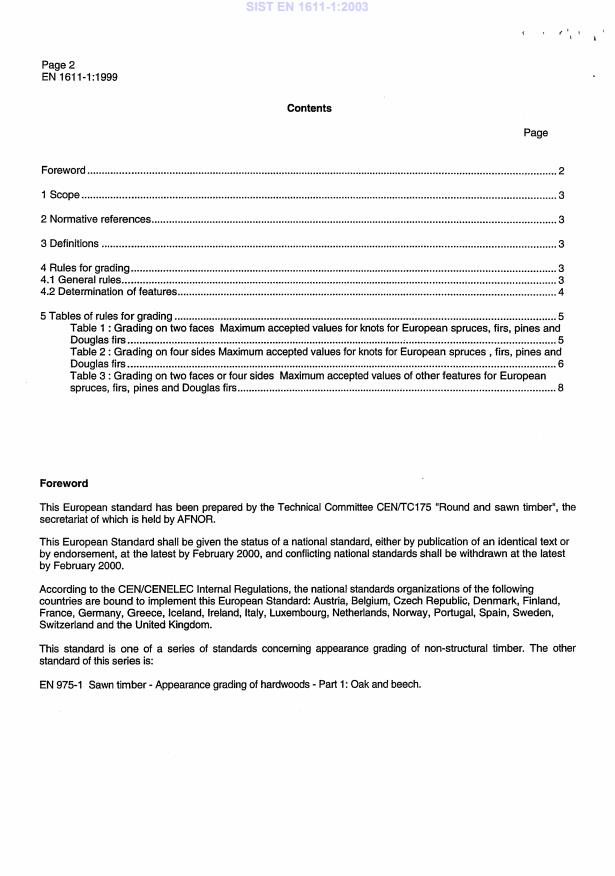
2003-01.Slovenski inštitut za standardizacijo. Razmnoževanje celote ali delov tega standarda ni dovoljeno.Schnittholz - Sortierung nach dem Aussehen von Nadelholz - Teil 1: Europäische Fichten, Tannen, Kiefern und DouglasieBois sciés - Classement d'aspect des bois résineux - Partie 1: Epicéas, sapins, pins et Douglas EuropéensSawn timber - Appearance grading of softwoods - Part 1: European spruces, firs, pines and Dougla
...
Questions, Comments and Discussion
Ask us and Technical Secretary will try to provide an answer. You can facilitate discussion about the standard in here.
Loading comments...