

SIST EN 60684-3-233:2006
(Main)Flexible insulating sleeving -- Part 3: Specifications for individual types of sleeving -- Sheet 233: Heat-shrinkable fluoroelastomer sleeving, flame retarded, fluid resistant, shrink ratio 2:1
- Abstract
This standard gives the requirements for two types of heat-shrinkable, flame retarded, fluid resistant, nominal shrink ratio 2:1, fluoroelastomer sleeving for use at temperatures up to 200 C: - Type A: thick wall; Type B: thin wall. These sleevings are normally supplied with internal diameters up to 51 mm, and the standard colour is black.
- Status
- Published
- Publication Date
- 30-Jun-2006
- Technical Committee
- IZO - Insulating materials
- Current Stage
- 6060 - National Implementation/Publication (Adopted Project)
- Start Date
- 01-Jul-2006
- Due Date
- 01-Jul-2006
- Completion Date
- 01-Jul-2006



SIST EN 60684-3-233:2006 is the SIST adoption of EN 60684-3-233:2006, a European Standard for flexible insulating sleeving. It specifies two types of heat-shrinkable, flame-retarded, fluid-resistant fluoroelastomer sleeving with a nominal shrink ratio of 2:1 for electrical applications up to 200 °C. Type A is thick wall and Type B is thin wall.
What does SIST EN 60684-3-233:2006 specify?
SIST EN 60684-3-233:2006 specifies the requirements for one sheet in the IEC 60684 series: Sheet 233 for heat-shrinkable fluoroelastomer sleeving. It covers the product form, the two wall types, the usual size range, the standard colour, and the test and acceptance requirements that define conformity.
The standard is organized into clauses 1 to 7 and Tables 1 to 6.
| Part | What it covers |
|---|---|
| Type A | Thick-wall sleeving |
| Type B | Thin-wall sleeving |
The scope says the sleeving is normally supplied with internal diameters up to 51 mm and that the standard colour is black. It also allows other sizes or colours as custom items if they meet the property requirements in Tables 3, 4, 5 and 6, except for dimensions and mass. That matters in practice because a purchaser can accept non-standard variants only by checking the performance tables, not by size alone.
What are the key requirements of SIST EN 60684-3-233:2006?
SIST EN 60684-3-233:2006 is centred on how the sleeving is identified, conditioned for test, sized, and checked for electrical, mechanical, thermal, fluid, and ageing performance. The most important requirements are in Clause 3, Clause 4, Clause 5, Clause 6, Clause 7, and Tables 1 to 6.
Identification and size control
Clause 3 gives the designation format: the description includes the IEC publication number, part, sheet, type, size and colour. In practice, this is the ordering language for procurement and traceability. The size is written as expanded/recovered internal diameter in millimetres, and colour abbreviations follow IEC 60757.
Tables 1 and 2 set the dimensional and mass requirements for Type A and Type B. Type A uses thicker walls and Type B thinner walls, so the buyer or inspector checks the right table before accepting a shipment.
Test conditioning and general conformity
Clause 4 requires the sleeving to be shrunk in forced-air circulation at 200 °C for the stated time before testing, unless another condition is specified. That means test specimens are prepared in a consistent recovered state before properties are measured.
Clause 5 ties the product to the general requirements of IEC 60684-1 and to the property tables in this sheet. Clause 6 says conformity is normally based on size 12,7/6,4 mm black sleeving, and colour fastness to light is qualified for all colours. In practice, this tells a laboratory which representative product to test for routine qualification.
Electrical, mechanical, and environmental performance
Table 3 combines the main acceptance requirements: tensile strength, elongation at break, longitudinal change, low-temperature bending, dimensional stability on storage, breakdown voltage, volume resistivity, flame propagation, copper corrosion, colour fastness to light, resistance to selected fluids, heat ageing, water absorption, and long-term ageing. These are the checks that show whether the sleeving will insulate, recover, survive handling, and stay serviceable in use.
Clause 7 and Table 4 set the breakdown voltage method and minimum values by recovered wall thickness. The voltage is applied at a stated rate, which matters because electrical test results depend on test speed as well as thickness.
Table 5 lists the selected fluids and temperatures for resistance testing, including fuels, oils, hydraulic fluids, cleaning fluids, runway de-icers, and aircraft de-icers. This is important for users in aviation and other fluid-exposed applications because chemical resistance has to match the actual service environment.
Table 6 adds fungus resistance and shelf life. The shelf-life requirement is especially relevant for stock control and incoming inspection because storage time affects whether material remains acceptable.
What terms does SIST EN 60684-3-233:2006 define?
- Type A - The thick-wall version of the sleeving, used where greater wall thickness is needed after recovery.
- Type B - The thin-wall version of the sleeving, used where a lighter wall is acceptable.
- Nominal shrink ratio 2:1 - The sleeving is intended to recover to about half of its expanded internal diameter.
- Breakdown voltage - The electrical voltage the sleeving can withstand before electrical failure during testing.
- Concentricity - A measure of how uniform the wall is around the circumference of the sleeving.
- Long-term ageing - A durability test used to show retained elongation after prolonged heat exposure.
- Colour fastness to light - The ability of the colour to resist visible change after light exposure.
Who uses SIST EN 60684-3-233:2006?
SIST EN 60684-3-233:2006 is used by designers and manufacturers of electrical and electronic equipment, especially where insulated wire, cable terminations, and protective sleeving must tolerate heat, fluids, and flame exposure. It is also used by quality managers, test laboratories, and buyers who need to specify, inspect, or qualify sleeving against a common product description.
What changed in SIST EN 60684-3-233:2006 from the previous edition?
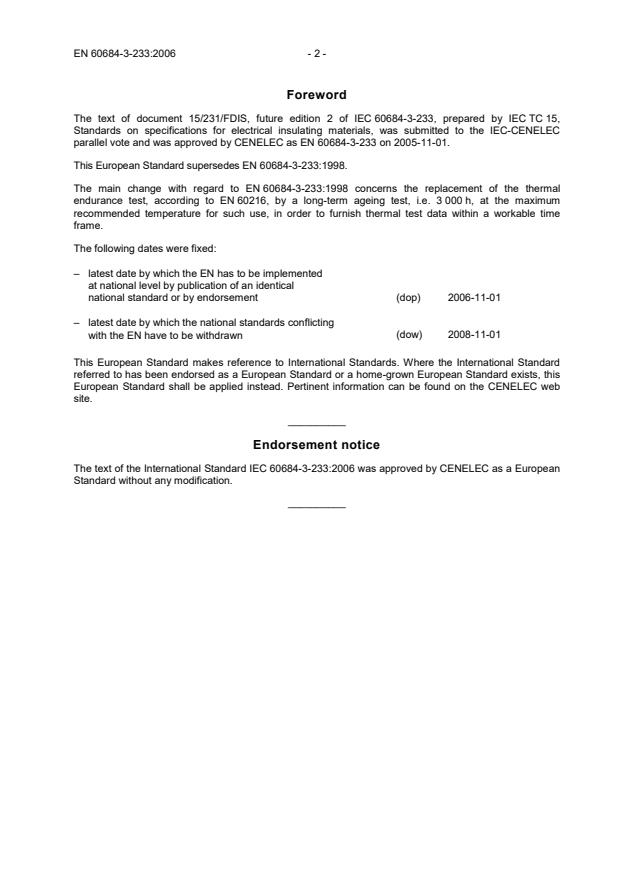
SIST EN 60684-3-233:2006 supersedes EN 60684-3-233:1998. The main stated change is the replacement of the thermal endurance test according to EN 60216 by a long-term ageing test, described in the foreword as 3 000 h at the maximum recommended temperature, so thermal test data can be obtained in a workable time frame.
Which standards are used with SIST EN 60684-3-233:2006?
SIST EN 60684-3-233:2006 relies on several companion and referenced standards:
- IEC 60684-1:2003 - Gives the definitions and general requirements for flexible insulating sleeving.
- IEC 60684-2:1997, Amendment 2003 - Provides the test methods used throughout the specification.
- IEC 60757:1983 - Gives colour designations used in the product designation.
- ISO 846:1997 - Provides the fungus resistance test method.
- ISO 1817:1999 - Provides liquid resistance testing for elastomeric materials.
What does the SIST EN 60684-3-233:2006 document contain?
SIST EN 60684-3-233:2006 contains the designation rule, test conditioning, size and mass tables for Type A and Type B, property requirements, breakdown voltage limits, selected-fluid resistance conditions, and additional requirements for fungus resistance and shelf life. It is a specification sheet rather than a design manual, so its main use is qualification, purchasing, and conformity assessment.
Relations
- Effective Date
- 06-May-2014
- Effective Date
- 09-Feb-2026
- Effective Date
- 03-Feb-2026
- Effective Date
- 03-Feb-2026
- Refers
SIST EN 60684-1:2004 - Flexible insulating sleeving -- Part 1: Definitions and general requirements - Effective Date
- 03-Feb-2026
- Effective Date
- 03-Feb-2026
- Effective Date
- 03-Feb-2026
- Referred By
SIST EN IEC 60684-2:2025 - Flexible insulating sleeving - Part 2: Methods of test (IEC 60684-2:2025) - Effective Date
- 03-Feb-2026
Get Certified
Connect with accredited certification bodies for this standard

IMQ S.p.A. (Certification)
Italian electrical product certification.

SLG Prüf- und Zertifizierungs GmbH
German testing and certification body.

UL Solutions
Global safety science company with testing, inspection and certification.
Sponsored listings
Frequently Asked Questions
SIST EN 60684-3-233:2006 is a standard published by the Slovenian Institute for Standardization (SIST). Its full title is "Flexible insulating sleeving -- Part 3: Specifications for individual types of sleeving -- Sheet 233: Heat-shrinkable fluoroelastomer sleeving, flame retarded, fluid resistant, shrink ratio 2:1". This standard covers: This standard gives the requirements for two types of heat-shrinkable, flame retarded, fluid resistant, nominal shrink ratio 2:1, fluoroelastomer sleeving for use at temperatures up to 200 C: - Type A: thick wall; Type B: thin wall. These sleevings are normally supplied with internal diameters up to 51 mm, and the standard colour is black.
This standard gives the requirements for two types of heat-shrinkable, flame retarded, fluid resistant, nominal shrink ratio 2:1, fluoroelastomer sleeving for use at temperatures up to 200 C: - Type A: thick wall; Type B: thin wall. These sleevings are normally supplied with internal diameters up to 51 mm, and the standard colour is black.
SIST EN 60684-3-233:2006 is classified under the following ICS (International Classification for Standards) categories: 29.035.20 - Plastics and rubber insulating materials. The ICS classification helps identify the subject area and facilitates finding related standards.
SIST EN 60684-3-233:2006 has the following relationships with other standards: It is inter standard links to SIST EN 60684-3-233:2001, SIST EN ISO 846:1999, SIST EN 60684-2:1998/A1:2004, SIST HD 457 S1:2003, SIST EN 60684-1:2004, SIST EN 60684-2:1998, SIST EN 60684-2:2011, SIST EN IEC 60684-2:2025. Understanding these relationships helps ensure you are using the most current and applicable version of the standard.
SIST EN 60684-3-233:2006 is available in PDF format for immediate download after purchase. The document can be added to your cart and obtained through the secure checkout process. Digital delivery ensures instant access to the complete standard document.
Standards Content (Sample)
Contents
- 1 Scope
- 2 Normative references
- 3 Designation
- 4 Conditions of test
- 5 Requirements
- 6 Sleeving conformance
- 7 Breakdown voltage
INTRODUCTION This International Standard is one of a series which deals with flexible insulating sleeving for electrical purposes.
The series consists of three parts:
Part 1: Definitions and general requirements (IEC 60684-1) Part 2: Methods of test (IEC 60684-2) Part 3: Specifications for individual types of sleeving (IEC 60684-3) This standard gives one of the sheets comprising part 3 as follows:
Sheet 233: Heat-shrinkable fluoroelastomer sleeving, flame retarded, fluid resistant, shrink ratio 2:1.
- 6 – 60684-3-233 IEC:2006(E) FLEXIBLE INSULATING SLEEVING –
Part 3: Specifications for individual types of sleeving – Sheet 233: Heat-shrinkable fluoroelastomer sleeving, flame retarded, fluid resistant, shrink ratio 2:1
1 Scope
This standard gives the requirements for two types of heat-shrinkable, flame retarded, fluid 1) resistant , nominal shrink ratio 2:1, fluoroelastomer sleeving for use at temperatures up to 200 °C:
− Type A: thick wall; − Type B: thin wall.
These sleevings are normally supplied with internal diameters up to 51 mm, and the standard colour is black.
Sizes or colours other than those specifically listed in this standard may be available as custom items. These items shall be considered to comply with this standard if they comply with the property requirements listed in Tables 3, 4, 5 and 6 except for . dimensions and mass Materials which conform to this specification meet established levels of performance. However, the selection of a material by a user for a specific application should be based on the actual requirements necessary for adequate performance in that application and not based on this specification alone
2 Normative references
The following referenced documents are indispensable for the application of this document. For dated references, only the edition cited applies. For undated references, the latest edition of the referenced document (including any amendments) applies.
IEC 60684-1:2003, Flexible insulating sleeving – Part 1: Definitions and general requirements IEC 60684-2.1:1997, Flexible insulating sleeving – Part 2: Methods of test Amendment (2003) IEC 60757:1983, Code for designation of colours ISO 846:1997, Plastics – Evaluation of the action of micr-organisms ISO 1817:1999, Rubber, vulcanized – Determination of the effect of liquids
1) Except to phosphate ester-based hydraulic fluids.
60684-3-233 IEC:2006(E) – 7 –
3 Designation
The sleeving shall be identified by the following designation:
Description IEC publication IEC Part IEC sheet Type Size (expanded and Colour number number number recovered internal diameter in mm)
Sleeving IEC 60684 - 3 -233 -A - 12,7/6,4 - BK Any colour abbreviation shall comply with IEC 60757, where applicable. Non-standard colours shall be written out in full.
4 Conditions of test
Unless otherwise specified, the sleeving shall be shrunk in a forced air circulation oven for (5 ± 1) min at 200 °C ± 5 K prior to testing.
5 Requirements
In addition to the general requirements given in IEC 60684-1, the sleeving shall comply with the requirements of Tables 1, 2, 3, 4, 5 and 6.
...