

SIST-TS CEN/TS 17981-2:2024
(Main)In vitro diagnostic Next Generation Sequencing (NGS) workflows - Part 2: Human RNA examination
General Information
- Abstract
This document specifies requirements and gives recommendations for next generation sequencing (NGS) workflows for in vitro diagnostics and biomedical research. This document covers the pre-examination processes, human RNA isolation, sequencing library preparation, sequencing, sequence analysis and reporting of the examination of sequences for diagnostic purposes from isolated RNA from, e.g. formalin-fixed and paraffin embedded tissues, fresh frozen tissues, fine needle aspirates (FNA), whole blood, circulating tumour cells (CTCs), exosomes and other extracellular vesicles, and circulating cell free RNA from plasma.
NOTE 1 Typical applications include, but are not limited to, NGS for oncology and clinical genetics, certain single-cell analyses.
This document is applicable to molecular in vitro diagnostic examinations including laboratory developed tests performed by medical laboratories, molecular pathology laboratories and molecular genetic laboratories. This document is also applicable to laboratory customers, in vitro diagnostics developers and manufacturers, biobanks, institutions, and organisations performing biomedical research.
This document is not applicable for in situ sequencing, forensic sequencing, sequencing of pathogens or microorganisms and microbiome analysis.
NOTE 2 International, national or regional regulations or requirements or multiples of them can also apply to specific topics covered in this document.
- Status
- Published
- Public Enquiry End Date
- 12-Sep-2023
- Publication Date
- 08-Feb-2024
- Technical Committee
- VAZ - Healthcare
- Current Stage
- 6060 - National Implementation/Publication (Adopted Project)
- Start Date
- 24-Jan-2024
- Due Date
- 30-Mar-2024
- Completion Date
- 09-Feb-2024

Overview
CEN/TS 17981-2:2023 specifies requirements and recommendations for Next Generation Sequencing (NGS) workflows focused on human RNA examination for in vitro diagnostics (IVD) and biomedical research. The Technical Specification covers the full NGS pipeline - from pre-examination processes and human RNA isolation to sequencing library preparation, sequencing, sequence analysis and reporting - for sample types such as FFPE, fresh frozen tissue, fine needle aspirates (FNA), whole blood, circulating tumour cells (CTCs), exosomes/extracellular vesicles, and circulating cell‑free RNA (cfRNA) from plasma. Typical use cases include oncology, clinical genetics, and certain single‑cell analyses. The document is intended for medical laboratories, molecular pathology and genetic labs, IVD developers and manufacturers, biobanks and research organisations.
Key topics and requirements
- Scope & exclusions
- Applies to molecular IVD examinations and laboratory‑developed tests based on RNA sequencing.
- Not applicable to in situ sequencing, forensic sequencing, pathogen/microorganism sequencing or microbiome analysis.
- Workflow phases
- Pre‑examination: specimen collection, transport, storage and human RNA isolation methods (FFPE, fresh frozen, FNA, blood, cfRNA, CTCs, exosomes).
- Examination: sequencing library preparation, RNA‑Seq methods, sequencing platform considerations (short vs long reads, panel vs transcriptome).
- Post‑examination: bioinformatics/sequence analysis, reporting and interpretation.
- Quality, validation and performance
- Requirements for examination design, development, verification, validation and ongoing performance monitoring.
- Emphasis on RNA sample quality/quantity assessment, sequencing QC, controls and metadata capture across the workflow.
- Reporting and traceability
- Attributes and content of diagnostic reports to support clinical interpretation and reproducibility.
- Special topics
- Annexes cover single‑cell workflows and spatial transcriptomics examples.
Practical applications and users
- Laboratories implementing RNA‑based NGS assays for cancer diagnostics, germline/somatic variant detection, fusion/transcript analysis and expression profiling.
- Developers and manufacturers of IVD kits and sequencing platforms seeking harmonized requirements for clinical RNA sequencing workflows.
- Biobanks and research institutions standardizing RNA sample handling for translational studies and multi‑site projects.
- Clinical teams and molecular pathologists relying on standardized reporting to inform treatment decisions.
Related standards
- CEN/TS 17390-1 (CTC RNA), CEN/TS 17688-1 (FNA RNA), CEN/TS 17742 (cfRNA), CEN/TS 17747 (exosomes)
- EN ISO 15189, EN ISO/IEC 17025, EN ISO/IEC 17020 - for laboratory quality and competence
Keywords: NGS workflow, in vitro diagnostic, human RNA, RNA‑Seq, FFPE, circulating cell free RNA, CTCs, sequencing library preparation, bioinformatics, molecular diagnostics, oncology.
Relations
- Effective Date
- 28-Jan-2026
- Effective Date
- 28-Jan-2026
- Effective Date
- 28-Jan-2026
- Effective Date
- 28-Jan-2026
- Effective Date
- 28-Jan-2026
- Effective Date
- 28-Jan-2026
- Effective Date
- 28-Jan-2026
- Effective Date
- 28-Jan-2026
- Effective Date
- 28-Jan-2026
- Effective Date
- 28-Jan-2026
- Effective Date
- 28-Jan-2026
- Effective Date
- 28-Jan-2026
- Effective Date
- 28-Jan-2026
Get Certified
Connect with accredited certification bodies for this standard

BSI Group
BSI (British Standards Institution) is the business standards company that helps organizations make excellence a habit.

TÜV Rheinland
TÜV Rheinland is a leading international provider of technical services.

TÜV SÜD
TÜV SÜD is a trusted partner of choice for safety, security and sustainability solutions.
Sponsored listings
Frequently Asked Questions
SIST-TS CEN/TS 17981-2:2024 is a technical specification published by the Slovenian Institute for Standardization (SIST). Its full title is "In vitro diagnostic Next Generation Sequencing (NGS) workflows - Part 2: Human RNA examination". This standard covers: This document specifies requirements and gives recommendations for next generation sequencing (NGS) workflows for in vitro diagnostics and biomedical research. This document covers the pre-examination processes, human RNA isolation, sequencing library preparation, sequencing, sequence analysis and reporting of the examination of sequences for diagnostic purposes from isolated RNA from, e.g. formalin-fixed and paraffin embedded tissues, fresh frozen tissues, fine needle aspirates (FNA), whole blood, circulating tumour cells (CTCs), exosomes and other extracellular vesicles, and circulating cell free RNA from plasma. NOTE 1 Typical applications include, but are not limited to, NGS for oncology and clinical genetics, certain single-cell analyses. This document is applicable to molecular in vitro diagnostic examinations including laboratory developed tests performed by medical laboratories, molecular pathology laboratories and molecular genetic laboratories. This document is also applicable to laboratory customers, in vitro diagnostics developers and manufacturers, biobanks, institutions, and organisations performing biomedical research. This document is not applicable for in situ sequencing, forensic sequencing, sequencing of pathogens or microorganisms and microbiome analysis. NOTE 2 International, national or regional regulations or requirements or multiples of them can also apply to specific topics covered in this document.
This document specifies requirements and gives recommendations for next generation sequencing (NGS) workflows for in vitro diagnostics and biomedical research. This document covers the pre-examination processes, human RNA isolation, sequencing library preparation, sequencing, sequence analysis and reporting of the examination of sequences for diagnostic purposes from isolated RNA from, e.g. formalin-fixed and paraffin embedded tissues, fresh frozen tissues, fine needle aspirates (FNA), whole blood, circulating tumour cells (CTCs), exosomes and other extracellular vesicles, and circulating cell free RNA from plasma. NOTE 1 Typical applications include, but are not limited to, NGS for oncology and clinical genetics, certain single-cell analyses. This document is applicable to molecular in vitro diagnostic examinations including laboratory developed tests performed by medical laboratories, molecular pathology laboratories and molecular genetic laboratories. This document is also applicable to laboratory customers, in vitro diagnostics developers and manufacturers, biobanks, institutions, and organisations performing biomedical research. This document is not applicable for in situ sequencing, forensic sequencing, sequencing of pathogens or microorganisms and microbiome analysis. NOTE 2 International, national or regional regulations or requirements or multiples of them can also apply to specific topics covered in this document.
SIST-TS CEN/TS 17981-2:2024 is classified under the following ICS (International Classification for Standards) categories: 11.100.10 - In vitro diagnostic test systems. The ICS classification helps identify the subject area and facilitates finding related standards.
SIST-TS CEN/TS 17981-2:2024 has the following relationships with other standards: It is inter standard links to SIST-TS CEN ISO/TS 7552-1:2025, SIST EN ISO 20184-1:2019, SIST EN ISO 13164-4:2023, SIST EN ISO 27065:2018/A1:2020, SIST-TS CEN/TS 17742:2022, SIST EN ISO 20166-1:2019, SIST EN ISO 15189:2023, SIST-TS CEN/TS 17747:2022, SIST EN ISO/IEC 17020:2012, SIST EN ISO 20186-1:2019, SIST-TS CEN/TS 17688-1:2022, SIST EN ISO/IEC 17025:2017, SIST EN ISO 15877-3:2009/A2:2021. Understanding these relationships helps ensure you are using the most current and applicable version of the standard.
SIST-TS CEN/TS 17981-2:2024 is available in PDF format for immediate download after purchase. The document can be added to your cart and obtained through the secure checkout process. Digital delivery ensures instant access to the complete standard document.
Standards Content (Sample)
SLOVENSKI STANDARD
01-marec-2024
In vitro diagnostični delovni postopki Sekvenciranje naslednje generacije (NGS) -
2. del: Preiskava človeškega RNK
In vitro diagnostic Next Generation Sequencing (NGS) workflows - Part 2: Human RNA
examination
Next Generation Sequencing (NGS)-Arbeitsabläufe für die In-vitro-Diagnostik - Teil 2:
Untersuchung von menschlicher RNA
Diagnostic in vitro Séquençage de nouvelle génération (NGS) - Partie 2 : Examens de
l'ARN humain
Ta slovenski standard je istoveten z: CEN/TS 17981-2:2023
ICS:
11.100.10 Diagnostični preskusni In vitro diagnostic test
sistemi in vitro systems
2003-01.Slovenski inštitut za standardizacijo. Razmnoževanje celote ali delov tega standarda ni dovoljeno.
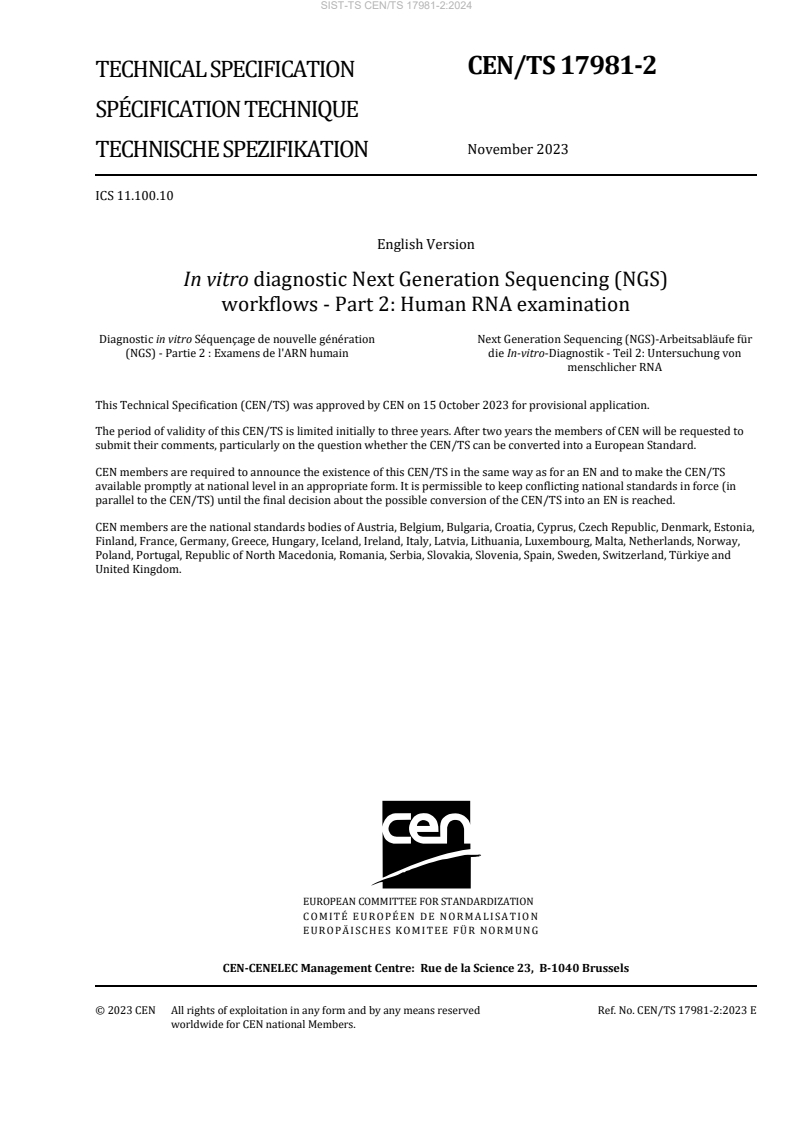
CEN/TS 17981-2
TECHNICAL SPECIFICATION
SPÉCIFICATION TECHNIQUE
November 2023
TECHNISCHE SPEZIFIKATION
ICS 11.100.10
English Version
In vitro diagnostic Next Generation Sequencing (NGS)
workflows - Part 2: Human RNA examination
Diagnostic in vitro Séquençage de nouvelle génération Next Generation Sequencing (NGS)-Arbeitsabläufe für
(NGS) - Partie 2 : Examens de l'ARN humain die In-vitro-Diagnostik - Teil 2: Untersuchung von
menschlicher RNA
This Technical Specification (CEN/TS) was approved by CEN on 15 October 2023 for provisional application.
The period of validity of this CEN/TS is limited initially to three years. After two years the members of CEN will be requested to
submit their comments, particularly on the question whether the CEN/TS can be converted into a European Standard.
CEN members are required to announce the existence of this CEN/TS in the same way as for an EN and to make the CEN/TS
available promptly at national level in an appropriate form. It is permissible to keep conflicting national standards in force (in
parallel to the CEN/TS) until the final decision about the possible conversion of the CEN/TS into an EN is reached.
CEN members are the national standards bodies of Austria, Belgium, Bulgaria, Croatia, Cyprus, Czech Republic, Denmark, Estonia,
Finland, France, Germany, Greece, Hungary, Iceland, Ireland, Italy, Latvia, Lithuania, Luxembourg, Malta, Netherlands, Norway,
Poland, Portugal, Republic of North Macedonia, Romania, Serbia, Slovakia, Slovenia, Spain, Sweden, Switzerland, Türkiye and
United Kingdom.
EUROPEAN COMMITTEE FOR STANDARDIZATION
COMITÉ EUROPÉEN DE NORMALISATIO N
EUROPÄISCHES KOMITEE FÜR NORMUN G
CEN-CENELEC Management Centre: Rue de la Science 23, B-1040 Brussels
© 2023 CEN All rights of exploitation in any form and by any means reserved Ref. No. CEN/TS 17981-2:2023 E
worldwide for CEN national Members.
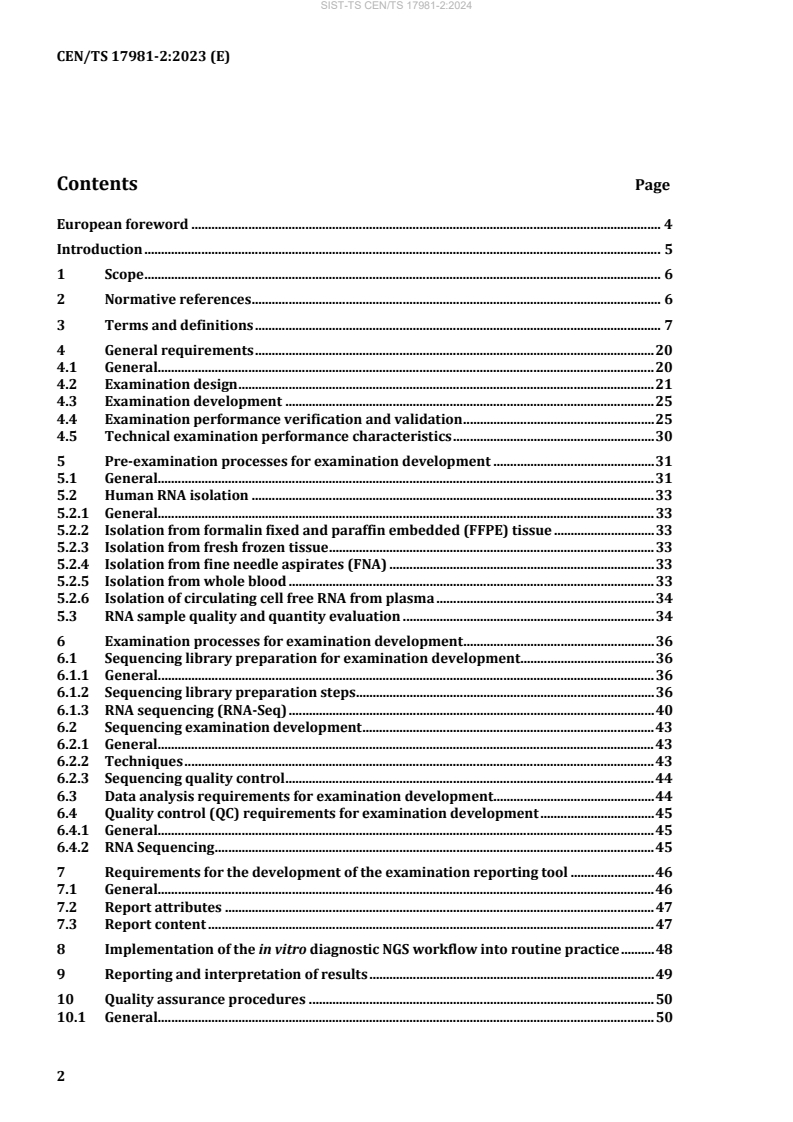
Contents Page
European foreword . 4
Introduction . 5
1 Scope . 6
2 Normative references . 6
3 Terms and definitions . 7
4 General requirements . 20
4.1 General. 20
4.2 Examination design . 21
4.3 Examination development . 25
4.4 Examination performance verification and validation . 25
4.5 Technical examination performance characteristics . 30
5 Pre-examination processes for examination development . 31
5.1 General. 31
5.2 Human RNA isolation . 33
5.2.1 General. 33
5.2.2 Isolation from formalin fixed and paraffin embedded (FFPE) tissue . 33
5.2.3 Isolation from fresh frozen tissue . 33
5.2.4 Isolation from fine needle aspirates (FNA) . 33
5.2.5 Isolation from whole blood . 33
5.2.6 Isolation of circulating cell free RNA from plasma . 34
5.3 RNA sample quality and quantity evaluation . 34
6 Examination processes for examination development . 36
6.1 Sequencing library preparation for examination development . 36
6.1.1 General. 36
6.1.2 Sequencing library preparation steps . 36
6.1.3 RNA sequencing (RNA-Seq) . 40
6.2 Sequencing examination development . 43
6.2.1 General. 43
6.2.2 Techniques . 43
6.2.3 Sequencing quality control . 44
6.3 Data analysis requirements for examination development . 44
6.4 Quality control (QC) requirements for examination development . 45
6.4.1 General. 45
6.4.2 RNA Sequencing . 45
7 Requirements for the development of the examination reporting tool . 46
7.1 General. 46
7.2 Report attributes . 47
7.3 Report content . 47
8 Implementation of the in vitro diagnostic NGS workflow into routine practice . 48
9 Reporting and interpretation of results . 49
10 Quality assurance procedures . 50
10.1 General. 50
10.2 Performance monitoring, optimization of the examination and interlaboratory
comparison . 50
Annex A (normative) in vitro diagnostic NGS workflow for single-cell analyses. 51
A.1 General information and requirements on single-cell analyses . 51
A.2 Pre-examination processes for examination development . 52
A.2.1 General information of applicable procedures . 52
A.2.2 Requirements for CTCs from blood specimen collection to CTC isolation . 52
A.2.3 Requirements for fresh frozen/FFPE human tissue from specimen collection to
isolation of single cells . 52
A.2.4 Human RNA isolation . 54
A.2.5 RNA sample quality evaluation. 55
A.3 Examination phase for examination development . 55
A.3.1 Sequencing library preparation for examination development for CTCs and single
cells from tissues . 55
A.3.2 Sequencing examination development for CTCs and single cells from tissues . 55
A.3.3 Data analysis requirements for examination development for CTCs and single cells
from tissues . 56
A.3.4 QC requirements for examination development . 57
A.4 Implementation of the in vitro diagnostic NGS workflow into routine practice . 57
A.5 Reporting and interpretation of results . 57
A.6 Quality assurance procedures . 57
Annex B (normative) Exemplary in vitro diagnostic NGS workflow for spatial transcriptomics
................................................................................................................................................................... 58
Annex C (informative) in vitro diagnostic NGS workflow scheme for the examination of RNA
................................................................................................................................................................... 59
Bibliography . 60
European foreword
This document (CEN/TS 17981-2:2023) has been prepared by Technical Committee CEN/TC 140 “In
vitro diagnostic medical devices”, the secretariat of which is held by DIN.
Attention is drawn to the possibility that some of the elements of this document may be the subject of
patent rights. CEN shall not be held responsible for identifying any or all such patent rights.
A list of all parts in this series can be found on the CEN website: www.cencenelec.eu.
Any feedback and questions on this document should be directed to the users’ national standards body.
A complete listing of these bodies can be found on the CEN website.
According to the CEN/CENELEC Internal Regulations, the national standards organisations of the
following countries are bound to announce this Technical Specification: Austria, Belgium, Bulgaria,
Croatia, Cyprus, Czech Republic, Denmark, Estonia, Finland, France, Germany, Greece, Hungary, Iceland,
Ireland, Italy, Latvia, Lithuania, Luxembourg, Malta, Netherlands, Norway, Poland, Portugal, Republic of
North Macedonia, Romania, Serbia, Slovakia, Slovenia, Spain, Sweden, Switzerland, Türkiye and the
United Kingdom.
Introduction
Molecular in vitro diagnostics has enabled significant progress in medicine. Further progress is expected
by new technologies analysing profiles of nucleic acids, proteins, and metabolites in human tissues and
body fluids. Next Generation Sequencing (NGS) takes a prominent place in the series of molecular
techniques used for diagnostics. It facilitates sequence analysis of nucleic acids that can result in precise
information for diagnosis and progression of diseases.
The NGS technique, however, has a very complex workflow that contains many steps. The target nucleic
acids can originate from different sources, e.g. tissues, blood, and body fluids. The profiles of the isolated
RNA can change during specimen collection, transport, storage and processing (e.g. formalin fixation)
making the outcome from diagnostics or research unreliable or even impossible because the subsequent
analytical assay will not determine the situation in the patient but an artificial profile generated during
the pre-examination process. The available material can be small, the cells in a tissue can be dispersed
heterogeneously (e.g. ratio of tumour to normal), the target nucleic acids can be circulating in blood or
body fluids free of cells or in circulating cells (e.g. circulating tumour cells (CTCs)). For a successful and
reliable sequence result, a suitable strategy needs to be chosen for every case depending on the available
material and disease conditions. Therefore, the NGS workflow can differ from case to case, and the NGS
workflow steps need to be carefully considered and chosen to get a sound and reliable result to determine
the best available treatment for the patient. In addition, sequence platforms can differ in their technique
(e.g. detection of a change in a current or fluorescence) and approach (e.g. whole transcriptome, panels,
short-read sequencing, long-read sequencing) for sequence assessment. The bioinformatics analysis can
differ in approach and ability to detect non-conformities and unreliable sequence results. To enable such
capabilities, NGS metadata needs to be collected during all workflow steps from the patient to the
reporting. In addition, controls and added controls need to be analysed properly. This way non-
conformities or detected unreliabilities can be reported to the patient and the treating physician. The
reporting of diagnostic NGS results can differ in clarity and depth, which can lead to different
interpretations.
Standardization of the entire NGS workflow from specimen collection to the reporting of the results to
the patient and the treating physician is needed for the development of reliable NGS examinations.
This document draws upon previous work to standardize the steps for NGS examinations from tissues,
blood and body fluids in what is referred to as the pre-examination phase (sample collection), the
examination phase (library preparation, sequencing), and the post-examination phase (analysis and
reporting).
In this document, the following verbal forms are used:
— “shall” indicates a requirement;
— “should” indicates a recommendation;
— “may” indicates a permission;
— “can” indicates a possibility or a capability.
1 Scope
This document specifies requirements and gives recommendations for next generation sequencing (NGS)
workflows for in vitro diagnostics and biomedical research. This document covers the pre-examination
processes, human RNA isolation, sequencing library preparation, sequencing, sequence analysis and
reporting of the examination of sequences for diagnostic purposes from isolated RNA from, e.g. formalin-
fixed and paraffin embedded tissues, fresh frozen tissues, fine needle aspirates (FNA), whole blood,
circulating tumour cells (CTCs), exosomes and other extracellular vesicles, and circulating cell free RNA
from plasma.
NOTE 1 Typical applications include, but are not limited to, NGS for oncology and clinical genetics, certain single-
cell analyses.
This document is applicable to molecular in vitro diagnostic examinations including laboratory developed
tests performed by medical laboratories, molecular pathology laboratories and molecular genetic
laboratories. This document is also applicable to laboratory customers, in vitro diagnostics developers
and manufacturers, biobanks, institutions, and organisations performing biomedical research.
This document is not applicable for in situ sequencing, forensic sequencing, sequencing of pathogens or
microorganisms and microbiome analysis.
NOTE 2 International, national or regional regulations or requirements or multiples of them can also apply to
specific topics covered in this document.
2 Normative references
The following documents are referred to in the text in such a way that some or all of their content
constitutes requirements of this document. For dated references, only the edition cited applies. For
undated references, the latest edition of the referenced document (including any amendments) applies.
CEN/TS 17390-1, Molecular in vitro diagnostic examinations — Specifications for pre-examination
processes for circulating tumor cells (CTCs) in venous whole blood — Part 1: Isolated RNA
CEN/TS 17688-1:2021, Molecular in vitro diagnostic examinations - Specifications for pre-examination
processes for Fine Needle Aspirates (FNAs) — Part 1: Isolated cellular RNA
CEN/TS 17747, Molecular in vitro diagnostic examinations — Specifications for pre-examination processes
for exosomes and other extracellular vesicles in venous whole blood — DNA, RNA and proteins
CEN/TS 17742, Molecular in vitro diagnostic examinations — Specifications for pre-examination processes
for venous whole blood — Isolated circulating cell free RNA from plasma
EN ISO 15189:2022, Medical laboratories — Requirements for quality and competence (ISO 15189:2022)
EN ISO/IEC 17020:2012, Conformity assessment — Requirements for the operation of various types of
bodies performing inspection (ISO/IEC 17020:2012)
EN ISO/IEC 17025:2017, General requirements for the competence of testing and calibration laboratories
(ISO/IEC 17025:2017)
EN ISO 20166-1:2018, Molecular in vitro diagnostic examinations — Specifications for pre-examination
processes for formalin-fixed and paraffin-embedded (FFPE) tissue — Part 1: Isolated RNA
(ISO 20166-1:2018)
EN ISO 20184-1:2018, Molecular in vitro diagnostic examinations — Specifications for pre-examination
processes for frozen tissue — Part 1: Isolated RNA (ISO 20184-1:2018)
EN ISO 20186-1, Molecular in vitro diagnostic examinations — Specifications for pre-examination
processes for venous whole blood — Part 1: Isolated cellular RNA (ISO 20186-1)
ISO 8601-1, Date and time — Representations for information interchange — Part 1: Basic rules
ISO 20397-1:2022, Biotechnology — Massively parallel sequencing — Part 1: Nucleic acid and library
preparation
ISO 20397-2, Biotechnology — Massively parallel sequencing — Part 2: Quality evaluation of sequencing
data
3 Terms and definitions
For the purposes of this document, the terms and definitions given in EN ISO 15189:2022 and the
following apply.
ISO and IEC maintain terminology databases for use in standardization at the following addresses:
— ISO Online browsing platform: available at https://www.iso.org/obp
— IEC Electropedia: available at https://www.electropedia.org/
3.1
aliquot
portion of a larger amount of homogenous material, assumed to be taken with negligible sampling error
Note 1 to entry: The term is usually applied to fluids. Tissues are heterogeneous and therefore cannot be aliquoted.
Note 2 to entry: The definition is derived from [1] [2] [3].
[SOURCE: EN ISO 20184-3:2021, 3.1, modified ─ Note 2 to entry was added.]
3.2
amplicon
specific DNA fragment produced by a DNA-amplification technology, such as the polymerase chain
reaction (PCR)
[SOURCE: ISO 13495:2013, 3.3.1]
3.3
analyte
component represented in the name of a measurable quantity
[SOURCE: EN ISO 17511:2021, 3.2]
3.4
analytical accuracy
closeness of the agreement between the result of an examination and a true value
Note 1 to entry: For NGS-based examinations, accuracy represents the degree of concordance (or agreement) of
results between a sequence obtained from the examination and the same sequence determined by a valid
comparator method, or between a reference sample run on an NGS-based examination and the high confidence
sequence of the reference.
3.5
analytical sensitivity
sensitivity of a measurement procedure
quotient of the change in a measurement indication and the corresponding change in a value of a quantity
being measured
Note 1 to entry: The sensitivity of a measurement procedure can depend on the value of the quantity being
measured.
Note 2 to entry: The change considered in the value of the quantity being measured must be large compared with
the resolution.
Note 3 to entry: The analytical sensitivity of a measuring system is the slope of the calibration curve.
Note 4 to entry: Analytical sensitivity is often confused with positive percentage agreement (PPA), because similar
calculations are used for both the analytical sensitivity and the PPA. However, the term PPA instead of analytical
sensitivity is only used, if a reference method is not available or is not used. The PPA represents merely an
estimation of the analytical sensitivity. PPA is applicable only to measurements of quantities that have the nature of
a count.
[SOURCE: ISO/IEC Guide 99:2007, 4.12, modified — definition slightly changed, new Note 3 and Note 4
was added.]
3.6
analytical specificity
capability of a measuring system, using a specified measurement procedure, to provide measurement
results for one or more measurands which do not depend on each other nor on any other quantity in the
system undergoing measurement
Note 1 to entry: Lack of analytical specificity is called analytical interference (see EN ISO 18113-1:2009, A.3.2).
Note 2 to entry: Specificity of a measurement procedure is not to be confused with clinical specificity (SOURCE:
EN ISO 18113-1:2009, A.3.16).
Note 3 to entry: VIM; JCGM 200:2012 uses the term selectivity for this concept instead of specificity.
Note 4 to entry: For qualitative and semiquantitative examination procedures, analytical specificity is determined
by the ability to obtain negative results in concordance with negative results obtained by the reference method.
Note 5 to entry: Analytical specificity is often confused with negative percentage agreement (NPA), because the
same calculations are used for both the analytical specificity and the NPA. However, the term NPA instead of
analytical specificity is only used, if a reference method is not available or is not used. The NPA represents merely
an estimation of the analytical specificity.
[SOURCE: EN ISO 18113-1:2009, A.3.4, modified — “should” was replaced by “is” and Note 5 was added.]
3.7
bioinformatics pipeline
suite of different bioinformatics tools that process the NGS data
3.8
ccfRNA
circulating cell free RNA
extracellular human RNA present in blood and plasma
Note 1 to entry: ccfRNA includes RNA present in vesicles such as exosomes.
3.9
clinical accuracy
diagnostic accuracy
extent of agreement between the outcome of the new examination and the reference method
3.10
clinical performance
ability of an examination to yield results that are correlated with a particular clinical condition,
physiological or pathological state in accordance with the target population and intended use(r)
Note 1 to entry: Although sometimes referred to as diagnostic performance or clinical validity; clinical
performance is the harmonized term endorsed by the Global Harmonization Task Force (GHTF) and its successor,
the International Medical Devices Regulators Forum (IMDRF).
Note 2 to entry: Evaluation of clinical performance often relies on the outcome of other types of clinical
examinations to define “true positive or true negative” results.
3.11
clinical sensitivity
diagnostic sensitivity
ability of an in vitro diagnostic examination procedure to identify the presence of a target marker
associated with a specific disease or condition
Note 1 to entry: Also defined as percent positivity in samples where the target marker is known to be present.
Note 2 to entry: Diagnostic sensitivity is expressed as a percentage (number fraction multiplied by 100), calculated
as 100 × the number of true positive values (TP) divided by the sum of the number of true positive values (TP) plus
the number of false negative values (FP), or 100 × TP/(TP + FN). This calculation is based on a study design where
only one sample is taken from each subject.
Note 3 to entry: The target condition is defined by criteria independent of the examination procedure under
consideration.
Note 4 to entry: Clinical sensitivity is often confused with positive percentage agreement (PPA), because the same
calculations are used for both the clinical sensitivity and the PPA. However, the term PPA instead of clinical
sensitivity is only used, if a reference method is not available or is not used. The PPA represents merely an
estimation of the clinical sensitivity.
[SOURCE: EN ISO 18113-1:2009, A.3.15, modified — “” was deleted and Note 4
was added.]
3.12
clinical specificity
diagnostic specificity
ability of an in vitro diagnostic examination procedure to recognise the absence of a target marker
associated with a specific disease or condition
Note 1 to entry: Also defined as percent negativity in samples where the target marker is known to be absent.
Note 2 to entry: Clinical specificity is expressed as a percentage (number fraction multiplied by 100), calculated as
100 × the number of true negative values (TN) divided by the sum of the number of true negative plus the number
of false positive values (FP), or 100 × TN/(TN + FP). This calculation is based on a study design where only one
sample is taken from each subject.
Note 3 to entry: The target condition is defined by criteria independent of the examination procedure under
consideration.
Note 4 to entry: Clinical specificity is often confused with negative percentage agreement (NPA), because the same
calculations are used for both the clinical specificity and the NPA. However, the term NPA instead of clinical
specificity is only used, if a reference method is not available or is not used. The NPA represents merely an
estimation of the clinical specificity.
[SOURCE: EN ISO 18113-1:2009, A.3.16, modified — “” was deleted and Note 4
was added.]
3.13
clinical utility
ability of a screening or diagnostic examination to prevent or ameliorate adverse health outcomes such
as mortality, morbidity, or disability through the adoption of efficacious treatments conditioned on
examination results
Note 1 to entry: Clinical utility can be part of scientific validity and clinical performance [4] [5].
[SOURCE: [4]]
3.14
clinical validity
predictive value of a test for a given clinical outcome
Note 1 to entry: Clinical validity is primarily determined by the sensitivity and specificity with which a test
identifies individuals with a defined clinical condition within a given population. The clinical validity of a genetic
test is the likelihood that, e.g. cancer will develop in someone with a positive test result.
3.15
closed system
non-modifiable system provided by the vendor including all necessary components for the examination
(i.e., hardware, software, procedures and reagents)
3.16
diagnosis
identification of a disease from its signs and symptoms, where the diagnostic process can involve
examinations and tests for classification of an individual's condition into separate and distinct categories
or subclasses that allow medical decisions about treatment and prognosis to be made
3.17
DNA
deoxyribonucleic acid
polymer of deoxyribonucleotides occurring in a double-stranded (dsDNA) or single-stranded (ssDNA)
form
[SOURCE: EN ISO 22174:2005, 3.1.2]
3.18
DNase
deoxyribonuclease
enzyme that catalyzes the degradation of DNA into smaller components
[SOURCE: EN ISO 20186-3:2019, 3.9]
3.19
EV
extracellular vesicle
particle naturally released from the cell that is delimited by a lipid bilayer and cannot replicate, i.e. does
not contain a functional nucleus
EXAMPLE Exosomes, endosomes, oncosomes, apoptotic bodies.
[SOURCE: [6]]
3.20
examination
analytical test
set of operations having the objective of determining the numerical value or characteristics of a property
[SOURCE: EN ISO 15189:2022, 3.8, modified — Notes to entry 1 to 3 have been removed. “analytical test”
has been added as a preferred term.]
3.21
examination manufacturer
analytical test manufacturer
entity that manufactures and/or produces a specific analytical test
[SOURCE: EN ISO 20166-4:2021, 3.16]
3.22
examination performance
analytical test performance
analytical performance
ability of an examination procedure to measure or detect a particular analyte
Note 1 to entry: Analytical performance is determined from analytical performance studies used to assess the
ability of an in vitro diagnostic examination procedure to measure or detect a particular analyte.
Note 2 to entry: Analytical performance includes such characteristics as analytical sensitivity, detection limit,
analytical specificity (interference and cross-reactivity), trueness, precision and linearity.
[SOURCE: EN ISO 20186-3:2019, 3.11]
3.23
formalin
saturated aqueous formaldehyde solution which at 100 % contains 37 % formaldehyde by mass
(corresponding to 40 % by volume)
[SOURCE: EN ISO 20166-1:2018, 3.11]
3.24
FNA
fine needle aspirate
specimen withdrawn by a non-operative procedure that uses a thin, hollow-bore needle
[SOURCE: CEN/TS 17688-1:2021, 3.18]
3.25
in vitro diagnostic NGS workflow
all activities required to generate the NGS examination result including the pre-examination processes
(3.39), examination (3.20) and post-examination processes (3.38)
3.26
in-house examination
laboratory developed examination
examination manufactured or modified and used by health institutions or medical laboratories intended
to be used only in their facility, to fulfil specific needs of target patient groups which cannot be met by an
equivalent IVD examination available on the market at the appropriate level of performance
Note 1 to entry: In-house examination is also often referred to as a laboratory developed test (LDT).
3.27
intended use
intended purpose
use of a product, process or service intended for medical purposes in accordance with the specifications,
instructions and information provided by the manufacturer
Note 1 to entry: The intended purpose indicates the object to be detected/measured, the examination’s function
(screening, monitoring, diagnosis, prognosis, companion diagnostic), if the examination is automated, specific
information to be provided as a component of the device (to determine physiological/pathological state, clinical
condition or predisposition, prediction to treatment response/reaction or monitoring of a therapy or non-
proprietary name of the medicinal product for companion test; safety to recipients), if the examination results are
qualitative or quantitative, the type of specimen required, and the intended population.
Note 2 to entry: The intended purpose directly drives the level of the performance evaluation, the examination
methodology, the hardware and software, the examination limitations, positive controls, risk to health (e.g.
diagnostic use or screening; consequences of false negatives (FN) or false positives (FP)), the number of samples,
and the types of samples.
[SOURCE: ISO 17966:2016, 3.15, modified ― Two notes were added.]
3.28
isoform
member of a set of highly similar RNA transcripts or proteins that originate from a single gene or gene
family
3.29
LOD
limit of detection
detection limit
measured quantity value, obtained by a given measurement procedure, for which the probability of
falsely claiming the absence of a component in a material is β, given a probability α of falsely claiming its
presence
Note 1 to entry: IUPAC recommends default values for α and β equal to 0,05.
Note 2 to entry: The term “sensitivity” is discouraged for this concept.
Note 3 to entry: Adapted from ISO/IEC Guide 99:2007, 4.18.
[SOURCE: ISO 15193:2009, 3.13, modified — Note 2 was deleted.]
3.30
long-read sequencing
subset of MPS (3.33) methods capable of measuring nucleic acid sequences of ≥2 kbp, that can directly
detect DNA bases, RNA bases and nucleic base modifications
Note 1 to entry: Long-read sequencing can be achieved by two approaches at the moment (enzymatic processing
or direct reading).
3.31
no template control
NTC
control reaction containing all reagents except the extracted test sample template nucleic acid
[SOURCE: ISO 20395:2019, 3.20]
3.32
MPS
massively parallel sequencing
nucleic acid sequencing techniques that detect millions or billions of sequences from individual input
nucleic acid molecules in parallel
Note 1 to entry: For DNA sequencing, alleles are analysed separately. Combining allele sequences with each other
is required to determine a genotype of a donor/patient at any tested position of the genome. For RNA sequencing,
locus-specific sequences are analysed by counting and/or by determining exon coverage or exon usage to determine
splicing.
Note 2 to entry: Massively parallel sequencing technology can provide millions or billions of reads per run.
3.33
NGS
next generation sequencing
high-capacity single molecule sequencing techniques
EXAMPLE MPS (3.32) including long-read sequencing (3.30) and short-read sequencing (3.61); in situ
sequencing, etc.
3.34
panel
sequencing panel
selected set of regions of a genome enriched for sequencing focused on associations with a particular
subject
3.35
performance characteristic
metrological property
one of the parameters used to define the minimum acceptable levels of critical properties of an IVD
medical device
EXAMPLE Detection limit, precision, specificity.
Note 1 to entry: Information about more than one performance characteristic is usually required to evaluate the
suitability of an IVD medical device for its intended medical use.
[SOURCE: EN ISO 18113-1:2009, 3.50 modified — Replaced “performance” in the definition with
“minimum acceptable levels of critical properties” to avoid a circular definition]
3.36
performance specification
document that defines what the customer desires as a product, its operational environments and all
required minimum acceptable levels of critical properties characteristics
[SOURCE: ISO 14621-1:2019, 3.1.5 modified — Replaced “performance” in the definition with “minimum
acceptable levels of critical properties” to avoid a circular definition]
3.37
pharmacogenomics
approach to establish the correlation of genetic differences among individuals that cause varied
responses to the same therapeutic drug and with developing drug therapies to compensate for these
differences
3.38
post-examination processes
post-examination phase
processes following the examination including review of results, formatting, releasing, reporting and
retention of examination results, retention and storage of clinical material, sample and waste disposal
[SOURCE: EN ISO 15189:2022, 3.23, modified — The alternative term “post-examination phase” was
added.]
3.39
pre-examination processes
pre-examination phase
processes that start, in chronological order, from the user's request and include the examination request,
preparation and identification of the patient, collection of the primary sample(s), transportation to and
within the laboratory, isolation of analytes, ending when the examination begins
Note 1 to entry: The pre-examination phase includes preparative processes that influence the outcome of the
intended examination.
[SOURCE: EN ISO 15189:2022, 3.24, modified — Note 1 was added, the alternative term “pre-
examination phase” was added, and “, isolation of analytes,” was added.]
3.40
proficiency testing
evaluation of participant performance against pre-established criteria by means of inter-laboratory
comparisons
[SOURCE: EN ISO/IEC 17043:2010, 3.7, modified — Term and definition are used here without the
original notes.]
3.41
protein
type of biological macromolecules composed of one or more chains with a defined sequence of amino
acids connected through peptide bonds
[SOURCE: EN ISO 20166-2:2018, 3.14]
3.42
proteinase
enzyme that catalyses the degradation of proteins into smaller components
3.43
reference material
RM
material, sufficiently homogeneous and stable regarding one or more properties, used in calibration,
assignment of a value to another material, or quality assurance
Note 1 to entry: “Reference material” comprises materials embodying quantities as well as nominal properties.
Note 2 to entry: Adapted from ISO/IEC Guide 99:2007, 5.13.
EXAMPLE 1 Human serum with an assigned quantity value for the amount-of-substance concentration of
cholesterol, used only as a calibrator, embodies a quantity.
EXAMPLE 2 DNA compound containing a specified nucleic acid sequence embodies a nominal property.
Note 3 to entry: In this definition, value covers both “quantity value” and “nominal property value”.
Note 4 to entry: Some reference materials have quantities which are metrologically traceable to a measurement
unit outside a system of units. Such materials include those containing antibodies to which International Units (IU)
have been assigned by the World Health Organization.
Note 5 to entry: A reference material is sometimes incorporated into a specially fabricated device, e.g.
— glass of known optical density in a transmission filter holder;
— spheres of uniform particle size mounted on a microscope slide; and
— calibration plate for microtiter plate reader.
[SOURCE: ISO 15194:2009, 3.4]
3.44
reference method
reference measurement procedure
measurement procedure accepted as providing measurement results fit for their intended use in
assessing measurement trueness of measured quantity values obtained from other measurement
procedures for quantities of the same kind, in calibration, or in characterizing reference materials
[SOURCE: ISO/IEC Guide 99:2007, 2.7]
3.45
reference range
reportable sequence variations that the examination can detect and that are considered benign or non-
pathogenic based on accepted scientific evidence
3.46
repeatability
measurement repeatability
measurement precision under a set of repeatability conditions of measurement (3.47)
[SOURCE: ISO 17123-1:2014, 3.2.5]
3.47
repeatability condition of measurement
repeatability condition
condition of measurement that includes the same measurement procedure, same operators, same
measuring system, same location (laboratory or usual building), and replicate measurements on the same
object over a short period of time
[SOURCE: ISO/IEC Guide 99:2007, 2.20, modified — The Notes have been deleted. In the definition, “out
of a set of conditions” and “same operating conditions” have been removed and “(laboratory or usual
building)” has been added after “location”.]
3.48
reportable range
span of sequences covering the region(s) targeted by the examination that fulfil the performance
characteristics
3.49
reproducibility
measurement reproducibility
measurement precision under reproducibility conditions of measurement (3.50)
Note 1 to entry: Relevant statistical terms are given in ISO 5725-1:2023 and ISO 5725-2:2019.
[SOURCE: ISO/IEC Guide 99:2007, 2.25]
3.50
reproducibility condition of measurement
reproducibility condition
condition of measurement that includes different laboratories, operators, measuring systems, and
replicate measurements on the same or similar objects
[SOURCE: ISO/IEC Guide 99:2007, 2.24, modified — The Notes have been deleted. In the definition, “out
of a set of conditions” has been removed and “locations” has been replaced by “laboratories”.]
3.51
reverse transcription
RT
process of making cDNA from an RNA template, using the enzymatic activity of a reverse transcriptase
associated with one or more oligonucleotide primers under a suitable set of conditions
[SOURCE: ISO 20395:2019, 3.27]
3.52
RT-dPCR
reverse transcription dPCR
process by which an RNA strand is first reverse transcribed into its DNA complement (complementary
DNA or cDNA) using reverse transcriptase and the resulting cDNA is amplified using dPCR
Note 1 to entry: This process can be one- or two-step.
Note 2 to entry: In one-step RT-dPCR, RT and dPCR amplification steps are performed sequentially, in the same
tube with gene-specific primers.
Note 3 to entry: In two-step RT-dPCR, RT and dPCR stages are performed as two independent reactions. In this
case, the RT step can use non-specific primers (i.e. a blend of oligo-dT primers and/or random oligonucleotides) to
produce a global cDNA population from all transcripts in the RNA sample. The cDNA is then used for subsequent
analysis by dPCR and interrogated for the sequences of interest using gene-specific PCR primers.
[SOURCE: ISO 20395:2019, 3.30]
3.53
RT-qPCR
reverse transcription qPCR
process by which an RNA strand is first reverse transcribed into its DNA complement (complementary
DNA or cDNA) using reverse transcriptase and the resulting cDNA is amplified using qPCR
Note 1 to entry: This process can be one- or two-step as is the case for RT-dPCR.
[SOURCE: ISO 20395:2019, 3.31]
3.54
RNA
ribonucleic acid
polymer of ribonucleotides occurring in a double-stranded or single-stranded form
[SOURCE: EN ISO 22174:2005, 3.1.3]
3.55
RNase
ribonuclease
enzym
...