

SIST EN 863:1996
(Main)Protective clothing - Mechanical properties - Test method: Puncture resistance
- Abstract
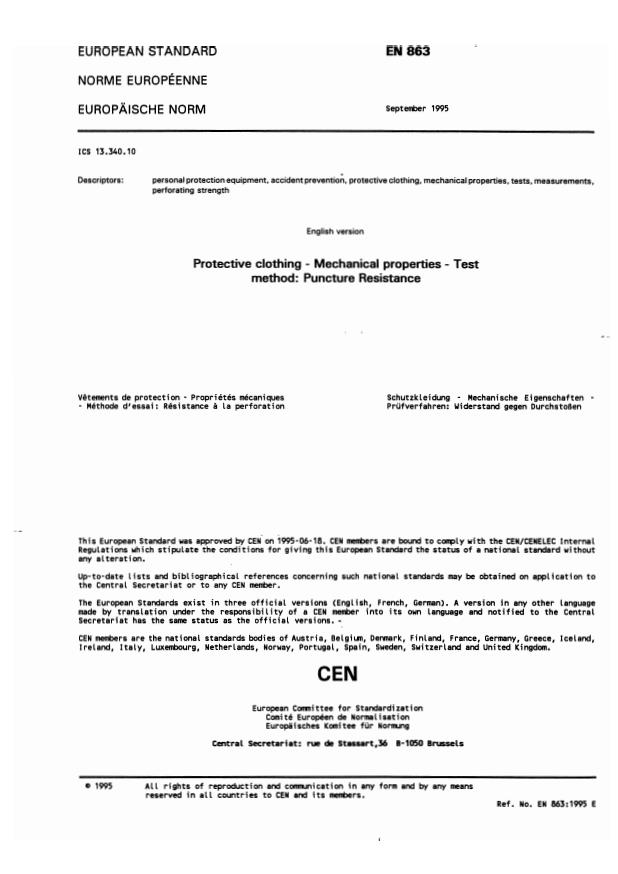
This European Standard specifies a test method for measuring the puncture resistance of protective clothing or materials used for these products. The puncture resistance is expressed as the maximum force required to push a spike with a specified speed through the test specimens.
- Status
- Published
- Publication Date
- 30-Nov-1996
- Technical Committee
- OVP - Personal protecting equipment
- Current Stage
- 6060 - National Implementation/Publication (Adopted Project)
- Start Date
- 01-Dec-1996
- Due Date
- 01-Dec-1996
- Completion Date
- 01-Dec-1996
89/686/EEC - Personal protective equipment (PPE)OJ Ref: C 143 OJ Date: 15-May-1996

SIST EN 863:1996 is a Slovenian standard published by SIST for a test method that measures the puncture resistance of protective clothing and the materials used for these products. It states puncture resistance as the maximum force needed to push a spike through a test specimen at a specified speed, so laboratories and manufacturers can compare materials in a consistent way. The Slovenian standard is identical to EN 863:1995.
What does SIST EN 863:1996 specify?
SIST EN 863:1996 specifies a mechanical test method for protective clothing and for materials intended to be used in protective clothing. The purpose is to measure how much force is needed to puncture the test specimen with a spike.
In practice, this gives buyers, quality managers, and test laboratories a common way to check whether a material or garment layer offers the puncture resistance they need. The document is focused on one performance property, so it is most useful when puncture resistance is part of product selection, incoming inspection, or product verification.
What are the key requirements of SIST EN 863:1996?
SIST EN 863:1996 centers on a single measurement: puncture resistance. The result is the maximum force required to push a spike through the specimen, so users must record force, not just whether puncture occurred.
- Use protective clothing or materials used for protective clothing as the test subject. This matters because the standard applies both to finished products and to candidate materials.
- Prepare test specimens for the test. In practice, this means the material must be presented in a form suitable for repeatable laboratory testing.
- Apply a spike to the specimen. The spike is the penetrating tool used to create the puncture, so the result reflects resistance to that specific type of mechanical action.
- Use a specified speed. Controlled speed keeps the test repeatable and lets different laboratories compare results more reliably.
- Measure the maximum force needed to push the spike through the specimen. This is the main output of the method and the value users document.
- Express puncture resistance as a force value. That makes the result practical for specifications, product comparison, and quality control records.
What terms does SIST EN 863:1996 define?
Protective clothing - Clothing designed to provide protection, and the standard applies to the clothing itself as well as the materials used in it.
Puncture resistance - The ability of a specimen to withstand penetration by a spike, measured here as force.
Test specimen - The piece of clothing material or product sample placed in the test.
Spike - The pointed tool used to push through the specimen during the puncture test.
Maximum force - The highest force recorded while the spike is pushed through the specimen; this is the reported test result.
Specified speed - The controlled rate at which the spike is driven through the specimen so the test can be repeated consistently.
Who uses SIST EN 863:1996?
SIST EN 863:1996 is used by manufacturers of protective clothing, material suppliers, testing laboratories, and quality managers who need to assess puncture resistance. It is also relevant to buyers and specifiers who compare protective materials and want a clear test method behind the declared performance.
In practice, these users apply the standard when qualifying materials, checking product consistency, or documenting mechanical performance for protective clothing programs.
What does the SIST EN 863:1996 document contain?
SIST EN 863:1996 contains a laboratory test method for puncture resistance rather than a design specification for clothing. Its core content is the procedure for pushing a spike through a specimen at a specified speed and reporting the maximum force.
The document is oriented toward mechanical property testing of protective clothing materials. That makes it useful for comparing materials, checking production consistency, and supporting product evaluation where puncture resistance matters.
Relations
- Effective Date
- 28-Jan-2026
- Effective Date
- 28-Jan-2026
- Effective Date
- 28-Jan-2026
- Effective Date
- 28-Jan-2026
- Effective Date
- 28-Jan-2026
- Effective Date
- 28-Jan-2026
- Effective Date
- 28-Jan-2026
- Effective Date
- 28-Jan-2026
- Effective Date
- 28-Jan-2026
- Effective Date
- 28-Jan-2026
- Effective Date
- 28-Jan-2026
Get Certified
Connect with accredited certification bodies for this standard

CIS Institut d.o.o.
Personal Protective Equipment (PPE) certification body. Notified Body NB-2890 for EU Regulation 2016/425 PPE.

Kiwa BDA Testing
Building and construction product certification.
Kmetijski inštitut Slovenije
Agricultural Institute of Slovenia. Soil testing, plant health, agricultural product analysis.
Sponsored listings
Frequently Asked Questions
SIST EN 863:1996 is a standard published by the Slovenian Institute for Standardization (SIST). Its full title is "Protective clothing - Mechanical properties - Test method: Puncture resistance". This standard covers: This European Standard specifies a test method for measuring the puncture resistance of protective clothing or materials used for these products. The puncture resistance is expressed as the maximum force required to push a spike with a specified speed through the test specimens.
This European Standard specifies a test method for measuring the puncture resistance of protective clothing or materials used for these products. The puncture resistance is expressed as the maximum force required to push a spike with a specified speed through the test specimens.
SIST EN 863:1996 is classified under the following ICS (International Classification for Standards) categories: 13.340.10 - Protective clothing. The ICS classification helps identify the subject area and facilitates finding related standards.
SIST EN 863:1996 has the following relationships with other standards: It is inter standard links to SIST-TP CEN/TR 15419:2018, SIST EN 943-1:2003, SIST EN 14325:2018, SIST EN 14404:2005+A1:2010, SIST EN 1073-1:1998, SIST EN 14404-1:2024, SIST EN 14325:2004, SIST EN ISO 14877:2003, SIST EN 15163:2017, SIST EN 1073-2:2002, SIST EN 14325:2018+A1:2024. Understanding these relationships helps ensure you are using the most current and applicable version of the standard.
SIST EN 863:1996 is associated with the following European legislation: EU Directives/Regulations: 2016/425, 89/686/EEC; Standardization Mandates: M/BC/CEN/90/2. When a standard is cited in the Official Journal of the European Union, products manufactured in conformity with it benefit from a presumption of conformity with the essential requirements of the corresponding EU directive or regulation.
SIST EN 863:1996 is available in PDF format for immediate download after purchase. The document can be added to your cart and obtained through the secure checkout process. Digital delivery ensures instant access to the complete standard document.
Standards Content (Sample)
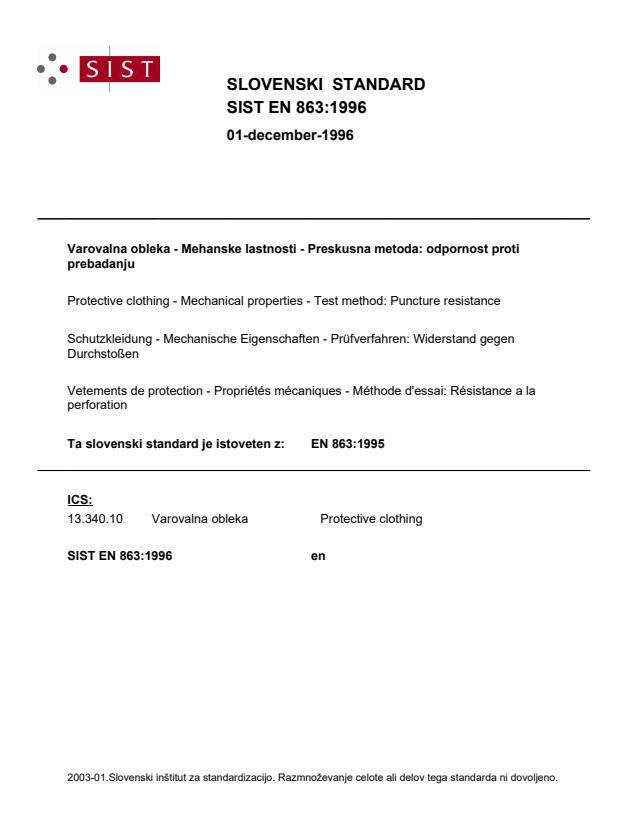
SLOVENSKI STANDARD
01-december-1996
Varovalna obleka - Mehanske lastnosti - Preskusna metoda: odpornost proti
prebadanju
Protective clothing - Mechanical properties - Test method: Puncture resistance
Schutzkleidung - Mechanische Eigenschaften - Prüfverfahren: Widerstand gegen
Durchstoßen
Vetements de protection - Propriétés
...