

SIST EN 60118-8:2006
(Main)Electroacoustics - Hearing aids -- Part 8: Methods of measurement of performance characteristics of hearing aids under simulated in situ working conditions
General Information
- Abstract
Describes methods for a test which simulates the acoustical effects of a median adult wearer on the performance of a hearing aid. Establishes certain guidelines for simulated in situ measurements of hearing aids; it describes a simplified method for simulated in situ measurements of hearing aids and a description for determination of the directivity index (DI) of directional microphones in hearing aids in the horizontal plane. In addition this second edition now specifies tolerances. Conformance to the specifications in this International Standard is demonstrated only when the result of a measurement, extended by the actual expanded uncertainty of measurement of the testing laboratory, lies fully within the tolerances specified in this International Standard extended by the values for Umax
- Status
- Published
- Publication Date
- 28-Feb-2006
- Current Stage
- 6060 - National Implementation/Publication (Adopted Project)
- Start Date
- 01-Mar-2006
- Due Date
- 01-Mar-2006
- Completion Date
- 01-Mar-2006

Overview
EN 60118-8:2005 (IEC 60118-8) - part of the Electroacoustics series on hearing aids - defines methods for measuring hearing-aid performance under simulated in situ working conditions. The standard specifies how to reproduce the acoustical effects of a median adult wearer (using a manikin and ear/occluded-ear simulators) so that laboratory measurements better reflect real-world performance. The 2005 (second) edition adds a simplified simulated in situ method, procedures to determine the directivity index (DI) of directional microphones in the horizontal plane, and specifies measurement tolerances and rules on expanded measurement uncertainty for conformance.
Key topics and requirements
- Simulated in situ measurement methods: Procedures to emulate the acoustical interaction between hearing aid and wearer using a standardized manikin and ear simulators.
- Manikin & ear simulator requirements: Guidance on manikin geometry, microphone positions, and the occluded-ear simulator coupling needed to obtain repeatable, representative results.
- Measurement parameters: Methods for obtaining simulated insertion gain, frequency response, OSPL90 (simulated in situ), and other electroacoustic characteristics under realistic coupling and placement.
- Directional microphone assessment: Procedures to measure horizontal-plane directivity patterns and compute the Directivity Index (DI) of directional hearing-aid microphones.
- Calibration & test environment: Specifications for sound source, free-field to hearing-aid-microphone transformations, and acoustical requirements for the test space.
- Tolerances and uncertainty: Conformance is demonstrated only when measured results, extended by the testing laboratory’s expanded uncertainty, lie fully within the standard’s specified tolerances (including Umax where applicable).
Applications and users
This standard is essential for:
- Hearing-aid manufacturers - product development, design validation, and specification reporting that reflect real-ear effects.
- Test laboratories and certification bodies - standardized test procedures, repeatability, and conformity assessment.
- Audiologists and clinical engineers - objective data for fitting algorithms and comparison of device behaviour under realistic conditions.
- Research institutions - investigations of microphone directivity, coupling strategies, and acoustic design trade-offs.
Practical benefits include improved correlation between lab data and real-ear performance, standardized DI measurements for directional systems, and consistent reporting for product comparison and regulatory compliance.
Related standards
- IEC/EN 60118-0 (general measurement of electroacoustical characteristics)
- IEC/EN 60118-7 (production and quality assurance measurements)
- IEC 60711 (occluded-ear simulator)
- IEC 60959 (head and torso simulator) These referenced documents provide complementary test equipment and measurement context used with EN 60118-8.
Relations
- Refers
SIST EN 60118-0:2002 - Hearing aids -- Part 0: Measurement of electroacoustical characteristics - Effective Date
- 03-Feb-2026
- Effective Date
- 03-Feb-2026
- Effective Date
- 03-Feb-2026
- Effective Date
- 03-Feb-2026
Get Certified
Connect with accredited certification bodies for this standard

BSI Group
BSI (British Standards Institution) is the business standards company that helps organizations make excellence a habit.

TÜV Rheinland
TÜV Rheinland is a leading international provider of technical services.

TÜV SÜD
TÜV SÜD is a trusted partner of choice for safety, security and sustainability solutions.
Sponsored listings
Frequently Asked Questions
SIST EN 60118-8:2006 is a standard published by the Slovenian Institute for Standardization (SIST). Its full title is "Electroacoustics - Hearing aids -- Part 8: Methods of measurement of performance characteristics of hearing aids under simulated in situ working conditions". This standard covers: Describes methods for a test which simulates the acoustical effects of a median adult wearer on the performance of a hearing aid. Establishes certain guidelines for simulated in situ measurements of hearing aids; it describes a simplified method for simulated in situ measurements of hearing aids and a description for determination of the directivity index (DI) of directional microphones in hearing aids in the horizontal plane. In addition this second edition now specifies tolerances. Conformance to the specifications in this International Standard is demonstrated only when the result of a measurement, extended by the actual expanded uncertainty of measurement of the testing laboratory, lies fully within the tolerances specified in this International Standard extended by the values for Umax
Describes methods for a test which simulates the acoustical effects of a median adult wearer on the performance of a hearing aid. Establishes certain guidelines for simulated in situ measurements of hearing aids; it describes a simplified method for simulated in situ measurements of hearing aids and a description for determination of the directivity index (DI) of directional microphones in hearing aids in the horizontal plane. In addition this second edition now specifies tolerances. Conformance to the specifications in this International Standard is demonstrated only when the result of a measurement, extended by the actual expanded uncertainty of measurement of the testing laboratory, lies fully within the tolerances specified in this International Standard extended by the values for Umax
SIST EN 60118-8:2006 is classified under the following ICS (International Classification for Standards) categories: 11.180.15 - Aids for deaf and hearing impaired people. The ICS classification helps identify the subject area and facilitates finding related standards.
SIST EN 60118-8:2006 has the following relationships with other standards: It is inter standard links to SIST EN 60118-0:2002, SIST HD 443 S1:2004, SIST EN IEC 60318-7:2023, SIST EN 60118-15:2012. Understanding these relationships helps ensure you are using the most current and applicable version of the standard.
SIST EN 60118-8:2006 is associated with the following European legislation: EU Directives/Regulations: TP271. When a standard is cited in the Official Journal of the European Union, products manufactured in conformity with it benefit from a presumption of conformity with the essential requirements of the corresponding EU directive or regulation.
SIST EN 60118-8:2006 is available in PDF format for immediate download after purchase. The document can be added to your cart and obtained through the secure checkout process. Digital delivery ensures instant access to the complete standard document.
Standards Content (Sample)
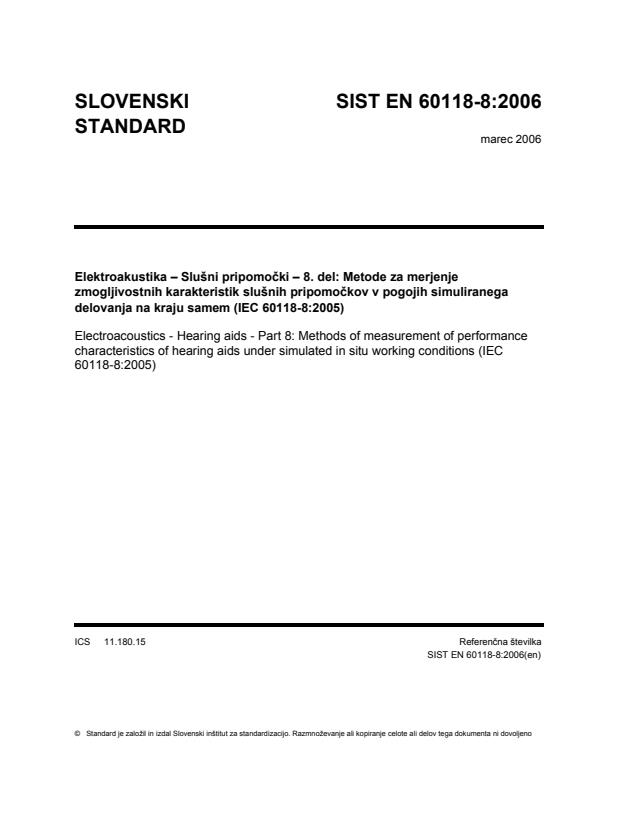
SLOVENSKI SIST EN 60118-8:2006
STANDARD
marec 2006
Elektroakustika – Slušni pripomočki – 8. del: Metode za merjenje
zmogljivostnih karakteristik slušnih pripomočkov v pogojih simuliranega
delovanja na kraju samem (IEC 60118-8:2005)
Electroacoustics - Hearing aids - Part 8: Methods of measurement of performance
characteristics of hearing aids under simulated in situ working conditions (IEC
60118-8:2005)
ICS 11.180.15 Referenčna številka
© Standard je založil in izdal Slovenski inštitut za standardizacijo. Razmnoževanje ali kopiranje celote ali delov tega dokumenta ni dovoljeno
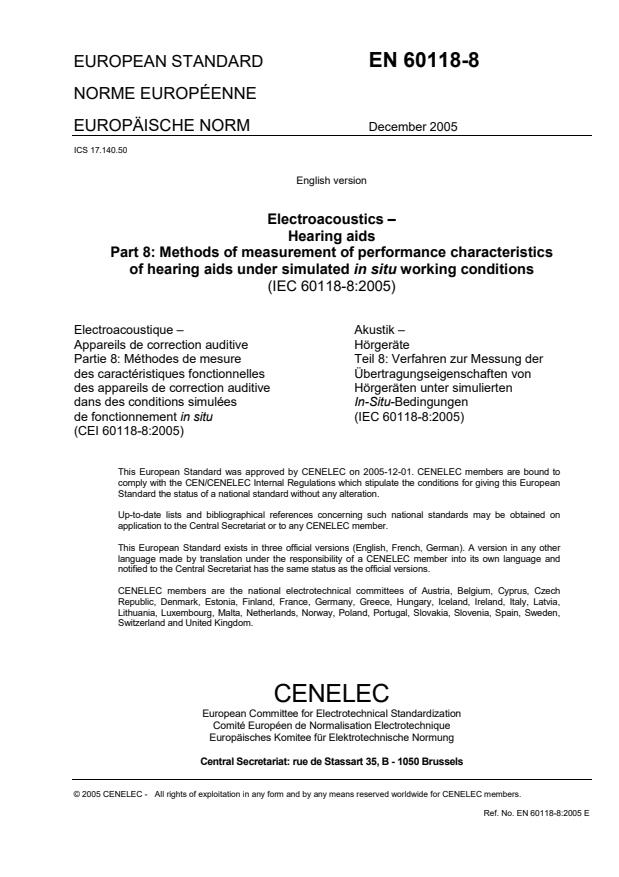
EUROPEAN STANDARD EN 60118-8
NORME EUROPÉENNE
EUROPÄISCHE NORM December 2005
ICS 17.140.50
English version
Electroacoustics –
Hearing aids
Part 8: Methods of measurement of performance characteristics
of hearing aids under simulated in situ working conditions
(IEC 60118-8:2005)
Electroacoustique – Akustik –
Appareils de correction auditive Hörgeräte
Partie 8: Méthodes de mesure Teil 8: Verfahren zur Messung der
des caractéristiques fonctionnelles Übertragungseigenschaften von
des appareils de correction auditive Hörgeräten unter simulierten
In-Situ-Bedingungen
dans des conditions simulées
de fonctionnement in situ (IEC 60118-8:2005)
(CEI 60118-8:2005)
This European Standard was approved by CENELEC on 2005-12-01. CENELEC members are bound to
comply with the CEN/CENELEC Internal Regulations which stipulate the conditions for giving this European
Standard the status of a national standard without any alteration.
Up-to-date lists and bibliographical references concerning such national standards may be obtained on
application to the Central Secretariat or to any CENELEC member.
This European Standard exists in three official versions (English, French, German). A version in any other
language made by translation under the responsibility of a CENELEC member into its own language and
notified to the Central Secretariat has the same status as the official versions.
CENELEC members are the national electrotechnical committees of Austria, Belgium, Cyprus, Czech
Republic, Denmark, Estonia, Finland, France, Germany, Greece, Hungary, Iceland, Ireland, Italy, Latvia,
Lithuania, Luxembourg, Malta, Netherlands, Norway, Poland, Portugal, Slovakia, Slovenia, Spain, Sweden,
Switzerland and United Kingdom.
CENELEC
European Committee for Electrotechnical Standardization
Comité Européen de Normalisation Electrotechnique
Europäisches Komitee für Elektrotechnische Normung
Central Secretariat: rue de Stassart 35, B - 1050 Brussels
© 2005 CENELEC - All rights of exploitation in any form and by any means reserved worldwide for CENELEC members.
Ref. No. EN 60118-8:2005 E
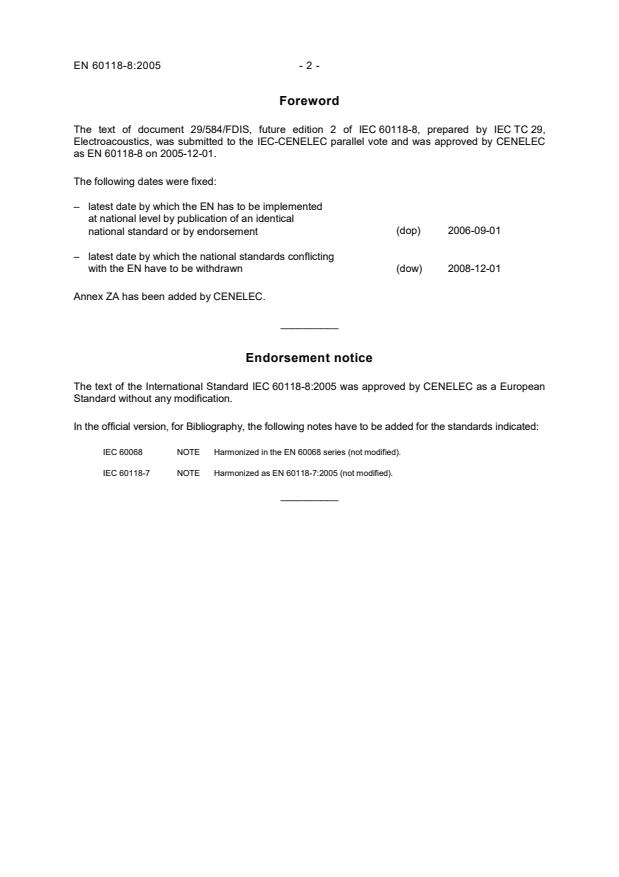
Foreword
The text of document 29/584/FDIS, future edition 2 of IEC 60118-8, prepared by IEC TC 29,
Electroacoustics, was submitted to the IEC-CENELEC parallel vote and was approved by CENELEC
as EN 60118-8 on 2005-12-01.
The following dates were fixed:
– latest date by which the EN has to be implemented
at national level by publication of an identical
national standard or by endorsement (dop) 2006-09-01
– latest date by which the national standards conflicting
with the EN have to be withdrawn (dow) 2008-12-01
Annex ZA has been added by CENELEC.
__________
Endorsement notice
The text of the International Standard IEC 60118-8:2005 was approved by CENELEC as a European
Standard without any modification.
In the official version, for Bibliography, the following notes have to be added for the standards indicated:
IEC 60068 NOTE Harmonized in the EN 60068 series (not modified).
IEC 60118-7 NOTE Harmonized as EN 60118-7:2005 (not modified).
__________
- 3 - EN 60118-8:2005
Annex ZA
(normative)
Normative references to international publications
with their corresponding European publications
The following referenced documents are indispensable for the application of this document. For dated
references, only the edition cited applies. For undated references, the latest edition of the referenced
document (including any amendments) applies.
NOTE Where an international publication has been modified by common modifications, indicated by (mod), the relevant
EN/HD applies.
Publication Year Title EN/HD Year
IEC 60118-0 1983 Hearing aids EN 60118-0 1993
Part 0: Measurement of electroacoustical
characteristics
1)
IEC 60263 - Scales and sizes for plotting frequency - -
characteristics and polar diagrams
1) 2)
IEC 60711 - Occluded-ear simulator for the HD 443 S1 1983
measurement of earphones coupled to
the ear by ear inserts
1)
IEC 60959 - Provisional head and torso simulator for - -
acoustic measurements on air conduction
hearing aids
1)
Undated reference.
2)
Valid edition at date of issue.
NORME CEI
INTERNATIONALE
IEC
60118-8
INTERNATIONAL
Deuxième édition
STANDARD
Second edition
2005-10
Electroacoustique –
Appareils de correction auditive –
Partie 8:
Méthodes de mesure des caractéristiques
fonctionnelles des appareils de correction
auditive dans des conditions simulées de
fonctionnement in situ
Electroacoustics –
Hearing aids –
Part 8:
Methods of measurement of performance
characteristics of hearing aids under
simulated in situ working conditions
IEC 2005 Droits de reproduction réservés Copyright - all rights reserved
Aucune partie de cette publication ne peut être reproduite ni No part of this publication may be reproduced or utilized in any
utilisée sous quelque forme que ce soit et par aucun procédé, form or by any means, electronic or mechanical, including
électronique ou mécanique, y compris la photocopie et les photocopying and microfilm, without permission in writing from
microfilms, sans l'accord écrit de l'éditeur. the publisher.
International Electrotechnical Commission, 3, rue de Varembé, PO Box 131, CH-1211 Geneva 20, Switzerland
Telephone: +41 22 919 02 11 Telefax: +41 22 919 03 00 E-mail: inmail@iec.ch Web: www.iec.ch
CODE PRIX
V
PRICE CODE
Commission Electrotechnique Internationale
International Electrotechnical Commission
МеждународнаяЭлектротехническаяКомиссия
Pour prix, voir catalogue en vigueur
For price, see current catalogue
60118-8 IEC:2005 – 3 –
CONTENTS
FOREWORD.7
INTRODUCTION.11
1 Scope.13
2 Normative references .13
3 Terms and definitions .13
4 Limitations.21
5 Test equipment.23
5.1 Acoustical requirements for the test space .23
5.2 Sound source .23
5.3 Manikin .25
5.4 Ear simulator.25
5.5 Ear insert simulator .25
5.6 Equipment for the measurement of occluded-ear simulator sound pressure
level .25
5.7 Equipment for automatic sweep frequency recording .27
5.8 Equipment for calibration of free field sound pressure level .27
6 Test conditions .27
6.1 Choice of test point .27
6.2 Ambient conditions .27
6.3 Manikin .27
6.4 Location of the hearing aid .29
6.5 Normal operating conditions for the hearing aid.29
7 Measurements.31
7.1 General .31
7.2 Adjustment of the reference input sound pressure level.31
7.3 Manikin frequency response (MFR) .31
7.4 Full-on simulated insertion gain measured by the constant reference input
SPL method .33
7.5 Full-on simulated insertion gain measured by the constant ear simulator SPL
method.33
7.6 Directional characteristics .35
7.7 Simulated in situ OSPL90 measurements .39
7.8 Simplified method to measure simulated in situ and insertion gain response .41
8 Frequency response recording charts .41
9 Maximum permitted expanded uncertainty of measurements .41
Annex A (normative) Free-field to hearing-aid-microphone transformation .45
Annex B (normative) Manikin unoccluded-ear gain (open ear response) .53
Annex C (informative) General requirements for a manikin .57
Bibliography.63
60118-8 IEC:2005 – 5 –
Figure A.1 – Microphone location and corresponding free-field to hearing-aid-
microphone transformation for behind-the-ear instruments.47
Figure A.2 – Microphone location and corresponding free-field to hearing-aid-
microphone transformation for full-concha instruments .47
Figure A.3 – Microphone location and corresponding free-field to hearing-aid-
microphone transformation for canal size instruments.49
Figure A.4 – Microphone location and corresponding free-field to hearing-aid-
microphone transformation for completely-in-the-ear canal instruments .49
Figure B.1 – Manikin unoccluded-ear gain frequency response.53
Figure C.1 – Manikin geometrical references .59
Figure C.2 – Co-ordinates for angles of azimuth and elevation.61
Table 1 – Values of U for basic measurements .43
max
Table A.1 – Numerical data for the various free-field to hearing-aid-microphone
transformation responses.51
Table B.1 – Numerical data of manikin unoccluded-ear gain frequency response.55
60118-8 IEC:2005 – 7 –
INTERNATIONAL ELECTROTECHNICAL COMMISSION
____________
ELECTROACOUSTICS –
HEARING AIDS –
Part 8: Methods of measurement of performance characteristics
of hearing aids under simulated in situ working conditions
FOREWORD
1) The International Electrotechnical Commission (IEC) is a worldwide organization for standardization comprising
all national electrotechnical committees (IEC National Committees). The object of IEC is to promote
international co-operation on all questions concerning standardization in the electrical and electronic fields. To
this end and in addition to other activities, IEC publishes International Standards, Technical Specifications,
Technical Reports, Publicly Available Specifications (PAS) and Guides (hereafter referred to as “IEC
Publication(s)”). Their preparation is entrusted to technical committees; any IEC National Committee interested
in the subject dealt with may participate in this preparatory work. International, governmental and non-
governmental organizations liaising with the IEC also participate in this preparation. IEC collaborates closely
with the International Organization for Standardization (ISO) in accordance with conditions determined by
agreement between the two organizations.
2) The formal decisions or agreements of IEC on technical matters express, as nearly as possible, an international
consensus of opinion on the relevant subjects since each technical committee has representation from all
interested IEC National Committees.
3) IEC Publications have the form of recommendations for international use and are accepted by IEC National
Committees in that sense. While all reasonable efforts are made to ensure that the technical content of IEC
Publications is accurate, IEC cannot be held responsible for the way in which they are used or for any
misinterpretation by any end user.
4) In order to promote international uniformity, IEC National Committees undertake to apply IEC Publications
transparently to the maximum extent possible in their national and regional publications. Any divergence
between any IEC Publication and the corresponding national or regional publication shall be clearly indicated in
the latter.
5) IEC provides no marking procedure to indicate its approval and cannot be rendered responsible for any
equipment declared to be in conformity with an IEC Publication.
6) All users should ensure that they have the latest edition of this publication.
7) No liability shall attach to IEC or its directors, employees, servants or agents including individual experts and
members of its technical committees and IEC National Committees for any personal injury, property damage or
other damage of any nature whatsoever, whether direct or indirect, or for costs (including legal fees) and
expenses arising out of the publication, use of, or reliance upon, this IEC Publication or any other IEC
Publications.
8) Attention is drawn to the Normative references cited in this publication. Use of the referenced publications is
indispensable for the correct application of this publication.
9) Attention is drawn to the possibility that some of the elements of this IEC Publication may be the subject of
patent rights. IEC shall not be held responsible for identifying any or all such patent rights.
International Standard IEC 60118-8 has been prepared by IEC technical committee 29:
Electroacoustics.
This second edition cancels and replaces the first edition published in 1983, and constitutes a
technical revision. The purpose of this revision is to update the publication with a simplified
method for simulated in situ measurements of hearing aids and a description for
determination of the directivity index (DI) of directional microphones in hearing aids in the
horizontal plane. Other parts of the standard are basically left unchanged.
60118-8 IEC:2005 – 9 –
The text of this standard is based on the following documents:
FDIS Report on voting
29/584/FDIS 29/589/RVD
Full information on the voting for the approval of this standard can be found in the report on
voting indicated in the above table.
This publication has been drafted in accordance with the ISO/IEC Directives, Part 2.
IEC 60118 consists of the following parts, under the general title Electroacoustics – Hearing
1)
:
aids
Part 0: Measurement of electroacoustical characteristics
Part 1: Hearing aids with induction pick-up coil input
Part 2: Hearing aids with automatic gain control circuits
Part 3: Hearing aid equipment not entirely worn on the listener
Part 4: Magnetic field strength in audio-frequency induction loops for hearing aid
purposes
Part 5: Nipples for insert earphones
Part 6: Characteristics of electrical input circuits for hearing aids
Part 7: Measurement of the performance characteristics of hearing aids for production,
supply and delivery quality assurance purposes
Part 8: Methods of measurement of performance characteristics of hearing aids under
simulated in situ working conditions
Part 9: Methods of measurement of characteristics of hearing aids with bone vibrator
output
Part 11: Symbols and other markings on hearing aids and related equipment
Part 12: Dimensions of electrical connector systems
Part 13: Electromagnetic compatibility (EMC)
Part 14: Specification of a digital interface device.
The committee has decided that the contents of this publication will remain unchanged until
the maintenance result date indicated on the IEC web site under "http://webstore.iec.ch" in
the data related to the specific publication. At this date, the publication will be
• reconfirmed;
• withdrawn;
• replaced by a revised edition, or
• amended.
—————————
1)
Various parts of the series were published under the general title Hearing aids. Future editions of these parts
will appear under the new general title.
60118-8 IEC:2005 – 11 –
INTRODUCTION
Measurement methods that take into account the acoustical influence of the wearer on the
performance of hearing aids are important, particularly when the results are to be used to
assist in the fitting of hearing aids. The information obtained using this standard is likely to be
more relevant to the fitting of hearing aids than that provided by publications concerned with
type approval and quality control such as IEC 60118-0, and IEC 60118-7.
The methods specified in this standard require a device such as a manikin to simulate the
presence of the wearer. It has been found necessary to establish certain guidelines for
simulated in situ measurements of hearing aids. The recommended methods are described in
this standard.
60118-8 IEC:2005 – 13 –
ELECTROACOUSTICS –
HEARING AIDS –
Part 8: Methods of measurement of performance characteristics
of hearing aids under simulated in situ working conditions
1 Scope
The purpose of this part of IEC 60118 is to describe methods for a test which simulates the
acoustical effects of a median adult wearer on the performance of a hearing aid.
It establishes certain guidelines for simulated in situ measurements of hearing aids; it
describes a simplified method for simulated in situ measurements of hearing aids and a
description for determination of the directivity index (DI) of directional microphones in hearing
aids in the horizontal plane.
In addition this second edition now specifies tolerances. Conformance to the specifications in
this International Standard is demonstrated only when the result of a measurement, extended
by the actual expanded uncertainty of measurement of the testing laboratory, lies fully within
the tolerances specified in this International Standard extended by the values for U
max
2 Normative references
The following referenced documents are indispensable for the application of this document.
For dated references, only the edition cited applies. For undated references, the latest edition
of the referenced document (including any amendments) applies.
IEC 60118-0:1983, Hearing aids – Part 0: Measurement of electroacoustical characteristics
IEC 60263, Scales and sizes for plotting frequency characteristics and polar diagrams
IEC 60711, Occluded-ear simulator for the measurement of earphones coupled to the ear by
ear inserts
IEC 60959, Provisional head and torso simulator for acoustic measurements of air conduction
hearing aids
3 Terms and definitions
For the purpose of this document, the following definitions apply:
60118-8 IEC:2005 – 15 –
3.1
sound pressure level
throughout this standard all sound pressure levels (abbreviated SPL) are referred to 20 µPa
3.2
pinna simulator
device which has the approximate shape and dimensions of a median adult human pinna
3.3
ear simulator
device for measuring the output sound pressure level of an earphone under well defined
loading conditions in a specified frequency range. It consists essentially of a principal cavity,
acoustic load networks and a calibrated microphone. The location of the microphone is
chosen so that the sound pressure at the microphone corresponds approximately to the sound
pressure existing at the human eardrum
3.4
occluded-ear simulator
ear simulator which simulates the inner part of the ear canal, from the tip of an ear insert to
the eardrum
3.5
ear canal extension
device which connects the concha portion of the pinna simulator with the outer (reference
plane) face of the occluded-ear simulator, simulating the outer part of the ear canal excluding
the pinna
3.6
ear insert simulator
device used to represent the acoustic coupling between an earphone and the ear canal (e.g.
an earmould or a similar device without a connecting tube)
3.7
manikin (head and torso simulator)
head and torso simulator extending downward from the top of the head to the waist and
designed to simulate the acoustic diffraction produced by a median adult human head and
torso. The head includes two pinna simulators, and contains at least one occluded-ear
simulator
3.8
reference point of a subject or manikin
point bisecting the line joining the centres of the openings of the ear canals (at the junction
between concha and ear canal) (see Figure C.1)
3.9
plane of symmetry of the manikin
plane passing through the reference point of the manikin that divides the left and right
portions of the manikin into symmetrical halves (see Figure C.1)
3.10
axis of rotation of the manikin
straight line passing through the reference point of the manikin and lying in the plane of
symmetry of the manikin, and having a direction that would be vertical if the manikin were
mounted in a position corresponding to that of a standing person (and about which the
manikin can be rotated) (see Figure C.1)
60118-8 IEC:2005 – 17 –
3.11
reference plane of the manikin
plane perpendicular to the axis of rotation containing the reference point of the manikin (see
Figure C.1)
3.12
test point
reproducible position in the test space at which the sound pressure level is measured with the
manikin absent and at which the reference point of the manikin is to be located for test
purposes
3.13
reference input sound pressure level
free field sound pressure level at the test point in the absence of the manikin
3.14
test axis
line joining the test point and the centre of the sound source (see Figure C.2)
3.15
test plane (for measurement of the uniformity of the free field wavefront)
plane perpendicular to the test axis and containing the test point
3.16
azimuth angle of sound incidence
θ
angle between the plane of symmetry of the manikin and the plane defined by the axis of
rotation and the test axis (see Figure C.2). When the manikin faces the sound source the
azimuth angle of sound incidence is defined as 0°. When the right ear of the manikin faces
the sound source, the azimuth angle is defined as 90°. When the left ear faces the sound
source, the angle is defined as 270°
3.17
elevation angle of sound incidence
α
angle between the reference plane of the manikin and the test axis (see Figure C.2). When
the top of the manikin points towards the sound source the elevation angle is defined as 90°.
When the test axis lies in the reference plane, the elevation angle is defined as 0°
3.18
reference position of the manikin in the test space
position of the manikin in the test space that meets the following conditions:
– the reference point coincides with the test point, and
– the angles of azimuth and elevation are both equal to zero.
3.19
manikin unoccluded-ear gain
MUEG
difference between the sound pressure level in the unoccluded-ear simulator and the
reference input sound pressure level. This will be a function of manikin position
60118-8 IEC:2005 – 19 –
3.20
manikin unoccluded-ear gain frequency response
MUEGFR
manikin unoccluded-ear gain expressed as a function of frequency, MFR (see 7.3) being a
function of manikin position
3.21
simulated in situ gain
SISG
difference between the SPL in the ear simulator produced by the hearing aid and the
reference input SPL. This will be a function of manikin position
3.22
simulated in situ gain frequency response
SISGFR
SISG expressed as a function of frequency
3.23
simulated insertion gain
SIG
difference between the SPL in the ear simulator produced by the hearing aid and the SPL in
the ear simulator with the hearing aid absent. This gain is equal to SISG-MUEG. This will be a
function of manikin position
3.24
full-on simulated insertion gain
SIG obtainable from a hearing aid with the gain control at maximum (full-on) and at stated
settings of the other hearing aid controls
3.25
simulated insertion gain frequency response
SIGFR
SIG expressed as a function of frequency
3.26
manikin unoccluded-ear directional response
MDR
sound pressure level in the ear simulator at a stated frequency as a function of azimuth
and/or elevation angle with the hearing aid absent
3.27
simulated in situ directional response
SISDR
sound pressure level in the ear simulator produced by the hearing aid as a function of azimuth
and/or elevation angle at a stated frequency, gain value and input level
60118-8 IEC:2005 – 21 –
3.28
directivity index DI
2D
for the purpose of this standard DI as a function of frequency is calculated from the SISDR
2D
as the difference between the sound intensity level for azimuth and elevation angle equal to
0° and the average sound intensity level for all azimuth angles and elevation angles,
assuming rotational symmetry about an axis defined by the intersection of a vertical plane
with zero azimuth angle and the reference plane.
3.29
SII weighted directivity index
SIIDI
2D
index calculated from the DI by applying a band importance function representing the
2D
relative importance of the different frequencies for speech perception and as such obtaining a
frequency independent index. The weighting factors used in the calculation are according to
ANSI S3.5:1997 (see 7.6.4.2)
3.30
simulated insertion directional response D
SIDR
difference between SISDR and MDR
3.31
simulated in situ OSPL90 (output sound pressure level for 90 dB input SPL)
output sound pressure level in the ear simulator produced by the hearing aid at a specified
frequency with the hearing aid gain control at maximum (full-on) and a reference input SPL of
90 dB
3.32
simulated in situ OSPL90 frequency response
simulated in situ OSPL90 expressed as a function of frequency
4 Limitations
4.1 The results obtained under simulated in situ conditions may differ substantially from
results obtained on an individual person, due to anatomical variation of head, torso, pinna,
ear canal, and eardrum. Care should therefore be taken when interpreting the results.
4.2 The methods recommended in this standard give information on the measurement of the
following parameters that are considered important for the evaluation of the performance of a
hearing aid as normally worn, and for which simulated in situ conditions are considered
essential:
– full-on insertion gain;
– insertion frequency response;
– directional characteristics;
– simulated in situ OSPL90.
NOTE The accuracy and repeatability of results obtained under simulated in situ conditions cannot generally be
expected to be as good as when using the free-field technique laid down in IEC 60118-0:1983. The use of
simulated in situ conditions for the measurements of hearing aid parameters other than those listed above is
therefore not included.
60118-8 IEC:2005 – 23 –
5 Test equipment
5.1 Acoustical requirements for the test space
5.1.1 The test space shall provide essentially free-field conditions over the frequency range
200 Hz to 8 000 Hz. Essentially free-field conditions are considered established when the
sound pressure level at positions 100 mm in front of and behind the test point do not deviate
from the inverse distance law (1/r law) by more than ±2 dB from 200 Hz to 400 Hz and ±1 dB
from 400 Hz to 8 000 Hz.
5.1.2 The manikin shall be mounted in the test space so that all points of the head and
shoulders of the manikin are λ/4 or more distant from the surfaces of the room, where λ is the
wavelength of the lowest measuring frequency. The distance between the centre of the sound
source and the test point shall be 1 m.
5.1.3 The test space shall be equipped with means that permit accurate and repeatable
positioning of the manikin.
5.1.4 Unwanted stimuli in the test space such as ambient noise or electrical and/or magnetic
stray fields shall be sufficiently low to ensure that test signals exceed the levels of unwanted
noise by more than 10 dB.
5.2 Sound source
5.2.1 The sound source shall consist only of coaxial elements. In order to avoid reflections,
the frontal surface of the sound source enclosure should be covered by a suitable absorbing
material. Maximum linear dimensions of the frontal surface of the sound source shall not
exceed 0,30 m.
5.2.2 Over the frequency range 200 Hz to 8 000 Hz, the sound source shall produce a
uniform wave-front in the space to be occupied by the manikin which shall be determined as
follows:
With the manikin absent, the SPL at four positions in the test plane 15 cm distant from the
test point shall not differ by more than ±2 dB from the SPL at the test point. Two of the four
positions are to be in the reference plane, to the left and right of the test point as viewed from
the sound source; the other two are to be on the axis of rotation above and below the test
point.
5.2.3 Over the frequency range 200 Hz to 8 000 Hz, the source shall be capable of
producing sound pressure levels with a maximum tolerance of ±1,5 dB (see 5.7) over the
range of 50 dB to 90 dB at the test point.
5.2.4 The frequency of the test signal shall not differ by more than 2 % from the indicated
value.
5.2.5 The total harmonic distortion of the test signal shall not exceed 2 % for sound pressure
levels up to 70 dB and 3 % for sound pressure levels greater than 70 dB and up to 90 dB, as
measured at the test point.
60118-8 IEC:2005 – 25 –
5.3 Manikin
Annex C states the general requirements for a manikin.
5.4 Ear simulator
The ear simulator shall consist of an occluded-ear simulator in accordance with IEC 60711,
+0,02
together with an ear canal extension 7,5 mm in diameter and 8,8 mm long with a
−0
tolerance of ±2 %, as measured from the outer face (reference plane) of the occluded-ear
simulator to the bottom of the concha portion of the artificial pinna.
5.5 Ear insert simulator
The method of coupling the small earphone (receiver) to the ear, for example closed mould,
open mould or no mould connections, shall be stated together with the lengths and diameters
of any connecting acoustic tubes used.
5.6 Equipment for the measurement of occluded-ear simulator sound pressure level
The equipment used for measurement of the occluded-ear simulator sound pressure level
produced by the hearing aid shall comply with the following requirements:
5.6.1 The calibration of the sound pressure level measurement system shall be within
±0,5 dB at a specified frequency.
NOTE The calibration of the microphone should be repeated sufficiently often to ensure that it remains within the
permitted limits during measurements.
5.6.2 The pressure sensitivity level of the measuring microphone shall be within ±1 dB in the
frequency range 200 Hz to 3 000 Hz and within ±2 dB in the range 3 000 Hz to 8 000 Hz
relative to the pressure sensitivity level at 1 000 Hz.
5.6.3 Total harmonic distortion in the measuring equipment over the frequency range 200 Hz
to 5 000 Hz shall be less than 1 % for sound pressure levels up to 130 dB and less than 3 %
for sound pressure levels above 130 dB and up to 145 dB.
5.6.4 The sound pressure level corresponding to hum, thermal agitation and other noise
sources shall be sufficiently low to ensure that the reading shall drop by at least 10 dB when
the test signal is switched off.
For this purpose, a high-pass filter not affecting frequencies of 200 Hz and above may be
employed.
5.6.5 The output indicator used shall give r.m.s. indication within ±0,5 dB for a signal crest
factor of not more than 3.
NOTE 1 If, under certain conditions, it is necessary to use a selective system to ensure that the response of the
hearing aid to the test signal can be differentiated from inherent noise in the hearing aid, the use of the selective
system should be stated in the test report.
NOTE 2 It is well known that the type of output indicator employed may influence the test results significantly if a
non-sinusoidal voltage is being measured. Such non-sinusoidal voltages may be present when making
measurements with high input levels to the hearing aid.
60118-8 IEC:2005 – 27 –
5.6.6 Since the calibration of the occluded-ear simulator depends on ambient conditions,
especially the atmospheric pressure, corrections for such dependence shall be made when
necessary (see 6.2).
5.7 Equipment for automatic sweep frequency recording
The equipment shall be capable of maintaining at the test point all requisite sound pressure
levels between 50 dB and 90 dB within such tolerances as specified in 5.2.3.
The uncertainty of the indicated frequency on a recorder chart shall be within ±5 %. The
automatically recorded values shall not differ more than 1 dB from the steady-state value over
the frequency range 200 Hz to 5 000 Hz and not more than 2 dB in the range 5 000 Hz to
8 000 Hz.
5.8 Equipment for calibration of free field sound pressure level
The calibration of the free field sound pressure level shall be within ±0,5 dB at a specified
frequency. The free field sensitivity level of the measuring microphone shall be within ±1 dB in
the frequency range 200 Hz to 5 000 Hz and within ±1,5 dB in the range 5 000 Hz to 8 000 Hz
relative to the free field sensitivity level at a specified frequency (usually 1 kHz).
6 Test conditions
6.1 Choice of test point
With the position of the sound source fixed in the test space, a test point is chosen, so that
the requirements of 5.1 are fulfilled.
The distance from the sound source to the test point shall be 1 m. This is considered to be
sufficient to reduce interaction between the sound source and the manikin to an acceptable
level when the latter is located at the test point.
6.2 Ambient conditions
Ambient conditions in the test space at the time of test shall be stated and kept within the
following tolerances:
– temperature: (23 ± 5) °C;
– relative humidity: (20 to 80) %;
+5
– atmospheric pressure: ( 101,3 ) kPa.
−20
NOTE If these conditions cannot be achieved, actual conditions shall be stated. See also IEC 60068.
6.3 Manikin
In order to achieve repeatable results no clothing or wig shall be used on the manikin.
60118-8 IEC:2005 – 29 –
6.4 Location of the hearing aid
6.4.1 Placement of the hearing aid on the manikin
The hearing aid shall be placed on the manikin in a way corresponding to actual use.
Body aids shall be placed 30 cm from the reference plane in the centre chest position, with
the back of the aid held firmly on the surface of the manikin.
6.4.2 Connection of the earphone to the ear simulator
The right ear of the manikin shall be used, unless otherwise stated.
The type of ear insert simulator and any tubing employed shall be stated. The fit of the pinna
simulator and ear canal extension shall be carefully observed to avoid leakage with closed
canal tests.
6.5 Normal operating conditions for the hearing aid
6.5.1 General
The normal operating conditions for the hearing aid which apply for measurement purposes
when no other conditions are prescribed, are:
6.5.2 Power supply
Either an actual battery of the type normally used in the hearing aid, partially discharged to
avoid the typical high initial voltage, or a suitable power supply that simulates the voltage and
internal impedance of real batteries of the type normally used, may be employed.
The type of power source used, the supply voltage and, in the case of a power supply, the
internal impedance shall be stated.
The battery voltage measurements shall be within ±50 mV of the value specified.
6.5.3 Gain control
Full-on gain control position, reference test gain position or other positions used, shall be
stated.
6.5.4 Other controls
The setting selected for the tone control shall be stated in the results. In general, the basic
setting (that giving the widest frequency range) shall be selected in preference to settings in
which the low or high frequencies are attenuated. If, however, there are reasons for regarding
some other settings as more representative of the normal use of the hearing aid, these
settings may be adopted provided they are clearly described in the results.
All other control settings should be chosen to give the highest OSPL90 and the highest
acoustic gain. If the highest OSPL90 is not associated with the highest acoustic gain, the
setting giving the highest OSPL90 shall be used.
60118-8 IEC:2005 – 31 –
6.5.5 Accessories used in connection with the hearing aid microphone opening
The particular accessories to be used shall be stated.
7 Measurements
7.1 General
7.1.1 The simulated insertion gain frequency response may be determined by two different
methods, yielding the same results if the hearing aid is operating as a linear device:
– constant reference input SPL method (see 7.4)
– constant ear simulator SPL method (ipsilateral ear) (see 7.5).
Due to modifications to the sound field by the head and open ear canal the constant ear
simulator SPL method will result in a considerably lower input SPL to the hearing aid than for
the constant reference input SPL method at certain frequencies.
The advantage of the constant ear simulator SPL method, however, is that the same
microphone system is used for measuring both input and output SPL. The method used shall
be stated.
NOTE The use of a contralateral ear simulator as a controlling device is not recommended due to the probable
lack of symmetry and its limitation for frontal sound incidence only.
7.1.2 Data should only be quoted for that part of the frequency range between 200 Hz and
8 000 Hz over which the output from the hearing aid falls by at least 10 dB when the signal
source is switched off.
7.2 Adjustment of the reference input sound pressure level
• Test procedure
a) The free field calibrated microphone (see 5.8) is placed at the test point with the manikin
absent.
b) The frequency of the sound source is varied over the range 200 Hz to 8 000 Hz. The
electrical input signal to the sound source required to produce a constant stated reference
input SPL is recorded (see 5.2.3).
NOTE For automatic frequency sweep recording tests, the reference input SPL can be kept constant using the
microphone to control the equipment in compliance with 5.7. Recording of the electrical input signal can be
conveniently undertaken using digital storage techniques or a tape recorder.
The use of equalizing filters only or a control microphone placed between the sound source and the test point has
not generally been found to be satisfactory.
7.3 Manikin frequency response (MFR)
7.3.1 Purpose
The purpose of this test is to measure the performance of the manikin to provide a basis for
determining the simulated insertion gain frequency response in accordance with the constant
reference input SPL method.
60118-8 IEC:2005 – 33 –
7.3.2 Test procedure
a) The manikin is placed at the reference position (see 3.18).
b) The frequency is varied over the range 200 Hz to 8 000 Hz, keeping the reference input
sound pressure level constant at 60 dB. The ear simulator SPL is recorded as a function
of frequency.
NOTE For automatic sweep frequency recording tests, this is conveniently achieved by providing a stored
electrical input signal to the sound source (see note to 7.2.1).
7.4 Full-on simulated insertion gain measured by the constant reference input SPL
method
Test procedure
a) Perform the measurements described in 7.2 and 7.3.
b) With the manikin in the reference position, locate the hearing aid in accordance with 6.4.
c) Turn the hearing aid gain control full-on and set other controls to their required positions.
d) At a suitable frequency, set the reference input SPL to 60 dB. If this does not produce
essentially linear input/output conditions in the hearing aid, the SPL should be reduced to
50 dB. Essentially linear input/output conditions are considered to exist if, at all
frequencies within the range 200 Hz to 8 000 Hz, a change in the input SPL of 10 dB
causes a change in the output SPL of (10 ± 1) dB. The input SPL shall be stated.
NOTE For hearing aids with certain circuit arrangements, e.g. some push-pull aids, non-linear input-output
characteristics may be observed over a large portion of the operating range.
e) Vary the frequency over the range 200 Hz to 8 000 Hz keeping the reference input SPL
constant at the level determined in item d) above. Record the ear simulator SPL as a
function of frequency.
f) Derive the full-on simulated insertion gain by subtracting the manikin unoccluded-ear SPL
(determined in item b) of 7.3.2) from the simulated in situ SPL (determined in item e)
above) at each frequency.
g) Plot the full-on simulated insertion gain as a function of frequency. The value may be
reported for a specified frequency.
NOTE 1 In some cases with hearing aids having high gain, it may be convenient to adopt a lower gain setting
than maximum for the measurement of the frequency response curve. In those cases, the gain setting should be
stated.
NOTE 2 The procedures may be repeated for other stated control settings or other stated manikin positions.
7.5 Full-on simulated insertion gain measured by the constant ear simulator
SPL method
An alternative procedure for determining the simulated insertion gain for a hearing aid is:
a) Place the manikin at the reference position with the hearing aid absent.
...