


oSIST prEN IEC 60794-3-11:2025
(Main)Optical fibre cables - Part 3-11: Outdoor cables - Detailed specification for duct, directly buried, and lashed aerial optical fibre telecommunication cables
Optical fibre cables - Part 3-11: Outdoor cables - Detailed specification for duct, directly buried, and lashed aerial optical fibre telecommunication cables
Lichtwellenleiterkabel – Teil 3-11: Außenkabel – Bauartspezifikation für Einmoden-LWL-Fernmeldeluftkabel für Röhren- und direkte Erdverlegung sowie Befestigung an Freileitungen oder Seilen
Câbles à fibres optiques - Partie 3-11: Câbles extérieurs - Spécification particulière pour les câbles de télécommunication à fibres optiques, destinés à être installés dans des conduites, directement enterrés et en aériens ligaturés
Optični kabli - 3-11. del: Kabli za zunanjo uporabo - Podrobna specifikacija za kanalske, neposredno vkopane in (z vezicami) povezane nadzemne optične telekomunikacijske kable
General Information
- Status
- Not Published
- Public Enquiry End Date
- 29-May-2025
- Technical Committee
- MOC - Mobile Communications
- Current Stage
- 4020 - Public enquire (PE) (Adopted Project)
- Start Date
- 12-Mar-2025
- Due Date
- 30-Jul-2025
- Completion Date
- 26-May-2025
Relations
- Effective Date
- 22-Jan-2023
Overview
oSIST prEN IEC 60794-3-11:2025 is a draft European and international standard developed by CLC and IEC for outdoor optical fibre telecommunication cables. This standard provides a detailed specification for optical fibre cables intended for duct, directly buried, and lashed aerial installations. It ensures that fibre optic cables used in outdoor environments meet rigorous mechanical, environmental, and optical requirements to perform reliably in diverse field conditions.
As fibre optic networks expand across telecommunication infrastructures, adherence to oSIST prEN IEC 60794-3-11:2025 ensures consistency, safety, and performance for high-speed data transmission and robust connectivity solutions.
Key Topics
- Scope and Applicability: Covers optical fibre cables designed for installation in ducts, direct burial, and aerial lashed methods.
- General Requirements: Addresses cable structure, materials, and functional characteristics tailored for outdoor environments.
- Optical Fibre Types:
- Single-mode fibres (various types, including dispersion unshifted, cut-off shifted, and bending loss insensitive)
- Multimode fibres (A1-OM2, A1-OM3, A1-OM4, A1-OM5)
- Cable Element Design: Focuses on buffer tubes, strength elements, crush and moisture protection, sheath materials, and proper identification.
- Mechanical and Environmental Performance:
- Tensile strength, crush and impact resistance, flexibility (bending, torsion, repeated bending)
- Resistance to environmental factors (temperature variations, water penetration, rodent/barrier protection)
- Optical Performance:
- Attenuation and attenuation coefficient limits
- Splice-ability and compatibility for both single-mode and multimode fibres
- Cut-off wavelength and polarization mode dispersion (PMD)
- Testing and Quality Assurance:
- Standardized test methods (referencing IEC 60794 and related documents)
- Acceptance criteria for attenuation, fibre strain, and environmental stability
Applications
This standard is essential for organizations involved in the design, manufacturing, and installation of outdoor fibre optic telecommunication networks. Key applications include:
- Telecommunication infrastructure: Ensures that outdoor fibre cables used in backbone, metropolitan, and access networks comply with international performance and safety benchmarks.
- Duct installation: Provides guidance on cable selection and installation techniques suitable for single and multiple sub-duct environments.
- Direct burial: Specifies requirements for cables exposed to mechanical stresses from methods like ploughing or trenching, and recommends solutions for long-term durability.
- Aerial installations: Addresses challenges like cable movement due to environmental loads (wind, ice, thermal expansion), emphasizing lashed aerial cable stability.
By following oSIST prEN IEC 60794-3-11:2025, network operators and installers can ensure longevity, reliability, and minimal maintenance for critical communication links.
Related Standards
oSIST prEN IEC 60794-3-11:2025 references and supplements several core opto-electronic standards, ensuring harmonized requirements and test procedures. Related standards include:
- IEC 60794-1-1, IEC 60794-3, IEC 60794-3-10: Covering general specifications and family specifications for fibre optic cables.
- IEC 60793-2-10, IEC 60793-2-50: Specifications for multimode and single-mode optical fibres, including category and performance details.
- IEC 60794-1-2, IEC 60794-1-21, IEC 60794-1-22, IEC 60794-1-23: Detailing basic test methods for mechanical and environmental assessment.
- IEC 60811 Series: Test methods for non-metallic insulating and sheathing materials of electric and optical cables.
- IEC TR 61931: Terms and definitions for optical fibre cables.
Aligning with these standards ensures compatibility and interoperability across global fibre optic deployments.
Keywords: oSIST prEN IEC 60794-3-11:2025, outdoor optical fibre cables, telecommunication cables, duct installation, directly buried cables, lashed aerial cables, optical cable standards, IEC 60794, fibre optic cable requirements, mechanical testing, environmental testing, single-mode fibre, multimode fibre, telecommunications infrastructure.


Get Certified
Connect with accredited certification bodies for this standard

ANCE
Mexican certification and testing association.

Intertek Slovenia
Intertek testing, inspection, and certification services in Slovenia.

LNE (Laboratoire National de Métrologie et d'Essais)
French national laboratory for metrology and testing.
Sponsored listings
Frequently Asked Questions
oSIST prEN IEC 60794-3-11:2025 is a draft published by the Slovenian Institute for Standardization (SIST). Its full title is "Optical fibre cables - Part 3-11: Outdoor cables - Detailed specification for duct, directly buried, and lashed aerial optical fibre telecommunication cables". This standard covers: Optical fibre cables - Part 3-11: Outdoor cables - Detailed specification for duct, directly buried, and lashed aerial optical fibre telecommunication cables
Optical fibre cables - Part 3-11: Outdoor cables - Detailed specification for duct, directly buried, and lashed aerial optical fibre telecommunication cables
oSIST prEN IEC 60794-3-11:2025 is classified under the following ICS (International Classification for Standards) categories: 33.180.10 - Fibres and cables. The ICS classification helps identify the subject area and facilitates finding related standards.
oSIST prEN IEC 60794-3-11:2025 has the following relationships with other standards: It is inter standard links to SIST EN 60794-3-11:2010. Understanding these relationships helps ensure you are using the most current and applicable version of the standard.
oSIST prEN IEC 60794-3-11:2025 is available in PDF format for immediate download after purchase. The document can be added to your cart and obtained through the secure checkout process. Digital delivery ensures instant access to the complete standard document.
Standards Content (Sample)
SLOVENSKI STANDARD
01-maj-2025
Optični kabli - 3-11. del: Kabli za zunanjo uporabo - Podrobna specifikacija za
kanalske, neposredno vkopane in (z vezicami) povezane nadzemne optične
telekomunikacijske kable
Optical fibre cables - Part 3-11: Outdoor cables - Detailed specification for duct, directly
buried, and lashed aerial optical fibre telecommunication cables
Câbles à fibres optiques - Partie 3-11: Câbles extérieurs - Spécification particulière pour
les câbles de télécommunication à fibres optiques, destinés à être installés dans des
conduites, directement enterrés et en aériens ligaturés
Ta slovenski standard je istoveten z: prEN IEC 60794-3-11:2025
ICS:
33.180.10 (Optična) vlakna in kabli Fibres and cables
2003-01.Slovenski inštitut za standardizacijo. Razmnoževanje celote ali delov tega standarda ni dovoljeno.
86A/2541/CDV
COMMITTEE DRAFT FOR VOTE (CDV)
PROJECT NUMBER:
IEC 60794-3-11 ED3
DATE OF CIRCULATION: CLOSING DATE FOR VOTING:
2025-03-07 2025-05-30
SUPERSEDES DOCUMENTS:
86A/2353/CD, 86A/2440/CC
IEC SC 86A : FIBRES AND CABLES
SECRETARIAT: SECRETARY:
France Mr Laurent Gasca
OF INTEREST TO THE FOLLOWING COMMITTEES: HORIZONTAL FUNCTION(S):
ASPECTS CONCERNED:
SUBMITTED FOR CENELEC PARALLEL VOTING NOT SUBMITTED FOR CENELEC PARALLEL VOTING
Attention IEC-CENELEC parallel voting
The attention of IEC National Committees, members of
CENELEC, is drawn to the fact that this Committee Draft
for Vote (CDV) is submitted for parallel voting.
The CENELEC members are invited to vote through the
CENELEC online voting system.
This document is still under study and subject to change. It should not be used for reference purposes.
Recipients of this document are invited to submit, with their comments, notification of any relevant patent rights of
which they are aware and to provide supporting documentation.
Recipients of this document are invited to submit, with their comments, notification of any relevant “In Some
Countries” clauses to be included should this proposal proceed. Recipients are reminded that the CDV stage is
the final stage for submitting ISC clauses. (SEE AC/22/2007 OR NEW GUIDANCE DOC).
TITLE:
Optical fibre cables - Part 3-11: Outdoor cables – Detailed specification for duct, directly
buried, and lashed aerial optical fibre telecommunication cables
PROPOSED STABILITY DATE: 2030
NOTE FROM TC/SC OFFICERS:
electronic file, to make a copy and to print out the content for the sole purpose of preparing National Committee positions.
You may not copy or "mirror" the file or printed version of the document, or any part of it, for any other purpose without
permission in writing from IEC.
IEC CDV 60794-3-11/Ed3 © IEC 2025 – 2 – 86A/2541/CDV
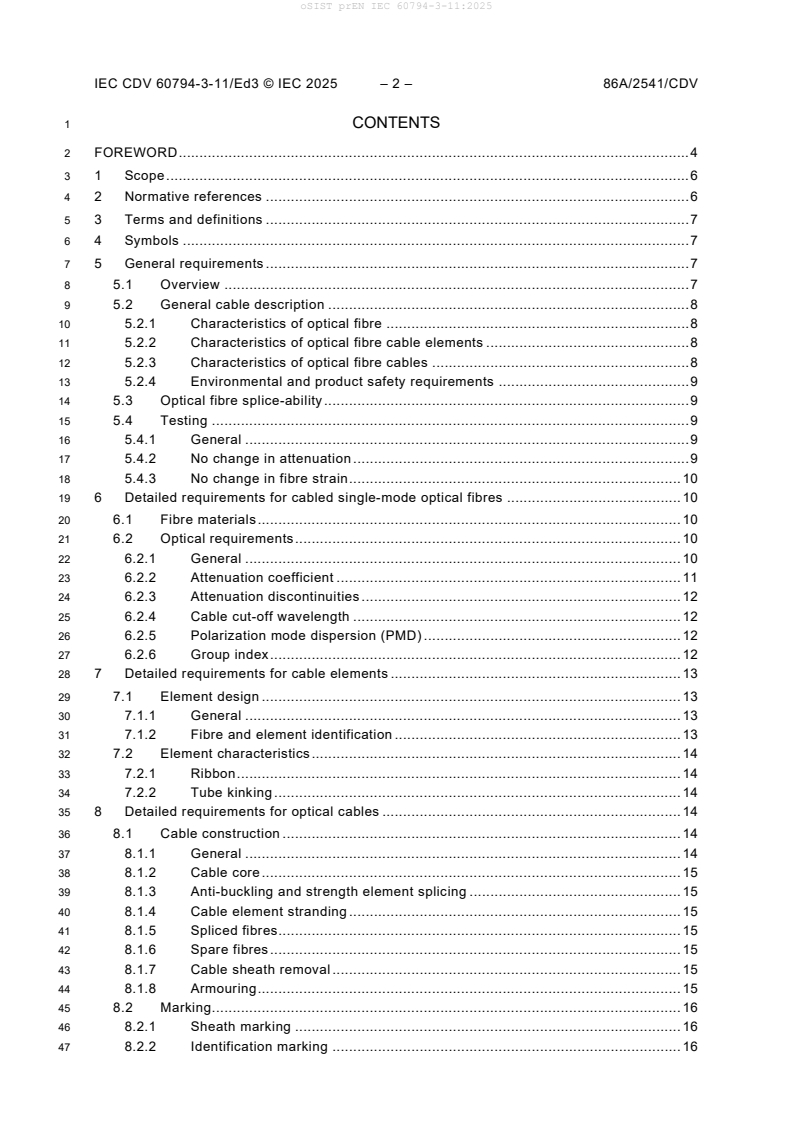
1 CONTENTS
2 FOREWORD . 4
3 1 Scope . 6
4 2 Normative references . 6
5 3 Terms and definitions . 7
6 4 Symbols . 7
7 5 General requirements . 7
8 5.1 Overview . 7
9 5.2 General cable description . 8
10 5.2.1 Characteristics of optical fibre . 8
11 5.2.2 Characteristics of optical fibre cable elements . 8
12 5.2.3 Characteristics of optical fibre cables . 8
13 5.2.4 Environmental and product safety requirements . 9
14 5.3 Optical fibre splice-ability . 9
15 5.4 Testing . 9
16 5.4.1 General . 9
17 5.4.2 No change in attenuation . 9
18 5.4.3 No change in fibre strain . 10
19 6 Detailed requirements for cabled single-mode optical fibres . 10
20 6.1 Fibre materials . 10
21 6.2 Optical requirements . 10
22 6.2.1 General . 10
23 6.2.2 Attenuation coefficient . 11
24 6.2.3 Attenuation discontinuities . 12
25 6.2.4 Cable cut-off wavelength . 12
26 6.2.5 Polarization mode dispersion (PMD) . 12
27 6.2.6 Group index . 12
28 7 Detailed requirements for cable elements . 13
29 7.1 Element design . 13
30 7.1.1 General . 13
31 7.1.2 Fibre and element identification . 13
32 7.2 Element characteristics . 14
33 7.2.1 Ribbon . 14
34 7.2.2 Tube kinking . 14
35 8 Detailed requirements for optical cables . 14
36 8.1 Cable construction . 14
37 8.1.1 General . 14
38 8.1.2 Cable core . 15
39 8.1.3 Anti-buckling and strength element splicing . 15
40 8.1.4 Cable element stranding . 15
41 8.1.5 Spliced fibres . 15
42 8.1.6 Spare fibres . 15
43 8.1.7 Cable sheath removal . 15
44 8.1.8 Armouring . 15
45 8.2 Marking . 16
46 8.2.1 Sheath marking . 16
47 8.2.2 Identification marking . 16
IEC CDV 60794-3-11/Ed3 © IEC 2025 – 3 – 86A/2541/CDV
48 8.2.3 Cable length marking . 16
49 8.3 Cable core materials . 17
50 8.3.1 Tube filling compound material (if required) . 17
51 8.3.2 Water-blocking material . 17
52 8.3.3 Cable material compatibility . 17
53 8.3.4 Tube material . 17
54 8.4 Cable sheath . 17
55 8.4.1 Sheath material . 17
56 8.4.2 Sheath thickness . 17
57 8.4.3 Outer cable diameter . 17
58 8.4.4 Moisture barrier . 18
59 8.4.5 Rodent resistant barrier . 18
60 8.5 Mechanical requirements . 18
61 8.5.1 General . 18
62 8.5.2 Tensile performance . 18
63 8.5.3 Crush . 19
64 8.5.4 Impact . 20
65 8.5.5 Repeated bending . 20
66 8.5.6 Torsion . 20
67 8.5.7 Bend . 21
68 8.6 Environmental requirements . 21
69 8.6.1 Temperature cycling . 21
70 8.6.2 Stripping force stability of cabled optical fibres . 23
71 8.6.3 Water penetration . 23
72 8.6.4 Environmental impact . 23
73 8.7 Electrical protection . 23
74 9 Quality assurance . 24
75 Annex A (informative) Guidance for ITU-T and IEC cabled fibre and fibre references . 25
76 A.1 Guidance for ITU-T and IEC cabled fibre and fibre references . 25
77 Annex B (informative) Fibres . 26
78 B.1 Fibre materials . 26
79 B.2 List of fibre attributes . 26
80 Bibliography . 28
82 Figure 1 – For all cycles except last . 22
83 Figure 2 – Last cycle. 22
85 Table 1 – Requirements for the attenuation coefficient of single-mode cabled fibre . 11
86 Table 2 – Requirements for the attenuation coefficient of cabled multimode fibre . 11
87 Table 3 – Colour for individual fibres or units (listed alphabetically) . 13
88 Table A.1 – ITU-T and IEC cross-reference . 25
89 Table B.1 – Dimensional attributes and measurement methods . 26
90 Table B.2 – Mechanical attributes and test methods . 27
91 Table B.3 – Transmission attributes and measurement methods . 27
92 Table B.4 – Environmental exposure tests . 27
93 Table B.5 – Attributes measured during or after environmental exposure . 27
IEC CDV 60794-3-11/Ed3 © IEC 2025 – 4 – 86A/2541/CDV
95 INTERNATIONAL ELECTROTECHNICAL COMMISSION
96 ____________
98 OPTICAL FIBRE CABLES –
100 Part 3-11: Outdoor cables –
101 Detailed specification for duct, directly buried, and lashed aerial
102 optical fibre telecommunication cables
104 FOREWORD
105 1) The International Electrotechnical Commission (IEC) is a worldwide organization for standardization comprising
106 all national electrotechnical committees (IEC National Committees). The object of IEC is to promote international
107 co-operation on all questions concerning standardization in the electrical and electronic fields. To this end and
108 in addition to other activities, IEC publishes International Standards, Technical Specifications, Technical Reports,
109 Publicly Available Specifications (PAS) and Guides (hereafter referred to as “IEC Publication(s)”). Their
110 preparation is entrusted to technical committees; any IEC National Committee interested in the subject dealt with
111 may participate in this preparatory work. International, governmental and non-governmental organizations liaising
112 with the IEC also participate in this preparation. IEC collaborates closely with the International Organization for
113 Standardization (ISO) in accordance with conditions determined by agreement between the two organizations.
114 2) The formal decisions or agreements of IEC on technical matters express, as nearly as possible, an international
115 consensus of opinion on the relevant subjects since each technical committee has representation from all
116 interested IEC National Committees.
117 3) IEC Publications have the form of recommendations for international use and are accepted by IEC National
118 Committees in that sense. While all reasonable efforts are made to ensure that the technical content of IEC
119 Publications is accurate, IEC cannot be held responsible for the way in which they are used or for any
120 misinterpretation by any end user.
121 4) In order to promote international uniformity, IEC National Committees undertake to apply IEC Publications
122 transparently to the maximum extent possible in their national and regional publications. Any divergence between
123 any IEC Publication and the corresponding national or regional publication shall be clearly indicated in the latter.
124 5) IEC itself does not provide any attestation of conformity. Independent certification bodies provide conformity
125 assessment services and, in some areas, access to IEC marks of conformity. IEC is not responsible for any
126 services carried out by independent certification bodies.
127 6) All users should ensure that they have the latest edition of this publication.
128 7) No liability shall attach to IEC or its directors, employees, servants or agents including individual experts and
129 members of its technical committees and IEC National Committees for any personal injury, property damage or
130 other damage of any nature whatsoever, whether direct or indirect, or for costs (including legal fees) and
131 expenses arising out of the publication, use of, or reliance upon, this IEC Publication or any other IEC
132 Publications.
133 8) Attention is drawn to the Normative references cited in this publication. Use of the referenced publications is
134 indispensable for the correct application of this publication.
135 9) IEC draws attention to the possibility that the implementation of this document may involve the use of (a)
136 patent(s). IEC takes no position concerning the evidence, validity or applicability of any claimed patent rights in
137 respect thereof. As of the date of publication of this document, IEC had not received notice of (a) patent(s), which
138 may be required to implement this document. However, implementers are cautioned that this may not represent
139 the latest information, which may be obtained from the patent database available at https://patents.iec.ch. IEC
140 shall not be held responsible for identifying any or all such patent rights.
141 IEC 60794-3-11 has been prepared by subcommittee 86A: OPTICAL FIBRES AND CABLES, of
142 IEC technical committee 86: FIBRE OPTICS. It is an International Standard.
143 This third edition cancels and replaces the second edition published in 2010. This edition
144 constitutes a technical revision.
145 This edition includes the following significant technical changes with respect to the previous
146 edition:
147 a) the title of the specification has been updated to include lashed applications;
148 b) the fibres specification clause (6.2.2) has been enlarged to include fibre types B-657.B2/B3’;
149 c) this specification has been updated to include multimode optical fibres.
IEC CDV 60794-3-11/Ed3 © IEC 2025 – 5 – 86A/2541/CDV
150 The text of this International Standard is based on the following documents:
Draft Report on voting
86A/XX/FDIS 86A/XX/RVD
152 Full information on the voting for its approval can be found in the report on voting indicated in
153 the above table.
154 The language used for the development of this International Standard is English.
155 This document was drafted in accordance with ISO/IEC Directives, Part 2, and developed in
156 accordance with ISO/IEC Directives, Part 1 and ISO/IEC Directives, IEC Supplement, available
157 at www.iec.ch/members_experts/refdocs. The main document types developed by IEC are
158 described in greater detail at www.iec.ch/publications.
159 The committee has decided that the contents of this document will remain unchanged until the
160 stability date indicated on the IEC website under webstore.iec.ch in the data related to the
161 specific document. At this date, the document will be
162 • reconfirmed,
163 • withdrawn,
164 • replaced by a revised edition, or
165 • amended.
IEC CDV 60794-3-11/Ed3 © IEC 2025 – 6 – 86A/2541/CDV
170 OPTICAL FIBRE CABLES –
172 Part 3-11: Outdoor cables –
173 Detailed specification for duct, directly buried, and lashed aerial
174 optical fibre telecommunication cables
177 1 Scope
178 This part of IEC 60794 sets forth detailed requirements and characteristics specific to this type of
179 optical fibre cables for duct, direct buried, and lashed installation.
180 This specification includes functional mechanical, environmental and optical requirements,
181 recommended features and test methods for assessing the product against the stated
182 requirements.
183 The specified test methods, where applicable, are those referenced in IEC 60794-1-1 and
184 described in detail in IEC 60794-1-21, IEC 60794-1-22, IEC 60794-1-23.
185 The requirements of this specification supplement those of the sectional specification
186 IEC 60794-3 and the family specification IEC 60794-3-10
187 2 Normative references
188 The following documents are referred to in the text in such a way that some or all of their content
189 constitutes requirements of this document. For dated references, only the edition cited applies.
190 For undated references, the latest edition of the referenced document (including any
191 amendments) applies.
192 IEC 60708, Low-frequency cables with polyolefin insulation and moisture barrier polyolefin
193 sheath
194 IEC 60793-1-22, Optical fibres – Part 1-22: Measurement methods and test procedures –
195 Length measurement
196 IEC 60793-1-40, Optical fibres – Part 1-40: Measurement methods and test procedures –
197 Attenuation
198 IEC 60793-1-44, Optical fibres – Part 1-44: Measurement methods and test procedures – Cut-
199 off wavelength
200 IEC 60793-1-48, Optical fibres – Part 1-48: Measurement methods and test procedures –
201 Polarization mode dispersion
202 IEC 60793-2-10, Optical fibres - Part 2-10: Product specifications - Sectional specification for
203 category A1 multimode fibres
204 IEC 60793-2-50, Optical fibres – Part 2-50: Product specifications – Sectional specification for
205 class B single-mode fibres
206 IEC 60794-1-1, Optical fibre cables – Part 1-1: Generic specification – General
207 IEC 60794-1-2, Optical fibre cables – Part 1-2: Generic specification – Basic optical cable test
208 procedures-General guidance
IEC CDV 60794-3-11/Ed3 © IEC 2025 – 7 – 86A/2541/CDV
209 IEC 60794-1-21, Optical fibre cables - Part 1-21: Generic specification - Basic optical cable test
210 procedures - Mechanical tests methods
211 IEC 60794-1-22, Optical fibre cables - Part 1-21: Generic specification - Basic optical cable test
212 procedures – Environmental test methods
213 IEC 60794-1-23, Optical fibre cables - Part 1-21: Generic specification - Basic optical cable test
214 procedures – Cable element test methods
216 IEC 60794-3 (all parts), Optical fibre cables – Part 3: Sectional specification – Outdoor cables
217 IEC 60794-3-10, Optical fibre cables – Part 3-10: Outdoor cables – Family specification for duct,
218 directly buried and lashed aerial optical telecommunication cables
219 IEC 60811-1-20, Common test methods for insulating and sheathing materials of electric cables
220 and optical cables – Part 1-1: Methods for general application – Measurement of thickness and
221 overall dimensions – Tests for determining the mechanical properties
222 IEC 60811-202, Electric and optical fibre cables - Test methods for non-metallic materials - Part
223 202: General tests - Measurement of thickness of non-metallic sheath
224 3 Terms and definitions
225 For the purposes of this document, the terms and definitions given in IEC TR 61931 apply.
226 ISO and IEC maintain terminology databases for use in standardization at the following
227 addresses:
228 • IEC Electropedia: available at https://www.electropedia.org/
229 • ISO Online browsing platform: available at https://www.iso.org/obp
230 4 Symbols
231 The following symbols are used in this document:
232 λ cable cut-off wavelength
cc
233 d outer cable diameter
234 SZ technique in which the lay reverses direction periodically.
235 5 General requirements
236 5.1 Overview
237 Optical fibres are widely used for telecommunication purposes and are cabled to satisfy the
238 functional requirements of the installation environment. Further, cables placed into ducts and
239 sub-ducts may be installed using solely, or a combination of, pushing, pulling, air-assisted, or
240 other non-listed installation techniques.
241 For duct installation, the environment and infrastructure can be varied and may also involve the
242 use of single and multiple sub-ducts.
243 Directly buried cables may be installed by a variety of methods such as ploughing and trenching
244 with different environments and infrastructure. This may require specific cable design solutions
245 based on multiple layers of armours and sheaths. It is recognised that certain designs of cable
246 for direct buried applications involving such solutions may also be suitable for duct installation.
IEC CDV 60794-3-11/Ed3 © IEC 2025 – 8 – 86A/2541/CDV
247 For aerial installation on poles, lashed aerial in metropolitan networks it is important to minimise
248 in-service cable movement. Movement of the cable produced by thermal changes, cable weight,
249 ice loading, wind, etc. may have a detrimental effect on the aerial cable.
250 5.2 General cable description
251 5.2.1 Characteristics of optical fibre
252 Single-mode optical fibres are classified according to their operational wavelength and
253 dispersion characteristics. The fibres covered by this specification are categorised as type B
254 and are described in IEC 60793-2-50. Single-mode fibre types featured in this specification are
255 listed below:
256 • dispersion unshifted (B-652.B/D);
257 • bending loss insensitive (B‑657.B2/B3/A1/A2);
258 • dispersion shifted (B‑653.A/B);
259 • cut-off shifted (B‑654.A/B/C/D/E), non-zero dispersion (B‑655.C/D/E) ;
260 • wide-band non-zero dispersion-shifted (B‑656).
261 Multimode optical fibres are classified according to their operational wavelength and modal
262 bandwidth. Multimode fibres as covered by this specification are Category A1as specified in
263 IEC 60793-2-10. multimode fibre types featured in this specification are listed below:
264 • A1-OM2
265 • A1-OM3
266 • A1-OM4
267 • A1-OM5
268 5.2.2 Characteristics of optical fibre cable elements
269 Optical fibre cable elements such as buffer tubes, tensile strength elements, crush protection
270 elements, water blocking elements, sheath removal elements and cable sheath shall be suitably
271 designed to provide adequate means of fibre location, identification, modularity, protection
272 during cable manufacture, installation, and termination.
273 The structure of these elements, and the materials used in their manufacture, shall not have
274 any long-term detrimental effects on fibre performance during the service life of the cable, splice
275 enclosure and/or cabinet.
276 To satisfy these functional requirements, the different elements shall comply with the
277 requirements of IEC 60794-3 series as well as those outlined in Clause 7 of this standard.
278 5.2.3 Characteristics of optical fibre cables
279 Optical fibre cables, for the intent of this standard, are completed cable products as shipped
280 by the manufacturer typically on disposable reels. Such products do not require additional
281 assembly, or the use of additional materials or protection to meet the requirements contained
282 herein. Some assembly or added protection is usually required only where the cables are
283 terminated to other cables or equipment, and typically involve the use of an optical fibre closure
284 or other hardware to protect fibre splices or connectorization points and other cable elements
285 like loose tubes, fibres, ribbons, etc.
287 The required levels of protection for the fibre can be achieved by laying up or assembling the
288 cable elements in association with suitable strength and/or anti-buckling members. These can
289 be either metallic or non-metallic and positioned at the centre of the cable core or as peripheral
IEC CDV 60794-3-11/Ed3 © IEC 2025 – 9 – 86A/2541/CDV
290 members in or underneath the outer cable sheath. The cable may also contain moisture barrier
291 tapes, metallic or non-metallic tapes, and water blocking or swellable materials.
292 5.2.4 Environmental and product safety requirements
293 IEC Guide 104 should be taken into account as far as possible. The materials of the cables in
294 contact with the environment shall not be hazardous to the environment and personnel.
295 It should be noted that the cables specified by this standard are rarely accessible once installed.
296 Therefore, the risk of exposure to hazardous materials, if any, is mostly a concern in the
297 handling of the cable during manufacturing and installation. Additionally, the type of outer
298 sheath specified herein is generally considered to be non-toxic, therefore the risk to the
299 environment or personnel is minimal once properly installed.
300 This standard does not address the use of all types of cable materials that may be utilized in
301 various cable designs to support meeting the requirements unique to a specific type of special
302 application (e.g., very high temperatures or resistance to specific chemical attack). In such
303 cases, it is incumbent on the customer and supplier to agree on the requirements applicable to
304 such materials and cable designs, and to determine any special handling precautions or
305 instructions needed as a result of their use.
306 5.3 Optical fibre splice-ability
307 All of the single-mode fibre types covered in this specification can readily achieve very low
308 splice loss levels using a range of commercially available splicing techniques.
309 Typical bi-directional splice losses at 1 550 nm should be below 0,1 dB, with an average of
310 0,05 dB for fusion splices between fibres of the same category performed by skilled operators
311 on active alignment splicers according to the current best practices. Additional fibre
312 compatibility guidelines are provided in IEC/TR 62000.
313 All of the multimode fibre types covered in this specification can readily achieve very low
314 splice loss levels using a range of commercially available splicing techniques.
316 Typical bi-directional splice losses at 850 nm should be below 0,1 dB, with an average of
317 0,05 dB for fusion splices between fibres of the same category performed by skilled operators
318 NOTE 1 Higher maximum splice losses can be tolerated without affecting the link transmission capability.
319 NOTE 2 Splices of fibres of the same category, but different manufacturers and/or different production processes,
320 do generally not exceed the above values.
321 NOTE 3 If fibres of different categories are spliced, typically the splice loss is slightly higher than with splices
322 between fibres of the same category.
323 5.4 Testing
324 5.4.1 General
325 For all test procedures, the atmospheric test conditions shall be as specified in IEC 60794-1-2.
326 All measured and computed values are to be rounded to the number of decimal places given in
327 the corresponding acceptance criteria for each requirement. The minimum number of tested
328 fibres in a cable should be as recommended in IEC 60794-1-1.
329 5.4.2 No change in attenuation
330 5.4.2.1 General
331 For some of the parameters specified in this standard, the objective is no change in attenuation.
IEC CDV 60794-3-11/Ed3 © IEC 2025 – 10 – 86A/2541/CDV
332 These parameters may be affected by measurement uncertainty arising from measurement
333 errors or calibration errors due to a lack of suitable reference standards. Acceptance criteria shall
334 be interpreted with respect to this consideration.
335 5.4.2.2 No change in attenuation
336 The total uncertainty of measurement for single-mode fibre shall be ≤ ± 0,05 dB for attenuation
337 or ± 0,05 dB/km for attenuation coefficient. Any measured value within this range shall be
338 considered as “no change in attenuation”.
339 The requirement for these parameters is indicated as “no change (≤ 0,05 dB)” or “no change (≤
340 0,05 dB/km)”. By agreement between the customer and the supplier, minor deviation from this
341 limit may be accepted at some low frequency, e.g. less than 10 %. However, for mechanical
342 tests no deviation in excess of 0,15 dB shall be accepted. For environmental tests, no deviation
343 in excess of 0,10 dB/km shall be accepted.
344 The total uncertainty of measurement for multimode fibre shall be ≤ ± 0,2 dB for the
345 attenuation or ≤ ± 0,2 dB/km for the attenuation coefficient. Any measured value within this
346 range shall be considered as “no change in attenuation”.
347 The requirement for these parameters is indicated as “no change (≤ ± 0,2 dB or ≤ ± 0,2
348 dB/km)”.By agreement between customer and supplier, minor deviation from this limit may be
349 accepted at some low frequency, for example less than 10 %. However, for mechanical tests
350 no deviation in excess of 0,5 dB shall be accepted. For environmental tests no deviation in
351 excess of 0,5 dB/km shall be accepted
352 5.4.3 No change in fibre strain
353 For some of the parameters specified in this standard, the objective is zero strain.
354 These parameters may be affected by measurement uncertainty arising from measurement
355 errors or calibration errors due to a lack of suitable reference standards. Acceptance criteria
356 shall be interpreted with respect to this consideration.
357 The total uncertainty of measurement for this standard shall be ± 0,05 % strain. Any measured
358 value within this range shall be considered as “zero”.
359 6 Detailed requirements for cabled single-mode optical fibres
360 6.1 Fibre materials
361 Use single-mode optical fibre as specified in IEC 60793-2-50, or multimode optical fibre as
362 specified in IEC 60793-2-10.
363 The coating surface shall be cleaned (e.g. from cable filling compounds) with only those
364 cleaning agents recommended by the fibre manufacturer. In any case, chlorine-based cleaning
365 agents shall not be used because of the health hazards involved.
366 6.2 Optical requirements
367 6.2.1 General
368 All single-mode optical fibre transmission attributes shall comply with the specifications IEC
369 60793-2-50, and multimode optical transmission attributes shall comply with the specifications
370 of IEC 60793-2-10. Attributes of the cabled fibre (attenuation, point discontinuity, polarization
371 mode dispersion, cable cut-off wavelength and group index) are specified in the following
372 subclauses. Other fibre attributes in IEC 60793-2-50 are summarized in the informative Annex
373 B.
IEC CDV 60794-3-11/Ed3 © IEC 2025 – 11 – 86A/2541/CDV
374 6.2.2 Attenuation coefficient
375 The cabled fibre attenuation coefficients for the fibre types covered by this specification shall
376 meet the following requirements in Table 1, or as otherwise agreed upon between the customer
377 and the supplier.
378 Table 1 – Requirements for the attenuation coefficient of single-mode cabled fibre
Maximum attenuation coefficient (dB/km)
Fibre category
at wavelengths (nm)
1 310 to 1 530 to
1 310 nm 1 383 nm 1 460 nm 1 550 nm 1 625 nm
1 625 nm 1 565 nm
IEC 60793‑2‑50, B‑652.B
(dispersion unshifted) – 0,40 n/a n/a n/a 0,35 n/a 0,40
ITU‑T G.652.B
IEC 60793‑2‑50, B‑652.D
(dispersion unshifted) – 0,40 0,40 0.40 0,40 0,30 0,30 0,40
ITU‑T G.652.D
IEC 60793‑2‑50, B‑654.A/B/C
(cut‑off shifted) – n/a n/a n/a n/a 0,22 n/a n/a
ITU‑T G.654.A/B/C
IEC 60793‑2‑50, B‑654.D (cut‑off
n/a n/a n/a n/a 0,20 n/a n/a
shifted) – ITU‑T G.654.D
IEC 60793‑2‑50, B‑654.E (cut‑off
n/a n/a n/a n/a 0.23 n/a n/a
shifted) – ITU‑T G.654.E
IEC 60793‑2‑50, B‑653.A/B
(dispersion shifted) – n/a n/a n/a n/a 0,35 n/a n/a
ITU‑T G.653.A/B
IEC 60793‑2‑50, B‑655.C/D/E
(non‑zero dispersion shifted) – n/a n/a n/a n/a 0,35 n/a 0,40
ITU‑T G.655.C/D/E
IEC 60793‑2‑50, B‑656 (wideband
non‑zero dispersion shifted) – n/a n/a n/a 0,4 0,35 n/a 0,40
ITU‑T G.656
IEC 60793‑2‑50, B‑657.A1/A2
(bending loss insensitive) – 0,40 0,40 0,40 0,40 0,30 0,30 0,40
ITU‑T G.657.A1/A2
IEC 60793‑2‑50, B‑657.B2/B3
(bending loss insensitive) – 0,40 0,40 0,40 0,40 0,30 0,30 0,40
ITU‑T G.657.B2/B3
n/a = not applicable
380 Table 2 – Requirements for the attenuation coefficient of cabled multimode fibre
Attenuation Attenuation
Fibre category coefficient at coefficient at Performance category
850 nm 1 300 nm
a
IEC 60793-2-10, A1-OM1 category 3,5 1,5
OM1
a
IEC 60793-2-10, A1-OM2 category 3,5 1,5
OM2
IEC 60793-2-10, A1-OM3 category 3,0 1,5 OM3
IEC 60793-2-10, A1-OM4 category 3,0 1,5 OM4
IEC 60793-2-10, A1-OM5 category 3,0 1,5 OM5
a
OM1 and OM2 are no longer supported but are shown here for completeness.
IEC CDV 60794-3-11/Ed3 © IEC 2025 – 12 – 86A/2541/CDV
382 Measurements shall be made in accordance with IEC 60793-1-40 at room temperature (23 °C
383 ± 5 °C).
384 6.2.3 Attenuation discontinuities
385 Point discontinuities / local variations representing non-reflective events shall be: ≤ 0,10 dB.
386 a) Test procedure:
387 Measurements shall be made in accordance with IEC 60793-1-40, method C (backscattering
388 technique).
389 b) Measurement variables:
390 Wavelength: 1 310 nm and/or 1 550 nm for single-mode optical fibers, and 850 nm and/or 1 300
391 nm for multimode optical fibre
392 6.2.4 Cable cut-off wavelength
393 Cable cut-off wavelength λ shall be:
cc
394 λ ≤ 1 260 nm for fibre types B‑652.B and B‑652.D ;
cc
395 λ ≤ 1 270 nm for fibre type B‑653.A/B;
cc
396 λ ≤ 1 450 nm for fibre type B‑655.C/D/ and B‑656;
cc
397 λ ≤ 1 530 nm for fibre type B‑654.A/B/C/D/E;
cc
398 λ ≤ 1 260 nm for fibre types B‑657.A1/A2/B2/B3.
cc
399 Test procedure:
400 Cut-off wavelength measurements shall be made in accordance with IEC 60793-1-44.
401 6.2.5 Polarization mode dispersion (PMD)
402 Polarization mode dispersion in single-mode fibre (PMD) is usually described in terms of a
403 differential group delay (DGD), which is the propagation time difference between the principal
404 states of polarization of an optical signal. PMD in cabled fibres and optical components causes
405 an optical pulse to spread in the time domain, which may impair the performance of a long
406 length and high bit rate (e.g. 10 Gbit/s transport over 400 km) optical fibre system. For these
407 systems, only the following evaluation may be useful.
408 Concerning the statistical nature of PMD in installed cable links, reference is made to
409 IEC 60794-3, Annex A.
410 The appropriate test method shall be selected from IEC 60793-1-48, which also describes the
411 statistical nature of PMD (see Introduction of IEC 60793-1-48):
0,5
412 – For links > 400 km, the link design value (PMD ) shall be less than or equal to 0,20 ps/km .
Q
413 Note, from ITU-T Recommendation G.652 Table I.2, this maximum link design value should
414 allow the possibility of 3 000 km links at 10 Gbit/s and 80 km (to 200 km) at 40 Gbit/s.
0,5
415 – For links ≤ 400 km, the link design value (PMD ) shall be less than or equal to 0,50 ps/km .
Q
416 Note from ITU-T Recommendation G.652 Table I.2 , this maximum link design value should
417 allow the possibility of 400 km links at 10 Gbit/s.
418 6.2.6 Group index
419 This parameter is used to determine the fibre length within cables or cable lengths (taking
420 construction into account) using IEC 60793-1-22, Method B. The group index for single-mode
IEC CDV 60794-3-11/Ed3 © IEC 2025 – 13 – 86A/2541/CDV
421 fibres shall be given at 1 310 nm for B‑652.B, B‑652.D, and B‑653.A/B, and G.657.A1,A2,B1,B2
422 fibres and at 1 550 nm for all fibres. The group index shall be given at 1 625 nm for any cable
423 specified for operation at 1 625 nm. The group index for multimode optical fibres shall be given
424 at 850 nm and 1 300 nm.
425 7 Detailed requirements for cable elements
426 7.1 Element design
427 7.1.1 General
428 An optical fibre cable element is an assembly of optical fibres arranged in such a way to
429 maintain its structure both inside the cable and once the sheath is removed.
430 The design intent of a fibre optic cable element is to organize fibres to facilitate fibre
431 identification and to improve handling.
432 Current cable designs may include the following fibre optic cable elements:
433 – Buffer tubes
434 – Tensile strength elements
435 – Crush protection elements
436 – Water blocking elements
437 – Sheath removal elements
438 – Cable sheath
439 7.1.2 Fibre and element identification
440 7.1.2.1 Fibre identification
441 The coated fibre or buffer shall be distinguishable by means of colour coding or positioning.
442 Fibre and cable units shall be distinguishable by means of numbering or colour coding. Cable
443 units are defined as structures within the cable that combines the fibres into groups. For
444 example, this can be accomplished by placing fibres inside a tube, wrapping them with a thread,
445 placing them in a ribbon, placing them inside a slot, or any other method that combines a group
446 of fibres into an identifiable unit.
447 Standard colours listed below alphabetically in Table 2 shall be used, as near as possible
448 (reasonable match) to IEC 60304. IEC TR 63194 provides information about the sequence of
449 fibre colour coding that varies between different regions and countries
450 The colour code system is to be agreed upon between the customer and the supplier.
451 Table 3 – Colour for individual fibres or units (listed alphabetically)
Colour
Black
Blue
Brown
Green
Grey
Orange
Pink
Red
IEC CDV 60794-3-11/Ed3 © IEC 2025 – 14 – 86A/2541/CDV
Colour
Turquoise
Violet
White
Yellow
452 NOTE For units containing more than 12 fibres, fibres should be identified by combining the above sequence with
453 an added identification (e.g. ring marking, dashed mark, tracer or coloured unit binders).
454 7.1.2.2 Element identification
455 The optical fibre cable elements shall be identified uniquely. One method is by the same colour
456 code as for the fibre identification. The first twelve elements (1-12) are identical to the first
457 twelve fibre colours. The next groups of twelve elements shall be identified by combining the
458 twelve colour sequence with an added identification.
459 Further alternatives are
460 – printing the sequential number on the element,
461 – marker/reference system (e.g. first element blue, second element yellow, followed by other
462 elements uncoloured),
463 – marking of the slots or the ribs in slotted core construction,
464 – block-bar numbering.
465 7.2 Element characteristics
466 7.2.1 Ribbon
467 Optical fibre ribbons shall comply with IEC 60794-1-31.
468 7.2.2 Tube kinking
469 The resistance of stranded loose tube elements to kinking shall be tested in accordance with
470 IEC 60794-1-23, method G7.
471 Test conditions:
472 Number of cycles: 5
473 Length L = 100 mm for tube diameter: d < 2,0 mm
474 Length L = 70 mm for tube diameter: 2,0 mm < d < 2,8 mm
475 Length L = 50 mm for tube diameter: d > 2,8 mm
477 Length L1: 350 mm
478 Length L2: 100 mm
479 The sample may be smoothed using a hot air fan.
480 8 Detailed requirements for
...
Questions, Comments and Discussion
Ask us and Technical Secretary will try to provide an answer. You can facilitate discussion about the standard in here.
Loading comments...