

SIST EN 12801:2002
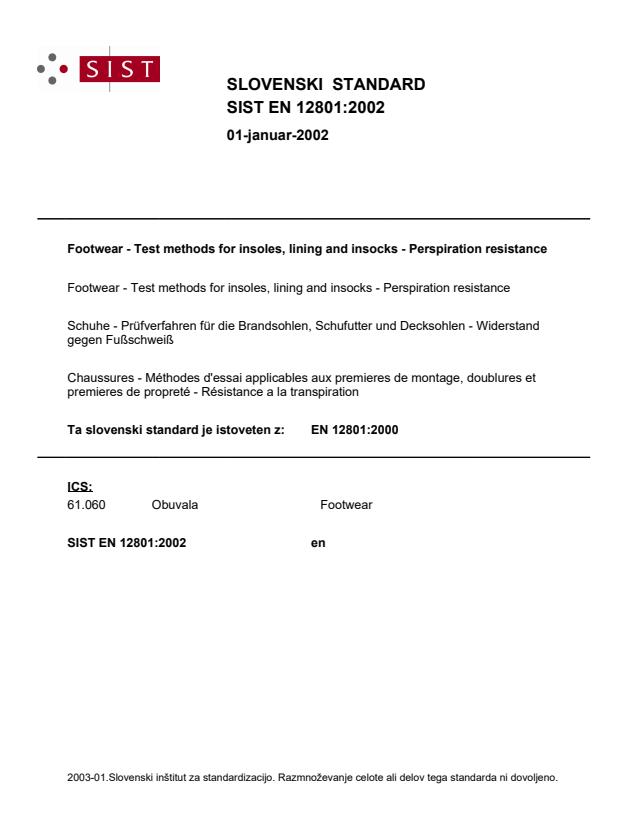
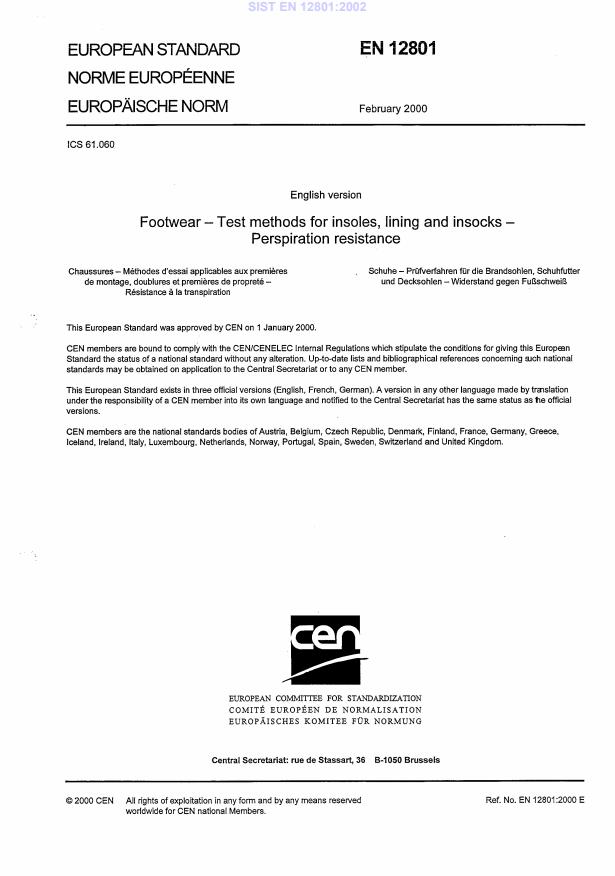
(Main)Footwear - Test methods for insoles, lining and insocks - Perspiration resistance
General Information
- Abstract
This European Standard specifies a method for the determination of the ageing of insoles, lining or insocks, caused by human sweat.
- Status
- Published
- Publication Date
- 31-Dec-2001
- Technical Committee
- SS SPL - Technical Board for the general field
- Current Stage
- 6060 - National Implementation/Publication (Adopted Project)
- Start Date
- 01-Jan-2002
- Due Date
- 01-Jan-2002
- Completion Date
- 01-Jan-2002

Overview
SIST EN 12801:2002 is a European Standard developed by CEN specifying test methods for assessing the perspiration resistance of footwear components such as insoles, linings, and insocks. This standard focuses on determining how these materials age and deteriorate when exposed to human sweat over time. By using standardized test procedures, manufacturers and testing laboratories can ensure that footwear components maintain durability and performance under perspiration conditions.
This standard is essential for quality control in the footwear industry, addressing the impact of moisture from sweat which can affect material integrity, comfort, and hygiene. SIST EN 12801:2002 supports the development of longer-lasting footwear by providing reliable testing methods for evaluating perspiration resistance.
Key Topics
- Scope of testing: Focuses specifically on insoles, linings, and insocks-key parts of footwear that are directly exposed to foot sweat.
- Ageing determination: Measures how materials change properties after exposure to simulated human perspiration.
- Test conditions: Defines controlled laboratory methods that mimic real-world sweat exposure.
- Material performance: Helps evaluate resistance to moisture-related degradation such as weakening, discoloration, and loss of functionality.
- Standardized procedures: Enables consistent, repeatable results across different testing facilities and manufacturers.
- Compliance: Aligns with European regulations and quality standards for footwear products.
Applications
- Footwear manufacturing: Assists manufacturers in selecting materials with proven perspiration resistance to improve product lifespan and wearer comfort.
- Quality assurance: Provides testing protocols for routine quality control checks on insoles, linings, and insocks.
- Research and development: Guides R&D teams in developing innovative materials and treatments to enhance durability against sweat exposure.
- Certification and labeling: Supports compliance claims relating to product durability and performance in perspiration conditions.
- Consumer safety and comfort: Helps ensure footwear maintains hygienic and comfortable conditions by resisting the adverse effects of prolonged sweat contact.
Related Standards
- EN ISO 20344 - Footwear - Test methods for general performance requirements.
- EN ISO 20347 - Occupational footwear standards detailing performance including moisture resistance.
- EN 13634 - Protective footwear standards with aspects of durability and resistance to environmental factors.
- ISO 105-E04 - Textiles - Color fastness to perspiration, applicable for lining materials.
- ASTM F2413 - American standard covering performance testing, including moisture resistance of footwear.
By adhering to SIST EN 12801:2002, footwear manufacturers and testing laboratories ensure high-quality, durable footwear components that withstand the challenges posed by human perspiration. This contributes not only to product longevity but also to the comfort and satisfaction of consumers worldwide.
Relations
- Effective Date
- 28-Jan-2026
- Effective Date
- 09-Feb-2026
- Effective Date
- 09-Feb-2026
- Effective Date
- 28-Jan-2026
- Effective Date
- 28-Jan-2026
- Effective Date
- 28-Jan-2026
- Effective Date
- 28-Jan-2026
- Effective Date
- 28-Jan-2026
- Effective Date
- 28-Jan-2026
- Effective Date
- 28-Jan-2026
- Effective Date
- 28-Jan-2026
- Effective Date
- 28-Jan-2026
- Effective Date
- 28-Jan-2026
- Effective Date
- 28-Jan-2026
- Effective Date
- 22-Dec-2008
Frequently Asked Questions
SIST EN 12801:2002 is a standard published by the Slovenian Institute for Standardization (SIST). Its full title is "Footwear - Test methods for insoles, lining and insocks - Perspiration resistance". This standard covers: This European Standard specifies a method for the determination of the ageing of insoles, lining or insocks, caused by human sweat.
This European Standard specifies a method for the determination of the ageing of insoles, lining or insocks, caused by human sweat.
SIST EN 12801:2002 is classified under the following ICS (International Classification for Standards) categories: 61.060 - Footwear. The ICS classification helps identify the subject area and facilitates finding related standards.
SIST EN 12801:2002 has the following relationships with other standards: It is inter standard links to SIST EN 12222:2000, SIST EN 60404-8-6:2017, SIST EN 60404-1:2017, SIST EN 12883:2001, SIST EN 13981-3:2006, SIST EN 15088:2006, SIST EN 15689:2012, SIST EN 1090-3:2008, SIST EN 1433:2003, SIST EN 14965:2006, SIST EN 13400:2004, SIST EN ISO 17709:2018, SIST EN 14874:2006, SIST EN 12892:2001, SIST EN 12801:2002/A1:2004. Understanding these relationships helps ensure you are using the most current and applicable version of the standard.
SIST EN 12801:2002 is available in PDF format for immediate download after purchase. The document can be added to your cart and obtained through the secure checkout process. Digital delivery ensures instant access to the complete standard document.
Standards Content (Sample)
2003-01.Slovenski inštitut za standardizacijo. Razmnoževanje celote ali delov tega standarda ni dovoljeno.Footwear - Test methods for insoles, lining and insocks - Perspiration resistanceSchuhe - Prüfverfahren für die Brandsohlen, Schufutter und Decksohlen - Widerstand gegen FußschweißChaussures - Méthodes d'essai applicables aux premieres de montage, doublures et premieres de propreté - Résistance a la tra
...