

SIST EN 2591-321:2001
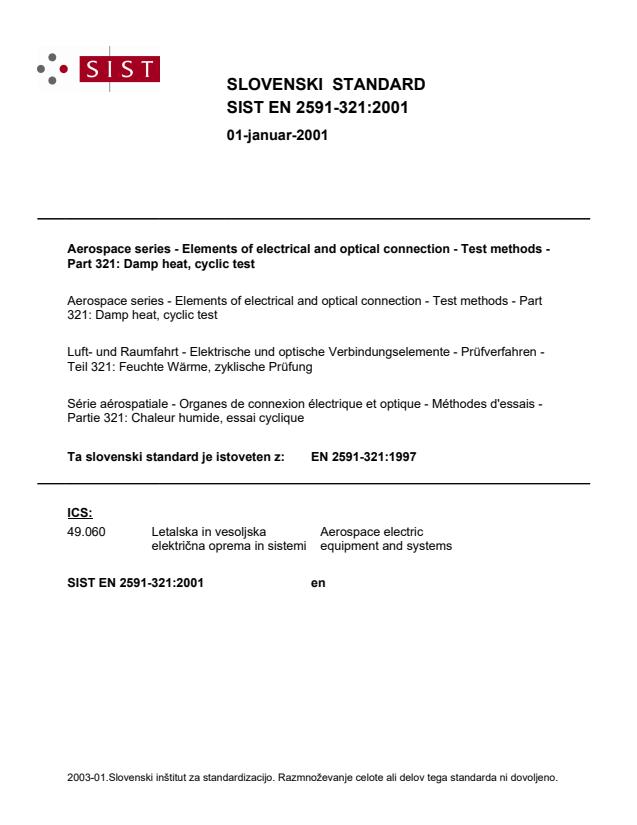
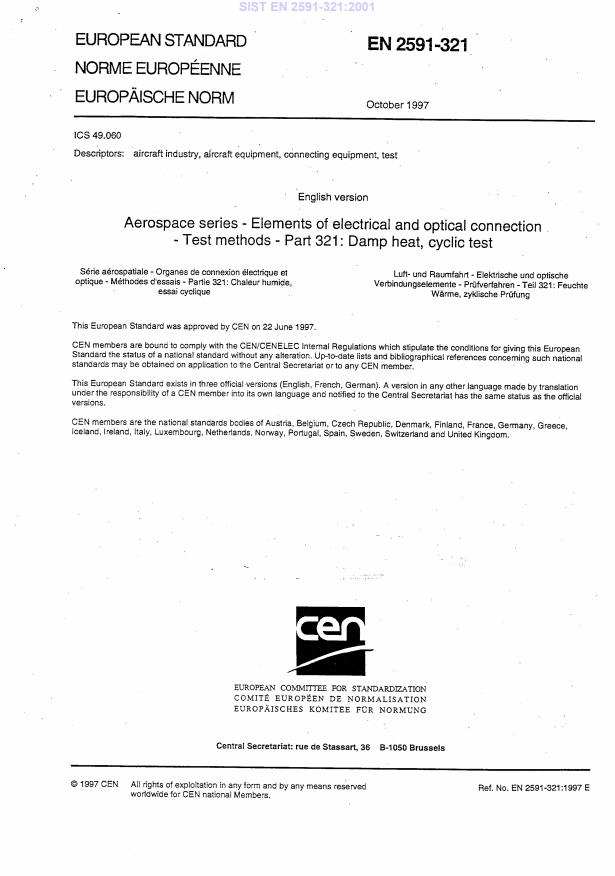
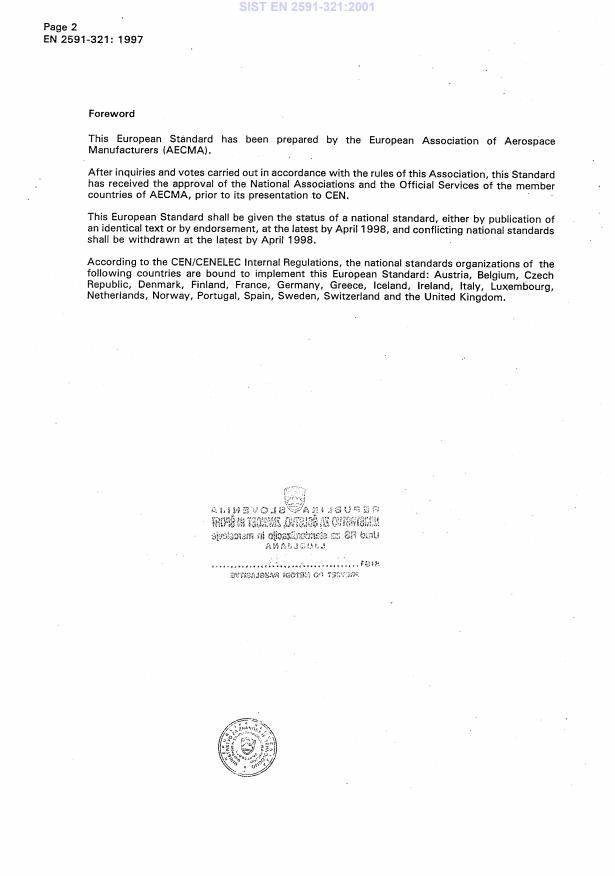
(Main)Aerospace series - Elements of electrical and optical connection - Test methods - Part 321: Damp heat, cyclic test
General Information
- Abstract
This standard specifies a method (cyclic test) of assessing the ability of elements of connection to function under conditions of damp heat. It shall be used together with EN 2591. This method forms part of test EN 2591-302.
- Status
- Published
- Publication Date
- 31-Dec-2000
- Technical Committee
- SS SPL - Technical Board for the general field
- Current Stage
- 6060 - National Implementation/Publication (Adopted Project)
- Start Date
- 01-Jan-2001
- Due Date
- 01-Jan-2001
- Completion Date
- 01-Jan-2001

Overview
EN 2591-321:1997 - part of the Aerospace series published by CEN - specifies a cyclic damp heat test method for elements of electrical and optical connection used in aerospace equipment. The standard describes how to assess the ability of connectors and similar connection elements to maintain functional performance when exposed to repeated cycles of humidity and temperature stress. It is intended to be used together with EN 2591 and forms part of the broader test regimen referenced in EN 2591-302.
Key Topics
- Scope and purpose: Defines the objective of a cyclic damp heat test to evaluate long-term reliability of electrical and optical connection elements in humid environments.
- Test method concept: Outlines a cyclic exposure regime (repeated humidity/temperature variations) designed to reveal degradation mechanisms such as corrosion, insulation breakdown, contact failures or optical attenuation increase.
- Performance assessment: Focuses on functional criteria - electrical continuity, contact resistance, insulation integrity, optical transmission - to determine if components continue to meet performance requirements after testing.
- Integration with EN 2591: Specifies that this part must be applied together with the general provisions of EN 2591 so that test setup, specimen preparation and acceptance criteria are consistent across the series.
- Test reporting and interpretation: Requires documentation of test conditions, observations and measured performance changes to support qualification and acceptance decisions.
Applications
- Connector qualification: Used by aerospace OEMs and suppliers to qualify electrical and optical connectors for aircraft, spacecraft and related systems.
- Design validation: Helps designers evaluate material choices, coatings and sealing strategies against cyclical moisture exposure.
- Quality assurance and incoming inspection: Employed by procurement and QA teams to verify supplier conformance to environmental durability requirements.
- Independent test laboratories: Provides a standardized method for labs performing environmental and reliability testing for aerospace customers.
- Regulatory and procurement compliance: Supports evidence for conformity with aerospace environmental test requirements during certification and supply-chain audits.
Related Standards
- EN 2591 (general series for elements of electrical and optical connection)
- EN 2591-302 (associated test procedure grouping that includes Part 321)
Keywords: EN 2591-321:1997, damp heat cyclic test, aerospace connectors, electrical and optical connection elements, environmental testing, humidity cycling, CEN standard, connector qualification.
Relations
- Effective Date
- 28-Jan-2026
- Effective Date
- 28-Jan-2026
- Effective Date
- 28-Jan-2026
- Effective Date
- 28-Jan-2026
- Effective Date
- 28-Jan-2026
- Effective Date
- 28-Jan-2026
- Effective Date
- 28-Jan-2026
- Effective Date
- 28-Jan-2026
- Effective Date
- 28-Jan-2026
- Effective Date
- 28-Jan-2026
- Effective Date
- 28-Jan-2026
- Effective Date
- 28-Jan-2026
- Effective Date
- 28-Jan-2026
- Effective Date
- 28-Jan-2026
- Effective Date
- 28-Jan-2026
Get Certified
Connect with accredited certification bodies for this standard

BUREAU VERITAS Certification Germany
Bureau Veritas certification in Germany.

Element Materials Technology
Materials testing and product certification.

AQMS Ltd.
AQMS provides ISO certification to SMEs across the UK.
Sponsored listings
Frequently Asked Questions
SIST EN 2591-321:2001 is a standard published by the Slovenian Institute for Standardization (SIST). Its full title is "Aerospace series - Elements of electrical and optical connection - Test methods - Part 321: Damp heat, cyclic test". This standard covers: This standard specifies a method (cyclic test) of assessing the ability of elements of connection to function under conditions of damp heat. It shall be used together with EN 2591. This method forms part of test EN 2591-302.
This standard specifies a method (cyclic test) of assessing the ability of elements of connection to function under conditions of damp heat. It shall be used together with EN 2591. This method forms part of test EN 2591-302.
SIST EN 2591-321:2001 is classified under the following ICS (International Classification for Standards) categories: 49.060 - Aerospace electric equipment and systems. The ICS classification helps identify the subject area and facilitates finding related standards.
SIST EN 2591-321:2001 has the following relationships with other standards: It is inter standard links to SIST EN 2591-408:2001, SIST EN 2591-206:2001, SIST EN 2591:2001, SIST EN 2591-101:2001, SIST EN 2591-302:2001, SIST EN 4644-001:2012, SIST EN 3155-071:2019, SIST EN 3155-027:2019, SIST EN 4639-102:2008, SIST EN 3155-076:2012, SIST EN 3646-001:2009, SIST EN 3155-081:2019, SIST EN 3155-071:2008, SIST EN 3155-017:2009, SIST EN 3155-024:2009. Understanding these relationships helps ensure you are using the most current and applicable version of the standard.
SIST EN 2591-321:2001 is available in PDF format for immediate download after purchase. The document can be added to your cart and obtained through the secure checkout process. Digital delivery ensures instant access to the complete standard document.
Standards Content (Sample)
2003-01.Slovenski inštitut za standardizacijo. Razmnoževanje celote ali delov tega standarda ni dovoljeno.Aerospace series - Elements of electrical and optical connection - Test methods - Part 321: Damp heat, cyclic testLuft- und Raumfahrt - Elektrische und optische Verbindungselemente - Prüfverfahren - Teil 321: Feuchte Wärme, zyklische PrüfungSérie aérospatiale - Organes de connexion électrique et optique - Méthodes d'essais - Partie 321: Chaleur humid
...