

SIST EN 54-3:2014+A1:2019
(Main)Fire detection and fire alarm systems - Part 3: Fire alarm devices - Sounders
General Information
- Abstract
This European Standard specifies the requirements, test methods and performance criteria for fire alarm sounders, including voice sounders, in a fixed installation intended to signal an audible warning between the fire detection and fire alarm systems and the occupants of a building (see EN 54-1:2011).
This European Standard provides for the assessment and verification of constancy of performance (AVCP) of fire alarm sounders to this EN.
This European Standard is not intended to cover:
a) loudspeaker type devices primarily intended for emitting emergency voice messages that are generated from an external audio source;
b) supervisory sounders, for example, within the control and indicating equipment.
- Status
- Published
- Publication Date
- 30-May-2019
- Technical Committee
- POZ - Požarna varnost
- Current Stage
- 6060 - National Implementation/Publication (Adopted Project)
- Start Date
- 08-May-2019
- Due Date
- 13-Jul-2019
- Completion Date
- 31-May-2019



Overview
SIST EN 54-3:2014+A1:2019 (EN 54-3) is the European standard that specifies requirements, test methods and performance criteria for fire alarm sounders, including voice sounders, used in fixed fire detection and fire alarm systems. It defines how sounders must perform to provide an audible warning to building occupants and sets out the Assessment and Verification of Constancy of Performance (AVCP) and factory production control (FPC) expectations. EN 54-3 applies to installed sounders but excludes loudspeaker devices that rely on an external audio source and supervisory sounders inside control equipment.
Key topics and technical requirements
EN 54-3 covers the full lifecycle of product performance and verification, including:
- Operational reliability: requirements for duration of operation, provision for external conductors, material flammability, enclosure protection and access.
- Performance under fire conditions: measurement of sound pressure level (SPL), permitted frequencies and sound patterns, synchronisation of multiple sounders, and voice sounder performance and sequence timing.
- Durability tests: environmental conditioning and comparative testing for heat resistance, humidity, shock & vibration, corrosion resistance and electrical stability.
- Software-controlled sounders: requirements for devices whose operation is determined by embedded software.
- Testing methods and instrumentation: detailed test arrangements, mounting, atmospheric conditions, tolerances, and reproducibility; normative annexes provide SPL measurement procedures (Annex A) and comparative environmental conditioning tests (Annex B).
- AVCP and factory production control: type testing, sampling, test reports, continuous surveillance and procedures for product modification.
- Marking, classification and data: required labelling, technical documentation and informative annexes on data supplied and regional sound patterns.
Practical applications and users
EN 54-3 is essential for:
- Manufacturers developing and certifying fire alarm sounders and voice sounders to meet European market requirements.
- Test laboratories performing type tests, environmental conditioning and SPL measurements.
- System designers & integrators who specify compliant audible devices for fire detection and alarm systems.
- Installers and maintenance teams ensuring installed sounders meet performance and durability expectations.
- Regulatory authorities and specifiers verifying AVCP and FPC compliance under CEN adoption.
Complying with EN 54-3 helps ensure reliable audible warnings in residential, commercial and public buildings and supports CE marking and harmonized product acceptance across CEN member states.
Related standards
- EN 54-1 (system overview and general requirements) - referenced for system-level context.
- Other EN 54-series parts (detection devices, control & indicating equipment) - used together to design compliant fire detection and alarm systems.
Keywords: EN 54-3, fire alarm sounders, voice sounders, sound pressure level, AVCP, fire detection systems, environmental testing, factory production control.
Relations
- Replaces
SIST EN 54-3:2014 - Fire detection and fire alarm systems - Part 3: Fire alarm devices - Sounders - Effective Date
- 01-Jul-2019
- Effective Date
- 09-Feb-2026
- Effective Date
- 09-Feb-2026
- Effective Date
- 09-Feb-2026
- Effective Date
- 09-Feb-2026
- Effective Date
- 09-Feb-2026
- Effective Date
- 09-Feb-2026
- Effective Date
- 09-Feb-2026
- Effective Date
- 09-Feb-2026
- Refers
SIST EN 60068-2-6:2008 - Environmental testing - Part 2-6: Tests - Test Fc: Vibration (sinusoidal) - Effective Date
- 09-Feb-2026
- Refers
SIST EN 60068-2-27:2009 - Environmental testing -- Part 2-27: Tests - Test Ea and guidance: Shock - Effective Date
- 09-Feb-2026
- Refers
SIST EN 60695-11-20:2015 - Fire hazard testing - Part 11-20: Test flames - 500 W flame test methods - Effective Date
- 09-Feb-2026
- Effective Date
- 09-Feb-2026
- Effective Date
- 09-Feb-2026
- Effective Date
- 09-Feb-2026
Get Certified
Connect with accredited certification bodies for this standard

CIS Institut d.o.o.
Personal Protective Equipment (PPE) certification body. Notified Body NB-2890 for EU Regulation 2016/425 PPE.

Kiwa BDA Testing
Building and construction product certification.
Kmetijski inštitut Slovenije
Agricultural Institute of Slovenia. Soil testing, plant health, agricultural product analysis.
Sponsored listings
Frequently Asked Questions
SIST EN 54-3:2014+A1:2019 is a standard published by the Slovenian Institute for Standardization (SIST). Its full title is "Fire detection and fire alarm systems - Part 3: Fire alarm devices - Sounders". This standard covers: This European Standard specifies the requirements, test methods and performance criteria for fire alarm sounders, including voice sounders, in a fixed installation intended to signal an audible warning between the fire detection and fire alarm systems and the occupants of a building (see EN 54-1:2011). This European Standard provides for the assessment and verification of constancy of performance (AVCP) of fire alarm sounders to this EN. This European Standard is not intended to cover: a) loudspeaker type devices primarily intended for emitting emergency voice messages that are generated from an external audio source; b) supervisory sounders, for example, within the control and indicating equipment.
This European Standard specifies the requirements, test methods and performance criteria for fire alarm sounders, including voice sounders, in a fixed installation intended to signal an audible warning between the fire detection and fire alarm systems and the occupants of a building (see EN 54-1:2011). This European Standard provides for the assessment and verification of constancy of performance (AVCP) of fire alarm sounders to this EN. This European Standard is not intended to cover: a) loudspeaker type devices primarily intended for emitting emergency voice messages that are generated from an external audio source; b) supervisory sounders, for example, within the control and indicating equipment.
SIST EN 54-3:2014+A1:2019 is classified under the following ICS (International Classification for Standards) categories: 13.220.20 - Fire protection; 13.320 - Alarm and warning systems. The ICS classification helps identify the subject area and facilitates finding related standards.
SIST EN 54-3:2014+A1:2019 has the following relationships with other standards: It is inter standard links to SIST EN 54-3:2014, SIST EN 60695-11-10:2014, SIST EN 60529:1997/A1:2000, SIST EN 60068-2-1:2008, SIST EN 60068-2-75:2001, SIST EN 60529:1997, SIST EN 60068-1:2001, SIST EN 60068-2-42:2004, SIST EN 60529:1997/A2:2014, SIST EN 60068-2-6:2008, SIST EN 60068-2-27:2009, SIST EN 60695-11-20:2015, SIST EN 60068-2-30:2006, SIST EN 60068-2-78:2013, SIST EN 61672-1:2004. Understanding these relationships helps ensure you are using the most current and applicable version of the standard.
SIST EN 54-3:2014+A1:2019 is associated with the following European legislation: EU Directives/Regulations: 2012-01-0929, 2020-01-0063, 305/2011; Standardization Mandates: M/109. When a standard is cited in the Official Journal of the European Union, products manufactured in conformity with it benefit from a presumption of conformity with the essential requirements of the corresponding EU directive or regulation.
SIST EN 54-3:2014+A1:2019 is available in PDF format for immediate download after purchase. The document can be added to your cart and obtained through the secure checkout process. Digital delivery ensures instant access to the complete standard document.
Standards Content (Sample)
SLOVENSKI STANDARD
01-julij-2019
Nadomešča:
SIST EN 54-3:2014
Sistemi za odkrivanje in javljanje požara ter alarmiranje - 3. del: Naprave za
alarmiranje - Zvočne naprave
Fire detection and fire alarm systems - Part 3: Fire alarm devices - Sounders
Brandmeldeanlagen - Teil 3: Feueralarmeinrichtungen Akustische Signalgeber
Systèmes de détection et d'alarme incendie - Partie 3 : Dispositifs sonores d'alarme feu
Ta slovenski standard je istoveten z: EN 54-3:2014+A1:2019
ICS:
13.220.20 Požarna zaščita Fire protection
13.320 Alarmni in opozorilni sistemi Alarm and warning systems
2003-01.Slovenski inštitut za standardizacijo. Razmnoževanje celote ali delov tega standarda ni dovoljeno.
EN 54-3:2014+A1
EUROPEAN STANDARD
NORME EUROPÉENNE
March 2019
EUROPÄISCHE NORM
ICS 13.220.20 Supersedes EN 54-3:2014
English Version
Fire detection and fire alarm systems - Part 3: Fire alarm
devices - Sounders
Systèmes de détection et d'alarme incendie - Partie 3 : Brandmeldeanlagen - Teil 3: Feueralarmeinrichtungen
Dispositifs sonores d'alarme feu Akustische Signalgeber
This European Standard was approved by CEN on 8 May 2014 and includes Amendment 1 approved by CEN on 14 October 2018.
CEN members are bound to comply with the CEN/CENELEC Internal Regulations which stipulate the conditions for giving this
European Standard the status of a national standard without any alteration. Up-to-date lists and bibliographical references
concerning such national standards may be obtained on application to the CEN-CENELEC Management Centre or to any CEN
member.
This European Standard exists in three official versions (English, French, German). A version in any other language made by
translation under the responsibility of a CEN member into its own language and notified to the CEN-CENELEC Management
Centre has the same status as the official versions.
CEN members are the national standards bodies of Austria, Belgium, Bulgaria, Croatia, Cyprus, Czech Republic, Denmark, Estonia,
Finland, Former Yugoslav Republic of Macedonia, France, Germany, Greece, Hungary, Iceland, Ireland, Italy, Latvia, Lithuania,
Luxembourg, Malta, Netherlands, Norway, Poland, Portugal, Romania, Serbia, Slovakia, Slovenia, Spain, Sweden, Switzerland,
Turkey and United Kingdom.
EUROPEAN COMMITTEE FOR STANDARDIZATION
COMITÉ EUROPÉEN DE NORMALISATION
EUROPÄISCHES KOMITEE FÜR NORMUNG
CEN-CENELEC Management Centre: Rue de la Science 23, B-1040 Brussels
© 2019 CEN All rights of exploitation in any form and by any means reserved Ref. No. EN 54-3:2014+A1:2019 E
worldwide for CEN national Members.
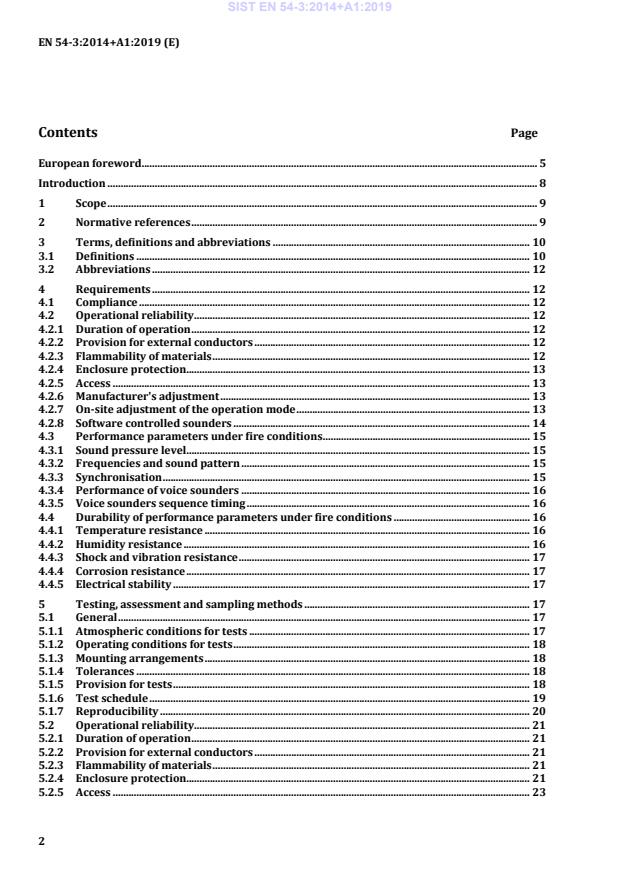
Contents Page
European foreword . 5
Introduction . 8
1 Scope . 9
2 Normative references . 9
3 Terms, definitions and abbreviations . 10
3.1 Definitions . 10
3.2 Abbreviations . 12
4 Requirements . 12
4.1 Compliance . 12
4.2 Operational reliability . 12
4.2.1 Duration of operation . 12
4.2.2 Provision for external conductors . 12
4.2.3 Flammability of materials . 12
4.2.4 Enclosure protection. 13
4.2.5 Access . 13
4.2.6 Manufacturer's adjustment . 13
4.2.7 On-site adjustment of the operation mode . 13
4.2.8 Software controlled sounders . 14
4.3 Performance parameters under fire conditions . 15
4.3.1 Sound pressure level . 15
4.3.2 Frequencies and sound pattern . 15
4.3.3 Synchronisation . 15
4.3.4 Performance of voice sounders . 16
4.3.5 Voice sounders sequence timing . 16
4.4 Durability of performance parameters under fire conditions . 16
4.4.1 Temperature resistance . 16
4.4.2 Humidity resistance . 16
4.4.3 Shock and vibration resistance . 17
4.4.4 Corrosion resistance . 17
4.4.5 Electrical stability . 17
5 Testing, assessment and sampling methods . 17
5.1 General . 17
5.1.1 Atmospheric conditions for tests . 17
5.1.2 Operating conditions for tests . 18
5.1.3 Mounting arrangements . 18
5.1.4 Tolerances . 18
5.1.5 Provision for tests . 18
5.1.6 Test schedule . 19
5.1.7 Reproducibility . 20
5.2 Operational reliability . 21
5.2.1 Duration of operation . 21
5.2.2 Provision for external conductors . 21
5.2.3 Flammability of materials . 21
5.2.4 Enclosure protection. 21
5.2.5 Access . 23
5.2.6 Manufacturer’s adjustments . 23
5.2.7 On site adjustments of the operating mode . 23
5.2.8 Requirements for software controlled devices . 23
5.3 Performance parameters under fire conditions . 23
5.3.1 Sound pressure level . 23
5.3.2 Frequencies and sound patterns . 24
5.3.3 Synchronisation . 24
5.3.4 Performance of voice sounders . 25
5.3.5 Voice sounder sequence timing . 26
5.4 Durability of performance parameters under fire conditions . 27
5.4.1 Heat resistance . 27
5.4.2 Humidity resistance . 30
5.4.3 Shock and vibration resistance . 32
5.4.4 Corrosion resistance, SO corrosion (endurance) . 36
5.4.5 Electrical stability . 37
6 Assessment and verification of constancy of performance (AVCP) . 38
6.1 General . 38
6.2 Type testing . 38
6.2.1 General . 38
6.2.2 Test samples, testing and compliance criteria . 39
6.2.3 Test reports . 39
6.3 Factory production control (FPC) . 39
6.3.1 General . 39
6.3.2 Requirements . 40
6.3.3 Product specific requirements . 42
6.3.4 Initial inspection of factory and FPC . 43
6.3.5 Continuous surveillance of FPC . 43
6.3.6 Procedure for modifications . 44
6.3.7 One-off products, pre-production products, (e.g. prototypes) and products produced
in very low quantities . 44
7 Classification and designation . 44
8 Marking, labelling and packaging . 44
Annex A (normative) !Sound pressure level measurement for fire alarm sounders" . 46
A.1 General . 46
A.2 Mounting arrangements. 46
A.3 Instrumentation . 46
A.4 Background noise level . 46
A.5 Measurement of sound pressure level . 46
Annex B (normative) Comparative sound pressure level test during environmental
conditioning . 51
B.1 General . 51
B.2 Test chamber . 51
B.2.1 Size . 51
B.2.2 Shape . 51
B.2.3 Rigidity . 52
B.2.4 Surface treatment . 52
B.3 Mounting arrangements. 52
B.4 Instrumentation . 52
B.5 Background noise level . 52
B.6 Test procedure . 52
B.6.1 Number and positioning of microphones . 52
B.6.2 Measurement of sound pressure level . 53
Annex C (informative) Data supplied with sounders . 56
Annex D (informative) Sound patterns used in some European countries . 57
D.1 Introduction . 57
D.2 Standards references . 57
D.3 Information on sound patterns . 58
D.3.1 Introduction . 58
Annex E (informative) Comparison of flammability test requirements in various standards . 61
E.1 Introduction . 61
E.2 Relevant standards . 61
E.3 Vertical burning tests . 61
E.4 Horizontal burning tests . 62
Annex ZA (informative) Relationship of this European Standard with Regulation (EU)
No.305/2011 . 64
Bibliography . 67
European foreword
This document (EN 54-3:2014+A1:2019) has been prepared by Technical Committee CEN/TC 72 “Fire
detection and fire alarm systems”, the secretariat of which is held by BSI.
This European Standard shall be given the status of a national standard, either by publication of an
identical text or by endorsement, at the latest by August 2019, and conflicting national standards shall
be withdrawn at the latest by March 2022.
Attention is drawn to the possibility that some of the elements of this document may be the subject of
patent rights. CEN shall not be held responsible for identifying any or all such patent rights.
This document supersedes !EN 54-3:2014".
This document includes Amendment 1 approved by CEN on 14 October 2018.
The start and finish of text introduced or altered by amendment is indicated in the text by tags ! ".
This document has been prepared under a mandate given to CEN by the European Commission and the
European Free Trade Association, and supports essential requirements of EU Directive(s).
For relationship with EU Directive(s), see informative Annex ZA, which is an integral part of this
document.
!EN 54-3:2001" has been revised so as to align with the second answer of CEN/TC 72 to Mandate
M/109. !EN 54-3:2014" includes new clauses and annexes as follows:
— Requirements for software controlled devices (5.2.8);
— Clause 6 Assessment and verification of constancy of performance (AVCP);
— Clause 7 Classification and designation;
— Clause 8 Marking, labelling and packaging;
— Annex C Data supplied with sounders;
— Annex D (informative) Sound patterns used in some European countries;
— Annex E (informative) Comparison of flammability test requirements in various standards.
The previous Annex C dealt with the requirements and test methods for voice sounders. The content of
this annex has been integrated in the main body of the standard, specifically under 4.3.3, 4.3.4, 4.3.5,
5.3.3. 5.3.4 and 5.3.5. In addition, Annex ZA has been revised to align with the Construction Products
Regulation (CPR).
!Amendment 1 to EN 54-3:2014 corrects some of the errors and clarifies some of the points."
EN 54, Fire detection and fire alarm systems, consists of the following parts:
— Part 1: Introduction
— Part 2: Control and indicating equipment
— Part 3: Fire alarm devices – Sounders
— Part 4: Power supply equipment
— Part 5: Heat detectors – Point detectors
— Part 7: Smoke detectors – Point detectors using scattered light, transmitted light or ionization
— Part 10: Flame detector – Point detectors
— Part 11: Manual call points
— Part 12: Smoke detectors – Line detector using an optical light beam
— Part 13: Compatibility assessment of system components
— Part 14: Guidelines for planning, design, installation, commissioning, use and maintenance
— Part 15: Point detectors using a combination of detected phenomena
— Part 16: Voice alarm control and indicating equipment
— Part 17: Short circuit isolators
— Part 18: Input/output devices
— Part 20: Aspirating smoke detectors
— Part 21: Alarm transmission and fault warning routine equipment
— Part 22: Line-type heat detectors
— Part 23: Fire alarm devices – Visual alarms
— Part 24: Components of voice alarm systems – Loudspeakers
— Part 25: Components using radio links and system requirements
— Part 26: Carbon monoxide detectors – Point detectors
— Part 27: Duct smoke detectors
— Part 28: Non-resettable (digital) line type heat detectors
— Part 29: Multi-sensor fire detectors - Point detectors using a combination of smoke and heat sensors
— Part 30: Multi-sensor fire detectors - Point detectors using a combination of carbon monoxide and
heat sensors
— Part 31: Multi-sensor detector – Point detectors using a combination of smoke, carbon monoxide and
optionally heat sensors
— Part 32: Guidelines for the planning, design, installation, commissioning, use and maintenance of voice
alarm systems
NOTE This list includes standards that are in preparation and other standards may be added. For current
status of published standards refer to www.cen.eu.
According to the CEN-CENELEC Internal Regulations, the national standards organisations of the
following countries are bound to implement this European Standard: Austria, Belgium, Bulgaria,
Croatia, Cyprus, Czech Republic, Denmark, Estonia, Finland, Former Yugoslav Republic of Macedonia,
France, Germany, Greece, Hungary, Iceland, Ireland, Italy, Latvia, Lithuania, Luxembourg, Malta,
Netherlands, Norway, Poland, Portugal, Romania, Serbia, Slovakia, Slovenia, Spain, Sweden, Switzerland,
Turkey and the United Kingdom.
Introduction
The purpose of a fire alarm sounder is to warn person(s) within, or in the vicinity of, a building of the
occurrence of a fire emergency situation in order to enable such a person(s) to take appropriate
measures.
This European Standard recognizes that the exact nature of the sound requirements, i.e. its frequency
range, temporal pattern and output level will vary according to the nature of the installation, the type of
risk present and appropriate measures to be taken, the type of signals used by other non-emergency
alarms (see, for example, EN ISO 7731) and national differences in custom and practice. The resulting
standard specifies, therefore, a common method for the testing of the operational performance of
sounders against the specification declared by the manufacturer rather than imposing common
requirements.
In some European countries, specific frequencies of sound and sound patterns are used. These may be
given in national codes or standards (see Annex D). Attention is drawn to national safety regulations
which may specify maximum safe sound pressure level received by occupants of a building.
Attention is also drawn to ISO 8201:1987, Acoustics – Audible emergency evacuation signal, the
international standard which specifies the temporal pattern and the required sound pressure level of an
audible emergency evacuation signal.
This European Standard gives common requirements for sounders as well as for their performance
under climatic, mechanical and electrical interference conditions which are likely to occur in the service
environment. This European Standard covers sounders for either an indoor or an outdoor application
environment category.
In fire detection and fire alarm systems, voice sounders are used as alarm devices for warning the
occupants of a building of the occurrence of a fire risk, using a combination of an attention-drawing
signal and dedicated voice message(s). The requirements, test methods and performance criteria
specified in this standard for sounders are also applicable to voice sounders. Additional requirements,
test methods and performance criteria specific to voice sounders are also incorporated.
1 Scope
This European Standard specifies the requirements, test methods and performance criteria for fire
alarm sounders, including voice sounders, in a fixed installation intended to signal an audible warning
between the fire detection and fire alarm systems and the occupants of a building (see EN 54-1:2011).
This European Standard provides for the assessment and verification of constancy of performance
(AVCP) of fire alarm sounders to this EN.
This European Standard is not intended to cover:
a) loudspeaker type devices primarily intended for emitting emergency voice messages that are
generated from an external audio source;
b) supervisory sounders, for example, within the control and indicating equipment.
2 Normative references
The following documents, in whole or in part, are normatively referenced in this document and are
indispensable for its application. For dated references, only the edition cited applies. For undated
references, the latest edition of the referenced document (including any amendments) applies.
EN 54-1:2011, Fire detection and fire alarm systems — Part 1: Introduction
EN 50130-4:2011, Alarm systems — Part 4: Electromagnetic compatibility — Product family standard:
Immunity requirements for components of fire, intruder, hold up, CCTV, access control and social alarm
systems
EN 60068-1:1994, Environmental testing — Part 1: General and guidance (IEC 60068-1:1988 +
Corrigendum 1988 + A1:1992)
EN 60068-2-1:2007, Environmental testing — Part 2-1: Tests — Test A: Cold (IEC 60068-2-1:2007)
EN 60068-2-2:2007, Environmental testing — Part 2-2: Tests — Test B: Dry heat (IEC 60068-2-2:2007)
EN 60068-2-6:2008, Environmental testing — Part 2-6: Tests — Test Fc: Vibration
(sinusoidal)(IEC 60068-2-6:2007)
EN 60068-2-27:2009, Environmental testing — Part 2-27: Tests — Test Ea and guidance: Shock
(IEC 60068-2-27:2008)
EN 60068-2-30:2005, Environmental testing — Part 2-30: Tests — Test Db: Damp heat, cyclic (12 h + 12 h
cycle) (IEC 60068-2-30:2005)
EN 60068-2-42:2003, Environmental testing — Part 2-42: Tests — Test Kc: Sulphur dioxide test for
contacts and connections (IEC 60068-2-42:2003)
EN 60068-2-75:1997, Environmental testing — Part 2-75: Tests — Test Eh: Hammer tests
(IEC 60068-2-75:1997)
EN 60068-2-78:2013, Environmental testing — Part 2-78: Tests — Test Cab: Damp heat, steady state
(IEC 60068-2-78:2012)
EN 60529:1991, Degrees of protection provided by enclosures (IP Code) (IEC 60529:1989)
EN 60529:1991/A1:2000, Degrees of protection provided by enclosures (IP Code)
(IEC 60529:1989/A1:1999)
!EN 60529:1991/A2:2013, Degrees of protection provided by enclosures (IP Code)
(IEC 60529:1989/A2:2013)"
EN 60695-11-10:2013, Fire hazard testing — Part 11-10: Test flames — 50 W horizontal and vertical
flame test methods (IEC 60695-11-10:2013)
!EN 60695-11-20:2015, Fire hazard testing — Part 11-20: Test flames — 500 W flame test methods
(IEC 60695-11-20:2015)"
EN 61672-1:2003, Electroacoustics — Sound level meters — Part 1: Specifications (IEC 61672-1:2002)
3 Terms, definitions and abbreviations
For the purposes of this European Standard, the following terms, definitions and abbreviations and
those given in EN 54-1 apply.
3.1 Definitions
3.1.1
A-weighted sound pressure level
L
pA
!sound pressure level, expressed in dB(A), which is 20 times the logarithm to base ten of the ratio of
the A-weighted sound pressure to the reference pressure of 20 μPa at 1 kHz"
Note 1 to entry: The A-weighting characteristics are given in EN 61672–1:2003.
3.1.2
delta sound pressure level
Δ(LpA)
decrease in the mean A-weighted sound pressure level between measurements on the same specimen
(Annex B)
Note 1 to entry: In this standard Δ(L ) is used to compare the sound pressure level measured during
pA
environmental tests with that first measured on the same specimen during the reproducibility test.
3.1.3
equivalent sound pressure level
LAeq,T
the value of the sound pressure level, in dB(A), of continuous sound that, within a specified time
interval, T, has the same mean-square sound pressure as a sound that varies with time
3.1.4
fire alarm sounder
sound generating device intended to signal an audible warning of fire between a fire detection and fire
alarm system and the occupants of a building
3.1.5
maximum sound pressure level
LAFmax,T
the maximum value of the sound pressure level, in dB(A), measured within a specified time interval, T
and with a specified time weighting
Note 1 to entry: For application within the framework of this standard the time weighting Fast applies. Refer to
EN 61672–1:2003.
3.1.6
mode (of operation)
one of a possible number of pre-defined sounds (or sound outputs) of the sounder which can be
selected by means specified by the manufacturer
EXAMPLE Sound patterns, sound pressure levels.
3.1.7
reference point
point representing the origin of the sound within or on the surface of the sounder as specified by the
manufacturer
Note 1 to entry: The reference point is used in Annex A.
3.1.8
sound pattern
pre-defined acoustic alarm signal
Note 1 to entry: Sound pattern is also often referred to as tone.
3.1.9
supervisory sounder
audible device on a piece of equipment used for drawing attention to a change of status
Note 1 to entry: Supervisory sounders are often mounted within the fire detection and fire alarm control and
indicating equipment.
3.1.10
type A sounder
device primarily intended for indoor applications
Note 1 to entry: Type A sounders may be suitable for some protected outdoor situations.
3.1.11
type B sounder
device primarily intended for outdoor applications
Note 1 to entry: Type B sounders may be more suitable than type A sounders for some indoor situations where
high temperature and/or humidity are present.
3.1.12
volume control
means for adjusting sound pressure level
3.2 Abbreviations
AC Alternating current
AVCP Assessment and verification of constancy of performance
CWFT Classified without Further Testing
DC Direct current
DoP Declaration of performance
MS Member states
NPD No performance determined
RMS Root mean square
SPL Sound pressure level
4 Requirements
4.1 Compliance
In order to comply with this standard, sounders shall meet the requirements of this clause, which shall
be verified by visual inspection or engineering assessment and shall be tested as described in Clause 5
and shall meet the requirements of the tests.
4.2 Operational reliability
4.2.1 Duration of operation
The sounder shall be rated for at least 100 h operation. No limitation by the manufacturer on duty
factor or maximum on-time shall prevent the device from operating the 1 h 'on' 1 h 'off' cycle required
by the test procedure described in 5.2.1.
!This requirement does not apply to the capacity of batteries that may be used within sounders as a
means of local storage of operating power. The capacity and charging requirements of such batteries
need to meet the requirement of the system."
4.2.2 Provision for external conductors
The sounder, unless it is a radio-linked component not using wires, shall provide space within its
enclosure for external conductors to be brought in and terminated. Entry holes for conductors or cables
shall be provided or the location where such holes are to be made shall be indicated, by providing a
template or some other suitable means.
Terminals for connecting external conductors to the sounder shall be designed so that the conductors
are clamped between metal surfaces without being damaged.
This requirement shall be assessed as specified in 5.2.2.
4.2.3 Flammability of materials
Plastic materials used in the construction of sounders shall comply with the following flammability
requirements:
a) EN 60695-11-10:2013 Class V-2 or HB75 for devices consuming less than or equal to 15 W of
power;
b) !EN 60695-11-20:2015 Class 5VB" for devices consuming more than 15 W of power.
NOTE Annex E gives information on the test requirements and classification given in the European Standards
and equivalent flammability ratings in UL 94.
This shall be assessed as specified in 5.2.3.
4.2.4 Enclosure protection
The degree of protection provided by the enclosure of the sounders shall meet the following
requirements:
a) Type A sounders: Code IP21C of !EN 60529:1991 as amended by EN 60529:1991/A1:2000 and
EN 60529:1991/A2:2013";
b) Type B sounders: Code IP33C of !EN 60529:1991 as amended by EN 60529:1991/A1:2000 and
EN 60529:1991/A2:2013".
This shall be assessed as specified in 5.2.4 and meet the compliance criteria of 5.2.4.3.
4.2.5 Access
Means shall be provided to limit access for removal of parts or the whole device and to make
adjustment to the mode of operation, e.g. special tool, codes, hidden screws, seals, etc.
NOTE The use of a special tool is intended to discourage unauthorised persons from easily accessing the
equipment.
This requirement shall be assessed as specified in 5.2.5.
4.2.6 Manufacturer's adjustment
It shall not be possible to change the manufacturer’s settings or to access the message recording
function of voice sounders except by special means (e.g. the use of a special code or tool) or by breaking
or removing a seal.
This requirement shall be assessed as specified in 5.2.6.
4.2.7 On-site adjustment of the operation mode
If there is provision for on-site adjustment of the mode of operation of the sounder:
a) For each setting, at which the manufacturer claims compliance with this standard, the sounder shall
comply with 4.2.6.
b) Any setting(s), at which the manufacturer does not claim compliance with this standard, shall
comply with 4.2.6 and:
1) !for volume controls, the limits of the compliant range of sound pressure levels shall be
clearly shown in the associated data,"
2) !for sound pattern(s), the compliant setting(s) shall be clearly marked in the associated
data."
These adjustments may be carried out at the sounder or at the control and indicating equipment.
This requirement shall be assessed as specified in 5.2.7.
4.2.8 Software controlled sounders
4.2.8.1 General
For sounders which rely on software control in order to fulfil the requirements of this standard, the
requirements of 4.2.8.2, 4.2.8.3 and 4.2.8.4 shall be met.
4.2.8.2 Software documentation
4.2.8.2.1 The manufacturer shall submit documentation which gives an overview of the software
design. This documentation shall be in sufficient detail for the design to be inspected for compliance
with this standard and shall include at least the following:
a) a functional description of the main program flow (e.g. as a flow diagram or structogram) including:
1) a brief description of the modules and the functions that they perform;
2) the way in which the modules interact,
3) the overall hierarchy of the program,
4) the way in which the software interacts with the hardware of the sounder,
5) the way in which the modules are called, including any interrupt processing.
b) a description of which areas of memory are used for the various purposes (e.g. the program, site
specific data and running data);
c) a designation, by which the software and its version can be uniquely identified.
4.2.8.2.2 The manufacturer shall have available detailed design documentation, which only needs to
be provided if required by the testing authority. It shall comprise at least the following:
a) an overview of the whole system configuration, including all software and hardware components;
b) a description of each module of the program, containing at least:
1) the name of the module,
2) a description of the tasks performed,
3) a description of the interfaces, including the type of data transfer, the valid data range and the
checking for valid data.
c) full source code listings, as hard copy or in machine-readable form (e.g. ASCII-code), including all
global and local variables, constants and labels used, and sufficient comment for the program flow
to be recognized;
d) details of any software tools used in the design and implementation phase (e.g. CASE-tools,
compilers).
4.2.8.3 Software design
In order to ensure the reliability of the sounder, the following requirements for the software design
shall apply:
a) the software shall have a modular structure;
b) the design of the interfaces for manually and automatically generated data shall not permit invalid
data to cause error in the program operation;
c) the software shall be designed to avoid the occurrence of deadlock of the program flow.
4.2.8.4 The storage of program and data
The !program" necessary to comply with this standard and any pre-set data, such as
manufacturer's settings, shall be held in non-volatile memory. Writing to areas of memory containing
this program and data shall only be possible by the use of some special tool or code and shall not be
possible during normal operation of the sounder.
Site-specific data shall be held in memory !that" will retain data for at least two weeks without
external power to the sounder, unless provision is made for the automatic renewal of such data,
following loss of power, within 1 h of power being restored.
4.2.8.5 Assessment
This requirement shall be assessed as specified in 5.2.8.
4.3 Performance parameters under fire conditions
4.3.1 Sound pressure level
The sounder shall produce A-weighted sound pressure levels as declared by the manufacturer.
The manufacturer may declare different sound pressure levels for operation under different conditions,
for example, when operating on different voltage ranges or with different sound patterns. If this is the
case the sound pressure level of each specimen shall be measured under each mode of operation (see
5.1.2).
!When tested in accordance with 5.3.1 the sounder shall produce A-weighted sound pressure levels
of at least 65 dB(A) in one direction and the sound pressure level measured at each of the specified
angles shall not be less than that declared by the manufacturer."
4.3.2 Frequencies and sound pattern
This standard covers sounders !that" produce different frequencies and sound patterns and,
therefore, does not specify a minimum and maximum frequency or specific sound pattern. The main
sound frequency(ies), frequency range(s) and sound pattern(s) shall be as declared by the
manufacturer when tested as specified in 5.3.2.
NOTE Annex D gives information on some of the sound patterns and frequencies used in different European
countries and on the international evacuation signal specified in ISO 8201.
4.3.3 Synchronisation
Sounders may interact acoustically when they are installed in close proximity. To prevent this, sounders
may have provision for synchronising warning signals and messages with that of other devices. If a
synchronisation function is provided, it shall meet the compliance criteria of 5.3.3.
When power interruption is used for synchronisation purposes, this shall not adversely affect the
warning signal or the voice message.
NOTE Synchronisation can be achieved by internal circuitry, the addition of a trigger wire connected between
devices or by other means as defined by the manufacturer.
4.3.4 Performance of voice sounders
Voice sounders shall be capable of producing an attention-drawing signal, and a voice message or
messages. The output level of the voice message relative to the attention drawing signal shall meet the
compliance criteria of 5.3.4.
4.3.5 Voice sounders sequence timing
For messages that require immediate action, the broadcast sequence and timings of voice sounders
shall be as specified in Table 1.
!
Table 1 — Voice sounders broadcast sequence and timings
Sequence steps Duration
a) attention-drawing signal 2 s to 10 s
b) silence 0,25 s to 2 s
c) voice message ≤ 30 s
d) silence 0,25 s to 2 s
The time between the start of each cycle shall not exceed 30 s. The periods of silence may need to be
longer than indicated in certain circumstances, for example in spaces with long reverberation times, but
shall not be such that the time between the start of each cycle exceeds 30 s."
For messages that do not require immediate action, it is permitted to extend either the silence period
after the voice message
...