


SIST EN 666:1999
(Main)Resilient floor coverings - Determination of gelling
Resilient floor coverings - Determination of gelling
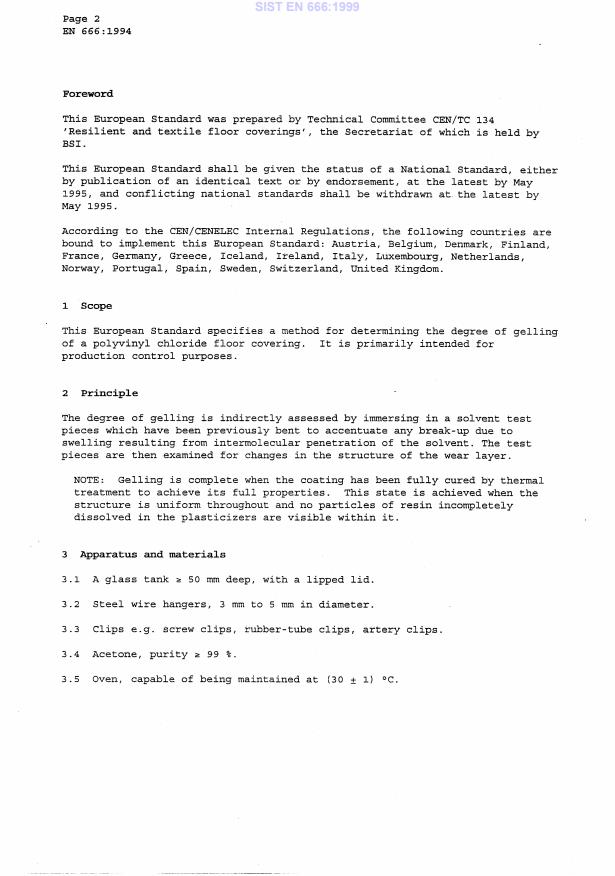
This European Standard specifies a method for determining the degree of gelling of a polyvinyl chloride floor covering. It is primarily intended for production control purposes.
Elastische Bodenbeläge - Bestimmung der Gelierung
Diese Europäische Norm legt ein Verfahren zur Bestimmung des Gelierung von Polyvinylchlorid-Bodenbelägen fest. Dieses Verfahren ist vorzugsweise für die Produktionskontrolle vorgesehen.
Revetements de sol résilients - Détermination de la gélification
La présente Norme Européenne prescrit une méthode de détermination du degré de gélification des revêtements de sol en polychlorure de vinyle. Elle est principalement destinée aux contrôles de production.
Netekstilne talne obloge - Ugotavljanje želiranja
General Information
- Status
- Published
- Publication Date
- 28-Feb-1999
- Technical Committee
- ITEK - Textile and textile products
- Current Stage
- 6060 - National Implementation/Publication (Adopted Project)
- Start Date
- 01-Mar-1999
- Due Date
- 01-Mar-1999
- Completion Date
- 01-Mar-1999
- Directive
- 89/106/EEC - Construction products
Overview
SIST EN 666:1999 is a European Standard developed by CEN that specifies the method for determining the degree of gelling in polyvinyl chloride (PVC) resilient floor coverings. Gelling refers to the extent to which PVC flooring materials undergo a gelation process, affecting their physical properties and durability. This standard is primarily intended for production control purposes, ensuring consistent quality and performance in the manufacture of resilient floor coverings.
Key Topics
- Determination of Gelling: SIST EN 666:1999 outlines a standardized procedure to measure the degree of gelling in PVC floor coverings, which is a critical indicator of the material’s stability and manufacturing consistency.
- Polyvinyl Chloride Floor Coverings: The standard specifically applies to resilient floor coverings made from PVC, a widely used material in commercial and residential flooring due to its durability and ease of maintenance.
- Quality Control in Production: The standard supports manufacturers in maintaining consistent product quality by providing a reliable testing method for gelling during floor covering production.
- Non-textile Floor Coverings: Categorized under ICS 97.150, this standard addresses non-textile resilient flooring products, differentiating from textile floor coverings often governed by other standards.
Applications
- Manufacturing Quality Assurance: By implementing SIST EN 666:1999, manufacturers can monitor and control the gelling level of PVC resilient floor coverings, ensuring the final product meets defined quality and performance criteria.
- Resilient Flooring Industry: This standard benefits producers, quality inspectors, and product developers involved in producing vinyl and other PVC-based flexible floorings.
- Product Development and Testing: Laboratories and research centers use this method to analyze new formulations of PVC floor coverings to optimize properties such as flexibility, wear resistance, and longevity.
- Regulatory Compliance: Adherence to this European Standard helps companies meet industry regulations and customer expectations, supporting product certification and market acceptance within Europe.
Related Standards
- EN 649 - Resilient floor coverings - Specifications for safety and technical performance of homogeneous and heterogeneous vinyl floor coverings.
- EN ISO 2439 - Rubber, vulcanized or thermoplastic - Determination of hardness (Shore hardness).
- EN 428 - Resilient floor coverings - Determination of thickness.
- EN 685 - Resilient, textile and laminate floor coverings - Classification.
- ISO 10581 - Resilient floor coverings - Polyvinyl chloride floor coverings with smooth surfaces - Specification.
These complementary standards provide additional testing methods and performance requirements relevant to resilient flooring products, ensuring a comprehensive approach to quality assessment and standardization.
Keywords: SIST EN 666:1999, resilient floor coverings, polyvinyl chloride, PVC flooring, gelling determination, production control, European Standard, flexible floor coverings, non-textile floor coverings, flooring quality assurance, CEN standard.

Frequently Asked Questions
SIST EN 666:1999 is a standard published by the Slovenian Institute for Standardization (SIST). Its full title is "Resilient floor coverings - Determination of gelling". This standard covers: This European Standard specifies a method for determining the degree of gelling of a polyvinyl chloride floor covering. It is primarily intended for production control purposes.
This European Standard specifies a method for determining the degree of gelling of a polyvinyl chloride floor covering. It is primarily intended for production control purposes.
SIST EN 666:1999 is classified under the following ICS (International Classification for Standards) categories: 97.150 - Floor coverings. The ICS classification helps identify the subject area and facilitates finding related standards.
SIST EN 666:1999 is associated with the following European legislation: EU Directives/Regulations: 305/2011, 89/106/EEC. When a standard is cited in the Official Journal of the European Union, products manufactured in conformity with it benefit from a presumption of conformity with the essential requirements of the corresponding EU directive or regulation.
SIST EN 666:1999 is available in PDF format for immediate download after purchase. The document can be added to your cart and obtained through the secure checkout process. Digital delivery ensures instant access to the complete standard document.
Standards Content (Sample)
SLOVENSKI STANDARD
01-marec-1999
Netekstilne talne obloge - Ugotavljanje želiranja
Resilient floor coverings - Determination of gelling
Elastische Bodenbeläge - Bestimmung der Gelierung
Revetements de sol résilients - Détermination de la gélification
Ta slovenski standard je istoveten z: EN 666:1994
ICS:
97.150 Netekstilne talne obloge Non-textile floor coverings
2003-01.Slovenski inštitut za standardizacijo. Razmnoževanje celote ali d
...
Questions, Comments and Discussion
Ask us and Technical Secretary will try to provide an answer. You can facilitate discussion about the standard in here.
Loading comments...