


SIST-TP CLC/TR 50600-99-3:2018
(Main)Information technology - Data centre facilities and infrastructures - Part 99-3: Guidance to the application of EN 50600 series
Information technology - Data centre facilities and infrastructures - Part 99-3: Guidance to the application of EN 50600 series
This document offers users additional information on the background of the requirements and recommendations in the EN 50600 series. In addition it constitutes a guideline for the correct application and interpretation of these standards.
Informationstechnik - Einrichtungen und Infrastrukturen von Rechenzentren - Teil 99-3: Anleitung zur Anwendung der Normenreihe EN 50600
Dieses Dokument bietet zusätzliche Informationen zum Hintergrund der Anforderungen und Empfehlungen der Reihe EN 50600. Zudem stellt er eine Leitlinie zur korrekten Anwendung und Auslegung dieser Normen dar.
Technologies de l’information - Installations et infrastructures des centres de traitement de données - Partie 99-3: Recommandations relatives à l’application de la série EN 50600
Informacijska tehnologija - Naprave in infrastruktura podatkovnih centrov - 99-3. del: Vodilo za uporabo skupine standardov EN 50600
To tehnično poročilo podaja vodilo za pomoč pri splošni uporabi zahtev za:
postopek oblikovanja podatkovnih centrov v skladu s standardom EN 50600-1; zasnovo podatkovnih centrov v skladu s skupino standardov EN 50600-2-X; delovanje in upravljanje podatkovnih centrov, vključno z uporabo in nadzorom KPI-jev, v skladu s skupino standardov EN 50600-3-X.
General Information
- Status
- Withdrawn
- Publication Date
- 12-Sep-2018
- Withdrawal Date
- 08-Mar-2026
- Technical Committee
- ELI - Electrical and communication installations
- Current Stage
- 9900 - Withdrawal (Adopted Project)
- Start Date
- 09-Mar-2026
- Due Date
- 01-Apr-2026
- Completion Date
- 09-Mar-2026
Relations
- Effective Date
- 03-Feb-2026

Get Certified
Connect with accredited certification bodies for this standard

BSI Group
BSI (British Standards Institution) is the business standards company that helps organizations make excellence a habit.

NYCE
Mexican standards and certification body.
Sponsored listings
Frequently Asked Questions
SIST-TP CLC/TR 50600-99-3:2018 is a technical report published by the Slovenian Institute for Standardization (SIST). Its full title is "Information technology - Data centre facilities and infrastructures - Part 99-3: Guidance to the application of EN 50600 series". This standard covers: This document offers users additional information on the background of the requirements and recommendations in the EN 50600 series. In addition it constitutes a guideline for the correct application and interpretation of these standards.
This document offers users additional information on the background of the requirements and recommendations in the EN 50600 series. In addition it constitutes a guideline for the correct application and interpretation of these standards.
SIST-TP CLC/TR 50600-99-3:2018 is classified under the following ICS (International Classification for Standards) categories: 35.020 - Information technology (IT) in general. The ICS classification helps identify the subject area and facilitates finding related standards.
SIST-TP CLC/TR 50600-99-3:2018 has the following relationships with other standards: It is inter standard links to SIST EN 50600-1:2019. Understanding these relationships helps ensure you are using the most current and applicable version of the standard.
SIST-TP CLC/TR 50600-99-3:2018 is associated with the following European legislation: Standardization Mandates: M/462. When a standard is cited in the Official Journal of the European Union, products manufactured in conformity with it benefit from a presumption of conformity with the essential requirements of the corresponding EU directive or regulation.
SIST-TP CLC/TR 50600-99-3:2018 is available in PDF format for immediate download after purchase. The document can be added to your cart and obtained through the secure checkout process. Digital delivery ensures instant access to the complete standard document.
Standards Content (Sample)
SLOVENSKI STANDARD
01-oktober-2018
Informacijska tehnologija - Naprave in infrastruktura podatkovnih centrov - 99-3.
del: Vodilo za uporabo skupine standardov EN 50600
Information technology - Data centre facilities and infrastructures - Part 99-3: Guidance
to the application of EN 50600 series
Informationstechnik - Einrichtungen und Infrastrukturen von Rechenzentren - Teil 99-3:
Anleitung zur Anwendung der Normenreihe EN 50600
Technologies de l’information - Installations et infrastructures des centres de traitement
de données - Partie 99-3: Recommandations relatives à l’application de la série EN
Ta slovenski standard je istoveten z: CLC/TR 50600-99-3:2018
ICS:
35.020 Informacijska tehnika in Information technology (IT) in
tehnologija na splošno general
2003-01.Slovenski inštitut za standardizacijo. Razmnoževanje celote ali delov tega standarda ni dovoljeno.
TECHNICAL REPORT CLC/TR 50600-99-3
RAPPORT TECHNIQUE
TECHNISCHER BERICHT
August 2018
ICS 35.020; 35.110; 35.160
English Version
Information technology - Data centre facilities and infrastructures
- Part 99-3: Guidance to the application of EN 50600 series
Technologies de l'information - Installations et Informationstechnik - Einrichtungen und Infrastrukturen von
infrastructures des centres de traitement de données - Rechenzentren - Teil 99-3: Anleitung zur Anwendung der
Partie 99-3: Recommandations relatives à l'application de la Normenreihe EN 50600
série EN 50600
This Technical Report was approved by CENELEC on 2018-07-09.
CENELEC members are the national electrotechnical committees of Austria, Belgium, Bulgaria, Croatia, Cyprus, the Czech Republic,
Denmark, Estonia, Finland, Former Yugoslav Republic of Macedonia, France, Germany, Greece, Hungary, Iceland, Ireland, Italy, Latvia,
Lithuania, Luxembourg, Malta, the Netherlands, Norway, Poland, Portugal, Romania, Serbia, Slovakia, Slovenia, Spain, Sweden,
Switzerland, Turkey and the United Kingdom.
European Committee for Electrotechnical Standardization
Comité Européen de Normalisation Electrotechnique
Europäisches Komitee für Elektrotechnische Normung
CEN-CENELEC Management Centre: Rue de la Science 23, B-1040 Brussels
© 2018 CENELEC All rights of exploitation in any form and by any means reserved worldwide for CENELEC Members.
Ref. No. CLC/TR 50600-99-3:2018 E
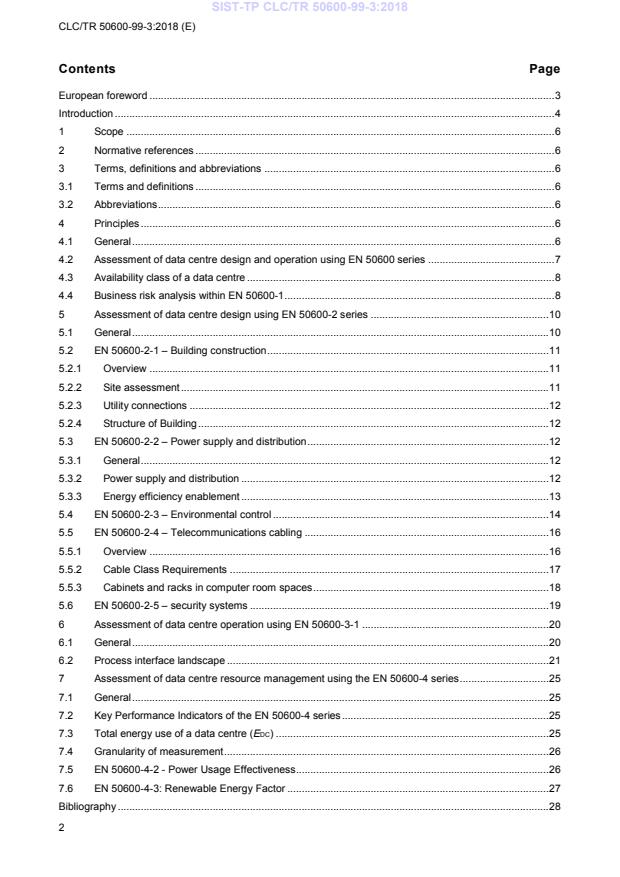
Contents Page
European foreword . 3
Introduction . 4
1 Scope . 6
2 Normative references . 6
3 Terms, definitions and abbreviations . 6
3.1 Terms and definitions . 6
3.2 Abbreviations . 6
4 Principles . 6
4.1 General . 6
4.2 Assessment of data centre design and operation using EN 50600 series . 7
4.3 Availability class of a data centre . 8
4.4 Business risk analysis within EN 50600-1 . 8
5 Assessment of data centre design using EN 50600-2 series . 10
5.1 General . 10
5.2 EN 50600-2-1 – Building construction . 11
5.2.1 Overview . 11
5.2.2 Site assessment . 11
5.2.3 Utility connections . 12
5.2.4 Structure of Building . 12
5.3 EN 50600-2-2 – Power supply and distribution . 12
5.3.1 General . 12
5.3.2 Power supply and distribution . 12
5.3.3 Energy efficiency enablement . 13
5.4 EN 50600-2-3 – Environmental control . 14
5.5 EN 50600-2-4 – Telecommunications cabling . 16
5.5.1 Overview . 16
5.5.2 Cable Class Requirements . 17
5.5.3 Cabinets and racks in computer room spaces . 18
5.6 EN 50600-2-5 – security systems . 19
6 Assessment of data centre operation using EN 50600-3-1 . 20
6.1 General . 20
6.2 Process interface landscape . 21
7 Assessment of data centre resource management using the EN 50600-4 series . 25
7.1 General . 25
7.2 Key Performance Indicators of the EN 50600-4 series . 25
7.3 Total energy use of a data centre (EDC) . 25
7.4 Granularity of measurement . 26
7.5 EN 50600-4-2 - Power Usage Effectiveness . 26
7.6 EN 50600-4-3: Renewable Energy Factor . 27
Bibliography . 28
European foreword
This document (CLC/TR 50600-99-3:2018) has been prepared by CLC/TC 215 “Electrotechnical aspects of
telecommunication equipment”.
Attention is drawn to the possibility that some of the elements of this document may be the subject of patent
rights. CENELEC shall not be held responsible for identifying any or all such patent rights.
This document has been prepared under a mandate given to CENELEC by the European Commission and the
European Free Trade Association.
Regarding the structure of the EN 50600 series, see the Introduction.
Introduction
The unrestricted access to internet-based information demanded by the information society has led to an
exponential growth of both internet traffic and the volume of stored/retrieved data. Data centres are housing and
supporting the information technology and network telecommunications equipment for data processing, data
storage and data transport. They are required both by network operators (delivering those services to customer
premises) and by enterprises within those customer premises.
Data centres need to provide modular, scalable and flexible facilities and infrastructures to easily accommodate
the rapidly changing requirements of the market. In addition, energy consumption of data centres has become
critical both from an environmental point of view (reduction of carbon footprint) and with respect to economic
considerations (cost of energy) for the data centre operator.
The implementation of data centres varies in terms of:
a) purpose (enterprise, co-location, co-hosting, or network operator facilities);
b) security level;
c) physical size;
d) accommodation (mobile, temporary and permanent constructions).
The needs of data centres also vary in terms of availability of service, the provision of security and the
objectives for energy efficiency. These needs and objectives influence the design of data centres in terms of
building construction, power distribution, environmental control and physical security. Effective management
and operational information is required to monitor achievement of the defined needs and objectives.
This series of documents specifies requirements and recommendations to support the various parties involved
in the design, planning, procurement, integration, installation, operation and maintenance of facilities and
infrastructures within data centres. These parties include:
1) owners, facility managers, ICT managers, project managers, main contractors;
2) architects, consultants, building designers and builders, system and installation designers;
3) facility and infrastructure integrators, suppliers of equipment;
4) installers, maintainers.
At the time of publication of this Technical Report, EN 50600 series will comprise the following standards and
documents:
EN 50600-1, Information technology — Data centre facilities and infrastructures — Part 1: General concepts;
EN 50600-2-1, Information technology — Data centre facilities and infrastructures — Part 2-1: Building
construction;
EN 50600-2-2, Information technology — Data centre facilities and infrastructures — Part 2-2: Power
distribution;
EN 50600-2-3, Information technology — Data centre facilities and infrastructures — Part 2-3: Environmental
control;
EN 50600-2-4, Information technology — Data centre facilities and infrastructures — Part 2-4:
Telecommunications cabling infrastructure;
EN 50600-2-5, Information technology — Data centre facilities and infrastructures — Part 2-5: Security systems;
EN 50600-3-1, Information technology — Data centre facilities and infrastructures — Part 3-1: Management and
operational information.
EN 50600-4-1, Information technology — Data centre facilities and infrastructures — Part 4-1: Overview of and
general requirements for key performance indicators
EN 50600-4-2, Information technology — Data centre facilities and infrastructures — Part 4-2: Power Usage
Effectiveness
EN 50600-4-3, Information technology — Data centre facilities and infrastructures — Part 4-3: Renewable
Energy Factor
CLC/TR 50600-99-1, Information technology — Data centre facilities and infrastructures — Part 99-1:
Recommended practices for energy management
CLC/TR 50600-99-2, Information technology — Data centre facilities and infrastructures — Part 99-2:
Recommended practices for environmental sustainability
CLC/TR 50600-99-3, Information technology — Data centre facilities and infrastructures — Part 99-3: Guidance
to the application of EN 50600 series
The inter-relationship of the documents within the EN 50600 series is shown in Figure 1.
Figure 1 — Schematic relationship between the EN 50600 series of documents
EN 50600-2-X documents specify requirements and recommendations for particular facilities and infrastructures
to support the relevant classification for “availability”, “physical security” and “energy efficiency enablement”
selected from EN 50600-1.
EN 50600-3-X documents specify requirements and recommendations for data centre operations, processes
and management.
EN 50600-4-X documents specify requirements and recommendations for key performance indicators (KPIs)
used to assess and improve the resource usage efficiency and effectiveness, respectively, of a data centre.
This Technical Report provides readers with an introduction into the EN 50600 series and the
interdependencies between the various standards in order to ease the correct application by all parties
concerned.
1 Scope
This document offers users additional information on the background of the requirements and recommendations
in the EN 50600 series. In addition it constitutes a guideline for the correct application and interpretation of
these standards.
2 Normative references
The following documents are referred to in the text in such a way that some or all of their content constitutes
requirements of this document. For dated references, only the edition cited applies. For undated references, the
latest edition of the referenced document (including any amendments) applies.
EN 50600 (all parts), Information technology - Data centres facilities and infrastructures
3 Terms, definitions and abbreviations
3.1 Terms and definitions
For the purposes of this document, the terms and definitions of series EN 50600 and the following apply.
ISO and IEC maintain terminological databases for use in standardization at the following addresses:
• IEC Electropedia: available at http://www.electropedia.org/
• ISO Online browsing platform: available at http://www.iso.org/obp
3.1.1
black building test
test to check resilience measures for availability of energy supply and distribution by switching off the main
supplies
3.1.2
distribution element
technical system to distribute air or cooling fluid within the environmental control system
3.2 Abbreviations
For the purposes of this document, the abbreviations of EN 50600 series and the following apply.
CHP combined heat and power
EMC electromagnetic compatibility
MP measurement point
N/A not applicable
4 Principles
4.1 General
The EN 50600 series addresses the following aspects of data centre design and operation:
a) construction;
b) availability;
c) physical security;
d) resource efficiency;
e) management and operation;
f) key performance indicators.
The EN 50600-2 series and its individual parts contain important requirements and recommendations for data
centres, namely their setup, structure and technical equipment. However, detailed mandatory requirements for
their application and the technical equipment are only partially contained in the individual parts of the series.
Instead, such detailed requirements are the result of the business and risk analysis carried out in accordance
with EN 50600-1.
The EN 50600-3 series deals with the management and operations; it introduces a number of processes
required for data centre operations and management as well as KPIs.
The EN 50600-4 series defines key performance indicators for data centres, including those for energy
efficiency.
If used consistently, the EN 50600 series provide a basis for the assessment of conformance to relevant
aspects of the design and operation of the facilities and infrastructures of a data centre.
It is probable that, in the coming years, an increasing number of organisations will seek an assessment of their
data centres against the conformance requirements of EN 50600 series of standards. To support the standards-
based approach, this Technical Report provides guidance to the application of the complete set of standards in
the EN 50600 series.
4.2 Assessment of data centre design and operation using the EN 50600 series
This clause makes transparent to those desiring “certification”, what options they have and what those
standards offer regarding “certification” - and what they do not.
However, standards bodies are not in a position to judge whether or not an organization offering certification
meets the underlying requirements - that is the role of accreditation specialists.
One of the objectives of standardization is to enable the determination of whether or not a product, process or
system meets a set of minimum requirements. The demonstration of that compliance (conformity assessment)
can be ascertained by one of three procedures described as:
a) 1st Party (carried out by the manufacturer or supplier),
b) 2nd Party (carried out by the user or operator) and
c) 3rd Party (carried out by a neutral and independent body).
The EN 50600 series are written without preference to one of these procedures, leaving the decision to bilateral
contracts or even national or regional legislation.
rd
There is nothing to stop a 3 party from assessing aspects of a data centre against conformance to
EN 50600 series. The same is true for the owner or operator of a data centre. The lack of any true certification
rd
system for data centres renders both approaches, and any assessment against alternative 3 party schemes,
as being of equal technical status.
EN 50600 series was developed to support the wide variety of business models associated with data centres.
Self-assessment or self-declaration of conformance against the requirements outlined above is comparatively
rd
simple and can be attractive to company owners, whereas a 3 Party assessment against those same
requirements might be more appropriate for owner/operators of data centres that market their services to others.
Self-declaration, rather than formal “certification”, is all that is available. The application of a European Norm as
rd
the basis for that assessment is clearly a step forward, but the choice of self-assessment or 3 party
assessment has to be based on the apparent and perceived value and application of the resulting assessment
versus the cost of the process to be employed.
Accredited assessment to one or more documents of the EN 50600 series may be viable/possible as part of one
of the schemes of EN ISO 9001, EN ISO 50001, EN ISO 14001 or the EN ISO/IEC 27000 series.
4.3 Availability class of a data centre
EN 50600-2-2, EN 50600-2-3 and EN 50600-2-4 provide design solutions for power supply and distribution,
environmental control and telecommunications cabling facilities and infrastructures respectively. The design
solutions are based on four Availability Classes (1 to 4).
The appropriate Availability Class within each of these standards is determined by application of the business
risk analysis of EN 50600-1.
The overall Availability Class of the data centre is defined as that of the lowest Availability Class selected across
the three facilities and infrastructures
In combination, EN 50600-1, EN 50600-2-2, EN 50600-2-3 and EN 50600-2-4 provide a comprehensive
framework for the assessment of the design availability of a data centre.
They are supported by EN 50600-2-1, EN 50600-2-5 and EN 50600-3-1 for the building construction, physical
security systems and operation respectively, but these are considered as subordinate to availability objectives.
4.4 Business risk analysis within EN 50600-1
EN 50600-1 requires a business risk analysis to be undertaken at the earliest stages of the planning process
which considers all relevant input variables or risk factors. The business risk analysis allows the appropriate
decisions to be made regarding:
a) the location and construction of the data centre using types of risk detailed in EN 50600-2-1;
b) the Availability Class for the power supply and distribution, environmental control and telecommunications
cabling facilities and infrastructures thereby defining the overall Availability Class for the data centre.
In order to comply with EN 50600-1, the risk analysis shall include an evaluation of all relevant input variables or
risk factors. The evaluation of business risk can give a summary assessment of the individual events or of their
influence as a group and assess them as a whole.
Attention is drawn to the fact that the EN 50600 series does not provide a set of fixed requirements or
recommendations on how to counteract a particular event or risk. The decision, which of the potential measures
are appriopriate, can only be the result of the risk analysis. This approach is described in the following example
concerning the selection of a data centre site in the proximity of surface and/or underground waters.
Business risk assessment example:
EN 50600 series does not define the distance required between a data centre site and a lake or river, as a
variety of factors needs to be taken into account to formulate the level of risk, including e.g.:
a) Is the water flowing or static?
b) What is the probability of flooding?
c) In relation to the high water line, where is the planned data centre or technical installation?
d) What are the topographic conditions around the data centre?
e) Is the area a designated flood plain?
This list of factors can be extended as necessary and only serves to show that, depending on the project, the
particular risk parameters differ. For this reason risk factors have to be assessed individually for each project.
The specific input parameters of the risk to be examined can be selected as appropriate. In the above example,
they consist of at least items a) to e). The consequences and likelihood of occurrence (see EN 50600-1:2012,
Clause 4) can then be qualified in the risk matrix.
Each type of risk should be analysed with increasing granularity until a result is reached which determines that
either the risk is acceptable or not. If the outcome of this analysis is that the risk is not acceptable then
appropriate measures (either constructional or technical) have to be considered in order to reduce the risk to an
acceptable level. There are five types of measures to mitigate risks for a selected location:
1) changes of location to protect the data centre against the threat – this is considered in the planning and
design phase;
2) constructional measures to enhance its resistance against external environmental threats;
3) technical solutions to minimize the impact of a threat and meeting the appropriate Availability Class for
power supply and distribution, environmental control and telecommunications cabling facilities and
infrastructures;
4) technical solutions to minimize the impact of a threat and meeting the appropriate Protection Class for the
spaces of the data centre;
and, where none of the above are viable:
5) organisational measures (but these are considered to be the weakest solution).
Once the appropriate measures have been implemented the documents of the EN 50600-2 series and
EN 50600-3-1 can be used to assess design or operational conformance (see Figure 2).
In the wider context of business risk mitigation, the business can adopt the following approaches to reduce and
manage the business risk as a result of the risk assessment, thus ensuring the risk mitigation actions reduce the
native risk to within the operational business appetite for risk:
MITIGATE
Controls are applied to the risk, whether logical, physical, or procedural to reduce the risk to an acceptable level
and within the business risk appetite.
TRANSFER
The risk is transferred to a third party.
TOLERATE
The identified business risk is tolerated and accepted by the business operations.
TERMINATE
The activities which give rise to the risk are terminated, as even with the application of risk mitigation controls,
the level of risk exceeds the business appetite for risk.
Risk appetite is the overall amount of risk judged to be acceptable by the business as agreed by members of
the board.
Addressing business risk analysis at the planning phase allows the widest range of, and most successful,
mitigation actions. The use of organisational actions to mitigate risk will generally be less effective and increase
operational costs.
Figure 2 — Process of risk analysis according to EN 50600-1
Besides the technical aspects, the result of a risk analysis normally also affects the economic aspects of the
project. In the example above, the preferred site for the data centre near a river or lake can have the effect that
the cost of implementing the structural and technical measures required for achieving a desired availability class
are not deemed acceptable and that the site is rejected as inappropriate.
In conclusion, the business risk analysis according to EN 50600-1 has a number of objectives, namely:
1) the basis against which to assess the conformance of a data centre to EN 50600-X;
2) facilitating a balanced approach between the availability demands of the data centre and the cost of
infrastructural measures;
3) the resulting Availability Class requirements for a specific project enable the assessment of conformance of
the design of the power supply and distribution, environmental control and telecommunications cabling
facilities and infrastructures.
It is a unique characteristic of the EN 50600 series that they provide a correlation between the availability and
the resulting structural or operational cost for a data centre.
5 Assessment of data centre design using the EN 50600-2 series
5.1 General
There are two possibilities for assessing a data centre design using EN 50600-2 series as described below.
a) Assessment of the design of one or more of the facilities or infrastructures of the data centre against the
requirements of the relevant aspects of the EN 50600-2 series. This allows the facility or infrastructure to be
designated as having a certain Availability Class in accordance with the relevant standard.
NOTE 1: Some EN 50600-2 documents are inter-related.
b) Assessment of the design of the overall data centre against the requirements of the complete set of
requirements of the EN 50600-2 series enabling the overall data centre to be confirmed to be in accordance
with EN 50600-2 series and be of a certain Availability Class in accordance with EN 50600-1.
In addition to these approaches, it is possible to assess the design specification produced on behalf of the data
centre owner/operator which not only employs the requirements of the EN 50600-2 series but also features one
or more of the recommendations within those standards.
NOTE 2: Recommendations can be considered as statements of additional good practice but are not a basis for
conformance to a standard.
However, EN 50600-2 documents are not intended to enable the assessment of an implementation against a
design specification.
In conclusion, only the following can be assessed for conformance with EN 50600-2 documents:
1) the design of one or more facilities or infrastructures of the data centre or the data centre as a whole;
2) the specification of one or more facilities or infrastructures of the data centre or the overall data centre.
In order to assist in these assessment processes:
- subclause 5.2 summarizes the requirements of EN 50600-2-1:2014;
- subclause 5.3 summarizes the requirements of EN 50600-2-2:2014;
- subclause 5.4 summarizes the requirements of EN 50600-2-3:2014;
- subclause 5.5 summarizes the requirements of EN 50600-2-4;
- subclause 5.6 summarizes the requirements of EN 50600-2-5.
It is not the role of this Technical Report to describe or explain all the requirements and recommendations of the
standards but the following subclauses highlight some of the requirements of the standards and how to apply
them.
5.2 EN 50600-2-1 – Building construction
5.2.1 Overview
EN 50600-2-1 belongs to those parts of the series of standards which contain a large number of requirements
and numerous specifications and recommendations concerning the site assessment and layout of a data
centre’s building structure.
5.2.2 Site assessment
EN 50600-2-1 requires that a risk analysis is undertaken.
EN 50600-2-1:2014, 5.1.1, contains a list of issues (a) to f)) relating to the assessment of the site location which
should be examined individually, ignoring aspects which are irrelevant for a specific project.
Additional criteria, as relevant, should be included in any such risk analysis and should be listed as being
assessed.
EN 50600-2-1 requires that a risk analysis be always carried out. In existing data centres, certain parameters
can no longer be modified (such as the location itself, certain structural conditions and the properties of the
ground etc.).
In order to assess conformance to EN 50600-2-1 documentary evidence is necessary to confirm that an
appropriate risk analysis has been undertaken.
With regard to site assessment, conformance only fails if the risk is considered unacceptable even after
mitigation is applied.
5.2.3 Utility connections
EN 50600-2-1:2014, 6.4, requires the construction to be compatible with the external utility objectives meeting
the Availability Class requirements identified for EN 50600-2-2 (power supply) and EN 50600-2-4
(telecommunications service provision).
5.2.4 Structure of Building
EN 50600-2-1:2014, Clause 7, contains requirements for the structure and construction of the data centre
premises.
The structure of the data centre premises is required to support the design solutions chosen to meet the
required Availability Class(es) for the power supply and distribution systems (EN 50600-2-2), environmental
control system (EN 50600-2-3) and telecommunications cabling infrastructure (EN 50600-2-4) .
The construction of the buildings is required to support the Protection Class requirements of EN 50600-2-5.
5.3 EN 50600-2-2 – Power supply and distribution
5.3.1 General
EN 50600-2-2 specifies requirements for power supply to, and power distribution within, data centres and
provide example implementations meeting the Availability Class desired following the business risk analysis of
EN 50600-1.
In addition, it defines granularity levels for the measurement of energy consumption in support of Key
Performance Indicators of the EN 50600-4 series documents.
5.3.2 Power supply and distribution
The functional elements of the power supply are divided into two specific areas:
1) the mains power supply to the data centre
2) the distribution of the power within the data centre.
This division represents a unique feature of EN 50600-2-2.
Figure 3 shows the design aspects that are addressed by the requirements of EN 50600-2-2 for both power
supply and power distribution infrastructures including requirements for physical security of the pathways and
spaces and the bonding of telecommunications equipment within the data centre
Figure 3 — Assessment criteria of EN 50600-2-2
In order to assess conformance to EN 50600-2-2, documentary evidence is necessary to confirm that an
appropriate analysis of these aspects has been undertaken.
The business risk analysis of EN 50600-1 determines the Availability Class required for the power supply and
distribution system. The Availability Class defines design objectives which mitigate failures in critical elements in
order maintain the desired level of availability.
In order to assess conformance to EN 50600-2-2, documentary evidence is necessary to confirm that the design
provides appropriate mitigation - based on the examples provided in EN 50600-2-2 or by showing equivalence.
5.3.3 Energy efficiency enablement
EN 50600-2-2:2014, Clause 8, specifies three Granularity Levels for the measurement of energy consumption
within the data centre.
The Granularity Level defines the locations for measurement and for each Granularity Level applied,
EN 50600-2-2 specifies requirements for the measurement accuracy of equipment used.
Although EN 50600-2-2 makes no recommendations for the Granularity Levels to be applied, Granularity Levels
of 2 or 3 will allow the ability of the data centre owner/operator to:
a) monitor and improve energy efficiency and other energy management objectives in conjunction with the
management and operational information requirements of EN 50600-3-1 (see Clause 6) and the Key
Performance Indicators of the EN 50600-4 series (see Clause 7);
b) monitor and control the energy consumption of equipment sub-systems and even individual equipments;
c) develop billing systems for energy consumption, where appropriate.
When planning corresponding systems within the power supply of a data centre, the most commonly asked
question is: Why is there such a large number of measuring devices at granularity level 2 and 3? A simple
example will illustrate why this is necessary. In many units and systems of the power distribution (such as UPS
systems), the data centre operators have to rely on the manufacturer's specifications. It is assumed that the
specified efficiency of the system is correct. Only when the units and systems are monitored with their own
measuring devices the operator of the data centre can compare the manufacturer’s data with the actual values.
An aspect of lifecycle management is the technically induced change in the data centre’s behaviour during a
particular period of use. Only by the permanent use of appropriate measuring systems aging symptoms of the
units in the system of the power supply can be detected. Knowledge of this allows the user to react in time when
faults or failures appear to be emerging.
A detailed record of the measurement results also allows the creation of surveys and statistics, which can also
be used to illustrate seasonal fluctuations in the operation of the data centre. Such a database is of
considerable advantage in order to identify and determine the ideal maintenance time, when utilization is at its
lowest.
The basis for this control are the correct selection, the adequate number and the correct placement of the
measuring devices in the power supply and power distribution system of a data centre. Likewise, a correct and
complete logging of the measured values forms the basis to establish an appropriate billing system for the data
centre.
Furthermore, the use of an adequate number and the correct placement of the measuring systems, according to
the selected granularity levels, is an essential prerequisite to correctly determine the key performance indicators
of the data centre. This, among others, is the value of Power Usage Effectiveness (PUE) (see EN 50600-4-2).
EN 50600-4-2 stipulates that all forms of electrical energy at the interfaces must be measured in kWh. If one of
the required energy forms is not indicated at the interfaces, the energy consumption in the data centre (E )
DC
cannot be determined and the PUE value cannot be calculated either. Therefore, data centres need at least
provide a level of granularity of 2 or 3.
A high degree of granularity of the data centre is also the prerequisite for determining the correct PUE value for
a data centre in a mixed usage building. Mixed usage means that those building parts which are not functionally
assigned to the data centre are not allocated to the system ‘data centre’ with regard to energy consumption.
Figure 4 is a schematic example for this. EN 50600-4-2 takes a system view on the data centre. The energy
flows through this system which is defined by the interfaces.
Figure 4 — Energy and system boundaries in the system data centre according to EN 50600-4-2
As described in EN 50600-4-2, the total energy consumption of a data centre in a building with mixed usage can
only be calculated as a system from the energy consumption of the data centre alone, if the measured values of
all shared technical subsystems permit a separation of the energy consumption.
If the energy consumption of shared technical subsystems cannot be separated, then the total energy
consumption of the data centre shall cover the entire building. The effect on the PUE value should be countered
by installing the measuring systems required for the separation.
Complete data acquisition is also the basis for determining the Renewable Energy Factor (REF). According to
EN 50600-4-3, it is defined as the share of renewable energy in the total energy consumption of the data centre.
If the total energy consumption of the data centre is not known or incomplete, the REF cannot be determined.
The higher Granularity Levels can also be required by national guidelines.
5.4 EN 50600-2-3 – Environmental control
The business risk analysis of EN 50600-1 determines the Availability Class required for the environmental
control system. The Availability Class defines design objectives which mitigate failures in critical elements in
order maintain the desired level of availability.
In order to assess conformance to EN 50600-2-3, documentary evidence is necessary to confirm that the design
provides appropriate mitigation - based on the examples provided in EN 50600-2-3 or by showing equivalence.
EN 50600-2-3 specifies the requirements and recommendations for environmental control systems in data
centres.
EN 50600-2-3 distinguishes two areas of functional elements for the devices and systems controlling the
environmental conditions, namely:
a) the supply elements, and
b) the distribution elements.
The exact allocation can be found in EN 50600-2-3:2014, Table 1. Note that some of the systems controlling the
environmental conditions combine the function of primary and secondary elements. In these cases, the exact
assignment will be determined during the planning process of a given project. As regards complex systems for
controlling the environmental conditions within a data centre, the above separation is an essential basis for the
proper planning and for the acceptance and evaluation process which follows.
EN 50600-2-3 designates requirements and recommendations for controlling the environmental conditions in all
areas of a data centre. Examples of such areas are the building entrance facility (BEF) (see EN 50173-1), the
generators, the electrical distribution, the telecommunication devices, etc. These areas are important for the
data centre’s function and have to be included in the environmental control conditions, where necessary. The
user of the standard can specify additional requirements for the devices and systems being planned. These
additional specifications will be documented so that they become part of the testing procedure for the
acceptance and evaluation process of the data centre.
EN 50600-2-3 requires that the control of the environmental conditions be designed to ensure that the
availability class determined after the risk assessment is supported. For this purpose, EN 50600-2-3 specifies
the requirements and recommendations for the respective availability class. However, these guidelines only
refer to general criteria in a data centre. Therefore, the user of the standard has to determine the project-specific
requirements during the planning process. An essential component is the risk analysis according to
EN 50600-1. The results of the risk analysis as well as of the planning process will be documented so that they
become part of the testing procedure for the acceptance and evaluation process of the data centre.
Furthermore, EN 50600-2-3 provides major support during the planning to enable the energy efficient operation
of the systems. The standard specifies the parameters for defining the necessary level of granularity. Based on
the selected level of granularity to enable energy efficiency, the standard provides the requirements and
recommendations related to the:
1) basic design of the devices and systems,
2) the resulting planning requirements, as well as the
3) requirements for installation.
The specifications for the devices and systems controlling the environmental conditions and enabling energy
efficiency in data centres represent a unique feature of EN 50600-2-3. EN 50600-2-3 provides the user with
further guidance for the planning. Check these aspects in order to conform to the standard and integrate them
into the planning process where relevant.
Compliance with the specified humidity is a parameter when controlling the environmental conditions in a data
centre. Control of humidity is subject to various external environmental conditions. These influences are taken
into account during planning, particularly with regard to the energy efficiency of the infrastructures and systems.
Similarly, the required speed of the fans, the maximum possible cold water temperature and the use of natural
cooling capacities will be investigated during planning.
When dimensioning infrastructures and systems for controlling the environmental conditions in a data centre,
ensure that they are sufficiently utilized under all operating conditions (different load conditions) and thus
achieve high energy efficiency. Besides the planned or even unplanned performance increase during the
lifecycle of the systems, the factor of simultaneous occurrence is a decisive planning parameter. This is
illustrated by an example. Normally, the following will not occur simultaneously at a data centre:
— 100 % occupancy of the data centre area, together with
— all plants and systems running at maximum power consumption, and
— the limits of ambient conditions (for example high outside temperatures) reach the limit of the technical
performance capacity of the plants and systems.
Determine this deviation from the theoretical maximum load during planning and take it into account when
calculating the correct simultaneity factor. The simultaneity factor also serves as a correction value for an
optimum energy planning. However, ensure during the risk analysis that the requirements for the simultan
...
Questions, Comments and Discussion
Ask us and Technical Secretary will try to provide an answer. You can facilitate discussion about the standard in here.
Loading comments...