

SIST EN 4557:2004
(Main)Aerospace series - Pipe coupling 37°, spherical, in heat resisting steel - Tees nipples, welded end - Inch series
General Information
- Abstract
This standard specifies the characteristics of welded tees with nipple for inch series pipe couplings, 37°, spherical, in heat resisting steel, for aerospace applications.
Nominal pressure: Class D per ISO 6771
- Status
- Published
- Publication Date
- 30-Apr-2004
- Technical Committee
- I08 - Imaginarni 08
- Current Stage
- 6060 - National Implementation/Publication (Adopted Project)
- Start Date
- 01-May-2004
- Due Date
- 01-May-2004
- Completion Date
- 01-May-2004

Overview
EN 4557:2003 is a CEN/AECMA aerospace standard that specifies the characteristics of welded tees with nipple for inch-series pipe couplings, 37° spherical, manufactured in heat-resisting steel. It applies to components used in aerospace fluid systems and components (ICS 49.080) and sets the nominal pressure classification to Class D per ISO 6771. The standard defines configuration, materials, designation, marking and references the technical specification for performance and inspection.
Key Topics
- Scope and pressure class: Components for aerospace fluid systems; nominal pressure Class D (ISO 6771).
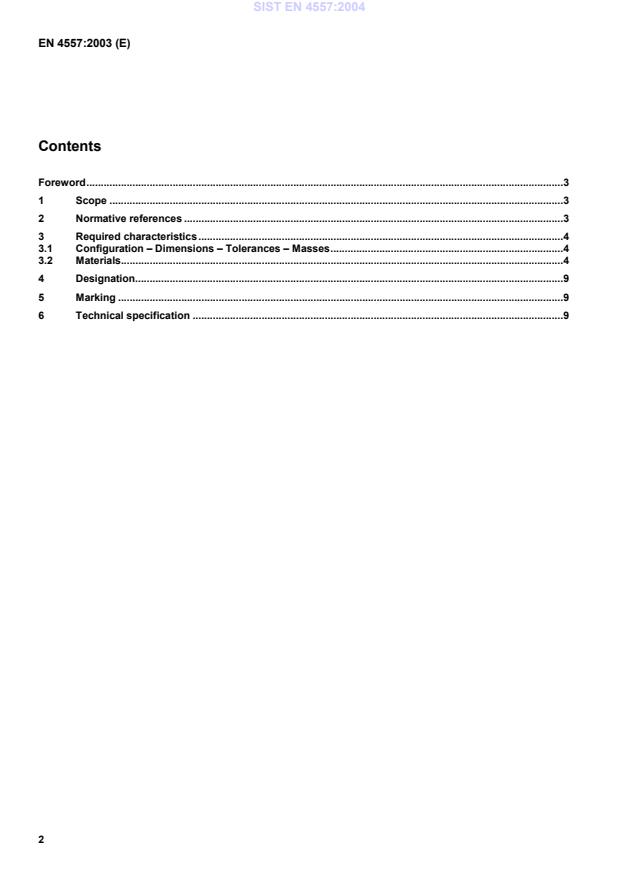
- Configuration & dimensions: Detailed shape, dimensions, tolerances and masses are given in Figures 1–3 and Tables 1–3. Dimensional codes use a notation that encodes tube wall thickness (A = 0.711 mm, B = 0.889 mm) and nominal diameters in sixteenths of an inch.
- Materials & hardness: Acceptable heat-resisting steels are those specified in EN 3363, EN 3468 or EN 3487 with minimum hardness HB > 140.
- Weld end options: Weld-end option codes (1, 2 or 3) specify whether the weld end is on one or both sides and are used in designation and manufacturing instructions.
- Threading & sealing: Thread types conform to ISO 3161 (UNJ threads) and related coupling/sealing geometry aligns with EN 4549 and EN 4550‑1.
- Marking & designation: Marking is according to EN 2424. Example designation format: “TEE NIPPLE EN4557 A1008 - 2” (standard number, dimensional code, weld end code).
- Technical specification & testing: Performance and inspection requirements refer to EN 4560.
Applications and Who Uses It
- Typical applications: Specification and production of welded tee nipples for aerospace fluid systems (fuel, hydraulic and pneumatic lines where heat-resisting steel and 37° spherical couplings are required).
- Primary users:
- Aerospace OEMs and suppliers specifying fittings for aircraft and spacecraft fluid systems
- Component manufacturers (for forging, machining, casting and welding of tees)
- Design and stress engineers integrating fittings into fluid system layouts
- Quality, inspection and procurement teams verifying compliance and traceability
- Certification bodies reviewing conformity with CEN/AECMA requirements
Related Standards
Normative and related references included in EN 4557:2003:
- ISO 3161 - UNJ threads (general requirements and limits)
- ISO 6771 - Pressure and temperature classifications for aerospace fluid systems
- EN 2424 - Marking of aerospace products
- EN 3363 / EN 3468 / EN 3487 - Aerospace steel grades and conditions
- EN 4549 - Coupling end welded design configuration
- EN 4550‑1 - 37° spherical coupling design (male sealing ends)
- EN 4560 - Technical specification (testing and inspection)
This standard is essential when specifying, manufacturing or procuring aerospace pipe fittings that must meet consistent geometry, material and marking requirements for reliable, certified fluid-system integration.
Relations
- Effective Date
- 28-Jan-2026
- Effective Date
- 28-Jan-2026
- Effective Date
- 28-Jan-2026
- Effective Date
- 28-Jan-2026
- Effective Date
- 28-Jan-2026
- Effective Date
- 28-Jan-2026
Get Certified
Connect with accredited certification bodies for this standard

BUREAU VERITAS Certification Germany
Bureau Veritas certification in Germany.

Element Materials Technology
Materials testing and product certification.

AQMS Ltd.
AQMS provides ISO certification to SMEs across the UK.
Sponsored listings
Frequently Asked Questions
SIST EN 4557:2004 is a standard published by the Slovenian Institute for Standardization (SIST). Its full title is "Aerospace series - Pipe coupling 37°, spherical, in heat resisting steel - Tees nipples, welded end - Inch series". This standard covers: This standard specifies the characteristics of welded tees with nipple for inch series pipe couplings, 37°, spherical, in heat resisting steel, for aerospace applications. Nominal pressure: Class D per ISO 6771
This standard specifies the characteristics of welded tees with nipple for inch series pipe couplings, 37°, spherical, in heat resisting steel, for aerospace applications. Nominal pressure: Class D per ISO 6771
SIST EN 4557:2004 is classified under the following ICS (International Classification for Standards) categories: 49.080 - Aerospace fluid systems and components. The ICS classification helps identify the subject area and facilitates finding related standards.
SIST EN 4557:2004 has the following relationships with other standards: It is inter standard links to SIST EN 4550-1:2015, SIST EN 10244-1:2009, SIST EN 3487:2025, SIST EN 4560:2015, SIST EN 4549:2014, SIST EN 2424:2008. Understanding these relationships helps ensure you are using the most current and applicable version of the standard.
SIST EN 4557:2004 is available in PDF format for immediate download after purchase. The document can be added to your cart and obtained through the secure checkout process. Digital delivery ensures instant access to the complete standard document.
Standards Content (Sample)
2003-01.Slovenski inštitut za standardizacijo. Razmnoževanje celote ali delov tega standarda ni dovoljeno.Aerospace series - Pipe coupling 37°, spherical, in heat resisting steel - Tees nipples, welded end - Inch seriesLuft- und Raumfahrt - Rohrverschraubung 37° mit Kugelbuchse, aus hochwarmfestem Stahl - T-Verschraubungen, zum Anschweißen - Inch-ReiheSérie aérospatiale - Systeme de raccordement sphérique, 37°, en acier résistant a chaud - Mamelons en Té a souder - Série inchAerospace series - Pipe coupling 37°, spherical, in heat resisting steel - Tees nipples, welded end - Inch series49.080Aerospace fluid systems and componentsICS:Ta slovenski standard je istoveten z:EN 4557:2003SIST EN 4557:2004en01-maj-2004SIST EN 4557:2004SLOVENSKI
STANDARD
EUROPEAN STANDARDNORME EUROPÉENNEEUROPÄISCHE NORMEN 4557February 2003ICS 49.080English versionAerospace series - Pipe coupling 37°, spherical, in heat resistingsteel - Tees nipples, welded end - Inch seriesSérie aérospatiale - Système de raccordement sphérique,37°, en acier résistant à chaud - Mamelons en Té à souder- Série inchThis European Standard was approved by CEN on 14 September 2002.CEN members are bound to comply with the CEN/CENELEC Internal Regulations which stipulate the conditions for giving this EuropeanStandard the status of a national standard without any alteration. Up-to-date lists and bibliographical references concerning such nationalstandards may be obtained on application to the Management Centre or to any CEN member.This European Standard exists in three official versions (English, French, German). A version in any other language made by translationunder the responsibility of a CEN member into its own language and notified to the Management Centre has the same status as the officialversions.CEN members are the national standards bodies of Austria, Belgium, Czech Republic, Denmark, Finland, France, Germany, Greece,Hungary, Iceland, Ireland, Italy, Luxembourg, Malta, Netherlands, Norway, Portugal, Slovak Republic, Spain, Sweden, Switzerland andUnited Kingdom.EUROPEAN COMMITTEE FOR STANDARDIZATIONCOMITÉ EUROPÉEN DE NORMALISATIONEUROPÄISCHES KOMITEE FÜR NORMUNGManagement Centre: rue de Stassart, 36
B-1050 Brussels© 2003 CENAll rights of exploitation in any form and by any means reservedworldwide for CEN national Members.Ref. No. EN 4557:2003 ESIST EN 4557:2004
1)Published as AECMA Prestandard at the date of publication of this standardSIST EN 4557:2004
...