

SIST EN 432:1999
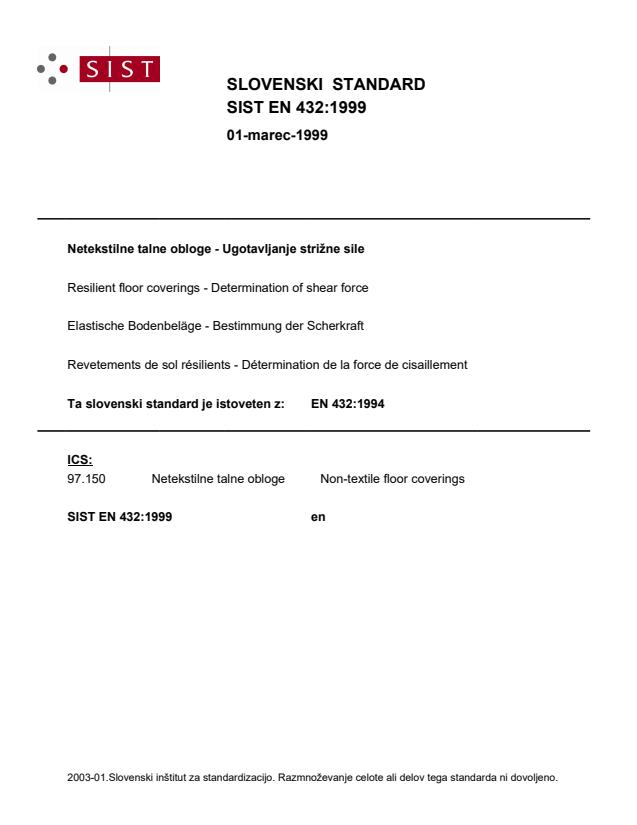
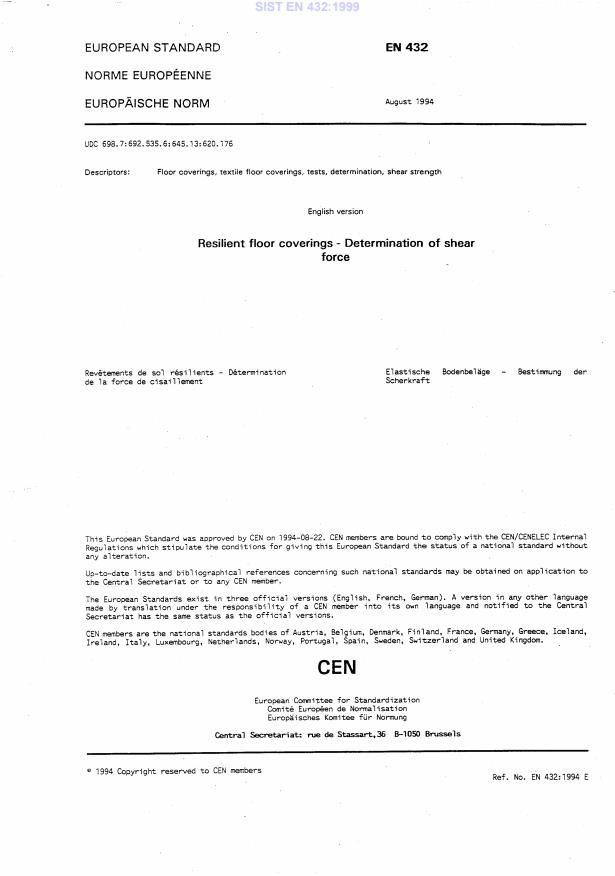
(Main)Resilient floor coverings - Determination of shear force
General Information
- Abstract
This European Standard specifies a method for determining the shear force of layers of a resilient floorcovering.
- Status
- Published
- Publication Date
- 28-Feb-1999
- Technical Committee
- ITEK - Textile and textile products
- Current Stage
- 6060 - National Implementation/Publication (Adopted Project)
- Start Date
- 01-Mar-1999
- Due Date
- 01-Mar-1999
- Completion Date
- 01-Mar-1999

Overview
SIST EN 432:1999 is a European Standard established by CEN that defines a precise method for the determination of shear force in resilient floor coverings. This standard is essential for manufacturers, quality control laboratories, and flooring installers to assess the mechanical behavior and durability of resilient flooring materials under shear stress.
Resilient floor coverings, such as vinyl, linoleum, and rubber flooring, require rigorous testing to ensure performance integrity, particularly regarding their ability to withstand shear forces during installation and everyday use. SIST EN 432:1999 provides a standardized laboratory procedure to measure this critical property.
Key Topics
Scope of Testing
SIST EN 432:1999 applies specifically to layers of resilient floor coverings, focusing on non-textile surfaces. It establishes a reproducible procedure for determining shear force, which is vital to evaluate flooring performance.Testing Methodology
The standard prescribes how to prepare floor covering samples and the equipment setup needed to apply shear stress. It outlines the step-by-step approach to measure the resistance to shear force, ensuring uniformity across laboratories and manufacturers.Interpretation of Results
Results derived from EN 432 testing help in assessing the structural stability of floor coverings under shear loads. They influence decisions related to material selection, adhesive compatibility, and installation techniques.Multilingual Accessibility
The document is available in several languages, reflecting its international acceptance and the widespread usage of resilient floor coverings in diverse markets.
Applications
Flooring Manufacturers
Use SIST EN 432:1999 to evaluate new resilient floor covering products, ensuring they meet shear force resistance requirements before market release.Quality Assurance Laboratories
Implement the standard for routine testing to verify batch consistency, enabling manufacturers to maintain product performance.Contractors and Installers
Reference shear force data to select suitable floor coverings and adhesives, facilitating installation that minimizes material damage and enhances longevity.Architects and Designers
Utilize test results to specify floor coverings suitable for high-traffic or shear-stress-prone environments, contributing to safer and more durable building designs.
Related Standards
EN 428: Resilient floor coverings - Determination of thickness
Complements EN 432 by specifying methods to measure flooring thickness, which can affect shear force resistance.EN 434: Resilient floor coverings - Determination of indentation
Provides procedures to assess indentation resistance, together with shear force resistance, offering a comprehensive evaluation of mechanical performance.EN 435: Resilient floor coverings - Determination of dimensional stability
Details testing for dimensional changes under heat, critical when considering installation conditions that can influence shear properties.ISO 10582: Resilient floor coverings - Heterogeneous polyvinyl chloride floor coverings
Shares common ground with EN 432 for performance testing of specific resilient flooring types.
By adhering to SIST EN 432:1999, stakeholders ensure resilient floor coverings meet stringent performance standards, contributing to safer, more durable, and high-quality flooring installations. This standard is integral for maintaining harmonized quality and reliability across the European flooring industry.
Relations
- Effective Date
- 09-Feb-2026
- Effective Date
- 09-Feb-2026
- Effective Date
- 09-Feb-2026
- Effective Date
- 28-Jan-2026
- Effective Date
- 28-Jan-2026
- Effective Date
- 28-Jan-2026
Frequently Asked Questions
SIST EN 432:1999 is a standard published by the Slovenian Institute for Standardization (SIST). Its full title is "Resilient floor coverings - Determination of shear force". This standard covers: This European Standard specifies a method for determining the shear force of layers of a resilient floorcovering.
This European Standard specifies a method for determining the shear force of layers of a resilient floorcovering.
SIST EN 432:1999 is classified under the following ICS (International Classification for Standards) categories: 97.150 - Floor coverings. The ICS classification helps identify the subject area and facilitates finding related standards.
SIST EN 432:1999 has the following relationships with other standards: It is inter standard links to SIST EN 61124:2007, SIST EN 60947-5-4:2004, SIST EN 61164:2004, SIST EN 650:2013, SIST EN 13413:2002, SIST EN 650:2025. Understanding these relationships helps ensure you are using the most current and applicable version of the standard.
SIST EN 432:1999 is associated with the following European legislation: EU Directives/Regulations: 305/2011, 89/106/EEC. When a standard is cited in the Official Journal of the European Union, products manufactured in conformity with it benefit from a presumption of conformity with the essential requirements of the corresponding EU directive or regulation.
SIST EN 432:1999 is available in PDF format for immediate download after purchase. The document can be added to your cart and obtained through the secure checkout process. Digital delivery ensures instant access to the complete standard document.
Standards Content (Sample)
2003-01.Slovenski inštitut za standardizacijo. Razmnoževanje celote ali delov tega standarda ni dovoljeno.Netekstilne talne obloge - Ugotavljanje strižne sileElastische Bodenbeläge - Bestimmung der ScherkraftRevetements de sol résilients - Détermination de la force de cisaillementResilient floor coverin
...