

kSIST prES 203 156 V1.1.1:2014
(Main)Environmental Engineering (EE) - Thermal Management requirements for outdoor enclosures
- Abstract
Write a thermal management standard for outdoor enclosure defined in EN 301 169-1, The idea is, that depending on the cooling solution adopted, to define: Cooling capacitance for cabinets depending on cabinet dimension Cabinet dissipation class Maximum acceptable Delta T between ambient temperature and inside temperature Preferable air flow On this way will be more easy define the responsability of equipment manufactures, cabinet manufactures and integrators.
- Status
- Not Published
- Technical Committee
- SPN - Services and Protocols for Networks
- Current Stage
- 5020 - Formal vote (FV) (Adopted Project)
- Start Date
- 29-Jul-2013
- Due Date
- 16-Sep-2013
- Completion Date
- 28-Aug-2013
Buy Documents
ETSI ES 203 156 V1.0.0 (2013-07) - Environmental Engineering (EE); Thermal Management requirements for outdoor enclosures
ETSI ES 203 156 V1.1.1 (2013-09) - Environmental Engineering (EE); Thermal Management requirements for outdoor enclosures
kSIST prES 203 156 V1.1.1:2014 is a standard for thermal management of outdoor enclosures used for telecommunications and other IT equipment. It specifies how to define cooling capacity, acceptable temperature rise, airflow matching, and the environmental class of equipment inside the enclosure so enclosure suppliers, equipment manufacturers, and integrators can work to the same thermal basis.
What does kSIST prES 203 156 V1.1.1:2014 specify?
kSIST prES 203 156 V1.1.1:2014 specifies thermal management requirements for empty outdoor enclosures defined in EN 301 169-1 and EN 301 169-2. It focuses on how the enclosure and the equipment inside should be matched so the internal micro-climate stays suitable in outdoor conditions.
The scope covers outdoor enclosures for telecommunication equipment of wireline and wireless access networks and other information technology equipment. EMC, safety, and acoustic noise are outside the main scope, although annex D gives related guidance.
The document is organized around the basic requirements in clause 4, the thermal management rules in clause 5, and a set of annexes that provide manufacturer data, measurement guidance, and supporting information.
| Annex | What it covers |
|---|---|
| Annex A | Thermal characterization data to be provided by the manufacturer |
| Annex B | Ambient temperature measurement point |
| Annex C | Solar radiation |
| Annex D | Safety and EMC guidance, plus acoustic noise |
| Annex E | Cabinet performance parameters |
| Annex F | Bibliography |
What are the key requirements of kSIST prES 203 156 V1.1.1:2014?
kSIST prES 203 156 V1.1.1:2014 requires the enclosure supplier to design the cabinet for the outdoor environment class in EN 300 019-1-4, class 4.1, and to make the enclosure support the environmental class of the equipment inside. In practice, this means the cabinet is not just a mechanical box - it must also create a usable thermal environment for the equipment it houses.
Thermal performance and environmental class
Clause 4.1 says the supplier should provide thermal characteristics from annex A so operators and integrators can predict thermal performance and choose equipment configurations. That matters because the thermal result depends on the cabinet, the cooling method, and the load inside, not only on the equipment itself.
Clause 4.2 distinguishes among three cabinet types:
- free cooling cabinet - equipment climatic conditions in line with Class 3.3
- heat exchanger cabinet - equipment climatic conditions in line with Class 3.3
- air conditioning cabinet - equipment climatic conditions in line with Class 3.2
This distinction matters because the equipment environment class changes with the cooling technology, so the buyer or integrator has to check that the planned equipment matches the cabinet type.
Cooling capacity
Clause 5.1 defines a standardized cooling capacity, K, using the heat dissipation of the equipment and the temperature difference between the ambient air and the air at the equipment inlet. The point of the definition is comparability: different cabinet vendors should be evaluated using the same basis.
The clause also notes that K can change with ambient temperature because fan speed may be adjusted. In practice, this means a cabinet may have different thermal performance at different outside temperatures, so the supplier should not describe cooling capacity as a single fixed figure without conditions.
Maximum acceptable delta T
Clause 5.2 says the cabinet should be designed to keep the delta T between ambient air and inlet air as small as possible, with below +10 °C recommended. For the reader, this means the cabinet should not allow the inlet air to drift far above the outside air if the equipment is to stay within its temperature limit.
The same clause also notes that the delta T can be negative in an air conditioning cabinet. This is important when comparing cooling technologies, because an air-conditioned enclosure may intentionally deliver inlet air cooler than ambient air.
Airflow matching
Clause 5.3 defines the preferred airflow route for subracks as in at the left, front, or bottom and out at the right, back, or top, consistent with EN 300 119-5. The enclosure airflow should match that route as closely as possible.
Clauses 5.3.1 and 5.3.2 separate the enclosure cooling concepts into:
- fresh air cooling with a continuous path between outside and inside
- heat exchanger and air conditioning systems with separate internal and external air circuits
The detailed subclauses for door-mounted, roof-mounted, and side-mounted TCUs give the preferred internal airflow directions and call for baffles or similar isolation devices to prevent short-circuiting between inlet and outlet. In practice, this tells the designer where to place the TCU and how to route air so the cooling system does not bypass the equipment.
Multiple equipment and cabinet layout
Clause 5.3.2 also recommends parallel airflow paths for multiple items of equipment. If serial airflow cannot be avoided, the air flow rate and temperature have to satisfy each item. The clause further requires clearance for airflow at the back or at the left and right sides, depending on the equipment airflow direction, and says obstacles such as cables should not block the path.
This matters for cabinet layout and wiring because a physically crowded cabinet can perform worse thermally even if the cooling unit is correctly sized.
Manufacturer data to support design
Annex A requires the manufacturer to provide thermal characterization data, including identification, physical geometry, openings and vents, mounting flanges, fan or fan tray details, air filter details, airflow path information, and cooling capacity data. That information is what operators and integrators use to model the cabinet and compare options before installation.
What terms does kSIST prES 203 156 V1.1.1:2014 define?
kSIST prES 203 156 V1.1.1:2014 defines the terms needed to describe cabinet cooling and the enclosure environment.
- Ambient - the spatial maximum temperature of the air entering the rack or cabinet.
- Cabinet - a free-standing, self-supporting enclosure for electrical or electronic equipment, usually with doors or removable side panels.
- Free cooling - a cooling technology that uses outside air directly for heat removal.
- Heat exchanger - a cooling technology that removes heat through exchange between two fluids, such as air-to-air or water-to-air, without directly using outside air.
- Air conditioning - a cooling technology that uses an operating refrigeration system to cool the internal air of the enclosure.
- Integrator - the end user, operator of telecommunication or IT equipment, or their agent.
- TCU (Temperature Control Unit) - the cooling unit used for fresh air cooling, heat exchange, or air conditioning.
- COP (Coefficient Of Performance) - the ratio between the total energy consumption of the cabinet and the energy consumption of the cooling system.
Who uses kSIST prES 203 156 V1.1.1:2014?
kSIST prES 203 156 V1.1.1:2014 is used by enclosure suppliers, equipment manufacturers, cabinet manufacturers, operators, and integrators. It is especially relevant where equipment from different suppliers is installed together in outdoor cabinets.
In practice, these users rely on the standard to:
- choose a suitable cooling concept for the cabinet size and heat load
- specify cabinet thermal data in a common format
- check airflow compatibility between the enclosure and the equipment
- assign responsibilities between cabinet and equipment suppliers
- support design reviews for telecom access network and other IT deployments outdoors
Which standards are used with kSIST prES 203 156 V1.1.1:2014?
kSIST prES 203 156 V1.1.1:2014 relies on a small set of companion standards to define environmental classes and airflow conventions.
- ETSI EN 300 019-1-4 - defines the outdoor environmental conditions for stationary use at non-weatherprotected locations.
- ETSI EN 300 019-1-3 - defines the environmental classes used for equipment inside the enclosure.
- ETSI EN 301 169-1 - defines equipped outdoor enclosures, which are one of the enclosure types covered by this thermal guidance.
- ETSI EN 301 169-2 - defines unequipped outdoor enclosures, also covered by this thermal guidance.
- ETSI EN 300 119-5 - gives the preferred airflow route for subracks and is used to match equipment airflow to cabinet airflow.
- ETSI TR 101 576 - discusses the applicability of environmental classes in outdoor cabinet environments.
- ETSI EN 300 019-2-4 - is used in annex C for the solar-radiation test effect.
- EN 60950-1 and EN 60950-22 - provide safety requirements referenced in annex D.
- ETSI EN 300 386 and ETSI EN 301 489-1 - are examples of EMC standards referenced in annex D.
- ETSI EN 300 753 - is referenced for acoustic noise guidance in annex D.
What does the kSIST prES 203 156 V1.1.1:2014 document contain?
kSIST prES 203 156 V1.1.1:2014 contains one main calculation for cooling capacity, a temperature-measurement figure, and several airflow diagrams for different TCU placements. It also includes annex A data fields that support thermal modelling and procurement review.
Annex A is the most practical annex for implementation because it tells the supplier what data to provide about geometry, openings, fans, filters, airflow paths, and cooling capacity. Annex B gives the ambient measurement point outside the enclosure, which matters when a cabinet is tested or characterized.
Annex C adds solar-radiation guidance, while annex D points readers to safety, EMC, and acoustic-noise standards. Annex E summarizes indicative cabinet performance parameters for free cooling, heat exchanger, and air conditioning solutions, and annex F gives bibliography references for further context.
Buy Documents
ETSI ES 203 156 V1.0.0 (2013-07) - Environmental Engineering (EE); Thermal Management requirements for outdoor enclosures
ETSI ES 203 156 V1.1.1 (2013-09) - Environmental Engineering (EE); Thermal Management requirements for outdoor enclosures
Get Certified
Connect with accredited certification bodies for this standard

IMP NDT d.o.o.
Non-destructive testing services. Radiography, ultrasonic, magnetic particle, penetrant, visual inspection.
Inštitut za kovinske materiale in tehnologije
Institute of Metals and Technology. Materials testing, metallurgical analysis, NDT.
Q Techna d.o.o.
NDT and quality assurance specialist. 30+ years experience. NDT personnel certification per ISO 9712, nuclear and thermal power plant inspections, QA/
Sponsored listings
Frequently Asked Questions
kSIST prES 203 156 V1.1.1:2014 is a standard published by the Slovenian Institute for Standardization (SIST). Its full title is "Environmental Engineering (EE) - Thermal Management requirements for outdoor enclosures". This standard covers: Write a thermal management standard for outdoor enclosure defined in EN 301 169-1, The idea is, that depending on the cooling solution adopted, to define: Cooling capacitance for cabinets depending on cabinet dimension Cabinet dissipation class Maximum acceptable Delta T between ambient temperature and inside temperature Preferable air flow On this way will be more easy define the responsability of equipment manufactures, cabinet manufactures and integrators.
Write a thermal management standard for outdoor enclosure defined in EN 301 169-1, The idea is, that depending on the cooling solution adopted, to define: Cooling capacitance for cabinets depending on cabinet dimension Cabinet dissipation class Maximum acceptable Delta T between ambient temperature and inside temperature Preferable air flow On this way will be more easy define the responsability of equipment manufactures, cabinet manufactures and integrators.
kSIST prES 203 156 V1.1.1:2014 is classified under the following ICS (International Classification for Standards) categories: 19.040 - Environmental testing. The ICS classification helps identify the subject area and facilitates finding related standards.
kSIST prES 203 156 V1.1.1:2014 is available in PDF format for immediate download after purchase. The document can be added to your cart and obtained through the secure checkout process. Digital delivery ensures instant access to the complete standard document.
Standards Content (Sample)
Final draft ETSI ES 203 156 V1.0.0 (2013-07)
ETSI Standard
Environment Engineering (EE);
Thermal Management requirements for outdoor enclosures
2 Final draft ETSI ES 203 156 V1.0.0 (2013-07)
Reference
DES/EE-01027
Keywords
air flow, cooling capacity, environment,
management, outdoor enclosure, thermal
ETSI
650 Route des Lucioles
F-06921 Sophia Antipolis Cedex - FRANCE
Tel.: +33 4 92 94 42 00 Fax: +33 4 93 65 47 16
Siret N° 348 623 562 00017 - NAF 742 C
Association à but non lucratif enregistrée à la
Sous-Préfecture de Grasse (06) N° 7803/88
Important notice
Individual copies of the present document can be downloaded from:
http://www.etsi.org
The present document may be made available in more than one electronic version or in print. In any case of existing or
perceived difference in contents between such versions, the reference version is the Portable Document Format (PDF).
In case of dispute, the reference shall be the printing on ETSI printers of the PDF version kept on a specific network drive
within ETSI Secretariat.
Users of the present document should be aware that the document may be subject to revision or change of status.
Information on the current status of this and other ETSI documents is available at
http://portal.etsi.org/tb/status/status.asp
If you find errors in the present document, please send your comment to one of the following services:
http://portal.etsi.org/chaircor/ETSI_support.asp
Copyright Notification
No part may be reproduced except as authorized by written permission.
The copyright and the foregoing restriction extend to reproduction in all media.
© European Telecommunications Standards Institute 2013.
All rights reserved.
TM TM TM
DECT , PLUGTESTS , UMTS and the ETSI logo are Trade Marks of ETSI registered for the benefit of its Members.
TM
3GPP and LTE™ are Trade Marks of ETSI registered for the benefit of its Members and
of the 3GPP Organizational Partners.
GSM® and the GSM logo are Trade Marks registered and owned by the GSM Association.
ETSI
3 Final draft ETSI ES 203 156 V1.0.0 (2013-07)
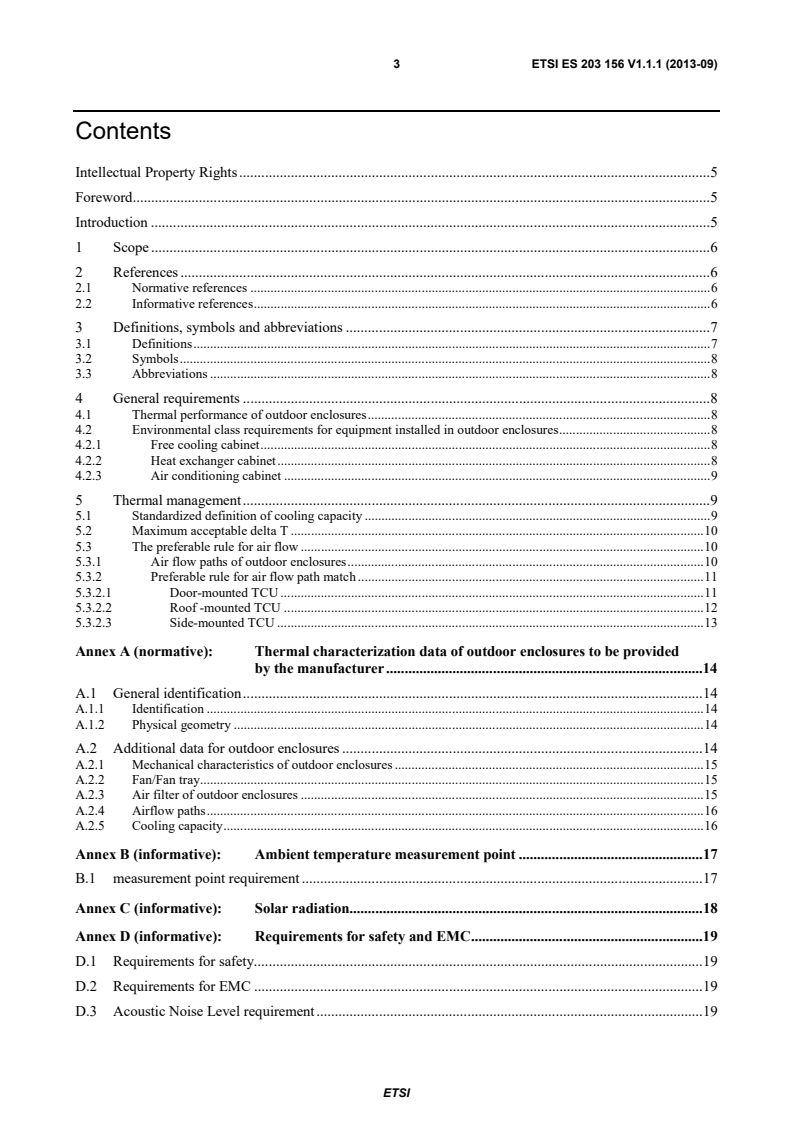
Contents
Intellectual Property Rights . 5
Foreword . 5
Introduction . 5
1 Scope . 6
2 References . 6
2.1 Normative references . 6
2.2 Informative references . 6
3 Definitions, symbols and abbreviations . 7
3.1 Definitions . 7
3.2 Symbols . 8
3.3 Abbreviations . 8
4 General requirements . 8
4.1 Thermal performance of outdoor enclosures . 8
4.2 Environmental class requirements for equipment installed in outdoor enclosures . 8
4.2.1 Free cooling cabinet . 8
4.2.2 Heat exchanger cabinet . 8
4.2.3 Air conditioning cabinet . 9
5 Thermal management . 9
5.1 Standardized definition of cooling capacity . 9
5.2 Maximum acceptable delta T . 10
5.3 The preferable rule for air flow . 10
5.3.1 Air flow paths of outdoor enclosures . 10
5.3.2 Preferable rule for air flow path match . 11
5.3.2.1 Door-mounted TCU . 11
5.3.2.2 Roof -mounted TCU . 12
5.3.2.3 Side-mounted TCU . 13
Annex A (normative): Thermal characterization data of outdoor enclosures to be provided
by the manufacturer . 14
A.1 General identification . 14
A.1.1 Identification . 14
A.1.2 Physical geometry . 14
A.2 Additional data for outdoor enclosures . 14
A.2.1 Mechanical characteristics of outdoor enclosures . 15
A.2.2 Fan/Fan tray. 15
A.2.3 Air filter of outdoor enclosures . 15
A.2.4 Airflow paths . 16
A.2.5 Cooling capacity . 16
Annex B (informative): Ambient temperature measurement point . 17
B.1 measurement point requirement . 17
Annex C (informative): Solar radiation. 18
Annex D (informative): Requirements for safety and EMC . 19
D.1 Requirements for safety. 19
D.2 Requirements for EMC . 19
D.3 Acoustic Noise Level requirement . 19
ETSI
4 Final draft ETSI ES 203 156 V1.0.0 (2013-07)
Annex E (informative): Cabinet performance parameters . 20
Annex F (informative): Bibliography . 21
History . 22
ETSI
5 Final draft ETSI ES 203 156 V1.0.0 (2013-07)
Intellectual Property Rights
IPRs essential or potentially essential to the present document may have been declared to ETSI. The information
pertaining to these essential IPRs, if any, is publicly available for ETSI members and non-members, and can be found
in ETSI SR 000 314: "Intellectual Property Rights (IPRs); Essential, or potentially Essential, IPRs notified to ETSI in
respect of ETSI standards", which is available from the ETSI Secretariat. Latest updates are available on the ETSI Web
server (http://ipr.etsi.org).
Pursuant to the ETSI IPR Policy, no investigation, including IPR searches, has been carried out by ETSI. No guarantee
can be given as to the existence of other IPRs not referenced in ETSI SR 000 314 (or the updates on the ETSI Web
server) which are, or may be, or may become, essential to the present document.
Foreword
This final draft ETSI Standard (ES) has been produced by ETSI Technical Committee Environmental Engineering (EE),
and is now submitted for the ETSI standards Membership Approval Procedure.
Introduction
Outdoor enclosure suppliers are trying to overcome their thermal issues in different solutions being developed. When
different equipments and outdoor enclosures from various suppliers are integrated, they can have a detrimental effect on
each other. The present document specifies the thermal management requirements for outdoor enclosures (defined in
EN 301 169-1 [i.4] and EN 301 169-2 [i.5]) to prevent outdoor enclosures having a detrimental thermal influence on
equipments inside.
ETSI
6 Final draft ETSI ES 203 156 V1.0.0 (2013-07)
1 Scope
The present document describes the thermal management requirements for outdoor enclosures defined in
EN 301 169-1 [i.4] and EN 301 169-2 [i.5]. These thermal management requirements to be defined include:
• a standardized definition of cooling capacity for outdoor enclosures;
• a maximum acceptable delta T between ambient temperature and inside temperature;
• the preferable rule for air flow inside outdoor enclosures;
• the environment class for equipment to be installed in outdoor enclosures.
Not all these requirement are applicable to outdoor enclosures defined in EN 301 169-1 [i.4] and EN 301 169-2 [i.5];
maximum acceptable delta T for equipment in line with EN 301 169-1 [i.4] should be considered as a guide to
developer.
The purpose of the present document is to make it more easy to define the responsibility of equipment manufacturers,
cabinet manufacturers and integrators.
The present document applies for those empty outdoor enclosures supplied for housing telecommunication equipment
of wireline and wireless access network and other information technology equipment.
EMC, safety and acoustic noise requirements are not parts of this document. Guidance on these aspects are contained in
annex D.
2 References
References are either specific (identified by date of publication and/or edition number or version number) or
non-specific. For specific references, only the cited version applies. For non-specific references, the latest version of the
reference document (including any amendments) applies.
Referenced documents which are not found to be publicly available in the expected location might be found at
http://docbox.etsi.org/Reference.
NOTE: While any hyperlinks included in this clause were valid at the time of publication, ETSI cannot guarantee
their long term validity.
2.1 Normative references
The following referenced documents are necessary for the application of the present document.
[1] ETSI EN 300 019-1-4: "Environmental Engineering (EE); Environmental conditions and
environmental tests for telecommunications equipment; Part 1-4: Classification of environmental
conditions; Stationary use at non-weatherprotected locations".
[2] ETSI EN 300 019-1-3: "Environmental Engineering (EE); Environmental conditions and
environmental tests for telecommunications equipment; Part 1-3: Classification of environmental
conditions; Stationary use at weatherprotected locations".
2.2 Informative references
The following referenced documents are not necessary for the application of the present document but they assist the
user with regard to a particular subject area.
[i.1] ETSI EN 300 386: "Electromagnetic compatibility and Radio spectrum Matters
(ERM);Telecommunication network equipment; ElectroMagnetic Compatibility (EMC)
requirements".
ETSI
7 Final draft ETSI ES 203 156 V1.0.0 (2013-07)
[i.2] ETSI EN 301 489-1: "Electromagnetic compatibility and Radio spectrum Matters (ERM);
ElectroMagnetic Compatibility (EMC) standard for radio equipment and services;
Part 1: Common technical requirements".
[i.3] IEC 61969-3: " Mechanical structures for electronic equipment - Outdoor enclosures -
Part 3: Sectional specification - Climatic, mechanical tests and safety aspects for cabinets and
cases".
[i.4] ETSI EN 301 169-1: "Equipment practice; Engineering requirements for outdoor enclosures;
Part 1: Equipped enclosures".
[i.5] ETSI EN 301 169-2: "Equipment practice; Engineering requirements for outdoor enclosures;
Part 2: Unequipped enclosures".
[i.6] ETSI EN 300 119-5: "Environmental Engineering (EE); European telecommunication standard for
equipment practice; Part 5: Thermal management".
[i.7] CENELEC EN 60950-1: "Information technology equipment - Safety - Part 1: General
requirements".
[i.8] CENELEC EN 60950-22: "Information technology equipment - Safety - Part 22: Equipment
installed outdoors".
[i.9] ETSI EN 300 753: "Environmental Engineering (EE); Acoustic noise emitted by
telecommunications equipment".
[i.10] ETSI EN 300 019-2-4: "Environmental Engineering (EE); Environmental conditions and
environmental tests for telecommunications equipment; Part 2-4: Specification of environmental
tests; Stationary use at non-weatherprotected locations".
[i.11] ETSI TR 101 576: "Environmental Engineering (EE); Recommendation for the applicability of
environmental classes in outdoor cabinet environment".
3 Definitions, symbols and abbreviations
3.1 Definitions
For the purposes of the present document, the following terms and definitions apply:
air conditioning: cooling technology where an operating refrigerator system is used for cooling the internal air of the
enclosure
ambient: spatial maximal temperature of the air entering the rack/cabinet
cabinet: free-standing and self-supporting enclosure for housing electrical and/or electronics equipment, usually fitted
with doors and/or side panels which may or may not be removable
free cooling: cooling technology in which the external air is directly used for the inside heat removal; also called direct
free cooling
heat exchanger: cooling technology in which the inside heat removal is provided (actively with fans or passively
without fans) without directly use of outside air but using an exchange between two fluids (e.g. air to air or water to air)
integrator: end user/operator of telecommunication or IT equipment or their agent
NOTE: For example an equipment manufacturer could be an operator's agent.
micro-climate: conditions found within the rack/cabinet creating a local ambient for the subrack
outdoor enclosures: enclosure exposed for the outdoor environment, for stationary use at non-weatherprotected
locations, for the protection of electronic equipment installed inside against outdoor environmental conditions
(IEC 61969-3 [i.3]).
ETSI
8 Final draft ETSI ES 203 156 V1.0.0 (2013-07)
outdoor location: location for equipment where protection from the weather and other outdoor influences provided by
a building or other structure is limited or non-existent
3.2 Symbols
For the purposes of the present document, the following symbols apply:
K cooling capacity of outdoor enclosure [W/°C]
Q heat dissipation from equipment inside cabinet [W]
T surrounding ambient temperature [°C] in which the outdoor enclosure is positioned
ambient
T temperature of air at the equipment inlet inside the cabinet [°C]
inlet
△T temperature difference between T and T [°C]
inlet ambient
3.3 Abbreviations
For the purposes of the present document, the following abbreviations apply:
COP Coefficient Of Performance
ICT Information and Communication Technology
TCU Temperature Control Unit (for example, fresh air cooling , heat- exchanger, air-conditioner)
4 General requirements
4.1 Thermal performance of outdoor enclosures
The supplier of outdoor enclosures shall design the cabinet so that the product fulfils the outdoor environment as
detailed in EN 300 019-1-4 [1], class 4.1. And under this environment class, the cabinet can ensure the equipments
whose environment class is defined in clause 4.2 othe present document to work in appropriate micro-climate.
To enable the operators/integrators to predict the thermal performance of outdoor enclosures and to decide the
equipment configuration inside, The supplier of outdoor enclosures should provide the relevant thermal characteristics
detailed in annex A of the present document.
4.2 Environmental class requirements for equipment installed in
outdoor enclosures
Possible use of environmental class for equipment installed in outdoor enclosures is discussed in TR 101 576 [i.11].
The outdoor enclosure provides a weather protected environment for the inside equipment. For effective cooling, the
equipment inlet air temperature, using some cooling technologies, is higher than the outdoor air temperature.
In the following is considered that the outdoor enclosure is required to meet EN 300 019-1-4 [1], class 4.1 with
temperature range from -33 °C to +40 °C; in this case the climatic conditions for the equipment inside the outdoor
cabinet shall be those defined in the following clauses.
4.2.1 Free cooling cabinet
• Climatic conditions in line with Class 3.3 (see EN 300 019-1-3 [2]).
4.2.2 Heat exchanger cabinet
• Climatic conditions in line with Class 3.3 (see EN 300 019-1-3 [2]).
ETSI
9 Final draft ETSI ES 203 156 V1.0.0 (
...
ETSI ES 203 156 V1.1.1 (2013-09)
ETSI Standard
Environmental Engineering (EE);
Thermal Management requirements for outdoor enclosures
2 ETSI ES 203 156 V1.1.1 (2013-09)
Reference
DES/EE-01027
Keywords
air flow, cooling capacity, environment,
management, outdoor enclosure, thermal
ETSI
650 Route des Lucioles
F-06921 Sophia Antipolis Cedex - FRANCE
Tel.: +33 4 92 94 42 00 Fax: +33 4 93 65 47 16
Siret N° 348 623 562 00017 - NAF 742 C
Association à but non lucratif enregistrée à la
Sous-Préfecture de Grasse (06) N° 7803/88
Important notice
Individual copies of the present document can be downloaded from:
http://www.etsi.org
The present document may be made available in more than one electronic version or in print. In any case of existing or
perceived difference in contents between such versions, the reference version is the Portable Document Format (PDF).
In case of dispute, the reference shall be the printing on ETSI printers of the PDF version kept on a specific network drive
within ETSI Secretariat.
Users of the present document should be aware that the document may be subject to revision or change of status.
Information on the current status of this and other ETSI documents is available at
http://portal.etsi.org/tb/status/status.asp
If you find errors in the present document, please send your comment to one of the following services:
http://portal.etsi.org/chaircor/ETSI_support.asp
Copyright Notification
No part may be reproduced except as authorized by written permission.
The copyright and the foregoing restriction extend to reproduction in all media.
© European Telecommunications Standards Institute 2013.
All rights reserved.
TM TM TM
DECT , PLUGTESTS , UMTS and the ETSI logo are Trade Marks of ETSI registered for the benefit of its Members.
TM
3GPP and LTE™ are Trade Marks of ETSI registered for the benefit of its Members and
of the 3GPP Organizational Partners.
GSM® and the GSM logo are Trade Marks registered and owned by the GSM Association.
ETSI
3 ETSI ES 203 156 V1.1.1 (2013-09)
Contents
Intellectual Property Rights . 5
Foreword . 5
Introduction . 5
1 Scope . 6
2 References . 6
2.1 Normative references . 6
2.2 Informative references . 6
3 Definitions, symbols and abbreviations . 7
3.1 Definitions . 7
3.2 Symbols . 8
3.3 Abbreviations . 8
4 General requirements . 8
4.1 Thermal performance of outdoor enclosures . 8
4.2 Environmental class requirements for equipment installed in outdoor enclosures . 8
4.2.1 Free cooling cabinet . 8
4.2.2 Heat exchanger cabinet . 8
4.2.3 Air conditioning cabinet . 9
5 Thermal management . 9
5.1 Standardized definition of cooling capacity . 9
5.2 Maximum acceptable delta T . 10
5.3 The preferable rule for air flow . 10
5.3.1 Air flow paths of outdoor enclosures . 10
5.3.2 Preferable rule for air flow path match . 11
5.3.2.1 Door-mounted TCU . 11
5.3.2.2 Roof -mounted TCU . 12
5.3.2.3 Side-mounted TCU . 13
Annex A (normative): Thermal characterization data of outdoor enclosures to be provided
by the manufacturer . 14
A.1 General identification . 14
A.1.1 Identification . 14
A.1.2 Physical geometry . 14
A.2 Additional data for outdoor enclosures . 14
A.2.1 Mechanical characteristics of outdoor enclosures . 15
A.2.2 Fan/Fan tray. 15
A.2.3 Air filter of outdoor enclosures . 15
A.2.4 Airflow paths . 16
A.2.5 Cooling capacity . 16
Annex B (informative): Ambient temperature measurement point . 17
B.1 measurement point requirement . 17
Annex C (informative): Solar radiation. 18
Annex D (informative): Requirements for safety and EMC . 19
D.1 Requirements for safety. 19
D.2 Requirements for EMC . 19
D.3 Acoustic Noise Level requirement . 19
ETSI
4 ETSI ES 203 156 V1.1.1 (2013-09)
Annex E (informative): Cabinet performance parameters . 20
Annex F (informative): Bibliography . 21
History . 22
ETSI
5 ETSI ES 203 156 V1.1.1 (2013-09)
Intellectual Property Rights
IPRs essential or potentially essential to the present document may have been declared to ETSI. The information
pertaining to these essential IPRs, if any, is publicly available for ETSI members and non-members, and can be found
in ETSI SR 000 314: "Intellectual Property Rights (IPRs); Essential, or potentially Essential, IPRs notified to ETSI in
respect of ETSI standards", which is available from the ETSI Secretariat. Latest updates are available on the ETSI Web
server (http://ipr.etsi.org).
Pursuant to the ETSI IPR Policy, no investigation, including IPR searches, has been carried out by ETSI. No guarantee
can be given as to the existence of other IPRs not referenced in ETSI SR 000 314 (or the updates on the ETSI Web
server) which are, or may be, or may become, essential to the present document.
Foreword
This ETSI Standard (ES) has been produced by ETSI Technical Committee Environmental Engineering (EE).
Introduction
Outdoor enclosure suppliers are trying to overcome their thermal issues in different solutions being developed. When
different equipments and outdoor enclosures from various suppliers are integrated, they can have a detrimental effect on
each other. The present document specifies the thermal management requirements for outdoor enclosures (defined in
EN 301 169-1 [i.4] and EN 301 169-2 [i.5]) to prevent outdoor enclosures having a detrimental thermal influence on
equipments inside.
ETSI
6 ETSI ES 203 156 V1.1.1 (2013-09)
1 Scope
The present document describes the thermal management requirements for outdoor enclosures defined in
EN 301 169-1 [i.4] and EN 301 169-2 [i.5]. These thermal management requirements to be defined include:
• a standardized definition of cooling capacity for outdoor enclosures;
• a maximum acceptable delta T between ambient temperature and inside temperature;
• the preferable rule for air flow inside outdoor enclosures;
• the environment class for equipment to be installed in outdoor enclosures.
Not all these requirement are applicable to outdoor enclosures defined in EN 301 169-1 [i.4] and EN 301 169-2 [i.5];
maximum acceptable delta T for equipment in line with EN 301 169-1 [i.4] should be considered as a guide to
developer.
The purpose of the present document is to make it more easy to define the responsibility of equipment manufacturers,
cabinet manufacturers and integrators.
The present document applies for those empty outdoor enclosures supplied for housing telecommunication equipment
of wireline and wireless access network and other information technology equipment.
EMC, safety and acoustic noise requirements are not parts of the present document. Guidance on these aspects are
contained in annex D.
2 References
References are either specific (identified by date of publication and/or edition number or version number) or
non-specific. For specific references, only the cited version applies. For non-specific references, the latest version of the
reference document (including any amendments) applies.
Referenced documents which are not found to be publicly available in the expected location might be found at
http://docbox.etsi.org/Reference.
NOTE: While any hyperlinks included in this clause were valid at the time of publication, ETSI cannot guarantee
their long term validity.
2.1 Normative references
The following referenced documents are necessary for the application of the present document.
[1] ETSI EN 300 019-1-4: "Environmental Engineering (EE); Environmental conditions and
environmental tests for telecommunications equipment; Part 1-4: Classification of environmental
conditions; Stationary use at non-weatherprotected locations".
[2] ETSI EN 300 019-1-3: "Environmental Engineering (EE); Environmental conditions and
environmental tests for telecommunications equipment; Part 1-3: Classification of environmental
conditions; Stationary use at weatherprotected locations".
2.2 Informative references
The following referenced documents are not necessary for the application of the present document but they assist the
user with regard to a particular subject area.
[i.1] ETSI EN 300 386: "Electromagnetic compatibility and Radio spectrum Matters
(ERM);Telecommunication network equipment; ElectroMagnetic Compatibility (EMC)
requirements".
ETSI
7 ETSI ES 203 156 V1.1.1 (2013-09)
[i.2] ETSI EN 301 489-1: "Electromagnetic compatibility and Radio spectrum Matters (ERM);
ElectroMagnetic Compatibility (EMC) standard for radio equipment and services;
Part 1: Common technical requirements".
[i.3] IEC 61969-3: "Mechanical structures for electronic equipment - Outdoor enclosures -
Part 3: Sectional specification - Climatic, mechanical tests and safety aspects for cabinets and
cases".
[i.4] ETSI EN 301 169-1: "Equipment practice; Engineering requirements for outdoor enclosures;
Part 1: Equipped enclosures".
[i.5] ETSI EN 301 169-2: "Equipment practice; Engineering requirements for outdoor enclosures;
Part 2: Unequipped enclosures".
[i.6] ETSI EN 300 119-5: "Environmental Engineering (EE); European telecommunication standard for
equipment practice; Part 5: Thermal management".
[i.7] CENELEC EN 60950-1: "Information technology equipment - Safety - Part 1: General
requirements".
[i.8] CENELEC EN 60950-22: "Information technology equipment - Safety - Part 22: Equipment
installed outdoors".
[i.9] ETSI EN 300 753: "Environmental Engineering (EE); Acoustic noise emitted by
telecommunications equipment".
[i.10] ETSI EN 300 019-2-4: "Environmental Engineering (EE); Environmental conditions and
environmental tests for telecommunications equipment; Part 2-4: Specification of environmental
tests; Stationary use at non-weatherprotected locations".
[i.11] ETSI TR 101 576: "Environmental Engineering (EE); Recommendation for the applicability of
environmental classes in outdoor cabinet environment".
3 Definitions, symbols and abbreviations
3.1 Definitions
For the purposes of the present document, the following terms and definitions apply:
air conditioning: cooling technology where an operating refrigerator system is used for cooling the internal air of the
enclosure
ambient: spatial maximal temperature of the air entering the rack/cabinet
cabinet: free-standing and self-supporting enclosure for housing electrical and/or electronics equipment, usually fitted
with doors and/or side panels which may or may not be removable
free cooling: cooling technology in which the external air is directly used for the inside heat removal; also called direct
free cooling
heat exchanger: cooling technology in which the inside heat removal is provided (actively with fans or passively
without fans) without directly use of outside air but using an exchange between two fluids (e.g. air to air or water to air)
integrator: end user/operator of telecommunication or IT equipment or their agent
NOTE: For example an equipment manufacturer could be an operator's agent.
micro-climate: conditions found within the rack/cabinet creating a local ambient for the subrack
outdoor enclosures: enclosure exposed for the outdoor environment, for stationary use at non-weatherprotected
locations, for the protection of electronic equipment installed inside against outdoor environmental conditions
(IEC 61969-3 [i.3])
ETSI
8 ETSI ES 203 156 V1.1.1 (2013-09)
outdoor location: location for equipment where protection from the weather and other outdoor influences provided by
a building or other structure is limited or non-existent
3.2 Symbols
For the purposes of the present document, the following symbols apply:
K cooling capacity of outdoor enclosure [W/°C]
Q heat dissipation from equipment inside cabinet [W]
T surrounding ambient temperature [°C] in which the outdoor enclosure is positioned
ambient
T temperature of air at the equipment inlet inside the cabinet [°C]
inlet
△T temperature difference between T and T [°C]
inlet ambient
3.3 Abbreviations
For the purposes of the present document, the following abbreviations apply:
COP Coefficient Of Performance
ICT Information and Communication Technology
TCU Temperature Control Unit (for example, fresh air cooling , heat- exchanger, air-conditioner)
4 General requirements
4.1 Thermal performance of outdoor enclosures
The supplier of outdoor enclosures shall design the cabinet so that the product fulfils the outdoor environment as
detailed in EN 300 019-1-4 [1], class 4.1. And under this environment class, the cabinet can ensure the equipments
whose environment class is defined in clause 4.2 of the present document to work in appropriate micro-climate.
To enable the operators/integrators to predict the thermal performance of outdoor enclosures and to decide the
equipment configuration inside, The supplier of outdoor enclosures should provide the relevant thermal characteristics
detailed in annex A of the present document.
4.2 Environmental class requirements for equipment installed in
outdoor enclosures
Possible use of environmental class for equipment installed in outdoor enclosures is discussed in TR 101 576 [i.11].
The outdoor enclosure provides a weather protected environment for the inside equipment. For effective cooling, the
equipment inlet air temperature, using some cooling technologies, is higher than the outdoor air temperature.
In the following is considered that the outdoor enclosure is required to meet EN 300 019-1-4 [1], class 4.1 with
temperature range from -33 °C to +40 °C; in this case the climatic conditions for the equipment inside the outdoor
cabinet shall be those defined in the following clauses.
4.2.1 Free cooling cabinet
• Climatic conditions in line with Class 3.3 (see EN 300 019-1-3 [2]).
4.2.2 Heat exchanger cabinet
• Climatic conditions in line with Class 3.3 (see EN 300 019-1-3 [2]).
ETSI
9 ETSI ES 203 156 V1.1.1 (2013-09)
4.2.3 Air conditionin
...