

SIST-TP IEC/TR2 61000-2-5:2004
(Main)Electromagnetic compatibility (EMC) - Part 2: Environment - Section 5: Classification of electromagnetic environments. Basic EMC publication
General Information
- Abstract
This publication is a technical report intended for guidance, not as a specification, for those who are in charge of writing immunity standards for an equipment or system. Its purpose is to classify electromagnetic environments and help improve the specification of the immunity requirements of an item containing electrical or electronic parts, and consequently obtain electromagnetic compatibility. It also gives basic guidance for the selection of immunity levels. The data are applicable to any equipment, subsystem or system making use of electromagnetic energy and operating in a specific location as defined by this report.
- Status
- Published
- Publication Date
- 31-Mar-2004
- Technical Committee
- EMC - Electromagnetic compatibility
- Current Stage
- 6060 - National Implementation/Publication (Adopted Project)
- Start Date
- 01-Apr-2004
- Due Date
- 01-Apr-2004
- Completion Date
- 01-Apr-2004

Overview
SIST-TP IEC/TR2 61000-2-5:2004 is a foundational technical report published by SIST, under the IEC 61000 series, focusing on electromagnetic compatibility (EMC). This document is designed to provide guidance-not enforceable requirements-for professionals developing immunity standards for equipment and systems. Its primary purpose is to classify different electromagnetic (EM) environments and offer essential support to those specifying immunity requirements for devices with electrical or electronic components. By clearly defining EM environment classifications, the report helps improve the process of achieving electromagnetic compatibility, thereby ensuring reliable operation and reducing risks of electromagnetic interference.
Key Topics
Electromagnetic Environment Classification
This technical report offers a structured approach to identify and describe various electromagnetic environments. By categorizing different settings-such as industrial, medical, and residential environments-it enables a more precise assessment of likely electromagnetic disturbances and sets a foundation for resilience planning.Guidance on Immunity Levels
The document gives basic advice for selecting appropriate immunity levels for equipment based on the specified environment. This helps ensure that systems continue to operate as intended when exposed to typical electromagnetic disturbances in their operational settings.Specification of Immunity Requirements
The standard aids authors of product and equipment standards in translating environmental classifications into practical immunity requirements. This forms a critical reference for specifying test conditions and required performance benchmarks.General Applicability
The guidance within is applicable to any equipment, subsystem, or system utilizing electromagnetic energy, regardless of industry or location. This broad applicability underlines the standard’s value in contemporary electrical and electronic system design.
Applications
Equipment and System Design
Manufacturers and system integrators can use the classifications to anticipate and mitigate environmental EMC risks during the design phase.Development of Immunity Standards
Standards writers rely on this publication to ensure that immunity benchmarks are rooted in real-world environmental conditions, improving the relevance and effectiveness of product standards.Site Planning and Installation
Facilities engineers and project planners can reference the classified environments to select and deploy equipment that meets appropriate immunity levels, supporting uninterrupted operations in critical applications such as data centers, healthcare, and industrial automation.Regulatory Compliance
The classification framework facilitates evidence-based justification of immunity requirements, supporting smoother conformity assessment and regulatory review processes.
Related Standards
IEC 61000 Series
The broader IEC 61000 series addresses EMC in detail, including general requirements, testing, and measurement techniques for immunity and emission. Notable related documents include:- IEC 61000-4 (Testing and measurement techniques)
- IEC 61000-6 (Generic EMC standards for various environments)
CISPR Standards
These provide specific EMC guidelines for various product categories and environments.Industry-Specific Standards
Many sectors, such as medical (IEC 60601) and industrial equipment, reference IEC 61000-2-5 classifications when setting sector-specific immunity and emission criteria.
Practical Value
SIST-TP IEC/TR2 61000-2-5:2004 serves as an authoritative reference for classifying EM environments and underpinning effective EMC management strategies. Its guidance helps ensure that electrical and electronic products operate reliably and safely in their intended contexts, streamlining both design and compliance efforts, and supporting widespread adoption of robust electromagnetic compatibility practices.
Relations
- Referred By
SIST EN ISO 20109:2017 - Simultaneous interpreting - Equipment - Requirements (ISO 20109:2016) - Effective Date
- 09-Feb-2026
Get Certified
Connect with accredited certification bodies for this standard

ANCE
Mexican certification and testing association.

Intertek Slovenia
Intertek testing, inspection, and certification services in Slovenia.

LNE (Laboratoire National de Métrologie et d'Essais)
French national laboratory for metrology and testing.
Sponsored listings
Frequently Asked Questions
SIST-TP IEC/TR2 61000-2-5:2004 is a standard published by the Slovenian Institute for Standardization (SIST). Its full title is "Electromagnetic compatibility (EMC) - Part 2: Environment - Section 5: Classification of electromagnetic environments. Basic EMC publication". This standard covers: This publication is a technical report intended for guidance, not as a specification, for those who are in charge of writing immunity standards for an equipment or system. Its purpose is to classify electromagnetic environments and help improve the specification of the immunity requirements of an item containing electrical or electronic parts, and consequently obtain electromagnetic compatibility. It also gives basic guidance for the selection of immunity levels. The data are applicable to any equipment, subsystem or system making use of electromagnetic energy and operating in a specific location as defined by this report.
This publication is a technical report intended for guidance, not as a specification, for those who are in charge of writing immunity standards for an equipment or system. Its purpose is to classify electromagnetic environments and help improve the specification of the immunity requirements of an item containing electrical or electronic parts, and consequently obtain electromagnetic compatibility. It also gives basic guidance for the selection of immunity levels. The data are applicable to any equipment, subsystem or system making use of electromagnetic energy and operating in a specific location as defined by this report.
SIST-TP IEC/TR2 61000-2-5:2004 is classified under the following ICS (International Classification for Standards) categories: 33.100.01 - Electromagnetic compatibility in general; 33.160.50 - Accessories. The ICS classification helps identify the subject area and facilitates finding related standards.
SIST-TP IEC/TR2 61000-2-5:2004 has the following relationships with other standards: It is inter standard links to SIST EN ISO 20109:2017. Understanding these relationships helps ensure you are using the most current and applicable version of the standard.
SIST-TP IEC/TR2 61000-2-5:2004 is available in PDF format for immediate download after purchase. The document can be added to your cart and obtained through the secure checkout process. Digital delivery ensures instant access to the complete standard document.
Standards Content (Sample)
IEC 60268-4 ®
Edition 5.0 2014-06
INTERNATIONAL
STANDARD
NORME
INTERNATIONALE
Sound system equipment –
Part 4: Microphones
Équipements pour systèmes électroacoustiques –
Partie 4: Microphones
All rights reserved. Unless otherwise specified, no part of this publication may be reproduced or utilized in any form
or by any means, electronic or mechanical, including photocopying and microfilm, without permission in writing from
either IEC or IEC's member National Committee in the country of the requester. If you have any questions about IEC
copyright or have an enquiry about obtaining additional rights to this publication, please contact the address below or
your local IEC member National Committee for further information.
Droits de reproduction réservés. Sauf indication contraire, aucune partie de cette publication ne peut être reproduite
ni utilisée sous quelque forme que ce soit et par aucun procédé, électronique ou mécanique, y compris la photocopie
et les microfilms, sans l'accord écrit de l'IEC ou du Comité national de l'IEC du pays du demandeur. Si vous avez des
questions sur le copyright de l'IEC ou si vous désirez obtenir des droits supplémentaires sur cette publication, utilisez
les coordonnées ci-après ou contactez le Comité national de l'IEC de votre pays de résidence.
IEC Central Office Tel.: +41 22 919 02 11
3, rue de Varembé Fax: +41 22 919 03 00
CH-1211 Geneva 20 info@iec.ch
Switzerland www.iec.ch
About the IEC
The International Electrotechnical Commission (IEC) is the leading global organization that prepares and publishes
International Standards for all electrical, electronic and related technologies.
About IEC publications
The technical content of IEC publications is kept under constant review by the IEC. Please make sure that you have the
latest edition, a corrigenda or an amendment might have been published.
IEC Catalogue - webstore.iec.ch/catalogue Electropedia - www.electropedia.org
The stand-alone application for consulting the entire The world's leading online dictionary of electronic and
bibliographical information on IEC International Standards, electrical terms containing more than 30 000 terms and
Technical Specifications, Technical Reports and other definitions in English and French, with equivalent terms in 14
documents. Available for PC, Mac OS, Android Tablets and additional languages. Also known as the International
iPad. Electrotechnical Vocabulary (IEV) online.
IEC publications search - www.iec.ch/searchpub IEC Glossary - std.iec.ch/glossary
The advanced search enables to find IEC publications by a More than 55 000 electrotechnical terminology entries in
variety of criteria (reference number, text, technical English and French extracted from the Terms and Definitions
committee,…). It also gives information on projects, replaced clause of IEC publications issued since 2002. Some entries
and withdrawn publications. have been collected from earlier publications of IEC TC 37,
77, 86 and CISPR.
IEC Just Published - webstore.iec.ch/justpublished
Stay up to date on all new IEC publications. Just Published IEC Customer Service Centre - webstore.iec.ch/csc
details all new publications released. Available online and If you wish to give us your feedback on this publication or
also once a month by email. need further assistance, please contact the Customer Service
Centre: csc@iec.ch.
A propos de l'IEC
La Commission Electrotechnique Internationale (IEC) est la première organisation mondiale qui élabore et publie des
Normes internationales pour tout ce qui a trait à l'électricité, à l'électronique et aux technologies apparentées.
A propos des publications IEC
Le contenu technique des publications IEC est constamment revu. Veuillez vous assurer que vous possédez l’édition la
plus récente, un corrigendum ou amendement peut avoir été publié.
Catalogue IEC - webstore.iec.ch/catalogue Electropedia - www.electropedia.org
Application autonome pour consulter tous les renseignements
Le premier dictionnaire en ligne de termes électroniques et
bibliographiques sur les Normes internationales,
électriques. Il contient plus de 30 000 termes et définitions en
Spécifications techniques, Rapports techniques et autres
anglais et en français, ainsi que les termes équivalents dans
documents de l'IEC. Disponible pour PC, Mac OS, tablettes
14 langues additionnelles. Egalement appelé Vocabulaire
Android et iPad.
Electrotechnique International (IEV) en ligne.
Recherche de publications IEC - www.iec.ch/searchpub
Glossaire IEC - std.iec.ch/glossary
Plus de 55 000 entrées terminologiques électrotechniques, en
La recherche avancée permet de trouver des publications IEC
en utilisant différents critères (numéro de référence, texte, anglais et en français, extraites des articles Termes et
comité d’études,…). Elle donne aussi des informations sur les Définitions des publications IEC parues depuis 2002. Plus
projets et les publications remplacées ou retirées. certaines entrées antérieures extraites des publications des
CE 37, 77, 86 et CISPR de l'IEC.
IEC Just Published - webstore.iec.ch/justpublished
Service Clients - webstore.iec.ch/csc
Restez informé sur les nouvelles publications IEC. Just
Published détaille les nouvelles publications parues. Si vous désirez nous donner des commentaires sur cette
Disponible en ligne et aussi une fois par mois par email. publication ou si vous avez des questions contactez-nous:
csc@iec.ch.
IEC 60268-4 ®
Edition 5.0 2014-06
INTERNATIONAL
STANDARD
NORME
INTERNATIONALE
Sound system equipment –
Part 4: Microphones
Équipements pour systèmes électroacoustiques –
Partie 4: Microphones
INTERNATIONAL
ELECTROTECHNICAL
COMMISSION
COMMISSION
ELECTROTECHNIQUE
PRICE CODE
INTERNATIONALE
CODE PRIX XA
ICS 33.160.50 ISBN 978-2-8322-1586-9
– 2 – IEC 60268-4:2014 © IEC 2014
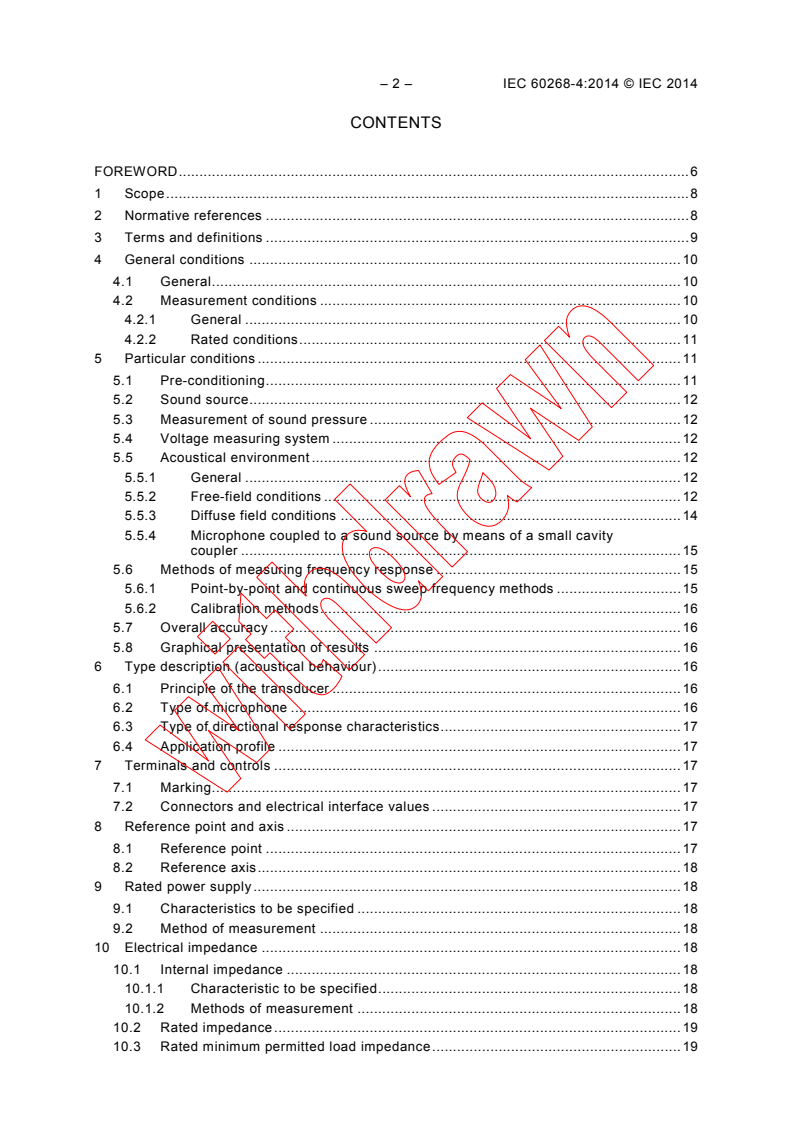
CONTENTS
FOREWORD . 6
1 Scope . 8
2 Normative references . 8
3 Terms and definitions . 9
4 General conditions . 10
4.1 General . 10
4.2 Measurement conditions . 10
4.2.1 General . 10
4.2.2 Rated conditions . 11
5 Particular conditions . 11
5.1 Pre-conditioning . 11
5.2 Sound source . 12
5.3 Measurement of sound pressure . 12
5.4 Voltage measuring system . 12
5.5 Acoustical environment . 12
5.5.1 General . 12
5.5.2 Free-field conditions . 12
5.5.3 Diffuse field conditions . 14
5.5.4 Microphone coupled to a sound source by means of a small cavity
coupler . 15
5.6 Methods of measuring frequency response . 15
5.6.1 Point-by-point and continuous sweep frequency methods . 15
5.6.2 Calibration methods . 16
5.7 Overall accuracy . 16
5.8 Graphical presentation of results . 16
6 Type description (acoustical behaviour) . 16
6.1 Principle of the transducer . 16
6.2 Type of microphone . 16
6.3 Type of directional response characteristics . 17
6.4 Application profile . 17
7 Terminals and controls . 17
7.1 Marking . 17
7.2 Connectors and electrical interface values . 17
8 Reference point and axis . 17
8.1 Reference point . 17
8.2 Reference axis . 18
9 Rated power supply . 18
9.1 Characteristics to be specified . 18
9.2 Method of measurement . 18
10 Electrical impedance . 18
10.1 Internal impedance . 18
10.1.1 Characteristic to be specified . 18
10.1.2 Methods of measurement . 18
10.2 Rated impedance . 19
10.3 Rated minimum permitted load impedance . 19
11 Sensitivity . 19
11.1 General . 19
11.2 Sensitivities with respect to acoustical environment . 20
11.2.1 Free-field sensitivity . 20
11.2.2 Diffuse-field sensitivity . 20
11.2.3 Close-talking or near-field sensitivity . 21
11.2.4 Pressure sensitivity . 21
11.3 Rated sensitivity . 22
12 Response . 22
12.1 Frequency response . 22
12.1.1 Characteristic to be specified . 22
12.1.2 Method of measurement . 23
12.1.3 Graphical presentation of results . 23
12.2 Effective frequency range . 23
12.2.1 Characteristic to be specified . 23
12.2.2 Method of measurement . 23
13 Directional characteristics . 23
13.1 Directional pattern . 23
13.1.1 Characteristic to be specified . 23
13.1.2 Methods of measurement . 23
13.1.3 Graphical presentation of results . 24
13.2 Directivity index . 25
13.2.1 Characteristic to be specified . 25
13.2.2 Method of measurement . 25
14 Amplitude non-linearity . 25
14.1 General . 25
14.2 Total harmonic distortion . 25
14.2.1 Characteristic to be specified . 25
14.2.2 Method of measurement . 25
th
14.3 Harmonic distortion of the n order (n = 2, 3,.) . 26
14.3.1 Characteristic to be specified . 26
14.3.2 Method of measurement . 26
14.4 Difference frequency distortion of second order . 27
14.4.1 Characteristic to be specified . 27
14.4.2 Method of measurement . 27
15 Limiting characteristics . 27
15.1 Rated maximum permissible peak sound pressure . 27
15.2 Overload sound pressure . 27
15.2.1 Characteristic to be specified . 27
15.2.2 Method of measurement . 28
16 Balance . 28
16.1 Balance of the microphone output . 28
16.2 Balance under working conditions . 28
17 Equivalent sound pressure level due to inherent noise . 29
17.1 Characteristic to be specified . 29
17.2 Method of measurement . 29
18 Ambient conditions . 30
18.1 General . 30
– 4 – IEC 60268-4:2014 © IEC 2014
18.2 Pressure range . 30
18.3 Temperature range . 30
18.4 Relative humidity range . 30
19 External influences . 30
19.1 General . 30
19.1.1 Specification and methods of measurement . 30
19.1.2 Other external interferences . 31
19.2 Equivalent sound pressure due to mechanical vibration . 31
19.2.1 Characteristic to be specified . 31
19.2.2 Method of measurement . 31
19.3 Equivalent sound pressure due to wind . 31
19.3.1 Characteristic to be specified . 31
19.3.2 Method of measurement . 31
19.4 Transient equivalent sound pressure due to "pop" effect . 34
19.4.1 Characteristic to be specified . 34
19.4.2 Method of measurement . 36
20 Electromagnetic compatibility (EMC) . 36
20.1 Regulatory requirements . 36
20.2 Requirements for preserving programme quality . 37
20.3 Performance criteria . 38
20.3.1 Criterion A . 38
20.3.2 Criterion B . 38
20.4 Testing for immunity to disturbances in the presence of acoustical noise . 38
20.5 Immunity to frequency-modulated radiated disturbances . 38
20.6 Immunity to magnetic fields . 39
20.7 Immunity to ripple on d.c. power supply . 39
20.8 Permanent magnetic field . 39
20.9 Evaluation and reporting of the test results . 39
21 Physical characteristics . 40
21.1 Dimensions . 40
21.2 Weight . 40
21.3 Cables and connectors . 40
22 Classification of the characteristics to be specified . 40
Annex A (normative) Additional characteristics . 43
A.1 Characteristic sensitivity for speech . 43
A.1.1 Characteristic to be specified . 43
A.1.2 Method of measurement . 43
A.2 Front-to-rear sensitivity index (0° – 180°) . 44
A.2.1 Characteristic to be specified . 44
A.2.2 Method of measurement . 44
A.3 Noise-cancelling index . 44
A.3.1 Characteristic to be specified . 44
A.3.2 Method of measurement . 44
A.4 Special characteristics for stereo microphones . 45
A.4.1 General . 45
A.4.2 Included angle of an XY (left-right) microphone . 45
A.4.3 Acceptance angle . 45
Annex B (informative) Sound insulation device . 46
Annex C (informative) Simplified procedure for “pop” measurements . 47
C.1 General . 47
C.2 Measurement set-up . 47
C.3 Measurement procedure . 47
C.4 Approximate inclusion of different frequency responses . 48
Annex D (informative) Recommendations for professional digital microphones . 50
D.1 General . 50
D.2 Data sheets for digital microphones . 50
Bibliography . 53
Figure 1 – Balance of the output . 28
Figure 2 – Balance under working conditions . 29
Figure 3 – Measurement set-up for wind influence . 32
Figure 4 – Wind generators, type 1 (Figure 4a) and type 2 (Figure 4b) . 33
Figure 5 – Electrical and mechanical set-up for the measuring of the "pop" effect . 35
Figure B.1 – Sound insulation device . 46
Figure C.1 – Measurement set-up . 49
Figure C.2 – Test fixture for the sound field sensitivity . 49
Table 1 – Reverberation time of the empty room . 14
Table 2 – Reference signal and characteristics . 36
Table 3 – Examples of EMC regulations and standards . 37
Table 4 – Basic EMC standards and their application to microphones . 37
Table 5 – Classification of characteristics . 41
Table A.1 – Speech power weighting factor at octave-band centre frequencies . 43
Table D.1 – Classification of the characteristics recommended to be specified . 50
Table D.2 – Additional digital characteristics to be specified . 52
– 6 – IEC 60268-4:2014 © IEC 2014
INTERNATIONAL ELECTROTECHNICAL COMMISSION
____________
SOUND SYSTEM EQUIPMENT –
Part 4: Microphones
FOREWORD
1) The International Electrotechnical Commission (IEC) is a worldwide organization for standardization comprising
all national electrotechnical committees (IEC National Committees). The object of IEC is to promote
international co-operation on all questions concerning standardization in the electrical and electronic fields. To
this end and in addition to other activities, IEC publishes International Standards, Technical Specifications,
Technical Reports, Publicly Available Specifications (PAS) and Guides (hereafter referred to as “IEC
Publication(s)”). Their preparation is entrusted to technical committees; any IEC National Committee interested
in the subject dealt with may participate in this preparatory work. International, governmental and non-
governmental organizations liaising with the IEC also participate in this preparation. IEC collaborates closely
with the International Organization for Standardization (ISO) in accordance with conditions determined by
agreement between the two organizations.
2) The formal decisions or agreements of IEC on technical matters express, as nearly as possible, an international
consensus of opinion on the relevant subjects since each technical committee has representation from all
interested IEC National Committees.
3) IEC Publications have the form of recommendations for international use and are accepted by IEC National
Committees in that sense. While all reasonable efforts are made to ensure that the technical content of IEC
Publications is accurate, IEC cannot be held responsible for the way in which they are used or for any
misinterpretation by any end user.
4) In order to promote international uniformity, IEC National Committees undertake to apply IEC Publications
transparently to the maximum extent possible in their national and regional publications. Any divergence
between any IEC Publication and the corresponding national or regional publication shall be clearly indicated in
the latter.
5) IEC itself does not provide any attestation of conformity. Independent certification bodies provide conformity
assessment services and, in some areas, access to IEC marks of conformity. IEC is not responsible for any
services carried out by independent certification bodies.
6) All users should ensure that they have the latest edition of this publication.
7) No liability shall attach to IEC or its directors, employees, servants or agents including individual experts and
members of its technical committees and IEC National Committees for any personal injury, property damage or
other damage of any nature whatsoever, whether direct or indirect, or for costs (including legal fees) and
expenses arising out of the publication, use of, or reliance upon, this IEC Publication or any other IEC
Publications.
8) Attention is drawn to the Normative references cited in this publication. Use of the referenced publications is
indispensable for the correct application of this publication.
9) Attention is drawn to the possibility that some of the elements of this IEC Publication may be the subject of
patent rights. IEC shall not be held responsible for identifying any or all such patent rights.
International Standard IEC 60268-4 has been prepared by IEC technical committee 100:
Audio, video and multimedia systems and equipment.
This fifth edition cancels and replaces the fourth edition published in 2010, and constitutes a
technical revision.
This edition includes the following significant technical changes with respect to the previous
edition:
– clarification of Table 5 of classification of characteristics;
– clarification of graphical representation;
– clarification of environmental influences;
– rewritten clause for EMC;
– tolerances and more specific values for noise measurements;
– inclusion of near-field response for sound source-to-microphone distances of the order of
30 cm.
The text of this standard is based on the following documents:
CDV Report on voting
100/2116/CDV 100/2186/RVC
Full information on the voting for the approval of this standard can be found in the report on
voting indicated in the above table.
This publication has been drafted in accordance with the ISO/IEC Directives, Part 2.
A list of all parts of the IEC 60268 series, under the general title Sound system equipment,
can be found on the IEC website.
The committee has decided that the contents of this publication will remain unchanged until
the stability date indicated on the IEC web site under "http://webstore.iec.ch" in the data
related to the specific publication. At this date, the publication will be
• reconfirmed,
• withdrawn,
• replaced by a revised edition, or
• amended.
– 8 – IEC 60268-4:2014 © IEC 2014
SOUND SYSTEM EQUIPMENT –
Part 4: Microphones
1 Scope
This part of IEC 60268 specifies methods of measurement for the electrical impedance,
sensitivity, directional response pattern, dynamic range and external influences of sound
system microphones, and also details the characteristics to be specified by the manufacturer.
It applies to sound system microphones for all applications for speech and music. It does not
apply to measurement microphones, but it does apply to each audio channel of microphones
having more than one channel, for example for stereo or similar use. It is also applicable to
flush-mounted microphones and to the analogue characteristics of microphones with digital
audio output.
For the purposes of this International Standard, a microphone includes all such devices as
transformers, pre-amplifiers, or other elements that form an integral part of the microphone,
up to the output terminals specified by the manufacturer.
The major characteristics of a microphone are considered in Clauses 6 to 21. Additional
characteristics are considered in Annex A, Annex C and Annex D.
NOTE The characteristics specified in this standard do not completely describe the subjective response of the
microphone. Further work is necessary to find new definitions and measurement procedures for a later replacement
by objective characteristics of at least some of the subjective descriptions used to describe microphone
performance.
2 Normative references
The following documents, in whole or in part, are normatively referenced in this document and
are indispensable for its application. For dated references, only the edition cited applies. For
undated references, the latest edition of the referenced document (including any
amendments) applies.
CISPR 35:–, Electromagnetic compatibility of multimedia equipment – Immunity
requirements
IEC 60268-1:1985, Sound system equipment – Part 1: General
Amendment 1:1988
Amendment 2:1988
IEC 60268-2:1987, Sound system equipment – Part 2: Explanation of general terms and
calculation methods
Amendment 1:1991
IEC 60268-3:2013, Sound system equipment – Part 3: Amplifiers
IEC 60268-5:2003, Sound system equipment – Part 5: Loudspeakers
Amendment 1:2007
Amendment 1:2007
_____________
To be published.
IEC 60268-11:1987, Sound system equipment – Part 11: Application of connectors for the
interconnection of sound system components
Amendment 1:1989
Amendment 2:1991
IEC 60268-12:1987, Sound system equipment – Part 12: Application of connectors for
broadcast and similar use
Amendment 1:1991
Amendment 2:1994
IEC 61000-4-2:2008, Electromagnetic compatibility (EMC) – Part 4-2: Testing and
measurement techniques – Electrostatic discharge immunity test
IEC 61000-4-3:2006, Electromagnetic compatibility (EMC) – Part 4-3: Testing and
measurement techniques - Radiated, radio-frequency, electromagnetic field immunity test
Amendment 1:2007
Amendment 2:2010
IEC 61000-4-4:2012, Electromagnetic compatibility (EMC) – Part 4-4: Testing and
measurement techniques – Electrical fast transient/burst immunity test
IEC 61000-4-6:2008, Electromagnetic compatibility (EMC) – Part 4-6: Testing and
measurement techniques – Immunity to conducted disturbances, induced by radio-frequency
fields
IEC 61000-4-8:2009, Electromagnetic compatibility (EMC) – Part 4-8: Testing and
measurement techniques – Power frequency magnetic field immunity test
IEC 61000-4-16, Electromagnetic compatibility (EMC) – Part 4-16: Testing and measurement
techniques – Test for immunity to conducted, common mode disturbances in the frequency
range 0 Hz to 150 kHz
IEC 61000-4-17:1999, Electromagnetic compatibility (EMC) – Part 4-17: Testing and
measurement techniques - Ripple on d.c. input power port immunity test
Amendment 1:2001
Amendment 2:2008
IEC 61260-1:2014, Electroacoustics – Octave-band and fractional-octave-band filters –
Part 1: Specifications
IEC 61938:2013, Multimedia systems – Guide to the recommended characteristics of
analogue interfaces to achieve interoperability
ITU-T Recommendation P.51:1996, Artificial mouth
EN 55103-2:2009, Electromagnetic compatibility – Product family standard for audio, video,
audio-visual and entertainment lighting control apparatus for professional use – Part 2:
Immunity
EN 300 422-2 V1.3.1:2011, Electromagnetic compatibility and radio spectrum matters (ERM)
– Wireless microphones in the 25 MHz to 3 GHz frequency range – Part 2: Harmonized EN
covering the essential requirements of article 3.2 of the R&TTE Directive
3 Terms and definitions
For the purposes of this document, the terms and definitions given in IEC 60268-1 and the
following apply.
– 10 – IEC 60268-4:2014 © IEC 2014
3.1
far-field microphone
microphone for use at a distance of more than 1 m from the source of sound
3.2
near-field microphone
microphone for use by an individual performer at a distance of approximately 30 cm
3.3
close-talking microphone
microphone for use at a distance of approximately 25 mm from the source of sound
4 General conditions
4.1 General
Special reference is made to IEC 60268-1, concerning:
• units and system of measurement;
• frequencies of measurement;
• quantities to be specified and their accuracy (see also 5.7);
• marking (see also 7.1);
• ambient conditions;
• filters, networks and measuring instruments for noise specification and measurement;
• individual specifications and type specifications;
• graphical presentation of characteristics;
• scales for graphical presentation;
• personal safety and prevention of spread of fire;
• method of producing a uniform alternating magnetic field;
• search coils for measuring the magnetic field strength,
and to IEC 61938 concerning powering of microphones.
4.2 Measurement conditions
4.2.1 General
For convenience in specifying how microphones shall be set up for measurement, three sets
of conditions have been defined in this standard, under the title of "rated conditions".
Microphones should be measured in conditions approximating those in which they are
intended to be used. Three sets of measurement conditions are specified in this standard:
free-field, near-field and close-talking. The differences between these sets of conditions are in
the distance to the sound source and the sound pressure level of the measurement.
Measurements shall be reported using at least one of these sets of conditions. Additional data
may be included, provided that the measurement conditions are specified.
Three ratings are basic to the formulation of these concepts:
– rated power supply (see 9.1);
– rated impedance (see 10.2);
– rated sensitivity (see 11.3).
To obtain the correct conditions for measurement, the above mentioned ratings shall be taken
from the specifications supplied by the manufacturer of the equipment.
The term "rated" applied to other characteristics relates to the specification or measurement
of the particular characteristic under rated conditions or under conditions unambiguously
connected to them. This applies, for example, to the following two characteristics:
– rated output voltage;
– rated equivalent sound pressure level due to inherent noise.
Methods of measurement are given in this standard for electrical impedance, sensitivity,
directional pattern, dynamic range and external influences. Where alternative methods are
given, the chosen method shall be specified.
4.2.2 Rated conditions
The microphone is understood to be working under rated conditions when the following
conditions are fulfilled:
– the microphone is connected to the resistive load specified in 5.4, or as specified by the
manufacturer;
– if the microphone needs a power supply, this is the rated power supply;
– the microphone (except a close-talking or near-field microphone) is placed in a sound field
meeting the free-field conditions in 5.5.2, the waves having zero degree incidence with
respect to the reference direction;
– the undisturbed sound pressure (in the absence of the microphone) in the sound field at
the reference point of the microphone is sinusoidal and set at a level of 1 Pa (94 dB SPL);
– for close-talking microphones, the microphone is placed at a stated distance, no more
than 25 mm from the artificial mouth complying with ITU-T Recommendation P.51, and the
undisturbed sound pressure in the sound field at the reference point of microphone is
sinusoidal and set at a level of 3 Pa (104 dB SPL);
– for near-field microphones, the microphone is placed at 30 cm from the artificial mouth
complying with ITU-T Recommendation P.51, and the undisturbed sound pressure in the
sound field at the reference point of microphone is sinusoidal and set at a level of 1 Pa
(94 dB SPL);
– if a special microphone needs a different measurement level, it shall be stated in the
technical data together with the reason for this. Levels related to the normal reference
level of 94 dB by multiples of 10 dB are preferred;
– controls, if any, are set to the position recommended by the manufacturer;
– in the absence of a clear reason to the contrary, the measurement frequency is 1 000 Hz
(see IEC 60268-1);
– the ambient pressure, relative humidity and ambient temperature are within the limits
given in IEC 60268-1, and shall be stated.
Measurements may be made at a sound pressure of 0,3 Pa if this is necessary due to
limitations of the performance of the loudspeaker or other measurement equipment, and only
if any change in performance between the level used and the reference level is known with
the necessary accuracy for the relevant characteristics.
5 Particular conditions
5.1 Pre-conditioning
A microphone with preamplifier shall be switched on for the period of time specified by the
manufacturer, before measurements are made, to allow the components to reach the
stationary temperature for rated conditions. If the manufacturer specifies no period, a period
– 12 – IEC 60268-4:2014 © IEC 2014
of 10 s shall be allowed for stabilization. If the microphone contains a vacuum tube or other
heating device the time shall be 10 min.
5.2 Sound source
The sound source shall be capable of producing at the microphone position the sound
pressure level as defined for rated conditions. The amplitude non-linearity of the sound
source shall be held to such a value that the effect on the measured response does not
exceed 0,5 dB. If the conditions of measurement preclude the possibility of securing
sufficiently low distortion, a narrow-band filter may be used at the microphone output
terminals, which allows the response at the fundamental frequency to be measured.
For free-field calibration and calibration of near-field microphones, the sound source shall be
contained in an enclosure which radiates sound from one well-defined opening only, and such
an opening shall be radially symmetrical with respect to the axis of the reference direction of
the microphone.
5.3 Measurement of sound pressure
A calibrated reference pressure microphone shall be used to measure the sound pressure.
The reference microphone shall be calibrated with an accuracy of ±1 dB or better.
5.4 Voltage measuring system
The voltage generated by the microphone, when in a sound field, shall be determined by
using a voltmeter with an input resistance of five times the rated impedance of the
microphone, unless otherwise stated by the manufacturer. If external equipment, such as a
power supply, applies an impedance in parallel with the microphone, its impedance shall be
taken into account.
NOTE Microphones having a rated impedance of 200 Ω often have an actual internal impedance in the order of
50 Ω, and perform best with a minimum load impedance around 1 000 Ω.
5.5 Acoustical environment
5.5.1 General
The microphone can be measured in different acoustical environments:
a) in a free field or similar with negligible boundary effects, e.g. by using special computer-
generated sound source signals:
– spherical waves, or
– plane waves, or
– waves produced by a specific sound source (artificial mouth or artificial head);
b) in a diffuse field;
c) coupled to a sound source by means of a small cavity (coupler).
5.5.2 Free-field conditions
5.5.2.1 General
A free-field sound wave is normally divergent in character. In certain circumstances it can
approximate an ideal plane wave. Free-field conditions can be obtained:
– in op
...
SLOVENSKI SIST-TP IEC/TR2 61000-2-
5:2004
STANDARD
april 2004
Electromagnetic compatibility (EMC) - Part 2: Environment – Section 5:
Classification of electromagnetic environments - Basic EMC publication
ICS 33.100.01 Referenčna številka
© Standard je založil in izdal Slovenski inštitut za standardizacijo. Razmnoževanje ali kopiranje celote ali delov tega dokumenta ni dovoljeno
1000-2-5 IEC:1995 − 3 −
CONTENTS
Page
FOREWORD . 7
Clause
1 General . 11
1.1 Scope and object. 11
1.2 Normative reference. 11
1.3 Approach. 11
2 Definitions . 15
2.1 Annotated definitions on electromagnetic compatibility. 17
2.2 Acronyms. 19
3 User's guide for this report. 19
3.1 Rationale for classification system . 19
3.2 Environmental phenomena. 19
3.3 Simplification of the environmental database. 21
4 Low-frequency electromagnetic phenomena . 25
4.1 Conducted low-frequency phenomena. 25
4.2 Radiated low-frequency phenomena. 33
5 High-frequency electromagnetic phenomena . 37
5.1 Conducted high-frequency phenomena . 37
5.2 Radiated high-frequency phenomena . 45
6 Electrostatic discharge. 49
6.1 ESD currents. 49
6.2 Fields produced by ESD currents. 51
7 Classification of environments .53
7.1 Types of location . 53
7.2 Impinging disturbances and equipment ports . 53
8 Principles of the selection of immunity levels. 57
8.1 Approach. 57
8.2 Uncertainties. 57
8.3 Criticality criteria. 59
1000-2-5 IEC:1995 − 5 −
Tables Page
1 Principal phenomena causing electromagnetic disturbances. 23
2 Range of disturbance degrees for harmonics in low-voltage power systems. 27
3 Range of disturbance degrees for signalling voltages in power systems . 29
4 Sources and range of disturbance degrees for voltage amplitude and frequency
in power systems . 31
5 Sources and range of disturbance degrees for low-frequency, common-mode
induced voltages in signal and control cables. 33
6 Sources and range of disturbance degrees for low-frequency magnetic fields . 35
7 Sources and range of disturbance degrees for low-frequency electric fields. 37
8 Disturbance degrees of induced CW voltages with respect to reference ground. 39
9 Sources and range of disturbance degrees for conducted unidirectional transients
in low-voltage a.c. power systems . 43
10 Sources and range of disturbance degrees for conducted oscillatory transients
in low-voltage a.c. power systems . 45
11 Sources and range of disturbance degrees for radiated oscillatory disturbances . 47
12 Sources and range of disturbance degrees for radiated pulsed disturbances. 49
13 Sources and range of disturbance degrees for ESD . 51
14 Range of disturbance degrees for field gradients caused by ESD . 51
A.1 Location class type 1. 65
A.2 Location class type 2. 69
A.3 Location class type 3. 73
A.4 Location class type 4. 77
A.5 Location class type 5. 81
A.6 Location class type 6. 85
A.7 Location class type 7. 89
A.8 Location class type 8. 93
B Typical waveforms for radiated oscillatory disturbances. 95
Annexes
A Examples of compatibility levels for typical location classes. 63
B Radiated oscillatory disturbances . 95
C Radiated pulsed disturbances. 99
1000-2-5 IEC:1995 − 7 −
INTERNATIONAL ELECTROTECHNICAL COMMISSION
_________
ELECTROMAGNETIC COMPATIBILITY (EMC) −−−−
Part 2: Environment −−−−
Section 5: Classification of electromagnetic environments
Basic EMC publication
FOREWORD
1) The IEC (International Electrotechnical Commission) is a worldwide organization for standardization
comprising all national electrotechnical committees (IEC National Committees). The object of the IEC is to
promote international co-operation on all questions concerning standardization in the electrical and electronic
fields. To this end and in addition to other activities, the IEC publishes International Standards. Their
preparation is entrusted to technical committees; any IEC National Committee interest in the subject dealt with
may participate in this preparatory work. International, governmental and non-governmental organizations
liaising with the IEC also participate in this preparation. The IEC collaborates closely with the International
Organization for Standardization (ISO) in accordance with conditions determined by agreement between the
two organizations.
2) The formal decisions or agreements of the IEC on technical matters, prepared by technical committees on
which all the National Committees having a special interest therein are represented, express as nearly as
possible, an international consensus of opinion on the subjects dealt with.
3) They have the form of recommendations for international use published in the form of standards, technical
reports or guides and they are accepted by the National Committees in that sense.
4) In order to promote international unification, IEC National Committees undertake to apply IEC International
Standards transparently to the maximum extent possible in their national and regional standards. Any
divergence between the IEC Standard and the corresponding national or regional standard shall be clearly
indicated in the latter.
The main task of IEC technical committees is to prepare International Standards. In
exceptional circumstances, a technical committee may propose the publication of a technical
report of one of the following types:
• type 1, when the required support cannot be obtained for the publication of an
International Standard, despite repeated efforts;
• type 2, when the subject is still under technical development or where for any other
reason there is the future but not immediate possibility of an agreement on an International
Standard;
• type 3, when a technical committee has collected data of a different kind from that which
is normally published as an International Standard, for example “state of the art”.
Technical reports of types 1 and 2 are subject to review within three years of publication to
decide whether they can be transformed into International Standards. Technical reports of type
3 do not necessarily have to be reviewed until the data they provide are considered to be no
longer valid or useful.
1000-2-5 IEC:1995 − 9 −
IEC 1000-2-5, which is a technical report of type 2, has been prepared by sub-committee 77B:
High-frequency phenomena, of IEC technical committee 77: Electromagnetic compatibility.
The text of this technical report is based on the following documents:
Committee draft Report on voting
77B(SEC)122 77B/142/RVC
Full information on the voting for the approval of this technical report can be found in the report
on voting indicated in the above table.
This document is issued in the type 2 technical report series of publications (according to
G.4.2.2 of part 1 of the IEC/ISO Directives) as a “prospective standard for provisional
application” in the field of electromagnetic compatibility because there is an urgent requirement
for guidance on how standards in this field should be used to meet an identified need.
This document is not to be regarded as an “International Standard”. It is proposed for
provisional application so that information and experience of its use in practice may be
gathered. Comments on the content of this document should be sent to the IEC Central Office.
A review of this type 2 technical report will be carried out not later than three years after its
publication, with the options of either extension for a further three years or conversion to an
International Standard or withdrawal.
Annexes A, B and C are for information only.
1000-2-5 IEC:1995 − 11 −
ELECTROMAGNETIC COMPATIBILITY (EMC) −−
−−
Part 2: Environment −−−−
Section 5: Classification of electromagnetic environments
Basic EMC publication
1 General
1.1 Scope and object
This section of IEC 1000-2 is a technical report intended for guidance, not as a specification,
for those who are in charge of writing immunity standards for an equipment or system. Its
purpose is to classify electromagnetic environments and help improve the specification of the
immunity requirements of an item containing electrical or electronic parts, and consequently
obtain electromagnetic compatibility. It also gives basic guidance for the selection of immunity
levels. The data are applicable to any equipment, subsystem or system making use of
electromagnetic energy and operating in a specific location as defined by this report. The
environment inside transportation equipment (vehicles, traction, ships, aircraft) is not described
in this report, but their effect on the surrounding environment is included.
It should be noted that the immunity level requirements chosen for the items are not only
inevitably bound to their environment, but also to the requirements of the applications (e.g. for
reliability or safety purposes). That could lead to more stringent requirements than usual.
These levels may also be established for more general purposes such as generic and product
standards, taking into account statistical and economical aspects as well as common
experiences in certain application fields.
1.2 Normative reference
The following normative document contains provisions which, through reference in this text,
constitute provisions of this section of IEC 1000-2. At the time of publication, the edition
indicated was valid. All normative documents are subject to revision and parties to agreements
based on this section of IEC 1000-2 are encouraged to investigate the possibility of applying
the most recent edition of the normative document indicated below. Members of IEC and ISO
maintain registers of currently valid International Standards.
IEC 50(161): 1990, International Electrotechnical Vocabulary (IEV) – Chapter 161: Electro-
magnetic compatibility
1.3 Approach
Classification of the electromagnetic environment is based on the classification or a description
of the electromagnetic phenomena prevailing at typical locations, not on existing test
specifications. However, given a choice among equal possibilities, harmonization with existing
test specifications (if appropriate) will simplify the situation and promote easier acceptance of
the recommendations. The definition of electromagnetic environment in IEC 50(161) makes
reference to “electromagnetic phenomena”. The term disturbance degree is used in this report
for quantifying the phenomena contributing to the electromagnetic environment, independently
1000-2-5 IEC:1995 − 13 −
of any consideration of test levels. The term “severity level” will not be used in this report to
describe the environment, as it is reserved for specifying immunity test levels in other IEC
publications.
Thus, the concept and term of electromagnetic phenomenon is the starting point for defining
the environment and selecting disturbance degrees in a classification document. Clauses 4, 5
and 6 of this report are the first step of the process. Three basic categories of phenomena
have been identified: low-frequency phenomena, high-frequency phenomena and electrostatic
discharge. In the first stage, attributes of the phenomena (amplitudes, waveforms, source
impedance, frequency of occurrence, etc.) will be defined generically, and the expected range
of disturbance degrees established. Then, in the second stage, ONE SINGLE value from that
range has been identified as most representative for each phenomenon at a specific class of
location and set forth as the compatibility level for that location class.
The process is illustrated in figure 1, showing how two sets of tables are used: a set of input
tables that are phenomena-oriented and establish a range of disturbance degrees for a given
phenomenon, and a set of output tables that are location-oriented and propose a table for each
class, with one value of compatibility level for each of the phenomena identified in the set of
input tables.
The final classification of environments into location classes and corresponding compatibility
levels is discussed in clause 7, with specific examples of location classes given in the tables of
annex A. The attributes of these location classes are based on the significant electromagnetic
characteristics of a location, rather than geographical or structural aspects. For instance, the
term “factory” is insufficient to categorize the location: in a factory, different localized
conditions such as a computer room, general office space, as well as the manufacturing floor,
proper, will be found.
The locations labels of the final classification imply specific definition of significant
electromagnetic attributes. Classes of locations other than those listed in annex A may be
identified and added to the set as the need arises.
It should be noted that this classification is based on environment data encountered circa 1990
with an acceptable probability factor. The disturbance degrees shown in annex A are offered as
examples of compatibility levels for the guidance of product committees, not as normative
permitted levels or immunity requirements. Those values are affected by uncertainties, and
might not describe extreme environments.
1000-2-5 IEC:1995 − 15 −
INPUT TABLES OUTPUT TABLES
Phenomenon oriented Location oriented
LF conducted Specification of one value
per phenomenon and
HF radiated interface port, with one
table for each location
Classification according to
class.
the disturbance degrees,
with one table for each
phenomenon:
A = controlled environment
1 =
2 =
natural
3 =
environments
4 =
. . . .
X = harsh environment
Phenomenon abc Location Class xyz
Port
Attribute
Degree
Phenom.
Figure 1 – Schematic of the two-step approach used for classification
with phenomenon-oriented input tables and location-oriented
output tables
2 Definitions
For definitions related to the general subject of electromagnetic compatibility, see IEC 50(161).
For the purpose of this section of IEC 1000-2, the following definitions apply.
Notes shown in normal characters are part of the IEC 50(161) definition. For the purpose of
this report, notes shown in italic characters have been added to the definition given in
IEC 50(161).
1000-2-5 IEC:1995 − 17 −
2.1 Annotated definitions on electromagnetic compatibility
2.1.1 (electromagnetic) compatibility level: Specified maximum electromagnetic
disturbance level expected to be impressed on a device, equipment or system operated in
particular conditions. [161-03-10]
NOTE – In practice the electromagnetic disturbance level is not an absolute maximum level but may be
exceeded by a small probability.
2.1.2 disturbance degree: Specified, quantified intensity within a range of disturbance levels
corresponding to a particular electromagnetic phenomenon encountered in the environment of
interest.
2.1.3 disturbance level: Level of a given electromagnetic disturbance, measured in a
specified way.
2.1.4 electromagnetic compatibility (EMC): Ability of a device, equipment or system to
function satisfactorily in its electromagnetic environment without introducing intolerable
electromagnetic disturbances to anything in that environment. [161-01-07, modified]
NOTE – For brevity, instead of repeating the wording "device, equipment or system", the term "item" is used
in this report.
2.1.5 (electromagnetic) environment: Totality of electromagnetic phenomena existing at a
given location. [161-01-01]
NOTES
1 In general, this totality is time-dependent and its description might need a statistical approach.
2 It is very important not to confuse the electromagnetic environment and the location itself.
2.1.6 (electromagnetic) disturbance: Any electromagnetic phenomenon which might degrade
the performance of a device, equipment or system, or adversely affect living or inert matter.
[161-01-05]
NOTE – An electromagnetic disturbance might be electromagnetic noise, an unwanted signal or a change in
the propagation medium itself.
2.1.7 (electromagnetic) susceptibility: Inability of a device, equipment or system to perform
without degradation in the presence of an electromagnetic disturbance. [161-01-21]
NOTE – Susceptibility is a lack of immunity.
2.1.8 immunity (to a disturbance): Ability of a device, equipment or system to perform
without degradation in the presence of an electromagnetic disturbance. [161-01-20]
2.1.9 immunity level: Maximum level of a given electromagnetic disturbance incident on a
particular device, equipment or system, for which it remains capable of operating at a required
degree of performance. [161-03-14]
2.1.10 location (EMC): Position or site marked by distinguishing electromagnetic features.
2.1.11 location class: Set of locations having a common property related to the types and
density of electrical and electronic equipment in use, including installation conditions and
external influences (see annex A).
1000-2-5 IEC:1995 − 19 −
2.2 Acronyms
ASD adjustable speed drive (also variable speed drive)
CW continuous wave
ESD electrostatic discharge
EUT equipment under test
ISM industrial, scientific and medical equipment
ITE information technology equipment
MRI magnetic resonance imaging (also nuclear magnetic resonance).
3 User's guide for this report
3.1 Rationale for classification system
The purpose of a classification system is to identify a limited set of parameters and associated
values which may be chosen when identifying performance requirements. The purpose of such
a system is primarily economic, in that it limits the number of variations in the number of types
of equipment which a manufacturer may produce. It also identifies the need (if any) for
appropriate interfaces.
The classification system proposed is rather exhaustive, and shows numerous electromagnetic
phenomena. It does not necessarily mean that the immunity of a given device shall be tested
against all these phenomena, but that a limited set of them may be chosen according to the
environment of concern and inherent characteristics of the device.
3.2 Environmental phenomena
The electromagnetic environment in which electronic systems are expected to operate without
interference is very complex. For the purpose of this classification, three categories of
environmental phenomena have been defined to describe all disturbances:
− low-frequency phenomena (conducted and radiated, from any source except ESD);
– high-frequency phenomena (conducted and radiated, from any source except ESD);
– electrostatic discharge (ESD) phenomena (conducted and radiated).
This distinction is necessary in order to recognize that electromagnetic disturbances occur in a
particular medium. Formally, when dealing with the electromagnetic environment, the
wavelength λ of the considered disturbance is the gauge for “long or large” and for “short or
small”. A system is small or a line is short if the wavelength is much greater than its
dimensions. Consequently, in that situation the frequency is low, as the frequency is inversely
proportional to wavelength. Large, long and high apply when the dimensions are, say, greater
than 1. However, in the context of the present report, low means that the dominant part of the
frequency spectrum of the disturbance is below 9 kHz and high if it is at frequencies (much)
higher than 9 kHz.
1000-2-5 IEC:1995 − 21 −
Radiated disturbances occur in the medium surrounding the equipment, while conducted
disturbances occur in various metallic media. The concept of ports, through which disturbances
have an impact on the equipment, allows a distinction among these various media: 1)
enclosure; 2) a.c. power mains; 3) d.c. power mains; 4) control/signal lines; 5) interface
between systems and earth or reference. The source, the coupling and the propagation
characteristics depend on the type of medium. The final tables of annex A show the
compatibility levels for various location classes, and are structured along this concept of
corresponding ports.
3.3 Simplification of the environmental database
It is neither possible nor absolutely necessary to describe completely an electromagnetic
environment. Consequently, any description is limited to certain properties of this environment.
The first step of a description should be the selection of appropriate electromagnetic properties
corresponding to the various phenomena that can create electromagnetic disturbances. Table
1 lists the types of phenomena. In this report, the boundary between low frequency and high
frequency is generally understood as being 9 kHz; however, when addressing a type of
disturbance prevailing in one frequency range with a small overlap into the other range, the
boundary might be slightly shifted to keep the phenomenon within one descriptive range.
An appropriate selection is only valid if its purpose is also specified. Considering the many
possible coupling mechanisms between an item and its electromagnetic environment, it
becomes apparent that, in order to accurately assess the necessary level of immunity for any
item, more information than is available about the environment would be needed. Accuracy of
electromagnetic environment descriptions are necessarily limited, as follows:
− some aspects of the environment are disregarded because the information is not
available;
− some aspects of the environment are disregarded because a classification system taking
them into account would become too complex;
− a statistical approach may be necessary, in order to consider only those events for which
the occurrence is likely.
The first two limitations are embedded in the selection of the disturbance types, while the
statistical aspect appears in the definition of environment classes and the selection of a single
value for compatibility levels, rather than a range of values.
Available databases at the time of elaboration of this report indicate the wide variety of
conducted and radiated disturbances that can be expected to occur in the diverse
environments encountered in the use of equipment. Evaluation by laboratory tests of the ability
of equipment to withstand these environments, or of the effectiveness of mitigation methods,
can be facilitated by a synthesis of the database. This synthesis leads to selecting a few
representative disturbance phenomena that will make tests uniform, meaningful and replicable.
1000-2-5 IEC:1995 − 23 −
Table 1 −− Principal phenomena causing electromagnetic disturbances
−−
Conducted low-frequency phenomena
– harmonics, interharmonics
– signalling voltages
– voltage fluctuations
– voltage dips and interruptions
– voltage unbalance
– power-frequency variations
– induced low-frequency voltages
– d.c. in a.c. networks
Radiated low-frequency phenomena
– magnetic fields
– electric fields
Conducted high-frequency phenomena
– induced CW voltages or currents
– unidirectional transients
– oscillatory transients
Radiated high-frequency phenomena
– magnetic fields
– electric fields
– electromagnetic fields
. continuous waves
. transients
Electrostatic discharge phenomena (ESD)
Nuclear electromagnetic pulse (NEMP) *
* Not considered in this report.
To assist equipment designers and users in making appropriate choices in defining immunity
test levels, the classification shows, for each phenomenon, only one compatibility level per
class of location. The characterization of each phenomenon is presented in tabular form, from
which a selection can be made. This approach gives a common base of reference for
specifying performance requirements for an equipment expected to be installed at various
types of locations, and yet provides the appropriate degree of compromise between a
conservative overdesign and a cost-conscious reduction of margins. The specification of these
requirements for specific equipment remains the field of product standards and, therefore,
cannot be addressed in the present report.
For a given equipment, the surrounding environment in which it is required to operate results
from the presence and nature of disturbance sources, as well as from the installation
conditions adopted. Typical installation practices take into consideration the mitigation which
can be obtained by separation, shielding and suppression. Therefore, it is important to take into
consideration the effect of these practices when suggesting disturbance degrees in specific
locations where various installation practices are generally applied. This report assigns a
representative degree for the various types of installations likely to be found at those locations.
1000-2-5 IEC:1995 − 25 −
The listing of disturbance degrees includes an "A" degree, for an environment where some
mitigation or control might be necessary to satisfy specific requirements, and an "X" degree
recognizing that in some situations exceptional conditions could prevail that need specific
recognition. The "A" degree corresponds to a situation where the environment is somewhat
controlled by the nature of the building, or installation practices inherent to a particular type of
location. The "X" degree corresponds to a degree of disturbance higher than is generally
encountered.
As with any classification scheme, its value lies in its generality. This classification recognizes
that there could be exceptional requirements associated with any specified location. The
consequences of such an occurrence must be taken into account in designing equipment for
operation in a particular classification category. For example, a particular type of switching
transient can occur infrequently in some type of location. Whether the equipment should be
designed to be “immune” to this particular disturbance depends upon whether its effects are
temporary (for instance, a reduction of reception quality that might be acceptable although
undesirable), or permanent and unacceptable (equipment damage or misoperation with
unacceptable consequences).
If no special performance requirement is expected at a given location, which is the general
case, the procedure is reduced to:
a) selecting the appropriate location class from those defined in clause 7 and annex A;
b) selecting the required immunity in accordance with the principles stated in clause 8.
The purpose of this technical report is not to specify immunity, but to allow product committees
to make a selection on a rational and informed basis, without specifying equipment immunity.
Data shown in the following tables are referred to well-known environmental conditions, such
as low-frequency phenomena or, in other cases, only proposed as representative levels for
classification.
4 Low-frequency electromagnetic phenomena
4.1 Conducted low-frequency phenomena
4.1.1 Harmonics (≤3 kHz)
Harmonic voltages are the result of harmonic currents from non-linear loads, flowing through
the network impedances at the harmonic frequencies, and causing a corresponding voltage
drop. The current and voltage contributions from various sources, such as several phase-
controlled rectifiers, add vectorially so that the resulting voltage is less than or equal to the
arithmetic sum of all contributions. A distinction can be made between two categories of
sources:
− small sources in great number in the low-voltage networks, from a variety of electronic
loads with rectifier input (household appliances, TV sets, personal computers, etc.);
− large individual sources on the LV, MV or HV networks, from industrial loads (such as
adjustable speed drives), traction rectifiers, etc.
1000-2-5 IEC:1995 − 27 −
The numerous small sources are the primary cause of harmonics in public distribution
networks. Large sources are significant in industrial areas where they add to the contribution
coming from residential areas. Table 2 shows the range of disturbance degrees to be expected
2 1/2
for the individual harmonics and for the total harmonic distortion factor (THD) = [ Σ u ] ,
n
where u = U /U , recognizing the fact that not all harmonics will reach the corresponding
n n 1
value simultaneously. Data concerning interharmonics are under consideration.
Table 2 −−−− Range of disturbance degrees for harmonics in low-voltage power systems
(in per cent of fundamental voltage)
Disturbance THD Odd (not multiple of 3) Multiples of 3 Even
degrees
5 7 11 13 17 19 23-25 >25 3 9 15 21 >21 2 4 6-10 >10
A Case-by-case according to the equipment requirements
(controlled)
1 8 6 5 3,5 3 2 1,5 1,5 * 5 1,5 0,3 0,2 0,2 2 1 0,5 0,2
2 10 8 7 5 4,5 4 4 3,5 ** 6 2,5 2 1,7 1 3 1,5 1 1
X (harsh) Case-by-case according to the situation
* = 0,2 + 12,5/n (where n is the order of the harmonic)
** = 3,5 to 1,0 (decreasing with increasing frequency)
NOTES
1 Degree A applies to protected supplies for equipment that may be sensitive to harmonics (possibly some
computer types, measurement instruments, medical apparatus, etc.).
2 Degree 1 corresponds to the compatibility level defined for low-voltage public distribution networks (see
IEC 1000-2-2). It may apply also for slightly disturbed industrial networks (small- and medium-size industrial
plants, commercial buildings).
3 Degree 2 applies to industrial networks and large commercial buildings.
4 Degree X applies to strongly disturbed industrial networks (steel plants, etc.).
Above values represent the levels which, according to a statistical distribution over time, are not exceeded in
95 % of the time in the most exposed points of a network. They correspond to the compatibility levels given in
IEC 1000-2-2 and IEC 1000-2-4.
4.1.2 Signalling voltages in power systems
Power networks are designed for the transmission of energy, but they can also be used for the
transmission of information by "mains signalling systems". The relevant standardization
documents consider three types of systems:
− ripple control systems used by electric utilities in public distribution networks, in the
range of 100 Hz to 3 kHz, generally below 500 Hz, with signals up to 9 % U . These
nom
systems are used in some countries in Europe and elsewhere;
− power-line carrier systems used by electric utilities in public distribution networks, in the
range 3 kHz to 95 kHz, with allowed signal levels up to 2,5% U . These signals, however,
nom
are strongly attenuated in the network (>40 dB). These systems are used mainly in the USA
and are developing elsewhere;
1000-2-5 IEC:1995 − 29 −
– signalling systems for end-user premises (residential or industrial), in the range of 95
kHz to 148,5 kHz in Europe (ITU region 1), or 500 kHz in the USA and Japan, with allowed
signal levels up to 0,6 % U or 5 % U .
nom nom
Table 3 −−−− Range of disturbance degrees for signalling voltages in power systems
(in per cent of nominal voltage)
Disturbance degrees Frequency range
kHz
0,1-3 3-95 95-148,5 148,5-500
A - Network without signalling Case-by-case according to the equipment requirements
1 - Emission level, near to the 0,1-0,5 kHz: 5 % 3-9 kHz: * General: 0,6 % 2-0,6
transmitter (mV, not %)
0,5-3 kHz: 5% to 9-95 kHz: 5 % Industrial areas:
1,3 % 5 %
X - Special cases (resonances) Case-by-case according to the situation
* Under consideration.
NOTES
1 Degree A: residual signals might exist, coupled from adjacent systems where intentional signals might be
present. For this degree, in contrast with other tables, degree A is not a controlled environment. Furthermore,
some types of installations might offer some degree of protection against this disturbance phenomenon. In
case of disturbing over-spill from adjacent networks, it might be necessarily to install blocking or absorbing
circuits.
2 Degree 1: for the range 0,1 kHz to 3 kHz, the values correspond to normal injection levels in actual
installations. For the other ranges, the values indicate the maximum allowed injection level measured on a
reference impedance. These values are only applied in ITU region 1, and other values might be used in ITU
region 2 or 3.
3 Degree X: normally the signals are more or less attenuated in the network. However, in certain cases of
resonance the signals may be enhanced. In the range 0,1 kHz to 3 kHz, a maximum of 9 % U is allowed.
n
4.1.3 Power system voltage and frequency variations
4.1.3.1 Amplitude
The 50/60 Hz power supply voltage amplitude can be the subject of various disturbances.
a) Continuous or randomly repeated and relatively rapid fluctuations within the normal
operating range, at a rate of occurrence ranging from 25 per second to one per minute. The
most disturbing effect of such fluctuations is a flickering of lighting levels (mainly low-power
incandescent lamps), causing physiological discomfort. Sources are generally industrial
loads such as arc furnaces (HV network), welding machines (LV network), switching of large
loads and capacitor banks. These rapid fluctuations should be differentiated from normal,
slow variations that cannot be considered as an EMC issue.
b) Voltage dips (ΔU ranging from 10 % to 99 % of U ) and short interruptions (ΔU = 100 %
nom
U ) with durations ranging from one half-cycle to several seconds. Interruptions lasting
nom
more than 1 min are no longer considered a low-frequency EMC issue, but power supply
interruptions. These voltage dips and short interruptions have various origins:
1000-2-5 IEC:1995 − 31 −
− short circuits in LV networks cleared by fuse operation (a few milliseconds);
− faults on MV and HV lines or other equipment, followed or not followed by automatic
reclosing (100 ms to 600 ms);
− switching of large loads, especially motors and capacitor banks.
c) Voltage unbalance is a condition of three-phase systems where the phases differ in
amplitude or are displaced from the normal phase relationship (3 × 120°). The degree of
unbalance is usually defined according to the method of symmetrical components as the
ratio of negative (or zero) sequence to the positive sequence component. The unbalance is
caused by asymmetrical loads or large single-phase loads such as traction systems or
single-phase furnaces.
4.1.3.2 Frequency
The power system frequency is generally very stable, with variations less than 0,1 Hz. During
network disturbances, however, it can vary over a wider range, up to 3 %. Large frequency
reductions are the consequence of major perturbations in the system.
Table 4 −−−− Sources and range of disturbance degrees for voltage amplitude
and frequency in power systems
Phenomena
Voltage Voltage dips Short Voltage Power freuency
(sources)
fluctuations with interruptions unbalance variation
(from 10 % to
normal
99 % U ) (>99 % U ) Un /U
nom nom neg pos
operating range
Disturbance (per cent of (duration) (duration) (per cent) (per cent)
degrees
U )
nom
A (controlled) Case-by-case according to the equipment requirements
1 <800 ms <600 ms 2 2
≤3
2 <3 s <60 s 3 2
≤10
X (harsh) Case-by-case according to the situation
4.1.4 Induced low-frequency voltages
Low-frequency currents in nearby cables might (according to actual currents, physical layout,
cable type and other parameters) induce low-frequency common-mode voltages into signal and
control cables. The coupling impedance varies with the proximity of the cables, and the
effective parallel length.
1000-2-5 IEC:1995 − 33 −
Table 5 −− Sources and range of disturbance degrees for low-frequency,
−−
common-mode induced voltages in signal and control cables (V)
Phenomena
Power distribution and mains cables carrying network Fault condition in power
(sources) 1)
frequency and harmonics under normal operating conditions system
2)
Disturbance 50 Hz to 1 kHz 1 kHz to 20 kHz 50 Hz to 1 kHz
degrees
A (controlled) Case-by-case according to the equipment requirements
1 0,05-1 0,05 100
2 0,15-3 0,15 300
3 0,5-10 0,5 1 000
3)
4 1-20 1 3 000
X (harsh) Case-by-case according to the situation
1) Values may be limited by ITU-T or other mandated mitigation methods.
2) Level of disturbance decreases as frequency increases in range shown.
3) May be limited by sparkover of clearances. On insulated ground circuits, higher voltages might occur.
The table above describes common-mode induced voltages. Differential-mode voltages may
also occur, and are strongly dependent on the type of cable and termination.
4.1.5 DC voltage in a.c. networks
Under consideration.
4.2 Radiated low-frequency phenomena
4.2.1 Magnetic fields
Magnetic fields at the 50/60 Hz power frequency are produced by several sources: nearby
power lines, in particular overhead lines; stray fields from transformers or other power system
apparatus; and industrial, office and household appliances. In areas where electric traction
exists, fields at the railway frequency will also be encountered. Significant magnetic fields at
harmonic frequencies appear only in special circumstances (rectifier stations and similar). The
effect is more significant for signal and control lines than for power mains. Table 6 does not
take into account transient fault conditions occurring in the power systems.
1000-2-5 IEC:1995 − 35 −
Table 6 −− Sources and range of disturbance degrees for low-frequency magnetic fields
−−
(in A/m, d.c. or r.m.s.)
Phenomena Railway Power system Harmonics of Not related to
1)
(sources) DC frequency frequency power system power
2) 3) 4) 5)
16-2/3 50/60 Hz 0,1-3 kHz systems
Disturbance
degrees
A (controlled) Case-by-case according to the equipment requirements
1 3 1 3 3/n 0,015
2 10 3 10 10/n 0,05
3 30 10 30 30/n 0,15
4 100 30 100 100/n 0,5
X (harsh) Case-by-case according to the situation
1) In addition to earth magnetic field of about 20 A/m to 60 A/m, depending on location, at 1 m above ground.
2) At 20 m from the track. The fields increase considerably the closer they get to the tracks. 1 A/m at 20 m, 1 m
above ground, corresponds to a locomotive of about 3 000 kW.
Some types of railway track signalling systems can also give rise to field strengths greater than level 1.
3) For overhead lines, measured at 1 m above ground.
Below the centre of the line, the magnetic field has a range of magnitude.
For household or commercial environments, measured at 0,3 m from the source, the magnetic field has a range
of magnitude of 1 A/m to 10 A/m.
4) Where n is the order of the harmonic.
5) Where audiofrequency inductive loops are present, the long-term average field strength in the frequency
range 100 Hz to 5 kHz may be 0,1 A/m (level 3), see IEC 118-4.
4.2.2 Electric fields
Significant electric fields appear under HV overhead power lines and in substations. Buildings
located under these lines provide a reduction factor of 10 to 20. Electric fields caused by
household equipment are generally very small.
1000-2-5 IEC:1995 − 37 −
Table 7 −− Sources and range of disturbance degrees for low-frequency electric fields
−−
(in kV/m, 1 m above ground)
Phenomena DC lines 16 2/3 Hz lines 50/60 Hz lines
(sources)
Disturbance (transmission or traction)
degrees
A (controlled) Case-by-case according to the requirements
1)
1 0,1 0,1
≤0,1
2)
2 1 0,3 ≤1
3)
310 1,0
≤10
4)
420 3,0 ≤20
X (harsh) Case-by-case according to the situation
1) Residential environment, far from overhead lines.
2) Outdoor, below overhead lines up to 30 kV and indoor, below overhead lines up to 765 kV.
3) Outdoor, below overhead lines up to 400 kV.
4) In HV stations up to 400 kV and below overhead lines up to 765 kV.
5 High-frequency electromagnetic phenomena
5.1 Conducted high-frequency phenomena
This type of disturbance is generally considered as occurring within the set of conductors of a
system, either in the power supply mains (a.c. or d.c.), or the signal/control lines of the many
types used in modern equipment. A frequent situation is that these systems are implemented
by separate organizations or different individuals, without consideration of voltage differences
that
...