

SIST EN 60835-3-6:2002
(Main)Methods of measurement for equipment used in digital microwave radio transmission systems -- Part 3: Measurements on satellite earth stations -- Section 6: High power amplifiers
- Abstract
Defines and describes the measurements normally carried out on high-power amplifiers used in satellite earth station transmitters.
- Status
- Published
- Publication Date
- 30-Sep-2002
- Technical Committee
- OMS - Equipment used in mobile services and satelite comunication systems
- Current Stage
- 6060 - National Implementation/Publication (Adopted Project)
- Start Date
- 01-Oct-2002
- Due Date
- 01-Oct-2002
- Completion Date
- 01-Oct-2002

SIST EN 60835-3-6:2002 is a Slovenian standard for measuring high-power amplifiers used in satellite earth station transmitters. It defines the measurement methods normally used for amplifiers in digital microwave radio transmission systems, so engineers and test laboratories can assess performance in a consistent way. The document is identical to EN 60835-3-6:1996 and is based on IEC 60835-3-6:1996.
What does SIST EN 60835-3-6:2002 specify?
SIST EN 60835-3-6:2002 specifies measurement methods for high-power amplifiers used in satellite earth station transmitters. Its scope is practical measurement, not a general design guide, and the document focuses on the amplifier behaviors that matter in service: output power, gain, efficiency, linearity, delay behavior, and unwanted emissions.
The document is organized into:
- Clause 1: Scope
- Clause 2: Normative references
- Clauses 3 to 10: the individual measurements
- Figures 1 to 4: the test arrangements used for gain stability, intermodulation products, intercept point, and unwanted r.f. radiation
What are the key requirements of SIST EN 60835-3-6:2002?
SIST EN 60835-3-6:2002 centers on measurements that show whether a high-power amplifier can deliver the required output without excessive distortion or leakage. Clause 3 to Clause 10 give the core methods, and several clauses point to IEC 835-1-3 for related transmission measurements.
Output power, gain, and efficiency
Clause 3 says to measure input and output power carefully and to exclude non-useful signals such as harmonics. A low-pass filter with known insertion loss is used when needed, which matters because false power readings can hide the true amplifier performance.
Clause 3 also distinguishes small-signal output power from rated output power or saturated output power. That distinction matters because high-power amplifiers are often used in a non-linear region, so a single gain value would be misleading.
Clause 3 defines efficiency as rated output power divided by total primary power, including cooling power where applicable. In practice, this tells a buyer or operator how much input power and auxiliary power are needed to produce the required RF output.
Gain stability
Clause 3 includes gain stability measurement after the amplifier reaches thermal stability. The standard records RF output power, RF input power, primary supply voltage(s), and ambient or coolant temperature over time. For users, this shows whether gain drifts during operation and whether temperature or supply changes are linked to that drift.
Frequency response and phase behavior
Clauses 6, 7, and 8 cover amplitude/frequency characteristics, group-delay/frequency characteristic, and amplitude modulation/phase modulation conversion factor. These measurements matter because flat gain, controlled delay, and low AM/PM conversion help avoid waveform distortion, adjacent-channel interference, and problems with modulation formats such as QAM.
Linearity and intermodulation
Clause 9 covers intermodulation products and uses several frequency pairs because non-linear behavior can vary across the operating band. The clause also describes the third order intercept point, ICP3, as a single-number way to express non-linearity. In practice, this helps compare amplifiers and estimate how strongly they will generate intermodulation under multi-carrier operation.
Unwanted radiation
Clause 10 measures unwanted radiation, also called cabinet radiation, from the amplifier enclosure rather than the intended RF output. This measurement is used to check interference and radiation hazard levels, and the result is reported as power density in mW/cm2.
What terms does SIST EN 60835-3-6:2002 define?
- High-power amplifier - An amplifier used in a satellite earth station transmitter to deliver microwave output power.
- Small-signal gain - The gain measured in the linear part of the input-output curve, before saturation effects dominate.
- Saturated output power - The output level where extra input power produces only a very small increase in output power.
- Gain stability - The variation in gain at a specified output power and frequency over a specified period.
- Third order intercept point (ICP3) - A fictitious dBm level used to summarize third-order intermodulation behavior.
- Unwanted radiation - RF radiation from the cabinet or enclosure that is not absorbed by the intended RF load.
- Amplitude modulation/phase modulation conversion factor - A measure of how carrier amplitude changes are converted into phase changes.
Who uses SIST EN 60835-3-6:2002?
SIST EN 60835-3-6:2002 is used by test engineers, laboratory staff, and technical specifiers working with satellite earth station transmitters and digital microwave radio transmission systems. It is also useful for quality managers and buyers who need to define how amplifier performance will be checked, especially for gain, efficiency, non-linearity, and unwanted emissions.
Which standards are used with SIST EN 60835-3-6:2002?
SIST EN 60835-3-6:2002 references two companion standards:
- IEC 835-1-2:1992 - provides the basic characteristics measurements common to terrestrial radio-relay systems and satellite earth stations.
- IEC 835-1-3:1992 - provides the transmission characteristics measurements used for amplitude/frequency, group-delay/frequency, and AM/PM conversion measurements.
What does the SIST EN 60835-3-6:2002 document contain?
The document contains the test methods and measurement arrangements needed to evaluate high-power amplifiers in satellite earth station transmitters. Figure 1 shows the setup for gain stability, Figure 2 the setup for intermodulation products, Figure 3 the intercept point illustration, and Figure 4 the setup for unwanted r.f. radiation measurements.
It also describes when measurements are made under cold conditions, when drive level must be kept constant, and when output power must be controlled for safe operation. For reporting, the document points users to specific recorded parameters and the way results are presented, such as multi-track XY recordings for gain stability and recorded locations for significant radiation.
Relations
- Effective Date
- 03-Feb-2026
- Effective Date
- 03-Feb-2026
Get Certified
Connect with accredited certification bodies for this standard

ANCE
Mexican certification and testing association.

Intertek Slovenia
Intertek testing, inspection, and certification services in Slovenia.

LNE (Laboratoire National de Métrologie et d'Essais)
French national laboratory for metrology and testing.
Sponsored listings
Frequently Asked Questions
SIST EN 60835-3-6:2002 is a standard published by the Slovenian Institute for Standardization (SIST). Its full title is "Methods of measurement for equipment used in digital microwave radio transmission systems -- Part 3: Measurements on satellite earth stations -- Section 6: High power amplifiers". This standard covers: Defines and describes the measurements normally carried out on high-power amplifiers used in satellite earth station transmitters.
Defines and describes the measurements normally carried out on high-power amplifiers used in satellite earth station transmitters.
SIST EN 60835-3-6:2002 is classified under the following ICS (International Classification for Standards) categories: 33.060.30 - Radio relay and fixed satellite communications systems. The ICS classification helps identify the subject area and facilitates finding related standards.
SIST EN 60835-3-6:2002 has the following relationships with other standards: It is inter standard links to SIST EN 60835-1-2:2002, SIST EN 60835-1-3:2002. Understanding these relationships helps ensure you are using the most current and applicable version of the standard.
SIST EN 60835-3-6:2002 is available in PDF format for immediate download after purchase. The document can be added to your cart and obtained through the secure checkout process. Digital delivery ensures instant access to the complete standard document.
Standards Content (Sample)
SLOVENSKI STANDARD
01-oktober-2002
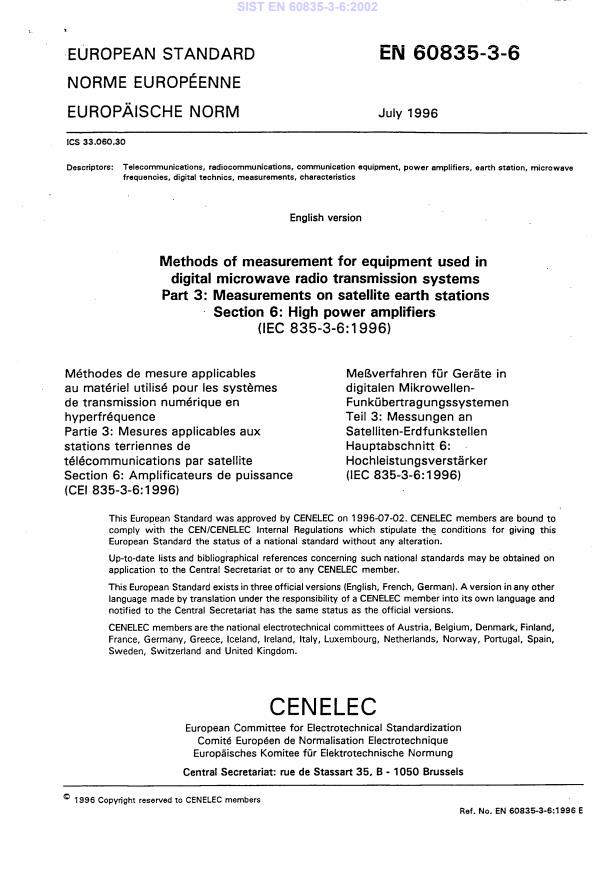
Methods of measurement for equipment used in digital microwave radio
transmission systems - Part 3: Measurements on satellite earth stations - Section
6: High power amplifiers (IEC 60835-3-6:1996)
Methods of measurement for equipment used in digital microwave radio transmission
systems -- Part 3: Measurements on satellite earth stations -- Section 6: High power
amplifiers
Meßverfahren für Geräte in digitalen Mikrowellen- Funkübertragungssystemen -- Teil 3:
Messungen an Satelliten-Erdfunkstellen -- Hauptabschnitt 6: Hochleistungsverstärker
Méthodes de mesure applicables au matériel utilisé pour les systèmes de transmission
numérique en hyperfréquence -- Partie 3: Mesures applicables aux stations terriennes de
télécommunications par satellite -- Section 6: Amplificateurs de puissance
Ta slovenski standard je istoveten z: EN 60835-3-6:1996
ICS:
33.060.30 Radiorelejni in fiksni satelitski Radio relay and fixed satellite
komunikacijski sistemi communications systems
2003-01.Slovenski inštitut za standardizacijo. Razmnoževanje celote ali delov tega standarda ni dovoljeno.
NORME CEI
INTERNATIONALE IEC
60835-3-6
INTERNATIONAL
Première édition
STANDARD
First edition
1996-03
Méthodes de mesure applicables au matériel
utilisé pour les systèmes de transmission
numérique en hyperfréquence
Partie 3:
Mesures applicables aux stations terriennes
de télécommunications par satellite
Section 6: Amplificateurs de puissance
Methods of measurement for equipment used in
digital microwave radio transmission systems
Part 3:
Measurements on satellite earth stations
Section 6: High-power amplifiers
© IEC 1996 Droits de reproduction réservés — Copyright - all rights reserved
Aucune partie de cette publication ne peut être reproduite ni No part of this publication may be reproduced or utilized in
utilisée sous quelque forme que ce soit et par aucun any form or by any means, electronic or mechanical,
procédé, électronique ou mécanique, y compris la photo- including photocopying and microfilm, without permission in
copie et les microfilms, sans l'accord écrit de l'éditeur. writing from the publisher.
International Electrotechnical Commission 3, rue de Varembé Geneva, Switzerland
Telefax: +41 22 919 0300 e-mail: inmail@iec.ch IEC web site http: //www.iec.ch
CODE PRIX
Commission Electrotechnique Internationale
PRICE CODE
International Electrotechnical Commission
IEC Me1+,ayHapon HaH 3neKTpoTexHH4ecKan HOMHCCHH
Pour prix, voir catalogue en vigueur
• •
For price, see current catalogue
835-3-6 © IEC:1996 - 3 -
CONTENTS
Page
FOREWORD 5
INTRODUCTION
Clause
1 Scope 9
2 Normative references 9
3 Power gain and efficiency 9
4 Return loss 13
5 Spurious signals 13
6 Amplitude/frequency characteristics 13
7 Group-delay/frequency characteristic 13
8 Amplitude modulation/phase modulation conversion factor 15
Intermodulation products
9 15
10 Unwanted radiation (leakage) 17
Figures
1 Arrangement for gain stability measurement 19
2 Arrangement for intermodulation products measurement 21
3 Illustration of intercept point 21
4 Arrangement for unwanted r.f. radiation measurements 23
835-3-6 © IEC:1996 - 5 -
INTERNATIONAL ELECTROTECHNICAL COMMISSION
METHODS OF MEASUREMENT FOR EQUIPMENT
USED IN DIGITAL MICROWAVE RADIO TRANSMISSION SYSTEMS –
Part 3: Measurements on satellite earth stations –
Section 6: High-power amplifiers
FOREWORD
1) The IEC (International Electrotechnical Commission) is a worldwide organization for standardization
comprising all national electrotechnical committees (IEC National Committees). The object of the IEC is to
promote international cooperation on all questions concerning standardization in the electrical and
electronic fields. To this end and in addition to other activities, the IEC publishes International Standards.
Their preparation is entrusted to technical committees; any IEC National Committee interested in
the subject dealt with may participate in this preparatory work. International, governmental and
non-governmental organizations liaising with the IEC also participate in this preparation. The IEC
collaborates closely with the International Organization for Standardization (ISO) in accordance with
conditions determined by agreement between the two organizations.
2) The formal decisions or agreements of the IEC on technical matters, express as nearly as possible an
international consensus of opinion on the relevant subjects since each technical committee has
representation from all interested National Committees.
3)
The documents produced have the form of recommendations for international use and are published in the
form of standards, technical reports or guides and they are accepted by the National Committees in that
sense.
4) In order to promote international unification, IEC National Committees undertake to apply IEC International
Standards transparently to the maximum extent possible in their national and regional standards. Any
divergence between the IEC Standard and the corresponding national or regional standard shall be clearly
indicated in the latter.
5)
The IEC provides no marking procedure to indicate its approval and cannot be rendered responsible for any
equipment declared to be in conformity with one of its standards.
6) Attention is drawn to the possibility that some of the elements of this International Standard may be the
subject of patent rights. IEC shall not be held responsible for identifying any or all such patent rights.
International Standard IEC 835-3-6 has been prepared by subcommittee 12E: Radio
relay and satellite communication systems, of IEC technical committee 12: Radio-
communications.
The text of this standard is based on the following documents:
FDIS Report on voting
12E/258/FDIS 12E/265/RV D
Full information on the voting for the approval of this standard can be found in the repo rt
on voting indicated in the above table.
835-3-6 © IEC:1996 - 7 -
INTRODUCTION
Power amplifiers need to deliver a microwave signal of sufficient output power. This signal
should be produced with maximum efficiency and reliability and with minimum distortion.
Generally, there are two categories of amplifiers, tubes and semiconductor devices.
Among the tubes, klystrons and travelling-wave tubes (TWT) are the most frequently
employed; semiconductor amplifiers normally include field-effect transistors (FET).
Travelling-wave tubes (TWT) and GaAs-field-effect transistors (FET) are most frequently
used in satellite earth stations.
Power amplifiers should have a flat gain over the specified bandwidth to avoid altering the
overall transfer characteristics of a system. They should also be as linear as possible to
avoid generation of sidelobes in the power spectrum and to limit adjacent channel
interference.
Finally, low AM to PM conversion and low intermodulation products are necessary to limit
the degradation caused by non-linearities.
835-3-6 © IEC:1996 - 9 -
METHODS OF MEASUREMENT FOR EQUIPMENT
USED IN DIGITAL MICROWAVE RADIO TRANSMISSION SYSTEMS –
Part 3: Measurements on satellite earth stations –
Section 6: High-power amplifiers
1 Scope
This section of IEC 835-3 defines and describes the measurements normally carried out
on high-power amplifiers used in satellite earth station transmitters.
2 Normative references
The following normative documents contain provisions which, through reference in this
text, constitute provisions of this section of IEC 835-3. At the time of publication, the
editions indicated were valid. All normative documents are subject to revision, and pa rties
to agreements based on this section of IEC 835-3 are encouraged to investigate the
possibility of applying the most recent editions of the normative documents indicated
below. Members of IEC and ISO maintain registers of currently valid International
Standards.
IEC 835-1-2: 1992, Methods of measurement for equipment used in digital microwave
radio transmission systems - Part 1: Measurements common to terrestrial radio-relay
systems and satellite earth stations - Section 2: Basic characteristics
IEC 835-1-3: 1992,
Methods of measurement for equipment used in digital microwave
radio transmission systems - Part 1: Measurements common to terrestrial radio-relay
systems and satellite earth stations - Section 3: Transmission characteristics
3 Power gain and efficiency
3.1 Input and output power
See IEC 835-1-2.
Special care shall be taken to exclude from the measurement non-useful signals such as
harmonics of the desired frequency. A low-pass filter of known inse rtion loss at the
measurement frequency shall be connected between the power meter and the
measurement point if not already included in the amplifier under test.
NOTE - Some amplifiers are subject to damage if driven to excessive output power, therefore it may be
necessary to limit the drive level during th
...