

SIST EN 14889-2:2006
(Main)Fibres for concrete - Part 2: Polymer fibres - Definitions, specifications and conformity
General Information
- Abstract
This Part 2 of EN 14889 specifies requirements for polymer fibres for structural or non-structural use in concrete, mortar and grout.
NOTE Structural use of fibres is where the addition of fibres is designed to contribute to the load bearing capacity of a concrete element. This standard covers fibres intended for use in all types of concrete and mortar, including sprayed concrete, flooring, precast, in-situ and repair concretes.
- Status
- Published
- Publication Date
- 30-Nov-2006
- Technical Committee
- BBB - Concrete, reinforced concrete and prestressed concrete
- Current Stage
- 6060 - National Implementation/Publication (Adopted Project)
- Start Date
- 01-Dec-2006
- Due Date
- 01-Dec-2006
- Completion Date
- 01-Dec-2006
- Directive
- 305/2011 - Regulation (eu) No 305/2011 of the European Parliament and of the Council of 9 march 2011 laying down harmonised conditions for the marketing of construction products and repealing council directive 89/106/eecOJ Ref: C 259 OJ Date: 08-Aug-2014
89/106/EEC - Construction productsOJ Ref: C 304 OJ Date: 13-Dec-2006

Overview
EN 14889-2:2006 - published by CEN - is the European standard for polymer fibres for concrete. It sets definitions, specifications and conformity requirements for polymer fibres intended for structural or non‑structural use in concrete, mortar and grout. The scope explicitly includes all delivery forms such as sprayed concrete, flooring, precast, in‑situ and repair concretes. The standard supports regulatory compliance (see informative Annex ZA) with the EU Construction Products Directive.
Key topics
- Classification: Fibres are categorised by physical form:
- Class I (micro fibres) - diameter < 0.30 mm (subclasses Ia mono‑filamented, Ib fibrillated)
- Class II (macro fibres) - diameter > 0.30 mm (used where residual flexural strength is required)
- Declared properties and tolerances:
- Length, (equivalent) diameter, aspect ratio and linear density must be declared.
- Tolerance examples from the standard: length >30 mm ±10% (individual), average ±5%; length ≤30 mm ±1.5 mm; Class II diameter and aspect ratio tolerances up to ±50%; Class I linear density ±10%.
- Material and geometry:
- Polymer type (polyolefins, polyesters, nylon, PVA, etc.) and fibre shape (straight, deformed, bundled) must be declared.
- Surface treatments/coatings (spin‑finish, adhesives) must be declared and controlled because they affect dispersion and air entrainment.
- Mechanical and thermal properties:
- Tensile properties (tenacity for Class I, tensile strength for Class II), modulus of elasticity, melting point and point of ignition are specified for conformity assessment.
- Performance effects and testing:
- Requirements cover effects on workability/consistence, strength of concrete, mixing behaviour and potential release of dangerous substances.
- Conformity assessment includes initial type testing and ongoing Factory Production Control (FPC), traceability and corrective action procedures.
Applications
- Use this standard when specifying, manufacturing or testing polymer fibres for concrete applications such as:
- Crack control in floors and slabs (micro fibres)
- Load-bearing enhancement and residual flexural capacity in structural members (macro fibres)
- Sprayed concrete, repair mortars, precast elements and industrial flooring
- It is essential for product declaration, CE marking and technical dossiers for construction products in EU markets.
Who should use this standard
- Fibre manufacturers and formulators
- Concrete and mortar producers
- Structural and materials engineers specifying fibre‑reinforced concrete
- Test laboratories and certification bodies
- Contractors and precast fabricators evaluating fibre performance
Related standards
- EN 14889-1 (steel fibres for concrete)
- EN 14845 series (test methods for fibres in concrete)
- EN 12350-3 (fresh concrete – Vebe test)
- EN ISO 2062 (textile yarn testing) and ISO 11357-3 (DSC for melting point)
Practical takeaway: EN 14889-2:2006 provides the product definitions, declared properties and conformity framework you need to specify, produce and certify polymer fibres for reliable performance in a wide range of concrete applications.
Relations
- Effective Date
- 28-Jan-2026
- Effective Date
- 28-Jan-2026
- Effective Date
- 28-Jan-2026
- Effective Date
- 28-Jan-2026
- Effective Date
- 28-Jan-2026
- Effective Date
- 15-Apr-2026
- Effective Date
- 28-Jan-2026
- Effective Date
- 28-Jan-2026
- Effective Date
- 28-Jan-2026
- Referred By
SIST EN 206:2013+A2:2021 - Concrete - Specification, performance, production and conformity - Effective Date
- 28-Jan-2026
- Referred By
SIST EN 206:2013+A1:2016 - Concrete - Specification, performance, production and conformity - Effective Date
- 28-Jan-2026
- Effective Date
- 28-Jan-2026
- Effective Date
- 28-Jan-2026
- Referred By
SIST EN 14487-1:2023 - Sprayed concrete - Part 1: Definitions, specifications and conformity - Effective Date
- 28-Jan-2026
- Referred By
SIST EN 14487-1:2006 - Sprayed concrete - Part 1: Definitions, specifications and conformity - Effective Date
- 28-Jan-2026
Get Certified
Connect with accredited certification bodies for this standard

DIBt (Deutsches Institut für Bautechnik)
German Institute for Building Technology.
DIN CERTCO
DIN Group product certification.

Aboma Certification B.V.
Specialized in construction, metal, and transport sectors.
Sponsored listings
Frequently Asked Questions
SIST EN 14889-2:2006 is a standard published by the Slovenian Institute for Standardization (SIST). Its full title is "Fibres for concrete - Part 2: Polymer fibres - Definitions, specifications and conformity". This standard covers: This Part 2 of EN 14889 specifies requirements for polymer fibres for structural or non-structural use in concrete, mortar and grout. NOTE Structural use of fibres is where the addition of fibres is designed to contribute to the load bearing capacity of a concrete element. This standard covers fibres intended for use in all types of concrete and mortar, including sprayed concrete, flooring, precast, in-situ and repair concretes.
This Part 2 of EN 14889 specifies requirements for polymer fibres for structural or non-structural use in concrete, mortar and grout. NOTE Structural use of fibres is where the addition of fibres is designed to contribute to the load bearing capacity of a concrete element. This standard covers fibres intended for use in all types of concrete and mortar, including sprayed concrete, flooring, precast, in-situ and repair concretes.
SIST EN 14889-2:2006 is classified under the following ICS (International Classification for Standards) categories: 91.100.30 - Concrete and concrete products. The ICS classification helps identify the subject area and facilitates finding related standards.
SIST EN 14889-2:2006 has the following relationships with other standards: It is inter standard links to SIST EN ISO 2062:2010, SIST EN 13392:2001, SIST EN 12350-3:2019, SIST EN ISO 6892-1:2020, SIST EN 15459:2008, SIST EN 206-1:2026, SIST EN 14845-1:2007, SIST EN 14845-2:2006, SIST EN 14487-2:2007, SIST EN 206:2013+A2:2021, SIST EN 206:2013+A1:2016, SIST EN 15564:2009, SIST EN 206:2013, SIST EN 14487-1:2023, SIST EN 14487-1:2006. Understanding these relationships helps ensure you are using the most current and applicable version of the standard.
SIST EN 14889-2:2006 is associated with the following European legislation: EU Directives/Regulations: 305/2011, 89/106/EEC; Standardization Mandates: M/128. When a standard is cited in the Official Journal of the European Union, products manufactured in conformity with it benefit from a presumption of conformity with the essential requirements of the corresponding EU directive or regulation.
SIST EN 14889-2:2006 is available in PDF format for immediate download after purchase. The document can be added to your cart and obtained through the secure checkout process. Digital delivery ensures instant access to the complete standard document.
Standards Content (Sample)
2003-01.Slovenski inštitut za standardizacijo. Razmnoževanje celote ali delov tega standarda ni dovoljeno.Fibres for concrete - Part 2: Polymer fibres - Definitions, specifications and conformityVlakna za beton – 2. del: Polimerna vlakna – Definicija, specifikacije in skladnostFibres pour béton - Partie 2 : Fibres polymere - Définition, spécifications et conformitéFasern für Beton - Teil 2: Polymerfasern - Begriffe, Festlegungen und KonformitätTa slovenski standard je istoveten z:EN 14889-2:2006SIST EN 14889-2:2006en91.100.30Beton in betonski izdelkiConcrete and concrete productsICS:SLOVENSKI
STANDARDSIST EN 14889-2:200601-december-2006
EUROPEAN STANDARDNORME EUROPÉENNEEUROPÄISCHE NORMEN 14889-2August 2006ICS 91.100.30 English VersionFibres for concrete - Part 2: Polymer fibres - Definitions,specifications and conformityFibres pour béton - Partie 2 : Fibres polymère - Définition,spécifications et conformitéFasern für Beton - Teil 2: Polymerfasern - Begriffe,Festlegungen und KonformitätThis European Standard was approved by CEN on 26 June 2006.CEN members are bound to comply with the CEN/CENELEC Internal Regulations which stipulate the conditions for giving this EuropeanStandard the status of a national standard without any alteration. Up-to-date lists and bibliographical references concerning such nationalstandards may be obtained on application to the Central Secretariat or to any CEN member.This European Standard exists in three official versions (English, French, German). A version in any other language made by translationunder the responsibility of a CEN member into its own language and notified to the Central Secretariat has the same status as the officialversions.CEN members are the national standards bodies of Austria, Belgium, Cyprus, Czech Republic, Denmark, Estonia, Finland, France,Germany, Greece, Hungary, Iceland, Ireland, Italy, Latvia, Lithuania, Luxembourg, Malta, Netherlands, Norway, Poland, Portugal, Romania,Slovakia, Slovenia, Spain, Sweden, Switzerland and United Kingdom.EUROPEAN COMMITTEE FOR STANDARDIZATIONCOMITÉ EUROPÉEN DE NORMALISATIONEUROPÄISCHES KOMITEE FÜR NORMUNGManagement Centre: rue de Stassart, 36
B-1050 Brussels© 2006 CENAll rights of exploitation in any form and by any means reservedworldwide for CEN national Members.Ref. No. EN 14889-2:2006: E
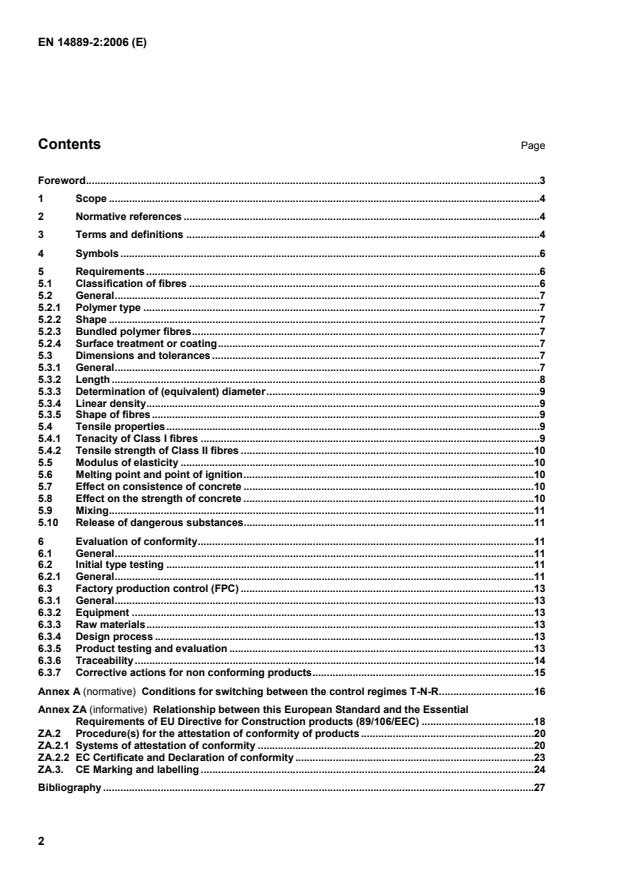
Initial type testing.11 6.2.1
General.11 6.3 Factory production control (FPC).13 6.3.1 General.13 6.3.2 Equipment.13 6.3.3 Raw materials.13 6.3.4 Design process.13 6.3.5 Product testing and evaluation.13 6.3.6 Traceability.14 6.3.7 Corrective actions for non conforming products.15 Annex A (normative)
Conditions for switching between the control regimes T-N-R.16 Annex ZA (informative)
Relationship between this European Standard and the Essential Requirements of EU Directive for Construction products (89/106/EEC).18 ZA.2 Procedure(s) for the attestation of conformity of products.20 ZA.2.1 Systems of attestation of conformity.20 ZA.2.2 EC Certificate and Declaration of conformity.23 ZA.3. CE Marking and labelling.24 Bibliography.27
Part 2 dealing with polymer fibres
This European Standard shall be given the status of a national standard, either by publication of an identical text or by endorsement, at the latest by February 2007, and conflicting national standards shall be withdrawn at the latest by May 2008. This document has been prepared under a mandate given to CEN by the European Commission and the European Free Trade Association, and supports essential requirements of the Construction Products Directive. For relationship with EU Directive(s), see informative Annex ZA, which is an integral part of this document. This European Standard should be given the status of a national standard. No existing European Standard is superseded. Not all fibre characteristics that may be relevant to the performance of a fibre concrete, structural or non-structural, such as early age effects, creep and chemical attack, have been addressed in this standard due to the difficulties of formulating meaningful and reproducible standardised test methods. According to the CEN/CENELEC Internal Regulations, the national standards organizations of the following countries are bound to implement this European Standard: Austria, Belgium, Cyprus, Czech Republic, Denmark, Estonia, Finland, France, Germany, Greece, Hungary, Iceland, Ireland, Italy, Latvia, Lithuania, Luxembourg, Malta, Netherlands, Norway, Poland, Portugal, Romania, Slovakia, Slovenia, Spain, Sweden, Switzerland and United Kingdom.
NOTE Structural use of fibres is where the addition of fibres is designed to contribute to the load bearing capacity of a concrete element. This standard covers fibres intended for use in all types of concrete and mortar, including sprayed concrete, flooring, precast, in-situ and repair concretes. 2 Normative references The following referenced documents are indispensable for the application of this document. For dated references, only the edition cited applies. For undated references, the latest edition of the referenced document (including any amendments) applies. EN 10002-1, Metallic materials – Tensile testing – Part 1: Method of test at ambient temperature EN 12350-3, Testing fresh concrete – Part 3: Vebe test EN 13392, Textiles – Monofilaments – Determination of linear density prEN 14845-1, Test methods for fibres in concrete – Part 1: Reference concretes EN 14845-2, Test methods for fibres in concrete – Part 2: Effect on concrete EN ISO 2062, Textiles – Yarns from packages – Determination of single-end breaking force and elongation at break (ISO 2062:1993) ISO 11357-3, Plastics – Differential scanning calorimetry (DSC) – Part 3: Determination of temperature and enthalpy of melting and crystallization 3 Terms and definitions For the purposes of this document, the following terms and definitions apply. 3.1 polymer polymeric material such as polyolefin, e.g. polypropylene or polyethylene, polyester, nylon, pva, polyacrylic, aramids and blends of them 3.2 polymer fibres straight or deformed pieces of extruded, orientated and cut material which are suitable to be homogeneously mixed into concrete or mortar 3.3 length distance between the outer ends of the fibre 3.3.1 developed length (for deformed fibres with irregular cross section) length of the deformed fibre after straightening the fibre without deforming the cross section
3.5 aspect ratio ratio of length to equivalent diameter of the fibre 3.6 fibre shape specific outer configuration of the fibre, both in the longitudinal direction and in the shape of the cross section and also the possible surface coatings and or bundling of the fibres 3.7 tensile strength of the fibre stress corresponding to the maximum force a fibre can resist. The tensile strength is calculated by dividing the maximum force a fibre can resist by the mean cross sectional area of the fibre.
3.8 elongation of the fibre
elongation of the fibre is defined as the ratio of the length change of the fibre to the initial length expressed as a percentage NOTE The length change should be measured on the fibre itself. 3.9 elastic modulus of the fibre
initial slope of the tensile stress versus elongation curve 3.10 linear density mass per unit length of a yarn or filament expressed in tex or its multiples or submultiples NOTE 1 tex = 1g/1000m 3.11 tenacity breaking force of a fibre divided by its linear density 3.12 melting point temperature at which a polymer becomes liquid 3.13 point of ignition temperature at which combustion is initiated 3.14 residual flexural strength notional stress at the tip of the notch which is assumed to act in an uncracked mid-span section, with linear stress distribution, of a prism subjected to the centre-point load Fj corresponding to CMODj where CMODj > CMODFL; or to δj where δj > δFL (j = 1,2,3,4). 3.15 crack mouth opening displacement (CMOD) linear displacement measured by a transducer installed on a prism subjected to a centre-point load F
A area of the cross section of the fibre, in mm2; d diameter of a fibre with a circular cross section, in mm; de equivalent diameter of the fibre, in mm; l measured length of the fibre, in mm; ld
developed length of the fibre in mm;
= l / d and is the aspect ratio of the fibre; m mass of the fibre, in g; ρ density of the polymer, in kg/m3; Ts melting point of the polymer, in °C; Ti point of ignition of the polymer, in °C;
Pmax maximum tensile load carrying capacity of the fibre, in N; Rm tensile strength of the fibre, in MPa; ε elongation of the fibre, in %; E elastic modulus of the fibre, in Mpa.
5 Requirements 5.1 Classification of fibres Polymer fibres shall be characterised by the manufacturer in accordance with their physical form: Class Ia:
Micro fibres:
< 0,30 mm in diameter;
Mono-filamented Class Ib
Micro fibres:
< 0,30 mm in diameter; Fibrillated Class II:
Macro fibres:
> 0,30 mm in diameter NOTE Class II fibres are generally used where an increase in residual flexural strength is required.
5.2.3 Bundled polymer fibres The type and size of the fibre bundle (e.g. glued, wrapped) shall be declared. 5.2.4 Surface treatment or coating Any surface treatment or coating (type and quantity), and any chemical or physical treatment of polymer fibres shall be declared and controlled. NOTE Spin finish is a term used to describe the addition of chemical(s) used to coat the fibres that will then help the fibre to disperse in concrete.
Without this coating some fibres will not easily disperse in concrete and will tend to ball up.
However some types of chemical used to coat the fibres can induce air into the concrete or mortar.
It is therefore important that any coating added to the fibre is controlled and is recorded as part of the initial type testing and as part of the factory control procedures. 5.3 Dimensions and tolerances 5.3.1 General The length, diameter and aspect ratio shall be declared for all fibres. The linear density shall be declared for Class I fibres.
Specimens of fibres, when sampled in accordance with 6.2.2 and measured in accordance with 5.3.2 and 5.3.3 shall not deviate from the declared value by more than the tolerances given in Table 1.
Table 1 — Tolerance limits for the dimensions of the fibres Property Symbol Deviation of the individual value relative to the declared value
Deviation of the average value relative to the declared value Length and developed length (all fibres)
l , ld
>30 mm (if applicable) ± 10 % ± 5 % ≤ 30 mm
± 1,5 mm
Class II fibres > 0,30 mm
(equivalent) diameter
length/diameter ratio de
± 50 %
± 50 % ± 5 %
± 10 %
Class I fibres ≤ 0,30 mm
linear density
L ± 10 % ± 10 %
5.3.2 Length The length shall be measured with a marking gauge with an accuracy of 0,1 mm.
In the case of an irregular cross section, the developed length of the fibre shall be determined.
For Class II fibres with a diameter greater than 0,3 mm, the diameter of the fibre shall be measured with a micrometer to a precision of 0,001 mm. 5.3.3.2 Fibre with elliptical cross section The diameter of the fibre shall be measured with a micrometer, in two directions, approximately at right angles, to a precision of 0,001 mm. The fibre diameter shall be the mean of the two diameters. 5.3.3.3 Rectangular fibres The width (w) and thickness (t) of the fibres shall be measured with a micrometer to a precision of 0,001 mm. The equivalent diameter, de, is calculated as
πtwde⋅⋅=4
5.3.3.4 Fibres with irregular cross section The mass, mf [g], and the developed length, ld [mm], of the fibre shall be determined. The mass shall be determined to an accuracy of 0,001 g and the length to an accuracy of 0,01 mm. The equivalent diameter shall be computed from the mass and the developed length using the following formula with the nominal density of the fibre, ρ, in [g/cm3]: ρπ⋅⋅⋅⋅=dfelmd6104 NOTE The nominal density ρ of Polypropylene is 0,9 g/cm3. 5.3.4 Linear density The linear density of Class I fibres shall be determined in accordance with EN 13392 and shall be declared. 5.3.5 Shape of fibres The manufacturer may freely choose the shape of the fibre. The control and tolerances on the shape shall be declared for each different shape.
Control may be carried out using optical equipment. 5.4 Tensile properties 5.4.1 Tenacity of Class I fibres The tenacity of Class I fibres shall be determined by either method A or method B of EN ISO 2062.
30 individual fibres shall be tested and all results for the breaking force shall be included in the calculation for the average and standard deviation.
The tenacity shall be calculated from the mean breaking force divided by the linear density determined by 5.3.4.
The tensile strength shall be determined on individual fibres which have a minimum length of 20 mm. 30 individual fibres shall be tested and all results shall be included in the calculation for the average and standard deviation.
The accepted tolerance on the declared value of Rm shall be 15 % for individual values and 7,5 % for the mean value. 5.5 Modulus of elasticity The modulus of elasticity for polymer fibres shall be tested according to EN 10002-1 and shall be declared.
The modulus shall be calculated using the stress and deformation at 10% and 30% of Rm. 30 individual strands shall be tested and all results shall be included in the calculation for the average and standard deviation.
The acceptable tolerance on the declared value of the Modulus of Elasticity is 15% for individual values and 10% for the mean value. 5.6 Melting point and point of ignition The melting point and point of ignition shall be determined in accordance with ISO 11357-3 and shall be declared. NOTE The melting point is an important characteristic where the fibre is to be used to modify the performance of concrete in fire. 5.7 Effect on consistence of concrete The effect of fibres on the consistence of a reference concrete conforming to prEN 14845-1 shall be determined.
The consistence according to EN 12350-3 shall be determined on the reference concrete without fibres and then on an identical mix with fibres. The effect on consistence shall be declared. The amount of fibres added shall be declared by the manufacturer and shall be the minimum amount of fibres needed to obtain the required strength specified in 5.8.
If a plasticiser or superplasticiser is needed in order to meet the consistence requirements when determining the required addition level of fibres, the amount and type shall also be declared by the manufacturer. The fibre manufacturer may additionally declare the consistence for the reference concrete with a range of dosages of fibres.
5.8 Effect on the strength of concrete
The effect on strength shall be determined according to EN 14845-2 using a reference concrete conforming to prEN 14845-1.
The unit volume of fibres in kg/m³ shall be declared by the manufacturer that achieves a residual flexural strength of 1,5 MPa at 0,5 mm CMOD (equivalent to 0,47 mm central deflection) and a residual flexural strength of 1MPa at 3,5 mm CMOD (equivalent to 3,02 mm central deflection).
...