


SIST EN ISO 14698-1:2004
(Main)Cleanrooms and associated controlled environments - Biocontamination control - Part 1: General principles and methods (ISO 14698-1:2003)
Cleanrooms and associated controlled environments - Biocontamination control - Part 1: General principles and methods (ISO 14698-1:2003)
ISO 14698:2003 establishes the principles and basic methodology of a formal system of biocontamination control (Formal System) for assessing and controlling biocontamination when cleanroom technology is applied for that purpose. It specifies the methods required for monitoring risk zones in a consistent way and for applying control measures appropriate to the degree of risk involved. In zones where risk is low, it can be used for information.
Reinräume und zugehörige Reinraumbereiche - Biokontaminationskontrolle - Teil 1: Allgemeine Grundlagen (ISO 14698-1:2003)
Dieser Teil von ISO 14698 legt die Grundlagen und grundlegende Verfahrensweisen für ein formelles System zur Biokontaminationskontrolle (Betriebliches System) in solchen Bereichen fest, in denen Reinraum-technologie zu diesem Zweck angewendet wird. Dieser Teil von ISO 14698 legt die Verfahren fest, die notwendig sind, um Risikobereiche konsistent zu überwachen und nach dem Grad der Gefährdung geeignete Kontrollmaßnahmen anwenden zu können. Für Bereiche mit nur geringem Risiko kann dieser Teil von ISO 14698 als Informationsquelle verwendet werden.
Es werden keine anwendungsspezifischen Anforderungen festgelegt. Auch werden Fragen des Brandschutzes und der Sicherheit nicht angesprochen. Im Hinblick auf diese Fragen siehe Sicherheits- und Brandschutzvorschriften.
Salles propres et environnements maîtrisés apparentés - Maîtrise de la biocontamination - Partie 1: Principes généraux et méthodes (ISO 14698-1:2003)
L'ISO 14698-1:2003 établit les principes et la méthodologie fondamentale d'un Système formalisé de maîtrise de la biocontamination (Système formalisé), système destiné à évaluer et à maîtriser la biocontamination, dans le cadre de l'application des technologies des salles propres à cet effet. L'ISO 14698-1:2003 spécifie les méthodes requises pour assurer une surveillance cohérente des zones à risque et pour appliquer les mesures de maîtrise adaptées au degré de risque concerné. Dans des zones où le risque est faible, l'ISO 14698-1:2003 peut servir de source d'informations.
L'ISO 14698-1:2003 ne fixe pas d'exigences spécifiques à des applications, ni ne traite des questions d'incendie et de sécurité pour lesquelles il convient de consulter les exigences réglementaires et autres documentations nationales ou locales.
Cleanrooms and associated controlled environments - Biocontamination control - Part 1: General principles and methods (ISO 14698-1:2003)
General Information
- Status
- Withdrawn
- Publication Date
- 31-Dec-2003
- Withdrawal Date
- 31-Aug-2020
- Technical Committee
- SS SPL - Technical Board for the general field
- Current Stage
- 9900 - Withdrawal (Adopted Project)
- Start Date
- 26-Aug-2020
- Due Date
- 18-Sep-2020
- Completion Date
- 01-Sep-2020


Frequently Asked Questions
SIST EN ISO 14698-1:2004 is a standard published by the Slovenian Institute for Standardization (SIST). Its full title is "Cleanrooms and associated controlled environments - Biocontamination control - Part 1: General principles and methods (ISO 14698-1:2003)". This standard covers: ISO 14698:2003 establishes the principles and basic methodology of a formal system of biocontamination control (Formal System) for assessing and controlling biocontamination when cleanroom technology is applied for that purpose. It specifies the methods required for monitoring risk zones in a consistent way and for applying control measures appropriate to the degree of risk involved. In zones where risk is low, it can be used for information.
ISO 14698:2003 establishes the principles and basic methodology of a formal system of biocontamination control (Formal System) for assessing and controlling biocontamination when cleanroom technology is applied for that purpose. It specifies the methods required for monitoring risk zones in a consistent way and for applying control measures appropriate to the degree of risk involved. In zones where risk is low, it can be used for information.
SIST EN ISO 14698-1:2004 is classified under the following ICS (International Classification for Standards) categories: 13.040.35 - Cleanrooms and associated controlled environments. The ICS classification helps identify the subject area and facilitates finding related standards.
SIST EN ISO 14698-1:2004 is available in PDF format for immediate download after purchase. The document can be added to your cart and obtained through the secure checkout process. Digital delivery ensures instant access to the complete standard document.
Standards Content (Sample)
SLOVENSKI STANDARD
01-januar-2004
Cleanrooms and associated controlled environments - Biocontamination control -
Part 1: General principles and methods (ISO 14698-1:2003)
Cleanrooms and associated controlled environments - Biocontamination control - Part 1:
General principles and methods (ISO 14698-1:2003)
Reinräume und zugehörige Reinraumbereiche - Biokontaminationskontrolle - Teil 1:
Allgemeine Grundlagen (ISO 14698-1:2003)
Salles propres et environnements maîtrisés apparentés - Maîtrise de la biocontamination
- Partie 1: Principes généraux et méthodes (ISO 14698-1:2003)
Ta slovenski standard je istoveten z: EN ISO 14698-1:2003
ICS:
13.040.35 Brezprašni prostori in Cleanrooms and associated
povezana nadzorovana controlled environments
okolja
2003-01.Slovenski inštitut za standardizacijo. Razmnoževanje celote ali delov tega standarda ni dovoljeno.
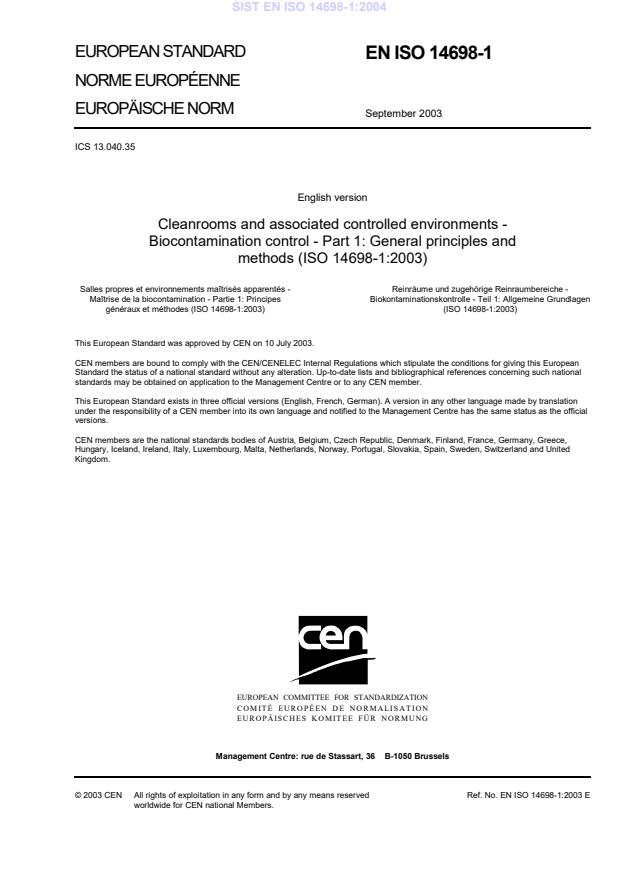
EUROPEAN STANDARD
EN ISO 14698-1
NORME EUROPÉENNE
EUROPÄISCHE NORM
September 2003
ICS 13.040.35
English version
Cleanrooms and associated controlled environments -
Biocontamination control - Part 1: General principles and
methods (ISO 14698-1:2003)
Salles propres et environnements maîtrisés apparentés - Reinräume und zugehörige Reinraumbereiche -
Maîtrise de la biocontamination - Partie 1: Principes Biokontaminationskontrolle - Teil 1: Allgemeine Grundlagen
généraux et méthodes (ISO 14698-1:2003) (ISO 14698-1:2003)
This European Standard was approved by CEN on 10 July 2003.
CEN members are bound to comply with the CEN/CENELEC Internal Regulations which stipulate the conditions for giving this European
Standard the status of a national standard without any alteration. Up-to-date lists and bibliographical references concerning such national
standards may be obtained on application to the Management Centre or to any CEN member.
This European Standard exists in three official versions (English, French, German). A version in any other language made by translation
under the responsibility of a CEN member into its own language and notified to the Management Centre has the same status as the official
versions.
CEN members are the national standards bodies of Austria, Belgium, Czech Republic, Denmark, Finland, France, Germany, Greece,
Hungary, Iceland, Ireland, Italy, Luxembourg, Malta, Netherlands, Norway, Portugal, Slovakia, Spain, Sweden, Switzerland and United
Kingdom.
EUROPEAN COMMITTEE FOR STANDARDIZATION
COMITÉ EUROPÉEN DE NORMALISATION
EUROPÄISCHES KOMITEE FÜR NORMUNG
Management Centre: rue de Stassart, 36 B-1050 Brussels
© 2003 CEN All rights of exploitation in any form and by any means reserved Ref. No. EN ISO 14698-1:2003 E
worldwide for CEN national Members.
CORRECTED 2003-10-01
Foreword
This document (EN ISO 14698-1:2003) has been prepared by Technical Committee ISO/TC 209
"Cleanrooms and associated controlled environments" in collaboration with Technical Committee
CEN/TC 243 "Cleanroom technology", the secretariat of which is held by BSI.
This European Standard shall be given the status of a national standard, either by publication of
an identical text or by endorsement, at the latest by March 2004, and conflicting national
standards shall be withdrawn at the latest by March 2004.
According to the CEN/CENELEC Internal Regulations, the national standards organizations of
the following countries are bound to implement this European Standard: Austria, Belgium, Czech
Republic, Denmark, Finland, France, Germany, Greece, Hungary, Iceland, Ireland, Italy,
Luxembourg, Malta, Netherlands, Norway, Portugal, Slovakia, Spain, Sweden, Switzerland and
the United Kingdom.
Endorsement notice
The text of ISO 14698-1:2003 has been approved by CEN as EN ISO 14698-1:2003 without any
modifications.
NOTE Normative references to International Standards are listed in Annex ZA (normative).
Annex ZA
(normative)
Normative references to international publications
with their relevant European publications
This European Standard incorporates by dated or undated reference, provisions from other
publications. These normative references are cited at the appropriate places in the text and the
publications are listed hereafter. For dated references, subsequent amendments to or revisions of
any of these publications apply to this European Standard only when incorporated in it by
amendment or revision. For undated references the latest edition of the publication referred to
applies (including amendments).
NOTE Where an International Publication has been modified by common modifications, indicated
by (mod.), the relevant EN/HD applies.
Publication Year Title EN Year
Cleanrooms and associated
ISO 14644-4 2001 EN ISO 14644-4 2001
controlled environments — Part 4:
Design, construction and start-up
Cleanrooms and associated
ISO 14698-2 2003 EN ISO 14698-2 2003
controlled environments -
Biocontamination control - Part 2:
Evaluation and interpretation of
biocontamination data
INTERNATIONAL ISO
STANDARD 14698-1
First edition
2003-09-01
Cleanrooms and associated controlled
environments — Biocontamination
control —
Part 1:
General principles and methods
Salles propres et environnements maîtrisés apparentés — Maîtrise de
la biocontamination —
Partie 1: Principes généraux et méthodes
Reference number
ISO 14698-1:2003(E)
©
ISO 2003
ISO 14698-1:2003(E)
PDF disclaimer
This PDF file may contain embedded typefaces. In accordance with Adobe's licensing policy, this file may be printed or viewed but
shall not be edited unless the typefaces which are embedded are licensed to and installed on the computer performing the editing. In
downloading this file, parties accept therein the responsibility of not infringing Adobe's licensing policy. The ISO Central Secretariat
accepts no liability in this area.
Adobe is a trademark of Adobe Systems Incorporated.
Details of the software products used to create this PDF file can be found in the General Info relative to the file; the PDF-creation
parameters were optimized for printing. Every care has been taken to ensure that the file is suitable for use by ISO member bodies. In
the unlikely event that a problem relating to it is found, please inform the Central Secretariat at the address given below.
© ISO 2003
All rights reserved. Unless otherwise specified, no part of this publication may be reproduced or utilized in any form or by any means,
electronic or mechanical, including photocopying and microfilm, without permission in writing from either ISO at the address below or
ISO's member body in the country of the requester.
ISO copyright office
Case postale 56 • CH-1211 Geneva 20
Tel. + 41 22 749 01 11
Fax + 41 22 749 09 47
E-mail copyright@iso.org
Web www.iso.org
Published in Switzerland
ii © ISO 2003 — All rights reserved
ISO 14698-1:2003(E)
Contents Page
Foreword. iv
Introduction . v
1 Scope. 1
2 Normative references . 1
3 Terms and definitions. 1
4 Principles of biocontamination control . 4
5 Establishing the Formal System . 5
6 Expression, interpretation and reporting of results. 10
7 Verification of the Formal System. 11
8 Training . 11
9 Documentation . 11
Annex A (informative) Guidance on determining airborne biocontamination . 12
Annex B (informative) Guidance on validating air samplers . 15
Annex C (informative) Guidance on determining biocontamination of surfaces . 18
Annex D (informative) Guidance on determining biocontamination of textiles. 20
Annex E (informative) Guidance on validating laundering processes. 22
Annex F (informative) Guidance on determining biocontamination of liquids . 26
Annex G (informative) Guidance on training . 28
Bibliography . 31
ISO 14698-1:2003(E)
Foreword
ISO (the International Organization for Standardization) is a worldwide federation of national standards bodies
(ISO member bodies). The work of preparing International Standards is normally carried out through ISO
technical committees. Each member body interested in a subject for which a technical committee has been
established has the right to be represented on that committee. International organizations, governmental and
non-governmental, in liaison with ISO, also take part in the work. ISO collaborates closely with the
International Electrotechnical Commission (IEC) on all matters of electrotechnical standardization.
International Standards are drafted in accordance with the rules given in the ISO/IEC Directives, Part 2.
The main task of technical committees is to prepare International Standards. Draft International Standards
adopted by the technical committees are circulated to the member bodies for voting. Publication as an
International Standard requires approval by at least 75 % of the member bodies casting a vote.
Attention is drawn to the possibility that some of the elements of this document may be the subject of patent
rights. ISO shall not be held responsible for identifying any or all such patent rights.
ISO 14698-1 was prepared by Technical Committee ISO/TC 209, Cleanrooms and associated controlled
environments.
ISO 14698 consists of the following parts, under the general title Cleanrooms and associated controlled
environments — Biocontamination control:
— Part 1: General principles and methods
— Part 2: Evaluation and interpretation of biocontamination data
iv © ISO 2003 — All rights reserved
ISO 14698-1:2003(E)
Introduction
The principles described here are intended to promote appropriate hygienic practices. This part of ISO 14698 is
one of a number of standards considering factors important for the creation of clean, controlled environments.
Hygiene has become increasingly important in many areas of modern society. In such areas, hygiene or
biocontamination control methods are, or will be, used to create safe and stable products. International trade
in hygiene-sensitive products has greatly increased. At the same time, the use of antimicrobial agents has
been reduced or forbidden, creating a need for increased biocontamination control.
This part of ISO 14698 is the first general International Standard for biocontamination control. However, many
factors besides cleanliness must be considered in the design, specification, operation and control of
cleanrooms and associated controlled environments.
In some circumstances, relevant regulatory agencies could impose supplementary policies or restrictions. In
such situations, appropriate adaptations of the standard testing procedures might be required.
INTERNATIONAL STANDARD ISO 14698-1:2003(E)
Cleanrooms and associated controlled environments —
Biocontamination control —
Part 1:
General principles and methods
1 Scope
This part of ISO 14698 establishes the principles and basic methodology of a formal system of
biocontamination control (Formal System) for assessing and controlling biocontamination when cleanroom
technology is applied for that purpose. This part of ISO 14698 specifies the methods required for monitoring
risk zones in a consistent way and for applying control measures appropriate to the degree of risk involved. In
zones where risk is low, it can be used as a source of information.
Application-specific requirements are not given. Neither are fire and safety issues addressed; for these, see
regulatory requirements and other national or local documentation.
2 Normative references
The following referenced documents are indispensable for the application of this document. For dated
references, only the edition cited applies. For undated references, the latest edition of the referenced
document (including any amendments) applies.
ISO 14644-4:2001, Cleanrooms and associated controlled environments — Part 4: Design, construction and
start-up
ISO 14698-2:2003, Cleanrooms and associated controlled environments — Biocontamination control —
Part 2: Evaluation and interpretation of biocontamination data
3 Terms and definitions
For the purposes of this document, the following terms and definitions apply.
3.1 General
3.1.1
action level
level set by the user in the context of controlled environments, which, when exceeded, requires immediate
intervention, including investigation of cause, and corrective action
3.1.2
alert level
level set by the user in the context of controlled environments, giving early warning of a drift from normal
conditions, which, when exceeded, should result in increased attention to the process
ISO 14698-1:2003(E)
3.1.3
bioaerosol
dispersed biological agents in a gaseous environment
3.1.4
biocontamination
contamination of materials, devices, individuals, surfaces, liquids, gases or air with viable particles
3.1.5
cleanroom
room in which the concentration of airborne particles is controlled, and which is constructed and used in a
manner to minimize the introduction, generation, and retention of particles inside the room, and in which other
relevant parameters e.g. temperature, humidity, and pressure, are controlled as necessary
[1]
[ISO 14644-1:1999, 2.1.1]
3.1.6
contact device
specially designed appliance holding an appropriate, sterile, culture medium with an accessible surface used
for surface sampling
3.1.7
contact plate
contact device where the container is a rigid dish
3.1.8
control point
point in a controlled environment at which control is applied and a hazard can be prevented, eliminated or
reduced to acceptable levels
3.1.9
controlled environment
defined zone in which sources of contamination are controlled by specified means
3.1.10
corrective action
action to be taken when the results of monitoring indicate that alert or action levels are exceeded
3.1.11
Formal System
system of biocontamination control with established and documented procedures
3.1.12
hazard
potential source of harm
[2]
[ISO/IEC Guide 51:1999, 3.5]
3.1.13
impact sampler
device designed to sample particles in the air, or other gas, through a collision with a solid surface
3.1.14
impingement sampler
device designed to sample particles in the air, or other gas, through a collision with a liquid surface and the
subsequent entering into the liquid
2 © ISO 2003 — All rights reserved
ISO 14698-1:2003(E)
3.1.15
qualification
process of demonstrating whether an entity — activity or process, product, organization, or any combination
thereof — is capable of fulfilling specified requirements
3.1.16
risk
combination of the probability of occurrence of harm and the severity of that harm
[2]
[ISO/IEC Guide 51:1999, 3.2]
3.1.17
risk zone
defined and delimited space where individuals, products or materials (or any combination of these) are
particularly vulnerable to contamination
3.1.18
settle plate
suitable container (e.g. a Petri dish) of appropriate size, containing an appropriate, sterile, culture medium,
which is left open for a defined period to collect viable particles depositing from the air
3.1.19
swab
sterile collection device, non-toxic and non-inhibitory to the growth of the microorganisms being sampled,
consisting of a specific matrix of suitable size, mounted on an applicator
3.1.20
target level
defined level set by the user as a goal for routine operations, for the user's own purpose
3.1.21
validation
confirmation, through the provision of objective evidence, that the requirements for a specific intended use or
application have been fulfilled
[3]
[ISO 9000:2000, 3.8.5]
3.1.22
verification
confirmation, through the provision of objective evidence, that specified requirements have been fulfilled
[3]
[ISO 9000:2000, 3.8.4]
NOTE Monitoring and auditing methods, procedures and tests, including random sampling and analysis, can be used
in the verification of the Formal System.
3.1.23
viable particle
particle that consists of, or supports, one or more live microorganisms
3.1.24
viable unit
VU
one or more viable particles which are enumerated as a single unit
NOTE When viable units are enumerated as colonies on agar media, it is common usage to name them colony
forming units (CFU). One CFU might consist of one or more VU.
ISO 14698-1:2003(E)
3.2 Occupancy states
3.2.1
as-built
condition where the installation is complete with all services connected and functioning, but with no production
equipment, materials or personnel present
[1]
[ISO 14644-1:1999, 2.4.1]
3.2.2
at-rest
condition where the installation is complete with equipment installed and operating in a manner agreed upon
by the customer and supplier, but with no personnel present
[1]
[ISO 14644-1:1999, 2.4.2]
3.2.3
operational
condition where the installation is functioning in the specified manner, with the specified number of personnel
present and working in the manner agreed upon
[1]
[ISO 14644-1:1999, 2.4.3]
4 Principles of biocontamination control
4.1 A formal system of biocontamination control (Formal System) shall be established, implemented and
maintained within cleanrooms and associated environments. The Formal System will assess and control
factors that can affect the microbiological quality of the process and product.
[4], [5]
There are a number of accepted methods for achieving this goal by risk assessment . The hazard analysis
[6], [7], [8], [9] [10]
critical control point (HACCP) system is commonly used. Fault tree analysis (FTA) , or the failure
[11]
mode and effect analysis (FMEA) , or any other validated equivalent system can be used.
In many such methods, any type of hazard can be considered. Within this part of ISO 14698, only
microbiological hazards are addressed.
4.2 To assess and control the microbiological hazards, any selected system shall address the following
principles:
a) identification of potential hazard(s) to the process or product, assessment of the likelihood of occurrence
of these hazard(s), and identification of measures for their prevention or control;
b) designation of risk zones and, in each zone, determination of the points, procedures, operational steps
and environmental conditions that can be controlled to eliminate the hazard(s) or minimize the likelihood
of their occurrence;
c) establishment of limits to ensure control;
d) establishment of a monitoring and observation schedule;
e) establishment of corrective actions to be taken when monitoring results indicate that a particular point,
procedure, operational step or environmental condition is not under control;
f) establishment of procedures, which may include supplementary tests and procedures, to verify that the
chosen Formal System is working effectively;
g) establishment of training procedures;
h) establishment and maintenance of appropriate documentation.
4 © ISO 2003 — All rights reserved
ISO 14698-1:2003(E)
5 Establishing the Formal System
5.1 General requirements
It is the responsibility of the user to develop, initiate, implement and document a Formal System for
biocontamination control that allows detection of adverse conditions in a timely fashion. It is imperative that
such a programme be tailored to the field of application, to the specific facility and to specified conditions, and
that this system be an integral part of a quality management system. The quality management system shall
include an appropriate training programme for the selected Formal System.
In addition, it is essential that a monitoring programme (see 5.3) be designed and implemented in a manner
that minimizes the possibility of the sampling activities themselves contributing to the contamination of the
product or risk zone or both.
Risk zones shall be classified according to relevant guidelines, regulations (where these exist) and the chosen
Formal System. Risk zones may also be classified according to the level of aerial and surface
biocontamination, for example, low, medium, high or very high risk.
NOTE The first two parts of a Formal System, as given in 4.2 a) and b), are not discussed in detail in this part of
ISO 14698, but information on how to identify, assess and control hazards is given in other sources. See, for example, [12].
5.2 Alert, action and target levels
The user of a cleanroom or controlled environment shall set microbiological alert and action levels. These
levels shall be appropriate to the field of application, to the classification of the risk zones and to what is
achievable using current technology. Microbiological target levels may be used as an alternative to
microbiological alert and action levels in some specific fields of application.
During initial start-up and at intervals established according to the Formal System, data on biocontamination
levels should be reviewed to establish or confirm a baseline for the determination of alert and action levels.
Alert and action levels may be related to the target levels in any specific applications where these are set.
Alert and action levels should be reviewed and adjusted as appropriate.
5.3 Monitoring of biocontamination
5.3.1 General
Detection and monitoring of biocontamination in risk zones shall be carried out by sampling and enumerating
viable units with appropriate methods in accordance with a sampling plan.
Examples of sources of biocontamination that can constitute a hazard are air, surfaces, textiles and liquids
(see Annexes A, C, D and F).
Microbiological sampling may be useful for providing baseline data as new installations are constructed and
commissioned, including, as relevant, in the as-built state. Monitoring in risk zones shall be performed when
the installation is in the as-built and at-rest states. Monitoring shall also be performed routinely in the
operational state according to the selected Formal System.
5.3.2 Sampling
5.3.2.1 General
The appropriate sampling method and related procedures shall be selected and performed to reflect the
complexity and variety of situations. Sampling shall be carried out using a device and method selected in
accordance with the written procedure and in accordance with the instructions provided by the device
manufacturer.
ISO 14698-1:2003(E)
5.3.2.2 Sampling device
A sampling device shall be selected according to the area being monitored. The selection for a particular
application shall take into consideration the following factors:
a) type of viable particles for which to sample;
b) sensitivity of the viable particles to the sampling procedure;
c) expected concentration of the viable particles;
d) indigenous microbial flora;
e) accessibility of the risk zones;
f) ability to detect low levels of biocontamination;
g) ambient conditions in the risk zone being sampled;
h) time and duration of sampling;
i) sampling method, material and properties of the sampling medium;
j) effect of the sampling device on the process or environment to be monitored;
k) collection accuracy and efficiency;
l) incubation and viable particle detection and evaluation method;
m) type of information to be obtained (e.g. qualitative or quantitative aspects);
n) efficiency of extraction/rinse fluids, where appropriate.
5.3.2.3 Sampling plan
A sampling plan shall be developed through the selected Formal System and shall be documented. A
documented sampling plan is essential for accurately assessing and interpreting biocontamination data.
Sampling shall be carried out when the area is in the operational condition and during periods of greatest
stress in the system, for example, before the end of a shift or when the greatest amount of activity is taking
place. Sampling in the at-rest condition may also provide useful information about the facility design and
performance.
The sampling plan shall comprise the following:
a) initial sampling plan to provide a reference point or baseline within the framework of the chosen Formal
System;
b) routine sampling plan resulting from the implementation of the chosen Formal System.
5.3.2.4 Design of the sampling plan
The sampling plan shall take into account the cleanliness level of the risk zone and the degree of
biocontamination control required for the activity being conducted, to protect individuals, the environment, the
process and the product. The following are examples of elements to be considered:
a) choice of the sampling location, taking account of the location and function of the risk zone;
6 © ISO 2003 — All rights reserved
ISO 14698-1:2003(E)
b) number of samples (limited or small sample volumes may not provide representative results, although, in
some cases, large numbers of samples may compensate for the size of the sample volumes);
c) frequency of sampling;
d) methods of sampling, including whether the tests will be qualitative or quantitative;
e) volume to be taken or the area that should be covered to constitute a sample;
f) diluents, rinse fluids, neutralizers, etc.;
g) factors pertinent to a particular situation that could affect culturing results;
h) impact of operations, personnel and equipment in risk zones which contribute to biocontamination, such
as
1) compressed gases,
2) room air,
3) manufacturing equipment,
4) monitoring/measuring devices,
5) storage containers,
6) number of persons present in zone,
7) unprotected surfaces of personnel,
8) personal attire,
9) protective clothing,
10) walls/ceilings,
11) floors,
12) doors,
13) benches,
14) chairs, or
15) air admitted from other sources.
5.3.2.5 Frequency of sampling
The frequencies of sampling shall be developed using the selected Formal System and shall be confirmed or
modified as necessary in the following cases:
a) when alert or action levels are exceeded consecutively;
b) after prolonged shut-down of activities;
c) on detection of infectious agents in risk zones;
d) after any significant maintenance work has been undertaken on the ventilation system;
ISO 14698-1:2003(E)
e) after changes to the process that affect the cleanroom environment;
f) after recording of unusual results;
g) after changes to the cleaning or disinfection procedures;
h) after unplanned incidents that could contribute to biocontamination.
5.3.2.6 Sampling sites
Sampling sites shall be determined through the selected Formal System, and included in the sampling plan.
More than one sample may be taken at each site and different numbers of samples may be taken at different
locations.
Sampling shall be carried out at the microbiological control points defined in a written procedure.
5.3.2.7 Identification of samples
The labelling of each sample shall carry the following information or a coding that provides traceability of the
information:
a) collection site;
b) date and time of collection;
c) person collecting the sample;
d) current activity at the time of sampling;
e) culture medium type;
f) any deviations from the sampling plan.
5.3.3 Validation
The selected monitoring system shall be used as part of the qualification and validation process for
cleanrooms and associated controlled environments in accordance with ISO 14698-2 and ISO 14644-4:2001,
Annex C.
NOTE Information on the validation of some microbiological methods is given in ISO 14698-2.
5.4 Processing of samples
The collection, transport and processing of samples shall not affect the viability and number of the collected
organisms. Factors to be considered are
a) transport/storage conditions and duration,
b) use of neutralizing agents, and
c) use of osmotic solutes.
Samples shall be collected in a manner and in containers such as not to add to, or inhibit, biocontamination.
8 © ISO 2003 — All rights reserved
ISO 14698-1:2003(E)
5.5 Culturing of samples
5.5.1 General
Culture media and incubation conditions (e.g. temperature, duration, oxygen tension, relative humidity) shall
be selected according to the types of microorganisms expected. This selection will also depend upon the
sampling environment and the procedure and equipment used.
5.5.2 Culture media
Culture media shall, if not otherwise indicated, be non-selective. Appropriate additives shall be included to
overcome, or minimize, the effects when residual antimicrobial activity at the sampling point is expected.
When culture media are used within cleanrooms or associated environments, the external surface of their
containers shall be maintained in a state of cleanliness appropriate to their use.
NOTE The adoption of double- or triple-wrapping may be necessary to maintain the state of cleanliness.
[13], [14]
Appropriate quality control procedures for the culture media shall be ensured .
5.5.3 Incubation
When selecting a suitable incubation temperature and time for the inoculated culture media, conditions that
favour the growth of the types of organisms expected to enter the clean environment shall be considered
whenever possible.
Total incubation periods of two to five days for bacteria and five to seven days for fungi are generally
acceptable, especially when the number of VU is low. When anaerobic, thermophilic, micro-aerophilic, or
nutritionally deficient or fastidious bacteria, and fungi, are of concern, specific atmospheric conditions and
incubation times could be necessary. Plates should be observed at appropriate intervals over the incubation
period.
5.6 Evaluation of sampling data
5.6.1 General
The evaluation of biocontamination data shall provide sufficient information for effective corrective actions.
Further information on the evaluation of biocontamination data is given in ISO 14698-2.
NOTE Monitoring of microbial contamination may be performed by the measurement of indirect indicators, e.g.
adenosine triphosphate (ATP) measurements. However, it should be noted that there may be no direct relation between
the presence of such indicators and biocontamination. It is therefore essential when the Formal System is being verified or
the monitoring system is being validated, that there be a direct estimation of biocontamination.
5.6.2 Enumeration
It is generally accepted that, as with other microbiological counts, the estimation of biocontamination can be
influenced by instruments and procedures used to perform these counts. Therefore the enumeration of viable
particles from the samples shall be performed only by appropriate validated methods.
[15], [16]
NOTE 1 Information on enumeration of viable particles is given in other sources .
NOTE 2 This part of ISO 14698 does not imply or accept any direct constant or causal link between concentrations of
viable and non-viable particles. Control levels for those parameters can be set separately as required.
ISO 14698-1:2003(E)
5.6.3 Characterization
Microbial monitoring cannot identify and quantify all the microbial species found in controlled environments.
Evaluation of results shall include choice of an appropriate level of characterization.
NOTE The level of characterization will depend upon the criticality of the area involved and whether investigation
warrants further identification. Broad categories based on cell morphology, staining properties and other characteristics
may be sufficient. When required, identification, at least to the genus level, can be carried out using established laboratory
methods. Information gathered through characterization can help in the evaluation of cleaning and disinfecting procedures
and in determining a source of contamination or an appropriate corrective action. Identification of isolates from critical
areas will usually take precedence over identification from non-critical areas.
6 Expression, interpretation and reporting of results
Quantitative results are expressed as viable units (VU) or as colony-forming units (CFU), depending on the
[17]
method used, using appropriate SI units . Information on data evaluation is given in ISO 14698-2.
To assist in interpretation, results shall be reviewed over extended periods to determine trends. Based on the
review of these investigations and specific testing results, decisions shall be made on the significance of
unusual results, and the acceptability of the operations or products processed under those conditions.
The test report shall include or make reference to the following:
a) type of sample;
b) method(s) used and, where appropriate, the number and title of the standard;
c) collecting device used;
d) sampling site;
e) type of activity underway at the time of sampling, including occupancy state;
f) number of persons within the sampling area, where appropriate;
g) sampling date and time of sampling;
h) sampling duration, where appropriate;
i) time of examination of samples;
j) conditions and duration of incubation;
k) variations from the described test method, as well as any factor that may have influenced the results;
l) test results from the examination of the collected samples after initial and final reading;
m) when quantitative tests have been performed, the results, expressed using appropriate SI units;
n) description of the isolate(s), if characterized;
o) name of the organization responsible for the test report and the date of completion of the test;
p) name and signature of the individual(s) responsible for performing the test.
10 © ISO 2003 — All rights reserved
ISO 14698-1:2003(E)
7 Verification of the Formal System
The results of monitoring biocontamination shall be examined periodically in order to confirm that the system
chosen is functioning in accordance with the established procedures and the specified requirements have
been fulfilled [see 4.2 f)].
NOTE This examination could require use of monitoring and auditing methods, procedures and tests, including
random sampling and analysis. It could also require the systematic verification of all working steps and equipment to
ensure the proper functioning of the Formal System.
If verification indicates deviations from the established limits or a change in the microbiological status of the
controlled environment, corrective action shall be initiated. If appropriate, the Formal System shall be modified.
8 Training
A training programme shall be implemented (see Annex G).
9 Documentation
Documentation shall include
description of the Formal System,
risk assessment report,
sampling plan,
action, alert and target levels, as applicable,
test and sampling procedures,
test report,
verification report, and
training records.
ISO 14698-1:2003(E)
Annex A
(informative)
Guidance on determining airborne biocontamination
A.1 Introduction
This annex provides guidance on the determination of airborne biocontamination in situations where microbial
control is considered desirable or necessary. This measurement involves collection of representative samples
for the detection of those viable particles that need to be controlled and monitored.
This assessment of airborne biocontamination is carried out in accordance with the basic principles of this part
of ISO 14698, which require the establishment of a Formal System to assess and control biocontamination
where cleanroom technology is applied.
Techniques for the validation of a sampling device are given in Annex B.
A.2 Principle
Detection and monitoring of microbial contamination of the air in a risk zone is carried out by collecting viable
particles with appropriate sampling devices, according to a sampling plan, when the risk zone is in the as-built
and at-rest states, as appropriate, and routinely under normal operation in the risk zone.
A.3 Sampling devices
A.3.1 General
There are a great variety of methods available for the collection and enumeration of airborne viable
[18]
particles . The selection of a particular method and device will depend upon the purpose for which the
sample is required. The collection efficiency of samplers will vary; an appropriate method or methods and
equipment should be carefully selected.
Sampling devices fall into two categories:
a) passive sampling devices, such as settle plates;
b) active sampling devices, such as impact, impingement and filtration samplers.
The manufacturer of these devices should provide instructions for their use as well as information on their
limitations. The collection efficiency of active sampling devices is discussed in Annex B.
A.3.2 Selection of a sampling device
The sampling rate, duration of sampling and type of sampling device can strongly influence the viability of the
microorganisms that are collected. Impingement devices may not be suitable for sampling airborne viable
particles because of their low sampling volume and low rate of sampling, and their tendency to disrupt clumps
of viable particles.
12 © ISO 2003 — All rights reserved
ISO 14698-1:2003(E)
Because of the number and variety of microbial air sampling systems commercially available, the selection for
a particular application should consider, as a minimum, the following factors:
a) type and size of viable particles to be sampled;
b) sensitivity of the viable particles to the sampling procedure;
c) expected concentration of viable particles;
d) ability to detect high or low levels of biocontamination;
[19]
e) appropriate culture media (see 5.5.2) ;
f) time and duration of sampling;
g) ambient conditions in the environment being sampled;
h) disturbance of unidirectional airflow by the sampling apparatus;
i) sampler properties such as
1) appropriate suction flow rate for low levels of viable airborne particles,
2) appropriate impact/airflow velocity,
3) collection accuracy and efficacy,
4) ease of handling (weight, size) and operation (ease of use, auxiliary equipment, dependence on
vacuum pumps, water, electricity, etc.),
5) ease of cleaning and disinfection or sterilization, and
6) possible intrinsic addition of viable particles to the biocontamination to be measured.
The exhaust air from the sampling apparatus should not contaminate the environment being sampled or be
reaspirated by the sampling device.
A.3.3 Passive microbial sampling devices (sedimentation sampling devices)
Passive microbial air sampling devices such as settle plates do not measure the total number of viable
particles in the air; they measure the rate at which viable particles settle on surfaces. Settle plates may
therefore be used for the qualitative and quantitative evaluation of airborne contamination of products. This
can be done by determining the settle plate count per time; then, by relating both the area and time of
exposure of the product to that of the settle plate, the possible contamination of the product can be
[20], [21]
calculated .
A.3.4 Active microbial sampling devices
A.3.4.1 General
The use of active air sampling devices in risk zones is essential for the assessment of the microbial quality of
air. There are several types of active devices commercially available, each having its own limitations.
Based on the principles of sampling, the two main types of apparatus considered suitable for risk zones with
normal (low level) biocontamination are impact samplers and filtration samplers.
ISO 14698-1:2003(E)
A.3.4.2 Impact and impingement samplers
Because there are a variety of impact and impingement samplers available for the detection of viable particles,
the device selected for use should have the following characteristics:
a) impact velocity of the air hitting the culture medium that is a compromise between
1) being high enough to allow the entrapment of viable particles down to approximately 1 µm, and
2) being low enough to ensure viability of viable particles by avoiding mechanical damage or the break-
up of clumps of bacteria or micromycetes;
b) sampling volume that is a compromise between being large enough to detect very low levels of
biocontamination and being small enough to avoid physical or chemical degradation of the collection
medium.
In areas of high biocontamination, the impaction method and sample volume should be selected in way
appropriate to achieving separate colonies, to allow the results to be interpreted.
The device should meet the following minimum requirements:
sufficient flow rate to collect 1 m in a reasonable time, without significant drying of the sampling medium;
appropriate air impact speed to the culture medium.
A.3.4.3 Filtration samplers
Filtration sampling devices are widely used for air sampling. By appropriate choice of pump, filter medium and
filter size, almost any desired sample quantity can be collected in a given sampling period.
For the design and use of a filtration sampling device, the following factors should be considered:
a) ensure that the filtration conditions do not affect the viability
...
Questions, Comments and Discussion
Ask us and Technical Secretary will try to provide an answer. You can facilitate discussion about the standard in here.
Loading comments...