


SIST ISO 6633:1995
(Main)Fruits, vegetables and derived products -- Determination of lead content -- Flameless atomic absorption spectrometric method
Fruits, vegetables and derived products -- Determination of lead content -- Flameless atomic absorption spectrometric method
The method consists in decomposing the organic matter in a nitric acid medium at high temperature and under pressure, and determining the lead(II) cation with a suitable spectrometer after the addition of orthophosphoric acid.
Fruits, légumes et produits dérivés -- Détermination de la teneur en plomb -- Méthode par spectrométrie d'absorption atomique sans flamme
Sadje, zelenjava in sadni in zelenjavni proizvodi - Določanje vsebnosti svinca - Neplamenska atomska absorpcijska spektrometrija
General Information
- Status
- Published
- Publication Date
- 28-Feb-1995
- Technical Committee
- KŽP - Agricultural food products
- Current Stage
- 6060 - National Implementation/Publication (Adopted Project)
- Start Date
- 01-Mar-1995
- Due Date
- 01-Mar-1995
- Completion Date
- 01-Mar-1995
Overview
SIST ISO 6633:1995 specifies a flameless atomic absorption spectrometric method for determining the lead content in fruits, vegetables, and their derived products. Developed by the International Organization for Standardization (ISO), this standard provides a reliable procedure essential for food safety testing and compliance with contamination limits. The technique involves decomposing organic matter via nitric acid at elevated temperature and pressure, followed by measuring lead(II) ions after the addition of orthophosphoric acid.
This method ensures accurate quantification of lead, a toxic heavy metal, critical to protect consumer health and meet regulatory requirements in food production and agricultural sectors.
Key Topics
Principle
- Decomposition of organic matrix in concentrated nitric acid under heat and pressure.
- Extraction and analysis of lead(II) cations using flameless atomic absorption spectrometry.
- Use of orthophosphoric acid to modify the matrix for accurate measurement.
Apparatus and Materials
- Mechanical PTFE-coated grinder for sample homogenization.
- Uniseal-type mineralization capsules made with PTFE and stainless steel jackets.
- Thermostatically controlled oven at 80 °C.
- Graphite furnace atomic absorption spectrometer equipped with a lead hollow cathode lamp, deuterium lamp for background correction, and argon or nitrogen as sweep gas.
- Analytical balance with high precision.
- Volumetric flasks, micropipettes, funnels, and hemolysis tubes for sample and reagent handling.
Reagents
- Analytical grade nitric acid and orthophosphoric acid free from lead contamination.
- Standard lead solutions for calibration prepared from lead nitrate.
- Bidistilled water or equivalent quality purification water to avoid interference.
Procedure Highlights
- Homogenizing and preparing the sample, including treatment for frozen products.
- Mineralization of the sample in nitric acid at 80 °C for 24 hours using sealed capsules.
- Introduction of aliquots into the graphite furnace following a controlled temperature program:
- Drying at 110 °C
- Thermal decomposition up to 700 °C
- Atomization at 2300 °C for absorbance measurement.
- Calibration using lead standard solutions to generate a curve for quantitative analysis.
- Blank tests to validate the absence of contamination and ensure measurement accuracy.
Expression of Results
- Lead content for liquids expressed in mg/L.
- Lead content for solid, paste, or dehydrated products expressed in mg/kg.
- Calculation formulas account for sample mass and moisture content for dry weight adjustments.
- Repeatability standard of less than 10% relative difference between replicate measurements.
Applications
SIST ISO 6633:1995 is fundamentally applied in:
- Food Safety Testing: Ensuring that lead levels in fruits, vegetables, and derived products remain within safe consumption limits.
- Quality Control Laboratories: Routine analysis of agricultural products to detect and quantify lead contamination.
- Environmental Monitoring: Assessing contamination impact on food through lead accumulation.
- Regulatory Compliance: Supporting adherence to food safety regulations established by national and international bodies.
- Research and Development: Studying the uptake of lead in crops, developing safer agricultural practices.
The method’s sensitivity and specificity make it a preferred choice for laboratories requiring precise detection of low-level lead contamination without flame atomization, reducing interference and improving analytical performance.
Related Standards
- ISO 6631: General methods for determination of heavy metals in food products.
- ISO 15763: Determination of cadmium in food products by atomic absorption spectrometry.
- ISO 9001: Quality management ensuring consistent application of methods in analytical laboratories.
- Codex Alimentarius Guidelines: Provides limits and recommendations on contaminants in food which this method helps enforce.
- Other Atomic Absorption Standards: Cover flame and graphite furnace techniques for various metals and matrices.
By implementing SIST ISO 6633:1995, organizations enhance their ability to perform precise, validated lead measurements assuring public health and meeting international food safety standards.

ISO 6633:1984 - Fruits, vegetables and derived products -- Determination of lead content -- Flameless atomic absorption spectrometric method
ISO 6633:1984 - Fruits, légumes et produits dérivés -- Détermination de la teneur en plomb -- Méthode par spectrométrie d'absorption atomique sans flamme
ISO 6633:1984 - Fruits, légumes et produits dérivés -- Détermination de la teneur en plomb -- Méthode par spectrométrie d'absorption atomique sans flamme
Frequently Asked Questions
SIST ISO 6633:1995 is a standard published by the Slovenian Institute for Standardization (SIST). Its full title is "Fruits, vegetables and derived products -- Determination of lead content -- Flameless atomic absorption spectrometric method". This standard covers: The method consists in decomposing the organic matter in a nitric acid medium at high temperature and under pressure, and determining the lead(II) cation with a suitable spectrometer after the addition of orthophosphoric acid.
The method consists in decomposing the organic matter in a nitric acid medium at high temperature and under pressure, and determining the lead(II) cation with a suitable spectrometer after the addition of orthophosphoric acid.
SIST ISO 6633:1995 is classified under the following ICS (International Classification for Standards) categories: 67.080.01 - Fruits, vegetables and derived products in general. The ICS classification helps identify the subject area and facilitates finding related standards.
SIST ISO 6633:1995 is available in PDF format for immediate download after purchase. The document can be added to your cart and obtained through the secure checkout process. Digital delivery ensures instant access to the complete standard document.
Standards Content (Sample)
2003-01.Slovenski inštitut za standardizacijo. Razmnoževanje celote ali delov tega standarda ni dovoljeno.Fruits, légumes et produits dérivés -- Détermination de la teneur en plomb -- Méthode par spectrométrie d'absorption atomique sans flammeFruits, vegetables and derived products -- Determination of lead content -- Flameless atomic absorption spectrometric method67.080.01Sadje, zelenjava in njuni proizvodi na splošnoFruits, vegetables and derived products in generalICS:Ta slovenski standard je istoveten z:ISO 6633:1984SIST ISO 6633:1995en01-marec-1995SIST ISO 6633:1995SLOVENSKI
STANDARD
International Standard INTERNATIONAL ORGANIZATION FOR STANDARDIZATION~MEIK~YHAPOCZHAR OPrAHM3AUMR f-t0 CTAHI1APTbl3ALWl~ORGANlSATlON INTERNATIONALE DE NORMALISATION Fruits, vegetables and derived products - Determination of lead content - Flameless atomic absorption spectrometric method Fruits, legumes et produits d&iv& - D&termination de la teneur en plomb - IWthode par spectrom&rie d’absorption atomique sans flamme First edition - 1984-09-15 UDC 634.V635.6 : 543.422 : 546.815 Ref. No. IS0 6633-1984 (E) Descriptors : agricultural products, fruit and vegetable products, fruits, vegetables, chemical analysis, determination of content, lead, atomic absorption method. Price based on 3 pages SIST ISO 6633:1995
Foreword IS0 (the International Organization for Standardization) is a worldwide federation of national standards bodies (IS0 member bodies). The work of preparing International Standards is normally carried out through IS0 technical committees. Every member body interested in a subject for which a technical committee has been established has the right to be represented on that committee. International organizations, govern- mental and non-governmental, in liaison with ISO, also take part in the work. Draft International Standards adopted by the technical committees are circulated to the member bodies for approval before their acceptance as International Standards by the IS0 Council. They are approved in accordance with IS0 procedures requiring at least 75 % approval by the member bodies voting. International Standard IS0 6633 was prepared by Technical Committee lSO/TC 34, Agricultural food products. 0 International Organization for Standardization, 1984 Printed in Switzerland SIST ISO 6633:1995
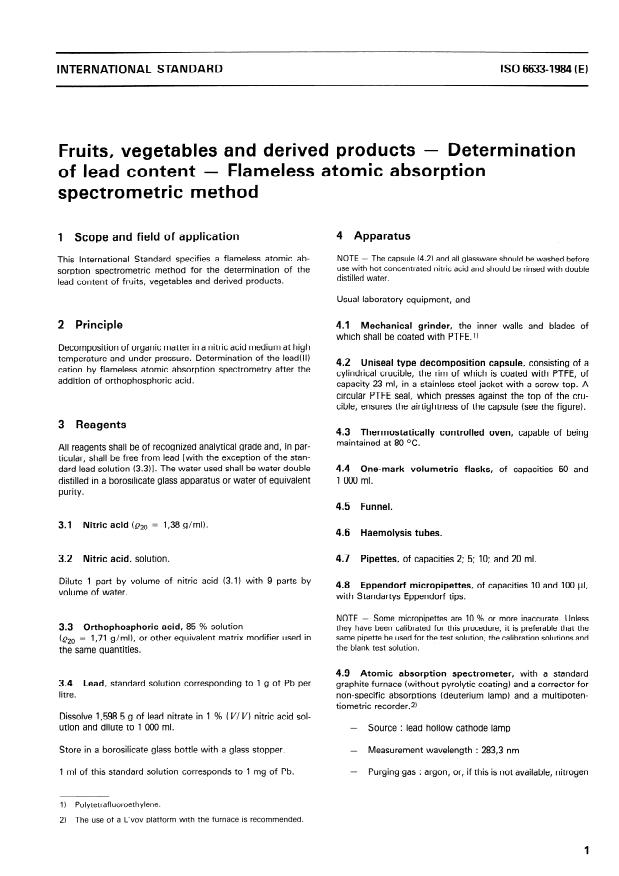
INTERNATIONAL STANDARD IS0 6633-1984 (E) Fruits, vegetables and derived products - Determination of lead content - Flameless atomic absorption spectrometric method 1 Scope and field of application This International Standard specifies a flameless atomic ab- sorption spectrometric method for the determination of the lead content of fruits, vegetables and derived products. 2 Principle Decomposition of organic matter in a nitric acid medium at high temperature and under pressure. Determination of the lead(H) cation by flameless atomic absorption spectrometry after the addition of orthophosphoric acid. 3 Reagents All reagents shall be of recognized analytical grade and, in par- ticular, shall be free from lead [with the exception of the stan- dard lead solution (3.311. The water used shall be water double distilled in a borosilicate glass apparatus or water of equivalent purity. 3.1 Nitric acid (@20 = I,38 g/ml). 3.2 Nitric acid, solution. Dilute 1 part by volume of nitric acid (3.1) with 9 parts by volume of water. 3.3 Orthophosphoric acid, 85 % solution (e20 = I,71 g/ml), or other equivalent matrix modifier used in the same quantities. 3.4 Lead, standard solution corresponding to 1 g of Pb per litre. Dissolve 1,598 5 g of lead nitrate in 1 % ( V/ V) nitric acid sol- ution and dilute to 1 000 ml. Store in a borosilicate glass bottle with a glass stopper. 1 ml of this standard solution corresponds to 1 mg of Pb. 4 Apparatus NOTE - The capsule (4.2) and all glassware should be washed before use with hot concentrated nitric acid and should be rinsed with double distilled water. Usual laboratory equipment, and 4.1 Mechanical grinder, the inner walls and blades of which shall be coated with PTFE.1) 4.2 Uniseal type decomposition capsule, consisting of a cylindrical crucible, the rim of which is coated with PTFE, of capacity 23 ml, in a stainless steel jacket with a screw top. A circular PTFE seal, which presses against the top of the cru- cible, ensures the airtightness of the capsule (see the figure). 4.3 Thermostatically controlled oven, capable of being maintained at 80 OC. 4.4 One-mark volumetric flasks, of capacities 50 and 1 000 ml. 4.5 Funnel. 4.6 Haemolysis tubes. 4.7 Pipettes, of capacities 2; 5; 10; and 20 ml. 4.8 Eppendorf micropipettes, of capacities 10 and 100 ~1, with Standartys Eppendorf tips. NOTE - Some micropipettes are 10 % or more inaccurate. Unless they have been calibrated for this procedure, it is preferable that the same pipette be used for the test solution, the calibration solutions and the blank test solution. 4.9 Atomic absorption spectrometer, with a standard graphite furnace (without pyrolytic coating) and a corrector for non-specific absorptions (deuterium lamp) and a multipoten- tiometric recorder?) - Source : lead hollow cathode lamp - Measurement wavelength : 283,3 nm - Purging gas : argon, or, if this is not available, nitrogen 1) Polytetrafluoroethylene. 2) The use of a L’vov platform with the furnace is recommended. SIST ISO 6633:1995
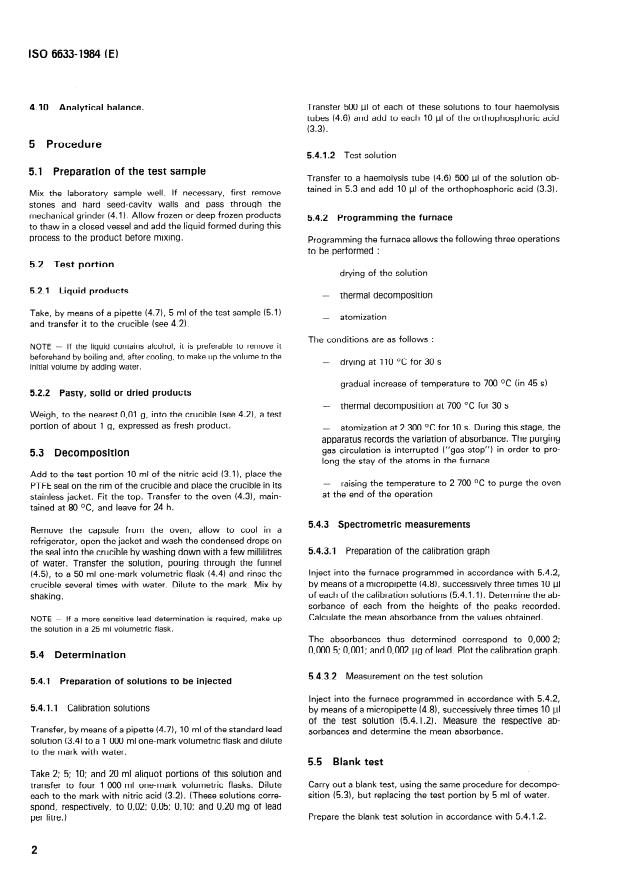
IS0 66334984 (El 4.10 Analytical balance. Transfer 500 ~1 tubes (4.6) and (3.3). of each of these solutions to four haemolysis add to each 10 pi of the ortho phosphoric acid 5 Procedure 5.4.1.2 Test solution 5.1 Preparation of the test sample Transfer to a haemolysis tube
...
International Standard
INTERNATIONAL ORGANIZATION FOR STANDARDIZATION~MEIK~YHAPOCZHAR OPrAHM3AUMR f-t0 CTAHI1APTbl3ALWl~ORGANlSATlON INTERNATIONALE DE NORMALISATION
Fruits, vegetables and derived products - Determination
- Flameless atomic absorption
of lead content
spectrometric method
Fruits, legumes et produits d&iv& - D&termination de la teneur en plomb
- IWthode par spectrom&rie d’absorption atomique
sans flamme
First edition - 1984-09-15
UDC 634.V635.6 : 543.422 : 546.815 Ref. No. IS0 6633-1984 (E)
Descriptors : agricultural products, fruit and vegetable products, fruits, vegetables, chemical analysis, determination of content, lead, atomic
absorption method.
Price based on 3 pages
Foreword
IS0 (the International Organization for Standardization) is a worldwide federation of
national standards bodies (IS0 member bodies). The work of preparing International
Standards is normally carried out through IS0 technical committees. Every member
body interested in a subject for which a technical committee has been established has
the right to be represented on that committee. International organizations, govern-
mental and non-governmental, in liaison with ISO, also take part in the work.
Draft International Standards adopted by the technical committees are circulated to
the member bodies for approval before their acceptance as International Standards by
the IS0 Council. They are approved in accordance with IS0 procedures requiring at
least 75 % approval by the member bodies voting.
International Standard IS0 6633 was prepared by Technical Committee lSO/TC 34,
Agricultural food products.
0 International Organization for Standardization, 1984
Printed in Switzerland
IS0 6633-1984 (E)
INTERNATIONAL STANDARD
Fruits, vegetables and derived products - Determination
of lead content - Flameless atomic absorption
spectrometric method
4 Apparatus
1 Scope and field of application
NOTE - The capsule (4.2) and all glassware should be washed before
This International Standard specifies a flameless atomic ab-
use with hot concentrated nitric acid and should be rinsed with double
sorption spectrometric method for the determination of the
distilled water.
lead content of fruits, vegetables and derived products.
Usual laboratory equipment, and
2 Principle 4.1 Mechanical grinder, the inner walls and blades of
which shall be coated with PTFE.1)
Decomposition of organic matter in a nitric acid medium at high
temperature and under pressure. Determination of the lead(H)
4.2 Uniseal type decomposition capsule, consisting of a
cation by flameless atomic absorption spectrometry after the
cylindrical crucible, the rim of which is coated with PTFE, of
addition of orthophosphoric acid.
capacity 23 ml, in a stainless steel jacket with a screw top. A
circular PTFE seal, which presses against the top of the cru-
cible, ensures the airtightness of the capsule (see the figure).
3 Reagents
4.3 Thermostatically controlled oven, capable of being
maintained at 80 OC.
All reagents shall be of recognized analytical grade and, in par-
ticular, shall be free from lead [with the exception of the stan-
dard lead solution (3.311. The water used shall be water double
4.4 One-mark volumetric flasks, of capacities 50 and
distilled in a borosilicate glass apparatus or water of equivalent 1 000 ml.
purity.
4.5 Funnel.
3.1 Nitric acid (@20 = I,38 g/ml).
4.6 Haemolysis tubes.
3.2 Nitric acid, solution. 4.7 Pipettes, of capacities 2; 5; 10; and 20 ml.
Dilute 1 part by volume of nitric acid (3.1) with 9 parts by
4.8 Eppendorf micropipettes, of capacities 10 and 100 ~1,
volume of water.
with Standartys Eppendorf tips.
NOTE - Some micropipettes are 10 % or more inaccurate. Unless
3.3 Orthophosphoric acid, 85 % solution
they have been calibrated for this procedure, it is preferable that the
same pipette be used for the test solution, the calibration solutions and
I,71 g/ml), or other equivalent matrix modifier used in
(e20 =
the blank test solution.
the same quantities.
4.9 Atomic absorption spectrometer, with a standard
3.4 Lead, standard solution corresponding to 1 g of Pb per graphite furnace (without pyrolytic coating) and a corrector for
litre.
non-specific absorptions (deuterium lamp) and a multipoten-
tiometric recorder?)
Dissolve 1,598 5 g of lead nitrate in 1 % ( V/ V) nitric acid sol-
ution and dilute to 1 000 ml. - Source : lead hollow cathode lamp
Store in a borosilicate glass bottle with a glass stopper. - Measurement wavelength : 283,3 nm
1 ml of this standard solution corresponds to 1 mg of Pb. - Purging gas : argon, or, if this is not available, nitrogen
1) Polytetrafluoroethylene.
2) The use of a L’vov platform with the furnace is recommended.
IS0 66334984 (El
4.10 Analytical balance. Transfer 500 ~1 of each of these solutions to four haemolysis
tubes (4.6) and add to each 10 pi of the ortho phosphoric acid
(3.3).
5 Procedure
5.4.1.2 Test solution
5.1 Preparation of the test sample
Transfer to a haemolysis tube (4.6) 500 1-11 of the solution ob-
tained in 5.3 and add 10 1-11 of the orthophosphoric acid (3.3).
Mix the laboratory sample well. If necessary, first remove
stones and hard seed-cavity walls and pass through the
mechanical grinder (4.1) _ Allow frozen or deep frozen products
5.4.2 Programming the furnace
to thaw in a closed vessel and add the liquid formed during this
process to the product before mixing.
allows the foll owing three ope
...
Norme internationale
INTERNATIONAL ORGANIZATION FOR STANDARDIZATION.ME~YHAPOfiHAR OPrAHM3AL&lR Il0 CTAH~APTbl3ALWlM~ORGANISATlON INTERNATIONALE DE NORMALISATION
Fruits, légumes et produits dérivés - Détermination de
Méthode par spectrométrie
la teneur en plomb -
d’absorption atomique sans flamme
- Flameless a tomic absorption spectrometric me thod
Fruits, vegetables and derived products Y Determina tion of lead content
Première édition - 1984-09-15
Réf. no : ISO 66334984 (FI
CDU 634N635.6 : 543.422 : 546.815
dosage, plomb, méthode d’absorption
Descripteurs : produit agricole, produit dérivé des fruits et légumes, fruit, légume, analyse chimique,
atomique.
Prix basé sur 3 pages
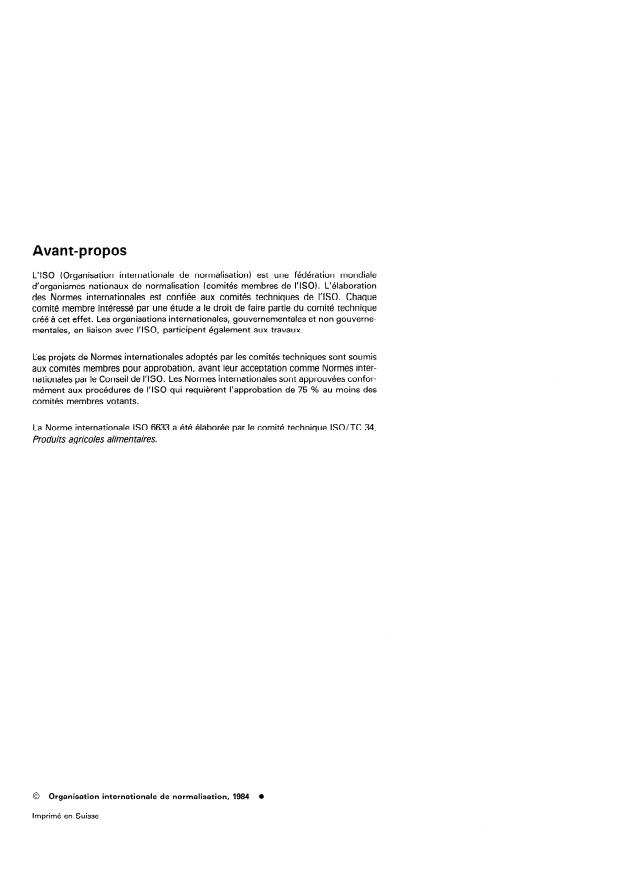
Avant-propos
L’ISO (Organisation internationale de normalisation) est une fédération mondiale
d’organismes nationaux de normalisation (comités membres de I’ISO). L’élaboration
des Normes internationales est confiée aux comités techniques de I’ISO. Chaque
comité membre intéressé par une étude a le droit de faire partie du comité technique
créé à cet effet. Les organisations internationales, gouvernementales et non gouverne-
mentales, en liaison avec I’ISO, participent également aux travaux.
Les projets de Normes internationales adoptés par les comités techniques sont soumis
aux comités membres pour approbation, avant leur acceptation comme Normes inter-
nationales par le Conseil de I’ISO. Les Normes internationales sont approuvées confor-
mément aux procédures de I’ISO qui requièrent l’approbation de 75 % au moins des
comités membres votants.
La Norme internationale ISO 6633 a été élaborée par le comité technique ISO/TC 34,
Produits agricoles alimentaires.
0 Organisation internationale de normalisation, 1984
Imprimé en Suisse
ISO 6633-1984 (F)
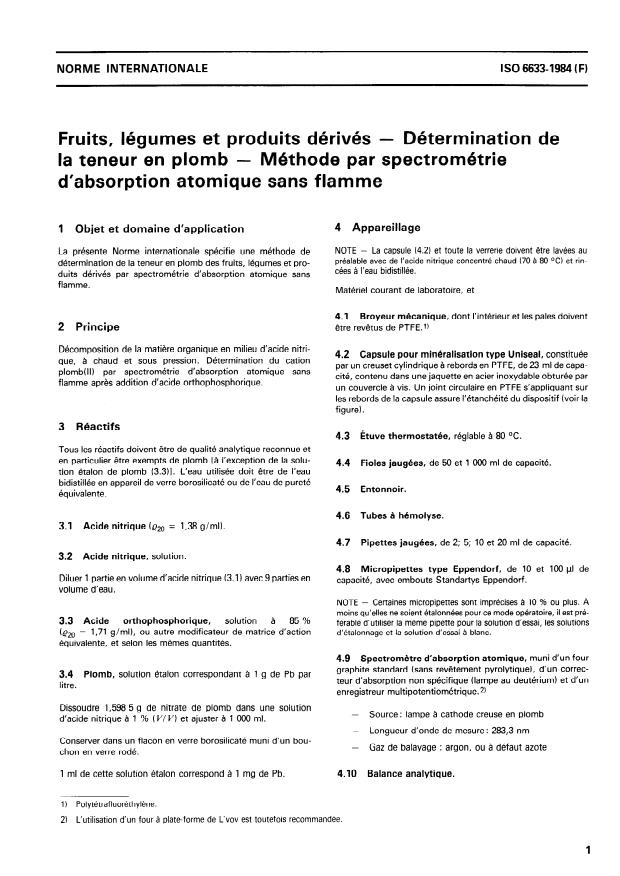
NORME INTERNATIONALE
Fruits, légumes et produits dérivés - Détermination de
Méthode par spectrométrie
la teneur en plomb -
d’absorption atomique sans flamme
4 Appareillage
1 Objet et domaine d’application
La capsule (4.2) et toute la verrerie doivent être lavées au
NOTE -
La présente Norme internationale spécifie une méthode de
préalable avec de l’acide nitrique concentré chaud (70 à 80 OC) et rin-
détermination de la teneur en plomb des fruits, légumes et pro-
cées à l’eau bidistillée.
duits dérivés par spectrométrie d’absorption atomique sans
flamme.
Matériel courant de laboratoire, et
4.1 Broyeur mécanique, dont l’intérieur et les pales doivent
être revêtus de PTFEJ
2 Principe
Décomposition de la matière organique en milieu d’acide nitri-
4.2 Capsule pour minéralisation type Uniseal, constituée
que, à chaud et sous pression. Détermination du cation
par un creuset cylindrique à rebords en PTFE, de 23 ml de capa-
d’absorption atomique sans
Plomb( I 1) par spectrométrie
cité, contenu dans une jaquette en acier inoxydable obturée par
flamme après addition d’acide orthophosphorique.
un couvercle à vis. Un joint circulaire en PTFE s’appliquant sur
les rebords de la capsule assure l’étanchéité du dispositif (voir la
figure).
3 Réactifs
4.3 Étuve thermostatée, réglable à 80 OC.
Tous les réactifs doivent être de qualité analytique reconnue et
en particulier être exempts de plomb [à l’exception de la solu-
4.4 Fioles jaugées, de 50 et 1 000 ml de capacité.
tion étalon de plomb (3.3)l. L’eau utilisée doit être de l’eau
bidistillée en appareil de verre borosilicaté ou de l’eau de pureté
4.5 Entonnoir.
équivalente.
4.6 Tubes à hémolyse.
3.1 Acide nitrique (ezO = 1,38 g/ml).
4.7 Pipettes jaugées, de 2; 5; 10 et 20 ml de capacité.
3.2 Acide nitrique, solution.
4.8 Micropipettes type Eppendorf, de 10 et 100 PI de
Diluer 1 partie en volume d’acide nitrique (3.1) avec 9 parties en
capacité, avec embouts Standartys Eppendorf.
volume d’eau.
NOTE - Certaines micropipettes sont imprécises à 10 % ou plus. À
moins qu’elles ne soient étalonnées pour ce mode opératoire, il est pré-
3.3 Acide orthophosphorique, solution à 85 %
férable d’utiliser la même pipette pour la solution d’essai, les solutions
1,71 g/ml), ou autre modificateur de matrice d’action d’étalonnage et la solution d’essai à blanc.
k?20 =
équivalente, et selon les mêmes quantités.
4.9 Spectromètre d’absorption atomique, muni d’un four
graphite standard (sans revêtement pyrolytique), d’un correc-
3.4 Plomb, solution étalon correspondant à 1 g de Pb par
teur d’absorption non spécifique (lampe au deutérium) et d’un
litre.
enregistreur multipotentiométrique.2)
Dissoudre 1,598 5 g de nitrate de plomb dans une solution
- Source: lampe à cathode creuse en plomb
d’acide nitrique à 1 % ( V/ V) et ajuster à 1 000 ml.
- Longueur d’onde de mesure: 283,3 nm
Conserver dans un flacon en verre borosilicaté muni d’un bou-
- Gaz de balayage : argon, ou à défaut azote
chon en verre rodé.
4.10 Balance analytique.
1 ml de cette solution étalon correspond à 1 mg de Pb.
1) Polytétrafluoréthylène.
2) L’utilisation d’un four à plate-forme de L’vov est toutefois recommandée.
ISO 6633-1984 (F)
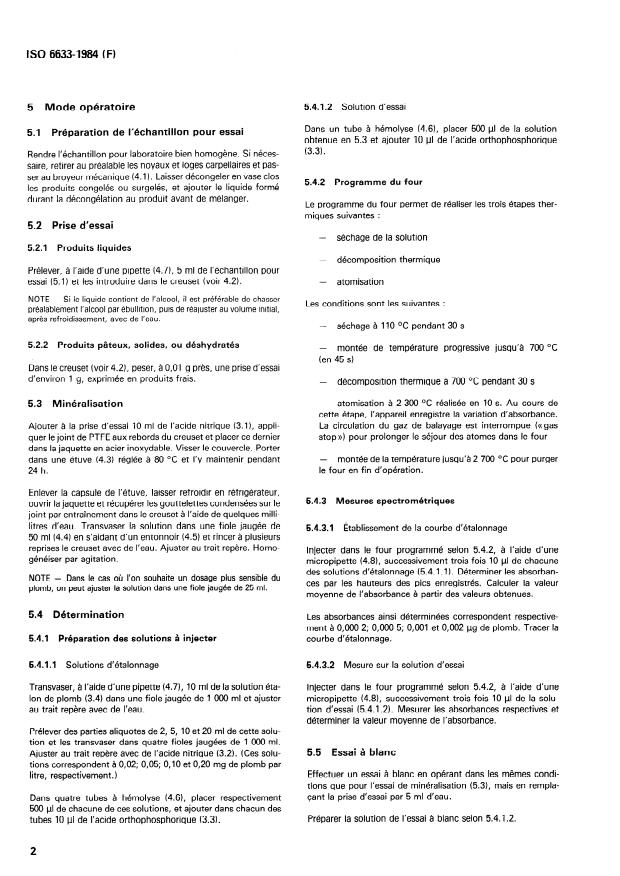
5.4.1.2 Solution d’essai
5 Mode opératoire
Dans un tube à hémolyse (4.6), placer 500 ~1 de la solution
Préparation de l’échantillon pour essai
5.1
obtenue en 5.3 et ajouter 10 PI de l’acide orthophosphorique
(3.3).
Rendre l’échantillon pour laboratoire bien homogène. Si néces-
saire, retirer au préalable les noyaux et loges carpellaires et pas-
ser au broyeur mécanique (4.1). Laisser décongeler en vase clos
5.4.2 Programme du four
les produits congelés ou surgelés, et ajouter le liquide formé
durant la décongélation au produit avant de mélanger.
Le programme du four permet de réaliser les trois étapes ther-
miques suivantes
5.2 Prise d’essai
-
séchage de la solution
52.1 Produits liquides
-
décomposition thermique
d’une pipette (4.7 ‘), 5
...
Norme internationale
INTERNATIONAL ORGANIZATION FOR STANDARDIZATION.ME~YHAPOfiHAR OPrAHM3AL&lR Il0 CTAH~APTbl3ALWlM~ORGANISATlON INTERNATIONALE DE NORMALISATION
Fruits, légumes et produits dérivés - Détermination de
Méthode par spectrométrie
la teneur en plomb -
d’absorption atomique sans flamme
- Flameless a tomic absorption spectrometric me thod
Fruits, vegetables and derived products Y Determina tion of lead content
Première édition - 1984-09-15
Réf. no : ISO 66334984 (FI
CDU 634N635.6 : 543.422 : 546.815
dosage, plomb, méthode d’absorption
Descripteurs : produit agricole, produit dérivé des fruits et légumes, fruit, légume, analyse chimique,
atomique.
Prix basé sur 3 pages
Avant-propos
L’ISO (Organisation internationale de normalisation) est une fédération mondiale
d’organismes nationaux de normalisation (comités membres de I’ISO). L’élaboration
des Normes internationales est confiée aux comités techniques de I’ISO. Chaque
comité membre intéressé par une étude a le droit de faire partie du comité technique
créé à cet effet. Les organisations internationales, gouvernementales et non gouverne-
mentales, en liaison avec I’ISO, participent également aux travaux.
Les projets de Normes internationales adoptés par les comités techniques sont soumis
aux comités membres pour approbation, avant leur acceptation comme Normes inter-
nationales par le Conseil de I’ISO. Les Normes internationales sont approuvées confor-
mément aux procédures de I’ISO qui requièrent l’approbation de 75 % au moins des
comités membres votants.
La Norme internationale ISO 6633 a été élaborée par le comité technique ISO/TC 34,
Produits agricoles alimentaires.
0 Organisation internationale de normalisation, 1984
Imprimé en Suisse
ISO 6633-1984 (F)
NORME INTERNATIONALE
Fruits, légumes et produits dérivés - Détermination de
Méthode par spectrométrie
la teneur en plomb -
d’absorption atomique sans flamme
4 Appareillage
1 Objet et domaine d’application
La capsule (4.2) et toute la verrerie doivent être lavées au
NOTE -
La présente Norme internationale spécifie une méthode de
préalable avec de l’acide nitrique concentré chaud (70 à 80 OC) et rin-
détermination de la teneur en plomb des fruits, légumes et pro-
cées à l’eau bidistillée.
duits dérivés par spectrométrie d’absorption atomique sans
flamme.
Matériel courant de laboratoire, et
4.1 Broyeur mécanique, dont l’intérieur et les pales doivent
être revêtus de PTFEJ
2 Principe
Décomposition de la matière organique en milieu d’acide nitri-
4.2 Capsule pour minéralisation type Uniseal, constituée
que, à chaud et sous pression. Détermination du cation
par un creuset cylindrique à rebords en PTFE, de 23 ml de capa-
d’absorption atomique sans
Plomb( I 1) par spectrométrie
cité, contenu dans une jaquette en acier inoxydable obturée par
flamme après addition d’acide orthophosphorique.
un couvercle à vis. Un joint circulaire en PTFE s’appliquant sur
les rebords de la capsule assure l’étanchéité du dispositif (voir la
figure).
3 Réactifs
4.3 Étuve thermostatée, réglable à 80 OC.
Tous les réactifs doivent être de qualité analytique reconnue et
en particulier être exempts de plomb [à l’exception de la solu-
4.4 Fioles jaugées, de 50 et 1 000 ml de capacité.
tion étalon de plomb (3.3)l. L’eau utilisée doit être de l’eau
bidistillée en appareil de verre borosilicaté ou de l’eau de pureté
4.5 Entonnoir.
équivalente.
4.6 Tubes à hémolyse.
3.1 Acide nitrique (ezO = 1,38 g/ml).
4.7 Pipettes jaugées, de 2; 5; 10 et 20 ml de capacité.
3.2 Acide nitrique, solution.
4.8 Micropipettes type Eppendorf, de 10 et 100 PI de
Diluer 1 partie en volume d’acide nitrique (3.1) avec 9 parties en
capacité, avec embouts Standartys Eppendorf.
volume d’eau.
NOTE - Certaines micropipettes sont imprécises à 10 % ou plus. À
moins qu’elles ne soient étalonnées pour ce mode opératoire, il est pré-
3.3 Acide orthophosphorique, solution à 85 %
férable d’utiliser la même pipette pour la solution d’essai, les solutions
1,71 g/ml), ou autre modificateur de matrice d’action d’étalonnage et la solution d’essai à blanc.
k?20 =
équivalente, et selon les mêmes quantités.
4.9 Spectromètre d’absorption atomique, muni d’un four
graphite standard (sans revêtement pyrolytique), d’un correc-
3.4 Plomb, solution étalon correspondant à 1 g de Pb par
teur d’absorption non spécifique (lampe au deutérium) et d’un
litre.
enregistreur multipotentiométrique.2)
Dissoudre 1,598 5 g de nitrate de plomb dans une solution
- Source: lampe à cathode creuse en plomb
d’acide nitrique à 1 % ( V/ V) et ajuster à 1 000 ml.
- Longueur d’onde de mesure: 283,3 nm
Conserver dans un flacon en verre borosilicaté muni d’un bou-
- Gaz de balayage : argon, ou à défaut azote
chon en verre rodé.
4.10 Balance analytique.
1 ml de cette solution étalon correspond à 1 mg de Pb.
1) Polytétrafluoréthylène.
2) L’utilisation d’un four à plate-forme de L’vov est toutefois recommandée.
ISO 6633-1984 (F)
5.4.1.2 Solution d’essai
5 Mode opératoire
Dans un tube à hémolyse (4.6), placer 500 ~1 de la solution
Préparation de l’échantillon pour essai
5.1
obtenue en 5.3 et ajouter 10 PI de l’acide orthophosphorique
(3.3).
Rendre l’échantillon pour laboratoire bien homogène. Si néces-
saire, retirer au préalable les noyaux et loges carpellaires et pas-
ser au broyeur mécanique (4.1). Laisser décongeler en vase clos
5.4.2 Programme du four
les produits congelés ou surgelés, et ajouter le liquide formé
durant la décongélation au produit avant de mélanger.
Le programme du four permet de réaliser les trois étapes ther-
miques suivantes
5.2 Prise d’essai
-
séchage de la solution
52.1 Produits liquides
-
décomposition thermique
d’une pipette (4.7 ‘), 5
...
Questions, Comments and Discussion
Ask us and Technical Secretary will try to provide an answer. You can facilitate discussion about the standard in here.
Loading comments...