

SIST-TS ETSI/TS 102 232-3 V3.15.1:2025
(Main)Lawful Interception (LI) - Handover Interface and Service-Specific Details (SSD) for IP delivery - Part 3: Service-specific details for internet access services
General Information
- Abstract
The present document specifies the general aspects of HI2 and HI3 interfaces for handover via IP based networks.
The present document:
• specifies the modular approach used for specifying IP based handover interfaces;
• specifies the header(s) to be added to IRI and CC sent over the HI2 and HI3 interfaces respectively;
• specifies protocols for the transfer of IRI and CC across the handover interfaces;
• specifies protocol profiles for the handover interface.
The present document is designed to be used where appropriate in conjunction with other deliverables that define the
service-specific IRI data formats (including ETSI TS 102 227 [i.1], ETSI TS 101 909-20-1 [33], ETSI
TS 101 909-20-2 [34], ETSI TS 102 232-2 [5], ETSI TS 102 232-3 [6], ETSI TS 102 232-4 [32], ETSI
TS 102 232-5 [37], ETSI TS 102 232-6 [36] and ETSI TS 102 232-7 [38]). Where possible, the present document aligns
with 3GPP TS 33.108 [9] and ETSI TS 101 671 [4] and supports the requirements and capabilities defined in ETSI
TS 101 331 [i.9] and ETSI TR 101 944 [i.4].
For the handover of intercepted data within GSM/UMTS PS and CS domains, the present document does not override
or supersede any specifications or requirements in 3GPP TS 33.108 [9] and ETSI TS 101 671 [4].
For the handover of services defined in 3GPP TS 33.128 [46], in the event of conflict between the present document
and 3GPP TS 33.128 [46], the terms of 3GPP TS 33.128 [46] apply.
- Status
- Published
- Publication Date
- 25-Jun-2025
- Technical Committee
- SPN - Services and Protocols for Networks
- Current Stage
- 6060 - National Implementation/Publication (Adopted Project)
- Start Date
- 23-Jun-2025
- Due Date
- 28-Aug-2025
- Completion Date
- 26-Jun-2025
Buy Documents
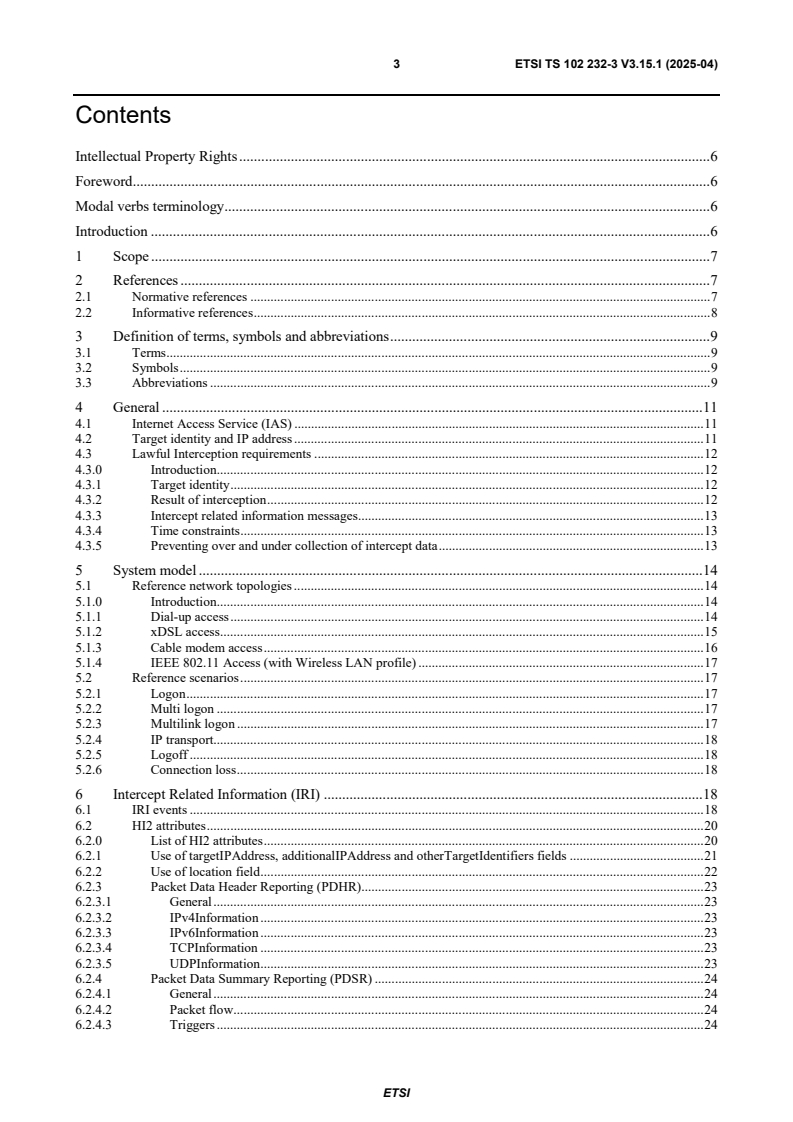
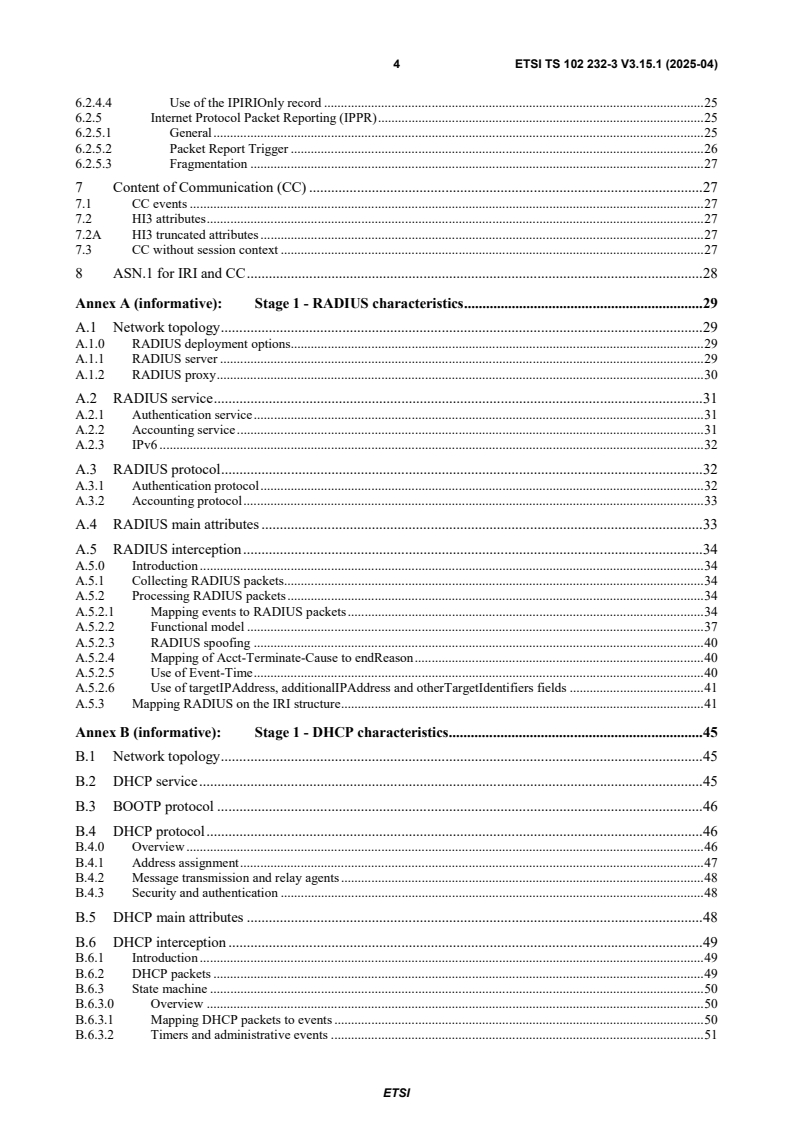
ETSI TS 102 232-3 V3.15.1 (2025-04) - Lawful Interception (LI); Handover Interface and Service-Specific Details (SSD) for IP delivery; Part 3: Service-specific details for internet access services

Overview
SIST-TS ETSI/TS 102 232-3 V3.15.1:2025 is a Slovenian technical specification aligned with ETSI standards, focusing on lawful interception (LI) within IP-based networks. Specifically, this standard addresses the handover interfaces and service-specific details for internet access services, providing guidelines for the interception of both Intercept Related Information (IRI) and Content of Communication (CC) in IP delivery environments.
The document applies a modular approach to define how network and law enforcement entities should communicate LI data, ensuring compliance with legal and security requirements in the digital era. It serves as a crucial reference for internet access providers (IAPs), telecommunications operators, and relevant authorities seeking to implement, audit, or comply with lawful interception obligations for IP-based internet services.
Key Topics
- Handover Interfaces (HI2 and HI3): Specifies requirements and protocols for the HI2 (for IRI) and HI3 (for CC) interfaces used in internet access services.
- Service-Specific Modular Approach: Describes a modular framework for specifying LI handover interfaces, supporting scalability and future-proofing.
- Header and Protocol Specifications: Defines headers for IRI and CC and outlines protocols for their secure and accurate transfer across handover points.
- Event and Attribute Handling: Provides definitions for IRI and CC events, with a focus on accurate mapping and attribute reporting during interception.
- Support for Technologies: Details the application of AAA protocols such as RADIUS and DHCP for associating target identities with IP addresses.
- Reference Scenarios: Includes use cases such as dial-up, xDSL, cable modem, and wireless LAN access.
- Alignment with International Standards: Ensures consistency with related ETSI and 3GPP specifications to reinforce interoperability and regulatory compliance.
Applications
The SIST-TS ETSI/TS 102 232-3 V3.15.1:2025 standard enables key practical applications, including:
- Lawful Interception Compliance: Assists service providers and operators in meeting the legal requirements for LI in IP-based internet access, supporting law enforcement activities while ensuring users' rights are respected.
- Efficient Interface Implementation: Guides developers, architects, and compliance teams in implementing standardized LI handover mechanisms for IRI and CC on modern internet services.
- Interoperability: Facilitates compatibility between various network equipment from different vendors thanks to a standardized, modular approach.
- Enhanced Security and Accountability: Ensures all intercepted data, including authentication and session information, is collected and transferred securely, with robust audit trails for accountability.
- Support for Multiple Access Technologies: Applicable to a range of network infrastructures, including broadband, Wi-Fi, DSL, and cable, as well as technologies using RADIUS and DHCP for dynamic IP assignment.
Related Standards
To ensure complete compliance and interoperability, the following standards play an essential complementary role:
- ETSI TS 101 671: Lawful Interception Handover Interface for telecommunications traffic.
- ETSI TS 102 232-1: General specification for IP delivery handover for lawful interception.
- ETSI TS 102 227: Service-specific IRI data formats.
- 3GPP TS 33.108: 3G security; Lawful Interception requirements.
- ETSI TS 101 331: Additional requirements and capabilities for LI.
- ETSI TS 102 232-series: Further parts for different IP service-specific details (Parts 2, 4, 5, 6, 7).
- IETF RFCs: Various protocols covered include RFC 2131 (DHCP), RFC 2865 (RADIUS), RFC 791 (IPv4), RFC 793 (TCP), RFC 768 (UDP), and others for IP networking and authentication.
Conclusion
SIST-TS ETSI/TS 102 232-3 V3.15.1:2025 is a cornerstone document for lawful interception of IP-based internet access services, empowering organizations to implement standardized, secure, and interoperable LI interfaces. By aligning with both European and global best practices, it supports regulatory compliance and robust operational security across converged communication networks. For those designing or maintaining IP-based internet access infrastructure, understanding and applying this standard is essential to ensure legal, technical, and operational excellence in lawful interception.
Buy Documents
ETSI TS 102 232-3 V3.15.1 (2025-04) - Lawful Interception (LI); Handover Interface and Service-Specific Details (SSD) for IP delivery; Part 3: Service-specific details for internet access services
Get Certified
Connect with accredited certification bodies for this standard

BSI Group
BSI (British Standards Institution) is the business standards company that helps organizations make excellence a habit.

NYCE
Mexican standards and certification body.
Sponsored listings
Frequently Asked Questions
SIST-TS ETSI/TS 102 232-3 V3.15.1:2025 is a standard published by the Slovenian Institute for Standardization (SIST). Its full title is "Lawful Interception (LI) - Handover Interface and Service-Specific Details (SSD) for IP delivery - Part 3: Service-specific details for internet access services". This standard covers: The present document specifies the general aspects of HI2 and HI3 interfaces for handover via IP based networks. The present document: • specifies the modular approach used for specifying IP based handover interfaces; • specifies the header(s) to be added to IRI and CC sent over the HI2 and HI3 interfaces respectively; • specifies protocols for the transfer of IRI and CC across the handover interfaces; • specifies protocol profiles for the handover interface. The present document is designed to be used where appropriate in conjunction with other deliverables that define the service-specific IRI data formats (including ETSI TS 102 227 [i.1], ETSI TS 101 909-20-1 [33], ETSI TS 101 909-20-2 [34], ETSI TS 102 232-2 [5], ETSI TS 102 232-3 [6], ETSI TS 102 232-4 [32], ETSI TS 102 232-5 [37], ETSI TS 102 232-6 [36] and ETSI TS 102 232-7 [38]). Where possible, the present document aligns with 3GPP TS 33.108 [9] and ETSI TS 101 671 [4] and supports the requirements and capabilities defined in ETSI TS 101 331 [i.9] and ETSI TR 101 944 [i.4]. For the handover of intercepted data within GSM/UMTS PS and CS domains, the present document does not override or supersede any specifications or requirements in 3GPP TS 33.108 [9] and ETSI TS 101 671 [4]. For the handover of services defined in 3GPP TS 33.128 [46], in the event of conflict between the present document and 3GPP TS 33.128 [46], the terms of 3GPP TS 33.128 [46] apply.
The present document specifies the general aspects of HI2 and HI3 interfaces for handover via IP based networks. The present document: • specifies the modular approach used for specifying IP based handover interfaces; • specifies the header(s) to be added to IRI and CC sent over the HI2 and HI3 interfaces respectively; • specifies protocols for the transfer of IRI and CC across the handover interfaces; • specifies protocol profiles for the handover interface. The present document is designed to be used where appropriate in conjunction with other deliverables that define the service-specific IRI data formats (including ETSI TS 102 227 [i.1], ETSI TS 101 909-20-1 [33], ETSI TS 101 909-20-2 [34], ETSI TS 102 232-2 [5], ETSI TS 102 232-3 [6], ETSI TS 102 232-4 [32], ETSI TS 102 232-5 [37], ETSI TS 102 232-6 [36] and ETSI TS 102 232-7 [38]). Where possible, the present document aligns with 3GPP TS 33.108 [9] and ETSI TS 101 671 [4] and supports the requirements and capabilities defined in ETSI TS 101 331 [i.9] and ETSI TR 101 944 [i.4]. For the handover of intercepted data within GSM/UMTS PS and CS domains, the present document does not override or supersede any specifications or requirements in 3GPP TS 33.108 [9] and ETSI TS 101 671 [4]. For the handover of services defined in 3GPP TS 33.128 [46], in the event of conflict between the present document and 3GPP TS 33.128 [46], the terms of 3GPP TS 33.128 [46] apply.
SIST-TS ETSI/TS 102 232-3 V3.15.1:2025 is classified under the following ICS (International Classification for Standards) categories: 35.240.95 - Internet applications. The ICS classification helps identify the subject area and facilitates finding related standards.
SIST-TS ETSI/TS 102 232-3 V3.15.1:2025 is available in PDF format for immediate download after purchase. The document can be added to your cart and obtained through the secure checkout process. Digital delivery ensures instant access to the complete standard document.
Standards Content (Sample)
TECHNICAL SPECIFICATION
Lawful Interception (LI);
Handover Interface and
Service-Specific Details (SSD) for IP delivery;
Part 3: Service-specific details for internet access services
2 ETSI TS 102 232-3 V3.15.1 (2025-04)
Reference
RTS/LI-00276-3
Keywords
access, internet, IP, lawful interception, security,
service
ETSI
650 Route des Lucioles
F-06921 Sophia Antipolis Cedex - FRANCE
Tel.: +33 4 92 94 42 00 Fax: +33 4 93 65 47 16
Siret N° 348 623 562 00017 - APE 7112B
Association à but non lucratif enregistrée à la
Sous-Préfecture de Grasse (06) N° w061004871
Important notice
The present document can be downloaded from the
ETSI Search & Browse Standards application.
The present document may be made available in electronic versions and/or in print. The content of any electronic and/or
print versions of the present document shall not be modified without the prior written authorization of ETSI. In case of any
existing or perceived difference in contents between such versions and/or in print, the prevailing version of an ETSI
deliverable is the one made publicly available in PDF format on ETSI deliver repository.
Users should be aware that the present document may be revised or have its status changed,
this information is available in the Milestones listing.
If you find errors in the present document, please send your comments to
the relevant service listed under Committee Support Staff.
If you find a security vulnerability in the present document, please report it through our
Coordinated Vulnerability Disclosure (CVD) program.
Notice of disclaimer & limitation of liability
The information provided in the present deliverable is directed solely to professionals who have the appropriate degree of
experience to understand and interpret its content in accordance with generally accepted engineering or
other professional standard and applicable regulations.
No recommendation as to products and services or vendors is made or should be implied.
No representation or warranty is made that this deliverable is technically accurate or sufficient or conforms to any law
and/or governmental rule and/or regulation and further, no representation or warranty is made of merchantability or fitness
for any particular purpose or against infringement of intellectual property rights.
In no event shall ETSI be held liable for loss of profits or any other incidental or consequential damages.
Any software contained in this deliverable is provided "AS IS" with no warranties, express or implied, including but not
limited to, the warranties of merchantability, fitness for a particular purpose and non-infringement of intellectual property
rights and ETSI shall not be held liable in any event for any damages whatsoever (including, without limitation, damages
for loss of profits, business interruption, loss of information, or any other pecuniary loss) arising out of or related to the use
of or inability to use the software.
Copyright Notification
No part may be reproduced or utilized in any form or by any means, electronic or mechanical, including photocopying and
microfilm except as authorized by written permission of ETSI.
The content of the PDF version shall not be modified without the written authorization of ETSI.
The copyright and the foregoing restriction extend to reproduction in all media.
© ETSI 2025.
All rights reserved.
ETSI
3 ETSI TS 102 232-3 V3.15.1 (2025-04)
Contents
Intellectual Property Rights . 6
Foreword . 6
Modal verbs terminology . 6
Introduction . 6
1 Scope . 7
2 References . 7
2.1 Normative references . 7
2.2 Informative references . 8
3 Definition of terms, symbols and abbreviations . 9
3.1 Terms . 9
3.2 Symbols . 9
3.3 Abbreviations . 9
4 General . 11
4.1 Internet Access Service (IAS) . 11
4.2 Target identity and IP address . 11
4.3 Lawful Interception requirements . 12
4.3.0 Introduction. 12
4.3.1 Target identity . 12
4.3.2 Result of interception . 12
4.3.3 Intercept related information messages. 13
4.3.4 Time constraints . 13
4.3.5 Preventing over and under collection of intercept data . 13
5 System model . 14
5.1 Reference network topologies . 14
5.1.0 Introduction. 14
5.1.1 Dial-up access . 14
5.1.2 xDSL access. 15
5.1.3 Cable modem access . 16
5.1.4 IEEE 802.11 Access (with Wireless LAN profile) . 17
5.2 Reference scenarios . 17
5.2.1 Logon . 17
5.2.2 Multi logon . 17
5.2.3 Multilink logon . 17
5.2.4 IP transport. 18
5.2.5 Logoff . 18
5.2.6 Connection loss . 18
6 Intercept Related Information (IRI) . 18
6.1 IRI events . 18
6.2 HI2 attributes . 20
6.2.0 List of HI2 attributes . 20
6.2.1 Use of targetIPAddress, additionalIPAddress and otherTargetIdentifiers fields . 21
6.2.2 Use of location field . 22
6.2.3 Packet Data Header Reporting (PDHR). 23
6.2.3.1 General . 23
6.2.3.2 IPv4Information . 23
6.2.3.3 IPv6Information . 23
6.2.3.4 TCPInformation . 23
6.2.3.5 UDPInformation . 23
6.2.4 Packet Data Summary Reporting (PDSR) . 24
6.2.4.1 General . 24
6.2.4.2 Packet flow . 24
6.2.4.3 Triggers . 24
ETSI
4 ETSI TS 102 232-3 V3.15.1 (2025-04)
6.2.4.4 Use of the IPIRIOnly record . 25
6.2.5 Internet Protocol Packet Reporting (IPPR) . 25
6.2.5.1 General . 25
6.2.5.2 Packet Report Trigger . 26
6.2.5.3 Fragmentation . 27
7 Content of Communication (CC) . 27
7.1 CC events . 27
7.2 HI3 attributes . 27
7.2A HI3 truncated attributes . 27
7.3 CC without session context . 27
8 ASN.1 for IRI and CC . 28
Annex A (informative): Stage 1 - RADIUS characteristics . 29
A.1 Network topology . 29
A.1.0 RADIUS deployment options. 29
A.1.1 RADIUS server . 29
A.1.2 RADIUS proxy . 30
A.2 RADIUS service . 31
A.2.1 Authentication service . 31
A.2.2 Accounting service . 31
A.2.3 IPv6 . 32
A.3 RADIUS protocol . 32
A.3.1 Authentication protocol . 32
A.3.2 Accounting protocol . 33
A.4 RADIUS main attributes . 33
A.5 RADIUS interception . 34
A.5.0 Introduction . 34
A.5.1 Collecting RADIUS packets. 34
A.5.2 Processing RADIUS packets . 34
A.5.2.1 Mapping events to RADIUS packets . 34
A.5.2.2 Functional model . 37
A.5.2.3 RADIUS spoofing . 40
A.5.2.4 Mapping of Acct-Terminate-Cause to endReason . 40
A.5.2.5 Use of Event-Time . 40
A.5.2.6 Use of targetIPAddress, additionalIPAddress and otherTargetIdentifiers fields . 41
A.5.3 Mapping RADIUS on the IRI structure . 41
Annex B (informative): Stage 1 - DHCP characteristics . 45
B.1 Network topology . 45
B.2 DHCP service . 45
B.3 BOOTP protocol . 46
B.4 DHCP protocol . 46
B.4.0 Overview . 46
B.4.1 Address assignment . 47
B.4.2 Message transmission and relay agents . 48
B.4.3 Security and authentication . 48
B.5 DHCP main attributes . 48
B.6 DHCP interception . 49
B.6.1 Introduction . 49
B.6.2 DHCP packets . 49
B.6.3 State machine . 50
B.6.3.0 Overview . 50
B.6.3.1 Mapping DHCP packets to events . 50
B.6.3.2 Timers and administrative events . 51
ETSI
5 ETSI TS 102 232-3 V3.15.1 (2025-04)
B.6.3.3 State information . 51
B.6.3.4 State machine diagram . 52
B.6.4 Mapping DHCP on the IRI structure . 52
Annex C (informative): IP IRI interception . 54
C.1 Introduction . 54
C.2 Requirements . 54
C.3 Proposed implementation . 54
Annex D (informative): TCP and UDP IRI interception . 55
D.1 Introduction . 55
D.2 Requirements . 55
D.3 HI2 requirements . 55
D.4 HI3 requirements . 56
D.5 General requirements . 56
Annex E (informative): Considerations regarding publicly exposed IP addresses . 57
Annex F (informative): Bibliography . 58
Annex G (informative): Change Request history . 59
History . 62
ETSI
6 ETSI TS 102 232-3 V3.15.1 (2025-04)
Intellectual Property Rights
Essential patents
IPRs essential or potentially essential to normative deliverables may have been declared to ETSI. The declarations
pertaining to these essential IPRs, if any, are publicly available for ETSI members and non-members, and can be
found in ETSI SR 000 314: "Intellectual Property Rights (IPRs); Essential, or potentially Essential, IPRs notified to
ETSI in respect of ETSI standards", which is available from the ETSI Secretariat. Latest updates are available on the
ETSI IPR online database.
Pursuant to the ETSI Directives including the ETSI IPR Policy, no investigation regarding the essentiality of IPRs,
including IPR searches, has been carried out by ETSI. No guarantee can be given as to the existence of other IPRs not
referenced in ETSI SR 000 314 (or the updates on the ETSI Web server) which are, or may be, or may become,
essential to the present document.
Trademarks
The present document may include trademarks and/or tradenames which are asserted and/or registered by their owners.
ETSI claims no ownership of these except for any which are indicated as being the property of ETSI, and conveys no
right to use or reproduce any trademark and/or tradename. Mention of those trademarks in the present document does
not constitute an endorsement by ETSI of products, services or organizations associated with those trademarks.
DECT™, PLUGTESTS™, UMTS™ and the ETSI logo are trademarks of ETSI registered for the benefit of its
Members. 3GPP™, LTE™ and 5G™ logo are trademarks of ETSI registered for the benefit of its Members and of the
3GPP Organizational Partners. oneM2M™ logo is a trademark of ETSI registered for the benefit of its Members and of ®
the oneM2M Partners. GSM and the GSM logo are trademarks registered and owned by the GSM Association.
Foreword
This Technical Specification (TS) has been produced by ETSI Technical Committee Lawful Interception (LI).
The present document is part 3 of a multi-part deliverable. Full details of the entire series can be found in part 1 [2].
The ASN.1 module is available as an electronic attachment to the present document (see clause 8 for more details).
Modal verbs terminology
In the present document "shall", "shall not", "should", "should not", "may", "need not", "will", "will not", "can" and
"cannot" are to be interpreted as described in clause 3.2 of the ETSI Drafting Rules (Verbal forms for the expression of
provisions).
"must" and "must not" are NOT allowed in ETSI deliverables except when used in direct citation.
Introduction
The intention of the present document has been to follow the advice given at ETSI meetings in all cases.
The present document focuses on intercepting IP data in relation to the use of Internet Access Services (IASs) and is to
be used in conjunction with ETSI TS 102 232-1 [2]. In the latter document the handing over of the intercepted data is
described.
ETSI
7 ETSI TS 102 232-3 V3.15.1 (2025-04)
1 Scope
The present document contains a stage 1 description of the interception information in relation to the process of binding
a "target identity" to an IP address when providing Internet access and a stage 2 description of when Intercept Related
Information (IRI) and Content of Communication (CC) need to be sent, and what information it needs to contain.
The present document includes but is not restricted to IRI based on application of Dynamic Host Configuration Protocol
(DHCP) and Remote Authentication Dial-In User Service (RADIUS) technology for binding a "target identity" to an IP
address and CC for the intercepted IP packets.
The definition of the Handover Interface 2 (HI2) and Handover Interface 3 (HI3) is outside the scope of the present
document. For the handover interface is referred to ETSI TS 102 232-1 [2].
2 References
2.1 Normative references
References are either specific (identified by date of publication and/or edition number or version number) or
non-specific. For specific references, only the cited version applies. For non-specific references, the latest version of the
referenced document (including any amendments) applies.
Referenced documents which are not found to be publicly available in the expected location might be found in the
ETSI docbox.
NOTE: While any hyperlinks included in this clause were valid at the time of publication, ETSI cannot guarantee
their long term validity.
The following referenced documents are necessary for the application of the present document.
[1] ETSI TS 101 671: "Telecommunications security; Lawful Interception (LI) Handover interface for
the lawful interception of telecommunications traffic".
NOTE: ETSI TS 101 671 is in status "historical" and is not maintained.
[2] ETSI TS 102 232-1: "Lawful Interception (LI); Handover Interface and Service-Specific Details
(SSD) for IP delivery; Part 1: Handover specification for IP delivery".
[3] IETF RFC 1122: "Requirements for Internet Hosts - Communication Layers".
[4] IETF RFC 1570: "PPP LCP Extensions".
[5] IETF RFC 1990: "The PPP Multilink Protocol (MP)".
[6] IETF RFC 2131: "Dynamic Host Configuration Protocol".
[7] IETF RFC 7542: "The Network Access Identifier".
[8] IETF RFC 2865: "Remote Authentication Dial In User Service (RADIUS)".
[9] IETF RFC 2866: "RADIUS Accounting".
[10] IETF RFC 3046: "DHCP Relay Agent Information Option".
[11] IETF RFC 3118: "Authentication for DHCP Messages".
[12] IETF RFC 3396: "Encoding Long Options in the Dynamic Host Configuration Protocol
(DHCPv4)".
ETSI
8 ETSI TS 102 232-3 V3.15.1 (2025-04)
[13] IEEE 802.11™ (ISO/IEC 8802-11): "IEEE Standard for Information technology -
Telecommunications and information exchange between systems - Local and metropolitan area
networks - Specific requirements - Part 11: Wireless LAN Medium Access Control (MAC) and
Physical Layer (PHY) Specifications".
[14] Recommendation ITU-T X.680: "Information technology -- Abstract Syntax Notation One
(ASN.1): Specification of basic notation".
[15] IETF RFC 2132: "DHCP Options and BOOTP Vendor Extensions".
[16] ISO 3166-1: "Codes for the representation of names of countries and their subdivisions -- Part 1:
Country code".
[17] IETF RFC 2869: "RADIUS Extensions".
[18] IETF RFC 3162: "RADIUS and IPv6".
[19] IETF RFC 4818: "RADIUS Delegated-IPv6-Prefix Attribute".
[20] IETF RFC 6911: "RADIUS Attributes for IPv6 Access Networks".
[21] IETF RFC 791: "Internet Protocol".
[22] IETF RFC 8200: "Internet Protocol, Version 6 (IPv6) Specification".
[23] IETF RFC 793: "Transmission Control Protocol".
[24] IETF RFC 3168: "The Addition of Explicit Congestion Notification (ECN) to IP".
[25] IETF RFC 3540: "Robust Explicit Congestion Notification (ECN) Signaling with Nonces".
[26] IETF RFC 768: "User Datagram Protocol".
[27] ETSI TS 103 120: "Lawful Interception (LI); Interface for warrant information".
2.2 Informative references
References are either specific (identified by date of publication and/or edition number or version number) or
non-specific. For specific references, only the cited version applies. For non-specific references, the latest version of the
referenced document (including any amendments) applies.
NOTE: While any hyperlinks included in this clause were valid at the time of publication, ETSI cannot guarantee
their long term validity.
The following referenced documents are not necessary for the application of the present document but they assist the
user with regard to a particular subject area.
[i.1] ETSI TR 102 205: "Methods for Testing and Specification (MTS); UML 2.0 action syntax
feasibility study".
[i.2] IEEE 802.1X™-2001: "IEEE Standards for Local and Metropolitan Area Networks: Port-Based
Network Access Control".
[i.3] draft-ietf-dhc-agentopt-radius-04.txt: "RADIUS Attributes Sub-option for the DHCP Relay Agent
Information Option".
[i.4] IANA bootp parameters.
[i.5] ETSI TS 102 232-3 (V3.4.1): "Lawful Interception (LI); Handover Interface and Service-Specific
Details (SSD) for IP delivery; Part 3: Service-specific details for internet access services".
[i.6] IETF RFC 2663: "IP Network Address Translator (NAT) Terminology and Considerations".
[i.7] IETF RFC 6264: "An Incremental Carrier-Grade NAT (CGN) for IPv6 Transition".
[i.8] IETF RFC 6888: "Common Requirements for Carrier-Grade NATs (CGNs)".
ETSI
9 ETSI TS 102 232-3 V3.15.1 (2025-04)
[i.9] IETF RFC 7422: "Deterministic Address Mapping to Reduce Logging in Carrier-Grade NAT
Deployments".
3 Definition of terms, symbols and abbreviations
3.1 Terms
For the purposes of the present document, the terms given in ETSI TS 102 232-1 [2] and the following apply:
access provider: Communications Service Provider (CSP), providing access to a network
NOTE: In the context of the present document, the network access is defined as IP based network access to the
Internet.
access service: set of access methods provided to a user to access a service and/or a supplementary service
NOTE: In the context of the present document, the service to be accessed is defined as the Internet.
accounting: act of collecting information on resource usage for the purpose of trend analysis, auditing, billing, or cost
allocation
authentication: property by which the correct identity of an entity or party is established with a required assurance
authorization: property by which the access rights to resources are established and enforced
NAT translated IP address: address realm, which has been mapped from an IP address in another address realm as a
result of the application of NAT techniques
NOTE: IETF RFC 2663 [i.6] provides general information about NAT terminology and considerations whereas
the IETF RFC 6264 [i.7], IETF RFC 6888 [i.8] and IETF RFC 7422 [i.9] provide information regarding
the use of CGN.
publicly exposed IP address: NAT translated IP address where the IP address is a public IP address
public IP address: address realm with unique network addresses assigned by IANA or an equivalent address registry
3.2 Symbols
Void.
3.3 Abbreviations
For the purposes of the present document, the following abbreviations apply:
AAA Authentication, Authorization and Accounting
ACK Acknowledge
ADSL Asymmetric Digital Subscriber Line
ANP Access Network Provider
AP Access Provider
ARP Address Resolution Protocol
ASN.1 Abstract Syntax Notation One
ATM Asynchronous Transfer Mode
BOOTP BOOTstrap Protocol
CC Content of Communication
CGN Carrier-Grade NAT
CHAP Challenge Handshake Authentication Protocol
CIN Communication Identity Number
CMTS Cable Modem Termination System
CPE Customer Premises Equipment
ETSI
10 ETSI TS 102 232-3 V3.15.1 (2025-04)
CSP Communications Service Provider (covers all AP/NWO/SvP)
DHCP Dynamic Host Configuration Protocol
DNS Domain Name System
DoS Denial of Service
DSL Digital Subscriber Line
DSLAM Digital Subscriber Line Access Multiplexer
ECN Explicit Congestion Notification
FQDN Fully Qualified Domain Name
GWR GateWay Router
HI1 Handover Interface 1 (for Administrative Information)
HI2 Handover Interface 2 (for Intercept Related Information)
HI3 Handover Interface 3 (for Content of Communication)
IANA Internet Assigned Numbers Authority
IAP Internet Access Provider
IAS Internet Access Service
IEEE Institute of Electrical and Electronic Engineers
IETF International Engineering Task Force
IF Interception Function
IIF Internal Interception Function
IT Information Technology
IP Internet Protocol
IPCC Internet Protocol Call Content
IPFIX Internet Protocol Flow Information eXport
IPPR Internet Protocol Packet Reporting
IPSEC Internet Protocol Security
IPv4 Internet Protocol (version 4)
IPv6 Internet Protocol (version 6)
iPV6 IP version 6
IRI Intercept Related Information
ISDN Integrated Services Digital Network
ISP Internet Service Provider
LAN Local Area Network
LCP Link Control Protocol
LEA Law Enforcement Agency
LEMF Law Enforcement Monitoring Facility
LI Lawful Interception
MAC Media Access Control
MF Mediation Function
NA Not Applicable
NAS Network Access Server
NAT Network Address Translation
NIC Network Interface Controller
NWO NetWork Operator
OID Object IDentifier
OSI Open Systems Interconnection
PAP Password Authentication Protocol
PC Personal Computer
PDA Personal Digital Assistant
PDHR Packet Data Header Reporting
PDSR Packet Data Summary Reporting
PDU Packet Data Unit
POP Point of Presence
PPP Point-to-Point Protocol
PPPoA Point-to-Point Protocol over ATM
PPPoE Point-to-Point Protocol over Ethernet
PSTN Public Switched Telephone Network
QoS Quality of Service
RADIUS Remote Authentication Dial-In User Service
SLIP Serial Line Interface Protocol
SvP Service Provider
TCLI Technical Committee for Lawful Interception
TCP Transmission Control Protocol
ETSI
11 ETSI TS 102 232-3 V3.15.1 (2025-04)
TLV Type-Length Value
UDP User Datagram Protocol
WAN Wide Area Network
WINS Windows Internet Name Service
xDSL any Digital Subscriber Line technology
4 General
4.1 Internet Access Service (IAS)
An Internet Access Service (IAS) provides access to the Internet to end users via a modem connected to a telephone,
cable or wireless access network owned by a NetWork Operator (NWO). The IAS is typically provided by an Internet
Access Provider (IAP) or Internet Service Providers (ISP), where an ISP also provides supplementary services such as
E-Mail, Chat, News, etc. For the remainder of the present document, the provider of the Internet Access Service (IAS)
will be referred to as IAP and although NWO and IAP may be the same party, in all figures in the present document,
they are depicted as separate entities.
Customer
Access
IAP
Premises
Internet
Network Network
Equipment
(CPE)
Customer NWO IAP/ISP
Figure 1: Internet access
The customer typically connects to the IAP via a Telco or cable company owned access network, such as the
PSTN/ISDN telephony network for dial-up and xDSL access, the cable-TV network for cable modem access or
alternatively a IEEE 802.11 [13] Wireless LAN.
The service provided by the IAP is no more and no less than to provide a user with a valid IP address for transporting
and receiving data over an IP based network and to provide transit access to the Internet for this data.
4.2 Target identity and IP address
Before the IAP can provide a user with a valid IP address, there is a need for Authentication, Authorization and during
or at the end of the communication session there is a need for Accounting.
In order to perform these functions, the IAP may deploy equipment in its network that implements an Authentication,
Authorization and Accounting (AAA) protocol such as RADIUS. The other protocol mentioned in the scope
declaration, DHCP, is not really an AAA protocol, since it does very limited authentication and no authorization or
accounting. DHCP can assign IP addresses and provide network configuration information to the user and is therefore
often used in combination with RADIUS or other (proprietary) equipment.
When a user is authenticated and authorized, the IAP will assign an IP address to the user. The assignment of the IP
address can be performed by using RADIUS, DHCP or a combination of the two. In the latter case, often the RADIUS
server will act as a client to the DHCP server, where the DHCP server assigns the IP address and the RADIUS server
forwards the information towards the user. The user will use the assigned IP address to communicate over the Internet
and therefore, for the duration of the session, traffic from and to this user can be identified by means of this IP address.
In some cases (e.g. dial-up access), the Network Access Server (NAS) may assign the IP address to the user; either from
a local IP address pool or by using DHCP and does not use RADIUS authentication for IP address assignment.
ETSI
12 ETSI TS 102 232-3 V3.15.1 (2025-04)
From an LI perspective, the moments of assignment and deassignment of the IP address and the protocol used for it are
of interest. It is at the moment of assignment, and only at that particular moment, that the target identity can be tied to a
dynamically assigned IP address, which can then further be used to intercept IP traffic from the particular user. At the
moment of deassignment, interception of IP data based on that particular IP address shall stop immediately, since the
IP address may be handed out to another user shortly after.
4.3 Lawful Interception requirements
4.3.0 Introduction
This clause lists the requirements for Lawful Interception. These requirements are derived from higher-level
requirements listed in ETSI TS 101 671 [1] and ETSI TS 102 232-1 [2] and are specific to Internet Access Services
(IASs). These requirements focus on both the administrative part of Internet access for delivery over HI2 as well as
capturing traffic for delivery over HI3.
4.3.1 Target identity
Where the special properties of a given service, and the justified requirements of the LEAs, necessitate the use of
various identifying characteristics for determination of the traffic to be intercepted, the provider (CSP) shall ensure that
the traffic can be intercepted on the basis of these characteristics.
In each case the characteristics shall be identifiable without unreasonable effort and shall be such that they allow clear
determination of the traffic to be intercepted.
The target identity will be dependent on the access mechanism used and the parameters available with the AP. The
target identity could be based on:
a) Username or Network Access Identifier (as defined in IETF RFC 7542 [7]).
b) IP address (IPv4 or IPv6).
c) Ethernet address.
d) Dial-in number calling line identity.
e) Cable modem identifier.
f) Other unique identifier agreed between AP and LEA.
The target identity shall uniquely identify the target in the provider's network. Investigations prior to the interception
might involve other identifiers such as a DNS name (Fully Qualified Domain Name (FQDN)).
4.3.2 Result of interception
The network operator, access provider or service provider shall provide Intercept Related Information (IRI), in relation
to each target service:
a) When an attempt is made to access the access network.
b) When an access to the access network is permitted.
c) When an access to the access network is not permitted.
d) On change of status (e.g. in the access network).
e) On change of location (this can be related or unrelated to the communication or at all times when the apparatus
is switched on).
The IRI shall contain:
a) Identities used by or associated with the target identity (e.g. dial-in calling line number and called line number,
access server identity, Ethernet addresses, access device identifier).
ETSI
13 ETSI TS 102 232-3 V3.15.1 (2025-04)
b) Details of services used and their associated parameters.
c) Information relating to status.
d) Timestamps.
Content of Communication (CC) shall be provided for every IP datagram sent through the IAP's network that:
a) Has the target's IP address as the IP source address.
b) Has the target's IP address as the IP destination address.
The CC shall contain:
a) A stream of octets for every captured datagram, containing a copy of the datagram from layer 3 upwards.
NOTE: Due to the possibility of IP source address spoofing, the fact that an intercepted packet has the target's
IP address as the IP source address does not guarantee that the packet was transmitted by the target;
i.e. an intercept in place at the interface connected to the target may not include packets originating from
other users spoofing the target's IP address and will not include packets from the actual target that contain
a spoofed IP address.
4.3.3 Intercept related information messages
Intercept Related Information (IRI) shall be conveyed to the LEMF in messages, or IRI data records, respectively.
Four types of IRI records are defined:
1) IRI-BEGIN record at the first event of a communication attempt, opening the IRI transaction.
2) IRI-END record at the end of a communication attempt, closing the IRI transaction.
3) IRI-CONTINUE record at any time during a communication attempt within the IRI transaction.
4) IRI-REPORT record used in general for non-communication related events.
For a description of the use and purpose of the various IRI records refer to ETSI TS 102 232-1 [2].
4.3.4 Time constraints
The delays for generating the Intercept Related Information (IRI) will only be caused by the access protocol handling
and the automated forwarding of this information to the delivery function.
The interception that takes places as a result of the identification of the target in the access service will experience no
unnecessary delay. The delay will only be caused by the access protocol handling and the automated forwarding of this
information to the interception function(s).
4.3.5 Preventing over and under collection of intercept data
Measures shall be taken to:
1) enable timely detection of system, network or software failures that may cause the interception system to over
or under collect data;
2) take appropriate action to prevent further over or under collection; and
3) report on the ano
...
SLOVENSKI STANDARD
01-september-2025
Zakonito prestrezanje (LI) - Izročilni vmesnik in storitveno specifične podrobnosti
(SSD) za IP-dostavo vsebin - 3. del: Storitveno specifične podrobnosti za storitve
internetnega dostopa
Lawful Interception (LI) - Handover Interface and Service-Specific Details (SSD) for IP
delivery - Part 3: Service-specific details for internet access services
Ta slovenski standard je istoveten z: ETSI TS 102 232-3 V3.15.1 (2025-04)
ICS:
35.240.95 Spletne uporabniške rešitve Internet applications
2003-01.Slovenski inštitut za standardizacijo. Razmnoževanje celote ali delov tega standarda ni dovoljeno.
TECHNICAL SPECIFICATION
Lawful Interception (LI);
Handover Interface and
Service-Specific Details (SSD) for IP delivery;
Part 3: Service-specific details for internet access services
2 ETSI TS 102 232-3 V3.15.1 (2025-04)
Reference
RTS/LI-00276-3
Keywords
access, internet, IP, lawful interception, security,
service
ETSI
650 Route des Lucioles
F-06921 Sophia Antipolis Cedex - FRANCE
Tel.: +33 4 92 94 42 00 Fax: +33 4 93 65 47 16
Siret N° 348 623 562 00017 - APE 7112B
Association à but non lucratif enregistrée à la
Sous-Préfecture de Grasse (06) N° w061004871
Important notice
The present document can be downloaded from the
ETSI Search & Browse Standards application.
The present document may be made available in electronic versions and/or in print. The content of any electronic and/or
print versions of the present document shall not be modified without the prior written authorization of ETSI. In case of any
existing or perceived difference in contents between such versions and/or in print, the prevailing version of an ETSI
deliverable is the one made publicly available in PDF format on ETSI deliver repository.
Users should be aware that the present document may be revised or have its status changed,
this information is available in the Milestones listing.
If you find errors in the present document, please send your comments to
the relevant service listed under Committee Support Staff.
If you find a security vulnerability in the present document, please report it through our
Coordinated Vulnerability Disclosure (CVD) program.
Notice of disclaimer & limitation of liability
The information provided in the present deliverable is directed solely to professionals who have the appropriate degree of
experience to understand and interpret its content in accordance with generally accepted engineering or
other professional standard and applicable regulations.
No recommendation as to products and services or vendors is made or should be implied.
No representation or warranty is made that this deliverable is technically accurate or sufficient or conforms to any law
and/or governmental rule and/or regulation and further, no representation or warranty is made of merchantability or fitness
for any particular purpose or against infringement of intellectual property rights.
In no event shall ETSI be held liable for loss of profits or any other incidental or consequential damages.
Any software contained in this deliverable is provided "AS IS" with no warranties, express or implied, including but not
limited to, the warranties of merchantability, fitness for a particular purpose and non-infringement of intellectual property
rights and ETSI shall not be held liable in any event for any damages whatsoever (including, without limitation, damages
for loss of profits, business interruption, loss of information, or any other pecuniary loss) arising out of or related to the use
of or inability to use the software.
Copyright Notification
No part may be reproduced or utilized in any form or by any means, electronic or mechanical, including photocopying and
microfilm except as authorized by written permission of ETSI.
The content of the PDF version shall not be modified without the written authorization of ETSI.
The copyright and the foregoing restriction extend to reproduction in all media.
© ETSI 2025.
All rights reserved.
ETSI
3 ETSI TS 102 232-3 V3.15.1 (2025-04)
Contents
Intellectual Property Rights . 6
Foreword . 6
Modal verbs terminology . 6
Introduction . 6
1 Scope . 7
2 References . 7
2.1 Normative references . 7
2.2 Informative references . 8
3 Definition of terms, symbols and abbreviations . 9
3.1 Terms . 9
3.2 Symbols . 9
3.3 Abbreviations . 9
4 General . 11
4.1 Internet Access Service (IAS) . 11
4.2 Target identity and IP address . 11
4.3 Lawful Interception requirements . 12
4.3.0 Introduction. 12
4.3.1 Target identity . 12
4.3.2 Result of interception . 12
4.3.3 Intercept related information messages. 13
4.3.4 Time constraints . 13
4.3.5 Preventing over and under collection of intercept data . 13
5 System model . 14
5.1 Reference network topologies . 14
5.1.0 Introduction. 14
5.1.1 Dial-up access . 14
5.1.2 xDSL access. 15
5.1.3 Cable modem access . 16
5.1.4 IEEE 802.11 Access (with Wireless LAN profile) . 17
5.2 Reference scenarios . 17
5.2.1 Logon . 17
5.2.2 Multi logon . 17
5.2.3 Multilink logon . 17
5.2.4 IP transport. 18
5.2.5 Logoff . 18
5.2.6 Connection loss . 18
6 Intercept Related Information (IRI) . 18
6.1 IRI events . 18
6.2 HI2 attributes . 20
6.2.0 List of HI2 attributes . 20
6.2.1 Use of targetIPAddress, additionalIPAddress and otherTargetIdentifiers fields . 21
6.2.2 Use of location field . 22
6.2.3 Packet Data Header Reporting (PDHR). 23
6.2.3.1 General . 23
6.2.3.2 IPv4Information . 23
6.2.3.3 IPv6Information . 23
6.2.3.4 TCPInformation . 23
6.2.3.5 UDPInformation . 23
6.2.4 Packet Data Summary Reporting (PDSR) . 24
6.2.4.1 General . 24
6.2.4.2 Packet flow . 24
6.2.4.3 Triggers . 24
ETSI
4 ETSI TS 102 232-3 V3.15.1 (2025-04)
6.2.4.4 Use of the IPIRIOnly record . 25
6.2.5 Internet Protocol Packet Reporting (IPPR) . 25
6.2.5.1 General . 25
6.2.5.2 Packet Report Trigger . 26
6.2.5.3 Fragmentation . 27
7 Content of Communication (CC) . 27
7.1 CC events . 27
7.2 HI3 attributes . 27
7.2A HI3 truncated attributes . 27
7.3 CC without session context . 27
8 ASN.1 for IRI and CC . 28
Annex A (informative): Stage 1 - RADIUS characteristics . 29
A.1 Network topology . 29
A.1.0 RADIUS deployment options. 29
A.1.1 RADIUS server . 29
A.1.2 RADIUS proxy . 30
A.2 RADIUS service . 31
A.2.1 Authentication service . 31
A.2.2 Accounting service . 31
A.2.3 IPv6 . 32
A.3 RADIUS protocol . 32
A.3.1 Authentication protocol . 32
A.3.2 Accounting protocol . 33
A.4 RADIUS main attributes . 33
A.5 RADIUS interception . 34
A.5.0 Introduction . 34
A.5.1 Collecting RADIUS packets. 34
A.5.2 Processing RADIUS packets . 34
A.5.2.1 Mapping events to RADIUS packets . 34
A.5.2.2 Functional model . 37
A.5.2.3 RADIUS spoofing . 40
A.5.2.4 Mapping of Acct-Terminate-Cause to endReason . 40
A.5.2.5 Use of Event-Time . 40
A.5.2.6 Use of targetIPAddress, additionalIPAddress and otherTargetIdentifiers fields . 41
A.5.3 Mapping RADIUS on the IRI structure . 41
Annex B (informative): Stage 1 - DHCP characteristics . 45
B.1 Network topology . 45
B.2 DHCP service . 45
B.3 BOOTP protocol . 46
B.4 DHCP protocol . 46
B.4.0 Overview . 46
B.4.1 Address assignment . 47
B.4.2 Message transmission and relay agents . 48
B.4.3 Security and authentication . 48
B.5 DHCP main attributes . 48
B.6 DHCP interception . 49
B.6.1 Introduction . 49
B.6.2 DHCP packets . 49
B.6.3 State machine . 50
B.6.3.0 Overview . 50
B.6.3.1 Mapping DHCP packets to events . 50
B.6.3.2 Timers and administrative events . 51
ETSI
5 ETSI TS 102 232-3 V3.15.1 (2025-04)
B.6.3.3 State information . 51
B.6.3.4 State machine diagram . 52
B.6.4 Mapping DHCP on the IRI structure . 52
Annex C (informative): IP IRI interception . 54
C.1 Introduction . 54
C.2 Requirements . 54
C.3 Proposed implementation . 54
Annex D (informative): TCP and UDP IRI interception . 55
D.1 Introduction . 55
D.2 Requirements . 55
D.3 HI2 requirements . 55
D.4 HI3 requirements . 56
D.5 General requirements . 56
Annex E (informative): Considerations regarding publicly exposed IP addresses . 57
Annex F (informative): Bibliography . 58
Annex G (informative): Change Request history . 59
History . 62
ETSI
6 ETSI TS 102 232-3 V3.15.1 (2025-04)
Intellectual Property Rights
Essential patents
IPRs essential or potentially essential to normative deliverables may have been declared to ETSI. The declarations
pertaining to these essential IPRs, if any, are publicly available for ETSI members and non-members, and can be
found in ETSI SR 000 314: "Intellectual Property Rights (IPRs); Essential, or potentially Essential, IPRs notified to
ETSI in respect of ETSI standards", which is available from the ETSI Secretariat. Latest updates are available on the
ETSI IPR online database.
Pursuant to the ETSI Directives including the ETSI IPR Policy, no investigation regarding the essentiality of IPRs,
including IPR searches, has been carried out by ETSI. No guarantee can be given as to the existence of other IPRs not
referenced in ETSI SR 000 314 (or the updates on the ETSI Web server) which are, or may be, or may become,
essential to the present document.
Trademarks
The present document may include trademarks and/or tradenames which are asserted and/or registered by their owners.
ETSI claims no ownership of these except for any which are indicated as being the property of ETSI, and conveys no
right to use or reproduce any trademark and/or tradename. Mention of those trademarks in the present document does
not constitute an endorsement by ETSI of products, services or organizations associated with those trademarks.
DECT™, PLUGTESTS™, UMTS™ and the ETSI logo are trademarks of ETSI registered for the benefit of its
Members. 3GPP™, LTE™ and 5G™ logo are trademarks of ETSI registered for the benefit of its Members and of the
3GPP Organizational Partners. oneM2M™ logo is a trademark of ETSI registered for the benefit of its Members and of ®
the oneM2M Partners. GSM and the GSM logo are trademarks registered and owned by the GSM Association.
Foreword
This Technical Specification (TS) has been produced by ETSI Technical Committee Lawful Interception (LI).
The present document is part 3 of a multi-part deliverable. Full details of the entire series can be found in part 1 [2].
The ASN.1 module is available as an electronic attachment to the present document (see clause 8 for more details).
Modal verbs terminology
In the present document "shall", "shall not", "should", "should not", "may", "need not", "will", "will not", "can" and
"cannot" are to be interpreted as described in clause 3.2 of the ETSI Drafting Rules (Verbal forms for the expression of
provisions).
"must" and "must not" are NOT allowed in ETSI deliverables except when used in direct citation.
Introduction
The intention of the present document has been to follow the advice given at ETSI meetings in all cases.
The present document focuses on intercepting IP data in relation to the use of Internet Access Services (IASs) and is to
be used in conjunction with ETSI TS 102 232-1 [2]. In the latter document the handing over of the intercepted data is
described.
ETSI
7 ETSI TS 102 232-3 V3.15.1 (2025-04)
1 Scope
The present document contains a stage 1 description of the interception information in relation to the process of binding
a "target identity" to an IP address when providing Internet access and a stage 2 description of when Intercept Related
Information (IRI) and Content of Communication (CC) need to be sent, and what information it needs to contain.
The present document includes but is not restricted to IRI based on application of Dynamic Host Configuration Protocol
(DHCP) and Remote Authentication Dial-In User Service (RADIUS) technology for binding a "target identity" to an IP
address and CC for the intercepted IP packets.
The definition of the Handover Interface 2 (HI2) and Handover Interface 3 (HI3) is outside the scope of the present
document. For the handover interface is referred to ETSI TS 102 232-1 [2].
2 References
2.1 Normative references
References are either specific (identified by date of publication and/or edition number or version number) or
non-specific. For specific references, only the cited version applies. For non-specific references, the latest version of the
referenced document (including any amendments) applies.
Referenced documents which are not found to be publicly available in the expected location might be found in the
ETSI docbox.
NOTE: While any hyperlinks included in this clause were valid at the time of publication, ETSI cannot guarantee
their long term validity.
The following referenced documents are necessary for the application of the present document.
[1] ETSI TS 101 671: "Telecommunications security; Lawful Interception (LI) Handover interface for
the lawful interception of telecommunications traffic".
NOTE: ETSI TS 101 671 is in status "historical" and is not maintained.
[2] ETSI TS 102 232-1: "Lawful Interception (LI); Handover Interface and Service-Specific Details
(SSD) for IP delivery; Part 1: Handover specification for IP delivery".
[3] IETF RFC 1122: "Requirements for Internet Hosts - Communication Layers".
[4] IETF RFC 1570: "PPP LCP Extensions".
[5] IETF RFC 1990: "The PPP Multilink Protocol (MP)".
[6] IETF RFC 2131: "Dynamic Host Configuration Protocol".
[7] IETF RFC 7542: "The Network Access Identifier".
[8] IETF RFC 2865: "Remote Authentication Dial In User Service (RADIUS)".
[9] IETF RFC 2866: "RADIUS Accounting".
[10] IETF RFC 3046: "DHCP Relay Agent Information Option".
[11] IETF RFC 3118: "Authentication for DHCP Messages".
[12] IETF RFC 3396: "Encoding Long Options in the Dynamic Host Configuration Protocol
(DHCPv4)".
ETSI
8 ETSI TS 102 232-3 V3.15.1 (2025-04)
[13] IEEE 802.11™ (ISO/IEC 8802-11): "IEEE Standard for Information technology -
Telecommunications and information exchange between systems - Local and metropolitan area
networks - Specific requirements - Part 11: Wireless LAN Medium Access Control (MAC) and
Physical Layer (PHY) Specifications".
[14] Recommendation ITU-T X.680: "Information technology -- Abstract Syntax Notation One
(ASN.1): Specification of basic notation".
[15] IETF RFC 2132: "DHCP Options and BOOTP Vendor Extensions".
[16] ISO 3166-1: "Codes for the representation of names of countries and their subdivisions -- Part 1:
Country code".
[17] IETF RFC 2869: "RADIUS Extensions".
[18] IETF RFC 3162: "RADIUS and IPv6".
[19] IETF RFC 4818: "RADIUS Delegated-IPv6-Prefix Attribute".
[20] IETF RFC 6911: "RADIUS Attributes for IPv6 Access Networks".
[21] IETF RFC 791: "Internet Protocol".
[22] IETF RFC 8200: "Internet Protocol, Version 6 (IPv6) Specification".
[23] IETF RFC 793: "Transmission Control Protocol".
[24] IETF RFC 3168: "The Addition of Explicit Congestion Notification (ECN) to IP".
[25] IETF RFC 3540: "Robust Explicit Congestion Notification (ECN) Signaling with Nonces".
[26] IETF RFC 768: "User Datagram Protocol".
[27] ETSI TS 103 120: "Lawful Interception (LI); Interface for warrant information".
2.2 Informative references
References are either specific (identified by date of publication and/or edition number or version number) or
non-specific. For specific references, only the cited version applies. For non-specific references, the latest version of the
referenced document (including any amendments) applies.
NOTE: While any hyperlinks included in this clause were valid at the time of publication, ETSI cannot guarantee
their long term validity.
The following referenced documents are not necessary for the application of the present document but they assist the
user with regard to a particular subject area.
[i.1] ETSI TR 102 205: "Methods for Testing and Specification (MTS); UML 2.0 action syntax
feasibility study".
[i.2] IEEE 802.1X™-2001: "IEEE Standards for Local and Metropolitan Area Networks: Port-Based
Network Access Control".
[i.3] draft-ietf-dhc-agentopt-radius-04.txt: "RADIUS Attributes Sub-option for the DHCP Relay Agent
Information Option".
[i.4] IANA bootp parameters.
[i.5] ETSI TS 102 232-3 (V3.4.1): "Lawful Interception (LI); Handover Interface and Service-Specific
Details (SSD) for IP delivery; Part 3: Service-specific details for internet access services".
[i.6] IETF RFC 2663: "IP Network Address Translator (NAT) Terminology and Considerations".
[i.7] IETF RFC 6264: "An Incremental Carrier-Grade NAT (CGN) for IPv6 Transition".
[i.8] IETF RFC 6888: "Common Requirements for Carrier-Grade NATs (CGNs)".
ETSI
9 ETSI TS 102 232-3 V3.15.1 (2025-04)
[i.9] IETF RFC 7422: "Deterministic Address Mapping to Reduce Logging in Carrier-Grade NAT
Deployments".
3 Definition of terms, symbols and abbreviations
3.1 Terms
For the purposes of the present document, the terms given in ETSI TS 102 232-1 [2] and the following apply:
access provider: Communications Service Provider (CSP), providing access to a network
NOTE: In the context of the present document, the network access is defined as IP based network access to the
Internet.
access service: set of access methods provided to a user to access a service and/or a supplementary service
NOTE: In the context of the present document, the service to be accessed is defined as the Internet.
accounting: act of collecting information on resource usage for the purpose of trend analysis, auditing, billing, or cost
allocation
authentication: property by which the correct identity of an entity or party is established with a required assurance
authorization: property by which the access rights to resources are established and enforced
NAT translated IP address: address realm, which has been mapped from an IP address in another address realm as a
result of the application of NAT techniques
NOTE: IETF RFC 2663 [i.6] provides general information about NAT terminology and considerations whereas
the IETF RFC 6264 [i.7], IETF RFC 6888 [i.8] and IETF RFC 7422 [i.9] provide information regarding
the use of CGN.
publicly exposed IP address: NAT translated IP address where the IP address is a public IP address
public IP address: address realm with unique network addresses assigned by IANA or an equivalent address registry
3.2 Symbols
Void.
3.3 Abbreviations
For the purposes of the present document, the following abbreviations apply:
AAA Authentication, Authorization and Accounting
ACK Acknowledge
ADSL Asymmetric Digital Subscriber Line
ANP Access Network Provider
AP Access Provider
ARP Address Resolution Protocol
ASN.1 Abstract Syntax Notation One
ATM Asynchronous Transfer Mode
BOOTP BOOTstrap Protocol
CC Content of Communication
CGN Carrier-Grade NAT
CHAP Challenge Handshake Authentication Protocol
CIN Communication Identity Number
CMTS Cable Modem Termination System
CPE Customer Premises Equipment
ETSI
10 ETSI TS 102 232-3 V3.15.1 (2025-04)
CSP Communications Service Provider (covers all AP/NWO/SvP)
DHCP Dynamic Host Configuration Protocol
DNS Domain Name System
DoS Denial of Service
DSL Digital Subscriber Line
DSLAM Digital Subscriber Line Access Multiplexer
ECN Explicit Congestion Notification
FQDN Fully Qualified Domain Name
GWR GateWay Router
HI1 Handover Interface 1 (for Administrative Information)
HI2 Handover Interface 2 (for Intercept Related Information)
HI3 Handover Interface 3 (for Content of Communication)
IANA Internet Assigned Numbers Authority
IAP Internet Access Provider
IAS Internet Access Service
IEEE Institute of Electrical and Electronic Engineers
IETF International Engineering Task Force
IF Interception Function
IIF Internal Interception Function
IT Information Technology
IP Internet Protocol
IPCC Internet Protocol Call Content
IPFIX Internet Protocol Flow Information eXport
IPPR Internet Protocol Packet Reporting
IPSEC Internet Protocol Security
IPv4 Internet Protocol (version 4)
IPv6 Internet Protocol (version 6)
iPV6 IP version 6
IRI Intercept Related Information
ISDN Integrated Services Digital Network
ISP Internet Service Provider
LAN Local Area Network
LCP Link Control Protocol
LEA Law Enforcement Agency
LEMF Law Enforcement Monitoring Facility
LI Lawful Interception
MAC Media Access Control
MF Mediation Function
NA Not Applicable
NAS Network Access Server
NAT Network Address Translation
NIC Network Interface Controller
NWO NetWork Operator
OID Object IDentifier
OSI Open Systems Interconnection
PAP Password Authentication Protocol
PC Personal Computer
PDA Personal Digital Assistant
PDHR Packet Data Header Reporting
PDSR Packet Data Summary Reporting
PDU Packet Data Unit
POP Point of Presence
PPP Point-to-Point Protocol
PPPoA Point-to-Point Protocol over ATM
PPPoE Point-to-Point Protocol over Ethernet
PSTN Public Switched Telephone Network
QoS Quality of Service
RADIUS Remote Authentication Dial-In User Service
SLIP Serial Line Interface Protocol
SvP Service Provider
TCLI Technical Committee for Lawful Interception
TCP Transmission Control Protocol
ETSI
11 ETSI TS 102 232-3 V3.15.1 (2025-04)
TLV Type-Length Value
UDP User Datagram Protocol
WAN Wide Area Network
WINS Windows Internet Name Service
xDSL any Digital Subscriber Line technology
4 General
4.1 Internet Access Service (IAS)
An Internet Access Service (IAS) provides access to the Internet to end users via a modem connected to a telephone,
cable or wireless access network owned by a NetWork Operator (NWO). The IAS is typically provided by an Internet
Access Provider (IAP) or Internet Service Providers (ISP), where an ISP also provides supplementary services such as
E-Mail, Chat, News, etc. For the remainder of the present document, the provider of the Internet Access Service (IAS)
will be referred to as IAP and although NWO and IAP may be the same party, in all figures in the present document,
they are depicted as separate entities.
Customer
Access
IAP
Premises
Internet
Network Network
Equipment
(CPE)
Customer NWO IAP/ISP
Figure 1: Internet access
The customer typically connects to the IAP via a Telco or cable company owned access network, such as the
PSTN/ISDN telephony network for dial-up and xDSL access, the cable-TV network for cable modem access or
alternatively a IEEE 802.11 [13] Wireless LAN.
The service provided by the IAP is no more and no less than to provide a user with a valid IP address for transporting
and receiving data over an IP based network and to provide transit access to the Internet for this data.
4.2 Target identity and IP address
Before the IAP can provide a user with a valid IP address, there is a need for Authentication, Authorization and during
or at the end of the communication session there is a need for Accounting.
In order to perform these functions, the IAP may deploy equipment in its network that implements an Authentication,
Authorization and Accounting (AAA) protocol such as RADIUS. The other protocol mentioned in the scope
declaration, DHCP, is not really an AAA protocol, since it does very limited authentication and no authorization or
accounting. DHCP can assign IP addresses and provide network configuration information to the user and is therefore
often used in combination with RADIUS or other (proprietary) equipment.
When a user is authenticated and authorized, the IAP will assign an IP address to the user. The assignment of the IP
address can be performed by using RADIUS, DHCP or a combination of the two. In the latter case, often the RADIUS
server will act as a client to the DHCP server, where the DHCP server assigns the IP address and the RADIUS server
forwards the information towards the user. The user will use the assigned IP address to communicate over the Internet
and therefore, for the duration of the session, traffic from and to this user can be identified by means of this IP address.
In some cases (e.g. dial-up access), the Network Access Server (NAS) may assign the IP address to the user; either from
a local IP address pool or by using DHCP and does not use RADIUS authentication for IP address assignment.
ETSI
12 ETSI TS 102 232-3 V3.15.1 (2025-04)
From an LI perspective, the moments of assignment and deassignment of the IP address and the protocol used for it are
of interest. It is at the moment of assignment, and only at that particular moment, that the target identity can be tied to a
dynamically assigned IP address, which can then further be used to intercept IP traffic from the particular user. At the
moment of deassignment, interception of IP data based on that particular IP address shall stop immediately, since the
IP address may be handed out to another user shortly after.
4.3 Lawful Interception requirements
4.3.0 Introduction
This clause lists the requirements for Lawful Interception. These requirements are derived from higher-level
requirements listed in ETSI TS 101 671 [1] and ETSI TS 102 232-1 [2] and are specific to Internet Access Services
(IASs). These requirements focus on both the administrative part of Internet access for delivery over HI2 as well as
capturing traffic for delivery over HI3.
4.3.1 Target identity
Where the special properties of a given service, and the justified requirements of the LEAs, necessitate the use of
various identifying characteristics for determination of the traffic to be intercepted, the provider (CSP) shall ensure that
the traffic can be intercepted on the basis of these characteristics.
In each case the characteristics shall be identifiable without unreasonable effort and shall be such that they allow clear
determination of the traffic to be intercepted.
The target identity will be dependent on the access mechanism used and the parameters available with the AP. The
target identity could be based on:
a) Username or Network Access Identifier (as defined in IETF RFC 7542 [7]).
b) IP address (IPv4 or IPv6).
c) Ethernet address.
d) Dial-in number calling line identity.
e) Cable modem identifier.
f) Other unique identifier agreed between AP and LEA.
The target identity shall uniquely identify the target in the provider's network. Investigations prior to the interception
might involve other identifiers such as a DNS name (Fully Qualified Domain Name (FQDN)).
4.3.2 Result of interception
The network operator, access provider or service provider shall provide Intercept Related Information (IRI), in relation
to each target service:
a) When an attempt is made to access the access network.
b) When an access to the access network is permitted.
c) When an access to the access network is not permitted.
d) On change of status (e.g. in the access network).
e) On change of location (this can be related or unrelated to the communication or at all times when the apparatus
is switched on).
The IRI shall contain:
a) Identities used by or associated with the target identity (e.g. dial-in calling line number and called line number,
access server identity, Ethernet addresses, access device identifier).
ETSI
13 ETSI TS 102 232-3 V3.15.1 (2025-04)
b) Details of services used and their associated parameters.
c) Information relating to status.
d) Timestamps.
Content of Communication (CC) shall be provided for every IP datagram sent through the IAP's network that:
a) Has the target's IP address as the IP source address.
b) Has the target's IP address as the IP destination address.
The CC shall contain:
a) A stream of octets for every captured datagram, containing a copy of the datagram from layer 3 upwards.
NOTE: Due to the possibility of IP source address spoofing, the fact that an intercepted packet has the target's
IP address as the IP source address does not guarantee that the packet was transmitted by the target;
i.e. an intercept in place at the interface connected to the target may not include packets originating from
other users spoofing the target's IP address and will not include packets from the actual target that contain
a spoofed IP address.
4.3.3 Intercept related information messages
Intercept Related Information (IRI) shall
...