

SIST EN 17869:2023
(Main)Hardware for furniture - Test method for strength and overload tests of connectors for furniture constructed from panel material
General Information
- Abstract
This document specifies test methods for the strength and overload tests of connectors for furniture constructed from panel material and procedures for evaluating test results.
This document is specifically intended for assessing cabinet connectors for carcases made of wood-based panel materials. The methods described can, however, be used to assess the relative performance of other types of connectors, e.g. some types of connectors for beds.
The strength and overload tests only apply to the connectors and their components, as well as the mounting to and in the cabinet carcase. They do not apply to additional functions that the connector can have, e.g. covering of the connector.
The tests described in this document are carried out according to a test setup with specified properties and characteristics.
The test results are only valid for the connector tested. The results can be used to represent the performance of production models, provided the tested model is representative of the production model.
Aging and the influences of temperature and humidity are not included. This document contains four informative annexes, providing additional methodologies for the detailed evaluation of the test results and a procedure for comparing the tested connector with a reference connector:
- Annex A (informative) Reference connector - Glued dowel;
- Annex B (informative) Ratio generation;
- Annex C (informative) Stiffness calculation for further evaluation of the overload;
- Annex D (informative) Evaluation by the characteristic value (5 % percentile).
- Status
- Published
- Public Enquiry End Date
- 24-Sep-2022
- Publication Date
- 05-Apr-2023
- Technical Committee
- POH - Furniture
- Current Stage
- 6060 - National Implementation/Publication (Adopted Project)
- Start Date
- 17-Mar-2023
- Due Date
- 22-May-2023
- Completion Date
- 06-Apr-2023

Overview
EN 17869:2023 - published by CEN - defines standardized test methods for strength and overload tests of connectors for furniture constructed from panel material. It is primarily intended to assess cabinet connectors for carcases made of wood‑based panel materials, but the methods can also be used to compare other connector types (for example some bed connectors). The standard specifies test setups, specimen geometry, force application, evaluation procedures and reporting requirements. Note: aging, temperature and humidity influences are not included in the scope.
Key Topics and Requirements
- Test focus: Strength and overload tests apply to the connector, its components and the mounting in the cabinet carcase - not to non‑structural functions such as covers.
- Test specimens: Two main specimen types are defined:
- Test specimen 1 - perpendicular force (single connector).
- Test specimen 2 - lateral force and torque (two connectors).
- Test equipment & setup:
- Loading device must be rotatable, steel, with limited transverse deflection (max 0.1 mm) and steel mandrel (≥12 mm diameter).
- Clamping devices must support full depth/length of specimens.
- Forces applied slowly (negligible dynamic effects); masses may be used (10 N = 1 kg).
- Material defaults: If not specified by the manufacturer, particleboard defaults to type P2 (EN 312) with reference properties (axial withdrawal of screws ~1 100 ± 100 N; density ~650 ± 50 kg/m3).
- Pre‑test conditions:
- Mount connectors per manufacturer instructions; if unspecified use the most adverse configuration and record it.
- Tighten connectors to the manufacturer’s torque, or to 80% of maximum torque if unspecified; record torque in the test report.
- Indoor ambient test temperature 15 °C to 25 °C; condition hygroscopic plastic parts at (23 ± 5) °C / (50 ± 5) % RH for ≥7 days.
- Tolerances: Forces ±5%; masses ±1%; dimensions ±0.5 mm; velocities ±5%.
- Evaluation & annexes:
- Annex A - reference connector (glued dowel).
- Annex B - ratio generation methodology.
- Annex C - stiffness calculation for overload evaluation.
- Annex D - evaluation using the 5 % percentile characteristic value.
Applications and Who Uses It
- Furniture manufacturers - validate connector performance for cabinet carcases and ensure representative production models meet strength requirements.
- Hardware designers & R&D - compare connector designs, optimize geometry and stiffness.
- Test laboratories & QA teams - execute standardized strength/overload tests and produce compliant test reports.
- Certification bodies & specifiers - use the results for product verification, procurement and conformity assessments.
- Value: Enables objective comparison of connector performance, supports product development, quality control and market surveillance.
Related Standards
- EN 312 - Particleboards - Specifications (default panel type P2)
- EN 320 - Determination of resistance to axial withdrawal of screws
- EN 323 - Wood‑based panels - Determination of density
Keywords: EN 17869:2023, hardware for furniture, connectors for furniture constructed from panel material, strength tests, overload tests, cabinet connectors, particle board testing, glued dowel reference, stiffness calculation, 5% percentile.
Relations
- Effective Date
- 22-Jul-2026
- Effective Date
- 28-Jan-2026
- Effective Date
- 28-Jan-2026
Frequently Asked Questions
SIST EN 17869:2023 is a standard published by the Slovenian Institute for Standardization (SIST). Its full title is "Hardware for furniture - Test method for strength and overload tests of connectors for furniture constructed from panel material". This standard covers: This document specifies test methods for the strength and overload tests of connectors for furniture constructed from panel material and procedures for evaluating test results. This document is specifically intended for assessing cabinet connectors for carcases made of wood-based panel materials. The methods described can, however, be used to assess the relative performance of other types of connectors, e.g. some types of connectors for beds. The strength and overload tests only apply to the connectors and their components, as well as the mounting to and in the cabinet carcase. They do not apply to additional functions that the connector can have, e.g. covering of the connector. The tests described in this document are carried out according to a test setup with specified properties and characteristics. The test results are only valid for the connector tested. The results can be used to represent the performance of production models, provided the tested model is representative of the production model. Aging and the influences of temperature and humidity are not included. This document contains four informative annexes, providing additional methodologies for the detailed evaluation of the test results and a procedure for comparing the tested connector with a reference connector: - Annex A (informative) Reference connector - Glued dowel; - Annex B (informative) Ratio generation; - Annex C (informative) Stiffness calculation for further evaluation of the overload; - Annex D (informative) Evaluation by the characteristic value (5 % percentile).
This document specifies test methods for the strength and overload tests of connectors for furniture constructed from panel material and procedures for evaluating test results. This document is specifically intended for assessing cabinet connectors for carcases made of wood-based panel materials. The methods described can, however, be used to assess the relative performance of other types of connectors, e.g. some types of connectors for beds. The strength and overload tests only apply to the connectors and their components, as well as the mounting to and in the cabinet carcase. They do not apply to additional functions that the connector can have, e.g. covering of the connector. The tests described in this document are carried out according to a test setup with specified properties and characteristics. The test results are only valid for the connector tested. The results can be used to represent the performance of production models, provided the tested model is representative of the production model. Aging and the influences of temperature and humidity are not included. This document contains four informative annexes, providing additional methodologies for the detailed evaluation of the test results and a procedure for comparing the tested connector with a reference connector: - Annex A (informative) Reference connector - Glued dowel; - Annex B (informative) Ratio generation; - Annex C (informative) Stiffness calculation for further evaluation of the overload; - Annex D (informative) Evaluation by the characteristic value (5 % percentile).
SIST EN 17869:2023 is classified under the following ICS (International Classification for Standards) categories: 97.140 - Furniture. The ICS classification helps identify the subject area and facilitates finding related standards.
SIST EN 17869:2023 has the following relationships with other standards: It is inter standard links to SIST EN 312:2011, SIST EN 323:1996, SIST EN 320:2011. Understanding these relationships helps ensure you are using the most current and applicable version of the standard.
SIST EN 17869:2023 is available in PDF format for immediate download after purchase. The document can be added to your cart and obtained through the secure checkout process. Digital delivery ensures instant access to the complete standard document.
Standards Content (Sample)
SLOVENSKI STANDARD
01-maj-2023
Pohištveno okovje - Preskusna metoda za preskuse trdnosti in preobremenitve
povezovalnih elementov za pohištvo, sestavljeno iz plošč
Hardware for furniture - Test method for strength and overload tests of connectors for
furniture constructed from panel material
Möbelbeschläge - Prüfverfahren zur Durchführung von Festigkeits- und
Schwellbelastungstests von Korpuseckverbindern für Möbel aus Holzwerkstoffplatten
Quincaillerie d'ameublement - Méthodes d'essai pour détermination de la résistance
mécanique et rigidité de ferrures d'assemblage de corps de meuble
Ta slovenski standard je istoveten z: EN 17869:2023
ICS:
97.140 Pohištvo Furniture
2003-01.Slovenski inštitut za standardizacijo. Razmnoževanje celote ali delov tega standarda ni dovoljeno.
EN 17869
EUROPEAN STANDARD
NORME EUROPÉENNE
March 2023
EUROPÄISCHE NORM
ICS 97.140
English Version
Hardware for furniture - Test methods for strength and
overload tests of connectors for furniture constructed
from panel material
Quincaillerie d'ameublement - Méthodes d'essai pour Möbelbeschläge - Prüfverfahren zur Durchführung von
détermination de la résistance mécanique et rigidité de Festigkeits- und Schwellbelastungstests von
ferrures d'assemblage de corps de meuble Korpuseckverbindern für Möbel aus
Holzwerkstoffplatten
This European Standard was approved by CEN on 13 January 2023.
CEN members are bound to comply with the CEN/CENELEC Internal Regulations which stipulate the conditions for giving this
European Standard the status of a national standard without any alteration. Up-to-date lists and bibliographical references
concerning such national standards may be obtained on application to the CEN-CENELEC Management Centre or to any CEN
member.
This European Standard exists in three official versions (English, French, German). A version in any other language made by
translation under the responsibility of a CEN member into its own language and notified to the CEN-CENELEC Management
Centre has the same status as the official versions.
CEN members are the national standards bodies of Austria, Belgium, Bulgaria, Croatia, Cyprus, Czech Republic, Denmark, Estonia,
Finland, France, Germany, Greece, Hungary, Iceland, Ireland, Italy, Latvia, Lithuania, Luxembourg, Malta, Netherlands, Norway,
Poland, Portugal, Republic of North Macedonia, Romania, Serbia, Slovakia, Slovenia, Spain, Sweden, Switzerland, Türkiye and
United Kingdom.
EUROPEAN COMMITTEE FOR STANDARDIZATION
COMITÉ EUROPÉEN DE NORMALISATION
EUROPÄISCHES KOMITEE FÜR NORMUNG
CEN-CENELEC Management Centre: Rue de la Science 23, B-1040 Brussels
© 2023 CEN All rights of exploitation in any form and by any means reserved Ref. No. EN 17869:2023 E
worldwide for CEN national Members.
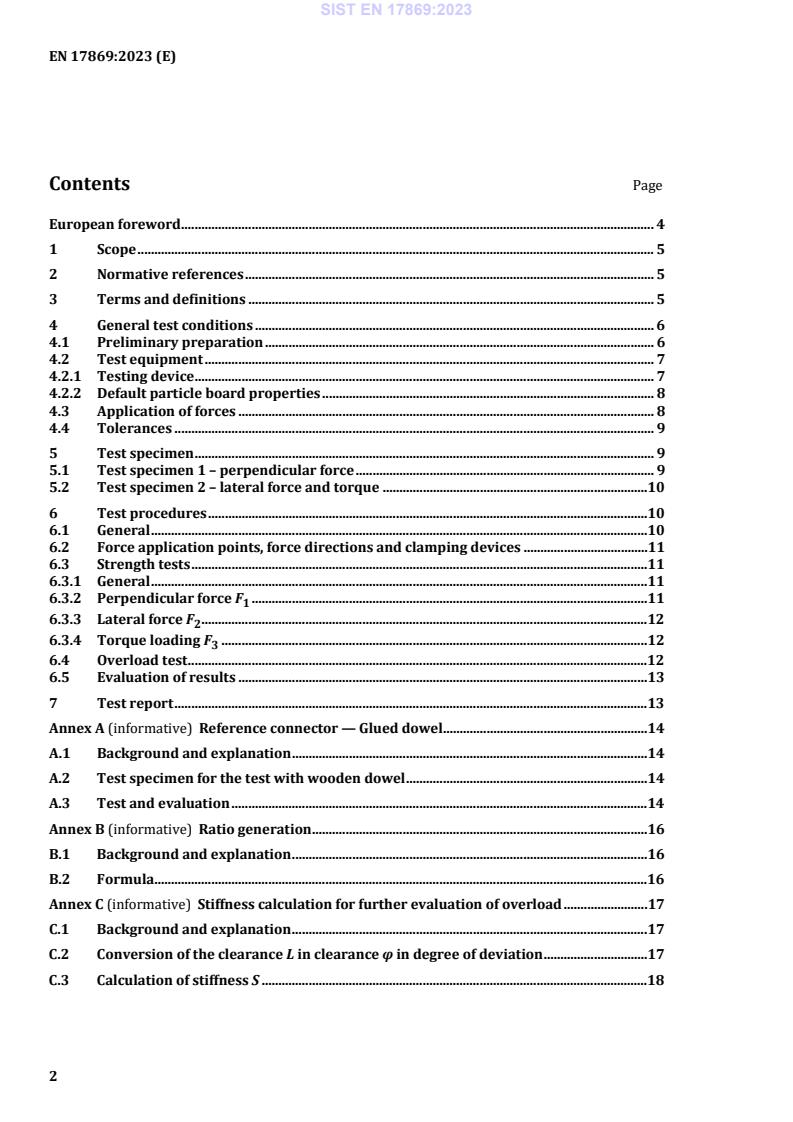
Contents Page
European foreword . 4
1 Scope . 5
2 Normative references . 5
3 Terms and definitions . 5
4 General test conditions . 6
4.1 Preliminary preparation . 6
4.2 Test equipment . 7
4.2.1 Testing device . 7
4.2.2 Default particle board properties . 8
4.3 Application of forces . 8
4.4 Tolerances . 9
5 Test specimen . 9
5.1 Test specimen 1 – perpendicular force . 9
5.2 Test specimen 2 – lateral force and torque .10
6 Test procedures .10
6.1 General .10
6.2 Force application points, force directions and clamping devices .11
6.3 Strength tests .11
6.3.1 General .11
6.3.2 Perpendicular force F .11
6.3.3 Lateral force F .12
6.3.4 Torque loading F .12
6.4 Overload test .12
6.5 Evaluation of results .13
7 Test report .13
Annex A (informative) Reference connector — Glued dowel .14
A.1 Background and explanation .14
A.2 Test specimen for the test with wooden dowel .14
A.3 Test and evaluation .14
Annex B (informative) Ratio generation .16
B.1 Background and explanation .16
B.2 Formula.16
Annex C (informative) Stiffness calculation for further evaluation of overload .17
C.1 Background and explanation .17
C.2 Conversion of the clearance L in clearance φ in degree of deviation .17
C.3 Calculation of stiffness S .18
Annex D (informative) Evaluation by the characteristic value (5 % percentile) . 19
D.1 Background . 19
D.2 General information . 19
D.3 Characteristic value for strength . 19
D.4 Characteristic value for stiffness and clearance in degrees . 21
Bibliography . 25
European foreword
This document (EN 17869:2023) has been prepared by Technical Committee CEN/TC 207 “Furniture”,
the secretariat of which is held by UNI.
This European Standard shall be given the status of a national standard, either by publication of an
identical text or by endorsement, at the latest by September 2023, and conflicting national standards shall
be withdrawn at the latest by September 2023.
Attention is drawn to the possibility that some of the elements of this document may be the subject of
patent rights. CEN shall not be held responsible for identifying any or all such patent rights.
Any feedback and questions on this document should be directed to the users’ national standards body.
A complete listing of these bodies can be found on the CEN website.
According to the CEN-CENELEC Internal Regulations, the national standards organisations of the
following countries are bound to implement this European Standard: Austria, Belgium, Bulgaria, Croatia,
Cyprus, Czech Republic, Denmark, Estonia, Finland, France, Germany, Greece, Hungary, Iceland, Ireland,
Italy, Latvia, Lithuania, Luxembourg, Malta, Netherlands, Norway, Poland, Portugal, Republic of North
Macedonia, Romania, Serbia, Slovakia, Slovenia, Spain, Sweden, Switzerland, Türkiye and the United
Kingdom.
1 Scope
This document specifies test methods for the strength and overload tests of connectors for furniture
constructed from panel material and procedures for evaluating test results.
This document is specifically intended for assessing cabinet connectors for carcases made of wood-based
panel materials. The methods described can, however, be used to assess the relative performance of other
types of connectors, e.g. some types of connectors for beds.
The strength and overload tests only apply to the connectors and their components, as well as the
mounting to and in the cabinet carcase. They do not apply to additional functions that the connector can
have, e.g. covering of the connector.
The tests described in this document are carried out according to a test setup with specified properties
and characteristics.
The test results are only valid for the connector tested. The results can be used to represent the
performance of production models, provided the tested model is representative of the production model.
Aging and the influences of temperature and humidity are not included. This document contains four
informative annexes, providing additional methodologies for the detailed evaluation of the test results
and a procedure for comparing the tested connector with a reference connector:
— Annex A (informative) Reference connector — Glued dowel;
— Annex B (informative) Ratio generation;
— Annex C (informative) Stiffness calculation for further evaluation of the overload;
— Annex D (informative) Evaluation by the characteristic value (5 % percentile).
2 Normative references
The following documents are referred to in the text in such a way that some or all of their content
constitutes requirements of this document. For dated references, only the edition cited applies. For
undated references, the latest edition of the referenced document (including any amendments) applies.
EN 312, Particleboards — Specifications
EN 320, Particleboards and fibreboards — Determination of resistance to axial withdrawal of screws
EN 323, Wood-based panels — Determination of density
3 Terms and definitions
For the purposes of this document, the following terms and definitions apply.
ISO and IEC maintain terminology databases for use in standardization at the following addresses:
• ISO Online browsing platform: available at https://www.iso.org/obp
• IEC Electropedia: available at https://www.electropedia.org/
3.1
clearance
L
force-free mobility of the connection, which occurs during the described tests due to repeated loading
Note 1 to entry: The clearance L is given in mm.
3.2
connector
connector for use in furniture constructed from panel materials, such as cabinet furniture and shelves
3.3
maximum torque
maximum achievable torque when screwing in the connectors without damaging the connector or the
furniture
4 General test conditions
4.1 Preliminary preparation
The connectors(s) shall be mounted according to the instructions of the manufacturer.
If mounting or assembly instructions are not supplied, or if different mounting positions of the connector
are possible, the most adverse configuration shall be used and the mounting or assembly method shall be
recorded in the test report.
Connectors shall be tightened to the manufacturer’s defined torque before testing and shall not be re-
tightened unless specifically required in the manufacturer's instructions. In case the torque is not
specified by the manufacturer, the connectors are tightened to 80 % of the maximum torque or to any
other reasonable value. The torque value shall be recorded in the report. Even if the configuration is to
be changed to produce the worst-case conditions this shall be recorded in the test report.
The design of the test specimens and test equipment shall not influence the test results and shall be
adjusted if necessary. Adjustments of the test specimens or the test equipment shall be recorded in the
test report.
The tests shall be carried out in indoor ambient conditions at a temperature between 15 °C and 25 °C. If
during a test the temperature is outside the range of 15 °C to 25 °C, the maximum and/or minimum
temperature shall be recorded in the test report.
Connectors which include structural hardware parts made of hygroscopic plastic materials, e.g.
polyamide in load-bearing function shall be conditioned at (23 ± 5) °C and a relative humidity of
(50 ± 5) % for at least seven days before testing. Panel materials used for the test setting shall be kept in
the standard climate for at least seven days before testing.
Before beginning the testing, visually inspect the connector(s) thoroughly. Record any defects so that
they are not assumed to have been caused by the tests. Carry out measurements when specified.
NOTE For accelerating the conditioning process, EN ISO 1110 [1] can be used.
4.2 Test equipment
4.2.1 Testing device
4.2.1.1 General
An apparatus which, by means of a loading device (Figure 1), allows the application of a compressive
force at the force application points as shown in Figure 5.
4.2.1.2 Loading device
The loading device shall be rotatable and made of steel without any play as shown in Figure 1. The bearing
shall be executed in such a way that the loading device can deflect by max. 0,1 mm transverse to the
vertical plane of symmetry shown in Figure 1 b). A schematic illustration of a suitable bearing is shown
in Figure 2.
Dimensions in millimetres
a) front view b) side view
Figure 1 — Loading device
The diameter of the mandrel for mounting the loading device should be at least 12 mm, the mandrel shall
be made of steel.
The loading device shall not prevent deformation of the test specimen or breaking of the connectors. The
two recesses of the loading device shall be enlarged as required. The dimension of any enlargement shall
be recorded in the test report.
Dimensions in millimetres
Key
1 illustration, schematic
2 loading device
3 mandrel
Figure 2 — Schematic illustration for the bearing of the loading device
4.2.1.3 Clamping device
The clamping device shall hold the test specimens and shall be mounted in accordance with Figure 5 and
shall extend over the entire depth/length of the test specimens.
Clamping device 1 shall be applied to test specimen 1.
Clamping device 2 shall be applied to test specimen 2.
4.2.2 Default particle board properties
If the manufacturer does not specify the panel board used for the tests in Clause 5, the particle board shall
comply with type P2 according to EN 312. The properties of the particle board shall be as specified in
Table 1.
Table 1 — Default particle board properties
Property Referenced standard Requirement
Axial withdrawal of screws EN 320 (1 100 ± 100) N
Density EN 323
(650 ± 50) kg/m
4.3 Application of forces
The forces shall be applied sufficiently slowly to ensure that negligible dynamic force is applied.
The forces may be replaced by masses. The relation 10 N = 1 kg shall be used for this purpose.
4.4 Tolerances
Unless otherwise stated, the following tolerances are applicable:
— Forces: ±5 % of the nominal force;
— Masses: ±1 % of the nominal mass;
— Dimensions: ±0,5 mm of the nominal dimension;
— Velocities: ±5 % of the nominal velocity.
NOTE For the purpose of uncertainty measurement, test results are not considered to be adversely affected
when the above tolerances are met.
5 Test specimen
5.1 Test specimen 1 – perpendicular force
The test specimen consists of one horizontal test part, one vertical test part and a connector. The test
parts shall be made of panel board with a thickness t. The dimensions of the test specimen shall be as
given i
...