

oSIST prEN 16002:2026
(Main)Flexible sheets for waterproofing - Determination of the resistance to wind load of mechanically fastened flexible sheets for roof waterproofing
- Abstract
This document specifies a test method to determine the resistance to wind load of mechanically fastened flexible sheets for roof waterproofing.
The assessment is limited to the performance of the mechanically fastened flexible sheets only. The test method does not include the determination of the performance of the fixing element and the mechanical fastener in combination with the structural deck.
- Status
- Not Published
- Public Enquiry End Date
- 08-Sep-2026
- Technical Committee
- VLA - Water proofing
- Current Stage
- 4020 - Public enquire (PE) (Adopted Project)
- Start Date
- 24-Jun-2026
- Due Date
- 11-Nov-2026

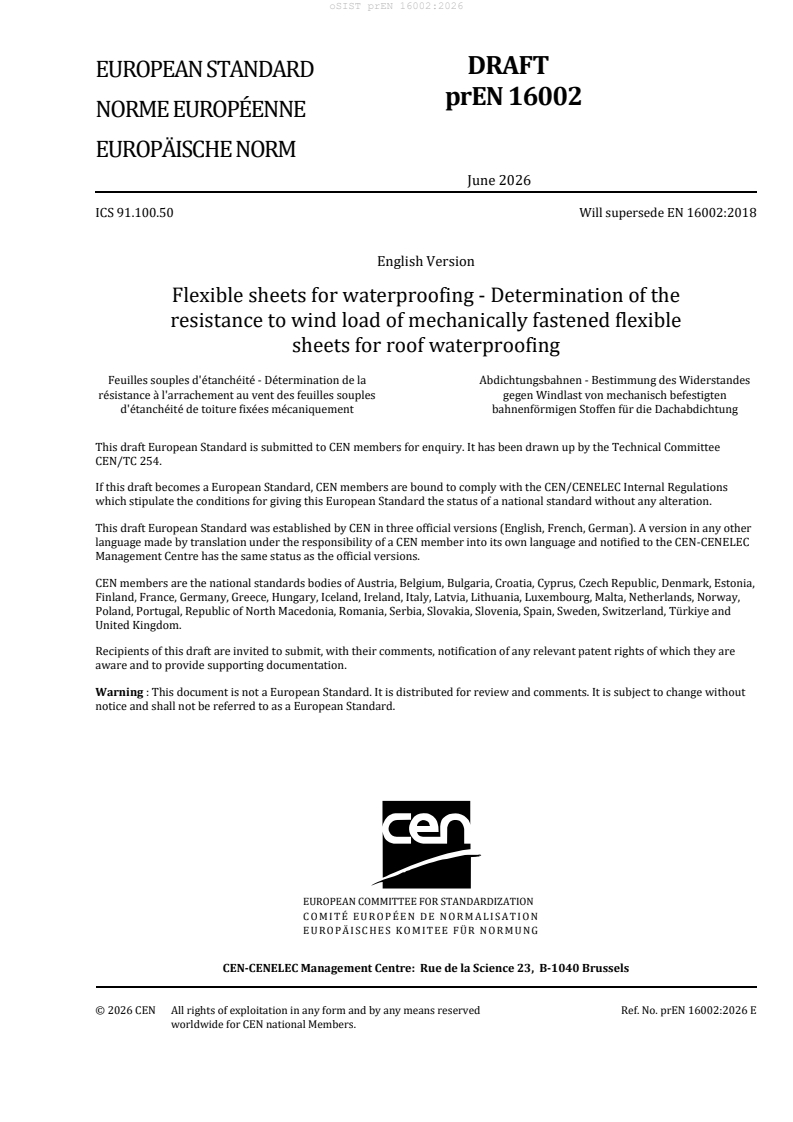
oSIST prEN 16002:2026 is a CEN draft European Standard for a laboratory test method that measures the resistance to wind load of mechanically fastened flexible sheets for roof waterproofing. It specifies how to prepare the test specimen, apply cyclic suction loads, and express the result as a characteristic load per discrete fastening point. Manufacturers, test laboratories, designers and roofing-system specifiers use it to compare products and to document wind-uplift performance.
What does oSIST prEN 16002:2026 specify?
oSIST prEN 16002:2026 specifies a test method for mechanically fastened flexible sheets used for roof waterproofing. The assessment focuses on the flexible sheet system under wind load, while the fixing element and the mechanical fastener in combination with the structural deck are outside the scope of the performance assessment.
The document is organized into clauses for scope, normative references, terms and definitions, symbols and abbreviations, sampling, test conditions, apparatus, test setup, testing, evaluation of results, application rules and the test report. In practice, that means the standard tells you what to test, how to test it, how to calculate the result and what to record so the result can be traced and compared.
What are the key requirements of oSIST prEN 16002:2026?
oSIST prEN 16002:2026 sets up a controlled wind-uplift test on a standard roof build-up. The result is not a general roof design value by itself; it is a measured resistance value for the mechanically fastened flexible sheet system, expressed per discrete fastening point.
Sampling, conditioning and specimen setup
- Clause 5 requires sampling of the flexible sheets according to EN 13416, while additional materials follow the relevant harmonized technical specifications or, if those are not available, the applicant’s instructions. This matters because the test result depends on the actual materials used in the specimen.
- Clause 6 requires conditioning of the specimen and apparatus for at least 16 h at (23 ± 5) °C, and testing under the same conditions. This reduces variability from temperature and handling.
- Clause 8.1 requires one test specimen, a specimen that fits the chamber, a pitch of (0 ± 2)° or (90 ± 2)°, and at least 3 rows of discrete fastening points. That keeps the test geometry consistent and comparable.
- Clause 8.2 controls the test area dimensions and spacing of the fastening pattern. The chamber and specimen geometry must prevent edge effects from distorting the result.
Materials used in the test build-up
- Clause 8.4 specifies mineral wool insulation boards according to EN 13162, with fixed thickness, compressibility and point-load characteristics. If other insulation or substrates are used, the setup must allow free airflow beneath the membrane. In practice, that airflow is needed so the suction load reaches the test area correctly.
- Clause 8.5 requires testing without air and vapour control layers. The result therefore reflects the roof build-up used in the test, not a layer that is absent from the specimen.
- Clause 8.6 allows the structural deck to be selected by the applicant, but it must be described in the test report. That makes the support condition part of the traceable test record.
Apparatus, load sequence and failure recording
- Clause 7 requires a pressure chamber with observation windows, an airtight seal, fan and control equipment, and time-pressure registration. The pressure and time recording must be detailed enough to show the applied load history.
- Clause 7.3 requires calibration of the pressure and time device, thermometer and chronometer once per year. This matters because the result depends on the accuracy of the suction load and the timing of each gust.
- Clause 9.2 defines the gust load/time shape, including the rise to peak load, load tolerance and maximum gust duration. The load history has to match the prescribed profile, not just reach a peak value.
- Clause 9.4 applies a proportional sequence of peak loads in cycles, with the load increased stepwise until failure. The test stops at failure, and Clause 9.5 requires recording environmental temperature, specimen behaviour, the failure cycle and the peak pressure at failure.
Evaluation and application of the result
- Clause 10.1 calculates the characteristic load per discrete fastening point from the peak pressure before failure and correction factors. In practice, this is the reported performance value.
- Clause 10.2 applies a geometric correction factor based on the fastening layout and specimen geometry. This adjusts the test result toward the behaviour of a full roof.
- Clause 10.3 applies a statistical correction factor based on the number and arrangement of fastening points. This reflects the different failure probability in a smaller test arrangement.
- Clause 11 explains where the result can be applied: to roof pitches from 0° to 90°, to other structural decks under stated conditions, to systems with an air and vapour control layer, and to insulation conditions defined in the standard. It also covers multi-layer systems and single-ply synthetic waterproofing systems within the stated material group limits.
What terms does oSIST prEN 16002:2026 define?
- Fastener - the object that attaches the fixing element to the structural deck, such as a screw, nail, expanding anchor or rivet.
- Fixing element - the component that secures the waterproofing system to the structural deck together with the fastener, such as washers, sleeves or continuous strips.
- Fastening system - the assembly of fasteners and fixing elements used to secure the waterproofing system to the deck.
- Discrete fastening point - one fastener plus one fixing element acting as a single attachment point.
- Jointing technique - the method used to make seams by overlapping or butt-jointing with a covering strip, using bonding or welding.
- Test specimen - the representative roof section made of one or more waterproofing layers, insulation and a structural deck.
- Structural deck - the roof deck or slab that transfers permanent and variable loads to the rest of the structure.
- Air and vapour control layer (AVCL) - a continuous low-permeability layer used to control movement of air and water vapour.
Who uses oSIST prEN 16002:2026?
oSIST prEN 16002:2026 is used by manufacturers of flexible waterproofing sheets, fastening systems and roof components, as well as by test laboratories that perform wind-uplift testing. It is also used by quality managers, technical assessors, certification bodies and buyers who need a documented performance value for mechanically fastened roof waterproofing.
Designers and specifiers use it when comparing roof build-ups, checking whether a fastening pattern is suitable, and preparing project documentation. Installers and suppliers also use the test report requirements to show which materials, deck type, insulation and fastening arrangement were tested.
What changed in oSIST prEN 16002:2026 from the previous edition?
oSIST prEN 16002:2026 supersedes EN 16002:2018 and EN 16002:2018/AC:2021. The foreword states these significant technical changes:
- the test is performed on a standard test configuration with a structural deck, an insulation layer and the mechanically fastened flexible sheet(s);
- the performance of the mechanical fastening system can be assessed separately using EAD 030351-00-0402:2019, Annex 2;
- the performance of the whole roof is to be calculated using the relevant national and/or international standards;
- the result is expressed as the resistance to wind load of the flexible sheet as a characteristic load per discrete fastening point;
- safety factors are defined in CEN/TS 17659 or by national regulation and/or European or national application documents.
Which standards are used with oSIST prEN 16002:2026?
| Document | What it contributes |
|---|---|
| EN 13162 | Specifies the mineral wool insulation products used in the test setup. |
| EN 13416 | Gives the sampling rules for flexible sheets for roof waterproofing. |
| EN 13707 | Provides terms and definitions for reinforced bitumen sheets. |
| EN 13956 | Provides terms and definitions for plastic and rubber sheets. |
| ISO/IEC Guide 98-3 | Gives the measurement uncertainty framework used for accuracy and uncertainty requirements. |
| CEN/TS 17659 | Is cited for design concepts, safety factors and application guidance. |
| EAD 030351-00-0402:2019 | Is cited for determining fastening system performance, including Annex 2. |
What does the oSIST prEN 16002:2026 document contain?
oSIST prEN 16002:2026 contains the apparatus requirements, chamber calibration conditions, test specimen dimensions, load/time diagram, and the cyclic suction loading procedure used to generate the failure result. It also includes figures for specimen layout and fastening spacing, a figure for the gust profile, and tables for the cycle load progression and the correction factor related to fastening layout.
The later clauses provide the calculation of the characteristic load, the geometric and statistical correction factors, and the rules for applying the result to other pitches, decks, insulation types and roof sheet systems. The test report clause then lists the information needed for traceability, including the specimen description, fastening pattern, deck details, failure mode, calibration date and reported characteristic load.
Relations
- Effective Date
- 14-May-2025
- Effective Date
- 07-May-2025
Get Certified
Connect with accredited certification bodies for this standard

DIBt (Deutsches Institut für Bautechnik)
German Institute for Building Technology.

DIN CERTCO
DIN Group product certification.

Aboma Certification B.V.
Specialized in construction, metal, and transport sectors.
Sponsored listings
Frequently Asked Questions
oSIST prEN 16002:2026 is a draft published by the Slovenian Institute for Standardization (SIST). Its full title is "Flexible sheets for waterproofing - Determination of the resistance to wind load of mechanically fastened flexible sheets for roof waterproofing". This standard covers: This document specifies a test method to determine the resistance to wind load of mechanically fastened flexible sheets for roof waterproofing. The assessment is limited to the performance of the mechanically fastened flexible sheets only. The test method does not include the determination of the performance of the fixing element and the mechanical fastener in combination with the structural deck.
This document specifies a test method to determine the resistance to wind load of mechanically fastened flexible sheets for roof waterproofing. The assessment is limited to the performance of the mechanically fastened flexible sheets only. The test method does not include the determination of the performance of the fixing element and the mechanical fastener in combination with the structural deck.
oSIST prEN 16002:2026 is classified under the following ICS (International Classification for Standards) categories: 91.060.20 - Roofs; 91.100.50 - Binders. Sealing materials. The ICS classification helps identify the subject area and facilitates finding related standards.
oSIST prEN 16002:2026 has the following relationships with other standards: It is inter standard links to SIST EN 16002:2019/AC:2022, SIST EN 16002:2019. Understanding these relationships helps ensure you are using the most current and applicable version of the standard.
oSIST prEN 16002:2026 is available in PDF format for immediate download after purchase. The document can be added to your cart and obtained through the secure checkout process. Digital delivery ensures instant access to the complete standard document.
Standards Content (Sample)
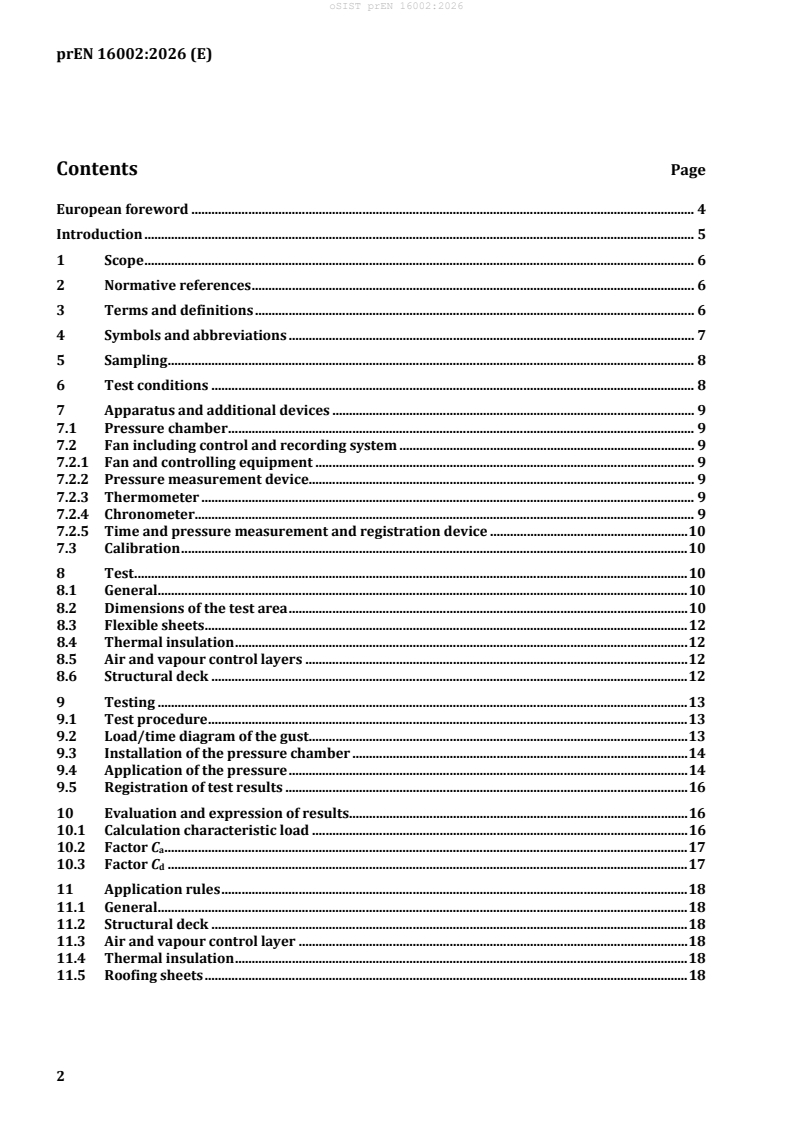
Contents
- Introduction
- 1 Scope
- 2 Normative references
- 3 Terms and definitions
- 3.1 fastener
- 3.2 fixing element
- 3.3 fastening system
- 3.4 discrete fastening point
- 3.5 jointing technique
- 3.6 test specimen
- 3.7 structural deck
- 3.8 air and vapour control layer (AVCL)
- 4 Symbols and abbreviations
- 5 Sampling
- 6 Test conditions
- 7 Apparatus and additional devices
- 7.1 Pressure chamber
- 7.2 Fan including control and recording system
- 7.3 Calibration
- 8 Test
- 8.1 General
- 8.2 Dimensions of the test area
- 8.3 Flexible sheets
- 8.4 Thermal insulation
- 8.5 Air and vapour control layers
- 8.6 Structural deck
- 9 Testing
- 9.1 Test procedure
- 9.2 Load/time diagram of the gust
- 9.3 Installation of the pressure chamber
- 9.4 Application of the pressure
- 9.5 Registration of test results
- 10 Evaluation and expression of results
- 10.1 Calculation characteristic load
- 10.2 Factor Ca
- 10.3 Factor C
- 11 Application rules
- 11.1 General
- 11.2 Structural deck
- 11.3 Air and vapour control layer
- 11.4 Thermal insulation
- 11.5 Roofing sheets
- 12 Test report
- Bibliography
Introduction
The test is performed on a standard test configuration, i.e. a structural deck, a layer of insulation material and the mechanically fastened flexible sheet(s) for waterproofing. For the determination of the performance of the mechanical fastening system, with or without possible structural decks, EAD 030351-00-0402:2019, Annex 2 may be used. The suppliers of these mechanical fastening systems should provide the required information.
For the calculation of the performance of wind load resistance of the whole roof, see the relevant national and/or international standards.
The result of this standard is the resistance to wind load of the flexible sheet expressed as the characteristic load per discrete fastening point. Safety factors are defined in CEN/TS 17659 or may be defined by national regulation and/or within European or national application documents.
oSIST prEN 16002:2026 prEN 16002:2026 (E)
1 Scope
This document specifies a test method to determine the resistance to wind load of mechanically fastened flexible sheets for roof waterproofing.
The assessment is limited to the performance of the mechanically fastened flexible sheets only. The test method does not include the determination of the performance of the fixing element and the mechanical fastener in combination with the structural deck.
2 Normative references
The following documents are referred to in the text in such a way that some or all of their content constitutes requirements of this document. For dated references, only the edition cited applies. For undated references, the latest edition of the referenced document (including any amendments) applies. EN 13162, Thermal insulation products for buildings — Factory made mineral wool (MW) products — Specification EN 13416, Flexible sheets for waterproofing — Bitumen, plastic and rubber sheets for roof waterproofing - Rules for sampling EN 13707, Flexible sheets for waterproofing — Reinforced bitumen sheets for roof waterproofing — Definitions and characteristics EN 13956, Flexible sheets for waterproofing — Plastic and rubber sheets for roof waterproofing — Definitions and characteristics ISO/IEC Guide 98-3, Uncertainty of measurement — Part 3: Guide to the expression of uncertainty in measurement (GUM:1995)
3 Terms and definitions
For the purposes of this document, the terms and definitions given in EN 13707 and EN 13956 and the following apply.
ISO and IEC maintain terminological databases for use in standardization at the following addresses:
- IEC Electropedia: available at https://www.electropedia.org/
- ISO Online browsing platform: available at https://www.iso.org/obp
3.1 fastener
object to fasten the fixing element to a structural deck Note 1 to entry: Fastener can be e.g. a screw, nail, expanding anchor or rivet.
3.2 fixing element
component that secures the waterproofing system, in connection with the fastener, to the structural deck Note 1 to entry: A fixing element is the fastening system without the fastener e.g. metal washers with or without a plastic sleeve, - plastic washers with or without an integrated sleeve, or - metal bar/continuous strips with or without a plastic sleeve
oSIST prEN 16002:2026 prEN 16002:2026 (E)
3.3 fastening system
assembly of the fasteners and the fixing elements intended to secure the waterproofing system to the structural deck Note 1 to entry: Whilst primarily intended to secure the covering against wind uplift forces, the system may contribute to securing intermediate layers such as thermal insulation, air and vapour control layers, etc. Note 2 to entry: Fastening system can be e.g. fasteners with: - metal washers with or without a plastic sleeve, - plastic washers with or without an integrated sleeve, or - metal bar/continuous strips with or without a plastic sleeve.
3.4 discrete fastening point
assembly of one single fastener and fixing element intended to secure the waterproofing system to the structural deck
3.5 jointing technique
technique of material-specific overlapping seam of waterproofing sheets or butt joint with a covering strip achieved by bonding (torch, adhesive) and/or welding (hot air, chemicals)
3.6 test specimen
representative part of the roof, consisting of one or more layers of flexible sheet for roof waterproofing, an insulation layer and a structural deck
3.7 structural deck
roofing deck/slab which has to transfer both permanent and variable loads to the other construction parts of the roof or building
3.8 air and vapour control layer (AVCL)
continuous layer of low permeability material to control the movement of air and water vapour
4 Symbols and abbreviations
For the purposes of this document, the following symbols apply. Unit
A area of influence of each discrete fastening point mm
a maximum spacing between rows of discrete fastening points mm b maximum spacing between discrete fastening points in a row mm C geometric correction factor - a C statistical correction factor - d g number of gusts, specified for each “proportional” peak load in a cycle -
oSIST prEN 16002:2026 prEN 16002:2026 (E) i proportional part of P % 100 %;n l length of the test area inside the pressure chamber mm m width of the test area inside the pressure chamber mm n number of cycles before failure - f P applied pressure during the gust kPa a P peak pressure during the gust kPa
P peak pressure of the cycle preceding the cycle of failure kPa test P peak pressure in the pressure chamber during cycle (n) kPa 100 %;n t time s ΔW applied load per discrete fastening point N a ΔW characteristic load for the resistance to wind uplift per discrete fastening point N char ΔW admissible (design) load for the resistance to wind uplift per discrete fastening point N adm ΔW peak load per discrete fastening point N
ΔW peak load per discrete fastening point of cycle (n) with n = 1, 2, 3, …, n N 100 %;n f α number of spaces between rows of discrete fastening points - β number of spaces between the discrete fastening points - γ material partial factor - M
5 Sampling
The flexible sheets for roof waterproofing shall be sampled according to EN 13416. All additional materials to construct the test specimen such as fixing elements, fasteners, insulation, structural deck, shall be according to the sampling requirements of the relevant European harmonized technical specifications. If these specifications are not available, then sampling shall be done according to the instructions of the applicant.
6 Test conditions
The test specimen and the apparatus shall be conditioned for at least 16 h in an environment of (23 ± 5) °C prior to the test and used under the same conditions.
oSIST prEN 16002:2026 prEN 16002:2026 (E)
7 Apparatus and additional devices
7.1 Pressure chamber
The pressure chamber shall meet the following requirements:
- the internal length and width of the pressure chamber shall be according to 8.2;
- the pressure chamber shall be provided with one or more windows in such a way that the test specimen can be observed during testing;
- it shall be possible to create an airtight seal between the test specimen and the pressure chamber;
- the pressure chamber is recommended to be capable of resisting a suction pressure of at least
10 000 N/m ; - the height of the pressure chamber shall be such that the applied pressure is equally distributed and not affected by deformations of the test specimen; - the pressure chamber and additional devices shall be calibrated according to 7.3. The pressure chamber shall include:
- fan including control and recording system according to 7.2.1;
- pressure and time measurement and registration device according to 7.2.5;
- thermometer according to 7.2.3;
- chronometer according to 7.2.4.
7.2 Fan including control and recording system
7.2.1 Fan and controlling equipment
The combination of the fan and the controlling equipment (e.g. valve) shall be capable of producing the dynamic load cycles, as defined in 9.4.
7.2.2 Pressure measurement device
The pressure and time measurement device shall have a measurement accuracy according to
ISO/IEC Guide 98-3 of less than ±2 %. A minimum accuracy of 20 N/m is allowed. The pressure and time registration device shall be capable of registering and storing the pressure level every 0,1 s during the whole test period.
...