


SIST EN 13226:2009
(Main)Wood flooring - Solid parquet elements with grooves and/or tongues
Wood flooring - Solid parquet elements with grooves and/or tongues
This European Standard specifies the characteristics of solid parquet elements with grooves and/or tongues for internal use as flooring. This standard is not applicable to panels made from elements for which a separate standard is in course of preparation.
This standard covers elements with or without surface treatment.
Holzfußböden - Massivholz-Elemente mit Nut und/oder Feder
Diese Europäische Norm legt die Merkmale von Massivholz-Elementen mit Nut und/oder Feder für die
Verwendung als Fußbodenbelag in Innenräumen fest. Diese Norm betrifft nicht aus Elementen
zusammengesetzte Parketttafeln; hierfür ist eine separate Norm in Vorbereitung.
Diese Norm gilt für Elemente mit oder ohne Oberflächenbehandlung.
Planchers en bois - Eléments de parquet massif avec rainures et/ou languettes
La présente norme européenne définit les caractéristiques des éléments de parquet massif avec rainures et/ou languettes pour utilisation en intérieur comme plancher. La présente norme ne s’applique pas aux panneaux constitués d’éléments pour lesquels une norme spécifique est en cours de préparation.
La présente norme couvre les éléments avec ou sans traitement de surface.
Lesene talne obloge - Masivne parketne deščice s peresom in/ali utorom
General Information
- Status
- Withdrawn
- Public Enquiry End Date
- 27-Feb-2009
- Publication Date
- 16-Aug-2009
- Withdrawal Date
- 17-Dec-2024
- Technical Committee
- LLZ - Les, lesni izdelki in zaščita lesa
- Current Stage
- 9900 - Withdrawal (Adopted Project)
- Start Date
- 17-Dec-2024
- Due Date
- 09-Jan-2025
- Completion Date
- 18-Dec-2024
Relations
- Effective Date
- 01-Sep-2009
- Effective Date
- 01-Jul-2020



Frequently Asked Questions
SIST EN 13226:2009 is a standard published by the Slovenian Institute for Standardization (SIST). Its full title is "Wood flooring - Solid parquet elements with grooves and/or tongues". This standard covers: This European Standard specifies the characteristics of solid parquet elements with grooves and/or tongues for internal use as flooring. This standard is not applicable to panels made from elements for which a separate standard is in course of preparation. This standard covers elements with or without surface treatment.
This European Standard specifies the characteristics of solid parquet elements with grooves and/or tongues for internal use as flooring. This standard is not applicable to panels made from elements for which a separate standard is in course of preparation. This standard covers elements with or without surface treatment.
SIST EN 13226:2009 is classified under the following ICS (International Classification for Standards) categories: 79.080 - Semi-manufactures of timber; 97.150 - Floor coverings. The ICS classification helps identify the subject area and facilitates finding related standards.
SIST EN 13226:2009 has the following relationships with other standards: It is inter standard links to SIST EN 13226:2003, SIST EN 13226:2025. Understanding these relationships helps ensure you are using the most current and applicable version of the standard.
You can purchase SIST EN 13226:2009 directly from iTeh Standards. The document is available in PDF format and is delivered instantly after payment. Add the standard to your cart and complete the secure checkout process. iTeh Standards is an authorized distributor of SIST standards.
Standards Content (Sample)
2003-01.Slovenski inštitut za standardizacijo. Razmnoževanje celote ali delov tega standarda ni dovoljeno.WRURPHolzfußböden - Massivholz-Elemente mit Nut und/oder FederPlanchers en bois - Eléments de parquet massif avec rainures et/ou languettesWood flooring - Solid parquet elements with grooves and/or tongues97.150Netekstilne talne oblogeNon-textile floor coverings79.080Polizdelki iz lesaSemi-manufactures of timberICS:Ta slovenski standard je istoveten z:EN 13226:2009SIST EN 13226:2009en,fr,de01-september-2009SIST EN 13226:2009SLOVENSKI
STANDARDSIST EN 13226:20031DGRPHãþD
EUROPEAN STANDARDNORME EUROPÉENNEEUROPÄISCHE NORMEN 13226May 2009ICS 79.080Supersedes EN 13226:2002
English VersionWood flooring - Solid parquet elements with grooves and/ortonguesPlanchers en bois - Eléments de parquet massif avecrainures et/ou languettesHolzfußböden - Massivholz-Elemente mit Nut und/oderFederThis European Standard was approved by CEN on 24 April 2009.CEN members are bound to comply with the CEN/CENELEC Internal Regulations which stipulate the conditions for giving this EuropeanStandard the status of a national standard without any alteration. Up-to-date lists and bibliographical references concerning such nationalstandards may be obtained on application to the CEN Management Centre or to any CEN member.This European Standard exists in three official versions (English, French, German). A version in any other language made by translationunder the responsibility of a CEN member into its own language and notified to the CEN Management Centre has the same status as theofficial versions.CEN members are the national standards bodies of Austria, Belgium, Bulgaria, Cyprus, Czech Republic, Denmark, Estonia, Finland,France, Germany, Greece, Hungary, Iceland, Ireland, Italy, Latvia, Lithuania, Luxembourg, Malta, Netherlands, Norway, Poland, Portugal,Romania, Slovakia, Slovenia, Spain, Sweden, Switzerland and United Kingdom.EUROPEAN COMMITTEE FOR STANDARDIZATIONCOMITÉ EUROPÉEN DE NORMALISATIONEUROPÄISCHES KOMITEE FÜR NORMUNGManagement Centre:
Avenue Marnix 17,
B-1000 Brussels© 2009 CENAll rights of exploitation in any form and by any means reservedworldwide for CEN national Members.Ref. No. EN 13226:2009: ESIST EN 13226:2009
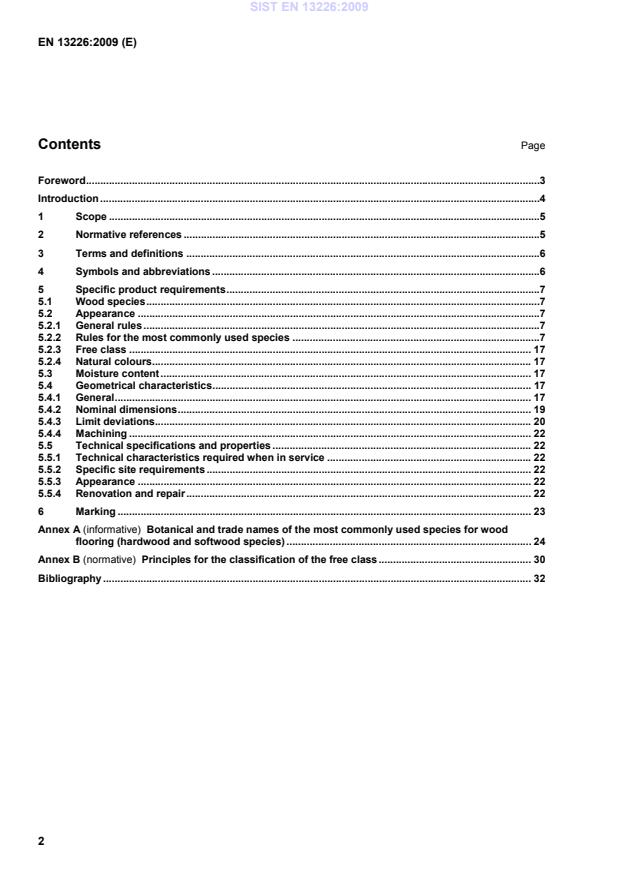
Botanical and trade names of the most commonly used species for wood flooring (hardwood and softwood species) . 24 Annex B (normative)
Principles for the classification of the free class . 30 Bibliography . 32
[EN 13756:2002] 3.2 right-handed strip element having the end tongue on the right when viewed on the face with the edge tongue directed towards the observer
[EN 13756:2002] 3.3 thickness above the groove thickness between the face and any discontinuity such as a change in the profile (excluding chamfering), a groove/glue pocket or a glue line (excluding the glue line of finger-joints)
[EN 13756:2002] 4 Symbols and abbreviations L Length of the face of the element; b Width of the face of the element; b1 Depth of the groove; b2 Width of the tongue; b3 Undercut; t Thickness between the face and the back of the element; t1 Thickness above the groove; t2 Width of the groove; t3 Thickness of the tongue; t4 Thickness of the part below the tongue; t5 Depth of optional glue pocket; a Slope of the upper lip; α Arrow tail; ß Slope of the under lip. SIST EN 13226:2009
1) The chamfering is visible when elements are assembled. SIST EN 13226:2009
Table 1 — Classification for Quercus spp. (oak) Face of the element
Features Class { ∆∆∆∆ … Sound sapwood Not permitted Permitted. Slight traces permitted Knots
Sound and intergrown Permitted if: diameter ≤ 8 mm Permitted if: diameter ≤ 10 mm All features permitted without limit to size or quantity if these do not impair the strength or the wearing quality of the wood flooring. Unsound knots diameter ≤ 1 mm diameter ≤ 5 mm Checks Not permitted Permitted up to 15 mm in length Bark pockets Not permitted Not permitted Lightning shake Not permitted Not permitted Slope of grain Permitted, no limit Permitted, no limit Colour variation Slight variation permitted Permitteda
Medullary ray Permitted Permitted Biodeterioration Not permitted Not permitted Not permitted, except blue stain and black holes Non-visible parts All features permitted without limit to size or quantity if these do not impair the strength or the wearing quality of the wood flooring. Sound sapwood is permitted from the back up to the upper part of the tongue without taking into account the limits set for the face. a Brown oak.
Features Class { ∆∆∆∆ … Sound sapwood Not applicable Not applicable Not applicable Knots
Sound and intergrown Permitted if: diameter ≤ 2 mm Permitted if: diameter ≤ 10 mm All features permitted without limit to size or quantity if these do not impair the strength or the wearing quality of the wood flooring. Unsound knots diameter ≤ 1 mm diameter ≤ 5 mm Checks Not permitted Permitted up to 15 mm in length Bark pockets Not permitted Not permitted Lightning shake Not permitted Not permitted Slope of grain Permitted, no limit Permitted, no limit Colour variation Slight variation permitted. Slight traces of natural discoloration and mineral lines permitted. Permitted Stick marks Not permitted Permitted Biodeterioration Not permitted Not permitted Not permitted, except blue stain and black holes Non-visible parts All features permitted without limit to size or quantity if these do not impair the strength or the wearing quality of the wood flooring.
Features Class { ∆∆∆∆ … Sound sapwood Not applicable Not applicable Not applicable Knots
Sound and intergrown Permitted if: diameter ≤ 2 mm Permitted if: diameter ≤ 10 mm All features permitted without limit to size or quantity if these do not impair the strength or the wearing quality of the wood flooring. Unsound knots diameter ≤ 1 mm diameter ≤ 5 mm Checks Not permitted Permitted up to 15 mm in length Bark pockets Not permitted Not permitted Lightning shake Not permitted Not permitted Slope of grain Permitted, no limit Permitted, no limit Colour variation Slight variation permitted a. Slight traces of natural discoloration permitted. Permitted Red heart Not permitted Permitted Stick marks Not permitted Permitted Medullary ray Permitted Permitted Biodeterioration Not permitted Not permitted Not permitted, except blue stain and black holes Non-visible parts All features permitted without limit to size or quantity if these do not impair the strength or the wearing quality of the wood flooring. a Permitted for steamed beech.
Features Class { ∆∆∆∆ … Sound sapwood Permitted Permitted Permitted Knots
Sound and intergrown
Permitted if
diameter ≤ 2 mma .
35 mm knots permitted with slight checks b, if not grouped together a. If grouped together, their total area c shall not exceed the representative area of one 35 mm diameter knot. No limit in diameter. Slight torn surface permitted. Knots holes or loose knots not permitted Unsound knots Not permitted Permitted if
diameter ≤ 15 mm Resin pockets and traces of pith Length ≤ 10 mm permitted Length ≤ 70 mm permitted Resin pockets are only permitted if the hole does not go through the thickness of the element. Checks and splits Hardly visible permitted Slight splits at the ends and checks permitted Splits at the ends and checks permitted Colour variation Permitted if natural colours of the wood Biodeterioration Not permitted Not permitted Not permitted Non-visible parts All features permitted without limit to size or quantity if these do not impair the strength or the wearing quality of the wood flooring. a Knots are grouped together if the distance separating them, measured from edge to edge, does not exceed 30 mm. b Knots are slightly checked provided the width of the check does not exceed 1 mm. c Area: (π x da1 x db1)/4 + (π x da2 x db2)/4 + … when da1 is the smallest and db1 the largest diameter of the first knot.
Features Class { ∆∆∆∆ … Sound sapwood Not permitted Not permitted Not permitted Knots
Sound and intergrown Permitted if: diameter ≤ 10 mm Permitted if: diameter ≤ 20 mm Permitted if: diameter ≤ 25 mm Unsound knots diameter ≤ 5 mm diameter ≤ 8 mm diameter ≤ 15 mm Curly grain Permitted up to 50 % of the face of the element Permitted Permitted Sound heart Permitted up to 20 % of the length of the element Permitted Permitted Yellow stain Permitted up to 5 % of the face of the element 50 % permitted Permitted Checks and splits Not permitted Permitted when the length ≤ width of the element Permitted when the length ≤ 50 % of the length of the element Ends checks going through the element Not permitted Permitted if ≤ 10 mm in length Permitted if ≤ 30 mm in length Red coloration / Blackheart Not permitted Permitted. when the length ≤ 20 % of the length of the element Permitted when the length ≤ 50 % of the length of the element Slope of the grain Permitted, no limit Permitted, no limit Permitted, no limit Bark pockets Lightning shake Not permitted Not permitted Not permitted Biodeterioration Not permitted Not permitted Not permitted, except blue stain and black holes Non-visible parts All features permitted without limit to size or quantity if these do not impair the strength or the wearing quality of the wood flooring. Sound sapwood is permitted from the back up to the upper of the tongue without taking into account the limits set for the face.
Features Class { ∆∆∆∆ … Sound sapwood Not permitted Permitted Slight traces permitted Knots
Sound and intergrown
Unsound knots Permitted if: diameter ≤ 10 mm
diameter ≤ 3 mm Permitted if: diameter ≤ 20 mm
diameter ≤ 10 mm All features permitted without limit to size or quantity if these do not impair the strength or the wearing quality of the wood flooring. Checks Not permitted Permitted up to 15 mm in length Bark pockets Not permitted Not permitted Lightning shake Not permitted Not permitted Slope of grain Permitted, no limit Permitted, no limit Colour variation 5 % of the face permitted Permitted Resin pockets Not permitted Permitted
2 mm in width Permitted 25 mm in length Biodeterioration Not permitted Not permitted Not permitted, except blue stain and black holes Non-visible parts All features permitted without limit to size or quantity if these do not impair the strength or the wearing quality of the wood flooring. Sound sapwood is permitted from the back up to the upper part of the tongue without taking into account the limits set for the face.
Features Class { ∆∆∆∆ … Sound sapwood Permitted Permitted All features permitted without limit to size or quantity if these do not impair the strength or the wearing quality of the wood flooring. Knots
Sound and intergrown Unsound knots Permitted if: diameter ≤ 10 mm diameter ≤ 3 mm Permitted if: diameter ≤ 20 mm diameter ≤ 10 mm Checks Not permitted
Permitted up to 15 mm in length Bark pockets Not permitted Not permitted Lightning shake Not permitted Not permitted Slope of grain Permitted, no limit Permitted, no limit Colour variation 5 % of the face permitted Permitted Resin pockets Not permitted Permitted 2 mm in width Permitted 25 mm in length Biodeterioration Not permitted Not permitted Not permitted, except blue stain and black holes Non-visible parts All features permitted without limit
...
Questions, Comments and Discussion
Ask us and Technical Secretary will try to provide an answer. You can facilitate discussion about the standard in here.
Loading comments...