


oSIST prEN IEC 63230:2025
(Main)Fatigue assessment of hydraulic turbine runners: from design to quality assurance
Fatigue assessment of hydraulic turbine runners: from design to quality assurance
Évaluation de la fatigue des roues de turbines hydrauliques: de la conception à l'assurance qualité
Ocena utrujenosti tekačev hidravlične turbine: od načrtovanja do zagotavljanja kakovosti
General Information
- Status
- Not Published
- Public Enquiry End Date
- 31-May-2025
- Technical Committee
- IEHT - Electrotechnics - Hydraulic turbins
- Current Stage
- 4020 - Public enquire (PE) (Adopted Project)
- Start Date
- 26-Mar-2025
- Due Date
- 13-Aug-2025
- Completion Date
- 27-May-2025
Overview
prEN IEC 63230:2025 provides guidance for the fatigue assessment of hydraulic turbine runners, covering reaction turbines of all sizes and configurations (e.g., Francis, Kaplan, propeller, diagonal). The standard addresses the full chain from design to quality assurance, specifying recommended methodologies to define load events, determine stresses, and assess fatigue using both S-N and fracture mechanics approaches. It also details manufacturing and inspection practices and best practices for on-site strain measurements and finite element analysis.
Key Topics
- Scope and applicability: Guidance applies to new and existing runners; excludes internal components of adjustable blade mechanisms. The standard clarifies when a fatigue assessment is useful and includes an annex with guidance on when it may not be required.
- Load events & stress history: Defines expected steady-state and transient load events and explains construction of stress histories and stress spectra for life assessment.
- Stress determination: Covers stresses from calculations (steady and transient) and from on-site strain gauge measurements, including instrumentation, signal treatment, and hotspot stress history determination.
- Fatigue assessment methods:
- S-N curve assessment: Design S-N curves, mean stress and residual stress effects, and cumulative damage calculations.
- Fracture mechanics assessment: Loading conditions, crack growth laws and thresholds, flaw definitions, stress intensity factor considerations and recommended crack-growth limits.
- Manufacturing & QA: Engineering instructions, hotspot area definition, material properties, welding practices, defects removal, post-weld heat treatment, non-destructive testing (NDT), corrosion protection and tolerance control.
- Best practices: Annexes include finite element analysis best practices and guidance on assessing the need for fatigue studies.
Applications
This standard is practical for:
- Design engineers developing new turbine runner geometries who require fatigue life validation.
- Asset owners and operators performing remaining-life or fitness-for-service assessments of in-service runners.
- Manufacturers implementing quality assurance processes to achieve prescribed fatigue properties (materials, welding, NDT and post‑weld treatments).
- Field teams conducting strain gauge campaigns and interpreting measurement data against predictive models.
Benefits include improved reliability of life estimates, harmonized assessment methods (S-N and fracture mechanics), and clearer manufacturing controls to reduce fatigue risk.
Related Standards
- IEC publications and ISO/IEC Directives referenced for normative procedures and drafting practices.
- National and industry guidance (e.g., BS 7910 referenced for flaw shape guidance in fracture mechanics).
Keywords: fatigue assessment, hydraulic turbine runners, S-N curve, fracture mechanics, strain gauges, hotspot, finite element analysis, manufacturing, quality assurance, NDT.

Frequently Asked Questions
oSIST prEN IEC 63230:2025 is a draft published by the Slovenian Institute for Standardization (SIST). Its full title is "Fatigue assessment of hydraulic turbine runners: from design to quality assurance". This standard covers: Fatigue assessment of hydraulic turbine runners: from design to quality assurance
Fatigue assessment of hydraulic turbine runners: from design to quality assurance
oSIST prEN IEC 63230:2025 is classified under the following ICS (International Classification for Standards) categories: 27.140 - Hydraulic energy engineering. The ICS classification helps identify the subject area and facilitates finding related standards.
You can purchase oSIST prEN IEC 63230:2025 directly from iTeh Standards. The document is available in PDF format and is delivered instantly after payment. Add the standard to your cart and complete the secure checkout process. iTeh Standards is an authorized distributor of SIST standards.
Standards Content (Sample)
SLOVENSKI STANDARD
01-maj-2025
Ocena utrujenosti tekačev hidravlične turbine: od načrtovanja do zagotavljanja
kakovosti
Fatigue assessment of hydraulic turbine runners: from design to quality assurance
Ta slovenski standard je istoveten z: prEN IEC 63230:2025
ICS:
27.140 Vodna energija Hydraulic energy engineering
2003-01.Slovenski inštitut za standardizacijo. Razmnoževanje celote ali delov tega standarda ni dovoljeno.
4/522/CDV
COMMITTEE DRAFT FOR VOTE (CDV)
PROJECT NUMBER:
IEC 63230 ED1
DATE OF CIRCULATION: CLOSING DATE FOR VOTING:
2025-03-21 2025-06-13
SUPERSEDES DOCUMENTS:
4/508/NP, 4/512A/RVN
IEC TC 4 : HYDRAULIC TURBINES
SECRETARIAT: SECRETARY:
Canada Mrs Christine Geraghty
OF INTEREST TO THE FOLLOWING COMMITTEES: HORIZONTAL FUNCTION(S):
ASPECTS CONCERNED:
SUBMITTED FOR CENELEC PARALLEL VOTING NOT SUBMITTED FOR CENELEC PARALLEL VOTING
Attention IEC-CENELEC parallel voting
The attention of IEC National Committees, members of
CENELEC, is drawn to the fact that this Committee Draft
for Vote (CDV) is submitted for parallel voting.
The CENELEC members are invited to vote through the
CENELEC online voting system.
This document is still under study and subject to change. It should not be used for reference purposes.
Recipients of this document are invited to submit, with their comments, notification of any relevant patent rights of
which they are aware and to provide supporting documentation.
Recipients of this document are invited to submit, with their comments, notification of any relevant “In Some
Countries” clauses to be included should this proposal proceed. Recipients are reminded that the CDV stage is
the final stage for submitting ISC clauses. (SEE AC/22/2007 OR NEW GUIDANCE DOC).
TITLE:
Fatigue assessment of hydraulic turbine runners: from design to quality assurance
PROPOSED STABILITY DATE: 2028
NOTE FROM TC/SC OFFICERS:
download this electronic file, to make a copy and to print out the content for the sole purpose of preparing National
Committee positions. You may not copy or "mirror" the file or printed version of the document, or any part of it, for
any other purpose without permission in writing from IEC.
2 IEC CDV 63230 ED1 © IEC 2025
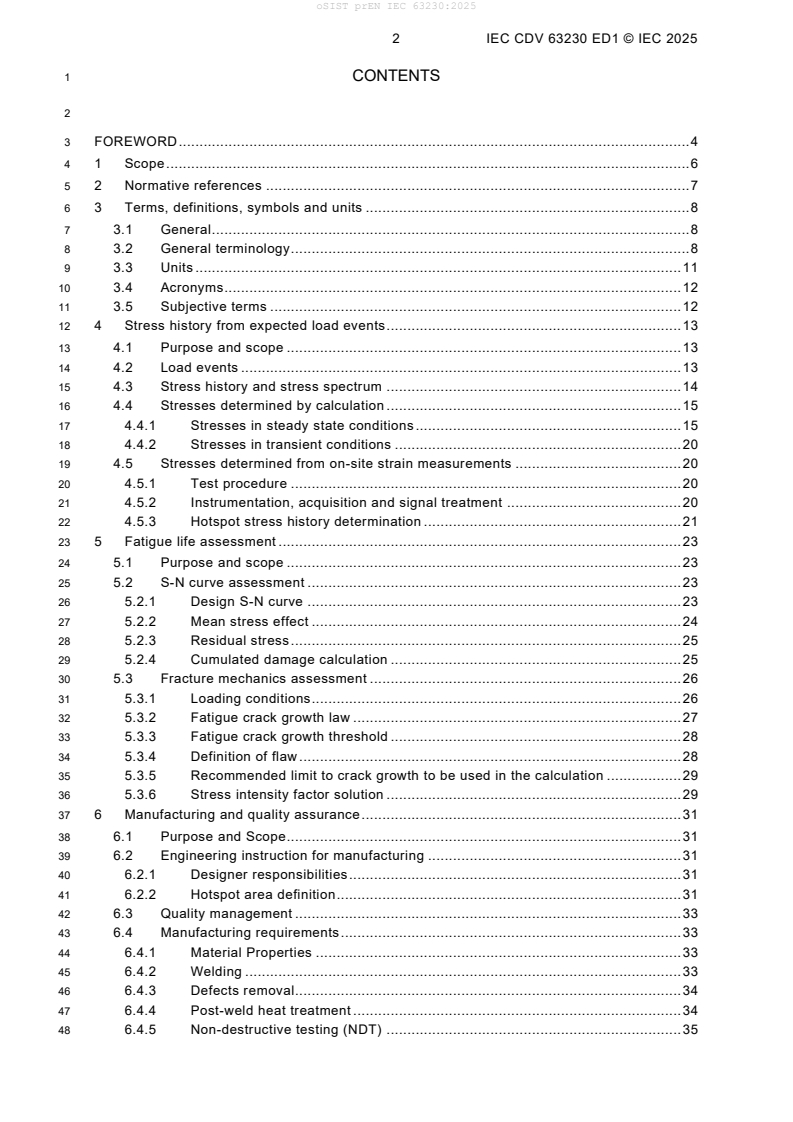
1 CONTENTS
3 FOREWORD . 4
4 1 Scope . 6
5 2 Normative references . 7
6 3 Terms, definitions, symbols and units . 8
7 3.1 General . 8
8 3.2 General terminology . 8
9 3.3 Units . 11
10 3.4 Acronyms . 12
11 3.5 Subjective terms . 12
12 4 Stress history from expected load events. 13
13 4.1 Purpose and scope . 13
14 4.2 Load events . 13
15 4.3 Stress history and stress spectrum . 14
16 4.4 Stresses determined by calculation . 15
17 4.4.1 Stresses in steady state conditions . 15
18 4.4.2 Stresses in transient conditions . 20
19 4.5 Stresses determined from on-site strain measurements . 20
20 4.5.1 Test procedure . 20
21 4.5.2 Instrumentation, acquisition and signal treatment . 20
22 4.5.3 Hotspot stress history determination . 21
23 5 Fatigue life assessment . 23
24 5.1 Purpose and scope . 23
25 5.2 S-N curve assessment . 23
26 5.2.1 Design S-N curve . 23
27 5.2.2 Mean stress effect . 24
28 5.2.3 Residual stress . 25
29 5.2.4 Cumulated damage calculation . 25
30 5.3 Fracture mechanics assessment . 26
31 5.3.1 Loading conditions . 26
32 5.3.2 Fatigue crack growth law . 27
33 5.3.3 Fatigue crack growth threshold . 28
34 5.3.4 Definition of flaw . 28
35 5.3.5 Recommended limit to crack growth to be used in the calculation . 29
36 5.3.6 Stress intensity factor solution . 29
37 6 Manufacturing and quality assurance . 31
38 6.1 Purpose and Scope. 31
39 6.2 Engineering instruction for manufacturing . 31
40 6.2.1 Designer responsibilities . 31
41 6.2.2 Hotspot area definition . 31
42 6.3 Quality management . 33
43 6.4 Manufacturing requirements . 33
44 6.4.1 Material Properties . 33
45 6.4.2 Welding . 33
46 6.4.3 Defects removal. 34
47 6.4.4 Post-weld heat treatment . 34
48 6.4.5 Non-destructive testing (NDT) . 35
IEC CDV 63230 ED1 © IEC 2025 3
49 6.4.6 Corrosion protection . 37
50 6.4.7 Manufacturing tolerances. 37
51 Annex A (informative) Finite element analysis best practices . 38
52 Annex B (informative) Guidance on the necessity of conducting a fatigue assessment . 40
53 B.1 Introduction . 40
54 B.2 Suggested characteristic of runners for which a fatigue assessment is not
55 required . 40
56 B.3 Suggested requirements and allowable stresses when fatigue assessment is
57 not required . 41
58 Bibliography . 42
60 Figure 2 – Example of load events included in a start-stop sequence . 14
61 Figure 3 – Example of a Francis runner strain measurement history during a start-stop
62 sequence with multiple power outputs [2] . 15
63 Figure 4 – Stochastic stress history of a steady state condition . 17
64 Figure 5 – Standard normalized stochastic stress spectrum curve and stress spectra
65 for real strain gauge data from which it was defined. . 19
66 Figure 6 – Stress spectrum combination method for predicted periodic and stochastic
67 stresses . 19
68 Figure 7 – Schematic representation of the localisation of strain gauges within a
69 prediction strain pattern [8] . 21
70 Figure 8 – Example of a goodness-of-fit representation between measurement and
71 simulation results. . 22
72 Figure 9 – Design S-N curve for 13%Cr-4%Ni stainless steel in river water at R = -1
73 (see 4.3 for stress amplitude calculation). . 24
74 Figure 11 – Creation of the design fatigue life load history based on typical 1-year load
75 histories from assembled load sequences for fracture mechanics assessments . 27
76 Figure 12 – Standardized crack propagation curves for 13%Cr-4%Ni stainless steel
77 according to Equation (5) . 28
78 Figure 13 – Definition of recommended initial flaw shapes for a) surface flaws b)
79 embedded flaws (adapted from BS7910 [16]) . 29
80 Figure 14. Illustration of the location and the definition of the hotspot areas on a
81 Francis runner (R1 : connection radius on blade pressure side; R2 : connection radius
82 on blade suction side; R3 connection radius on blade outflow surface) . 32
84 Table 1 – Example of specified expected steady state conditions. 13
85 Table 2 – Example of specified expected transient conditions . 14
86 Table 3 – Main sources of runner excitation . 16
87 Table 4 – Design S-N curve coefficients for 13%Cr-4%Ni stainless steels in river water. 24
88 Table 5 – Parameters of the 13%Cr-4%Ni fatigue crack growth law . 28
4 IEC CDV 63230 ED1 © IEC 2025
92 INTERNATIONAL ELECTROTECHNICAL COMMISSION
93 ____________
95 Fatigue assessment of hydraulic turbine runners: from design to quality
96 assurance
98 FOREWORD
99 1) The International Electrotechnical Commission (IEC) is a worldwide organization for standardization comprising
100 all national electrotechnical committees (IEC National Committees). The object of IEC is to promote international
101 co-operation on all questions concerning standardization in the electrical and electronic fields. To this end and
102 in addition to other activities, IEC publishes International Standards, Technical Specifications, Technical Reports,
103 Publicly Available Specifications (PAS) and Guides (hereafter referred to as “IEC Publication(s)”). Their
104 preparation is entrusted to technical committees; any IEC National Committee interested in the subject dealt with
105 may participate in this preparatory work. International, governmental and non-governmental organizations liaising
106 with the IEC also participate in this preparation. IEC collaborates closely with the International Organization for
107 Standardization (ISO) in accordance with conditions determined by agreement between the two organizations.
108 2) The formal decisions or agreements of IEC on technical matters express, as nearly as possible, an international
109 consensus of opinion on the relevant subjects since each technical committee has representation from all
110 interested IEC National Committees.
111 3) IEC Publications have the form of recommendations for international use and are accepted by IEC National
112 Committees in that sense. While all reasonable efforts are made to ensure that the technical content of IEC
113 Publications is accurate, IEC cannot be held responsible for the way in which they are used or for any
114 misinterpretation by any end user.
115 4) In order to promote international uniformity, IEC National Committees undertake to apply IEC Publications
116 transparently to the maximum extent possible in their national and regional publications. Any divergence between
117 any IEC Publication and the corresponding national or regional publication shall be clearly indicated in the latter.
118 5) IEC itself does not provide any attestation of conformity. Independent certification bodies provide conformity
119 assessment services and, in some areas, access to IEC marks of conformity. IEC is not responsible for any
120 services carried out by independent certification bodies.
121 6) All users should ensure that they have the latest edition of this publication.
122 7) No liability shall attach to IEC or its directors, employees, servants or agents including individual experts and
123 members of its technical committees and IEC National Committees for any personal injury, property damage or
124 other damage of any nature whatsoever, whether direct or indirect, or for costs (including legal fees) and
125 expenses arising out of the publication, use of, or reliance upon, this IEC Publication or any other IEC
126 Publications.
127 8) Attention is drawn to the Normative references cited in this publication. Use of the referenced publications is
128 indispensable for the correct application of this publication.
129 9) Attention is drawn to the possibility that some of the elements of this IEC Publication may be the subject of patent
130 rights. IEC shall not be held responsible for identifying any or all such patent rights.
131 International Standard IEC 63230 has been prepared by subcommittee WG37: Fatigue of
132 hydraulic turbines runners of IEC technical committee TC4: Hydraulic Turbines.
133 The text of this International Standard is based on the following documents:
FDIS Report on voting
XX/XX/FDIS XX/XX/RVD
134 Full information on the voting for the approval of this International Standard can be found in the
135 report on voting indicated in the above table.
136 This document has been drafted in accordance with the ISO/IEC Directives, Part 2.
IEC CDV 63230 ED1 © IEC 2025 5
137 The committee has decided that the contents of this document will remain unchanged until the
138 stability date indicated on the IEC website under "http://webstore.iec.ch" in the data related to
139 the specific document. At this date, the document will be
140 • reconfirmed,
141 • withdrawn,
142 • replaced by a revised edition, or
143 • amended.
144 The National Committees are requested to note that for this document the stability date
145 is 20XX.
146 THIS TEXT IS INCLUDED FOR THE INFORMATION OF THE NATIONAL COMMITTEES AND WILL BE DELETED
147 AT THE PUBLICATION STAGE.
6 IEC CDV 63230 ED1 © IEC 2025
149 Fatigue assessment of hydraulic turbine runners: from design to quality
150 assurance
154 1 Scope
155 This International Standard applies to runners of reaction turbines , regardless of their size and
156 capacity. These may include radial turbines such as Francis turbines, axial turbines such as
157 Kaplan and propeller turbines, as well as diagonal turbines, in all possible configurations. In the
158 case of turbine runners with adjustable blades, the internal mechanical components of the
159 blades’ adjustment mechanism are excluded from this document.
160 This document outlines the recommended methodologies for conducting a fatigue assessment
161 of turbine runners. It encompasses several key aspects, such as defining the load events to be
162 considered during the assessment, determining stresses for each of these load events, as well
163 as the detailed approaches for assessing fatigue of new and existing runners. Additionally, it
164 includes manufacturing and quality assurance requirements that must be complied with to
165 achieve the desired material fatigue properties and effectively apply the proposed fatigue
166 assessment methodologies. This document also contains best practices for performing and
167 analyzing on-site strain gauge measurements performed on existing runners to evaluate their
168 fatigue life.
169 The purpose of this document is to provide guidelines to assess fatigue in new and existing
170 turbine runners. It does not specify if a fatigue assessment must be performed or not for a given
171 runner. However, it includes an annex that provides guidance to evaluate the necessity of
172 realizing a fatigue assessment or not for a given new runner. The methods described in this
173 document can also be used for remaining life assessments of in-service runners. However,
174 caution should be exercised as the assessed runner materials’ fatigue properties and quality
175 level could differ from the prescriptions found in the manufacturing and quality assurance
176 section of this standard which have been defined for new runners. Finally, it should be
177 mentioned that fatigue assessment alone is not sufficient for a complete validation of the
178 mechanical integrity of a new runner design. Other mechanical validations not covered in this
179 standard typically have to be conducted.
IEC CDV 63230 ED1 © IEC 2025 7
182 2 Normative references
183 The following documents are referred to in the text in such a way that some or all of their content
184 constitutes requirements of this document. For dated references, only the edition cited applies.
185 For undated references, the latest edition of the referenced document (including any
186 amendments) applies.
187 IEC 60609-1:2004 Hydraulic turbines, storage pumps and pump-turbines -
188 Cavitation pitting evaluation - Part 1: Evaluation in reaction
189 turbines, storage pumps and pump-turbines
190 IEC 60994:1991/COR1:1997 Guide for field measurement of vibrations and pulsations in
191 hydraulic machines (turbines, storage pumps and pump-
192 turbines)
193 IEC TR 61364:1999 Nomenclature for hydroelectric powerplant machinery
194 IEC 62256:2017 Hydraulic turbines, storage pumps and pump-turbines -
195 Rehabilitation and performance improvement
196 IEC TS 62882:2020 Hydraulic machines - Francis turbine pressure fluctuation
197 transposition
198 CCH 70-4 Specification for inspection of steel castings for hydraulic
199 machines
200 BS 7910:2019 Guide to methods for assessing the acceptability of flaws in
201 metallic structures
202 ASTM E1049-85(2017) Standard Practices for Cycle Counting in Fatigue Analysis
203 ASTM E1823-21 Standard Terminology Relating to Fatigue and Fracture
204 Testing
205 ASME Section VIII, Division 2 ASME Boiler and Pressure Vessel Code, Section VIII, Division
206 2 : Alternative Rules
8 IEC CDV 63230 ED1 © IEC 2025
208 3 Terms, definitions, symbols and units
209 3.1 General
210 For the purposes of this document, the following terms, definitions, symbols and units apply.
211 Specialized terms are explained where they appear.
212 ISO and IEC maintain terminological databases for use in standardization at the following
213 addresses:
214 • IEC Electropedia: available at http://www.electropedia.org/
215 • ISO Online browsing platform: available at http://www.iso.org/obp
216 3.2 General terminology
217 The terms below are defined specifically in the context of this document. The provided
218 definitions may not be complete or coherent with definitions from other standards and codes.
219 Continuous normal operating range
220 Operating range of the turbine for unrestricted yearly operating duration, typically delimited by
221 minimum and maximum values of net head, minimum values of net positive suction energy, as
222 well as minimum and maximum values of either or a combination of flow, turbine power output
223 and guide vane opening.
224 Cycle counting method
225 Method of counting the number of discrete stress (strain) cycles of different amplitude and mean
226 from a history of varying stress (strain).
227 Design fatigue life
228 The minimum period of time during which the runner is expected to function, according to its
229 corresponding stress history.
230 Design S-N curve
231 S-N curve defined for design purposes of specific components. It includes sufficient reduction
232 coefficients to ensure conservative results and corresponds to what is considered a sufficient
233 level of reliability for its related specific components. As the determination of this curve includes
234 the return of experience on past runners, it cannot be associated with specific levels of
235 probability of survival.
236 Designer
237 Entity responsible for analysing and translating technical specifications into design solutions
238 that have the required reliability, safety, integrity and performance levels.
239 Dynamic stresses
240 Refers to the variation of stress over time around a mean stress.
241 Fatigue crack initiation
242 Fatigue phase during which damage is accumulated in a runner under the action of stress
243 cycles. In the context of a fatigue crack initiation assessment as part of this standard, the runner
244 material is considered to be continuous, and stress is determined according to the principles of
245 continuum mechanics.
247 Fatigue crack propagation
IEC CDV 63230 ED1 © IEC 2025 9
248 Fatigue phase during which a crack propagates in a runner under the action of stress cycles.
249 In the context of a fatigue crack propagation assessment as part this standard , the runner
250 material is considered containing a discontinuity and stress is determined according to the
251 principles of fracture mechanics.
252 Hotspots
253 Locations on the runner with the highest fatigue damage sums for a given stress history. This
254 normally corresponds to the location of the highest dynamic stress during steady state
255 conditions or the highest stress range of the start-stop sequence.
256 Load event
257 Loading applied to the runner during a specific steady state or transient condition (e.g. start-
258 up, speed-no-load)
259 Load rejection
260 A transient operating condition characterized by an emergency automatic sequence where
261 sudden loss of load and subsequent closing of the guide vanes initiated by the triggering of a
262 speed protection result in a turbine-generator unit going from a given power output to transient
263 overspeed and back to speed-no-load or standstill.
264 Load sequence
265 Series of load events, which may include a combination of steady state and transient conditions,
266 that are frequently repeated (e.g. start-stop load sequence: standstill – start-up - SNL- ramp-
267 up - full load – stop – standstill).
268 Manufacturer
269 Entity responsible for carrying out the entire manufacturing process until completion of the
270 hydraulic machine component.
271 Maximum power output
272 Highest turbine or unit power output within the continuous normal operating range under a given
273 net head.
274 Mean stress
275 Refers to the constant average stress of a steady state condition or moving average stress of
276 a transient stress history. May also refer to the mean stress of a single fatigue cycle from a
277 stress spectrum as obtained from a cycle counting algorithm.
278 Owner
279 Entity buyer and/or user of the hydraulic machine component or its representative.
280 Periodic stresses
281 Refers to dynamic stresses of constant amplitude and frequency.
282 Rainflow algorithm
283 Specific cycle counting method. In this document, Rainflow refers to the method named
284 “Simplified Rainflow Counting for Repeating Histories” as per ASTM E1049 [1].
286 Rated power output
287 Maximum turbine or unit power output within the continuous normal operating range under the
288 rated net head.
10 IEC CDV 63230 ED1 © IEC 2025
289 Residual stress
290 Refers to internal stresses in static equilibrium that remain in the absence of any external
291 loading. In runners, such residual stresses most often stem from welding, casting, machining
292 and/or forming.
293 Rework
294 Refers to the process of correcting defective, failed, or non-conforming features in a prototype
295 runner after inspection. In the context of this standard, this process may include weld repair,
296 machining, grinding and polishing.
297 Runaway
298 A no-load and non-excited steady state operating condition where a turbine-generator unit is
299 rotating at its maximum runaway speed achieved with guide vanes fully open, i.e. up to the
300 mechanical stop of the operating mechanism or servomotor(s) under the maximum net head of
301 the continuous operating range, or high turbine specific hydraulic energy temporary operating
302 range, or whichever condition results in the highest rotational speed.
303 Shutdown
304 A transient operating condition characterized by a normal automatic sequence where a turbine-
305 generator unit goes from a given power output to standstill.
306 Speed-no-load
307 A no-load steady state operating condition where a turbine-generator unit is rotating at
308 synchronous speed, ready to be synchronized with the grid with positive speed direction and
309 zero power output. The generator field winding may be excited or not.
310 Start-up
311 A transient operating condition characterized by a normal automatic sequence where a turbine-
312 generator unit goes from standstill with guide vanes closed to speed-no-load.
313 Static stress
314 Refers to the constant mean stress, linearized or not, calculated by static structural finite
315 element analysis for a given steady state condition.
316 Steady state conditions
317 Refers to operating conditions of the turbine characterised by constant (or almost constant)
318 values of net head, turbine power output, net positive suction head and rotational speed. Runner
319 mean stresses and characteristics of runner dynamic stresses (amplitude, range, frequency
320 spectrum, standard deviation, etc.) remain constant for a given steady state condition.
321 Stochastic stresses
322 Refers to dynamic stresses of randomly varying amplitudes and wideband frequency contents.
323 Stress (strain) amplitude
324 One half of the stress (strain) range of a cycle.
326 Stress (strain) cycle
327 Variation of stress (strain) at a particular point in the runner as obtained from a cycle counting
328 method and consisting of a change in stress (strain) between defined minimum (valley) and
329 maximum (peak) values and back again.
330 Stress (strain) history
IEC CDV 63230 ED1 © IEC 2025 11
331 Record or calculation of the stress (strain) over time at a particular point in the runner during a
332 load event or during one or successive load sequences.
333 Stress (strain) range
334 The algebraic difference between successive peak and valley stress or strain. In constant
335 amplitude loading, the range is given as follows:
336 ΔS = S - S
max min
337 Stress (strain) ratio
338 The algebraic ratio of the lowest algebraic value of an applied stress or strain cycle ( Smin or
339 ) and the highest algebraic value of applied stress or strain load in a cycle ( S or ).
min max max
341 Figure 1 – Constant amplitude loading illustration of the main fatigue stress (strain) parameters
342 Stress (strain) spectrum or rainflow count
343 Tabulation of the number of all discrete stress (strain) cycles of given amplitude and mean
344 stress (strain) level, as obtained from the Rainflow algorithm applied to a stress (strain) history.
345 Supplier
346 Entity responsible for supplying to the owner the equipment in conformity with contractual
347 specifications.
348 Temporary operating range
349 Operating ranges of the turbine outside the continuous normal operating range subject to a
350 specified allowed maximum number of yearly operating hours.
351 Transient conditions
352 Refers to a fast or slow transition from one steady state condition to another (including
353 standstill). Runner mean stress and characteristics of runner dynamic stresses (amplitude,
354 range, frequency spectrum, standard deviation, etc.) vary during a given transient condition.
355 3.3 Units
356 The International System of Units (SI, see ISO 80000-4) has been used throughout this
357 document.
358 All terms are given in SI base units or derived coherent units. The basic equations are valid
359 using these units. This has to be taken into account if other than coherent SI units are used for
360 certain data (e.g. kilowatt instead of watt for power, kilopascal or bar instead of pascal for
361 pressure, min-1 instead of s-1 for rotational speed, etc.). Temperatures may be given in degrees
362 Celsius since absolute temperatures (in kelvins) are rarely required.
12 IEC CDV 63230 ED1 © IEC 2025
363 Any other system of units may be used if agreed in writing by the contracting parties.
364 3.4 Acronyms
365 Below is a list of acronyms used throughout the document.
366 • BHN Brinell hardness number
367 • CFD Computational fluid dynamics
368 • FEA/FEM Finite element analysis/method
369 • NDT Non-destructive testing
370 • PWHT Post-weld heat treatment
371 • RSI Rotor-stator interaction
372 • SNL Speed-no-load
373 3.5 Subjective terms
374 Some terms used in this standard may have a subjective interpretation, e.g. suitable, adequate,
375 sufficient, significant. This may lead to discussions between owners and suppliers. To provide
376 a degree of objectivity to these terms, the level of accuracy of the related assessment must be
377 considered. Any method, measurement, analysis, simulation, etc. may be considered suitable,
378 appropriate, adequate, sufficient, significant, etc., as long as it is consistent with the precision
379 of the overall assessment and doesn't increase the level of uncertainty by itself.
380 This also applies if the supplier proposes alternative methods, in which case the supplier sh all
381 demonstrate to the owner that the accuracy achieved by the proposed alternative method is
382 equal to or better than the methods described in this standard. The supplier shall provide
383 documentation to support the alternative method such as internal or public documentation
384 reviewed by independent peers comparing the proposed alternative methods with relevant
385 benchmarks. The owner must evaluate the information provided and decide whether to accept
386 the method, failing which the original method must be used.
IEC CDV 63230 ED1 © IEC 2025 13
388 4 Stress history from expected load events
389 4.1 Purpose and scope
390 This section provides general information on load events and related stresses that must be
391 considered as part of a fatigue assessment of a runner. Its main purposes are:
392 • to provide guidance on operating conditions to be considered and the definition of related
393 load events required for runner fatigue assessment;
394 • to define the characteristic of fatigue-relevant loads and stresses to which runners may be
395 subject;
396 • to provide a general discussion on how stresses related to specific load events and
397 sequences may be predicted or calculated.
398 4.2 Load events
399 The definition of load events for the fatigue assessment of a runner must be established on a
400 case-by-case basis depending on the expected operating regime of the turbine. The expected
401 type, range, frequency and number of load events, as well as the required design fatigue life,
402 shall be specified by the owner.
403 For the design of new runners, or residual life assessment of existing runners, owners shall
404 specify the steady state conditions under which the turbine is expected to be operated.
405 These steady state conditions should typically be specified in terms of yearly hours of operation
406 in a similar manner as shown in Table 1. This should include operation at each specified steady
407 state condition for the rated net head, as well for the minimum, maximum and any other relevant
408 net heads in the case of a large net head range. The power or flow ranges shown in Table 1
409 represent one example and may be modified by the owner to suit the expected operation of the
410 specified runner.
411 The specified yearly hours of operation within power or flow ranges outside typical normal
412 operating ranges (e.g. below 60-70% of the maximum power in the case of a Francis runner)
413 must be as realistically defined as possible to avoid unnecessary constraints on the design
414 which may lead to compromise on efficiency and/or cavitation behaviour.
415 Table 1 – Example of specified expected steady state conditions
Power or flow range (%) Power [MW] Number of Number of …
or flow [m /s] hours per year hours per year
range for head ___m for head ___m
High load temporary operating range
90%-100%
70%-90%
40%-70%
10%-40%
Low load temporary operating range
Speed-no-load
Other steady-state conditions
416 In addition to steady state conditions, owners shall also specify all transient conditions that the
417 runner may realistically see during its lifetime, along with the expected number of events for
418 each transient condition, which may be in terms of number of occurrences per year or for the
419 entire design fatigue life, in a manner similar to Table 2 below.
14 IEC CDV 63230 ED1 © IEC 2025
420 Table 2 – Example of specified expected transient conditions
Transient condition Number of events
(per year or per entire design fatigue life)
Start-ups/shutdowns
Load rejections
Speed ramp-up to runaway
Power variations
from ___MW to ___MW (or in % of maximum power)
from ___MW to ___MW
from ___MW to ___MW
Synchronous condenser transitions
Ancillary services relevant for fatigue
(e.g. frequency control, load control, black starts)
421 In addition, for the assessment of existing runners, the owner should provide historical
422 operational data since the runner’s commissioning, information on on-site repairs and
423 modifications, all available hydraulic performance data, as well as all relevant test data to
424 establish the actual hydraulic conditions under which the runner was operated.
425 4.3 Stress history and stress spectrum
426 In order to define the stress history for a runner, the designer shall create sequences of
427 transient and steady state load events to represent the expected runner operation. Each
428 sequence shall begin and end at the same condition, thus representing a complete cycle. The
429 creation of such representative load sequences, as opposed to using only the separate load
430 events part of the sequence, is required as the resulting stress history may result in a larger
431 cycle envelope.
432 With such an established stress history, a stress spectrum can be obtained by applying a cycle
433 counting method to the entire stress history. The technicalities of various cycle counting
434 methods to be used in fatigue analysis are explained in the ASTM E1049 standard [1]. In the
435 context of this standard, the simplified rainflow counting method as described in ASTM E1049
436 is recommended.
437 Figure 2 shows an example of a schematic representation of such a load sequence, while
438 Figure 3 presents an example of a strain measurement illustrating the strain history of a stop-
439 start-power-stop sequence.
441 Figure 2 – Example of load events included in a start-stop sequence
IEC CDV 63230 ED1 © IEC 2025 15
444 Figure 3 – Example of a Francis runner strain measurement history during a start-stop
445 sequence with multiple power outputs [2]
446 For FEA stress evaluation, stress amplitude and mean stress values of the different stress
447 cycles included in the stress spectrum shall be derived from the complete stress tensor using
448 standardized methods detailed in well-known codes (e.g. [3, 4]). For instance, for S-N curve
449 analysis, the equivalent Von Mises stress of the resulting tensor can be used, and for crack
450 propagation analysis, the maximum principal stress of the resulting tensor can be used.
451 4.4 Stresses determined by calculation
452 4.4.1 Stresses in steady state conditions
453 Stresses in the runner during steady state conditions can include static stresses, dynamic
454 stresses, or a combination of both.
455 4.4.1.1 Static stresses
456 Static stresses in runners under steady state conditions are typically calculated by FEA using
457 a linear elastic model of strain-stress correlation.
458 The specific load cases to be considered for the calculation will vary on a case-by-case basis
459 depending on the operating regime and expected load events of a given runner. At a minimum,
460 static stresses should be calculated for the following load events:
461 • speed-no-load;
462 • maximum flow or maximum power output condition, whichever results in the most
463 unfavourable static stresses in each assessed hotspot of the runner. This shall consider the
464 high load temporary operating range if applicable;
465 • maximum theoretical runaway speed.
466 Prediction of static stresses in these steady state conditions using FEA is a well-established
467 method that has been shown, through strain gauge testing, to accurately predict static stresses
468 in the runner. Annex A provides guidelines on best practices for static structural FEA of turbine
469 runners.
16 IEC CDV 63230 ED1 © IEC 2025
471 4.4.1.2 Dynamic stresses
472 Dynamic stresses occurring in runners during operation at steady state conditions typically
473 include periodic stresses, stochastic stresses, or a superposition of both.
474 Periodic stresses are caused by hydraulic phenomena acting as sources of excitation. Such
475 exciting phenomena may be amplified by resonance conditions when external excitation
476 frequencies under specific nodal diameters coincide with one or more of the runner’s natural
477 frequencies of the same nodal diameter.
478 On the other hand, stochastic stresses are typically of a random and irregular nature and cannot
479 be associated with specific frequencies.
480 Potential sources of excitation which should be considered include:
481 Table 3 – Main sources of runner excitation
Type of excitation source Characteristic
Rotor stator interaction (RSI) Periodic
Draft tube vortex Periodic
Von Karman Vortices Periodic
Inter blade vortices Stochastic
Vaneless space vortices Stochastic
482 In addition to assessing static stresses, the runner supplier/designer should assess dynamic
483 stresses in relevant steady state conditions, covering the entire operating range, either by
484 predicting the stresses themselves or providing justification to demonstrate that the periodic
485 and/or stochastic stresses can be neglected. Such stress predictions and justifications may be
486 based on reference stress measurements and/or calculations from similar runners.
487 4.4.1.2.1 Periodic stresses
488 One of the main potentially damaging periodic phenomenon in Francis runners is rotor-stator
489 interaction (RSI). As defined in IEC 62882 [5], this phenomenon can be described as the
490 interaction between the rotating flow perturbations caused by the runner blades and the flow
491 perturbations caused by the guide vanes wakes. Depending on several factors such as the
492 geometry of the runner, number of runner blades, geometry and number of guide vanes, as well
493 as hydraulic conditions, this interaction may cause local pressure fluctuations that follow a
494 temporal and spatial circumferential pattern compatible with specific runner natural frequencies
495 and nodal diameters, thus leading to resonance and potential amplification of local periodic
496 stresses. In such case, given the typical high load frequency associated with RSI, fatigue cracks
497 may initiate and propagate rapidly.
498 Periodic stresses induced by the part load vortex rope under the runner can also be significant
499 and cause fatigue damage. Because of the relatively low frequency of the part load rope, it
500 rarely causes amplification of the periodic stresses by resonance of the runner and is regarded
501 more as a quasi-static phenomenon.
502 Present-day computational fluid dynamics and numerical stress analysis methods and tools
503 typically allow for reliable prediction of periodic stresses induced by RSI and the part load vortex
504 rope. For the RSI stress prediction, the proximity of resonance and the associated amplification
505 must be taken into account. Finite element modal analysis of the runner is also often employed
506 to evaluate the risk of runner resonance from RSI or any other potential exciting phenomena.
507 Annex A also provides guidelines on best practices for finite element modal analysis of turbine
508 runners.
IEC CDV 63230 ED1 © IEC 2025 17
509 4.4.1.2.2 Stochastic stresses
510 Dynamic stresses that cannot be attributed to specific periodic phenomena are usually of a
511 stochastic nature.
512 Understanding of runner stochastic stresses d
...
Questions, Comments and Discussion
Ask us and Technical Secretary will try to provide an answer. You can facilitate discussion about the standard in here.
Loading comments...