


oSIST prEN ISO 9001:2025
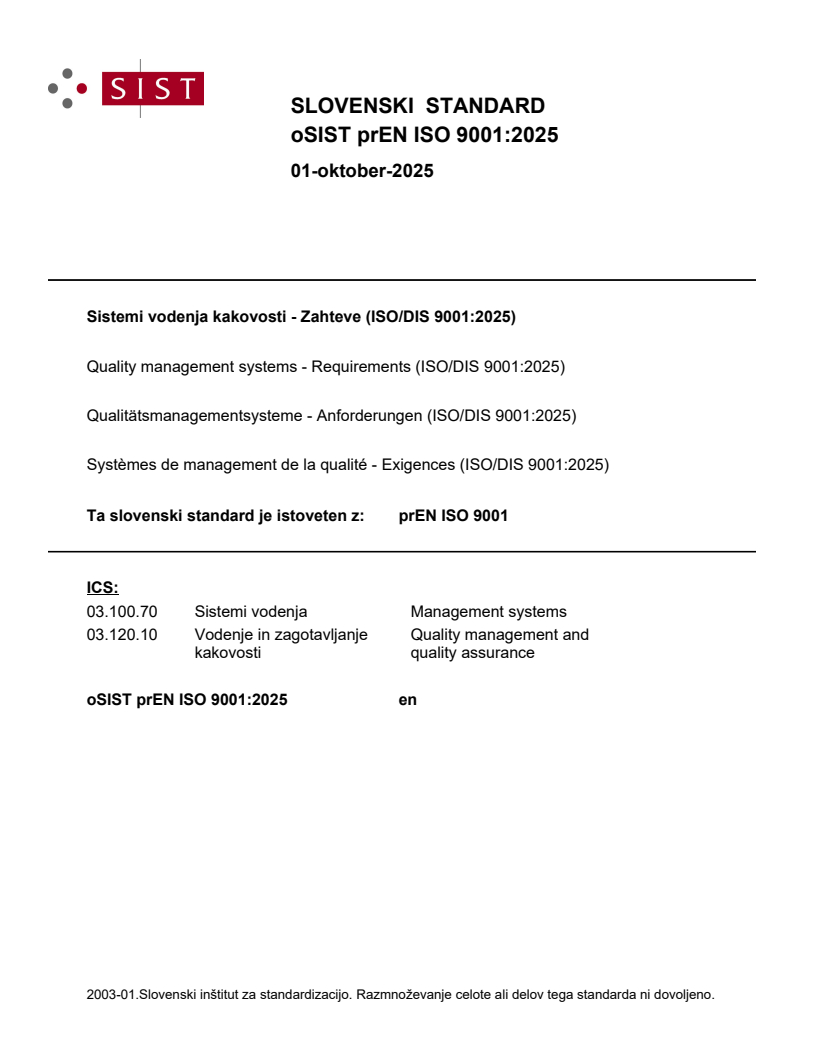
(Main)Quality management systems - Requirements (ISO/DIS 9001:2025)
Quality management systems - Requirements (ISO/DIS 9001:2025)
This document specifies requirements for a quality management system when an organization:
a) needs to demonstrate its ability to consistently provide products and services that meet customer and applicable statutory and regulatory requirements, and
b) aims to enhance customer satisfaction through the effective application of the system, including processes for improvement of the system and the assurance of conformity to customer and applicable statutory and regulatory requirements.
All the requirements of this document are generic and are intended to be applicable to any organization, regardless of its type or size, or the products and services it provides.
Qualitätsmanagementsysteme - Anforderungen (ISO/DIS 9001:2025)
Systèmes de management de la qualité - Exigences (ISO/DIS 9001:2025)
Ce document spécifie les exigences relatives au système de management de la qualité lorsqu'un organisme:
a) doit démontrer son aptitude à fournir constamment des produits et des services conformes aux exigences des clients et aux exigences légales et réglementaires applicables, et
b) vise à accroître la satisfaction de ses clients par l'application efficace du système, y compris les processus pour l'amélioration du système et l'assurance de la conformité aux exigences des clients et aux exigences légales et réglementaires applicables.
Toutes les exigences de ce document sont génériques et prévues pour s'appliquer à tout organisme, quels que soient son type ou sa taille, ou les produits et services qu'il fournit.
Sistemi vodenja kakovosti - Zahteve (ISO/DIS 9001:2025)
General Information
- Status
- Not Published
- Public Enquiry End Date
- 02-Nov-2025
- Technical Committee
- VZK - Quality management and quality assurance
- Current Stage
- 4020 - Public enquire (PE) (Adopted Project)
- Start Date
- 20-Aug-2025
- Due Date
- 07-Jan-2026
- Completion Date
- 10-Nov-2025
Relations
- Effective Date
- 01-Oct-2025
- Effective Date
- 01-Oct-2025
Overview
prEN ISO 9001 (ISO/DIS 9001:2025) - Quality management systems - Requirements - is the draft CEN adoption of the ISO/DIS 9001:2025 international standard. This document specifies generic requirements for a quality management system (QMS) that apply to any organization, regardless of type or size. It is circulated as a draft for comment and approval (ISO/TC 176/SC 2, secretariat BSI) and is subject to change until final publication.
Key search terms: ISO 9001, quality management systems, QMS requirements, ISO/DIS 9001:2025, prEN ISO 9001, quality assurance, customer satisfaction.
Key topics and requirements
The draft standard structures requirements across familiar ISO 9001 headings (Clauses 4–10). Major technical topics include:
- Context of the organization (Clause 4): understanding organizational context, interested parties, and defining the QMS scope.
- Leadership (Clause 5): top management commitment, customer focus, quality policy, roles and responsibilities.
- Planning (Clause 6): actions to address risks and opportunities, quality objectives, and planning changes.
- Support (Clause 7): resources, people, infrastructure, organizational knowledge, competence, awareness, documented information and communication.
- Operation (Clause 8): operational planning and control, customer requirements, design and development, control of externally provided processes/products/services, production/service provision, identification, preservation and release.
- Performance evaluation (Clause 9): monitoring, measurement, customer satisfaction, analysis, internal audit and management review.
- Improvement (Clause 10): continual improvement and control of nonconforming outputs.
The draft emphasizes the process approach and the Plan-Do-Check-Act (PDCA) cycle along with quality management principles that underpin effective QMS performance.
Practical applications and who uses it
prEN ISO 9001:2025 is intended for organizations aiming to:
- Demonstrate consistent delivery of products and services meeting customer and statutory/regulatory requirements.
- Enhance customer satisfaction through a structured QMS and continual improvement.
- Improve process control, supplier management, and risk-aware planning.
Typical users:
- Quality managers and QMS implementers
- Senior leadership seeking systemic quality governance
- SMEs and large enterprises across manufacturing, services, public sector and non-profits
- Auditors, consultants, and certification bodies preparing for the updated standard
Related standards and integration
The draft includes a section on the relationship with other management system standards, supporting integration with environmental, information security or other management systems where organizations adopt multiple ISO frameworks.
Using this standard helps organizations establish a scalable, auditable QMS that supports compliance, customer focus, and continual improvement.


Frequently Asked Questions
oSIST prEN ISO 9001:2025 is a draft published by the Slovenian Institute for Standardization (SIST). Its full title is "Quality management systems - Requirements (ISO/DIS 9001:2025)". This standard covers: This document specifies requirements for a quality management system when an organization: a) needs to demonstrate its ability to consistently provide products and services that meet customer and applicable statutory and regulatory requirements, and b) aims to enhance customer satisfaction through the effective application of the system, including processes for improvement of the system and the assurance of conformity to customer and applicable statutory and regulatory requirements. All the requirements of this document are generic and are intended to be applicable to any organization, regardless of its type or size, or the products and services it provides.
This document specifies requirements for a quality management system when an organization: a) needs to demonstrate its ability to consistently provide products and services that meet customer and applicable statutory and regulatory requirements, and b) aims to enhance customer satisfaction through the effective application of the system, including processes for improvement of the system and the assurance of conformity to customer and applicable statutory and regulatory requirements. All the requirements of this document are generic and are intended to be applicable to any organization, regardless of its type or size, or the products and services it provides.
oSIST prEN ISO 9001:2025 is classified under the following ICS (International Classification for Standards) categories: 03.100.70 - Management systems; 03.120.10 - Quality management and quality assurance. The ICS classification helps identify the subject area and facilitates finding related standards.
oSIST prEN ISO 9001:2025 has the following relationships with other standards: It is inter standard links to SIST EN ISO 9001:2015/A1:2024, SIST EN ISO 9001:2015. Understanding these relationships helps ensure you are using the most current and applicable version of the standard.
oSIST prEN ISO 9001:2025 is associated with the following European legislation: EU Directives/Regulations: 765/2008; Standardization Mandates: M/580. When a standard is cited in the Official Journal of the European Union, products manufactured in conformity with it benefit from a presumption of conformity with the essential requirements of the corresponding EU directive or regulation.
oSIST prEN ISO 9001:2025 is available in PDF format for immediate download after purchase. The document can be added to your cart and obtained through the secure checkout process. Digital delivery ensures instant access to the complete standard document.
Standards Content (Sample)
SLOVENSKI STANDARD
01-oktober-2025
Sistemi vodenja kakovosti - Zahteve (ISO/DIS 9001:2025)
Quality management systems - Requirements (ISO/DIS 9001:2025)
Qualitätsmanagementsysteme - Anforderungen (ISO/DIS 9001:2025)
Systèmes de management de la qualité - Exigences (ISO/DIS 9001:2025)
Ta slovenski standard je istoveten z: prEN ISO 9001
ICS:
03.100.70 Sistemi vodenja Management systems
03.120.10 Vodenje in zagotavljanje Quality management and
kakovosti quality assurance
2003-01.Slovenski inštitut za standardizacijo. Razmnoževanje celote ali delov tega standarda ni dovoljeno.
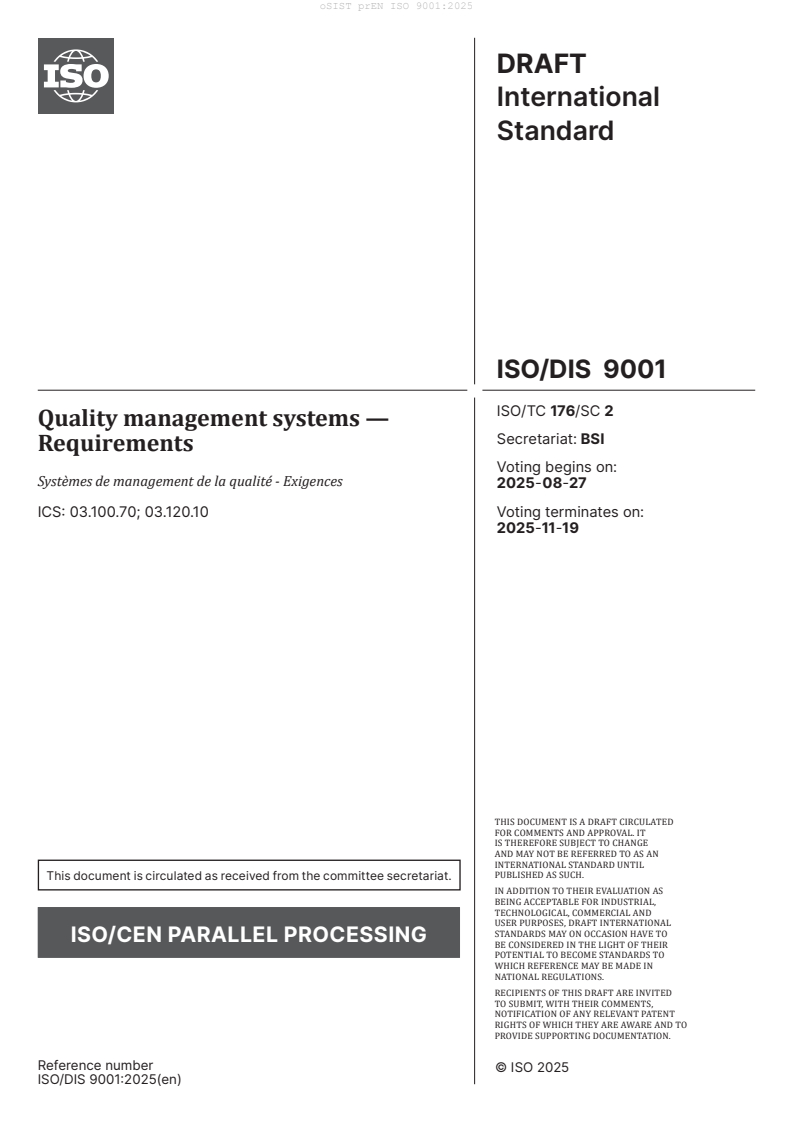
DRAFT
International
Standard
ISO/DIS 9001
ISO/TC 176/SC 2
Quality management systems —
Secretariat: BSI
Requirements
Voting begins on:
Systèmes de management de la qualité - Exigences
2025-08-27
Voting terminates on:
ICS: 03.100.70; 03.120.10
2025-11-19
THIS DOCUMENT IS A DRAFT CIRCULATED
FOR COMMENTS AND APPROVAL. IT
IS THEREFORE SUBJECT TO CHANGE
AND MAY NOT BE REFERRED TO AS AN
INTERNATIONAL STANDARD UNTIL
PUBLISHED AS SUCH.
This document is circulated as received from the committee secretariat.
IN ADDITION TO THEIR EVALUATION AS
BEING ACCEPTABLE FOR INDUSTRIAL,
TECHNOLOGICAL, COMMERCIAL AND
USER PURPOSES, DRAFT INTERNATIONAL
STANDARDS MAY ON OCCASION HAVE TO
ISO/CEN PARALLEL PROCESSING
BE CONSIDERED IN THE LIGHT OF THEIR
POTENTIAL TO BECOME STANDARDS TO
WHICH REFERENCE MAY BE MADE IN
NATIONAL REGULATIONS.
RECIPIENTS OF THIS DRAFT ARE INVITED
TO SUBMIT, WITH THEIR COMMENTS,
NOTIFICATION OF ANY RELEVANT PATENT
RIGHTS OF WHICH THEY ARE AWARE AND TO
PROVIDE SUPPORTING DOCUMENTATION.
Reference number
ISO/DIS 9001:2025(en)
DRAFT
ISO/DIS 9001:2025(en)
International
Standard
ISO/DIS 9001
ISO/TC 176/SC 2
Quality management systems —
Secretariat: BSI
Requirements
Voting begins on:
Systèmes de management de la qualité - Exigences
ICS: 03.100.70; 03.120.10 Voting terminates on:
THIS DOCUMENT IS A DRAFT CIRCULATED
FOR COMMENTS AND APPROVAL. IT
IS THEREFORE SUBJECT TO CHANGE
AND MAY NOT BE REFERRED TO AS AN
INTERNATIONAL STANDARD UNTIL
PUBLISHED AS SUCH.
This document is circulated as received from the committee secretariat.
IN ADDITION TO THEIR EVALUATION AS
BEING ACCEPTABLE FOR INDUSTRIAL,
© ISO 2025
TECHNOLOGICAL, COMMERCIAL AND
USER PURPOSES, DRAFT INTERNATIONAL
All rights reserved. Unless otherwise specified, or required in the context of its implementation, no part of this publication may
STANDARDS MAY ON OCCASION HAVE TO
ISO/CEN PARALLEL PROCESSING
be reproduced or utilized otherwise in any form or by any means, electronic or mechanical, including photocopying, or posting on
BE CONSIDERED IN THE LIGHT OF THEIR
the internet or an intranet, without prior written permission. Permission can be requested from either ISO at the address below
POTENTIAL TO BECOME STANDARDS TO
WHICH REFERENCE MAY BE MADE IN
or ISO’s member body in the country of the requester.
NATIONAL REGULATIONS.
ISO copyright office
RECIPIENTS OF THIS DRAFT ARE INVITED
CP 401 • Ch. de Blandonnet 8
TO SUBMIT, WITH THEIR COMMENTS,
CH-1214 Vernier, Geneva
NOTIFICATION OF ANY RELEVANT PATENT
Phone: +41 22 749 01 11
RIGHTS OF WHICH THEY ARE AWARE AND TO
PROVIDE SUPPORTING DOCUMENTATION.
Email: copyright@iso.org
Website: www.iso.org
Published in Switzerland Reference number
ISO/DIS 9001:2025(en)
ii
ISO/DIS 9001:2025(en)
Contents Page
Foreword .v
Introduction .vi
0.1 General .vi
0.2 Quality management principles .vi
0.3 Process approach . vii
0.3.1 General. vii
0.3.2 Plan-Do-Check-Act cycle.viii
0.4 Relationship with other management system standards . ix
1 Scope . 1
2 Normative references . 1
3 Terms and definitions . 1
4 Context of the organization . 5
4.1 Understanding the organization and its context .5
4.2 Understanding the needs and expectations of interested parties .6
4.3 Determining the scope of the quality management system .6
4.4 Quality management system .6
5 Leadership . 7
5.1 Leadership and commitment .7
5.1.1 General .7
5.1.2 Customer focus .7
5.2 Quality policy .8
5.3 Roles, responsibilities and authorities .8
6 Planning . 9
6.1 Actions to address risks and opportunities .9
6.1.1 Determining risks and opportunities .9
6.1.2 Actions to address risks .9
6.1.3 Actions to address opportunities .9
6.2 Quality objectives and planning to achieve them.10
6.3 Planning of changes .10
7 Support .11
7.1 Resources .11
7.1.1 General .11
7.1.2 People .11
7.1.3 Infrastructure .11
7.1.4 Environment for the operation of processes .11
7.1.5 Monitoring and measuring resources .11
7.1.6 Organizational knowledge . 12
7.2 Competence . 12
7.3 Awareness . 12
7.4 Communication . 13
7.5 Documented information . 13
7.5.1 General . 13
7.5.2 Creating and updating documented information . 13
7.5.3 Control of documented information . 13
8 Operation . 14
8.1 Operational planning and control .14
8.2 Requirements for products and services .14
8.2.1 Customer communication .14
8.2.2 Determining the requirements for products and services . 15
8.2.3 Review of the requirements for products and services . 15
8.2.4 Changes to requirements for products and services . 15
8.3 Design and development of products and services .16
iii
ISO/DIS 9001:2025(en)
8.3.1 General .16
8.3.2 Design and development planning .16
8.3.3 Design and development inputs .16
8.3.4 Design and development controls .17
8.3.5 Design and development outputs .17
8.3.6 Design and development changes .17
8.4 Control of externally provided processes, products and services .17
8.4.1 General .17
8.4.2 Type and extent of control .18
8.4.3 Information for external providers .18
8.5 Production and service provision .19
8.5.1 Control of production and service provision .19
8.5.2 Identification and traceability .19
8.5.3 Property belonging to customers or external providers .19
8.5.4 Preservation . 20
8.5.5 Post-delivery activities . 20
8.5.6 Control of changes . 20
8.6 Release of products and services . 20
8.7 Control of nonconforming outputs .21
9 Performance evaluation .21
9.1 Monitoring, measurement, analysis and evaluation . .21
9.1.1 General .21
9.1.2 Customer satisfaction .21
9.1.3 Analysis and evaluation . 22
9.2 Internal audit . 22
9.2.1 General . 22
9.2.2 Internal audit programme . 22
9.3 Management review . 23
9.3.1 General . 23
9.3.2 Management review inputs . 23
9.3.3 Management review results . 23
10 Improvement .23
10.1 Continual improvement . 23
10.2 Nonconformity and corrective action .24
Annex A (informative) Clarification of structure, terminology and clauses .25
Bibliography .40
iv
ISO/DIS 9001:2025(en)
Foreword
ISO (the International Organization for Standardization) is a worldwide federation of national standards
bodies (ISO member bodies). The work of preparing International Standards is normally carried out through
ISO technical committees. Each member body interested in a subject for which a technical committee
has been established has the right to be represented on that committee. International organizations,
governmental and non-governmental, in liaison with ISO, also take part in the work. ISO collaborates closely
with the International Electrotechnical Commission (IEC) on all matters of electrotechnical standardization.
The procedures used to develop this document and those intended for its further maintenance are described
in the ISO/IEC Directives, Part 1. In particular, the different approval criteria needed for the different types
of ISO documents should be noted. This document was drafted in accordance with the editorial rules of the
ISO/IEC Directives, Part 2 (see www.iso.org/directives).
ISO draws attention to the possibility that the implementation of this document may involve the use of (a)
patent(s). ISO takes no position concerning the evidence, validity or applicability of any claimed patent rights
in respect thereof. As of the date of publication of this document, ISO had not received notice of (a) patent(s)
which may be required to implement this document. However, implementers are cautioned that this may not
represent the latest information, which may be obtained from the patent database available at www.iso.org/
patents. ISO shall not be held responsible for identifying any or all such patent rights.
Any trade name used in this document is information given for the convenience of users and does not
constitute an endorsement.
For an explanation of the voluntary nature of standards, the meaning of ISO specific terms and expressions
related to conformity assessment, as well as information about ISO's adherence to the World Trade
Organization (WTO) principles in the Technical Barriers to Trade (TBT), see www.iso.org/iso/foreword.html.
This document was prepared by Technical Committee ISO/TC 176, Quality management and quality assurance,
Subcommittee SC 2, Quality systems.
This sixth edition cancels and replaces the fifth edition ( EN ISO 9001:2015).
v
ISO/DIS 9001:2025(en)
Introduction
0.1 General
The adoption of a quality management system is a strategic decision for an organization that can help to
improve its overall performance and provide a sound basis for sustainable development initiatives.
The potential benefits to an organization of implementing a quality management system based on the
requirements in this document are:
a) the ability to consistently provide products and services that meet customer and applicable statutory
and regulatory requirements;
b) facilitating opportunities to enhance customer satisfaction;
c) addressing risks and opportunities associated with its context and objectives;
d) the ability to demonstrate conformity to specified quality management system requirements.
This document can be used by internal and external parties.
It is not the intent of this document to imply the need for:
— uniformity in the structure of different quality management systems;
— alignment of documentation to the clause structure of this document;
— the use of the specific terminology of this document within the organization.
The quality management system requirements specified in this document are complementary to
requirements for products and services.
Consistently meeting requirements and addressing future needs and expectations of customers and relevant
interested parties poses a challenge for organizations in an increasingly dynamic and complex environment.
To achieve this objective, the organization can adopt various forms of improvement in addition to continual
improvement, such as breakthrough change, innovation and reorganization.
In this document, the following verbal forms are used:
— “shall” indicates a requirement;
— “should” indicates a recommendation;
— “may” indicates a permission;
— “can” indicates a possibility or a capability.
Information marked as “NOTE” is for guidance in understanding or clarifying the associated requirement.
Annex A provides information and clarifications that can support understanding of the requirements of this
document. This is an informative annex and does not contain any additional requirements.
The explanatory information is given only on clauses needing clarification.
[1]
For guidance on the application of all clauses in this document see ISO/TS 9002 .
0.2 Quality management principles
This document is based on the quality management principles described in ISO/CD 9000. The descriptions
include a statement of each principle, a rationale of why the principle is important for the organization,
some examples of benefits associated with the principle and examples of typical actions to improve the
organization's performance when applying the principle.
vi
ISO/DIS 9001:2025(en)
The quality management principles are:
— customer focus;
— leadership;
— engagement of people;
— process approach;
— improvement;
— evidence-based decision making;
— relationship management.
0.3 Process approach
0.3.1 General
This document promotes the adoption of a process approach when establishing, implementing and
improving the effectiveness of a quality management system, to enhance customer satisfaction by meeting
customer requirements. Specific requirements considered essential to the adoption of a process approach
are included in 4.4.
Understanding and managing interrelated processes as a system contributes to the organization's
effectiveness and efficiency in achieving its intended results. This approach enables the organization to
control the interrelationships and interdependencies among the processes of the system, so that the overall
performance of the organization can be enhanced.
The process approach involves the systematic determination and management of processes, and their
interactions, so as to achieve the intended results in accordance with the quality policy and strategic
direction of the organization. Management of the processes and the system as a whole can be achieved using
the PDCA cycle (see 0.3.2) with an overall focus on risk-based thinking (see A.6.1.2) and opportunity-based
thinking (see A.6.1.3) aimed at taking advantage of opportunities and preventing undesirable results.
The application of the process approach in a quality management system enables:
a) understanding and consistency in meeting requirements;
b) the consideration of processes in terms of added value;
c) the achievement of effective process performance;
d) improvement of processes based on the results of evaluation of data and information.
Figure 1 gives a schematic representation of any process and shows the interaction of its elements. The
monitoring and measuring check points, which are necessary for control, are specific to each process and
will vary depending on the process steps and related risks.
vii
ISO/DIS 9001:2025(en)
Figure 1 — Schematic representation of the elements of a single process
0.3.2 Plan-Do-Check-Act cycle
The PDCA cycle can be applied to all processes and to the quality management system as a whole. Figure 2
illustrates how Clause 4 to Clause 10 of this document can be grouped in relation to the PDCA cycle.
NOTE Numbers in brackets refer to the clauses in this document.
Figure 2 — Representation of the structure of this document in the PDCA cycle
viii
ISO/DIS 9001:2025(en)
The PDCA cycle can be briefly described as follows:
— Plan: establish the objectives of the system and its processes, and the resources needed to deliver results
in accordance with customers' requirements and the organization's policies, and determine and address
risks and opportunities;
— Do: implement what was planned;
— Check: monitor and (where applicable) measure processes and the resulting products and services
against policies, objectives, requirements and planned activities, and report the results;
— Act: take actions to improve performance, as necessary.
0.4 Relationship with other management system standards
This document applies the harmonized structure to improve alignment among ISO management systems
standards.
This document enables an organization to use the process approach, coupled with the PDCA cycle, risk-
based thinking and opportunity-based thinking, to align or integrate its quality management system with
the requirements of other management system standards.
This document relates to :
— ISO/CD 9000 Quality management systems — Fundamentals and vocabulary provides essential background
for the proper understanding and implementation of this document;
ISO 9004[2]
— Quality management – Quality of an organization – Guidance to achieve sustained success provides
guidance for organizations that choose to progress beyond the requirements of this document.
ISO/TS 9002[1]
— Quality management systems - Guidelines for the application of ISO 9001 provides
implementation guidance.
This document does not include requirements specific to other management systems, such as those for
environmental management, occupational health and safety management, or financial management.
Sector-specific ISO quality management system standards based on the requirements of this document have
been developed. Some of these standards specify additional quality management system requirements, while
others are limited to providing guidance to the application of this document within the particular sector.
[3]
NOTE See https://www.iso.org/management-system-standards-list.html for a list of all management system
standards.
ix
DRAFT International Standard ISO/DIS 9001:2025(en)
Quality management systems — Requirements
1 Scope
This document specifies requirements for a quality management system when an organization:
a) needs to demonstrate its ability to consistently provide products and services that meet customer and
applicable statutory and regulatory requirements, and
b) aims to enhance customer satisfaction through the effective application of the system, including
processes for improvement of the system and the assurance of conformity to customer and applicable
statutory and regulatory requirements.
All the requirements of this document are generic.
This document is applicable to any organization, regardless of its type or size, or the products and services
it provides.
NOTE 1 In this document, the terms “product” or “service” only apply to products and services intended for, or
required by, a customer.
NOTE 2 Statutory and regulatory requirements can be expressed as legal requirements.
2 Normative references
The following documents are referred to in the text in such a way that some or all of their content constitutes
requirements of this document. For dated references, only the edition cited applies. For undated references,
the latest edition of the referenced document (including any amendments) applies.
ISO 3534-2:2006, Statistics — Vocabulary and symbols — Part 2: Applied statistics
ISO 9000:2015, Quality management systems — Fundamentals and vocabulary
ISO/CD 9000, Quality management systems — Fundamentals and vocabulary
EN ISO 9001:2015, Quality management systems - Requirements (ISO 9001:2015)
3 Terms and definitions
For the purposes of this document, the terms and definitions given in ISO/CD 9000 including the following apply.
ISO and IEC maintain terminology databases for use in standardization at the following addresses: • ISO
Online browsing platform: available at https:// www .iso .org/ obp
• IEC Electropedia: available at https:// www .electropedia .org
3.1
organization
person or group of people that has its own functions with responsibilities, authorities and relationships to
achieve its objectives (3.6)
Note 1 to entry: The concept of organization includes, but is not limited to, sole-trader, company, corporation, firm,
enterprise, authority, partnership, charity or institution, or part or combination thereof, whether incorporated or not,
public or private.
ISO/DIS 9001:2025(en)
Note 2 to entry: If the organization is part of a larger entity, the term “organization” refers only to the part of the larger
entity that is within the scope of the quality management system (3.4.1).
3.2
interested party
stakeholder
person or organization (3.1) that can affect, be affected by, or perceive itself to be affected by a decision or
activity
EXAMPLE Customers, owners, people in an organization, providers, bankers, regulators, unions, partners or
society that can include competitors or opposing pressure groups.
3.3
top management
person or group of people who directs and controls an organization (3.1) at the highest level
Note 1 to entry: Top management has the power to delegate authority and provide resources within the organization.
Note 2 to entry: If the scope of the management system (3.4) covers only part of an organization, then top management
refers to those who direct and control that part of the organization.
3.4
management system
set of interrelated or interacting elements of an organization (3.1) to establish policies (3.5) and objectives
(3.6), as well as processes (3.8) to achieve those objectives
Note 1 to entry: A management system can address a single discipline or several disciplines.
Note 2 to entry: The management system elements include the organization’s structure, roles and responsibilities,
planning and operation.
Note 3 to entry: The management system elements can include the organization’s policies, practices, rules, and beliefs.
Note 4 to entry: An organization manages its interrelated elements in an orderly manner to achieve its objectives.
Note 5 to entry: The scope of a management system can include the whole of the organization, specific and identified
functions of the organization, specific and identified sections of the organization, or one or more functions across a
group of organizations.
3.4.1
quality management system
part of a management system (3.4) related to quality
3.5
policy
intentions and direction of an organization (3.1) as formally expressed by its top management (3.3)
3.5.1
quality policy
policy (3.5) related to quality
Note 1 to entry: The quality policy is generally consistent with the overall policy of the organization (3.1), can be
aligned with the organization's vision and mission and provides a framework for the setting of quality objectives
(3.6.1).
Note 2 to entry: Quality management principles presented in ISO/CD 9000 can form a basis for the establishment of a
quality policy.
3.6
objective
result to be achieved
Note 1 to entry: An objective can be strategic, tactical, or operational.
ISO/DIS 9001:2025(en)
Note 2 to entry: Objectives can relate to different disciplines (such as finance, health and safety, and environment).
They can be, for example, organization-wide or specific to a project, product, service, or process (3.8).
Note 3 to entry: An objective can be expressed in other ways, e.g. as an intended result, as a purpose, as an operational
criterion, as a quality objective (3.6.1)or by the use of other words with similar meaning (e.g. aim, goal, or target).
Note 4 to entry: In the context of quality management system (3.4.1), quality objectives (3.6.1) are set by the organization
(3.1), consistent with the quality policy (3.5.1), to achieve specific results.
3.6.1
quality objective
objective (3.6) related to quality
Note 1 to entry: Quality objectives are generally based on the organization's (3.1) quality policy (3.5.1).
Note 2 to entry: Quality objectives are generally specified for relevant functions, levels and processes (3.8) in the
organization.
3.7
risk
effect of uncertainty
Note 1 to entry: An effect is a deviation from the expected — positive or negative.
Note 2 to entry: Uncertainty is the state, even partial, of deficiency of information related to, understanding or
knowledge of an event, its consequence, or likelihood.
Note 3 to entry: risk (3.7) is often characterized by reference to potential events and consequences or a combination
of these.
Note 4 to entry: Risk is often expressed in terms of a combination of the consequences of an event (including changes
in circumstances) and the associated likelihood of occurrence.
Note 5 to entry: The word “risk” is sometimes used when there is the possibility of only negative consequences.
3.8
process
set of interrelated or interacting activities that uses or transforms inputs to deliver a result
Note 1 to entry: Whether the result of a process is called an output, a product or a service depends on the context of
the reference.
Note 2 to entry: Inputs to a process are generally the outputs of other processes and outputs of a process are generally
the inputs to other processes.
Note 3 to entry: Two or more interrelated and interacting processes in series can also be referred to as a process.
Note 4 to entry: Processes in an organization (3.1) are generally planned and carried out under controlled conditions
to ensure that intended results can be achieved.
Note 5 to entry: A process where the conformity (3.15) of the resulting output cannot be readily or economically
validated is frequently referred to as a “special process”.
3.9
competence
ability to apply knowledge and skills to achieve intended results
Note 1 to entry: Demonstrated competence is sometimes referred to as qualification.
3.10
documented information
information required to be controlled and maintained by an organization (3.1) and the medium on which it
is contained
Note 1 to entry: Documented information can be in any format and media and from any source.
ISO/DIS 9001:2025(en)
Note 2 to entry: Documented information can refer to:
— the management system (3.4), including related processes (3.8);
— information created in order for the organization to operate (documentation);
— evidence of results achieved (records).
3.11
performance
measurable result
Note 1 to entry: Performance can relate either to quantitative or qualitative findings.
Note 2 to entry: Performance can relate to managing activities, processes (3.8), products, services, systems or
organizations (3.1).
3.12
continual improvement
recurring activity to enhance performance (3.11)
3.13
effectiveness
extent to which planned activities are realized and planned results are achieved
3.14
requirement
need or expectation that is stated, generally implied or obligatory
Note 1 to entry: “Generally implied” means that it is custom or common practice for the organization (3.1) and
interested party (3.2) that the need or expectation under consideration is implied.
Note 2 to entry: A specified requirement is one that is stated, e.g. in documented information (3.10).
Note 3 to entry: A qualifier can be used to denote a specific type of requirement, e.g. product requirement, service
requirement, quality management requirement, customer requirement, quality requirement.
Note 4 to entry: Requirements can be generated by different interested parties or by the organization itself.
3.15
conformity
fulfilment of a requirement (3.14)
Note 1 to entry: In English the word “conformance” is synonymous but deprecated. In French the word “compliance” is
synonymous but deprecated.
3.16
nonconformity
non-fulfilment of a requirement (3.14)
3.17
corrective action
action to eliminate the cause(s) of a nonconformity (3.16) and to prevent recurrence
Note 1 to entry: There can be more than one cause for a nonconformity.
Note 2 to entry: Corrective action is taken to prevent recurrence whereas preventive action is taken to prevent
occurrence.
ISO/DIS 9001:2025(en)
3.18
audit
systematic and independent process (3.8) for obtaining evidence and evaluating it objectively to determine
the extent to which the audit criteria are fulfilled
Note 1 to entry: An audit can be an internal audit (first party) or an external audit (second party or third party), and it
can be a combined audit (combining two or more disciplines).
Note 2 to entry: An internal audit is conducted by the organization (3.1) itself, or by an external party on its behalf.
Note 3 to entry: “Audit evidence” and “audit criteria” are defined in ISO 19011.
Note 4 to entry: The fundamental elements of an audit include the determination of the conformity (3.15) of an object
according to a procedure carried out by people selected to ensure impartiality and objectivity of the audit process.
Note 5 to entry: Internal audits are conducted for management review and other internal purposes and can form
the basis for an organization’s declaration of conformity. Independence can be demonstrated by the freedom from
responsibility for the activity being audited.
Note 6 to entry: Second party audits are conducted by parties having an interest in the organization, such as customers,
or by other persons on their behalf. Third-party audits are conducted by external, independent auditing organizations
such as those providing certification/registration of conformity or governmental agencies.
Note 7 to entry: An audit can also be a joint audit carried out by two or more auditing organizations.
3.19
measurement
process (3.8) to determine a value
Note 1 to entry: According to ISO 3534-2:2006 , 3.2.1, the value determined is generally the value of a quantity.
3.20
monitoring
determining the status of a system, a process (3.8) or an activity
Note 1 to entry: To determine the status, there can be a need to check, supervise or critically observe.
Note 2 to entry: Monitoring can also determine the status of a product or a service.
Note 3 to entry: Monitoring is generally a determination of the status of an object carried out at different stages or at
different times.
4 Context of the organization
4.1 Understanding the organization and its context
The organization shall determine external and internal issues that are relevant to its purpose and its strategic
direction and that affect its ability to achieve the intended result(s) of its quality management system.
The organization shall determine whether climate change is a relevant issue.
The organization shall monitor and review information about these external and internal issues.
NOTE 1 Issues can include positive and negative factors or conditions for consideration.
NOTE 2 Understanding the external context can be facilitated by considering legal, technological, competitive,
market, cultural, political, social, economic and environmental issues, whether international, national, regional or local.
NOTE 3 Understanding the internal context can be facilitated by considering issues related to the organization's
strategic direction, values, culture, resources, knowledge and performance.
--------
...
Questions, Comments and Discussion
Ask us and Technical Secretary will try to provide an answer. You can facilitate discussion about the standard in here.
Loading comments...