

SIST EN 301 908-1 V6.2.1:2013
(Main)IMT cellular networks - Harmonized EN covering the essential requirements of article 3.2 of the R&TTE Directive - Part 1: Introduction and common requirements
- Abstract
The present document applies to user equipment, repeaters and base stations for IMT, falling within the scope of one of the other parts of EN 301 908, except for IMT-2000 FDMA/TDMA (DECT). The present document also covers the corresponding ancillary equipment. NOTE 1: EN 301 908-10 [5] contains in particular requirements for radiated spurious emissions and control and monitoring functions applicable to IMT-2000 FDMA/TDMA (DECT) equipment. The present document includes technical requirements which are common to equipment falling within the scope of several of the other parts. NOTE 2: The other parts of EN 301 908, which are listed in the foreword of the present document, specify technical requirements in respect of a particular type of IMT equipment. NOTE 3: ITU-R Recommendations M.1457-10 [1] and M.2012 [2] define the characteristics of the members of the IMT-2000 family and IMT-Advanced respectively by means of references to technical specifications developed by Standards Development organizations. The present document applies to equipment designed to meet any version of the terrestrial specifications referenced in ITU-R Recommendations M.1457-10 [1] and M.2012 [2]. The present document is intended to cover the provisions of Directive 1999/5/EC [i.2] (R&TTE Directive), article 3.2, which states that "… radio equipment shall be so constructed that it effectively uses the spectrum allocated to terrestrial/space radio communications and orbital resources so as to avoid harmful interference."
In addition to the present document, other ENs that specify technical requirements in respect of essential requirements under other parts of article 3 of the R&TTE Directive [i.2] may apply to equipment within the scope of the present document.
- Status
- Published
- Public Enquiry End Date
- 30-Sep-2012
- Publication Date
- 22-May-2013
- Technical Committee
- MOC - Mobile Communications
- Current Stage
- 6060 - National Implementation/Publication (Adopted Project)
- Start Date
- 14-May-2013
- Due Date
- 19-Jul-2013
- Completion Date
- 23-May-2013
Buy Documents
en_30190801v060101c - IMT cellular networks; Harmonized EN covering the essential requirements of article 3.2 of the R&TTE Directive; Part 1: Introduction and common requirements
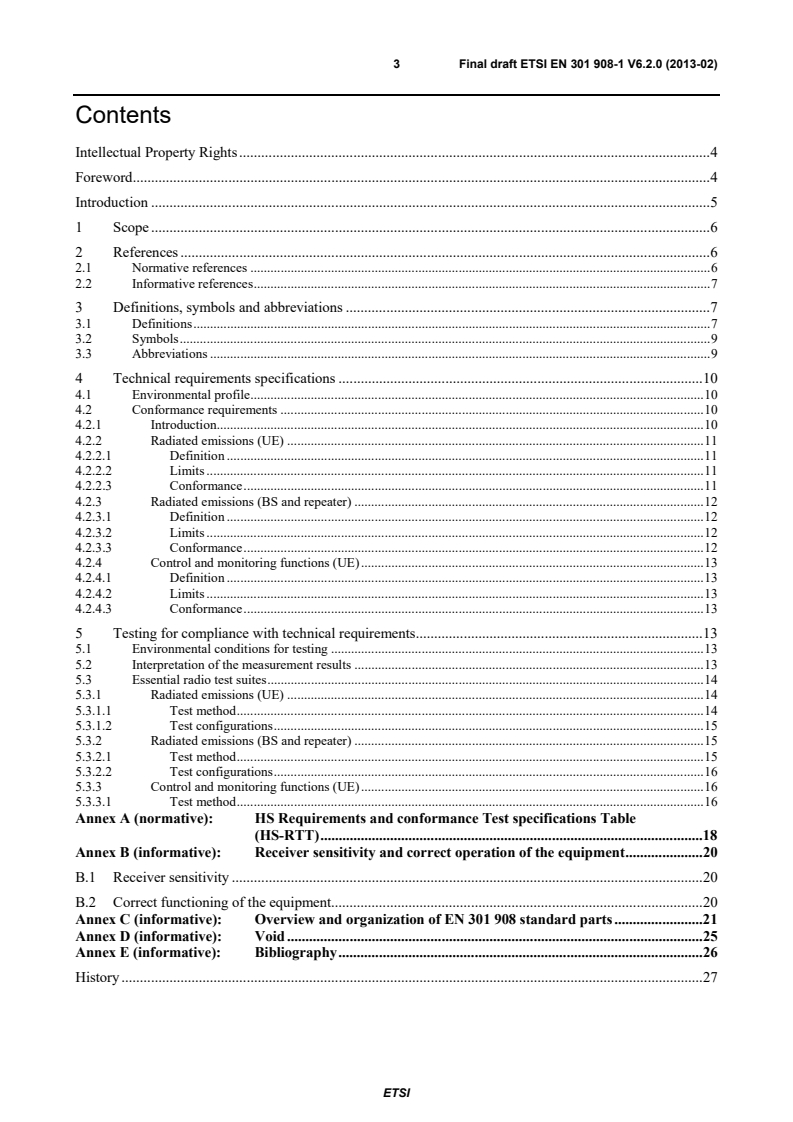
ETSI EN 301 908-1 V6.2.0 (2013-02) - IMT cellular networks; Harmonized EN covering the essential requirements of article 3.2 of the R&TTE Directive; Part 1: Introduction and common requirements
ETSI EN 301 908-1 V6.2.1 (2013-04) - IMT cellular networks; Harmonized EN covering the essential requirements of article 3.2 of the R&TTE Directive; Part 1: Introduction and common requirements



SIST EN 301 908-1 V6.2.1:2013 is the Slovenian adoption of ETSI EN 301 908-1 V6.2.1, a Harmonized European Standard for IMT cellular networks. It specifies common technical requirements and test methods for user equipment (UE), base stations (BS), repeaters and related ancillary equipment, for use with the other parts of EN 301 908. The document supports article 3.2 of the R&TTE Directive, where the practical concern is limiting harmful interference by using spectrum correctly.
What does SIST EN 301 908-1 V6.2.1:2013 specify?
SIST EN 301 908-1 V6.2.1:2013 specifies the common requirements for IMT radio equipment covered by the EN 301 908 family, except IMT-2000 FDMA/TDMA (DECT). It focuses on radio performance items that are shared across several IMT technologies, rather than the technology-specific requirements in the other parts.
The document is organized into:
- Scope
- References
- Definitions, symbols and abbreviations
- Technical requirements specifications
- Testing for compliance with technical requirements
- Annexes A to E
| Annex | What it covers |
|---|---|
| Annex A | HS Requirements and conformance Test specifications Table (HS-RTT) |
| Annex B | Receiver sensitivity and correct operation of the equipment |
| Annex C | Overview and organization of EN 301 908 standard parts |
| Annex D | Void |
| Annex E | Bibliography |
What are the key requirements of SIST EN 301 908-1 V6.2.1:2013?
SIST EN 301 908-1 V6.2.1:2013 sets three common essential parameters: radiated emissions for UE, radiated emissions for BS and repeaters, and control and monitoring functions for UE. In practice, this means the supplier must show that the equipment limits unwanted radiation and, for UE, does not transmit when it should not.
Environmental profile and applicability
Clause 4.1 says the technical requirements apply within the declared operational environmental profile. The supplier must declare that profile, and the equipment must comply throughout the stated operating range. For a buyer or test lab, this means the test conditions have to match the declared use conditions, not an arbitrary environment.
Clause 4 also assumes the operating band is shared among IMT systems or systems with compatible characteristics. That matters because the emission limits are set to protect other spectrum users in shared bands.
Radiated emissions for UE
Clause 4.2.2 requires UE and ancillary equipment to control unwanted emissions from the enclosure port. The limits are defined for the spurious domain and are tied to ITU-R Recommendations SM.329-12 and SM.1539-1.
In practice, UE is tested in both traffic mode and idle mode, and the manufacturer declares the traffic mode configuration used at maximum output power. That matters because emissions can change depending on whether the UE is connected to a network and how it is operating.
Radiated emissions for BS and repeaters
Clause 4.2.3 applies the same general idea to BS and repeaters. The equipment must limit unwanted emissions, and the test is run on a representative configuration.
A BS with multiple enclosures may have the Radio digital unit and the Radio unit tested separately. That is useful in real projects because large base station systems are often built from more than one physical enclosure, and the standard allows testing to follow that structure.
Control and monitoring functions for UE
Clause 4.2.4 verifies that UE control and monitoring functions prevent transmission in the absence of a valid network. The maximum measured power during the test must not exceed -30 dBm.
In practice, this requirement checks that a UE does not radiate when it should be inactive. This is important for avoiding interference from devices that are switched on but not properly controlled by the network.
Testing and measurement uncertainty
Clause 5 states that tests are performed at representative points within the declared operational environmental profile. It also requires the test report to include measurement uncertainty.
The standard gives maximum uncertainty values for UE, BS and repeaters, and it uses a coverage factor of 1.96 for 95% confidence. If the test system has greater uncertainty than the stated limits, the test has to be tightened so that it does not make a failed device look compliant. For labs, that means uncertainty is part of the compliance decision, not just a reporting note.
Essential radio test suites and presumption of conformity
Clause 5.3 links each requirement to a specific test suite:
- Radiated emissions for UE - clause 5.3.1
- Radiated emissions for BS and repeater - clause 5.3.2
- Control and monitoring functions for UE - clause 5.3.3
Annex A shows which requirements are unconditional and which tests are essential. For presumption of conformity under article 3.2, the essential tests in the HS-RTT table are the key route through the standard.
What terms does SIST EN 301 908-1 V6.2.1:2013 define?
- Ancillary equipment - Equipment used with a UE, repeater or BS to add control or operational features, but which cannot provide user functions on its own.
- Applicable part - The specific part of the EN 301 908 series whose scope includes the equipment being tested.
- Environmental profile - The range of environmental conditions under which the equipment must comply.
- Idle mode - The UE state when it is switched on but has no Radio Resource Control (RRC) connection.
- Traffic mode - The UE state when it is switched on and has an established RRC connection.
- Base Station RF bandwidth - The bandwidth in which a BS transmits and receives multiple carriers and/or RATs simultaneously.
- Channel bandwidth - The RF bandwidth that supports a single E-UTRA, Mobile WiMAX or UMB RF carrier in a cell.
Who uses SIST EN 301 908-1 V6.2.1:2013?
Manufacturers and suppliers of IMT UE, BS, repeaters and ancillary equipment use this standard to design and declare conformity for radio equipment covered by the EN 301 908 family. Test laboratories use it for emission testing, control-function testing and measurement uncertainty reporting.
It is also relevant to conformity assessment bodies, quality managers and regulatory teams working with R&TTE article 3.2 compliance. Annex C shows that it applies across several IMT technologies, including IMT-2000 and IMT-Advanced families such as UTRA FDD, UTRA TDD, cdma2000, E-UTRA, UMB and Mobile WiMAX.
What changed in SIST EN 301 908-1 V6.2.1:2013 from the previous edition?
This version replaces EN 301 908-1 V6.2.0. The document history lists V6.2.1 as the April 2013 publication.
Which standards are used with SIST EN 301 908-1 V6.2.1:2013?
The standard relies on these named references for its technical basis and test context:
- ITU-R Recommendation M.1457-10 - defines the terrestrial radio interfaces of IMT-2000.
- ITU-R Recommendation M.2012 - defines the terrestrial radio interfaces of IMT-Advanced.
- ITU-R Recommendation SM.329-12 - provides the spurious-domain emissions basis used for emission limits and test methods.
- ITU-R Recommendation SM.1539-1 - supports the boundary between out-of-band and spurious domains.
- ETSI EN 301 908-10 - provides requirements for IMT-2000 FDMA/TDMA (DECT), including radiated spurious emissions and control and monitoring functions.
- ETSI EN 301 502 - applies to GSM/EDGE base station equipment when a BS is only single-RAT GSM/EDGE capable.
What does the SIST EN 301 908-1 V6.2.1:2013 document contain?
SIST EN 301 908-1 V6.2.1:2013 contains cross-reference tables, emission limit tables, measurement uncertainty tables, test methods and test configurations. It also includes figures showing example ports and base-station enclosure arrangements, which help laboratories identify the interfaces to exercise during testing.
Annex A gives the HS Requirements and conformance Test specifications Table used for presumption of conformity. Annex B explains why receiver sensitivity and correct functioning are treated the way they are. Annex C maps the EN 301 908 parts to IMT technologies and frequency bands, which helps a user find the correct companion part for a given UE, BS or repeater.
Buy Documents
en_30190801v060101c - IMT cellular networks; Harmonized EN covering the essential requirements of article 3.2 of the R&TTE Directive; Part 1: Introduction and common requirements
ETSI EN 301 908-1 V6.2.0 (2013-02) - IMT cellular networks; Harmonized EN covering the essential requirements of article 3.2 of the R&TTE Directive; Part 1: Introduction and common requirements
ETSI EN 301 908-1 V6.2.1 (2013-04) - IMT cellular networks; Harmonized EN covering the essential requirements of article 3.2 of the R&TTE Directive; Part 1: Introduction and common requirements
Get Certified
Connect with accredited certification bodies for this standard

ANCE
Mexican certification and testing association.

Intertek Slovenia
Intertek testing, inspection, and certification services in Slovenia.

LNE (Laboratoire National de Métrologie et d'Essais)
French national laboratory for metrology and testing.
Sponsored listings
Frequently Asked Questions
SIST EN 301 908-1 V6.2.1:2013 is a standard published by the Slovenian Institute for Standardization (SIST). Its full title is "IMT cellular networks - Harmonized EN covering the essential requirements of article 3.2 of the R&TTE Directive - Part 1: Introduction and common requirements". This standard covers: The present document applies to user equipment, repeaters and base stations for IMT, falling within the scope of one of the other parts of EN 301 908, except for IMT-2000 FDMA/TDMA (DECT). The present document also covers the corresponding ancillary equipment. NOTE 1: EN 301 908-10 [5] contains in particular requirements for radiated spurious emissions and control and monitoring functions applicable to IMT-2000 FDMA/TDMA (DECT) equipment. The present document includes technical requirements which are common to equipment falling within the scope of several of the other parts. NOTE 2: The other parts of EN 301 908, which are listed in the foreword of the present document, specify technical requirements in respect of a particular type of IMT equipment. NOTE 3: ITU-R Recommendations M.1457-10 [1] and M.2012 [2] define the characteristics of the members of the IMT-2000 family and IMT-Advanced respectively by means of references to technical specifications developed by Standards Development organizations. The present document applies to equipment designed to meet any version of the terrestrial specifications referenced in ITU-R Recommendations M.1457-10 [1] and M.2012 [2]. The present document is intended to cover the provisions of Directive 1999/5/EC [i.2] (R&TTE Directive), article 3.2, which states that "… radio equipment shall be so constructed that it effectively uses the spectrum allocated to terrestrial/space radio communications and orbital resources so as to avoid harmful interference." In addition to the present document, other ENs that specify technical requirements in respect of essential requirements under other parts of article 3 of the R&TTE Directive [i.2] may apply to equipment within the scope of the present document.
The present document applies to user equipment, repeaters and base stations for IMT, falling within the scope of one of the other parts of EN 301 908, except for IMT-2000 FDMA/TDMA (DECT). The present document also covers the corresponding ancillary equipment. NOTE 1: EN 301 908-10 [5] contains in particular requirements for radiated spurious emissions and control and monitoring functions applicable to IMT-2000 FDMA/TDMA (DECT) equipment. The present document includes technical requirements which are common to equipment falling within the scope of several of the other parts. NOTE 2: The other parts of EN 301 908, which are listed in the foreword of the present document, specify technical requirements in respect of a particular type of IMT equipment. NOTE 3: ITU-R Recommendations M.1457-10 [1] and M.2012 [2] define the characteristics of the members of the IMT-2000 family and IMT-Advanced respectively by means of references to technical specifications developed by Standards Development organizations. The present document applies to equipment designed to meet any version of the terrestrial specifications referenced in ITU-R Recommendations M.1457-10 [1] and M.2012 [2]. The present document is intended to cover the provisions of Directive 1999/5/EC [i.2] (R&TTE Directive), article 3.2, which states that "… radio equipment shall be so constructed that it effectively uses the spectrum allocated to terrestrial/space radio communications and orbital resources so as to avoid harmful interference." In addition to the present document, other ENs that specify technical requirements in respect of essential requirements under other parts of article 3 of the R&TTE Directive [i.2] may apply to equipment within the scope of the present document.
SIST EN 301 908-1 V6.2.1:2013 is classified under the following ICS (International Classification for Standards) categories: 33.060.99 - Other equipment for radiocommunications; 33.100.01 - Electromagnetic compatibility in general. The ICS classification helps identify the subject area and facilitates finding related standards.
SIST EN 301 908-1 V6.2.1:2013 is associated with the following European legislation: EU Directives/Regulations: 1999/5/EC, 2005-01-1864. When a standard is cited in the Official Journal of the European Union, products manufactured in conformity with it benefit from a presumption of conformity with the essential requirements of the corresponding EU directive or regulation.
SIST EN 301 908-1 V6.2.1:2013 is available in PDF format for immediate download after purchase. The document can be added to your cart and obtained through the secure checkout process. Digital delivery ensures instant access to the complete standard document.
Standards Content (Sample)
Contents
- Introduction
- 6 Draft ETSI EN 301 908-1 V6.1.1 (2012-07)
- 1 Scope
- 2 References
- 2.1 Normative references
- 7 Draft ETSI EN 301 908-1 V6.1.1 (2012-07)
- 2.2 Informative references
- 3 Definitions, symbols and abbreviations
- 3.1 Definitions
- 8 Draft ETSI EN 301 908-1 V6.1.1 (2012-07)
- 9 Draft ETSI EN 301 908-1 V6.1.1 (2012-07)
- 3.2 Symbols
- 3.3 Abbreviations
- 10 Draft ETSI EN 301 908-1 V6.1.1 (2012-07)
- 4 Technical requirements specifications
- 4.1 Environmental profile
- 4.2 Conformance requirements
- 11 Draft ETSI EN 301 908-1 V6.1.1 (2012-07)
- 30 MHz ≤ f < 1 000 MHz -57 dBm/100 kHz -36 dBm/100 kHz All
- 1 GHz ≤ f < 12,75 GHz
- 10 MHz
- 12 Draft ETSI EN 301 908-1 V6.1.1 (2012-07)
- 30 MHz ≤ f < 1 000 MHz -36 dBm/100 kHz All
- 1 GHz ≤ f < 12,75 GHz
- 13 Draft ETSI EN 301 908-1 V6.1.1 (2012-07)
- 5 Testing for compliance with technical requirements
- 5.1 Environmental conditions for testing
- 5.2 Interpretation of the measurement results
- 14 Draft ETSI EN 301 908-1 V6.1.1 (2012-07)
- 5.3 Essential radio test suites
- 15 Draft ETSI EN 301 908-1 V6.1.1 (2012-07)
- 16 Draft ETSI EN 301 908-1 V6.1.1 (2012-07)
- 17 Draft ETSI EN 301 908-1 V6.1.1 (2012-07)
- 18 Draft ETSI EN 301 908-1 V6.1.1 (2012-07)
- 19 Draft ETSI EN 301 908-1 V6.1.1 (2012-07)
- 20 Draft ETSI EN 301 908-1 V6.1.1 (2012-07)
- 21 Draft ETSI EN 301 908-1 V6.1.1 (2012-07)
- 22 Draft ETSI EN 301 908-1 V6.1.1 (2012-07)
- 23 Draft ETSI EN 301 908-1 V6.1.1 (2012-07)
- 24 Draft ETSI EN 301 908-1 V6.1.1 (2012-07)
- 25 Draft ETSI EN 301 908-1 V6.1.1 (2012-07)
- Bibliography
- 26 Draft ETSI EN 301 908-1 V6.1.1 (2012-07)
Introduction
The present document is part of a set of standards developed by ETSI and is designed to fit in a modular structure to cover all radio and telecommunications terminal equipment within the scope of the R&TTE Directive [i.2]. The modular structure is shown in EG 201 399 [i.3].
ETSI
6 Draft ETSI EN 301 908-1 V6.1.1 (2012-07)
1 Scope
The present document applies to user equipment, repeaters and base stations for IMT, falling within the scope of one of the other parts of EN 301 908, except for IMT-2000 FDMA/TDMA (DECT). The present document also covers the corresponding ancillary equipment.
NOTE 1: EN 301 908-10 [5] contains in particular requirements for radiated spurious emissions and control and monitoring functions applicable to IMT-2000 FDMA/TDMA (DECT) equipment. The present document includes technical requirements which are common to equipment falling within the scope of several of the other parts.
NOTE 2: The other parts of EN 301 908, which are listed in the foreword of the present document, specify technical requirements in respect of a particular type of IMT equipment. NOTE 3: ITU-R Recommendation M.1457-10 [1] defines the characteristics of the members of the IMT-2000 family by means of references to technical specifications developed by Standards Development organizations. The present document applies to equipment designed to meet any version of the terrestrial specifications referenced in ITU-R Recommendation M.1457-10 [1]. The present document is intended to cover the provisions of Directive 1999/5/EC [i.2] (R&TTE Directive), article 3.2, which states that "… radio equipment shall be so constructed that it effectively uses the spectrum allocated to terrestrial/space radio communications and orbital resources so as to avoid harmful interference." In addition to the present document, other Ens that specify technical requirements in respect of essential requirements under other parts of article 3 of the R&TTE Directive [i.2] may apply to equipment within the scope of the present document.
NOTE 4: A list of such Ens is included on the web site http://www.newapproach.org.
2 References
References are either specific (identified by date of publication and/or edition number or version number) or non-specific. For specific references, only the cited version applies. For non-specific references, the latest version of the referenced document (including any amendments) applies.
Referenced documents which are not found to be publicly available in the expected location might be found at http://docbox.etsi.org/Reference.
NOTE: While any hyperlinks included in this clause were valid at the time of publication, ETSI cannot guarantee their long term validity.
2.1 Normative references
The following referenced documents are necessary for the application of the present document. [1] ITU-R Recommendation M.1457-10 (2011): "Detailed specifications of the terrestrial radio interfaces of International Mobile Telecommunications-2000 (IMT-2000)". [2] Void.
[3] ITU-R Recommendation SM.329-11 (2011): "Unwanted emissions in the spurious domain". [4] ITU-R Recommendation SM.1539-1 (2002): "Variation of the boundary between the out-of-band and spurious domains required for the application of Recommendations ITU-R SM.1541 and ITU-R SM.329".
ETSI
7 Draft ETSI EN 301 908-1 V6.1.1 (2012-07)
[5] ETSI EN 301 908-10 (V4.1.1): "Electromagnetic compatibility and Radio spectrum Matters (ERM); Base Stations (BS), Repeaters and User Equipment (UE) for IMT-2000 Third-Generation cellular networks; Part 10: Harmonized EN for IMT-2000, FDMA/TDMA (DECT) covering essential requirements of article 3.2 of the R&TTE Directive". [6] ETSI EN 301 502 (V10.1.1): "Global System for Mobile communications (GSM); Harmonized EN for Base Station Equipment covering the essential requirements of article 3.2 of the R&TTE Directive".
2.2 Informative references
The following referenced documents are not necessary for the application of the present document but they assist the user with regard to a particular subject area.
[i.1] Directive 98/34/EC of the European Parliament and of the Council of 22 June 1998 laying down a procedure for the provision of information in the field of technical standards and regulations. [i.2] Directive 1999/5/EC of the European Parliament and of the Council of 9 March 1999 on radio equipment and telecommunications terminal equipment and the mutual recognition of their conformity (R&TTE Directive).
[i.3] ETSI EG 201 399: "Electromagnetic compatibility and Radio spectrum Matters (ERM); A guide to the production of Harmonized Standards for application under the R&TTE Directive". [i.4] Void.
[i.5] ETSI TR 100 028 (all parts) (V1.4.1): "Electromagnetic compatibility and Radio spectrum Matters (ERM); Uncertainties in the measurement of mobile radio equipment characteristics". [i.6] Directive 98/48/EC of the European Parliament and of the Council of 20 July 1998 amending Directive 98/34/EC laying down a procedure for the provision of information in the field of technical standards and regulations.
3 Definitions, symbols and abbreviations
3.1 Definitions
For the purposes of the present document, the terms and definitions given in the R&TTE Directive [i.2] and the following apply:
ancillary equipment: equipment (apparatus), used in connection with a User Equipment (UE), Repeater or Base Station (BS) is considered as an ancillary equipment (apparatus) if:
- the equipment is intended for use in conjunction with a user equipment UE, repeater or BS to provide additional operational and/or control features to the radio equipment, (e.g. to extend control to another position or location); and
- the equipment cannot be used on a stand alone basis to provide user functions independently of a UE, BS or combination of BS and repeater; and
- the UE, BS or combination of BS and repeater to which it is connected, is capable of providing some intended operation, such as transmitting and/or receiving without the ancillary equipment (i.e. it is not a sub-unit of the main equipment essential to the main equipment basic functions). applicable part: part of the multi-part deliverable, of which the present document is the first part, for which the scope of that document includes the equipment to be tested Base Station RF bandwidth: bandwidth in which a Base Station transmits and receives multiple carriers and/or RATs simultaneously ETSI
8 Draft ETSI EN 301 908-1 V6.1.1 (2012-07)
channel bandwidth: RF bandwidth supporting a single E-UTRA, Mobile WiMAX or UMB RF carrier with the transmission bandwidth configured in the uplink or downlink of a cell NOTE: The channel bandwidth is measured in MHz and is used as a reference for transmitter and receiver RF requirements.
enclosure port: physical boundary of the apparatus through which electromagnetic fields may radiate or impinge NOTE: In the case of integral antenna equipment, this port is inseparable from the antenna port. environmental profile: range of environmental conditions under which equipment within the scope of the present document is required to comply with the provisions of the present document idle mode: state of User Equipment (UE) when switched on but with no Radio Resource Control (RRC) connection IMT-2000: third generation mobile systems which are scheduled to start service around the year 2000 subject to market considerations NOTE: ITU-R Recommendation M.1457-10 [1] identifies the detailed specifications for the IMT-2000 radio interfaces.
Lower RF bandwidth edge: frequency of the lower edge of the Base Station RF bandwidth, used as a frequency reference point for transmitter and receiver requirements MSR Base Station: Base Station characterized by the ability of its receiver and transmitter to process two or more carriers in common active RF components simultaneously in a declared RF bandwidth, where at least one carrier is of a different RAT than the other carrier(s) port: particular interface, of the specified equipment (apparatus), with the electromagnetic environment NOTE: For example, any connection point on an equipment intended for connection of cables to or from that equipment is considered as a port (see figure 3.1-1).
Enclosure port
Antenna port AC Power port
Signal/Control port DC Power port Apparatus
Telecommunications port Earth port
Figure 3.1-1: Examples of ports BS Equipment Radio Equipment
Figure 3.1-2: BS with single enclosure solution ETSI
9 Draft ETSI EN 301 908-1 V6.1.1 (2012-07)
BS Equipment Radio Equipment Radio digital Radio unit unit
Figure 3.1-3: BS with multiple enclosure solution radio communications equipment: telecommunications equipment which includes one or more transmitters and/or receivers and/or parts thereof for use in a fixed, mobile or portable application NOTE: It can be operated with ancillary equipment but if so, is not dependent on it for basic functionality. radio digital unit: equipment which contains base band and functionality for controlling Radio unit radio equipment: equipment which contains Radio digital unit and Radio unit radio unit: equipment which contains transmitter and receiver signal and control port: port which carries information or control signals, excluding antenna ports telecommunication port: port which is intended to be connected to telecommunication networks (e.g. public switched telecommunication networks, integrated services digital networks), local area networks (e.g. Ethernet, token ring) and similar networks traffic mode: state of User Equipment (UE) when switched on and with Radio Resource Control (RRC) connection established Upper RF bandwidth edge: frequency of the upper edge of the Base Station RF bandwidth, used as a frequency reference point for transmitter and receiver requirements WiMAX: trade marked name for the OFDMA TDD WMAN IMT technology
3.2 Symbols
For the purposes of the present document, the following symbols apply:
BW Channel bandwidth Channel F Upper RF bandwidth edge BW RF, high F Lower RF bandwidth edge BW RF, low
3.3 Abbreviations
For the purposes of the present document, the following abbreviations apply:
BS Base Station CDMA Code Division Multiple Access CW Continuous Wave DECT Digital Enhanced Cordless Telecommunication e.i.r.p. equivalent isotropically radiated power e.r.p. effective radiated power EDGE Enhanced Data rates for GSM Evolution EMC ElectroMagnetic Compatibility ETSI
10 Draft ETSI EN 301 908-1 V6.1.1 (2012-07)
ERM Electromagnetic compatibility and Radio spectrum Matters EUT Equipment Under Test E-UTRA Evolved Universal Terrestrial Radio Access NOTE: Also known as LTE.
FDD Frequency Division Duplex FDMA Frequency Division Multiple Access GSM Global System for Mobile communications IMT International Mobile Telecommunications IMT-2000 International Mobile Telecommunications 2000 ITU-R International Telecommunication Union Radio sector LTE Long Term Evolution NOTE: Also known as E-UTRA.
MSG Mobile Standards Group MSR Multi-Standard Radio OFDMA Orthogonal Frequency Division Multiple Access R&TTE Radio Telecommunications and Terminal Equipment RAT Radio Access Technology RF Radio Frequency RIT Radio Interface Technology RMS Root Mean Square RRC Radio Resource Control SDO Standard Development Organization TDD Time Division Duplex TDMA Time Division Multiple Access TFES Task Force for European Standards for IMT TIA Telecommunications Industry Association UE User Equipment UMB Ultra Mobile Broadband UTRA Universal Terrestrial Radio Access UWC Universal Wireless Communications WMAN Wireless Metropolitan Area Network
4 Technical requirements specifications
4.1 Environmental profile
The technical requirements of the present document apply under the environmental profile for operation of the equipment, which shall be declared by the supplier. The equipment shall comply with all the technical requirements of the present document at all times when operating within the boundary limits of the declared operational environmental profile.
4.2 Conformance requirements
The requirements in the present document are based on the assumption that the operating band is shared between systems of the IMT family or systems having compatible characteristics.
4.2.1 Introduction
To meet the essential requirement under article 3.2 of Directive 1999/5/EC [i.2] (R&TTE Directive) for IMT equipment three common essential parameters have been identified. Tables 4.2.1-1 and 4.2.1-2 provide cross-references, for UE, repeater and BS respectively, between these essential parameters and the corresponding technical requirements for equipment within the scope of the present document.
ETSI
11 Draft ETSI EN 301 908-1 V6.1.1 (2012-07)
Table 4.2.1-1: Cross references for User Equipment (UE) Essential parameter Corresponding technical requirements Radiated emissions 4.2.2 Radiated emissions (UE) Control and monitoring functions 4.2.4 Control and monitoring functions (UE)
Table 4.2.1-2: Cross references for Base Stations (BS), and repeaters Essential parameter Corresponding technical requirements Radiated emissions 4.2.3 Radiated emissions (BS and repeater)
NOTE: Receiver sensitivity, use of correct timing and use of correct code are covered in clauses B.1 and B.2 respectively.
4.2.2 Radiated emissions (UE)
4.2.2.1 Definition
This test assesses the ability of radio communications equipment and ancillary equipment to limit unwanted emissions from the enclosure port.
This test is applicable to radio communications equipment and ancillary equipment. This test shall be performed on the radio communications equipment and/or a representative configuration of the ancillary equipment.
4.2.2.2 Limits
The frequency boundary and reference bandwidths for the detailed transitions of the limits between the requirements for out-of-band emissions and spurious emissions are based on ITU-R Recommendations SM.329-11 [3] and SM.1539-1 [4].
The requirements shown in table 4.2.2.2-1 are only applicable for frequencies in the spurious domain. Table 4.2.2.2-1: Radiated spurious emissions requirements (UE) Frequency Minimum Minimum requirement Applicability requirement (e.r.p.)/ (e.r.p.)/ reference reference bandwidth bandwidth traffic mode idle mode
30 MHz ≤ f < 1 000 MHz -57 dBm/100 kHz -36 dBm/100 kHz All
-47 dBm/1 MHz -30 dBm/1 MHz All
1 GHz ≤ f < 12,75 GHz
fc - 2,5 × 5 MHz < f < fc Not defined UTRA FDD, + 2,5 × 5 MHz UTRA TDD, 3,84 Mcps option, cdma2000, spreading rate 3 fc - 2,5 × BW MHz < f < fc + Not defined E-UTRA FDD, E-UTRA TDD, Channel Mobile WiMAX, UMB 2,5 × BW MHz Channel fc - 2,5 × 10 MHz < f < fc1 + 2,5 × Not defined UTRA TDD, 7,68 Mcps option
10 MHz
fc - 4 MHz < f < fc + 4 MHz Not defined UTRA TDD, 1,28 Mcps option cdma2000, spreading rate 1 fc - 500 kHz < f < fc + 500 kHz Not defined UWC 136, 200 kHz option fc - 250 kHz < f < fc + 250 kHz Not defined UWC 136, 30 kHz option NOTE: fc is the UE transmit centre frequency.
4.2.2.3 Conformance
Conformance tests described in clause 5.3.1 shall be carried out. ETSI
12 Draft ETSI EN 301 908-1 V6.1.1 (2012-07)
4.2.3 Radiated emissions (BS and repeater)
4.2.3.1 Definition
This test assesses the ability of BS and repeater to limit unwanted emission from the enclosure port. This test is applicable to Base Stations, except for BS that are only single-RAT GSM/EDGE capable and also applicable to repeaters. This test shall be performed on a representative configuration of the equipment under test. For a BS with multiple enclosures, the BS part with Radio digital unit and the Radio unit may be tested separately. For Base Stations that are only single-RAT GSM/EDGE capable, the limits and the test method in clauses 4.2.16 and 5.3.16 of EN 301 502 [6] apply.
4.2.3.2 Limits
The frequency boundary and reference bandwidths for the detailed transitions of the limits between the requirements for out-of-band emissions and spurious emissions are based on ITU-R Recommendations SM.329-11 [3] and SM.1539-1 [4].
The requirements, shown in table 4.2.3.2-1, are applicable for frequencies in the spurious domain. The BS and repeater shall meet the limits given in table 4.2.3.2-1. Table 4.2.3.2-1: Radiated spurious emissions requirements (BS and repeater) Frequency Minimum Applicability requirement (e.r.p.)/ reference bandwidth
30 MHz ≤ f < 1 000 MHz -36 dBm/100 kHz All
-30 dBm/1 MHz All
...
Contents
- Introduction
- 6 Final draft ETSI EN 301 908-1 V6.2.0 (2013-02)
- 1 Scope
- 2 References
- 2.1 Normative references
- 7 Final draft ETSI EN 301 908-1 V6.2.0 (2013-02)
- 2.2 Informative references
- 3 Definitions, symbols and abbreviations
- 3.1 Definitions
- 8 Final draft ETSI EN 301 908-1 V6.2.0 (2013-02)
- 9 Final draft ETSI EN 301 908-1 V6.2.0 (2013-02)
- 3.2 Symbols
- 3.3 Abbreviations
- 10 Final draft ETSI EN 301 908-1 V6.2.0 (2013-02)
- 4 Technical requirements specifications
- 4.1 Environmental profile
- 4.2 Conformance requirements
- 11 Final draft ETSI EN 301 908-1 V6.2.0 (2013-02)
- 30 MHz ≤ f < 1 000 MHz -57 dBm/100 kHz -36 dBm/100 kHz All
- 1 GHz ≤ f < 12,75 GHz
- 10 MHz
- 12 Final draft ETSI EN 301 908-1 V6.2.0 (2013-02)
- 30 MHz ≤ f < 1 000 MHz -36 dBm/100 kHz All
- 1 GHz ≤ f < 12,75 GHz
- 13 Final draft ETSI EN 301 908-1 V6.2.0 (2013-02)
- 5 Testing for compliance with technical requirements
- 5.1 Environmental conditions for testing
- 5.2 Interpretation of the measurement results
- 14 Final draft ETSI EN 301 908-1 V6.2.0 (2013-02)
- 5.3 Essential radio test suites
- 15 Final draft ETSI EN 301 908-1 V6.2.0 (2013-02)
- 16 Final draft ETSI EN 301 908-1 V6.2.0 (2013-02)
- 17 Final draft ETSI EN 301 908-1 V6.2.0 (2013-02)
- 18 Final draft ETSI EN 301 908-1 V6.2.0 (2013-02)
- 19 Final draft ETSI EN 301 908-1 V6.2.0 (2013-02)
- 20 Final draft ETSI EN 301 908-1 V6.2.0 (2013-02)
- 21 Final draft ETSI EN 301 908-1 V6.2.0 (2013-02)
- 22 Final draft ETSI EN 301 908-1 V6.2.0 (2013-02)
- 23 Final draft ETSI EN 301 908-1 V6.2.0 (2013-02)
- 24 Final draft ETSI EN 301 908-1 V6.2.0 (2013-02)
- 25 Final draft ETSI EN 301 908-1 V6.2.0 (2013-02)
- 26 Final draft ETSI EN 301 908-1 V6.2.0 (2013-02)
- Bibliography
- 27 Final draft ETSI EN 301 908-1 V6.2.0 (2013-02)
Introduction
The present document is part of a set of standards developed by ETSI and is designed to fit in a modular structure to cover all radio and telecommunications terminal equipment within the scope of the R&TTE Directive [i.2]. The modular structure is shown in EG 201 399 [i.3].
ETSI
6 Final draft ETSI EN 301 908-1 V6.2.0 (2013-02)
1 Scope
The present document applies to user equipment, repeaters and base stations for IMT, falling within the scope of one of the other parts of EN 301 908, except for IMT-2000 FDMA/TDMA (DECT). The present document also covers the corresponding ancillary equipment.
NOTE 1: EN 301 908-10 [5] contains in particular requirements for radiated spurious emissions and control and monitoring functions applicable to IMT-2000 FDMA/TDMA (DECT) equipment. The present document includes technical requirements which are common to equipment falling within the scope of several of the other parts.
NOTE 2: The other parts of EN 301 908, which are listed in the foreword of the present document, specify technical requirements in respect of a particular type of IMT equipment. NOTE 3: ITU-R Recommendations M.1457-10 [1] and M.2012 [2] define the characteristics of the members of the IMT-2000 family and IMT-Advanced respectively by means of references to technical specifications developed by Standards Development organizations. The present document applies to equipment designed to meet any version of the terrestrial specifications referenced in ITU-R Recommendations M.1457-10 [1] and M.2012 [2].
The present document is intended to cover the provisions of Directive 1999/5/EC [i.2] (R&TTE Directive), article 3.2, which states that "… radio equipment shall be so constructed that it effectively uses the spectrum allocated to terrestrial/space radio communications and orbital resources so as to avoid harmful interference." In addition to the present document, other ENs that specify technical requirements in respect of essential requirements under other parts of article 3 of the R&TTE Directive [i.2] may apply to equipment within the scope of the present document.
NOTE 4: A list of such Ens is included on the web site http://www.newapproach.org.
2 References
References are either specific (identified by date of publication and/or edition number or version number) or non-specific. For specific references, only the cited version applies. For non-specific references, the latest version of the referenced document (including any amendments) applies.
Referenced documents which are not found to be publicly available in the expected location might be found at http://docbox.etsi.org/Reference.
NOTE: While any hyperlinks included in this clause were valid at the time of publication, ETSI cannot guarantee their long term validity.
2.1 Normative references
The following referenced documents are necessary for the application of the present document. [1] ITU-R Recommendation M.1457-10 (2011): "Detailed specifications of the terrestrial radio interfaces of International Mobile Telecommunications-2000 (IMT-2000)". [2] ITU-R Recommendation M.2012 (2012): "Detailed specifications of the terrestrial radio interfaces of International Mobile Telecommunications-Advanced (IMT-Advanced)". [3] ITU-R Recommendation SM.329-12 (2012): "Unwanted emissions in the spurious domain". [4] ITU-R Recommendation SM.1539-1 (2002): "Variation of the boundary between the out-of-band and spurious domains required for the application of Recommendations ITU-R SM.1541 and ITU-R SM.329".
ETSI
7 Final draft ETSI EN 301 908-1 V6.2.0 (2013-02)
[5] ETSI EN 301 908-10 (V4.1.1): "Electromagnetic compatibility and Radio spectrum Matters (ERM); Base Stations (BS), Repeaters and User Equipment (UE) for IMT-2000 Third-Generation cellular networks; Part 10: Harmonized EN for IMT-2000, FDMA/TDMA (DECT) covering essential requirements of article 3.2 of the R&TTE Directive". [6] ETSI EN 301 502 (V10.2.1): "Global System for Mobile communications (GSM); Harmonized EN for Base Station Equipment covering the essential requirements of article 3.2 of the R&TTE Directive".
2.2 Informative references
The following referenced documents are not necessary for the application of the present document but they assist the user with regard to a particular subject area.
[i.1] Directive 98/34/EC of the European Parliament and of the Council of 22 June 1998 laying down a procedure for the provision of information in the field of technical standards and regulations. [i.2] Directive 1999/5/EC of the European Parliament and of the Council of 9 March 1999 on radio equipment and telecommunications terminal equipment and the mutual recognition of their conformity (R&TTE Directive).
[i.3] ETSI EG 201 399: "Electromagnetic compatibility and Radio spectrum Matters (ERM); A guide to the production of Harmonized Standards for application under the R&TTE Directive". [i.4] Void.
[i.5] ETSI TR 100 028 (all parts) (V1.4.1): "Electromagnetic compatibility and Radio spectrum Matters (ERM); Uncertainties in the measurement of mobile radio equipment characteristics". [i.6] Directive 98/48/EC of the European Parliament and of the Council of 20 July 1998 amending Directive 98/34/EC laying down a procedure for the provision of information in the field of technical standards and regulations.
3 Definitions, symbols and abbreviations
3.1 Definitions
For the purposes of the present document, the terms and definitions given in the R&TTE Directive [i.2] and the following apply:
ancillary equipment: equipment (apparatus), used in connection with a User Equipment (UE), Repeater or Base Station (BS) is considered as an ancillary equipment (apparatus) if:
- the equipment is intended for use in conjunction with a user equipment UE, repeater or BS to provide additional operational and/or control features to the radio equipment, (e.g. to extend control to another position or location); and
- the equipment cannot be used on a stand alone basis to provide user functions independently of a UE, BS or combination of BS and repeater; and
- the UE, BS or combination of BS and repeater to which it is connected, is capable of providing some intended operation, such as transmitting and/or receiving without the ancillary equipment (i.e. it is not a sub-unit of the main equipment essential to the main equipment basic functions). applicable part: part of the multi-part deliverable, of which the present document is the first part, for which the scope of that document includes the equipment to be tested Base Station RF bandwidth: bandwidth in which a Base Station transmits and receives multiple carriers and/or RATs simultaneously ETSI
8 Final draft ETSI EN 301 908-1 V6.2.0 (2013-02)
channel bandwidth: RF bandwidth supporting a single E-UTRA, Mobile WiMAX or UMB RF carrier with the transmission bandwidth configured in the uplink or downlink of a cell NOTE: The channel bandwidth is measured in MHz and is used as a reference for transmitter and receiver RF requirements.
enclosure port: physical boundary of the apparatus through which electromagnetic fields may radiate or impinge NOTE: In the case of integral antenna equipment, this port is inseparable from the antenna port. environmental profile: range of environmental conditions under which equipment within the scope of the present document is required to comply with the provisions of the present document idle mode: state of User Equipment (UE) when switched on but with no Radio Resource Control (RRC) connection IMT-2000: mobile systems as defined in ITU-R Recommendation M.1457-10 [1] NOTE: ITU-R Recommendation M.1457-10 [1] identifies the detailed specifications for the IMT-2000 radio interfaces.
IMT-Advanced: mobile systems as defined in ITU-R Recommendation M.2012 [2] NOTE: ITU-R Recommendation M.2012 [2] identifies the detailed specifications for the IMT-Advanced radio interfaces.
Lower RF bandwidth edge: frequency of the lower edge of the Base Station RF bandwidth, used as a frequency reference point for transmitter and receiver requirements MSR Base Station: Base Station characterized by the ability of its receiver and transmitter to process two or more carriers in common active RF components simultaneously in a declared RF bandwidth, where at least one carrier is of a different RAT than the other carrier(s) port: particular interface, of the specified equipment (apparatus), with the electromagnetic environment NOTE: For example, any connection point on an equipment intended for connection of cables to or from that equipment is considered as a port (see figure 3.1-1).
Enclosure port
Antenna port AC Power port
Signal/Control port DC Power port Apparatus
Telecommunications port Earth port
Figure 3.1-1: Examples of ports BS Equipment Radio Equipment
Figure 3.1-2: BS with single enclosure solution ETSI
9 Final draft ETSI EN 301 908-1 V6.2.0 (2013-02)
BS Equipment Radio Equipment Radio digital Radio unit unit
Figure 3.1-3: BS with multiple enclosure solution radio communications equipment: telecommunications equipment which includes one or more transmitters and/or receivers and/or parts thereof for use in a fixed, mobile or portable application NOTE: It can be operated with ancillary equipment but if so, is not dependent on it for basic functionality. radio digital unit: equipment which contains base band and functionality for controlling Radio unit radio equipment: equipment which contains Radio digital unit and Radio unit radio unit: equipment which contains transmitter and receiver signal and control port: port which carries information or control signals, excluding antenna ports telecommunication port: port which is intended to be connected to telecommunication networks (e.g. public switched telecommunication networks, integrated services digital networks), local area networks (e.g. Ethernet, token ring) and similar networks traffic mode: state of User Equipment (UE) when switched on and with Radio Resource Control (RRC) connection established Upper RF bandwidth edge: frequency of the upper edge of the Base Station RF bandwidth, used as a frequency reference point for transmitter and receiver requirements WiMAX: trade marked name for the OFDMA TDD WMAN IMT technology
3.2 Symbols
For the purposes of the present document, the following symbols apply:
BW Channel bandwidth Channel F Upper RF bandwidth edge BW RF, high F Lower RF bandwidth edge BW RF, low
3.3 Abbreviations
For the purposes of the present document, the following abbreviations apply:
BS Base Station CDMA Code Division Multiple Access CW Continuous Wave DECT Digital Enhanced Cordless Telecommunication e.i.r.p. equivalent isotropically radiated power e.r.p. effective radiated power EDGE Enhanced Data rates for GSM Evolution EMC ElectroMagnetic Compatibility ETSI
10 Final draft ETSI EN 301 908-1 V6.2.0 (2013-02)
ERM Electromagnetic compatibility and Radio spectrum Matters EUT Equipment Under Test E-UTRA Evolved Universal Terrestrial Radio Access NOTE: Also known as LTE.
FDD Frequency Division Duplex FDMA Frequency Division Multiple Access GSM Global System for Mobile communications IMT International Mobile Telecommunications NOTE: Includes both IMT-2000 and IMT-Advanced RITs.
ITU-R International Telecommunication Union Radio sector LTE Long Term Evolution NOTE: Also known as E-UTRA.
MSG Mobile Standards Group MSR Multi-Standard Radio OFDMA Orthogonal Frequency Division Multiple Access R&TTE Radio Telecommunications and Terminal Equipment RAT Radio Access Technology RF Radio Frequency RIT Radio Interface Technology RMS Root Mean Square RRC Radio Resource Control SDO Standard Development Organization TDD Time Division Duplex TDMA Time Division Multiple Access TFES Task Force for European Standards for IMT TIA Telecommunications Industry Association UE User Equipment UMB Ultra Mobile Broadband UTRA Universal Terrestrial Radio Access UWC Universal Wireless Communications WMAN Wireless Metropolitan Area Network
4 Technical requirements specifications
4.1 Environmental profile
The technical requirements of the present document apply under the environmental profile for operation of the equipment, which shall be declared by the supplier. The equipment shall comply with all the technical requirements of the present document at all times when operating within the boundary limits of the declared operational environmental profile.
4.2 Conformance requirements
The requirements in the present document are based on the assumption that the operating band is shared between systems of the IMT family or systems having compatible characteristics.
4.2.1 Introduction
To meet the essential requirement under article 3.2 of Directive 1999/5/EC [i.2] (R&TTE Directive) for IMT equipment three common essential parameters have been identified. Tables 4.2.1-1 and 4.2.1-2 provide cross-references, for UE, repeater and BS respectively, between these essential parameters and the corresponding technical requirements for equipment within the scope of the present document.
ETSI
11 Final draft ETSI EN 301 908-1 V6.2.0 (2013-02)
Table 4.2.1-1: Cross references for User Equipment (UE) Essential parameter Corresponding technical requirements Radiated emissions 4.2.2 Radiated emissions (UE) Control and monitoring functions 4.2.4 Control and monitoring functions (UE)
Table 4.2.1-2: Cross references for Base Stations (BS), and repeaters Essential parameter Corresponding technical requirements Radiated emissions 4.2.3 Radiated emissions (BS and repeater)
NOTE: Receiver sensitivity, use of correct timing and use of correct code are covered in clauses B.1 and B.2 respectively.
4.2.2 Radiated emissions (UE)
4.2.2.1 Definition
This test assesses the ability of radio communications equipment and ancillary equipment to limit unwanted emissions from the enclosure port.
This test is applicable to radio communications equipment and ancillary equipment. This test shall be performed on the radio communications equipment and/or a representative configuration of the ancillary equipment.
4.2.2.2 Limits
The frequency boundary and reference bandwidths for the detailed transitions of the limits between the requirements for out-of-band emissions and spurious emissions are based on ITU-R Recommendations SM.329-12 [3] and SM.1539-1 [4].
The requirements shown in table 4.2.2.2-1 are only applicable for frequencies in the spurious domain. Table 4.2.2.2-1: Radiated spurious emissions requirements (UE) Frequency Minimum Minimum requirement Applicability requirement (e.r.p.)/ (e.r.p.)/ reference reference bandwidth bandwidth traffic mode idle mode
30 MHz ≤ f < 1 000 MHz -57 dBm/100 kHz -36 dBm/100 kHz All
-47 dBm/1 MHz -30 dBm/1 MHz All
1 GHz ≤ f < 12,75 GHz
fc - 2,5 × 5 MHz < f < fc Not defined UTRA FDD, + 2,5 × 5 MHz UTRA TDD, 3,84 Mcps option, cdma2000, spreading rate 3 fc - 2,5 × BW MHz < f < fc + Not defined E-UTRA FDD, E-UTRA TDD, Channel Mobile WiMAX, UMB 2,5 × BW MHz Channel fc - 2,5 × 10 MHz < f < fc1 + 2,5 × Not defined UTRA TDD, 7,68 Mcps option
10 MHz
fc - 4 MHz < f < fc + 4 MHz Not defined UTRA TDD, 1,28 Mcps option cdma2000, spreading rate 1 fc - 500 kHz < f < fc + 500 kHz Not defined UWC 136, 200 kHz option fc - 250 kHz < f < fc + 250 kHz Not defined UWC 136, 30 kHz option NOTE: fc is the UE transmit centre frequency.
4.2.2.3 Conformance
Conformance tests described in clause 5.3.1 shall be carried out. ETSI
12 Final draft ETSI EN 301 908-1 V6.2.0 (2013-02)
4.2.3 Radiated emissions (BS and repeater)
4.2.3.1 Definition
This test assesses the ability of BS and repeater to limit unwanted emission from the enclosure port. This test is applicable to Base Stations, except for BS that are only single-RAT GSM/EDGE capable and also applicable to repeaters. This test shall be performed on a representative configuration of the equipment under test. For a BS with multiple enclosures, the BS part with Radio digital unit and the Radio unit may be tested separately. For Base Stations that are only single-RAT GSM/EDGE capable, the limits and the test method in clauses 4.2.16 and 5.3.16 of EN 301 502 [6] apply.
4.2.3.2 Limits
The frequency boundary and reference bandwidths for the detailed transitions of the limits between the requirements for out-of-band emissions and spurious emissions are based on ITU-R Recommendations SM.329-12 [3] and SM.1539-1 [4].
The requirements, shown in table 4.2.3.2-1, are applicable for frequencies in the spurious domain. The BS and repeater shall meet the limits given in table 4.2.3.2-1. Table 4.2.3.2-1: Radiated spurious emissions requirements (BS and repeater) Frequency Minimum Applicability requirement (e.r.p.)/ reference bandwidth
30 MHz ≤ f < 1 000 MHz -36 dBm/100 kHz All
-30 dBm/1 MHz All
...
Contents
- Introduction
- 6 ETSI EN 301 908-1 V6.2.1 (2013-04)
- 1 Scope
- 2 References
- 2.1 Normative references
- 7 ETSI EN 301 908-1 V6.2.1 (2013-04)
- 2.2 Informative references
- 3 Definitions, symbols and abbreviations
- 3.1 Definitions
- 8 ETSI EN 301 908-1 V6.2.1 (2013-04)
- 9 ETSI EN 301 908-1 V6.2.1 (2013-04)
- 3.2 Symbols
- 3.3 Abbreviations
- 10 ETSI EN 301 908-1 V6.2.1 (2013-04)
- 4 Technical requirements specifications
- 4.1 Environmental profile
- 4.2 Conformance requirements
- 11 ETSI EN 301 908-1 V6.2.1 (2013-04)
- 30 MHz ≤ f < 1 000 MHz -57 dBm/100 kHz -36 dBm/100 kHz All
- 1 GHz ≤ f < 12,75 GHz
- 10 MHz
- 12 ETSI EN 301 908-1 V6.2.1 (2013-04)
- 30 MHz ≤ f < 1 000 MHz -36 dBm/100 kHz All
- 1 GHz ≤ f < 12,75 GHz
- 13 ETSI EN 301 908-1 V6.2.1 (2013-04)
- 5 Testing for compliance with technical requirements
- 5.1 Environmental conditions for testing
- 5.2 Interpretation of the measurement results
- 14 ETSI EN 301 908-1 V6.2.1 (2013-04)
- 5.3 Essential radio test suites
- 15 ETSI EN 301 908-1 V6.2.1 (2013-04)
- 16 ETSI EN 301 908-1 V6.2.1 (2013-04)
- 17 ETSI EN 301 908-1 V6.2.1 (2013-04)
- 18 ETSI EN 301 908-1 V6.2.1 (2013-04)
- 19 ETSI EN 301 908-1 V6.2.1 (2013-04)
- 20 ETSI EN 301 908-1 V6.2.1 (2013-04)
- 21 ETSI EN 301 908-1 V6.2.1 (2013-04)
- 22 ETSI EN 301 908-1 V6.2.1 (2013-04)
- 23 ETSI EN 301 908-1 V6.2.1 (2013-04)
- 24 ETSI EN 301 908-1 V6.2.1 (2013-04)
- 25 ETSI EN 301 908-1 V6.2.1 (2013-04)
- 26 ETSI EN 301 908-1 V6.2.1 (2013-04)
- Bibliography
- 27 ETSI EN 301 908-1 V6.2.1 (2013-04)
Introduction
The present document is part of a set of standards developed by ETSI and is designed to fit in a modular structure to cover all radio and telecommunications terminal equipment within the scope of the R&TTE Directive [i.2]. The modular structure is shown in EG 201 399 [i.3].
ETSI
6 ETSI EN 301 908-1 V6.2.1 (2013-04)
1 Scope
The present document applies to user equipment, repeaters and base stations for IMT, falling within the scope of one of the other parts of EN 301 908, except for IMT-2000 FDMA/TDMA (DECT). The present document also covers the corresponding ancillary equipment.
NOTE 1: EN 301 908-10 [5] contains in particular requirements for radiated spurious emissions and control and monitoring functions applicable to IMT-2000 FDMA/TDMA (DECT) equipment. The present document includes technical requirements which are common to equipment falling within the scope of several of the other parts.
NOTE 2: The other parts of EN 301 908, which are listed in the foreword of the present document, specify technical requirements in respect of a particular type of IMT equipment. NOTE 3: ITU-R Recommendations M.1457-10 [1] and M.2012 [2] define the characteristics of the members of the IMT-2000 family and IMT-Advanced respectively by means of references to technical specifications developed by Standards Development organizations. The present document applies to equipment designed to meet any version of the terrestrial specifications referenced in ITU-R Recommendations M.1457-10 [1] and M.2012 [2].
The present document is intended to cover the provisions of Directive 1999/5/EC [i.2] (R&TTE Directive), article 3.2, which states that "… radio equipment shall be so constructed that it effectively uses the spectrum allocated to terrestrial/space radio communications and orbital resources so as to avoid harmful interference." In addition to the present document, other ENs that specify technical requirements in respect of essential requirements under other parts of article 3 of the R&TTE Directive [i.2] may apply to equipment within the scope of the present document.
NOTE 4: A list of such Ens is included on the web site http://www.newapproach.org.
2 References
References are either specific (identified by date of publication and/or edition number or version number) or non-specific. For specific references, only the cited version applies. For non-specific references, the latest version of the referenced document (including any amendments) applies.
Referenced documents which are not found to be publicly available in the expected location might be found at http://docbox.etsi.org/Reference.
NOTE: While any hyperlinks included in this clause were valid at the time of publication, ETSI cannot guarantee their long term validity.
2.1 Normative references
The following referenced documents are necessary for the application of the present document. [1] ITU-R Recommendation M.1457-10 (2011): "Detailed specifications of the terrestrial radio interfaces of International Mobile Telecommunications-2000 (IMT-2000)". [2] ITU-R Recommendation M.2012 (2012): "Detailed specifications of the terrestrial radio interfaces of International Mobile Telecommunications-Advanced (IMT-Advanced)". [3] ITU-R Recommendation SM.329-12 (2012): "Unwanted emissions in the spurious domain". [4] ITU-R Recommendation SM.1539-1 (2002): "Variation of the boundary between the out-of-band and spurious domains required for the application of Recommendations ITU-R SM.1541 and ITU-R SM.329".
ETSI
7 ETSI EN 301 908-1 V6.2.1 (2013-04)
[5] ETSI EN 301 908-10 (V4.1.1) (07-2009): "Electromagnetic compatibility and Radio spectrum Matters (ERM); Base Stations (BS), Repeaters and User Equipment (UE) for IMT-2000 Third- Generation cellular networks; Part 10: Harmonized EN for IMT-2000, FDMA/TDMA (DECT) covering essential requirements of article 3.2 of the R&TTE Directive". [6] ETSI EN 301 502 (V10.2.1) (11-2012): "Global System for Mobile communications (GSM); Harmonized EN for Base Station Equipment covering the essential requirements of article 3.2 of the R&TTE Directive".
2.2 Informative references
The following referenced documents are not necessary for the application of the present document but they assist the user with regard to a particular subject area.
[i.1] Directive 98/34/EC of the European Parliament and of the Council of 22 June 1998 laying down a procedure for the provision of information in the field of technical standards and regulations. [i.2] Directive 1999/5/EC of the European Parliament and of the Council of 9 March 1999 on radio equipment and telecommunications terminal equipment and the mutual recognition of their conformity (R&TTE Directive).
[i.3] ETSI EG 201 399: "Electromagnetic compatibility and Radio spectrum Matters (ERM); A guide to the production of Harmonized Standards for application under the R&TTE Directive". [i.4] Void.
[i.5] ETSI TR 100 028 (all parts) (V1.4.1): "Electromagnetic compatibility and Radio spectrum Matters (ERM); Uncertainties in the measurement of mobile radio equipment characteristics". [i.6] Directive 98/48/EC of the European Parliament and of the Council of 20 July 1998 amending Directive 98/34/EC laying down a procedure for the provision of information in the field of technical standards and regulations.
3 Definitions, symbols and abbreviations
3.1 Definitions
For the purposes of the present document, the terms and definitions given in the R&TTE Directive [i.2] and the following apply:
ancillary equipment: equipment (apparatus), used in connection with a User Equipment (UE), Repeater or Base Station (BS) is considered as an ancillary equipment (apparatus) if:
- the equipment is intended for use in conjunction with a user equipment UE, repeater or BS to provide additional operational and/or control features to the radio equipment, (e.g. to extend control to another position or location); and
- the equipment cannot be used on a stand alone basis to provide user functions independently of a UE, BS or combination of BS and repeater; and
- the UE, BS or combination of BS and repeater to which it is connected, is capable of providing some intended operation, such as transmitting and/or receiving without the ancillary equipment (i.e. it is not a sub-unit of the main equipment essential to the main equipment basic functions). applicable part: part of the multi-part deliverable, of which the present document is the first part, for which the scope of that document includes the equipment to be tested Base Station RF bandwidth: bandwidth in which a Base Station transmits and receives multiple carriers and/or RATs simultaneously ETSI
8 ETSI EN 301 908-1 V6.2.1 (2013-04)
channel bandwidth: RF bandwidth supporting a single E-UTRA, Mobile WiMAX or UMB RF carrier with the transmission bandwidth configured in the uplink or downlink of a cell NOTE: The channel bandwidth is measured in MHz and is used as a reference for transmitter and receiver RF requirements.
enclosure port: physical boundary of the apparatus through which electromagnetic fields may radiate or impinge NOTE: In the case of integral antenna equipment, this port is inseparable from the antenna port. environmental profile: range of environmental conditions under which equipment within the scope of the present document is required to comply with the provisions of the present document idle mode: state of User Equipment (UE) when switched on but with no Radio Resource Control (RRC) connection IMT-2000: mobile systems as defined in ITU-R Recommendation M.1457-10 [1] NOTE: ITU-R Recommendation M.1457-10 [1] identifies the detailed specifications for the IMT-2000 radio interfaces.
IMT-Advanced: mobile systems as defined in ITU-R Recommendation M.2012 [2] NOTE: ITU-R Recommendation M.2012 [2] identifies the detailed specifications for the IMT-Advanced radio interfaces.
Lower RF bandwidth edge: frequency of the lower edge of the Base Station RF bandwidth, used as a frequency reference point for transmitter and receiver requirements MSR Base Station: Base Station characterized by the ability of its receiver and transmitter to process two or more carriers in common active RF components simultaneously in a declared RF bandwidth, where at least one carrier is of a different RAT than the other carrier(s) port: particular interface, of the specified equipment (apparatus), with the electromagnetic environment NOTE: For example, any connection point on an equipment intended for connection of cables to or from that equipment is considered as a port (see figure 3.1-1).
Enclosure port
Antenna port AC Power port
Signal/Control port DC Power port Apparatus
Telecommunications port Earth port
Figure 3.1-1: Examples of ports BS Equipment Radio Equipment
Figure 3.1-2: BS with single enclosure solution ETSI
9 ETSI EN 301 908-1 V6.2.1 (2013-04)
BS Equipment Radio Equipment Radio digital Radio unit unit
Figure 3.1-3: BS with multiple enclosure solution radio communications equipment: telecommunications equipment which includes one or more transmitters and/or receivers and/or parts thereof for use in a fixed, mobile or portable application NOTE: It can be operated with ancillary equipment but if so, is not dependent on it for basic functionality. radio digital unit: equipment which contains base band and functionality for controlling Radio unit radio equipment: equipment which contains Radio digital unit and Radio unit radio unit: equipment which contains transmitter and receiver signal and control port: port which carries information or control signals, excluding antenna ports telecommunication port: port which is intended to be connected to telecommunication networks (e.g. public switched telecommunication networks, integrated services digital networks), local area networks (e.g. Ethernet, token ring) and similar networks traffic mode: state of User Equipment (UE) when switched on and with Radio Resource Control (RRC) connection established Upper RF bandwidth edge: frequency of the upper edge of the Base Station RF bandwidth, used as a frequency reference point for transmitter and receiver requirements WiMAX: trade marked name for the OFDMA TDD WMAN IMT technology
3.2 Symbols
For the purposes of the present document, the following symbols apply:
BW Channel bandwidth Channel F Upper RF bandwidth edge BW RF, high F Lower RF bandwidth edge BW RF, low
3.3 Abbreviations
For the purposes of the present document, the following abbreviations apply:
BS Base Station CDMA Code Division Multiple Access CW Continuous Wave DECT Digital Enhanced Cordless Telecommunication e.i.r.p. equivalent isotropically radiated power e.r.p. effective radiated power EDGE Enhanced Data rates for GSM Evolution EMC ElectroMagnetic Compatibility ETSI
10 ETSI EN 301 908-1 V6.2.1 (2013-04)
ERM Electromagnetic compatibility and Radio spectrum Matters EUT Equipment Under Test E-UTRA Evolved Universal Terrestrial Radio Access NOTE: Also known as LTE.
FDD Frequency Division Duplex FDMA Frequency Division Multiple Access GSM Global System for Mobile communications IMT International Mobile Telecommunications NOTE: Includes both IMT-2000 and IMT-Advanced RITs.
ITU-R International Telecommunication Union Radio sector LTE Long Term Evolution NOTE: Also known as E-UTRA.
MSG Mobile Standards Group MSR Multi-Standard Radio OFDMA Orthogonal Frequency Division Multiple Access R&TTE Radio Telecommunications and Terminal Equipment RAT Radio Access Technology RF Radio Frequency RIT Radio Interface Technology RMS Root Mean Square RRC Radio Resource Control SDO Standard Development Organization TDD Time Division Duplex TDMA Time Division Multiple Access TFES Task Force for European Standards for IMT TIA Telecommunications Industry Association UE User Equipment UMB Ultra Mobile Broadband UTRA Universal Terrestrial Radio Access UWC Universal Wireless Communications WMAN Wireless Metropolitan Area Network
4 Technical requirements specifications
4.1 Environmental profile
The technical requirements of the present document apply under the environmental profile for operation of the equipment, which shall be declared by the supplier. The equipment shall comply with all the technical requirements of the present document at all times when operating within the boundary limits of the declared operational environmental profile.
4.2 Conformance requirements
The requirements in the present document are based on the assumption that the operating band is shared between systems of the IMT family or systems having compatible characteristics.
4.2.1 Introduction
To meet the essential requirement under article 3.2 of Directive 1999/5/EC [i.2] (R&TTE Directive) for IMT equipment three common essential parameters have been identified. Tables 4.2.1-1 and 4.2.1-2 provide cross-references, for UE, repeater and BS respectively, between these essential parameters and the corresponding technical requirements for equipment within the scope of the present document.
ETSI
11 ETSI EN 301 908-1 V6.2.1 (2013-04)
Table 4.2.1-1: Cross references for User Equipment (UE) Essential parameter Corresponding technical requirements Radiated emissions 4.2.2 Radiated emissions (UE) Control and monitoring functions 4.2.4 Control and monitoring functions (UE)
Table 4.2.1-2: Cross references for Base Stations (BS), and repeaters Essential parameter Corresponding technical requirements Radiated emissions 4.2.3 Radiated emissions (BS and repeater)
NOTE: Receiver sensitivity, use of correct timing and use of correct code are covered in clauses B.1 and B.2 respectively.
4.2.2 Radiated emissions (UE)
4.2.2.1 Definition
This test assesses the ability of radio communications equipment and ancillary equipment to limit unwanted emissions from the enclosure port.
This test is applicable to radio communications equipment and ancillary equipment. This test shall be performed on the radio communications equipment and/or a representative configuration of the ancillary equipment.
4.2.2.2 Limits
The frequency boundary and reference bandwidths for the detailed transitions of the limits between the requirements for out-of-band emissions and spurious emissions are based on ITU-R Recommendations SM.329-12 [3] and SM.1539-1 [4].
The requirements shown in table 4.2.2.2-1 are only applicable for frequencies in the spurious domain. Table 4.2.2.2-1: Radiated spurious emissions requirements (UE) Frequency Minimum Minimum requirement Applicability requirement (e.r.p.)/ (e.r.p.)/ reference reference bandwidth bandwidth traffic mode idle mode
30 MHz ≤ f < 1 000 MHz -57 dBm/100 kHz -36 dBm/100 kHz All
-47 dBm/1 MHz -30 dBm/1 MHz All
1 GHz ≤ f < 12,75 GHz
fc - 2,5 × 5 MHz < f < fc Not defined UTRA FDD, + 2,5 × 5 MHz UTRA TDD, 3,84 Mcps option, cdma2000, spreading rate 3 fc - 2,5 × BW MHz < f < fc + Not defined E-UTRA FDD, E-UTRA TDD, Channel Mobile WiMAX, UMB 2,5 × BW MHz Channel fc - 2,5 × 10 MHz < f < fc1 + 2,5 × Not defined UTRA TDD, 7,68 Mcps option
10 MHz
fc - 4 MHz < f < fc + 4 MHz Not defined UTRA TDD, 1,28 Mcps option cdma2000, spreading rate 1 fc - 500 kHz < f < fc + 500 kHz Not defined UWC 136, 200 kHz option fc - 250 kHz < f < fc + 250 kHz Not defined UWC 136, 30 kHz option NOTE: fc is the UE transmit centre frequency.
4.2.2.3 Conformance
Conformance tests described in clause 5.3.1 shall be carried out. ETSI
12 ETSI EN 301 908-1 V6.2.1 (2013-04)
4.2.3 Radiated emissions (BS and repeater)
4.2.3.1 Definition
This test assesses the ability of BS and repeater to limit unwanted emission from the enclosure port. This test is applicable to Base Stations, except for BS that are only single-RAT GSM/EDGE capable and also applicable to repeaters. This test shall be performed on a representative configuration of the equipment under test. For a BS with multiple enclosures, the BS part with Radio digital unit and the Radio unit may be tested separately. For Base Stations that are only single-RAT GSM/EDGE capable, the limits and the test method in clauses 4.2.16 and 5.3.16 of EN 301 502 [6] apply.
4.2.3.2 Limits
The frequency boundary and reference bandwidths for the detailed transitions of the limits between the requirements for out-of-band emissions and spurious emissions are based on ITU-R Recommendations SM.329-12 [3] and SM.1539-1 [4].
The requirements, shown in table 4.2.3.2-1, are applicable for frequencies in the spurious domain. The BS and repeater shall meet the limits given in table 4.2.3.2-1. Table 4.2.3.2-1: Radiated spurious emissions requirements (BS and repeater) Frequency Minimum Applicability requirement (e.r.p.)/ reference bandwidth
30 MHz ≤ f < 1 000 MHz -36 dBm/100 kHz All
-30 dBm/1 MHz All
...
Contents
- Introduction
- 6 ETSI EN 301 908-1 V6.2.1 (2013-04)
- 1 Scope
- 2 References
- 2.1 Normative references
- 7 ETSI EN 301 908-1 V6.2.1 (2013-04)
- 2.2 Informative references
- 3 Definitions, symbols and abbreviations
- 3.1 Definitions
- 8 ETSI EN 301 908-1 V6.2.1 (2013-04)
- 9 ETSI EN 301 908-1 V6.2.1 (2013-04)
- 3.2 Symbols
- 3.3 Abbreviations
- 10 ETSI EN 301 908-1 V6.2.1 (2013-04)
- 4 Technical requirements specifications
- 4.1 Environmental profile
- 4.2 Conformance requirements
- 11 ETSI EN 301 908-1 V6.2.1 (2013-04)
- 30 MHz ≤ f < 1 000 MHz -57 dBm/100 kHz -36 dBm/100 kHz All
- 1 GHz ≤ f < 12,75 GHz
- 10 MHz
- 12 ETSI EN 301 908-1 V6.2.1 (2013-04)
- 30 MHz ≤ f < 1 000 MHz -36 dBm/100 kHz All
- 1 GHz ≤ f < 12,75 GHz
- 13 ETSI EN 301 908-1 V6.2.1 (2013-04)
- 5 Testing for compliance with technical requirements
- 5.1 Environmental conditions for testing
- 5.2 Interpretation of the measurement results
- 14 ETSI EN 301 908-1 V6.2.1 (2013-04)
- 5.3 Essential radio test suites
- 15 ETSI EN 301 908-1 V6.2.1 (2013-04)
- 16 ETSI EN 301 908-1 V6.2.1 (2013-04)
- 17 ETSI EN 301 908-1 V6.2.1 (2013-04)
- 18 ETSI EN 301 908-1 V6.2.1 (2013-04)
- 19 ETSI EN 301 908-1 V6.2.1 (2013-04)
- 20 ETSI EN 301 908-1 V6.2.1 (2013-04)
- 21 ETSI EN 301 908-1 V6.2.1 (2013-04)
- 22 ETSI EN 301 908-1 V6.2.1 (2013-04)
- 23 ETSI EN 301 908-1 V6.2.1 (2013-04)
- 24 ETSI EN 301 908-1 V6.2.1 (2013-04)
- 25 ETSI EN 301 908-1 V6.2.1 (2013-04)
- 26 ETSI EN 301 908-1 V6.2.1 (2013-04)
- Bibliography
- 27 ETSI EN 301 908-1 V6.2.1 (2013-04)
Introduction
The present document is part of a set of standards developed by ETSI and is designed to fit in a modular structure to cover all radio and telecommunications terminal equipment within the scope of the R&TTE Directive [i.2]. The modular structure is shown in EG 201 399 [i.3].
ETSI
SIST EN 301 908-1 V6.2.1:2013
6 ETSI EN 301 908-1 V6.2.1 (2013-04)
1 Scope
The present document applies to user equipment, repeaters and base stations for IMT, falling within the scope of one of the other parts of EN 301 908, except for IMT-2000 FDMA/TDMA (DECT). The present document also covers the corresponding ancillary equipment.
NOTE 1: EN 301 908-10 [5] contains in particular requirements for radiated spurious emissions and control and monitoring functions applicable to IMT-2000 FDMA/TDMA (DECT) equipment. The present document includes technical requirements which are common to equipment falling within the scope of several of the other parts.
NOTE 2: The other parts of EN 301 908, which are listed in the foreword of the present document, specify technical requirements in respect of a particular type of IMT equipment. NOTE 3: ITU-R Recommendations M.1457-10 [1] and M.2012 [2] define the characteristics of the members of the IMT-2000 family and IMT-Advanced respectively by means of references to technical specifications developed by Standards Development organizations. The present document applies to equipment designed to meet any version of the terrestrial specifications referenced in ITU-R Recommendations M.1457-10 [1] and M.2012 [2].
The present document is intended to cover the provisions of Directive 1999/5/EC [i.2] (R&TTE Directive), article 3.2, which states that "… radio equipment shall be so constructed that it effectively uses the spectrum allocated to terrestrial/space radio communications and orbital resources so as to avoid harmful interference." In addition to the present document, other ENs that specify technical requirements in respect of essential requirements under other parts of article 3 of the R&TTE Directive [i.2] may apply to equipment within the scope of the present document.
NOTE 4: A list of such Ens is included on the web site http://www.newapproach.org.
2 References
References are either specific (identified by date of publication and/or edition number or version number) or non-specific. For specific references, only the cited version applies. For non-specific references, the latest version of the referenced document (including any amendments) applies.
Referenced documents which are not found to be publicly available in the expected location might be found at http://docbox.etsi.org/Reference.
NOTE: While any hyperlinks included in this clause were valid at the time of publication, ETSI cannot guarantee their long term validity.
2.1 Normative references
The following referenced documents are necessary for the application of the present document. [1] ITU-R Recommendation M.1457-10 (2011): "Detailed specifications of the terrestrial radio interfaces of International Mobile Telecommunications-2000 (IMT-2000)". [2] ITU-R Recommendation M.2012 (2012): "Detailed specifications of the terrestrial radio interfaces of International Mobile Telecommunications-Advanced (IMT-Advanced)". [3] ITU-R Recommendation SM.329-12 (2012): "Unwanted emissions in the spurious domain". [4] ITU-R Recommendation SM.1539-1 (2002): "Variation of the boundary between the out-of-band and spurious domains required for the application of Recommendations ITU-R SM.1541 and ITU-R SM.329".
ETSI
SIST EN 301 908-1 V6.2.1:2013
7 ETSI EN 301 908-1 V6.2.1 (2013-04)
[5] ETSI EN 301 908-10 (V4.1.1) (07-2009): "Electromagnetic compatibility and Radio spectrum Matters (ERM); Base Stations (BS), Repeaters and User Equipment (UE) for IMT-2000 Third- Generation cellular networks; Part 10: Harmonized EN for IMT-2000, FDMA/TDMA (DECT) covering essential requirements of article 3.2 of the R&TTE Directive". [6] ETSI EN 301 502 (V10.2.1) (11-2012): "Global System for Mobile communications (GSM); Harmonized EN for Base Station Equipment covering the essential requirements of article 3.2 of the R&TTE Directive".
2.2 Informative references
The following referenced documents are not necessary for the application of the present document but they assist the user with regard to a particular subject area.
[i.1] Directive 98/34/EC of the European Parliament and of the Council of 22 June 1998 laying down a procedure for the provision of information in the field of technical standards and regulations. [i.2] Directive 1999/5/EC of the European Parliament and of the Council of 9 March 1999 on radio equipment and telecommunications terminal equipment and the mutual recognition of their conformity (R&TTE Directive).
[i.3] ETSI EG 201 399: "Electromagnetic compatibility and Radio spectrum Matters (ERM); A guide to the production of Harmonized Standards for application under the R&TTE Directive". [i.4] Void.
[i.5] ETSI TR 100 028 (all parts) (V1.4.1): "Electromagnetic compatibility and Radio spectrum Matters (ERM); Uncertainties in the measurement of mobile radio equipment characteristics". [i.6] Directive 98/48/EC of the European Parliament and of the Council of 20 July 1998 amending Directive 98/34/EC laying down a procedure for the provision of information in the field of technical standards and regulations.
3 Definitions, symbols and abbreviations
3.1 Definitions
For the purposes of the present document, the terms and definitions given in the R&TTE Directive [i.2] and the following apply:
ancillary equipment: equipment (apparatus), used in connection with a User Equipment (UE), Repeater or Base Station (BS) is considered as an ancillary equipment (apparatus) if:
- the equipment is intended for use in conjunction with a user equipment UE, repeater or BS to provide additional operational and/or control features to the radio equipment, (e.g. to extend control to another position or location); and
- the equipment cannot be used on a stand alone basis to provide user functions independently of a UE, BS or combination of BS and repeater; and
- the UE, BS or combination of BS and repeater to which it is connected, is capable of providing some intended operation, such as transmitting and/or receiving without the ancillary equipment (i.e. it is not a sub-unit of the main equipment essential to the main equipment basic functions). applicable part: part of the multi-part deliverable, of which the present document is the first part, for which the scope of that document includes the equipment to be tested Base Station RF bandwidth: bandwidth in which a Base Station transmits and receives multiple carriers and/or RATs simultaneously ETSI
SIST EN 301 908-1 V6.2.1:2013
8 ETSI EN 301 908-1 V6.2.1 (2013-04)
channel bandwidth: RF bandwidth supporting a single E-UTRA, Mobile WiMAX or UMB RF carrier with the transmission bandwidth configured in the uplink or downlink of a cell NOTE: The channel bandwidth is measured in MHz and is used as a reference for transmitter and receiver RF requirements.
enclosure port: physical boundary of the apparatus through which electromagnetic fields may radiate or impinge NOTE: In the case of integral antenna equipment, this port is inseparable from the antenna port. environmental profile: range of environmental conditions under which equipment within the scope of the present document is required to comply with the provisions of the present document idle mode: state of User Equipment (UE) when switched on but with no Radio Resource Control (RRC) connection IMT-2000: mobile systems as defined in ITU-R Recommendation M.1457-10 [1] NOTE: ITU-R Recommendation M.1457-10 [1] identifies the detailed specifications for the IMT-2000 radio interfaces.
IMT-Advanced: mobile systems as defined in ITU-R Recommendation M.2012 [2] NOTE: ITU-R Recommendation M.2012 [2] identifies the detailed specifications for the IMT-Advanced radio interfaces.
Lower RF bandwidth edge: frequency of the lower edge of the Base Station RF bandwidth, used as a frequency reference point for transmitter and receiver requirements MSR Base Station: Base Station characterized by the ability of its receiver and transmitter to process two or more carriers in common active RF components simultaneously in a declared RF bandwidth, where at least one carrier is of a different RAT than the other carrier(s) port: particular interface, of the specified equipment (apparatus), with the electromagnetic environment NOTE: For example, any connection point on an equipment intended for connection of cables to or from that equipment is considered as a port (see figure 3.1-1).
Enclosure port
Antenna port AC Power port
Signal/Control port DC Power port Apparatus
Telecommunications port Earth port
Figure 3.1-1: Examples of ports BS Equipment Radio Equipment
Figure 3.1-2: BS with single enclosure solution ETSI
SIST EN 301 908-1 V6.2.1:2013
9 ETSI EN 301 908-1 V6.2.1 (2013-04)
BS Equipment Radio Equipment Radio digital Radio unit unit
Figure 3.1-3: BS with multiple enclosure solution radio communications equipment: telecommunications equipment which includes one or more transmitters and/or receivers and/or parts thereof for use in a fixed, mobile or portable application NOTE: It can be operated with ancillary equipment but if so, is not dependent on it for basic functionality. radio digital unit: equipment which contains base band and functionality for controlling Radio unit radio equipment: equipment which contains Radio digital unit and Radio unit radio unit: equipment which contains transmitter and receiver signal and control port: port which carries information or control signals, excluding antenna ports telecommunication port: port which is intended to be connected to telecommunication networks (e.g. public switched telecommunication networks, integrated services digital networks), local area networks (e.g. Ethernet, token ring) and similar networks traffic mode: state of User Equipment (UE) when switched on and with Radio Resource Control (RRC) connection established Upper RF bandwidth edge: frequency of the upper edge of the Base Station RF bandwidth, used as a frequency reference point for transmitter and receiver requirements WiMAX: trade marked name for the OFDMA TDD WMAN IMT technology
3.2 Symbols
For the purposes of the present document, the following symbols apply:
BW Channel bandwidth Channel F Upper RF bandwidth edge BW RF, high F Lower RF bandwidth edge BW RF, low
3.3 Abbreviations
For the purposes of the present document, the following abbreviations apply:
BS Base Station CDMA Code Division Multiple Access CW Continuous Wave DECT Digital Enhanced Cordless Telecommunication e.i.r.p. equivalent isotropically radiated power e.r.p. effective radiated power EDGE Enhanced Data rates for GSM Evolution EMC ElectroMagnetic Compatibility ETSI
SIST EN 301 908-1 V6.2.1:2013
10 ETSI EN 301 908-1 V6.2.1 (2013-04)
ERM Electromagnetic compatibility and Radio spectrum Matters EUT Equipment Under Test E-UTRA Evolved Universal Terrestrial Radio Access NOTE: Also known as LTE.
FDD Frequency Division Duplex FDMA Frequency Division Multiple Access GSM Global System for Mobile communications IMT International Mobile Telecommunications NOTE: Includes both IMT-2000 and IMT-Advanced RITs.
ITU-R International Telecommunication Union Radio sector LTE Long Term Evolution NOTE: Also known as E-UTRA.
MSG Mobile Standards Group MSR Multi-Standard Radio OFDMA Orthogonal Frequency Division Multiple Access R&TTE Radio Telecommunications and Terminal Equipment RAT Radio Access Technology RF Radio Frequency RIT Radio Interface Technology RMS Root Mean Square RRC Radio Resource Control SDO Standard Development Organization TDD Time Division Duplex TDMA Time Division Multiple Access TFES Task Force for European Standards for IMT TIA Telecommunications Industry Association UE User Equipment UMB Ultra Mobile Broadband UTRA Universal Terrestrial Radio Access UWC Universal Wireless Communications WMAN Wireless Metropolitan Area Network
4 Technical requirements specifications
4.1 Environmental profile
The technical requirements of the present document apply under the environmental profile for operation of the equipment, which shall be declared by the supplier. The equipment shall comply with all the technical requirements of the present document at all times when operating within the boundary limits of the declared operational environmental profile.
4.2 Conformance requirements
The requirements in the present document are based on the assumption that the operating band is shared between systems of the IMT family or systems having compatible characteristics.
4.2.1 Introduction
To meet the essential requirement under article 3.2 of Directive 1999/5/EC [i.2] (R&TTE Directive) for IMT equipment three common essential parameters have been identified. Tables 4.2.1-1 and 4.2.1-2 provide cross-references, for UE, repeater and BS respectively, between these essential parameters and the corresponding technical requirements for equipment within the scope of the present document.
ETSI
SIST EN 301 908-1 V6.2.1:2013
11 ETSI EN 301 908-1 V6.2.1 (2013-04)
Table 4.2.1-1: Cross references for User Equipment (UE) Essential parameter Corresponding technical requirements Radiated emissions 4.2.2 Radiated emissions (UE) Control and monitoring functions 4.2.4 Control and monitoring functions (UE)
Table 4.2.1-2: Cross references for Base Stations (BS), and repeaters Essential parameter Corresponding technical requirements Radiated emissions 4.2.3 Radiated emissions (BS and repeater)
NOTE: Receiver sensitivity, use of correct timing and use of correct code are covered in clauses B.1 and B.2 respectively.
4.2.2 Radiated emissions (UE)
4.2.2.1 Definition
This test assesses the ability of radio communications equipment and ancillary equipment to limit unwanted emissions from the enclosure port.
This test is applicable to radio communications equipment and ancillary equipment. This test shall be performed on the radio communications equipment and/or a representative configuration of the ancillary equipment.
4.2.2.2 Limits
The frequency boundary and reference bandwidths for the detailed transitions of the limits between the requirements for out-of-band emissions and spurious emissions are based on ITU-R Recommendations SM.329-12 [3] and SM.1539-1 [4].
The requirements shown in table 4.2.2.2-1 are only applicable for frequencies in the spurious domain. Table 4.2.2.2-1: Radiated spurious emissions requirements (UE) Frequency Minimum Minimum requirement Applicability requirement (e.r.p.)/ (e.r.p.)/ reference reference bandwidth bandwidth traffic mode idle mode
30 MHz ≤ f < 1 000 MHz -57 dBm/100 kHz -36 dBm/100 kHz All
-47 dBm/1 MHz -30 dBm/1 MHz All
1 GHz ≤ f < 12,75 GHz
fc - 2,5 × 5 MHz < f < fc Not defined UTRA FDD, + 2,5 × 5 MHz UTRA TDD, 3,84 Mcps option, cdma2000, spreading rate 3 fc - 2,5 × BW MHz < f < fc + Not defined E-UTRA FDD, E-UTRA TDD, Channel Mobile WiMAX, UMB 2,5 × BW MHz Channel fc - 2,5 × 10 MHz < f < fc1 + 2,5 × Not defined UTRA TDD, 7,68 Mcps option
10 MHz
fc - 4 MHz < f < fc + 4 MHz Not defined UTRA TDD, 1,28 Mcps option cdma2000, spreading rate 1 fc - 500 kHz < f < fc + 500 kHz Not defined UWC 136, 200 kHz option fc - 250 kHz < f < fc + 250 kHz Not defined UWC 136, 30 kHz option NOTE: fc is the UE transmit centre frequency.
4.2.2.3 Conformance
Conformance tests described in clause 5.3.1 shall be carried out. ETSI
SIST EN 301 908-1 V6.2.1:2013
12 ETSI EN 301 908-1 V6.2.1 (2013-04)
4.2.3 Radiated emissions (BS and repeater)
4.2.3.1 Definition
This test assesses the ability of BS and repeater to limit unwanted emission from the enclosure port. This test is applicable to Base Stations, except for BS that are only single-RAT GSM/EDGE capable and also applicable to repeaters. This test shall be performed on a representative configuration of the equipment under test. For a BS with multiple enclosures, the BS part with Radio digital unit and the Radio unit may be tested separately. For Base Stations that are only single-RAT GSM/EDGE capable, the limits and the test method in clauses 4.2.16 and 5.3.16 of EN 301 502 [6] apply.
4.2.3.2 Limits
The frequency boundary and reference bandwidths for the detailed transitions of the limits between the requirements for out-of-band emissions and spurious emissions are based on ITU-R Recommendations SM.329-12 [3] and SM.1539-1 [4].
The requirements, shown in table 4.2.3.2-1, are applicable for frequencies in the spurious domain. The BS and repeater shall meet the limits given in table 4.2.3.2-1. Table 4.2.3.2-1: Radiated spurious emissions requirements (BS and repeater) Frequency Minimum Applicability requirement (e.r.p.)/ reference bandwidth
30 MHz ≤ f < 1 000 MHz -36 dBm/100 kHz All
-30 dBm/1 MHz All
...