


SIST EN ISO 13606-3:2019
(Main)Health informatics - Electronic health record communication - Part 3: Reference archetypes and term lists (ISO 13606-3:2019)
Health informatics - Electronic health record communication - Part 3: Reference archetypes and term lists (ISO 13606-3:2019)
This document specifies a means for communicating part or all of the electronic health record (EHR) of one or more identified subjects of care between EHR systems, or between EHR systems and a centralised EHR data repository.
It can also be used for EHR communication between an EHR system or repository and clinical applications or middleware components (such as decision support components), or personal health applications and devices, that need to access or provide EHR data, or as the representation of EHR data within a distributed (federated) record system.
This document defines term lists that each specify the set of values for the particular attributes of the Reference Model defined in ISO 13606-1. It also defines normative and informative Reference Archetypes that enable frequently-occurring instances of EHR data to be represented within a consistent structure when communicated using this document.
Medizinische Informatik - Kommunikation von Patientendaten in elektronischer Form - Teil 3: Referenzarchetypen und Begriffslisten (ISO 13606-3:2019)
Informatique de santé - Communication du dossier de santé informatisé - Partie 3: Archétypes de référence et listes de termes (ISO 13606-3:2019)
Le présent document spécifie un moyen de communication de tout ou partie du dossier de santé informatisé (DSI) d'un seul ou de plusieurs sujets des soins identifiés entre systèmes de DSI, ou entre des systèmes de DSI et un référentiel de données de DSI centralisé.
Il peut également être utilisé pour la communication de DSI entre un système ou référentiel de DSI et des applications médicales ou composants intergiciels (tels que des composants d'aide à la prise de décision) ou des applications et appareils de santé personnels nécessitant d'avoir accès aux ou de fournir des données de DSI, ou pour la représentation des données de DSI dans un système réparti (fédéré).
Le présent document relatif à la communication des DSI définit des listes de termes qui spécifient chacune l'ensemble de valeurs pour les attributs particuliers du modèle de référence défini dans l'ISO 13606-1. Elle définit également des archétypes de référence normatifs et informatifs qui permettent de représenter en une structure cohérente les instances de données de DSI qui apparaissent fréquemment, lorsqu'elles sont communiquées à l'aide du présent document.
Zdravstvena informatika - Komunikacija z elektronskimi zdravstvenimi zapisi - 3. del: Referenčni arhetipi in seznami izrazov (ISO 13606-3:2019)
Ta del standarda ISO 13606 določa komunikacijo nekaterih ali vseh elektronskih zdravstvenih kartonov (EHR) identificiranega subjekta oskrbe med sistemi EHR oziroma med sistemi EHR in centralizirano zbirko podatkov EHR. Lahko se uporablja tudi za komunikacijo med sistemom EHR, aplikacijami za shranjevanje in kliničnimi aplikacijami oziroma komponentami vmesne programske opreme (kot so podporne komponente odločanja), ki potrebujejo dostop do podatkov EHR ali zagotavljajo podatke EHR, ali za predstavitev podatkov EHR v okviru porazdeljenega (združenega) sistema evidentiranja.
Ta del standarda ISO 13606 (vrsta standardov o komunikaciji z elektronskimi zapisi na področju zdravstva) določa sezname izrazov, ki določajo nabor vrednosti, ki jih lahko privzamejo določeni atributi referenčnega modela, opredeljenega v standardu ISO 13606-1. Določa tudi informativne referenčne arhetipe, ki ustrezajo sestavljenim podatkovnim strukturam na ravni ENTRY v referenčnih modelih openEHR in HL7 različice 3 za namen predstavitve teh primerov v konsistentni strukturi pri komunikaciji z uporabo tega dela standarda ISO 13606.
General Information
- Status
- Published
- Public Enquiry End Date
- 06-Jul-2017
- Publication Date
- 18-Jul-2019
- Technical Committee
- ITC - Information technology
- Current Stage
- 6060 - National Implementation/Publication (Adopted Project)
- Start Date
- 15-Jul-2019
- Due Date
- 19-Sep-2019
- Completion Date
- 19-Jul-2019
Relations
- Effective Date
- 01-Sep-2019
Overview
SIST EN ISO 13606-3:2019 - Health informatics - Electronic health record communication - Part 3: Reference archetypes and term lists (ISO 13606-3:2019) defines archetypes and controlled term lists to support consistent, interoperable exchange of part or all of an electronic health record (EHR). It is part of the ISO 13606 series and works with the ISO 13606-1 Reference Model to enable EHR communication between systems, repositories, clinical applications, middleware (e.g., decision support), personal health apps/devices, and federated record systems. This edition (2019) supersedes the 2008 version and was prepared under ISO/TC 215 and CEN/TC 251.
Key topics and technical requirements
- Reference archetypes: Normative and informative archetypes for frequently occurring EHR structures (e.g., demographic entities, medicinal product, clinical items such as Health condition, Dosage, ClinicalContext).
- Term lists (controlled vocabularies): Predefined lists for attributes of the ISO 13606-1 Reference Model (examples include SUBJECT_CATEGORY, VERSION_STATUS, MODE and various LINK description lists).
- Attribute and class coverage: Term lists and archetypes cover classes and attributes such as LINK, EXTERNAL_LINK, ELEMENT, DEMOGRAPHIC_ELEMENT, ATTACHMENT (including integrity check algorithm options), and null_flavour handling.
- Conformance guidance: Mechanisms to ensure implementations adhere to the Reference Model and use archetypes/termlists consistently for exchange.
- Contsys-based information structures: Guidance for creating clinical reference information structures as a basis for archetype development and reuse.
- Multilingual/publisher context: Published as EN ISO and recognized across CEN member states (English/French/German).
Practical applications and users
Who benefits:
- EHR vendors implementing archetype-based exchange and EHR export/import features.
- Health information exchange (HIE) architects and national EHR repositories enabling standardized data sharing.
- Developers of clinical applications, middleware (decision support, analytics), and personal health devices that consume or produce EHR data.
- Standards, interoperability and clinical informatics teams defining data models, conformance profiles, and mapping strategies.
Typical uses:
- Packaging and transmitting patient record fragments with consistent structure and semantics.
- Reusing reference archetypes to reduce ambiguity in shared clinical data (demographics, medications, conditions).
- Mapping local data to standardized term lists for consistent interpretation across systems.
Related standards
- ISO 13606-1 (Reference Model) - foundational model referenced by Part 3.
- Other parts of the ISO 13606 series and ISO/TC 215 health informatics standards for EHR interoperability.
Keywords: SIST EN ISO 13606-3:2019, ISO 13606-3, EHR communication, reference archetypes, term lists, electronic health record interoperability, health informatics.







Related Packages

Frequently Asked Questions
SIST EN ISO 13606-3:2019 is a standard published by the Slovenian Institute for Standardization (SIST). Its full title is "Health informatics - Electronic health record communication - Part 3: Reference archetypes and term lists (ISO 13606-3:2019)". This standard covers: This document specifies a means for communicating part or all of the electronic health record (EHR) of one or more identified subjects of care between EHR systems, or between EHR systems and a centralised EHR data repository. It can also be used for EHR communication between an EHR system or repository and clinical applications or middleware components (such as decision support components), or personal health applications and devices, that need to access or provide EHR data, or as the representation of EHR data within a distributed (federated) record system. This document defines term lists that each specify the set of values for the particular attributes of the Reference Model defined in ISO 13606-1. It also defines normative and informative Reference Archetypes that enable frequently-occurring instances of EHR data to be represented within a consistent structure when communicated using this document.
This document specifies a means for communicating part or all of the electronic health record (EHR) of one or more identified subjects of care between EHR systems, or between EHR systems and a centralised EHR data repository. It can also be used for EHR communication between an EHR system or repository and clinical applications or middleware components (such as decision support components), or personal health applications and devices, that need to access or provide EHR data, or as the representation of EHR data within a distributed (federated) record system. This document defines term lists that each specify the set of values for the particular attributes of the Reference Model defined in ISO 13606-1. It also defines normative and informative Reference Archetypes that enable frequently-occurring instances of EHR data to be represented within a consistent structure when communicated using this document.
SIST EN ISO 13606-3:2019 is classified under the following ICS (International Classification for Standards) categories: 35.240.80 - IT applications in health care technology. The ICS classification helps identify the subject area and facilitates finding related standards.
SIST EN ISO 13606-3:2019 has the following relationships with other standards: It is inter standard links to SIST EN 13606-3:2008. Understanding these relationships helps ensure you are using the most current and applicable version of the standard.
SIST EN ISO 13606-3:2019 is available in PDF format for immediate download after purchase. The document can be added to your cart and obtained through the secure checkout process. Digital delivery ensures instant access to the complete standard document.
Standards Content (Sample)
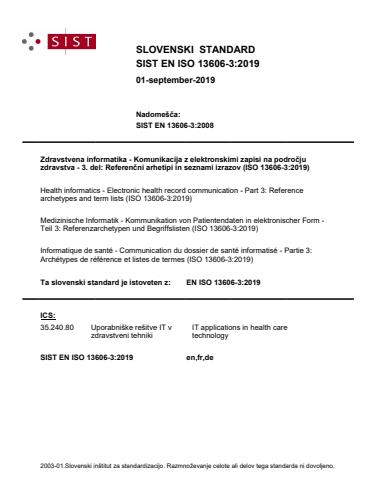
SLOVENSKI STANDARD
01-september-2019
Nadomešča:
SIST EN 13606-3:2008
Zdravstvena informatika - Komunikacija z elektronskimi zdravstvenimi zapisi - 3.
del: Referenčni arhetipi in seznami izrazov (ISO 13606-3:2019)
Health informatics - Electronic health record communication - Part 3: Reference
archetypes and term lists (ISO 13606-3:2019)
Medizinische Informatik - Kommunikation von Patientendaten in elektronischer Form -
Teil 3: Referenzarchetypen und Begriffslisten (ISO 13606-3:2019)
Informatique de santé - Communication du dossier de santé informatisé - Partie 3:
Archétypes de référence et listes de termes (ISO 13606-3:2019)
Ta slovenski standard je istoveten z: EN ISO 13606-3:2019
ICS:
35.240.80 Uporabniške rešitve IT v IT applications in health care
zdravstveni tehniki technology
2003-01.Slovenski inštitut za standardizacijo. Razmnoževanje celote ali delov tega standarda ni dovoljeno.
EN ISO 13606-3
EUROPEAN STANDARD
NORME EUROPÉENNE
July 2019
EUROPÄISCHE NORM
ICS 35.240.80 Supersedes EN 13606-3:2008
English Version
Health informatics - Electronic health record
communication - Part 3: Reference archetypes and term
lists (ISO 13606-3:2019)
Informatique de santé - Communication du dossier de Medizinische Informatik - Kommunikation von
santé informatisé - Partie 3: Archétypes de référence et Patientendaten in elektronischer Form - Teil 3:
listes de termes (ISO 13606-3:2019) Referenzarchetypen und Begriffslisten (ISO 13606-
3:2019)
This European Standard was approved by CEN on 2 July 2019.
CEN members are bound to comply with the CEN/CENELEC Internal Regulations which stipulate the conditions for giving this
European Standard the status of a national standard without any alteration. Up-to-date lists and bibliographical references
concerning such national standards may be obtained on application to the CEN-CENELEC Management Centre or to any CEN
member.
This European Standard exists in three official versions (English, French, German). A version in any other language made by
translation under the responsibility of a CEN member into its own language and notified to the CEN-CENELEC Management
Centre has the same status as the official versions.
CEN members are the national standards bodies of Austria, Belgium, Bulgaria, Croatia, Cyprus, Czech Republic, Denmark, Estonia,
Finland, France, Germany, Greece, Hungary, Iceland, Ireland, Italy, Latvia, Lithuania, Luxembourg, Malta, Netherlands, Norway,
Poland, Portugal, Republic of North Macedonia, Romania, Serbia, Slovakia, Slovenia, Spain, Sweden, Switzerland, Turkey and
United Kingdom.
EUROPEAN COMMITTEE FOR STANDARDIZATION
COMITÉ EUROPÉEN DE NORMALISATION
EUROPÄISCHES KOMITEE FÜR NORMUNG
CEN-CENELEC Management Centre: Rue de la Science 23, B-1040 Brussels
© 2019 CEN All rights of exploitation in any form and by any means reserved Ref. No. EN ISO 13606-3:2019 E
worldwide for CEN national Members.
Contents Page
European foreword . 3
European foreword
This document (EN ISO 13606-3:2019) has been prepared by Technical Committee ISO/TC 215 "Health
informatics" in collaboration with Technical Committee CEN/TC 251 “Health informatics” the
secretariat of which is held by NEN.
This European Standard shall be given the status of a national standard, either by publication of an
identical text or by endorsement, at the latest by January 2020, and conflicting national standards shall
be withdrawn at the latest by January 2020.
Attention is drawn to the possibility that some of the elements of this document may be the subject of
patent rights. CEN shall not be held responsible for identifying any or all such patent rights.
This document supersedes EN 13606-3:2008.
According to the CEN-CENELEC Internal Regulations, the national standards organizations of the
following countries are bound to implement this European Standard: Austria, Belgium, Bulgaria,
Croatia, Cyprus, Czech Republic, Denmark, Estonia, Finland, France, Germany, Greece, Hungary, Iceland,
Ireland, Italy, Latvia, Lithuania, Luxembourg, Malta, Netherlands, Norway, Poland, Portugal, Republic of
North Macedonia, Romania, Serbia, Slovakia, Slovenia, Spain, Sweden, Switzerland, Turkey and the
United Kingdom.
Endorsement notice
The text of ISO 13606-3:2019 has been approved by CEN as EN ISO 13606-3:2019 without any
modification.
INTERNATIONAL ISO
STANDARD 13606-3
Second edition
2019-06
Health informatics — Electronic
health record communication —
Part 3:
Reference archetypes and term lists
Informatique de santé — Communication du dossier de santé
informatisé —
Partie 3: Archétypes de référence et listes de termes
Reference number
ISO 13606-3:2019(E)
©
ISO 2019
ISO 13606-3:2019(E)
© ISO 2019
All rights reserved. Unless otherwise specified, or required in the context of its implementation, no part of this publication may
be reproduced or utilized otherwise in any form or by any means, electronic or mechanical, including photocopying, or posting
on the internet or an intranet, without prior written permission. Permission can be requested from either ISO at the address
below or ISO’s member body in the country of the requester.
ISO copyright office
CP 401 • Ch. de Blandonnet 8
CH-1214 Vernier, Geneva
Phone: +41 22 749 01 11
Fax: +41 22 749 09 47
Email: copyright@iso.org
Website: www.iso.org
Published in Switzerland
ii © ISO 2019 – All rights reserved
ISO 13606-3:2019(E)
Contents Page
Foreword .v
Introduction .vi
1 Scope . 1
2 Normative references . 1
3 Terms and definitions . 1
4 Abbreviations. 2
5 Conformance . 2
6 Term lists . 2
6.1 Introduction . 2
6.2 Termlist SUBJECT_CATEGORY, Class ENTRY, attribute subject_of_information_category . 3
6.3 Termlist VERSION_STATUS, Class BASE_COMPONENT, attribute version_status. 3
6.4 Termlist MODE, Reference Archetype Healthcare activity participation . 4
6.5 Class LINK, attribute link_description . 4
6.5.1 Termlist RELATED_TO, Class LINK, attribute link_description . 5
6.5.2 Termlist AUTHORISED_BY, Class LINK, attribute link_description . 5
6.5.3 Termlist SAME_HEALTH_ISSUE, Class LINK, attribute link_description . 6
6.5.4 Termlist SAME_PLAN, Class LINK, attribute link_description . 8
6.5.5 Termlist RELATED_DOCUMENTATION, Class LINK, attribute link_description . 8
6.6 Termlist, Class EXTERNAL_LINK, attribute target_information_type . 9
6.7 Termlist, Classes ELEMENT and DEMOGRAPHIC_ELEMENT, attribute null_flavour .10
6.8 Termlist, Class ATTACHMENT, attribute IntegrityCheckAlgorithm .10
7 Reference archetype for null_flavor .10
7.1 Archetype name: Null_flavor .10
8 Reference archetype for the access policy COMPOSITION .11
8.1 Archetype name: Access_policy_rule .11
9 Reference archetypes for demographic entities .12
9.1 Archetype name: EntityIdentifier .12
9.2 Archetype name: useablePeriod .13
9.3 Archetype name: LocationAddress .13
9.4 Archetype name: TelecommunicationAddress .14
9.5 Archetype name: Address . .16
9.6 Archetype name: Namepart .17
9.7 Archetype name: PersonName .18
9.8 Archetype name: Person.19
9.9 Archetype name: HealthcareOrganization .20
9.10 Archetype name: ServiceDepartment .21
9.11 Archetype name: HealthcarePersonnel .22
9.12 Archetype name: MedicalDevice .23
9.13 Archetype name: SubjectOfInformation .25
9.14 Archetype name: Contact .25
9.15 Archetype name: HealthcareActivityParticipation .26
9.16 Archetype name: HealthcareActivityFacility .26
9.17 Archetype name: HealthcareActivityFramework .27
9.18 Summary of demographic-related data types in ISO 21090 .27
9.18.1 Identification and Location Datatypes .27
9.18.2 Name and Address Datatypes .29
10 Reference archetypes for medicinal product .31
10.1 Archetype name: MedicinalProduct .31
11 Reference archetypes for clinical information specifications .37
11.1 General .37
ISO 13606-3:2019(E)
11.2 Archetype name: Health condition .38
11.3 Archetype name: Healthcare activity element.42
11.4 Archetype name: ClinicalContext .47
11.5 Archetype name: Activity management .49
11.6 Archetype name: Association .50
11.7 Archetype name: Consideration.51
11.8 Archetype name: Dosage .52
11.9 Archetype name: Method .52
12 Contsys-based clinical reference information structures as the basis for
development of clinical archetypes .54
12.1 Introduction .54
12.1.1 Criteria/characteristics .56
12.1.2 Basic concepts as bases for the Contsys-based information structure .56
12.1.3 Method for development of Contsys-based clinical reference information
structures .56
12.1.4 Steps in defining the information structures .57
12.2 Content of information structures .58
12.2.1 Structures for single concepts .58
12.2.2 Structures for reuse in clinical situations — Clusters complementing
structures for basic clinical concepts .58
12.2.3 Structures for compound documents in an EHR .59
12.2.4 Other comments .59
12.2.5 Format .60
12.3 Specializations of types of Health condition .60
12.4 Information structures for single concepts .61
12.4.1 Health condition .61
12.5 Healthcare activity element .67
12.5.1 Performer .72
12.6 Pharmacological treatment .73
12.6.1 Pharmacological treatment .73
12.6.2 Dosage .74
12.7 Indirect healthcare activity elements .74
12.7.1 Healthcare assessment .75
12.7.2 Assessments to conclude or exclude health conditions .75
12.7.3 Healthcare needs Assessment .76
12.7.4 Clinical risk assessment .78
12.7.5 Healthcare evaluation . .78
12.8 Care plan .80
12.9 Clusters complementing the information structures for single clinical concepts .83
12.9.1 Activity Management including healthcare planning .83
12.9.2 Assessment scale representation .84
12.9.3 Association .84
12.9.4 Clinical Context . .85
12.9.5 Clinical process concern .87
12.9.6 Clinical risk .87
12.9.7 Consideration .88
12.9.8 Knowledge base .89
12.9.9 Method specification .90
12.9.10 Priority Level .91
12.9.11 Version information .92
12.10 Compound structures as combinations of the Contsys based clinical reference
information structures for clinical content and clinical context .93
12.10.1 Personal health record overview .93
12.10.2 Professional health record overview .93
12.10.3 Knowledge based healthcare activity planning of healthcare investigations .93
12.10.4 Knowledge based healthcare activity planning of healthcare treatments .94
Bibliography .95
iv © ISO 2019 – All rights reserved
ISO 13606-3:2019(E)
Foreword
ISO (the International Organization for Standardization) is a worldwide federation of national standards
bodies (ISO member bodies). The work of preparing International Standards is normally carried out
through ISO technical committees. Each member body interested in a subject for which a technical
committee has been established has the right to be represented on that committee. International
organizations, governmental and non-governmental, in liaison with ISO, also take part in the work.
ISO collaborates closely with the International Electrotechnical Commission (IEC) on all matters of
electrotechnical standardization.
The procedures used to develop this document and those intended for its further maintenance are
described in the ISO/IEC Directives, Part 1. In particular the different approval criteria needed for the
different types of ISO documents should be noted. This document was drafted in accordance with the
editorial rules of the ISO/IEC Directives, Part 2 (see www .iso .org/directives).
Attention is drawn to the possibility that some of the elements of this document may be the subject of
patent rights. ISO shall not be held responsible for identifying any or all such patent rights. Details of
any patent rights identified during the development of the document will be in the Introduction and/or
on the ISO list of patent declarations received (see www .iso .org/patents).
Any trade name used in this document is information given for the convenience of users and does not
constitute an endorsement.
For an explanation on the voluntary nature of standards, the meaning of ISO specific terms and
expressions related to conformity assessment, as well as information about ISO's adherence to the
World Trade Organization (WTO) principles in the Technical Barriers to Trade (TBT) see the following
URL: www .iso .org/iso/foreword .html.
This document was prepared by Technical Committee ISO/TC 215, Health Informatics.
This second edition cancels and replaces the first edition (ISO 13606-3:2009), which has been technically
revised. The main changes compared to the previous edition are summarised in the Introduction.
A list of all parts in the ISO 13606 series can be found on the ISO website.
Any feedback or questions on this document should be directed to the user’s national standards body. A
complete listing of these bodies can be found at www .iso .org/members .html.
ISO 13606-3:2019(E)
Introduction
0.1 General
This document is part of a five-part series of standards, published jointly by CEN and ISO through the
Vienna Agreement. In this document, dependency upon any of the other parts of this series of standards
is explicitly stated where it applies.
0.2 Preface
ISO 13606-3 defines two kinds of specifications.
1) A normative set of (coded) term lists that each defines a controlled vocabulary for a Reference
Model attribute that is defined in ISO 13606-1;
2) A set of Reference Archetypes that specify how the ISO 13606-1 Reference Model should be applied
for communicating information for:
— null_flavor;
— access policies;
— demographic entities;
— example clinical reference archetypes, conforming to ISO 13940 (Contsys).
0.3 Term Lists
Each term list is referenced by its corresponding attribute as an invariant constraint in ISO 13606-1,
by referring to its term list name. For each term list, every code value is accompanied by a phrase and
description; however, in each case it is the code that is used as the Reference Model attribute value.
Language translations of the phrase and description will therefore not affect the instances of RECORD_
COMPONENT that are communicated using this document.
Should any revision prove necessary in the future to these term lists, a technical revision to this
document will be required. Such a revised document should specify an updated Reference Model
identifier that should then be used as the value of the rm_id of an EHR_EXTRACT, to inform the recipient
of the version of this document that was used in its creation.
0.4 Reference archetypes
An archetype, sometimes known as a clinical model, specifies a pattern for representing an aspect of
clinical documentation within an electronic health record. An archetype defines the structural and
semantic relationships between fine-grained data items, including the domains of content each data
item may contain in order to be a valid component of that archetype. The concept of archetypes is
outlined in the introduction of ISO 13606-1, and the formal representation of archetypes is specified
in ISO 13606-2. Archetypes are used in this document to shape parts of an EHR extract, in order to
provide predictability of the way in which clinical information is represented within it.
Given the vast domain of health and healthcare, there might eventually be hundreds of archetypes
covering its many different documentation and communication needs. Because archetypes might be
created by different communities in different countries and settings, there is a risk that archetypes
for similar areas of documentation will be made differently by different groups, and therefore hamper
interoperability. Reference archetypes are archetypes that represent very fundamental areas of clinical
documentation, which might be used as they are or may serve as a kind of base pattern for more
specialised archetypes. By acting as the base pattern for a set of specialised archetypes, the members
of the set are likely to be better structurally and semantically aligned with each other. Their use will
facilitate semantic interoperability by making it easier for EHR extracts that have used different
members of that set to be interpreted collectively.
vi © ISO 2019 – All rights reserved
ISO 13606-3:2019(E)
A reference archetype is a starting point for archetype specialisation (using a sub-set of properties
and/or constraints on the ELEMENT value domains), or localised by adding natural language or
local terminology mappings, or may be extended with additional properties. In all such cases the
reference archetype should be specified as the underlying “specialisation parent”, in accordance
with ISO 13606-2. Some reference archetypes may be implemented directly. A reference archetype
is therefore a conventional archetype that has been designated as a recommended (informative) or
mandated (normative) basis for developing commonly required archetypes.
This document defines several categories of reference archetypes, some of which have been designated
as normative and others informative. The decision of which to make normative is based on the
information source used to create each reference archetype: if the underlying source is itself part of this
document or is required to implement it then it has been designated as normative. If it is an external
source such as another standard, which might be revised at a different time point to this document,
then the reference archetype has been made informative.
In this document, a normative null_flavor reference archetype is defined to be used for the corresponding
property in ISO 13606-1. A normative access policy rule reference archetype is specified in accordance
with the corresponding information model for an access policy rule specified in ISO 13606-4.
Informative reference archetypes are defined for the most frequently needed demographic entities. An
informative archetype is specified for medicinal product, which has been defined in accordance with
the ISO IDMP standard series.
The examples of clinical reference archetypes presented in Clause 11 are based on the clinical reference
information structures in Clause 12. The clinical reference information structures in Clause 12 are
developed out from the clinical concepts as they are defined in ISO 13940:2015 (Contsys).
Each selected clinical concept in Contsys has been elaborated based on the definition, relations and
explanations in notes given in ISO 13940. The attributes of the clinical reference information structures
are thus mainly based on ISO 13940. Some further attributes are added to harmonize the structures
with e.g. FHIR resources or openEHR.
The result is information structures representing basic clinical concepts including a gross list of
attributes for each concept. The gross list is intended to be comprehensive and cover all needs for
clinical information in different specializations and applications. This approach reflects the general
idea to include all needed types of characteristics/attributes and constrain the number applied when
specializing clinical archetypes for instantiation.
The level of granularity/abstraction of the classes/selected concepts in the clinical reference information
structures in Clause 12 and in the examples of clinical reference archetypes in Clause 11 is explained by
the purpose of being general at the conceptual level for all clinical situations where information about
this type of concept is relevant (content as well as context) but still specific for that clinical concept.
One example of the chosen level of abstraction is healthcare activity element as the concretized
specialization of healthcare activity with a specific purpose (e.g. investigation or treatment). Another
example could be that the method of performing activity elements are specified at a general level
common for surgical treatments, pharmacological treatments (including administration routes) and
laboratory tests as investigations.
Clause 12 includes clinical reference information models, conformant to ISO 13940(Contsys), to be used
as bases for specifying clinical reference archetypes. These are aimed for further specializations as
clinical archetypes in an EHR. The clinical reference information models are also aimed for further
use as a basis for harmonizing between coexisting standards for specifying clinical content. A future
possibility could be to develop FHIR resources based on these reference models. Another possibility for
future development is that CIMI archetypes could accept the same bases as a “middle layer” between
their reference model and specific archetypes. Altogether such approaches could result in harmonization
of the different information specification standards/approaches to the common conceptual basis of
Contsys. These resources are offered in an informative Clause to indicate the direction of ongoing work
to develop a portfolio of Reference Archetypes that align with Contsys and with corresponding FHIR
resources, but which are not yet mature enough to include here as normative specifications.
INTERNATIONAL STANDARD ISO 13606-3:2019(E)
Health informatics — Electronic health record
communication —
Part 3:
Reference archetypes and term lists
1 Scope
This document specifies a means for communicating part or all of the electronic health record (EHR)
of one or more identified subjects of care between EHR systems, or between EHR systems and a
centralised EHR data repository.
It can also be used for EHR communication between an EHR system or repository and clinical
applications or middleware components (such as decision support components), or personal health
applications and devices, that need to access or provide EHR data, or as the representation of EHR data
within a distributed (federated) record system.
This document defines term lists that each specify the set of values for the particular attributes of the
Reference Model defined in ISO 13606-1. It also defines normative and informative Reference Archetypes
that enable frequently-occurring instances of EHR data to be represented within a consistent structure
when communicated using this document.
2 Normative references
The following documents are referred to in the text in such a way that some or all of their content
constitutes requirements of this document. For dated references, only the edition cited applies. For
undated references, the latest edition of the referenced document (including any amendments) applies.
ISO 13606-1, Health informatics — Electronic health record communication — Part 1: Reference model
3 Terms and definitions
For the purposes of this document, the terms and definitions given in ISO 13606-1 and the following apply.
ISO and IEC maintain terminological databases for use in standardization at the following addresses:
— ISO Online browsing platform: available at https: //www .iso .org/obp
— IEC Electropedia: available at http: //www .electropedia .org/
3.1
healthcare activity
activity intended directly or indirectly to improve or maintain a health state
Note 1 to entry: Each specialization of this concept represents healthcare activities performed by a specialization
of healthcare actor.
Note 2 to entry: Different types of healthcare activity elements (e.g. healthcare investigation or healthcare
treatment) may be performed during a healthcare activity.
Note 3 to entry: See the concepts healthcare provider activity, self-care activity, healthcare third party activity and
automated healthcare when it comes to the recording of information that are the result of healthcare activities (e.g.
ratified observations).
ISO 13606-3:2019(E)
EXAMPLE A blood pressure measurement completed by a qualified nurse including the healthcare activity
elements of taking, documenting and evaluation.
[SOURCE: ISO 13940:2015]
3.2
reference archetype
archetype serving as a base pattern for archetype specialisations
4 Abbreviations
For the purposes of this document, the following abbreviations apply.
EHR Electronic Health Record
EU European Union
GP General Practitioner
HL7 Health Level Seven
ISO International Organization for Standardization
OID Object Identifier
UML Unified Modelling Language
5 Conformance
When electronic health record information is to be communicated using ISO 13606 (all parts) and
where an attribute of the Reference Model defined in ISO 13606-1 requires a value to be taken from a
bounded set of codes from a named term list, the code shall be one of those defined in Clause 6 for the
correspondingly-named term list.
An archetype that is used to organize the structure and semantics of part of an electronic health record
that is communicated using this standard series shall be a logical transformation or specialization of a
normative reference archetype defined in Clauses 7 or 8, if the archetype is intended to communicate
information corresponding to the scope of one of those reference archetypes. This document does not
prescribe the structure or semantics of any other archetypes used to communicate electronic health
record information.
6 Term lists
6.1 Introduction
The Reference Model defined in ISO 13606-1 defines several attributes whose values are to be selected
from a fixed list of values. This clause defines those value lists (term lists) for each of those attributes.
Attributes not included in this clause (or defined in ISO 13606-4) may take any value that conform to
the data type and invariant specifications defined in ISO 13606-1.
There are no attributes in the Reference Model to specify the clinical content being communicated,
except for the identifier of the archetypes that specify its overall structure and semantics and the term
list defining semantic linkage between RECORD_COMPONENTs. Clinical concepts as they are defined in
ISO 13940:2015, and a reference information structure as the informative basis for developing clinical
reference archetypes, are presented in Clause 12.
2 © ISO 2019 – All rights reserved
ISO 13606-3:2019(E)
6.2 Termlist SUBJECT_CATEGORY, Class ENTRY, attribute subject_of_information_
category
This attribute provides a coarse-grained definition of the person who is the subject of an ENTRY. The
default value is DS00 (the patient, or subject of care). A more fine-grained definition of the information
subject (such as the precise relative with a family history) can be specified through the ENTRY.subject_
of_information.relationship attribute.
Code Meaning Description
DS00 subject of care healthcare actor with a person role; who seeks to receive, is
receiving, or has received healthcare
DS01 relative of subject of care person role being any human relative, without limitation to
biological or adoptive relatives
DS02 next of kin person role being either the closest living relative of the subject
of care or identified as the one he has a close relationship with
DS03 foetus or neonate or infant the baby or babies being described by an ENTRY in the EHR of
the mother
DS04 mother the mother of a foetus or neonate, if being described in the
EHR of a baby (e.g. during pregnancy)
DS05 donor person role being the donor of an organ or body specimen
being described by an ENTRY in the EHR of the recipient
DS06 unrelated person person role being any other person not related to the subject of
care, such as an employer, friend, carer
DS07 healthcare third party healthcare actor (organization or person) other than a health-
care provider or the subject of care
DS08 subject of care proxy healthcare third party having person role with the right to
take decisions on behalf of the subject of care
NOTE If ENTRY.subject_of_information_category is null, the value DS00 is assumed.
The original list has been extended and revised to align with terms and concepts used in ISO 13940
(Contsys).
6.3 Termlist VERSION_STATUS, Class BASE_COMPONENT, attribute version_status
This attribute is used to indicate the status of a particular version of a RECORD_COMPONENT. This
attribute is optional, and if no value is provided it is to be assumed that the RECORD_COMPONENT
is the first definitive version corresponding to code value VER01. In all cases, the new version of a
RECORD_COMPONENT shall replace the former version, as specified in ISO 13606-1.
Code Meaning Description
VER00 Draft The version is known at the time of committal to be incom-
plete (because additional information is expected later)
or if the necessary authorisations have not been made
: VER00 implies that the EHR recipient might in future
expect to receive a more definitive updated version of this
RECORD_COMPONENT
VER01 Finished The version is committed with the intention of being a
final version, with no anticipated reason for revision
VER02 Updated The version is an update of the previous version, usually
by adding supplementary information that was not availa-
ble at the time of committal.
Revision is intended for additions usually to be made by
the original author within a short time frame, and not for
recoding an evolving clinical story
ISO 13606-3:2019(E)
Code Meaning Description
VER03 Correction The version corrects errors made in the recording of the
previous version
VER04 Deletion (in error) The version logically deletes the previous version to cor-
rect an error of documentation (e.g. if the RECORD_COM-
PONENT had been placed in the wrong patient’s EHR)
VER05 Legal deletion The version logically deletes the previous version because
the removal is the outcome of a legal or policy matter (e.g.
if the subject of care has exercised rights to have the infor-
mation removed)
VER06 Encoded The version updates the previous version through the
addition of coded terms to which content in the previous
version has been mapped, without replacing any of the
original content of the previous version
NOTE If BASE_COMPONENT.version_status is null, the value VER01 is assumed.
6.4 Termlist MODE, Reference Archetype Healthcare activity participation
Code Description
MODE01 Participation in person
MODE02 Participation using remote control to perform healthcare activity elements
MODE03 Participation via videoconference or similar electronics means (sound and video)
MODE04 Participation via telephone or similar electronics means (sound only)
MODE05 Participation using on-line communication of text and possibly also pictures
MODE05 Contributing by providing text and/or pictures ahead of the health
...
SLOVENSKI STANDARD
01-september-2019
Nadomešča:
SIST EN 13606-3:2008
Zdravstvena informatika - Komunikacija z elektronskimi zapisi na področju
zdravstva - 3. del: Referenčni arhetipi in seznami izrazov (ISO 13606-3:2019)
Health informatics - Electronic health record communication - Part 3: Reference
archetypes and term lists (ISO 13606-3:2019)
Medizinische Informatik - Kommunikation von Patientendaten in elektronischer Form -
Teil 3: Referenzarchetypen und Begriffslisten (ISO 13606-3:2019)
Informatique de santé - Communication du dossier de santé informatisé - Partie 3:
Archétypes de référence et listes de termes (ISO 13606-3:2019)
Ta slovenski standard je istoveten z: EN ISO 13606-3:2019
ICS:
35.240.80 Uporabniške rešitve IT v IT applications in health care
zdravstveni tehniki technology
2003-01.Slovenski inštitut za standardizacijo. Razmnoževanje celote ali delov tega standarda ni dovoljeno.
EN ISO 13606-3
EUROPEAN STANDARD
NORME EUROPÉENNE
July 2019
EUROPÄISCHE NORM
ICS 35.240.80 Supersedes EN 13606-3:2008
English Version
Health informatics - Electronic health record
communication - Part 3: Reference archetypes and term
lists (ISO 13606-3:2019)
Informatique de santé - Communication du dossier de Medizinische Informatik - Kommunikation von
santé informatisé - Partie 3: Archétypes de référence et Patientendaten in elektronischer Form - Teil 3:
listes de termes (ISO 13606-3:2019) Referenzarchetypen und Begriffslisten (ISO 13606-
3:2019)
This European Standard was approved by CEN on 2 July 2019.
CEN members are bound to comply with the CEN/CENELEC Internal Regulations which stipulate the conditions for giving this
European Standard the status of a national standard without any alteration. Up-to-date lists and bibliographical references
concerning such national standards may be obtained on application to the CEN-CENELEC Management Centre or to any CEN
member.
This European Standard exists in three official versions (English, French, German). A version in any other language made by
translation under the responsibility of a CEN member into its own language and notified to the CEN-CENELEC Management
Centre has the same status as the official versions.
CEN members are the national standards bodies of Austria, Belgium, Bulgaria, Croatia, Cyprus, Czech Republic, Denmark, Estonia,
Finland, France, Germany, Greece, Hungary, Iceland, Ireland, Italy, Latvia, Lithuania, Luxembourg, Malta, Netherlands, Norway,
Poland, Portugal, Republic of North Macedonia, Romania, Serbia, Slovakia, Slovenia, Spain, Sweden, Switzerland, Turkey and
United Kingdom.
EUROPEAN COMMITTEE FOR STANDARDIZATION
COMITÉ EUROPÉEN DE NORMALISATION
EUROPÄISCHES KOMITEE FÜR NORMUNG
CEN-CENELEC Management Centre: Rue de la Science 23, B-1040 Brussels
© 2019 CEN All rights of exploitation in any form and by any means reserved Ref. No. EN ISO 13606-3:2019 E
worldwide for CEN national Members.
Contents Page
European foreword . 3
European foreword
This document (EN ISO 13606-3:2019) has been prepared by Technical Committee ISO/TC 215 "Health
informatics" in collaboration with Technical Committee CEN/TC 251 “Health informatics” the
secretariat of which is held by NEN.
This European Standard shall be given the status of a national standard, either by publication of an
identical text or by endorsement, at the latest by January 2020, and conflicting national standards shall
be withdrawn at the latest by January 2020.
Attention is drawn to the possibility that some of the elements of this document may be the subject of
patent rights. CEN shall not be held responsible for identifying any or all such patent rights.
This document supersedes EN 13606-3:2008.
According to the CEN-CENELEC Internal Regulations, the national standards organizations of the
following countries are bound to implement this European Standard: Austria, Belgium, Bulgaria,
Croatia, Cyprus, Czech Republic, Denmark, Estonia, Finland, France, Germany, Greece, Hungary, Iceland,
Ireland, Italy, Latvia, Lithuania, Luxembourg, Malta, Netherlands, Norway, Poland, Portugal, Republic of
North Macedonia, Romania, Serbia, Slovakia, Slovenia, Spain, Sweden, Switzerland, Turkey and the
United Kingdom.
Endorsement notice
The text of ISO 13606-3:2019 has been approved by CEN as EN ISO 13606-3:2019 without any
modification.
INTERNATIONAL ISO
STANDARD 13606-3
Second edition
2019-06
Health informatics — Electronic
health record communication —
Part 3:
Reference archetypes and term lists
Informatique de santé — Communication du dossier de santé
informatisé —
Partie 3: Archétypes de référence et listes de termes
Reference number
ISO 13606-3:2019(E)
©
ISO 2019
ISO 13606-3:2019(E)
© ISO 2019
All rights reserved. Unless otherwise specified, or required in the context of its implementation, no part of this publication may
be reproduced or utilized otherwise in any form or by any means, electronic or mechanical, including photocopying, or posting
on the internet or an intranet, without prior written permission. Permission can be requested from either ISO at the address
below or ISO’s member body in the country of the requester.
ISO copyright office
CP 401 • Ch. de Blandonnet 8
CH-1214 Vernier, Geneva
Phone: +41 22 749 01 11
Fax: +41 22 749 09 47
Email: copyright@iso.org
Website: www.iso.org
Published in Switzerland
ii © ISO 2019 – All rights reserved
ISO 13606-3:2019(E)
Contents Page
Foreword .v
Introduction .vi
1 Scope . 1
2 Normative references . 1
3 Terms and definitions . 1
4 Abbreviations. 2
5 Conformance . 2
6 Term lists . 2
6.1 Introduction . 2
6.2 Termlist SUBJECT_CATEGORY, Class ENTRY, attribute subject_of_information_category . 3
6.3 Termlist VERSION_STATUS, Class BASE_COMPONENT, attribute version_status. 3
6.4 Termlist MODE, Reference Archetype Healthcare activity participation . 4
6.5 Class LINK, attribute link_description . 4
6.5.1 Termlist RELATED_TO, Class LINK, attribute link_description . 5
6.5.2 Termlist AUTHORISED_BY, Class LINK, attribute link_description . 5
6.5.3 Termlist SAME_HEALTH_ISSUE, Class LINK, attribute link_description . 6
6.5.4 Termlist SAME_PLAN, Class LINK, attribute link_description . 8
6.5.5 Termlist RELATED_DOCUMENTATION, Class LINK, attribute link_description . 8
6.6 Termlist, Class EXTERNAL_LINK, attribute target_information_type . 9
6.7 Termlist, Classes ELEMENT and DEMOGRAPHIC_ELEMENT, attribute null_flavour .10
6.8 Termlist, Class ATTACHMENT, attribute IntegrityCheckAlgorithm .10
7 Reference archetype for null_flavor .10
7.1 Archetype name: Null_flavor .10
8 Reference archetype for the access policy COMPOSITION .11
8.1 Archetype name: Access_policy_rule .11
9 Reference archetypes for demographic entities .12
9.1 Archetype name: EntityIdentifier .12
9.2 Archetype name: useablePeriod .13
9.3 Archetype name: LocationAddress .13
9.4 Archetype name: TelecommunicationAddress .14
9.5 Archetype name: Address . .16
9.6 Archetype name: Namepart .17
9.7 Archetype name: PersonName .18
9.8 Archetype name: Person.19
9.9 Archetype name: HealthcareOrganization .20
9.10 Archetype name: ServiceDepartment .21
9.11 Archetype name: HealthcarePersonnel .22
9.12 Archetype name: MedicalDevice .23
9.13 Archetype name: SubjectOfInformation .25
9.14 Archetype name: Contact .25
9.15 Archetype name: HealthcareActivityParticipation .26
9.16 Archetype name: HealthcareActivityFacility .26
9.17 Archetype name: HealthcareActivityFramework .27
9.18 Summary of demographic-related data types in ISO 21090 .27
9.18.1 Identification and Location Datatypes .27
9.18.2 Name and Address Datatypes .29
10 Reference archetypes for medicinal product .31
10.1 Archetype name: MedicinalProduct .31
11 Reference archetypes for clinical information specifications .37
11.1 General .37
ISO 13606-3:2019(E)
11.2 Archetype name: Health condition .38
11.3 Archetype name: Healthcare activity element.42
11.4 Archetype name: ClinicalContext .47
11.5 Archetype name: Activity management .49
11.6 Archetype name: Association .50
11.7 Archetype name: Consideration.51
11.8 Archetype name: Dosage .52
11.9 Archetype name: Method .52
12 Contsys-based clinical reference information structures as the basis for
development of clinical archetypes .54
12.1 Introduction .54
12.1.1 Criteria/characteristics .56
12.1.2 Basic concepts as bases for the Contsys-based information structure .56
12.1.3 Method for development of Contsys-based clinical reference information
structures .56
12.1.4 Steps in defining the information structures .57
12.2 Content of information structures .58
12.2.1 Structures for single concepts .58
12.2.2 Structures for reuse in clinical situations — Clusters complementing
structures for basic clinical concepts .58
12.2.3 Structures for compound documents in an EHR .59
12.2.4 Other comments .59
12.2.5 Format .60
12.3 Specializations of types of Health condition .60
12.4 Information structures for single concepts .61
12.4.1 Health condition .61
12.5 Healthcare activity element .67
12.5.1 Performer .72
12.6 Pharmacological treatment .73
12.6.1 Pharmacological treatment .73
12.6.2 Dosage .74
12.7 Indirect healthcare activity elements .74
12.7.1 Healthcare assessment .75
12.7.2 Assessments to conclude or exclude health conditions .75
12.7.3 Healthcare needs Assessment .76
12.7.4 Clinical risk assessment .78
12.7.5 Healthcare evaluation . .78
12.8 Care plan .80
12.9 Clusters complementing the information structures for single clinical concepts .83
12.9.1 Activity Management including healthcare planning .83
12.9.2 Assessment scale representation .84
12.9.3 Association .84
12.9.4 Clinical Context . .85
12.9.5 Clinical process concern .87
12.9.6 Clinical risk .87
12.9.7 Consideration .88
12.9.8 Knowledge base .89
12.9.9 Method specification .90
12.9.10 Priority Level .91
12.9.11 Version information .92
12.10 Compound structures as combinations of the Contsys based clinical reference
information structures for clinical content and clinical context .93
12.10.1 Personal health record overview .93
12.10.2 Professional health record overview .93
12.10.3 Knowledge based healthcare activity planning of healthcare investigations .93
12.10.4 Knowledge based healthcare activity planning of healthcare treatments .94
Bibliography .95
iv © ISO 2019 – All rights reserved
ISO 13606-3:2019(E)
Foreword
ISO (the International Organization for Standardization) is a worldwide federation of national standards
bodies (ISO member bodies). The work of preparing International Standards is normally carried out
through ISO technical committees. Each member body interested in a subject for which a technical
committee has been established has the right to be represented on that committee. International
organizations, governmental and non-governmental, in liaison with ISO, also take part in the work.
ISO collaborates closely with the International Electrotechnical Commission (IEC) on all matters of
electrotechnical standardization.
The procedures used to develop this document and those intended for its further maintenance are
described in the ISO/IEC Directives, Part 1. In particular the different approval criteria needed for the
different types of ISO documents should be noted. This document was drafted in accordance with the
editorial rules of the ISO/IEC Directives, Part 2 (see www .iso .org/directives).
Attention is drawn to the possibility that some of the elements of this document may be the subject of
patent rights. ISO shall not be held responsible for identifying any or all such patent rights. Details of
any patent rights identified during the development of the document will be in the Introduction and/or
on the ISO list of patent declarations received (see www .iso .org/patents).
Any trade name used in this document is information given for the convenience of users and does not
constitute an endorsement.
For an explanation on the voluntary nature of standards, the meaning of ISO specific terms and
expressions related to conformity assessment, as well as information about ISO's adherence to the
World Trade Organization (WTO) principles in the Technical Barriers to Trade (TBT) see the following
URL: www .iso .org/iso/foreword .html.
This document was prepared by Technical Committee ISO/TC 215, Health Informatics.
This second edition cancels and replaces the first edition (ISO 13606-3:2009), which has been technically
revised. The main changes compared to the previous edition are summarised in the Introduction.
A list of all parts in the ISO 13606 series can be found on the ISO website.
Any feedback or questions on this document should be directed to the user’s national standards body. A
complete listing of these bodies can be found at www .iso .org/members .html.
ISO 13606-3:2019(E)
Introduction
0.1 General
This document is part of a five-part series of standards, published jointly by CEN and ISO through the
Vienna Agreement. In this document, dependency upon any of the other parts of this series of standards
is explicitly stated where it applies.
0.2 Preface
ISO 13606-3 defines two kinds of specifications.
1) A normative set of (coded) term lists that each defines a controlled vocabulary for a Reference
Model attribute that is defined in ISO 13606-1;
2) A set of Reference Archetypes that specify how the ISO 13606-1 Reference Model should be applied
for communicating information for:
— null_flavor;
— access policies;
— demographic entities;
— example clinical reference archetypes, conforming to ISO 13940 (Contsys).
0.3 Term Lists
Each term list is referenced by its corresponding attribute as an invariant constraint in ISO 13606-1,
by referring to its term list name. For each term list, every code value is accompanied by a phrase and
description; however, in each case it is the code that is used as the Reference Model attribute value.
Language translations of the phrase and description will therefore not affect the instances of RECORD_
COMPONENT that are communicated using this document.
Should any revision prove necessary in the future to these term lists, a technical revision to this
document will be required. Such a revised document should specify an updated Reference Model
identifier that should then be used as the value of the rm_id of an EHR_EXTRACT, to inform the recipient
of the version of this document that was used in its creation.
0.4 Reference archetypes
An archetype, sometimes known as a clinical model, specifies a pattern for representing an aspect of
clinical documentation within an electronic health record. An archetype defines the structural and
semantic relationships between fine-grained data items, including the domains of content each data
item may contain in order to be a valid component of that archetype. The concept of archetypes is
outlined in the introduction of ISO 13606-1, and the formal representation of archetypes is specified
in ISO 13606-2. Archetypes are used in this document to shape parts of an EHR extract, in order to
provide predictability of the way in which clinical information is represented within it.
Given the vast domain of health and healthcare, there might eventually be hundreds of archetypes
covering its many different documentation and communication needs. Because archetypes might be
created by different communities in different countries and settings, there is a risk that archetypes
for similar areas of documentation will be made differently by different groups, and therefore hamper
interoperability. Reference archetypes are archetypes that represent very fundamental areas of clinical
documentation, which might be used as they are or may serve as a kind of base pattern for more
specialised archetypes. By acting as the base pattern for a set of specialised archetypes, the members
of the set are likely to be better structurally and semantically aligned with each other. Their use will
facilitate semantic interoperability by making it easier for EHR extracts that have used different
members of that set to be interpreted collectively.
vi © ISO 2019 – All rights reserved
ISO 13606-3:2019(E)
A reference archetype is a starting point for archetype specialisation (using a sub-set of properties
and/or constraints on the ELEMENT value domains), or localised by adding natural language or
local terminology mappings, or may be extended with additional properties. In all such cases the
reference archetype should be specified as the underlying “specialisation parent”, in accordance
with ISO 13606-2. Some reference archetypes may be implemented directly. A reference archetype
is therefore a conventional archetype that has been designated as a recommended (informative) or
mandated (normative) basis for developing commonly required archetypes.
This document defines several categories of reference archetypes, some of which have been designated
as normative and others informative. The decision of which to make normative is based on the
information source used to create each reference archetype: if the underlying source is itself part of this
document or is required to implement it then it has been designated as normative. If it is an external
source such as another standard, which might be revised at a different time point to this document,
then the reference archetype has been made informative.
In this document, a normative null_flavor reference archetype is defined to be used for the corresponding
property in ISO 13606-1. A normative access policy rule reference archetype is specified in accordance
with the corresponding information model for an access policy rule specified in ISO 13606-4.
Informative reference archetypes are defined for the most frequently needed demographic entities. An
informative archetype is specified for medicinal product, which has been defined in accordance with
the ISO IDMP standard series.
The examples of clinical reference archetypes presented in Clause 11 are based on the clinical reference
information structures in Clause 12. The clinical reference information structures in Clause 12 are
developed out from the clinical concepts as they are defined in ISO 13940:2015 (Contsys).
Each selected clinical concept in Contsys has been elaborated based on the definition, relations and
explanations in notes given in ISO 13940. The attributes of the clinical reference information structures
are thus mainly based on ISO 13940. Some further attributes are added to harmonize the structures
with e.g. FHIR resources or openEHR.
The result is information structures representing basic clinical concepts including a gross list of
attributes for each concept. The gross list is intended to be comprehensive and cover all needs for
clinical information in different specializations and applications. This approach reflects the general
idea to include all needed types of characteristics/attributes and constrain the number applied when
specializing clinical archetypes for instantiation.
The level of granularity/abstraction of the classes/selected concepts in the clinical reference information
structures in Clause 12 and in the examples of clinical reference archetypes in Clause 11 is explained by
the purpose of being general at the conceptual level for all clinical situations where information about
this type of concept is relevant (content as well as context) but still specific for that clinical concept.
One example of the chosen level of abstraction is healthcare activity element as the concretized
specialization of healthcare activity with a specific purpose (e.g. investigation or treatment). Another
example could be that the method of performing activity elements are specified at a general level
common for surgical treatments, pharmacological treatments (including administration routes) and
laboratory tests as investigations.
Clause 12 includes clinical reference information models, conformant to ISO 13940(Contsys), to be used
as bases for specifying clinical reference archetypes. These are aimed for further specializations as
clinical archetypes in an EHR. The clinical reference information models are also aimed for further
use as a basis for harmonizing between coexisting standards for specifying clinical content. A future
possibility could be to develop FHIR resources based on these reference models. Another possibility for
future development is that CIMI archetypes could accept the same bases as a “middle layer” between
their reference model and specific archetypes. Altogether such approaches could result in harmonization
of the different information specification standards/approaches to the common conceptual basis of
Contsys. These resources are offered in an informative Clause to indicate the direction of ongoing work
to develop a portfolio of Reference Archetypes that align with Contsys and with corresponding FHIR
resources, but which are not yet mature enough to include here as normative specifications.
INTERNATIONAL STANDARD ISO 13606-3:2019(E)
Health informatics — Electronic health record
communication —
Part 3:
Reference archetypes and term lists
1 Scope
This document specifies a means for communicating part or all of the electronic health record (EHR)
of one or more identified subjects of care between EHR systems, or between EHR systems and a
centralised EHR data repository.
It can also be used for EHR communication between an EHR system or repository and clinical
applications or middleware components (such as decision support components), or personal health
applications and devices, that need to access or provide EHR data, or as the representation of EHR data
within a distributed (federated) record system.
This document defines term lists that each specify the set of values for the particular attributes of the
Reference Model defined in ISO 13606-1. It also defines normative and informative Reference Archetypes
that enable frequently-occurring instances of EHR data to be represented within a consistent structure
when communicated using this document.
2 Normative references
The following documents are referred to in the text in such a way that some or all of their content
constitutes requirements of this document. For dated references, only the edition cited applies. For
undated references, the latest edition of the referenced document (including any amendments) applies.
ISO 13606-1, Health informatics — Electronic health record communication — Part 1: Reference model
3 Terms and definitions
For the purposes of this document, the terms and definitions given in ISO 13606-1 and the following apply.
ISO and IEC maintain terminological databases for use in standardization at the following addresses:
— ISO Online browsing platform: available at https: //www .iso .org/obp
— IEC Electropedia: available at http: //www .electropedia .org/
3.1
healthcare activity
activity intended directly or indirectly to improve or maintain a health state
Note 1 to entry: Each specialization of this concept represents healthcare activities performed by a specialization
of healthcare actor.
Note 2 to entry: Different types of healthcare activity elements (e.g. healthcare investigation or healthcare
treatment) may be performed during a healthcare activity.
Note 3 to entry: See the concepts healthcare provider activity, self-care activity, healthcare third party activity and
automated healthcare when it comes to the recording of information that are the result of healthcare activities (e.g.
ratified observations).
ISO 13606-3:2019(E)
EXAMPLE A blood pressure measurement completed by a qualified nurse including the healthcare activity
elements of taking, documenting and evaluation.
[SOURCE: ISO 13940:2015]
3.2
reference archetype
archetype serving as a base pattern for archetype specialisations
4 Abbreviations
For the purposes of this document, the following abbreviations apply.
EHR Electronic Health Record
EU European Union
GP General Practitioner
HL7 Health Level Seven
ISO International Organization for Standardization
OID Object Identifier
UML Unified Modelling Language
5 Conformance
When electronic health record information is to be communicated using ISO 13606 (all parts) and
where an attribute of the Reference Model defined in ISO 13606-1 requires a value to be taken from a
bounded set of codes from a named term list, the code shall be one of those defined in Clause 6 for the
correspondingly-named term list.
An archetype that is used to organize the structure and semantics of part of an electronic health record
that is communicated using this standard series shall be a logical transformation or specialization of a
normative reference archetype defined in Clauses 7 or 8, if the archetype is intended to communicate
information corresponding to the scope of one of those reference archetypes. This document does not
prescribe the structure or semantics of any other archetypes used to communicate electronic health
record information.
6 Term lists
6.1 Introduction
The Reference Model defined in ISO 13606-1 defines several attributes whose values are to be selected
from a fixed list of values. This clause defines those value lists (term lists) for each of those attributes.
Attributes not included in this clause (or defined in ISO 13606-4) may take any value that conform to
the data type and invariant specifications defined in ISO 13606-1.
There are no attributes in the Reference Model to specify the clinical content being communicated,
except for the identifier of the archetypes that specify its overall structure and semantics and the term
list defining semantic linkage between RECORD_COMPONENTs. Clinical concepts as they are defined in
ISO 13940:2015, and a reference information structure as the informative basis for developing clinical
reference archetypes, are presented in Clause 12.
2 © ISO 2019 – All rights reserved
ISO 13606-3:2019(E)
6.2 Termlist SUBJECT_CATEGORY, Class ENTRY, attribute subject_of_information_
category
This attribute provides a coarse-grained definition of the person who is the subject of an ENTRY. The
default value is DS00 (the patient, or subject of care). A more fine-grained definition of the information
subject (such as the precise relative with a family history) can be specified through the ENTRY.subject_
of_information.relationship attribute.
Code Meaning Description
DS00 subject of care healthcare actor with a person role; who seeks to receive, is
receiving, or has received healthcare
DS01 relative of subject of care person role being any human relative, without limitation to
biological or adoptive relatives
DS02 next of kin person role being either the closest living relative of the subject
of care or identified as the one he has a close relationship with
DS03 foetus or neonate or infant the baby or babies being described by an ENTRY in the EHR of
the mother
DS04 mother the mother of a foetus or neonate, if being described in the
EHR of a baby (e.g. during pregnancy)
DS05 donor person role being the donor of an organ or body specimen
being described by an ENTRY in the EHR of the recipient
DS06 unrelated person person role being any other person not related to the subject of
care, such as an employer, friend, carer
DS07 healthcare third party healthcare actor (organization or person) other than a health-
care provider or the subject of care
DS08 subject of care proxy healthcare third party having person role with the right to
take decisions on behalf of the subject of care
NOTE If ENTRY.subject_of_information_category is null, the value DS00 is assumed.
The original list has been extended and revised to align with terms and concepts used in ISO 13940
(Contsys).
6.3 Termlist VERSION_STATUS, Class BASE_COMPONENT, attribute version_status
This attribute is used to indicate the status of a particular version of a RECORD_COMPONENT. This
attribute is optional, and if no value is provided it is to be assumed that the RECORD_COMPONENT
is the first definitive version corresponding to code value VER01. In all cases, the new version of a
RECORD_COMPONENT shall replace the former version, as specified in ISO 13606-1.
Code Meaning Description
VER00 Draft The version is known at the time of committal to be incom-
plete (because additional information is expected later)
or if the necessary authorisations have not been made
: VER00 implies that the EHR recipient might in future
expect to receive a more definitive updated version of this
RECORD_COMPONENT
VER01 Finished The version is committed with the intention of being a
final version, with no anticipated reason for revision
VER02 Updated The version is an update of the previous version, usually
by adding supplementary information that was not availa-
ble at the time of committal.
Revision is intended for additions usually to be made by
the original author within a short time frame, and not for
recoding an evolving clinical story
ISO 13606-3:2019(E)
Code Meaning Description
VER03 Correction The version corrects errors made in the recording of the
previous version
VER04 Deletion (in error) The version logically deletes the previous version to cor-
rect an error of documentation (e.g. if the RECORD_COM-
PONENT had been placed in the wrong patient’s EHR)
VER05 Legal deletion The version logically deletes the previous version because
the removal is the outcome of a legal or policy matter (e.g.
if the subject of care has exercised rights to have the infor-
mation removed)
VER06 Encoded The version updates the previous version through the
addition of coded terms to which content in the previous
version has been mapped, without replacing any of the
original content of the previous version
NOTE If BASE_COMPONENT.version_status is null, the value VER01 is assumed.
6.4 Termlist MODE, Reference Archetype Healthcare activity participation
Code Description
MODE01 Participation in person
MODE02 Participation using remote control to perform healthcare activity elements
MODE03 Participation via videoconference or similar electronics means (sound and video)
MODE04 Participation via telephone or similar electronics means (sound only)
MODE05 Participation using on-line communication of text and possibly also pictures
MODE05 Contributing by providin
...
Questions, Comments and Discussion
Ask us and Technical Secretary will try to provide an answer. You can facilitate discussion about the standard in here.
Loading comments...