

SIST EN 15151-2:2012
(Main)Mountaineering equipment - Braking devices - Part 2: Manual braking devices, safety requirements and test methods
General Information
- Abstract
This standard specifies safety requirements and test methods for manual braking devices used in mountaineering, climbing and related activities for belaying and abseiling, with only manual control, to protect against falls from a height.
This European Standard applies to braking devices which are loaded with one person and which use mountaineering ropes according to EN 892. In case of abseiling and lowering down this standard also applies to braking devices, used with low stretch kernmantel ropes according to EN 1891.
- Status
- Published
- Public Enquiry End Date
- 19-Sep-2010
- Publication Date
- 25-Sep-2012
- Technical Committee
- SPO - Sports
- Current Stage
- 6060 - National Implementation/Publication (Adopted Project)
- Start Date
- 04-Sep-2012
- Due Date
- 09-Nov-2012
- Completion Date
- 26-Sep-2012


Overview
EN 15151-2:2012 (CEN) specifies safety requirements and test methods for manual braking devices used in mountaineering, climbing and related activities for belaying and abseiling. It covers devices that rely solely on manual control and are intended to be loaded with a single person. The standard applies to devices used with dynamic mountaineering ropes (EN 892) and, for abseiling/lowering, with low-stretch kernmantel ropes (EN 1891).
Key topics and technical requirements
- Scope and application: Devices for one-person loads; intended rope types per EN 892 and EN 1891 (for abseiling).
- Classification (Clause 4.2):
- Type 1 - abseiling, no friction-adjust function
- Type 2 - belaying and abseiling, no friction-adjust function
- Type 3 - abseiling with friction-adjust function
- Type 4 - belaying and abseiling with friction-adjust function
- Safety requirements (Clause 5):
- Design safeguards to prevent unintentional rope release without deliberate user actions.
- No sharp or abrasive edges that could damage rope or injure users.
- Attachment points sized to accept standard connectors and meet dimensional criteria in the standard.
- Devices must be designed for the manufacturer‑stated rope diameter range.
- Static strength and testing (Clauses 5.2, 6.5, 6.6):
- Static strength tests are performed at both minimum and maximum rope diameters declared by the manufacturer, in all user-configurations.
- Additional tests apply when the device is intended to be used as a belay anchor or to block a second climber.
- Test conditions include controlled temperature and use of new ropes/devices per test.
- Marking and documentation (Clauses 7–8):
- Mandatory markings: manufacturer name, EN 15151-2 reference, model ID, minimum/maximum rope diameters (to 0.1 mm), pictogram directing users to instructions, and visual rope-placement indicators.
- Manufacturer’s instructions must include intended use, competence advisories, rope compatibility, how the friction function works (where applicable), maintenance, inspection, lifespan guidance, and environmental/chemical effects.
Applications and users
- Who uses this standard:
- Manufacturers and product designers of manual braking devices
- Test laboratories and conformity assessment bodies
- Certification and regulatory authorities in the EU/EEA
- Professional guides, mountaineering schools, rescue services, procurement officers and experienced users evaluating device suitability
- Practical uses:
- Product design validation and type testing
- Creating compliant marking, manuals and safety instructions
- Specifying equipment for climbing centres, guided expeditions and rescue kits
- Comparing devices for rope compatibility, performance and safety features
Related standards
- EN 892 - Dynamic mountaineering ropes (rope requirements referenced)
- EN 1891 - Low stretch kernmantel ropes (where applicable)
- EN 15151-1 - Braking devices with manually assisted locking (related part covering assisted-lock devices)
Keywords: EN 15151-2:2012, manual braking devices, mountaineering equipment, belaying, abseiling, safety requirements, test methods, EN 892, EN 1891, CEN.
Relations
- Splited From
oSIST prEN 15151:2005 - Mountaineering equipment - Descenders - Safety requirements and test methods - Effective Date
- 07-Mar-2023
- Effective Date
- 28-Jan-2026
- Effective Date
- 28-Jan-2026
- Effective Date
- 28-Jan-2026
- Parent
oSIST prEN 15151:2005 - Mountaineering equipment - Descenders - Safety requirements and test methods - Effective Date
- 04-Mar-2009
Frequently Asked Questions
SIST EN 15151-2:2012 is a standard published by the Slovenian Institute for Standardization (SIST). Its full title is "Mountaineering equipment - Braking devices - Part 2: Manual braking devices, safety requirements and test methods". This standard covers: This standard specifies safety requirements and test methods for manual braking devices used in mountaineering, climbing and related activities for belaying and abseiling, with only manual control, to protect against falls from a height. This European Standard applies to braking devices which are loaded with one person and which use mountaineering ropes according to EN 892. In case of abseiling and lowering down this standard also applies to braking devices, used with low stretch kernmantel ropes according to EN 1891.
This standard specifies safety requirements and test methods for manual braking devices used in mountaineering, climbing and related activities for belaying and abseiling, with only manual control, to protect against falls from a height. This European Standard applies to braking devices which are loaded with one person and which use mountaineering ropes according to EN 892. In case of abseiling and lowering down this standard also applies to braking devices, used with low stretch kernmantel ropes according to EN 1891.
SIST EN 15151-2:2012 is classified under the following ICS (International Classification for Standards) categories: 97.220.40 - Outdoor and water sports equipment. The ICS classification helps identify the subject area and facilitates finding related standards.
SIST EN 15151-2:2012 has the following relationships with other standards: It is inter standard links to oSIST prEN 15151:2005, SIST EN 892:2012+A3:2023, SIST EN 15151-1:2012, SIST EN 1891:1999; is excused to oSIST prEN 15151:2005. Understanding these relationships helps ensure you are using the most current and applicable version of the standard.
SIST EN 15151-2:2012 is available in PDF format for immediate download after purchase. The document can be added to your cart and obtained through the secure checkout process. Digital delivery ensures instant access to the complete standard document.
Standards Content (Sample)
2003-01.Slovenski inštitut za standardizacijo. Razmnoževanje celote ali delov tega standarda ni dovoljeno.Bergsteigerausrüstung - Bremsgeräte - Teil 2: Manuelle Bremsgeräte, sicherheitstechnische Anforderungen und PrüfverfahrenEquipement d'alpinisme et d'escalade - Dispositifs de freinage - Partie 2: Dispositifs de freinage manuelles, exigences de sécurité et méthodes d'essaiMountaineering equipment - Braking devices - Part 2: Manual braking devices, safety requirements and test methods97.220.40Oprema za športe na prostem in vodne športeOutdoor and water sports equipmentICS:Ta slovenski standard je istoveten z:EN 15151-2:2012SIST EN 15151-2:2012en,fr,de01-oktober-2012SIST EN 15151-2:2012SLOVENSKI
STANDARD
EUROPEAN STANDARD NORME EUROPÉENNE EUROPÄISCHE NORM
EN 15151-2
August 2012 ICS 97.220.40 English Version
Mountaineering equipment - Braking devices - Part 2: Manual braking devices, safety requirements and test methods
Equipement d'alpinisme et d'escalade - Dispositifs de freinage - Partie 2: Dispositifs de freinage manuels, exigences de sécurité et méthodes d'essai
Bergsteigerausrüstung - Bremsgeräte - Teil 2: Manuelle Bremsgeräte, sicherheitstechnische Anforderungen und Prüfverfahren This European Standard was approved by CEN on 30 June 2012.
CEN members are bound to comply with the CEN/CENELEC Internal Regulations which stipulate the conditions for giving this European Standard the status of a national standard without any alteration. Up-to-date lists and bibliographical references concerning such national standards may be obtained on application to the CEN-CENELEC Management Centre or to any CEN member.
This European Standard exists in three official versions (English, French, German). A version in any other language made by translation under the responsibility of a CEN member into its own language and notified to the CEN-CENELEC Management Centre has the same status as the official versions.
CEN members are the national standards bodies of Austria, Belgium, Bulgaria, Croatia, Cyprus, Czech Republic, Denmark, Estonia, Finland, Former Yugoslav Republic of Macedonia, France, Germany, Greece, Hungary, Iceland, Ireland, Italy, Latvia, Lithuania, Luxembourg, Malta, Netherlands, Norway, Poland, Portugal, Romania, Slovakia, Slovenia, Spain, Sweden, Switzerland, Turkey and United Kingdom.
EUROPEAN COMMITTEE FOR STANDARDIZATION
COMITÉ EUROPÉEN DE NORMALISATION EUROPÄISCHES KOMITEE FÜR NORMUNG
Management Centre:
Avenue Marnix 17,
B-1000 Brussels © 2012 CEN All rights of exploitation in any form and by any means reserved worldwide for CEN national Members. Ref. No. EN 15151-2:2012: ESIST EN 15151-2:2012
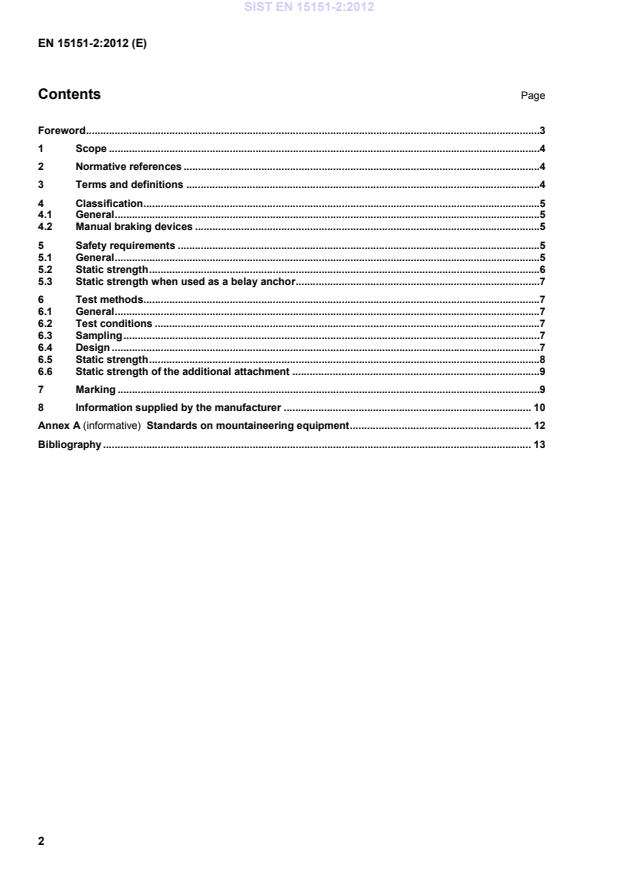
Contents Page Foreword .31Scope .42Normative references .43Terms and definitions .44Classification .54.1General .54.2Manual braking devices .55Safety requirements .55.1General .55.2Static strength .65.3Static strength when used as a belay anchor .76Test methods .76.1General .76.2Test conditions .76.3Sampling .76.4Design .76.5Static strength .86.6Static strength of the additional attachment .97Marking .98Information supplied by the manufacturer . 10Annex A (informative)
Standards on mountaineering equipment . 12Bibliography . 13 SIST EN 15151-2:2012
3 Foreword This document (EN 15151-2:2012) has been prepared by Technical Committee CEN/TC 136 “Sports, playground and other recreational facilities and equipment”, the secretariat of which is held by DIN. This European Standard shall be given the status of a national standard, either by publication of an identical text or by endorsement, at the latest by February 2013, and conflicting national standards shall be withdrawn at the latest by February 2013. Attention is drawn to the possibility that some of the elements of this document may be the subject of patent rights. CEN [and/or CENELEC] shall not be held responsible for identifying any or all such patent rights. This European Standard EN 15151 "Mountaineering equipment - Braking devices" consists of: Part 1: Braking devices with assisted locking, safety requirements and test methods; Part 2: Manual braking devices, safety requirements and test methods. This standard is one of a package of standards for mountaineering equipment (see Annex A). According to the CEN/CENELEC Internal Regulations, the national standards organisations of the following countries are bound to implement this European Standard: Austria, Belgium, Bulgaria, Croatia, Cyprus, Czech Republic, Denmark, Estonia, Finland, Former Yugoslav Republic of Macedonia, France, Germany, Greece, Hungary, Iceland, Ireland, Italy, Latvia, Lithuania, Luxembourg, Malta, Netherlands, Norway, Poland, Portugal, Romania, Slovakia, Slovenia, Spain, Sweden, Switzerland, Turkey and the United Kingdom.
1 Scope This European Standard specifies safety requirements and test methods for manual braking devices used in mountaineering, climbing and related activities for belaying and abseiling, with only manual control, to protect against falls from a height. This European Standard applies to braking devices which are loaded with one person and which use mountaineering ropes according to EN 892. In case of abseiling and lowering down this standard also applies to braking devices, used with low stretch kernmantel ropes according to EN 1891.
2 Normative references The following documents, in whole or in part, are normatively referenced in this document and are indispensable for its application. For dated references, only the edition cited applies. For undated references, the latest edition of the referenced document (including any amendments) applies. EN 892, Mountaineering equipment — Dynamic mountaineering ropes — Safety requirements and test methods EN 1891, Personal protective equipment for the prevention of falls from a height — Low stretch kernmantel ropes EN 15151-1:2012, Mountaineering equipment — Braking devices — Part 1: braking devices with manually assisted locking, safety requirements and test methods 3 Terms and definitions For the purposes of this document, the following terms and definitions apply. 3.1 braking device mechanical device which generates forces on the rope, to oppose movement of the rope through the device 3.2 manual braking device device controlled by hand force applied to the free end of the rope, that produces a magnified force in the active rope in a continuous and reversible manner, such that when the force in the free end of the rope is reduced to zero, the braking effect becomes negligibly small 3.3 attachment point any system which is required and intended for the attachment of a connector according to the information supplied by the manufacturer
Note 1 to entry: For information on connectors, see EN 12275 or EN 362. 3.4
function to adjust the friction inherent characteristic of the device that allows the friction to be changed
5 4 Classification 4.1 General Figure 1 gives the classification of braking devices used in mountaineering, climbing and related activities. Manual braking devices are classified according to 4.2. Braking devices with manually assisted locking are defined in EN 15151-1:2012, 4.2.
Key A abseiling B belaying Figure 1 — Classification of braking devices 4.2 Manual braking devices 4.2.1 Type 1: devices for abseiling without a function to adjust the friction; 4.2.2 Type 2: devices for belaying and abseiling without a function to adjust the friction; 4.2.3 Type 3: devices for abseiling with a function to adjust the friction; 4.2.4 Type 4: devices for belaying and abseiling with a function to adjust the friction. 5 Safety requirements 5.1 General 5.1.1 An overview of the requirements related to the various types of manual braking device is given in SIST EN 15151-2:2012
Table 1. Requirements for braking devices with manually assisted locking are given in EN 15151-1:2012. Table 1 — Overview of requirements related to various types of manual braking devices Clause Requirem
...