

SIST EN 1569:2020
(Main)Surfaces for sports areas - Determination of the behaviour under a rolling load
General Information
- Abstract
This document specifies a method of test for the determination of behaviour under a rolling load of certain surfaces for sports areas. It is suitable for tests undertaken in the laboratory and on site.
- Status
- Published
- Public Enquiry End Date
- 14-Jan-2019
- Publication Date
- 18-Jun-2020
- Technical Committee
- SPO - Sports
- Current Stage
- 6060 - National Implementation/Publication (Adopted Project)
- Start Date
- 25-May-2020
- Due Date
- 30-Jul-2020
- Completion Date
- 19-Jun-2020



Overview
SIST EN 1569:2020 is a European standard developed by CEN that specifies a precise method for testing the behaviour of sports area surfaces under rolling loads. Applicable to both laboratory and on-site conditions, this standard provides a reliable approach to evaluating the durability and performance of indoor sports surfaces when subjected to stresses such as those caused by wheeled equipment. It supersedes the previous EN 1569:1999 edition, introducing enhancements in equipment and test reproducibility.
Key Topics
- Scope: Focuses on determining how surfaces used in sports areas respond to rolling loads, especially stressing critical areas like joints or welded parts.
- Test Apparatus: Includes a loaded steel wheel with specific dimensions (100 mm diameter, 30 mm width), guide tracks to ensure consistent wheel placement, and mechanisms for controlled movement at approximately 1 m/s. The apparatus incorporates loads as per product specification or agreement.
- Test Specimen Preparation: Requires a minimum specimen size of 1500 mm by 1500 mm, including supporting layers installed as per manufacturer instructions. Specimens are conditioned at 23 ± 2 °C for at least 3 hours before testing.
- Procedure: The loaded wheel repeatedly traverses a 50 mm wide strip across the specimen 300 times, followed by a perpendicular series of the same test to another area, enabling assessment of damage such as cracking or surface indentation.
- Measurement: Post-test inspection includes visual and microscopic examination for surface damage and precise measurement of any residual indentations exceeding 0.5 mm after a recovery period of 15–20 minutes.
- Reporting: Test reports must document the standard version, surface identification, test conditions, observed damage, and indentation depths.
Applications
SIST EN 1569:2020 is vital for:
- Manufacturers of sports surfaces seeking to validate the durability and mechanical resistance of their products under realistic loading scenarios.
- Sports facility managers and installers who require on-site verification of surface resilience and quality assurance prior to commissioning or maintenance.
- Laboratories conducting performance testing to ensure compliance with international standards and to support product certification processes.
- Designers and engineers aiming to specify surfaces that will withstand repetitive rolling load stresses from equipment such as carts, maintenance trolleys, or sports wheelchairs.
By providing reproducible, quantifiable results, this standard helps maintain high safety and performance levels across indoor sports flooring installations.
Related Standards
While SIST EN 1569:2020 focuses on rolling load behaviour, it is complementary to other CEN standards and relevant guidelines in the domain of sports facility surfaces and sports equipment testing, such as:
- EN 14877 - Synthetic surfaces for sport areas - Specification
- EN 12235 - Synthetic turf - Determination of mechanical performance characteristics
- ISO 20590 - Sports and other recreational facilities - Indoor surfaces for sports areas - Methods of test for the determination of shock absorption
- CEN/TC 217 - The technical committee responsible for surfaces for sports areas, ensuring coherent and harmonized standards across Europe
These interconnected standards enable comprehensive assessment of sports surfaces, covering aspects from surface composition and safety to performance under various mechanical and environmental stresses.
Keywords: SIST EN 1569:2020, sports surfaces testing, rolling load behaviour, sports area flooring, surface durability, CEN standards, indoor sports surfaces, surface indentation measurement, sports facility testing, rolling load resistance.
Relations
- Replaces
SIST EN 1569:2002 - Surfaces for sports areas - Determination of the behaviour under a rolling load - Effective Date
- 01-Jul-2020
- Effective Date
- 28-Jan-2026
Frequently Asked Questions
SIST EN 1569:2020 is a standard published by the Slovenian Institute for Standardization (SIST). Its full title is "Surfaces for sports areas - Determination of the behaviour under a rolling load". This standard covers: This document specifies a method of test for the determination of behaviour under a rolling load of certain surfaces for sports areas. It is suitable for tests undertaken in the laboratory and on site.
This document specifies a method of test for the determination of behaviour under a rolling load of certain surfaces for sports areas. It is suitable for tests undertaken in the laboratory and on site.
SIST EN 1569:2020 is classified under the following ICS (International Classification for Standards) categories: 97.220.10 - Sports facilities. The ICS classification helps identify the subject area and facilitates finding related standards.
SIST EN 1569:2020 has the following relationships with other standards: It is inter standard links to SIST EN 1569:2002, SIST EN 14904:2006. Understanding these relationships helps ensure you are using the most current and applicable version of the standard.
SIST EN 1569:2020 is available in PDF format for immediate download after purchase. The document can be added to your cart and obtained through the secure checkout process. Digital delivery ensures instant access to the complete standard document.
Standards Content (Sample)
SLOVENSKI STANDARD
01-julij-2020
Nadomešča:
SIST EN 1569:2002
Podloge za športne dejavnosti - Ugotavljanje obnašanja pri kotalni obremenitvi
Surfaces for sports areas - Determination of the behaviour under a rolling load
Sportböden - Bestimmung des Verhaltens bei rollender Last
Sols sportifs - Détermination du comportement sous charge roulante
Ta slovenski standard je istoveten z: EN 1569:2020
ICS:
97.220.10 Športni objekti Sports facilities
2003-01.Slovenski inštitut za standardizacijo. Razmnoževanje celote ali delov tega standarda ni dovoljeno.
EN 1569
EUROPEAN STANDARD
NORME EUROPÉENNE
May 2020
EUROPÄISCHE NORM
ICS 97.220.10 Supersedes EN 1569:1999
English Version
Surfaces for sports areas - Determination of the behaviour
under a rolling load
Sols sportifs - Détermination du comportement sous Sportböden - Bestimmung des Verhaltens bei rollender
charge roulante Last
This European Standard was approved by CEN on 2 March 2020.
CEN members are bound to comply with the CEN/CENELEC Internal Regulations which stipulate the conditions for giving this
European Standard the status of a national standard without any alteration. Up-to-date lists and bibliographical references
concerning such national standards may be obtained on application to the CEN-CENELEC Management Centre or to any CEN
member.
This European Standard exists in three official versions (English, French, German). A version in any other language made by
translation under the responsibility of a CEN member into its own language and notified to the CEN-CENELEC Management
Centre has the same status as the official versions.
CEN members are the national standards bodies of Austria, Belgium, Bulgaria, Croatia, Cyprus, Czech Republic, Denmark, Estonia,
Finland, France, Germany, Greece, Hungary, Iceland, Ireland, Italy, Latvia, Lithuania, Luxembourg, Malta, Netherlands, Norway,
Poland, Portugal, Republic of North Macedonia, Romania, Serbia, Slovakia, Slovenia, Spain, Sweden, Switzerland, Turkey and
United Kingdom.
EUROPEAN COMMITTEE FOR STANDARDIZATION
COMITÉ EUROPÉEN DE NORMALISATION
EUROPÄISCHES KOMITEE FÜR NORMUNG
CEN-CENELEC Management Centre: Rue de la Science 23, B-1040 Brussels
© 2020 CEN All rights of exploitation in any form and by any means reserved Ref. No. EN 1569:2020 E
worldwide for CEN national Members.
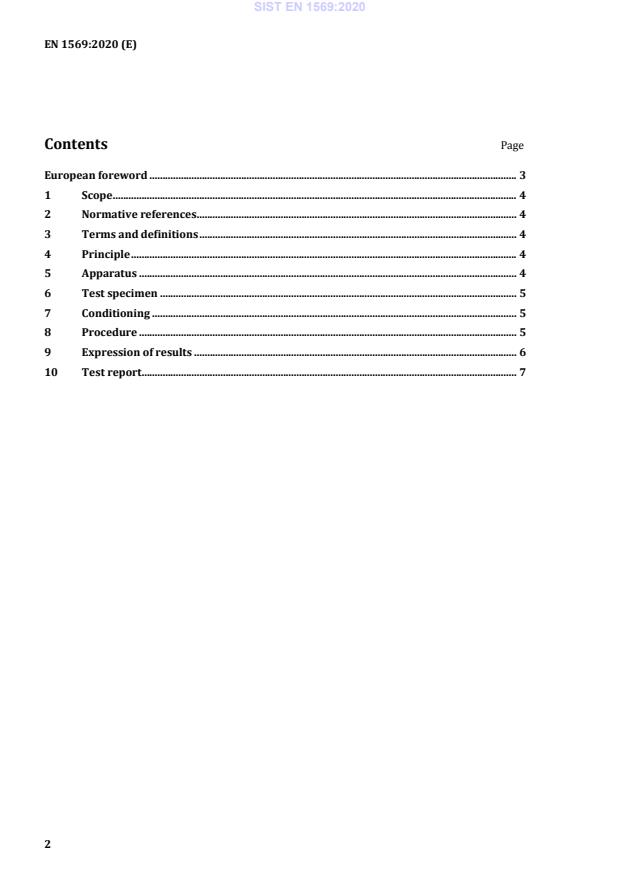
Contents Page
European foreword . 3
1 Scope . 4
2 Normative references . 4
3 Terms and definitions . 4
4 Principle . 4
5 Apparatus . 4
6 Test specimen . 5
7 Conditioning . 5
8 Procedure . 5
9 Expression of results . 6
10 Test report . 7
European foreword
This document (EN 1569:2020) has been prepared by Technical Committee CEN/TC 217 “Surfaces for
sports areas”, the secretariat of which is held by AFNOR.
This European Standard shall be given the status of a national standard, either by publication of an
identical text or by endorsement, at the latest by November 2020, and conflicting national standards shall
be withdrawn at the latest by November 2020.
Attention is drawn to the possibility that some of the elements of this document may be the subject of
patent rights. CEN shall not be held responsible for identifying any or all such patent rights.
This document supersedes EN 1569:1999.
The main change compared to the previous edition is an enhanced equipment description to improve the
reproducibility of the test, including:
— guide tracks to ensure the test wheel always passes over the same area,
— use of a metronome or similar to set the pace of movement or mechanical means such as an
automated drive s
...