

oSIST prEN ISO 18363-1:2026
(Main)Animal and vegetable fats and oils - Determination of fatty-acid-bound chloropropanediols (MCPDs) and glycidol by GC/MS - Part 1: Method using fast alkaline transesterification and measurement for 3-MCPD and differential measurement for glycidol (ISO/FDIS 18363-1:2026)
- Abstract
ISO 18363-1:2015 describes a procedure for the indirect determination of 3-MCPD esters (bound 3-MCPD) and possible free 3-MCPD after alkaline catalysed ester cleavage and derivatization with phenylboronic acid (PBA). Furthermore, this part of ISO 18363 enables the indirect determination of glycidyl esters (bound glycidol) under the assumption that no other substances are present that react at room temperature with inorganic chloride to generate 3-MCPD.
ISO 18363-1:2015 is applicable to solid and liquid fats and oils. Milk and milk products (or fat coming from milk and milk products) are excluded from the scope of this part of ISO 18363.
- Status
- Not Published
- Public Enquiry End Date
- 13-Dec-2026
- Technical Committee
- KŽP - Agricultural food products
- Current Stage
- 4020 - Public enquire (PE) (Adopted Project)
- Start Date
- 13-Nov-2026
- Due Date
- 02-Apr-2027

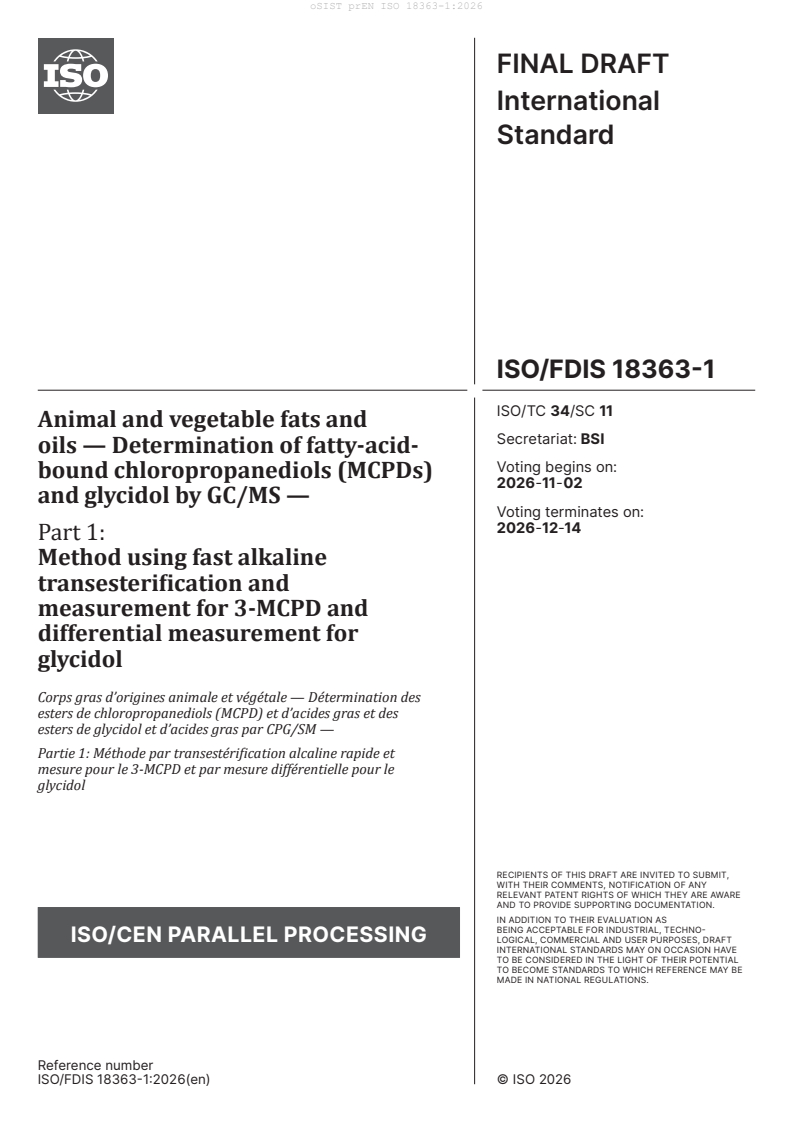
oSIST prEN ISO 18363-1:2026 specifies a GC/MS method for animal and vegetable fats and oils to determine fatty-acid-bound chloropropanediols (MCPDs) and glycidol by indirect measurement. It uses fast alkaline transesterification, phenylboronic acid (PBA) derivatization, and a differential result for glycidol, and it is intended for laboratories testing fats and oils. The document is the differential method equivalent to DGF standard C-VI 18 (10) and identical to AOCS Official Method Cd 29c-13.
What does oSIST prEN ISO 18363-1:2026 specify?
oSIST prEN ISO 18363-1:2026 specifies the scope, principle, reagents, apparatus, procedure, calculation, precision, and test report content for the method. It applies to solid and liquid fats and oils, and it excludes milk and milk products, including fat from milk and milk products.
The document also makes clear that the result includes possible free 3-MCPD, and that the method does not separate free from bound analytes. For glycidol, the method works only on the assumption that no other substances are present that react at room temperature with inorganic chloride to generate 3-MCPD.
The document is organized into Clauses 1 to 11, followed by one informative annex:
| Annex | What it covers |
|---|---|
| Annex A | Results of the collaborative trial and precision data |
What are the key requirements of oSIST prEN ISO 18363-1:2026?
oSIST prEN ISO 18363-1:2026 is built around two parallel assays, A and B, and the reported result depends on which assay is used. Assay A gives the combined amount of bound 3-MCPD and bound glycidol as 3-MCPD, while assay B gives bound 3-MCPD only. For glycidol, the document uses the difference between A and B, multiplied by a transformation factor.
Sample handling and applicability
Clause 7 says liquid samples are used as received. Solid or turbid fats are carefully melted, but water-rich solid samples that separate after melting are not melted and may be used as such or isolated by liquid-liquid extraction. In practice, this matters because sample preparation can change the analytical result if chloride-containing phases or water are present.
Reaction sequence and split determination
Clause 8 specifies that each sample is split into two 100 mg portions and spiked with a surrogate standard. Both portions are treated with sodium hydroxide or sodium methoxide in methanol, but assay A is stopped with acidified sodium chloride and assay B with an acidic chloride-free salt solution. This difference is what allows glycidol to be measured indirectly and 3-MCPD to be reported either as total or genuine 3-MCPD.
Extraction, derivatization, and GC/MS measurement
Clause 8 requires matrix clean-up, extraction into organic solvent, derivatization with PBA, drying over anhydrous sodium sulfate, and final re-dissolution in isooctane. Clause 8.5 specifies GC/MS conditions such as electron-impact ionization, selected ion monitoring (SIM), a programmed injector, and defined ion traces for the analyte and surrogate standard. For users, this means the laboratory needs a comparable chromatographic and mass-spectrometric setup to obtain results that match the method.
Quantification and calibration
Clause 9 quantifies analytes from the signal-area ratio of analyte to isotopically labelled surrogate standard. The document also calls for periodic matrix calibration to determine method linearity, relative recovery, and the glycidol transformation factor. That calibration is important because the glycidol result is not measured directly but calculated from the two assay outputs.
Quality control and reporting
Clause 4 and Clause 11 require a daily blank check for contamination and a test report that states whether assay A or assay B was used. The report must also include the sample identification, the sampling method if known, the result, any relevant deviations from the method, and the test date. This matters because the two assays support different interpretations of the result.
Precision
Clause 10 refers to the interlaboratory study in Annex A and uses it to state repeatability and reproducibility. The precision data apply to the matrices and concentration ranges studied, so users should treat them as method-performance data, not as universal values for every fat or oil.
What terms does oSIST prEN ISO 18363-1:2026 define?
Bound 3-MCPD is the sum of all 3-MCPD derivatives that are cleaved by the alkaline alcoholysis step, and the result is reported as mass fraction in mg/kg.
Bound glycidol is the sum of all glycidyl derivatives that are cleaved by the same kind of treatment, also reported as mass fraction in mg/kg.
Assay A is the preparation that measures the sum of bound 3-MCPD and bound glycidol as 3-MCPD after chloride-containing acidic stopping conditions.
Assay B is the preparation that measures bound 3-MCPD only, because chloride-free stopping conditions prevent glycidol from turning into additional 3-MCPD.
The surrogate standard is the isotopically labelled reference compound added before analysis so the result can be quantified from a signal-area ratio.
The transformation factor is the factor used to convert the A-B difference into glycidol content under the method’s reaction conditions.
PBA is phenylboronic acid, the derivatization reagent used before GC/MS measurement.
Who uses oSIST prEN ISO 18363-1:2026?
oSIST prEN ISO 18363-1:2026 is used by analytical laboratories, quality control teams, and regulatory testing groups that measure MCPDs and glycidol in fats and oils. It is relevant for refined and non-refined vegetable oils and fats, and it can also be applied to animal fats and used frying oils and fats when the laboratory validates the matrix first.
The method is also useful for producers, buyers, and food-testing organizations that need a documented GC/MS procedure for comparing fat and oil samples and reporting 3-MCPD and glycidol consistently.
What changed in oSIST prEN ISO 18363-1:2026 from the previous edition?
oSIST prEN ISO 18363-1:2026 is the second edition and it cancels and replaces ISO 18363-1:2015. The foreword states that this is a minor revision, and the stated change is alignment of the Introduction with the other parts of the ISO 18363 series.
Which standards are used with oSIST prEN ISO 18363-1:2026?
ISO 3696 provides the water specification used for analytical work in the method.
ISO 5555 is the recommended sampling standard referred to for taking samples of animal and vegetable fats and oils.
ISO 5725-2 is used in Annex A to evaluate the precision data from the collaborative trial.
ISO 18363 (all parts) is the series family, and parts 2, 3, and 4 are named in the document as related methods for other MCPD and glycidol determinations.
What does the oSIST prEN ISO 18363-1:2026 document contain?
oSIST prEN ISO 18363-1:2026 contains a complete laboratory method, from scope and terminology through calculation and reporting. It includes the reagent list, apparatus list, sample preparation steps, the two-assay procedure, and the GC/MS operating conditions.
It also provides the calculation approach for assay A, assay B, the transformation factor, and glycidol by difference. Clause 10 and Annex A give precision information from an interlaboratory study, and Annex A includes summary tables for repeatability and reproducibility.
The document finishes with reporting requirements that make the assay choice part of the reported result. That is important because assay A and assay B do not mean the same thing analytically.
Relations
- Effective Date
- 12-Aug-2026
Get Certified
Connect with accredited certification bodies for this standard

BSI Group
BSI (British Standards Institution) is the business standards company that helps organizations make excellence a habit.

Bureau Veritas
Bureau Veritas is a world leader in laboratory testing, inspection and certification services.

DNV
DNV is an independent assurance and risk management provider.
Sponsored listings
Frequently Asked Questions
oSIST prEN ISO 18363-1:2026 is a draft published by the Slovenian Institute for Standardization (SIST). Its full title is "Animal and vegetable fats and oils - Determination of fatty-acid-bound chloropropanediols (MCPDs) and glycidol by GC/MS - Part 1: Method using fast alkaline transesterification and measurement for 3-MCPD and differential measurement for glycidol (ISO/FDIS 18363-1:2026)". This standard covers: ISO 18363-1:2015 describes a procedure for the indirect determination of 3-MCPD esters (bound 3-MCPD) and possible free 3-MCPD after alkaline catalysed ester cleavage and derivatization with phenylboronic acid (PBA). Furthermore, this part of ISO 18363 enables the indirect determination of glycidyl esters (bound glycidol) under the assumption that no other substances are present that react at room temperature with inorganic chloride to generate 3-MCPD. ISO 18363-1:2015 is applicable to solid and liquid fats and oils. Milk and milk products (or fat coming from milk and milk products) are excluded from the scope of this part of ISO 18363.
ISO 18363-1:2015 describes a procedure for the indirect determination of 3-MCPD esters (bound 3-MCPD) and possible free 3-MCPD after alkaline catalysed ester cleavage and derivatization with phenylboronic acid (PBA). Furthermore, this part of ISO 18363 enables the indirect determination of glycidyl esters (bound glycidol) under the assumption that no other substances are present that react at room temperature with inorganic chloride to generate 3-MCPD. ISO 18363-1:2015 is applicable to solid and liquid fats and oils. Milk and milk products (or fat coming from milk and milk products) are excluded from the scope of this part of ISO 18363.
oSIST prEN ISO 18363-1:2026 is classified under the following ICS (International Classification for Standards) categories: 67.200.10 - Animal and vegetable fats and oils. The ICS classification helps identify the subject area and facilitates finding related standards.
oSIST prEN ISO 18363-1:2026 has the following relationships with other standards: It is inter standard links to SIST EN ISO 18363-1:2022. Understanding these relationships helps ensure you are using the most current and applicable version of the standard.
oSIST prEN ISO 18363-1:2026 is available in PDF format for immediate download after purchase. The document can be added to your cart and obtained through the secure checkout process. Digital delivery ensures instant access to the complete standard document.
Standards Content (Sample)
Contents
- Introduction
- 1 Scope
- 2 Normative references
- 3 Terms and definitions
- 3.1 bound 3-MCPD
- 3.2 bound glycidol
- 4 Principle
- 5 Reagents
- 5.1 General
- 5.2 Standard and reference compounds
- 5.3 Solvents
- 5.4 Other reagents
- 6 Apparatus
- 7 Sample
- 7.1 Sampling
- 7.2 Preparation of the test sample
- 8 Procedure
- 8.1 Spiking with surrogate standard and homogenization
- 8.2 Ester cleavage and glycidol transformation
- 8.3 Matrix clean up
- 8.4 Derivatization
- 8.5 Gas chromatography/mass spectrometry references
- 9 Expression of results
- 10 Precision
- 10.1 Interlaboratory test
- 10.2 Repeatability
- 10.3 Reproducibility
- 11 Test report
- Annex A
- Bibliography
Introduction
[1] The ISO 18363 series can be used for the determination of ester-bound MCPD and glycidol. This introduction describes the methods specified in the different parts so that the analyst can decide which methods are suitable for application. The detailed application of each method is contained within the scope of each individual method.
[2] This document (i.e. 18363-1) is a differential method equivalent to the DGF standard C-VI 18 (10) and [3] identical to AOCS Official Method Cd 29c-13 . In brief, it is based on a fast alkaline catalysed release of 3-MCPD and glycidol from the ester derivatives. Glycidol is subsequently converted into induced 3-MCPD. It consists of two parts. The first part (A) allows the determination of the sum of ester-bound 3-MCPD and ester-bound glycidol, whereas the second part (B) determines ester-bound 3-MCPD only. Both assays are based on the release of the target analytes 3-MCPD and glycidol from the ester-bound form by an alkaline catalysed alcoholysis carried out at room temperature. In part A, an acidified sodium chloride solution is used to stop the reaction and subsequently convert the glycidol into induced 3-MCPD. Thus, 3-MCPD and glycidol become indistinguishable in part A. In part B, the reaction stop is achieved by the addition of an acidified chloride-free salt solution which also prevents the conversion of glycidol into induced MCPD. Consequently, part B allows the determination of the genuine 3-MCPD content. Finally, the glycidol content of the sample is proportional to the difference of both assays (A – B) and can be calculated when the transformation ratio from glycidol to 3-MCPD has been determined. This document is applicable to the fast determination of ester-bound 3-MCPD and glycidol in refined and non-refined vegetable oils and fats. This document can also apply to animal fats and used frying oils and fats, but a validation study must be undertaken before the analysis of these matrices. Any free analytes within the sample would be included in the results, but the document does not allow the distinction between free and bound analytes. However, as of publication of this document, research has not shown any evidence of a free analyte content as high as the esterified analyte content in refined vegetable oils and fats. In principle, this document can also be modified in such a way [4] that the determination of 2-MCPD is feasible , but again, a validation study must be undertaken before the analysis of this analyte.
[5] [6] ISO 18363-2 represents AOCS Official Method Cd 29b-13 . In brief, it is based on a slow alkaline release of MCPD and glycidol from the ester derivatives. Glycidol is subsequently converted into 3-MBPD. [7] [5] ISO 18363-2 consists of two sample preparations that differ in the use of internal standards. Both preparations are used for the determination of ester-bound 2-MCPD and 3-MCPD. In part A, a preliminary result for ester-bound glycidol is determined. Because the 3-MCPD present in the sample is converted to some minor extent into induced glycidol by the sample preparation, part B serves to quantify this amount of induced glycidol that is subsequently subtracted from the preliminary glycidol result of part A. By the use of isotopically labelled free MCPD isomers in assay A and isotopically labelled ester-bound 2-MCPD and 3-MCPD in part B, the efficiency of ester cleavage can be monitored. Both assays A and B are based on the release of the target analytes 2-MCPD, 3-MCPD and glycidol from the ester-bound form by a slow alkaline catalysed alcoholysis in the cold. In both sample preparations, the reaction is stopped by the addition of an acidified concentrated sodium bromide solution so as to convert the unstable and volatile glycidol into 3-MBPD which shows comparable properties to 3-MCPD with regard to its stability and chromatographic performance. Moreover, the major excess of bromide ions prevents the undesired formation of 3-MCPD from glycidol in [5] the case of samples which contain naturally occurring amounts of chloride. ISO 18363-2 is applicable to the determination of ester-bound 3-MCPD, 2-MCPD and glycidol in refined and unrefined vegetable oils and fats. It also applies to animal fats and used frying oils and fats, but a validation study must be undertaken before the analysis of these matrices. Any free analytes within the sample are included in the results, but the document does not allow the distinction between free and bound analytes. However, as of publication of this document, research has not shown any evidence of a free analyte content as high as the esterified analyte content in refined vegetable oils and fats.
[8] [9][10] ISO 18363-3 represents AOCS Official Method Cd 29a-13 . In brief, it is based on the conversion of glycidyl esters into 3-MBPD esters and a slow acidic catalysed release of MCPD and MBPD from the ester [8] derivatives. ISO 18363-3 is based on a single sample preparation in which glycidyl esters are converted into MBPD monoesters, and subsequently the free analytes 2-MCPD, 3-MCPD and 3-MBPD are released by a slow acid-catalysed alcoholysis. The 3-MBPD represents the genuine content of bound glycidol. ISO 18363-3 [8] is applicable to the determination of ester-bound 2-MCPD, 3-MCPD and glycidol in refined and non-refined vegetable oils and fats. It also applies to animal fats and used frying oils and fats, but a validation study must be undertaken before the analysis of these matrices. The method is suited for the analysis of bound
oSIST prEN ISO 18363-1:2026 ISO/FDIS 18363-1:2026(en) [8] (esterified) analytes, but if required, ISO 18363-3 can also be performed without the initial conversion of glycidyl esters. In such a setup, both free and bound 2-MCPD and 3-MCPD forms are included in the results and the amount of free analytes can be calculated as the difference between two determinations performed in both setups. However, as of publication of this document, research has not shown any evidence of a free analyte content as high as the esterified analyte content in refined vegetable oils and fats. [11] ISO 18363-4 specifies a rapid procedure based on fast alkaline cleavage of the MCPD and glycidyl esters. The released glycidol is subsequently converted into 3-MBPD. The pH of the fast alkaline cleavage generally causes the released MCPD to partially convert to glycidol during the cleavage of the esters, leading to overestimation of the glycidyl ester content of the sample. By adding two distinct isotopically labelled esterbound 3-MCPD and glycidol internal standards, it is possible to quantify the amount of labelled glycidol resulting from the degradation of the released internal standard. This information can be used to correct for overestimation of the glycidyl ester induced glycidol by 3-MCPD induced glycidol. The same two internal standards are used for quantification of the bound MCPD and glycidol, requiring a single sample preparation [12] to quantify bound 2-MCPD-, 3-MCPD- and glycidol esters. In analogue with ISO 18363-1 , this document [8] and ISO 18363-3 , the released MCPDs and 3-MBPD are derivatized with phenylboronic acid before GC- [1] [11] MS/MS analysis. In contrast to the other parts of the ISO 18363 series , ISO 18363-4 requires GC-MS/ MS instrumentation to unambiguously detect each of the (isotopically labelled) MBPDs required for correct [11] quantification of the glycidyl ester induced glycidol. ISO 18363-4 is applicable to the determination of ester-bound 3-MCPD, 2-MCPD and glycidol in refined and unrefined vegetable oils and fats. It also applies to animal fats and used frying oils and fats, but a validation study must be undertaken before analysis of [11] these matrices. Any free analytes within the sample are included in the results, but ISO 18363-4 will not allow the distinction between free and bound analytes. However, as of publication of this document, research has not shown any evidence of a free analyte content as high as the esterified analyte content in refined vegetable oils and fats.
oSIST prEN ISO 18363-1:2026 FINAL DRAFT International Standard ISO/FDIS 18363-1:2026(en) Animal and vegetable fats and oils — Determination of fattyacid-bound chloropropanediols (MCPDs) and glycidol by GC/ MS — Part 1:
Method using fast alkaline transesterification and measurement for 3-MCPD and differential measurement for glycidol
1 Scope
This document specifies a procedure for the indirect determination of 3-MCPD esters (bound 3-MCPD) and possible free 3-MCPD after alkaline catalysed ester cleavage and derivatization with phenylboronic acid (PBA). Furthermore, this document enables the indirect determination of glycidyl esters (bound glycidol) under the assumption that no other substances are present that react at room temperature with inorganic chloride to generate 3-MCPD.
This document is applicable to solid and liquid fats and oils. It does not apply to milk and milk products (or fat coming from milk and milk products).
2 Normative references
The following documents are referred to in the text in such a way that some or all of their content constitutes requirements of this document. For dated references, only the edition cited applies. For undated references, the latest edition of the referenced document (including any amendments) applies. ISO 3696, Water for analytical laboratory use — Specification and test methods
3 Terms and definitions
For the purposes of this document, the following terms and definitions apply. ISO and IEC maintain terminology databases for use in standardization at the following addresses:
- ISO Online browsing platform: available at https:// www .iso .org/ obp
- IEC Electropedia: available at https:// www .electropedia .org/
3.1 bound 3-MCPD
sum of all 3-MCPD derivatives being cleaved by alkaline catalysed alcoholysis (especially fatty acid esters) according to the reference method Note 1 to entry: The content of 3-MCPD is calculated and reported as a mass fraction, in milligrams per kilogram (mg/ kg).
Note 2 to entry: In fats and oils, the amount of free 3-MCPD which can possibly occur is generally negligibly low but has a bearing on the result.
oSIST prEN ISO 18363-1:2026 ISO/FDIS 18363-1:2026(en)
3.2 bound glycidol
sum of all glycidyl derivatives being cleaved by alkaline catalysed alcoholysis (especially fatty acid esters) according to the specified standard Note 1 to entry: The content of glycidol is calculated and reported as a mass fraction, in milligrams per kilogram (mg/ kg).
Note 2 to entry: The presence of free glycidol in fats and oils is unlikely because of the instability of this compound.
4 Principle
For the determination of the sum of bound 3-MCPD and bound glycidol as free 3-MCPD (assay A), an aliquot of the sample is spiked with surrogate standard d -3-MCPD-1,2-bis-palmitoyl ester and dissolved in tertiary-
...