

SIST EN 283:2000
(Main)Swap bodies - Testing
General Information
- Abstract
This European Standard lays down the basic testing requirements for swap bodies of class A, B and C, which are suitable for conveyance by road and rail vehicles, including interchange between these modes of transport. This standard does not apply to specific cargo swap bodies (e.g. tank type swap bodies).
- Status
- Published
- Publication Date
- 30-Nov-2000
- Technical Committee
- SS SPL - Technical Board for the general field
- Current Stage
- 6060 - National Implementation/Publication (Adopted Project)
- Start Date
- 01-Dec-2000
- Due Date
- 01-Dec-2000
- Completion Date
- 01-Dec-2000
- Ref Project
EN 283:1991 - Swap bodies - Testing



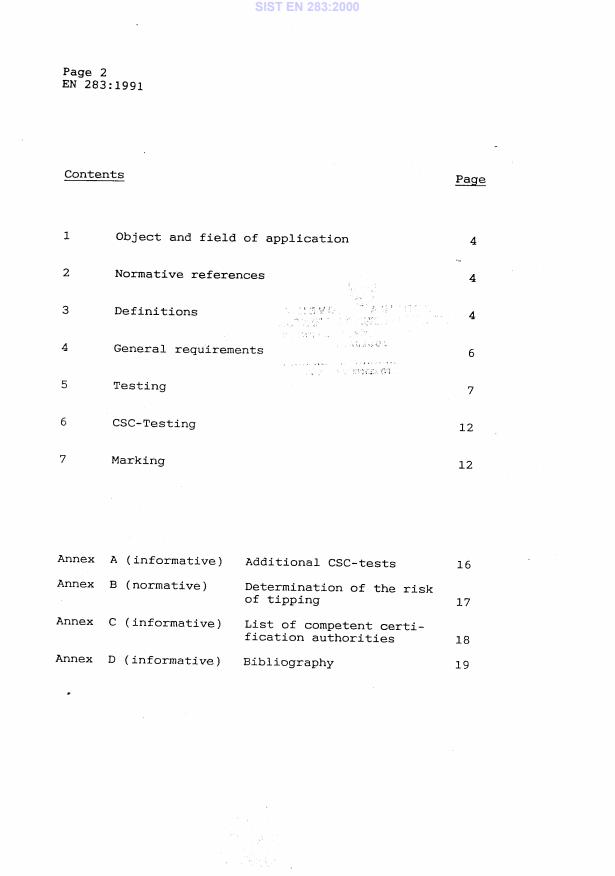
Overview
EN 283:1991 - Swap bodies - Testing is a European Standard that defines the basic testing requirements for swap bodies of class A, B and C intended for carriage by road and rail, including their interchangeability between modes. The standard applies to general-purpose swap bodies and excludes specialised cargo types (for example, tank-type swap bodies). The document has been adopted nationally (e.g., SIST EN 283:2000 in Slovenia).
Key Topics
The standard sets out the essential areas to be verified when assessing a swap body’s suitability for intermodal transport. Key technical topics typically covered include:
- Scope and classification of swap bodies (classes A, B, C) and applicability for road/rail use
- Basic testing requirements to demonstrate fitness for conveyance and interchangeability between road and rail vehicles
- Structural integrity and durability testing to ensure the body withstands operational stresses over time
- Handling and interface features, such as corner fittings, locking/coupling points and other attachment details required for safe lifting and transfer
- Securing and lashing provisions to confirm load restraint when carried on different transport modes
- Marking, documentation and conformity requirements to support consistent inspection and traceability
- Exclusions clarifying that specific cargo swap bodies (e.g., tank swap bodies) are outside the scope
(Note: EN 283 provides framework-level testing requirements rather than proprietary design specifications. For detailed test methods, consult the full standard text.)
Applications
EN 283 is practical for organizations involved in design, manufacture, testing and operation of intermodal swap bodies:
- Swap body manufacturers use the standard to design products that meet basic intermodal testing expectations and regulatory access to European markets.
- Testing laboratories and certification bodies apply the standard to assess conformity and issue test reports or approvals.
- Logistics operators and rail/road carriers reference the standard when specifying intermodal equipment for safe interchange and transport reliability.
- Vehicle and terminal designers use the requirements to ensure compatibility between swap bodies and handling/transport equipment.
Keywords: EN 283, swap bodies testing, swap body standard, intermodal transport, class A B C, interchangeability, SIST EN 283.
Related Standards (if applicable)
Users should consider EN 283 alongside other European and international standards governing freight containers, intermodal unit interfaces, cargo securing and testing procedures to build a comprehensive compliance and testing program. National adoptions (e.g., SIST EN 283:2000) reflect the standard’s use across member states.
Relations
- Effective Date
- 28-Jan-2026
- Effective Date
- 28-Jan-2026
Get Certified
Connect with accredited certification bodies for this standard

BRCGS (Brand Reputation Compliance Global Standards)
Global food safety and quality standards owner.
Sponsored listings
Frequently Asked Questions
SIST EN 283:2000 is a standard published by the Slovenian Institute for Standardization (SIST). Its full title is "Swap bodies - Testing". This standard covers: This European Standard lays down the basic testing requirements for swap bodies of class A, B and C, which are suitable for conveyance by road and rail vehicles, including interchange between these modes of transport. This standard does not apply to specific cargo swap bodies (e.g. tank type swap bodies).
This European Standard lays down the basic testing requirements for swap bodies of class A, B and C, which are suitable for conveyance by road and rail vehicles, including interchange between these modes of transport. This standard does not apply to specific cargo swap bodies (e.g. tank type swap bodies).
SIST EN 283:2000 is classified under the following ICS (International Classification for Standards) categories: 55.180.10 - General purpose containers. The ICS classification helps identify the subject area and facilitates finding related standards.
SIST EN 283:2000 has the following relationships with other standards: It is inter standard links to SIST-TS CEN/TS 13853:2004, SIST EN 284:2007. Understanding these relationships helps ensure you are using the most current and applicable version of the standard.
SIST EN 283:2000 is associated with the following European legislation: EU Directives/Regulations: 2008/68/EC, 2018-01-1387. When a standard is cited in the Official Journal of the European Union, products manufactured in conformity with it benefit from a presumption of conformity with the essential requirements of the corresponding EU directive or regulation.
SIST EN 283:2000 is available in PDF format for immediate download after purchase. The document can be added to your cart and obtained through the secure checkout process. Digital delivery ensures instant access to the complete standard document.
Standards Content (Sample)
2003-01.Slovenski inštitut za standardizacijo. Razmnoževanje celote ali delov tega standarda ni dovoljeno.Swap bodies - TestingWechselbehälter - PrüfungCaisses mobiles - EssaisSwap bodies - Testing55.180.10General purpose containersICS:Ta slovenski standard je istoveten z:EN 283:1991SIST EN 283:2000en01-december-2000SIST EN 283:2000SLOVENSKI
STANDARD
...