


oSIST prEN IEC 61000-4-29:2025
(Main)Electromagnetic compatibility (EMC) - Part 4-29: Testing and measurement techniques - Voltage dips, short interruptions and voltage variations on d.c. input power port immunity tests
Electromagnetic compatibility (EMC) - Part 4-29: Testing and measurement techniques - Voltage dips, short interruptions and voltage variations on d.c. input power port immunity tests
Elektromagnetische Verträglichkeit (EMV) - Teil 4-29: Prüf- und Messverfahren - Prüfungen der Störfestigkeit gegen Spannungseinbrüche, Kurzzeitunterbrechungen und Spannungsschwankungen an Gleichstrom-Netzeingängen
Compatibilité électromagnétique (CEM) - Partie 4-29: Techniques d'essai et de mesure - Essais d'immunité aux creux de tension, coupures brèves et varations de tension sur les accès d'alimentation en courant continu
Elektromagnetna združljivost (EMC) - 4-29. del: Preskusne in merilne tehnike - Preskusi odpornosti proti upadom napetosti, kratkotrajnim prekinitvam in odklonom napetosti za enosmerni (DC) napajalni priključek
General Information
- Status
- Not Published
- Public Enquiry End Date
- 26-Mar-2025
- Technical Committee
- EMC - Electromagnetic compatibility
- Current Stage
- 4020 - Public enquire (PE) (Adopted Project)
- Start Date
- 10-Jan-2025
- Due Date
- 30-May-2025
- Completion Date
- 10-Mar-2025
Relations
- Effective Date
- 23-Jan-2023
- Effective Date
- 09-Nov-2021
Overview
prEN IEC 61000-4-29:2025 (IEC 61000-4-29 ED2) is a dedicated electromagnetic compatibility (EMC) standard that defines reproducible test methods for immunity to voltage dips, short interruptions and voltage variations at the d.c. input power port of electrical and electronic equipment. Applicable to low-voltage d.c. power ports supplied by external d.c. networks, the document provides a common, repeatable basis for laboratory testing to assess how Equipment Under Test (EUT) responds to sudden or gradual changes in d.c. supply voltage. Note: d.c. input ripple is excluded (see IEC 61000-4-17).
Key Topics and Requirements
- Scope and objectives - establishes test coverage for low-voltage d.c. input ports and guidance for product committees and manufacturers on selecting appropriate test severity.
- Test levels - defines preferred ranges and durations for voltage dips, short interruptions and voltage variations (see included tables for levels and durations).
- Test generator - requirements and performance characteristics for generating test conditions, including distinctions between low‑impedance and high‑impedance (short interruption) operating modes.
- Verification - procedures to verify output voltage, switching characteristics, output impedance and peak inrush current drive capability of the test generator.
- Test set-up and procedure - standardized wiring, laboratory reference conditions (climatic and electromagnetic) and the sequence for executing tests on the EUT.
- Evaluation and reporting - criteria for assessing EUT performance, documenting malfunctions and producing a comprehensive test report.
- Annexes - informative examples of test generators and set-ups, normative inrush current measurement methods (Annex B), and a description of the d.c. environment.
Practical Applications
This standard is used to:
- Provide repeatable immunity testing for devices that rely on low-voltage d.c. feeds.
- Help manufacturers and test laboratories validate robustness against supply disturbances (voltage dips, interruptions, variations).
- Support product committees in defining appropriate test severity for particular product types and end‑use scenarios. Typical stakeholders: EMC test laboratories, product design and validation teams, manufacturers of d.c.-powered equipment and modules, and conformity assessment bodies.
Related Standards
- IEC 61000-4-11 - AC voltage dips, short interruptions and variations (complementary guidance)
- IEC 61000-4-17 - D.C. input ripple (scope excluded from 4-29)
- IEC 60050(161) - EMC vocabulary and terms
Keywords: EMC, IEC 61000-4-29, prEN IEC 61000-4-29:2025, voltage dips, short interruptions, voltage variations, d.c. input power port, immunity testing, test generator, inrush current, EUT.

Frequently Asked Questions
oSIST prEN IEC 61000-4-29:2025 is a draft published by the Slovenian Institute for Standardization (SIST). Its full title is "Electromagnetic compatibility (EMC) - Part 4-29: Testing and measurement techniques - Voltage dips, short interruptions and voltage variations on d.c. input power port immunity tests". This standard covers: Electromagnetic compatibility (EMC) - Part 4-29: Testing and measurement techniques - Voltage dips, short interruptions and voltage variations on d.c. input power port immunity tests
Electromagnetic compatibility (EMC) - Part 4-29: Testing and measurement techniques - Voltage dips, short interruptions and voltage variations on d.c. input power port immunity tests
oSIST prEN IEC 61000-4-29:2025 is classified under the following ICS (International Classification for Standards) categories: 33.100.20 - Immunity. The ICS classification helps identify the subject area and facilitates finding related standards.
oSIST prEN IEC 61000-4-29:2025 has the following relationships with other standards: It is inter standard links to SIST EN 61000-4-29:2003, SIST EN 61000-4-29:2003. Understanding these relationships helps ensure you are using the most current and applicable version of the standard.
oSIST prEN IEC 61000-4-29:2025 is associated with the following European legislation: EU Directives/Regulations: 2014/30/EU; Standardization Mandates: M/490. When a standard is cited in the Official Journal of the European Union, products manufactured in conformity with it benefit from a presumption of conformity with the essential requirements of the corresponding EU directive or regulation.
oSIST prEN IEC 61000-4-29:2025 is available in PDF format for immediate download after purchase. The document can be added to your cart and obtained through the secure checkout process. Digital delivery ensures instant access to the complete standard document.
Standards Content (Sample)
SLOVENSKI STANDARD
01-marec-2025
Elektromagnetna združljivost (EMC) - 4-29. del: Preskusne in merilne tehnike -
Preskusi odpornosti proti upadom napetosti, kratkotrajnim prekinitvam in
odklonom napetosti za enosmerni (DC) napajalni priključek
Electromagnetic compatibility (EMC) - Part 4-29: Testing and measurement techniques -
Voltage dips, short interruptions and voltage variations on d.c. input power port immunity
tests
Elektromagnetische Verträglichkeit (EMV) - Teil 4-29: Prüf- und Messverfahren -
Prüfungen der Störfestigkeit gegen Spannungseinbrüche, Kurzzeitunterbrechungen und
Spannungsschwankungen an Gleichstrom-Netzeingängen
Compatibilité électromagnétique (CEM) - Partie 4-29: Techniques d'essai et de mesure -
Essais d'immunité aux creux de tension, coupures brèves et varations de tension sur les
accès d'alimentation en courant continu
Ta slovenski standard je istoveten z: prEN IEC 61000-4-29:2025
ICS:
33.100.20 Imunost Immunity
2003-01.Slovenski inštitut za standardizacijo. Razmnoževanje celote ali delov tega standarda ni dovoljeno.
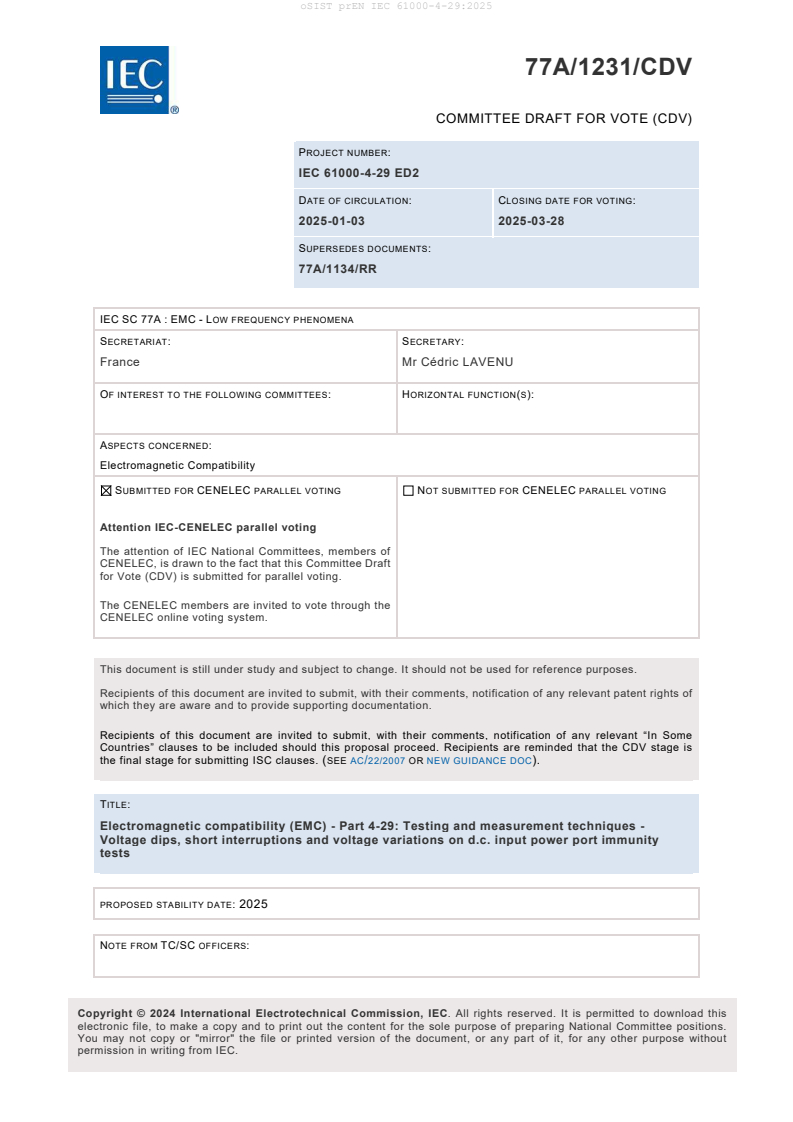
77A/1231/CDV
COMMITTEE DRAFT FOR VOTE (CDV)
PROJECT NUMBER:
IEC 61000-4-29 ED2
DATE OF CIRCULATION: CLOSING DATE FOR VOTING:
2025-01-03 2025-03-28
SUPERSEDES DOCUMENTS:
77A/1134/RR
IEC SC 77A : EMC - LOW FREQUENCY PHENOMENA
SECRETARIAT: SECRETARY:
France Mr Cédric LAVENU
OF INTEREST TO THE FOLLOWING COMMITTEES: HORIZONTAL FUNCTION(S):
ASPECTS CONCERNED:
Electromagnetic Compatibility
SUBMITTED FOR CENELEC PARALLEL VOTING NOT SUBMITTED FOR CENELEC PARALLEL VOTING
Attention IEC-CENELEC parallel voting
The attention of IEC National Committees, members of
CENELEC, is drawn to the fact that this Committee Draft
for Vote (CDV) is submitted for parallel voting.
The CENELEC members are invited to vote through the
CENELEC online voting system.
This document is still under study and subject to change. It should not be used for reference purposes.
Recipients of this document are invited to submit, with their comments, notification of any relevant patent rights of
which they are aware and to provide supporting documentation.
Recipients of this document are invited to submit, with their comments, notification of any relevant “In Some
Countries” clauses to be included should this proposal proceed. Recipients are reminded that the CDV stage is
the final stage for submitting ISC clauses. (SEE AC/22/2007 OR NEW GUIDANCE DOC).
TITLE:
Electromagnetic compatibility (EMC) - Part 4-29: Testing and measurement techniques -
Voltage dips, short interruptions and voltage variations on d.c. input power port immunity
tests
PROPOSED STABILITY DATE: 2025
NOTE FROM TC/SC OFFICERS:
electronic file, to make a copy and to print out the content for the sole purpose of preparing National Committee positions.
You may not copy or "mirror" the file or printed version of the document, or any part of it, for any other purpose without
permission in writing from IEC.
IEC CDV 61000-4-29 ED2 © IEC 2024 2 77A/1231/CDV
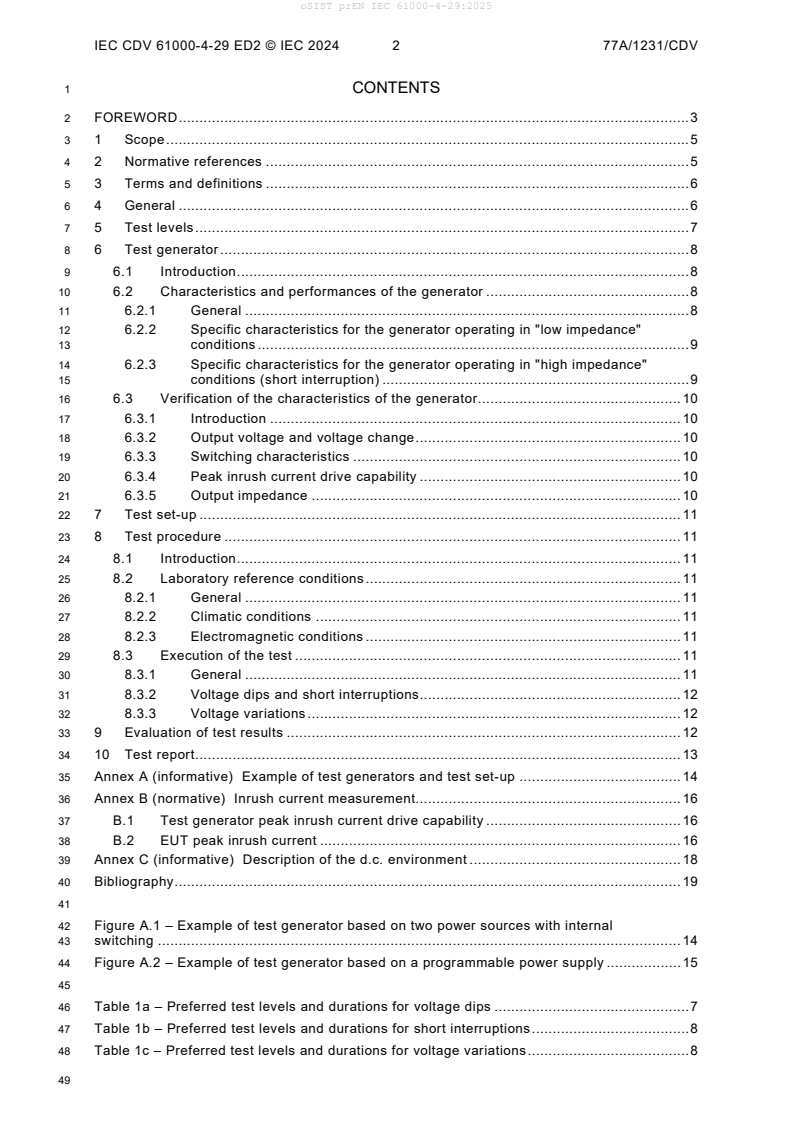
1 CONTENTS
2 FOREWORD . 3
3 1 Scope . 5
4 2 Normative references . 5
5 3 Terms and definitions . 6
6 4 General . 6
7 5 Test levels . 7
8 6 Test generator . 8
9 6.1 Introduction . 8
10 6.2 Characteristics and performances of the generator . 8
11 6.2.1 General . 8
12 6.2.2 Specific characteristics for the generator operating in "low impedance"
13 conditions . 9
14 6.2.3 Specific characteristics for the generator operating in "high impedance"
15 conditions (short interruption) . 9
16 6.3 Verification of the characteristics of the generator. 10
17 6.3.1 Introduction . 10
18 6.3.2 Output voltage and voltage change . 10
19 6.3.3 Switching characteristics . 10
20 6.3.4 Peak inrush current drive capability . 10
21 6.3.5 Output impedance . 10
22 7 Test set-up . 11
23 8 Test procedure . 11
24 8.1 Introduction . 11
25 8.2 Laboratory reference conditions . 11
26 8.2.1 General . 11
27 8.2.2 Climatic conditions . 11
28 8.2.3 Electromagnetic conditions . 11
29 8.3 Execution of the test . 11
30 8.3.1 General . 11
31 8.3.2 Voltage dips and short interruptions . 12
32 8.3.3 Voltage variations . 12
33 9 Evaluation of test results . 12
34 10 Test report . 13
35 Annex A (informative) Example of test generators and test set-up . 14
36 Annex B (normative) Inrush current measurement. 16
37 B.1 Test generator peak inrush current drive capability . 16
38 B.2 EUT peak inrush current . 16
39 Annex C (informative) Description of the d.c. environment . 18
40 Bibliography . 19
42 Figure A.1 – Example of test generator based on two power sources with internal
43 switching . 14
44 Figure A.2 – Example of test generator based on a programmable power supply . 15
46 Table 1a – Preferred test levels and durations for voltage dips . 7
47 Table 1b – Preferred test levels and durations for short interruptions . 8
48 Table 1c – Preferred test levels and durations for voltage variations . 8
IEC CDV 61000-4-29 ED2 © IEC 2024 3 77A/1231/CDV
50 INTERNATIONAL ELECTROTECHNICAL COMMISSION
51 ____________
53 ELECTROMAGNETIC COMPATIBILITY (EMC) –
55 Part 4-29: Testing and measurement techniques – Voltage dips, short
56 interruptions and voltage variations on d.c. input power port immunity
57 tests
60 FOREWORD
61 1) The International Electrotechnical Commission (IEC) is a worldwide organization for standardization comprising
62 all national electrotechnical committees (IEC National Committees). The object of IEC is to promote international
63 co-operation on all questions concerning standardization in the electrical and electronic fields. To this end and
64 in addition to other activities, IEC publishes International Standards, Technical Specifications, Technical Reports,
65 Publicly Available Specifications (PAS) and Guides (hereafter referred to as "IEC Publication(s)"). Their
66 preparation is entrusted to technical committees; any IEC National Committee interested in the subject dealt with
67 may participate in this preparatory work. International, governmental and non-governmental organizations liaising
68 with the IEC also participate in this preparation. IEC collaborates closely with the International Organization for
69 Standardization (ISO) in accordance with conditions determined by agreement between the two organizations.
70 2) The formal decisions or agreements of IEC on technical matters express, as nearly as possible, an international
71 consensus of opinion on the relevant subjects since each technical committee has representation from all
72 interested IEC National Committees.
73 3) IEC Publications have the form of recommendations for international use and are accepted by IEC National
74 Committees in that sense. While all reasonable efforts are made to ensure that the technical content of IEC
75 Publications is accurate, IEC cannot be held responsible for the way in which they are used or for any
76 misinterpretation by any end user.
77 4) In order to promote international uniformity, IEC National Committees undertake to apply IEC Publications
78 transparently to the maximum extent possible in their national and regional publications. Any divergence between
79 any IEC Publication and the corresponding national or regional publication shall be clearly indicated in the latter.
80 5) IEC itself does not provide any attestation of conformity. Independent certification bodies provide conformity
81 assessment services and, in some areas, access to IEC marks of conformity. IEC is not responsible for any
82 services carried out by independent certification bodies.
83 6) All users should ensure that they have the latest edition of this publication.
84 7) No liability shall attach to IEC or its directors, employees, servants or agents including individual experts and
85 members of its technical committees and IEC National Committees for any personal injury, property damage or
86 other damage of any nature whatsoever, whether direct or indirect, or for costs (including legal fees) and
87 expenses arising out of the publication, use of, or reliance upon, this IEC Publication or any other IEC
88 Publications.
89 8) Attention is drawn to the Normative references cited in this publication. Use of the referenced publications is
90 indispensable for the correct application of this publication.
91 9) IEC draws attention to the possibility that the implementation of this document may involve the use of (a)
92 patent(s). IEC takes no position concerning the evidence, validity or applicability of any claimed patent rights in
93 respect thereof. As of the date of publication of this document, IEC had not received notice of (a) patent(s), which
94 may be required to implement this document. However, implementers are cautioned that this may not represent
95 the latest information, which may be obtained from the patent database available at https://patents.iec.ch [and/or]
96 www.iso.org/patents. IEC shall not be held responsible for identifying any or all such patent rights.
97 IEC 61000-4-29 has been prepared by subcommittee 77A: EMC – Low frequency phenomena,
98 of IEC technical committee 77: Electromagnetic compatibility. It is an International Standard.
99 This standard forms part 4-29 of IEC 61000. It has the status of a basic EMC publication in
100 accordance with IEC Guide 107.
101 This second edition cancels and replaces the first edition published in 2000. This edition
102 constitutes a technical revision.
103 The text of this International Standard is based on the following documents:
Draft Report on voting
XX/XX/FDIS XX/XX/RVD
IEC CDV 61000-4-29 ED2 © IEC 2024 4 77A/1231/CDV
105 Full information on the voting for its approval can be found in the report on voting indicated in
106 the above table.
107 The language used for the development of this International Standard is English.
108 This document was drafted in accordance with ISO/IEC Directives, Part 2, and developed in
109 accordance with ISO/IEC Directives, Part 1 and ISO/IEC Directives, IEC Supplement, available
110 at www.iec.ch/members_experts/refdocs. The main document types developed by IEC are
111 described in greater detail at www.iec.ch/publications.
112 The committee has decided that the contents of this document will remain unchanged until the
113 stability date indicated on the IEC website under webstore.iec.ch in the data related to the
114 specific document. At this date, the document will be
115 • reconfirmed,
116 • withdrawn,
117 • replaced by a revised edition, or
118 • amended.
IEC CDV 61000-4-29 ED2 © IEC 2024 5 77A/1231/CDV
122 ELECTROMAGNETIC COMPATIBILITY (EMC) –
124 Part 4-29: Testing and measurement techniques – Voltage dips, short
125 interruptions and voltage variations on d.c. input
128 1 Scope
129 This part of IEC 61000 defines test methods for immunity to voltage dips, short interruptions
130 and voltage variations at the d.c. input power port of electrical or electronic equipment.
131 This standard is applicable to low voltage d.c. power ports of equipment supplied by external
132 d.c. networks.
133 The object of this standard is to establish a common and reproducible basis for testing electrical
134 and electronic equipment when subjected to voltage dips, short interruptions or voltage
135 variations on d.c. input power ports.
136 This standard defines:
137 – the range of test levels;
138 – the test generator;
139 – the test set-up;
140 – the test procedure.
141 The test described hereinafter applies to electrical and electronic equipment and systems. It
142 also applies to modules or subsystems whenever the EUT (equipment under test) rated power
143 is greater than the test generator capacity specified in clause 6.
144 The ripple at the d.c. input power port is not included in the scope of this part of IEC 61000. It
145 is covered by IEC 61000-4-17 1)
146 This standard does not specify the tests to be applied to particular apparatus or systems. Its
147 main aim is to give a general basic reference to IEC product committees. These product
148 committees (or users and manufacturers of equipment) remain responsible for the appropriate
149 choice of the tests and the severity level to be applied to their equipment.
150 2 Normative references
151 The following documents are referred to in the text in such a way that some or all of their content
152 constitutes requirements of this document. For dated references, only the edition cited applies.
153 For undated references, the latest edition of the referenced document (including any
154 amendments) applies.
155 IEC 60050(161), International Electrotechnical Vocabulary (IEV) – Chapter 161:
156 Electromagnetic compatibility
157 IEC 61000-4-11, Electromagnetic compatibility (EMC) – Part 4: Testing and measuring
158 techniques – Section 11: Voltage dips, short interruptions and voltage variations immunity tests
159 IEC 60038:2021, IEC standard voltages
IEC CDV 61000-4-29 ED2 © IEC 2024 6 77A/1231/CDV
160 3 Terms and definitions
161 For the purposes of this document, the following terms and definitions apply.
162 ISO and IEC maintain terminology databases for use in standardization at the following
163 addresses:
164 • IEC Electropedia: available at https://www.electropedia.org/
165 • ISO Online browsing platform: available at https://www.iso.org/obp
166 3.1
167 EUT
168 equipment under test
169 3.2
170 immunity (to a disturbance)
171 the ability of a device, equipment or system to perform without degradation in the presence of
172 an electromagnetic disturbance
173 [IEV 161-01-20]
174 3.3
175 voltage dip
176 a sudden reduction of the voltage at a point in the low voltage d.c. distribution system, followed
177 by voltage recovery after a short period of time, from a few milliseconds up to a few seconds
178 [IEV 161-08-10, modified]
179 3.4
180 short interruption
181 the disappearance of the supply voltage at a point of the low voltage d.c. distributed system for
182 a period of time typically not exceeding 1 min. In practice, a dip with amplitude at least 80 % of
183 the nominal voltage may be considered as an interruption.
184 3.5
185 voltage variation
186 a gradual change of the supply voltage to the lowest supply voltage and highest supply voltage
187 a higher or lower value than the rated voltage. defined by the equipment manufacturer. The
188 duration of the change can be short or long.
189 3.6
190 malfunction
191 the termination of the ability of an equipment to carry out intended functions, or the execution
192 of unintended functions by the equipment.
193 4 General
194 The operation of electrical or electronic equipment may be affected by voltage dips, short
195 interruptions or voltage variations of the power supply.
196 Voltage dips and short interruptions are mainly caused by faults in the d.c. distribution system,
197 or by sudden large changes of load. It is also possible for two or more consecutive dips or
198 interruptions to occur.
199 Faults in the d.c. distribution system may inject transient overvoltages into the distribution
200 network; this particular phenomenon is not covered by this standard.
201 Voltage interruptions are primarily caused by the switching of mechanical relays when changing
202 from one source to another (e.g. from generator set to battery).
IEC CDV 61000-4-29 ED2 © IEC 2024 7 77A/1231/CDV
During a short interruption, the d.c. supply network may present either a "high impedance" or
204 "low impedance" condition. The first condition can be due to switching from one source to
205 another; the second condition can be due to the clearing of an overload or fault condition on
206 the supply bus. The latter can cause reverse current (negative peak inrush current) from the
207 load.
208 These phenomena are random in nature and can be characterised in terms of the deviation
209 from the rated nominal voltage, and duration. Voltage dips and short interruptions are not
210 always abrupt.
211 The primary cause of voltage variations is the discharging and recharging of battery systems;
212 however they are also created when there are significant changes to the load condition of the
213 d.c. network.
214 Voltage variations can be also an inherent function of a d.c. power system when using droop
215 control.
216 5 Test levels
217 The rated voltage for the equipment (U ) shall be used, as a reference for the specification of
T
218 the voltage test level.
219 The following voltage test levels (in % U ) are used:
T
220 – 0 %, corresponding to interruptions;
221 – 40 % and 70 %, corresponding to dips with residual voltages of 40 % and 70 %;
222 – 80 % and 120 %, corresponding to ±20 % variations.
223 The change of the voltage is abrupt, in the range of µs (see generator specification in clause 6).
224 The preferred test levels and durations are given in tables 1a, 1b and 1c.
225 The levels and durations shall be selected by the product committee.
226 The test conditions of “high impedance” and “low impedance” reported in table 1b refer to the
227 output impedance of the test generator as seen by the EUT during the voltage interruption;
228 additional information is given in the definition of the test generator and test procedures.
229 Table 1a – Preferred test levels and durations for voltage dips
Test Tes
...
Questions, Comments and Discussion
Ask us and Technical Secretary will try to provide an answer. You can facilitate discussion about the standard in here.
Loading comments...