

oSIST prEN 13608-3:2006
Health informatics - Security for healthcare communication - Part 3: Secure data channels
General Information
- Abstract
- Status
- Not Published
- Technical Committee
- ITC - Information technology

Overview
The oSIST prEN 13608-3:2006:2006 is a European standard developed by CEN/TC 251 focusing on health informatics security, specifically addressing secure data channels for healthcare communication. As part of the multipart prEN 13608 series, Part 3 defines the security measures for interactive communication links within healthcare environments, ensuring confidentiality, data integrity, and authentication during data exchange.
This standard provides a framework to protect sensitive medical and patient data transmitted through digital communications, directly supporting legal compliance, patient privacy, and professional accountability. It emphasizes the establishment of secure channels that safely connect healthcare systems and software applications without exposing data to unauthorized access or tampering.
Key Topics
Secure Data Channels: Defined as reliable communication protocols securing arbitrary data streams with two essential security services:
- Authentication of communicating parties
- Preservation of data confidentiality and integrity
Communication Phases: The protocol operates in two main phases:
- Negotiation Phase – Entities authenticate, exchange certificates, agree on cryptographic parameters (cipher suites), and derive a shared secret key.
- Communication Phase – Secure transmission of encrypted user data using the agreed cipher suite.
Security Properties:
- Interactivity: Supports real-time negotiation to meet security policies
- Transience: Encrypted data exists only during transmission, ensuring ephemeral data protection
- Performance: Uses asymmetric algorithms only during negotiation, optimizing resource use during data transfer
- Forward Secrecy: Prevents decryption of past communications if keys are compromised later
- Completeness and Transparency: Does not require extra out-of-band authentication communication and integrates seamlessly with existing protocols and systems
TLS Integration: The standard utilizes the IETF Transport Layer Security (TLS) protocol to implement secure data channels over reliable transmission protocols. TLS profiles customized for healthcare communication ensure interoperability and compliance with healthcare security needs.
Definitions & Normative References: Includes key terms such as encryption, digital signature, cipher suite, and authentication based on established ISO and RFC documents, reinforcing best practices in security and cryptography.
Applications
- Healthcare IT Systems: Enables secure online interactions between electronic health record systems, medical devices, and hospital networks.
- Remote Patient Data Access: Protects confidentiality and integrity during remote login, telemedicine sessions, or data downloads over the internet (e.g., secure HTTP).
- Medical Imaging Communications: Ensures safe transmission of DICOM files and related imaging data between healthcare entities.
- Inter-Organizational Data Exchange: Facilitates secure communication channels between different healthcare providers, labs, and insurers while complying with legislation.
By adhering to oSIST prEN 13608-3:2006, healthcare organizations can implement secure, legally compliant data channels that protect patient information from interception or alteration, fostering trust and security in digital healthcare communication.
Related Standards
- prEN 13608-1: Concepts and Terminology for Healthcare Communication Security – Provides foundational terminology and overall concepts to support Parts 2 and 3.
- prEN 13608-2: Secure Data Objects – Focuses on securing individual data objects rather than communication channels.
- ISO 7498-2: Security Architecture in Open Systems Interconnection (OSI) – Defines the fundamental security framework referenced in oSIST prEN 13608-3:2006.
- RFC 2246: IETF TLS Protocol – The basis for secure data channel cryptographic mechanisms used in healthcare communications.
- ISO 10181-1: Security Frameworks for Open Systems – Provides additional security framework definitions referenced by the standard.
Adopting oSIST prEN 13608-3:2006 reinforces healthcare IT infrastructure by implementing robust secure communication channels tailored for the sensitive nature of health data, supporting interoperability, legal compliance, and the highest information security standards in healthcare environments.
Relations
- Effective Date
- 18-Jan-2023
- Effective Date
- 22-Dec-2008
Get Certified
Connect with accredited certification bodies for this standard

BSI Group
BSI (British Standards Institution) is the business standards company that helps organizations make excellence a habit.

Bureau Veritas
Bureau Veritas is a world leader in laboratory testing, inspection and certification services.

DNV
DNV is an independent assurance and risk management provider.
Sponsored listings
Frequently Asked Questions
oSIST prEN 13608-3:2006 is a draft published by the Slovenian Institute for Standardization (SIST). Its full title is "Health informatics - Security for healthcare communication - Part 3: Secure data channels". This standard covers: Health informatics - Security for healthcare communication - Part 3: Secure data channels
Health informatics - Security for healthcare communication - Part 3: Secure data channels
oSIST prEN 13608-3:2006 is classified under the following ICS (International Classification for Standards) categories: 35.030 - IT Security; 35.240.80 - IT applications in health care technology. The ICS classification helps identify the subject area and facilitates finding related standards.
oSIST prEN 13608-3:2006 has the following relationships with other standards: It is inter standard links to SIST ENV 13608-3:2003, SIST ENV 13608-3:2003. Understanding these relationships helps ensure you are using the most current and applicable version of the standard.
oSIST prEN 13608-3:2006 is available in PDF format for immediate download after purchase. The document can be added to your cart and obtained through the secure checkout process. Digital delivery ensures instant access to the complete standard document.
Standards Content (Sample)
SLOVENSKI STANDARD
01-februar-2006
Zdravstvena informatika – Varnost komuniciranja v zdravstvenem varstvu – 3. del:
Varni podatkovni kanali
Health informatics - Security for healthcare communication - Part 3: Secure data
channels
Medizinische Informatik - Sicherheit für die Kommunikation im Gesundheitswesen - Teil
3: Sicherheit für Datenkanäle
Informatique de santé - Sécurité des communications dans le domaine de la santé -
Partie 3 : Canaux de communication de données sécurisés
Ta slovenski standard je istoveten z: prEN 13608-3
ICS:
35.240.80 Uporabniške rešitve IT v IT applications in health care
zdravstveni tehniki technology
2003-01.Slovenski inštitut za standardizacijo. Razmnoževanje celote ali delov tega standarda ni dovoljeno.
EUROPEAN STANDARD
DRAFT
NORME EUROPÉENNE
EUROPÄISCHE NORM
November 2005
ICS Will supersede ENV 13608-3:2000
English Version
Health informatics - Security for healthcare communication - Part
3: Secure data channels
Informatique de santé - Sécurité des communications dans
le domaine de la santé - Partie 3 : Canaux de
communication de données sécurisés
This draft European Standard is submitted to CEN members for enquiry. It has been drawn up by the Technical Committee CEN/TC 251.
If this draft becomes a European Standard, CEN members are bound to comply with the CEN/CENELEC Internal Regulations which
stipulate the conditions for giving this European Standard the status of a national standard without any alteration.
This draft European Standard was established by CEN in three official versions (English, French, German). A version in any other language
made by translation under the responsibility of a CEN member into its own language and notified to the Management Centre has the same
status as the official versions.
CEN members are the national standards bodies of Austria, Belgium, Cyprus, Czech Republic, Denmark, Estonia, Finland, France,
Germany, Greece, Hungary, Iceland, Ireland, Italy, Latvia, Lithuania, Luxembourg, Malta, Netherlands, Norway, Poland, Portugal, Slovakia,
Slovenia, Spain, Sweden, Switzerland and United Kingdom.
Recipients of this draft are invited to submit, with their comments, notification of any relevant patent rights of which they are aware and to
provide supporting documentation.
: This document is not a European Standard. It is distributed for review and comments. It is subject to change without notice and
Warning
shall not be referred to as a European Standard.
EUROPEAN COMMITTEE FOR STANDARDIZATION
COMITÉ EUROPÉEN DE NORMALISATION
EUROPÄISCHES KOMITEE FÜR NORMUNG
Management Centre: rue de Stassart, 36 B-1050 Brussels
© 2005 CEN All rights of exploitation in any form and by any means reserved Ref. No. prEN 13608-3:2005: E
worldwide for CEN national Members.
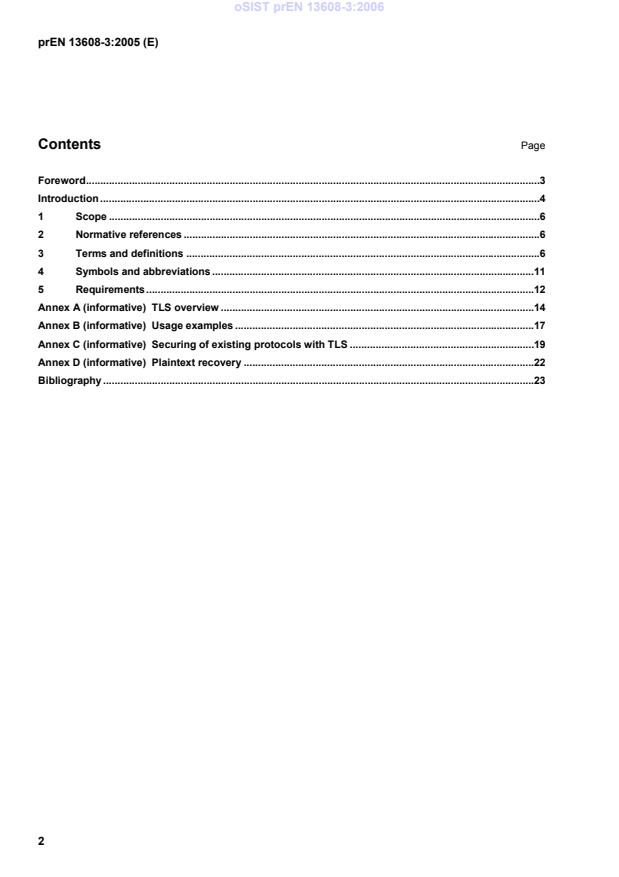
Contents Page
Foreword.3
Introduction .4
1 Scope .6
2 Normative references .6
3 Terms and definitions .6
4 Symbols and abbreviations .11
5 Requirements.12
Annex A (informative) TLS overview .14
Annex B (informative) Usage examples .17
Annex C (informative) Securing of existing protocols with TLS .19
Annex D (informative) Plaintext recovery .22
Bibliography .23
Foreword
This document (prEN 13608-3:2005) has been prepared by Technical Committee CEN/TC 251 “Health
informatics”, the secretariat of which is held by NEN.
This document is currently submitted to the CEN Enquiry.
This document will supersede ENV 13608-3:2000.
EN 13608 consists of the following parts, under the general title Health informatics — Security for Healthcare
Communication:
Part 1: Concepts and Terminology
Part 2: Secure Data Objects
Part 3: Secure Data Channels
This standard is designed to meet the demands of the Technical Report CEN/TC251/N98-110 Health
Informatics — Framework for security protection of health care communication.
This standard is drafted using the conventions of the ISO/IEC Directive Part 3.
All annexes are informative.
Introduction
The use of data processing and telecommunications in health care must be accompanied by appropriate
security measures to ensure data confidentiality and integrity in compliance with the legal framework,
protecting patients as well as professional accountability and organizational assets. In addition, availability
aspects are important to consider in many systems.
In that sense, the multipart standard prEN 13608 has the intention of explaining and detailing to the healthcare
end user the different alternatives they have to cope with in terms of security measures that might be
implemented to fulfil their security needs and obligations. Incorporated within this is the standardization of
some elements related to the information communication process where they fall within the security domain.
In the continuity of the Framework for security protection of health care communication (CEN/TC251/N98-110),
hereafter denoted the Framework, whose CEN Report aimed at promoting a better understanding of the
security issues in relations to the healthcare IT-communication, this European standard shall aid in producing
systems to enable health professionals and applications to communicate and interact securely and therefore
safely, legitimately, lawfully and precisely.
The multipart standard prEN 13068 is key communication security standard that can be generically applied to
a wide range of communication protocols and information system applications relevant to healthcare, though
they are neither complete nor exhaustive in that respect. This standard must be defined within the context and
scenarios defined by the TC251 work programme, in which the messaging paradigm for information system
interaction is one of the essentials, as it was reflected by the Framework (Framework for security -protection
of health care communication.)
Secure Data Channel
This part 3 of the European standard on Security for Healthcare Communication describes how to securely
communicate arbitrary octet streams by means of a secure data channel communication protocol.
NOTE This standard does not specify methods related to availability, storage or transportation of key certificates or
other infra-structural issues, nor does it cover application security aspects such as user authentication.
A secure data channel is defined for the purposes of this standard as a reliable communication protocol that
implements the following security services:
1) authentication of communicating entities prior to the communication of any other data preservation of
data integrity;
2) preservation of confidentiality of the communicated data.
A secure data channel protocol operates in two distinct phases which, however, may be repeated:
1) negotiation phase: authentication of communicating entities (e.g. exchange of certificates),
negotiation of the cipher suite to be used, derivation of a shared secret using a key exchange
algorithm;
2) communication phase: transmission of user data encrypted according to the negotiated cipher suite.
In addition the secure data channel can be closed by either party when it is no longer required.
The concept of a secure data channel can be best understood by looking at it’s properties, especially in
comparison with the properties of a secure data object (prENV 13608-2).
1) Interactivity: the negotiation phase allows the communicating entities to interactively agree upon a
cipher suite that meets both parties’ security policies for the communication scenario in question (e.g.
national vs. international communication). If the cipher suite negotiation is unsuccessful, no
communication session is established.
2) Transience: the secure data channel, being part of a layered communication protocol, receives and
delivers unsecured user data from and back to the calling layer. The encrypted representation of the
data is transient (e.g. available only during transmission) and unavailable to the calling layer (e.g.
application).
3) Performance: after the establishment of the cipher suite and shared secret during the negotiation
phase, there is no need to use the computationally resource intensive asymmetric cryptographic
algorithms during the communication phase. On the other hand, because of the transience of the
encrypted representation of the data, encryption must be performed during the communication
process and cannot be pre-computed off-line.
4) Forward secrecy: can be easily implemented as part of the key exchange protocol.
5) Completeness: since the authentication of the communicating entities (e.g. certificate exchange) is
part of the protocol, no additional out-of-band communication (e.g. look-up of certificates in a trusted
directory) is required to use the secure data channel, except if certificate revocation lists are used.
6) Transparency: a secure data channel can be implemented such that it’s upper service access point
resembles it’s lower service access point (e.g. TCP/IP socket interface). This allows the easy
addition of security services to existing non-security-aware systems and protocols by integrating the
secure data channel as an additional layer in the communication protocol stack. A well-known
example for this approach is ”Secure HTTP” (HTTP over SSL3).
The IETF Transport Layer Security (TLS) specification is a description of how to provide a secure data
channel. Although TLS is an IETF specification, it is not limited to TCP/IP. TLS only requires the presence of a
reliable transmission protocol. This means that ”TLS over OSI” would be possible if desired. This European
standard defines a set of profiles used within TLS for use within healthcare communication over secure data
channels.
1 Scope
This European standard specifies services and methods for securing interactive communications used within
healthcare.
Interactive communications are defined for the purposes of this standard as scenarios where both systems
are online and in bi-directional communication simultaneously. Securing in this European standard includes
the preservation of data integrity, the preservation of confidentiality with respect to the data being
communicated, and accountability in terms of authentication of one or both communicating parties.
NOTE Examples of interactive communication are the download of HTML content over the Internet, a DICOM
communication, or remote login to a computer.
This European standard does not specify methods related to availability of the interactive communication,
certification and certificate management and key management. Neither does this European standard specify a
mechanism for concealing that a communication session is in progress. This European standard does not
specify the methods or services required to secure the communicating systems themselves.
2 Normative references
The following referenced documents are indispensable for the application of this document. For dated
references, only the edition cited applies. For undated references, the latest edition of the referenced
document (including any amendments) applies.
ISO 7498-2, Information processing systems — Open Systems Interconnection — Basis reference mode —
Part 2: Security architecture.
ISO 8824, Information technology — Open Systems Interconnection — Specification of Abstract Syntax
Notation One (ASN.1) (Version 2 1991-04-24).
ISO 9594-8, Information technology — Open Systems Interconnection — The Directory: Authentication
framework.
ISO 10181-1, Information technology — Open Systems Interconnection — Security frameworks for open
systems: Overview.
RFC 2246, Internet Engineering Task Force: The TLS (Transport Layer Security) Protocol, RFC 2246.
3 Terms and definitions
For the purposes of this document, the following terms and definitions apply.
3.1
accountability
the property that ensures that the actions of an entity may be traced uniquely to the entity
[ISO 7498-2]
3.2
asymmetric cryptographic algorithm
an algorithm for performing encipherment or the corresponding decipherment in which the keys used for
encipherment and decipherment differ
[ISO 10181-1]
3.3
authentication
process of reliably identifying security subjects by securely associating an identifier and its authenticator
See also data origin authentication and peer entity authentication
[ISO 7498-2].
3.4
availability
property of being accessible and useable upon demand by an authorised entity
[ISO 7498-2]
3.5
certificate revocation
act of removing any reliable link between a certificate and its related owner (or security subject owner),
because the certificate is not trusted any more whereas it is unexpired
3.6
certificate holder
an entity that is named as the subject of a valid certificate
3.7
certificate user
an entity that needs to know, with certainty, the public key of another entity
[ISO 9594-8]
3.8
certificate verification
verifying that a certificate is authentic
3.9
certification
use of digital signature to make transferable statement about beliefs of identity, or statements about
delegation of authority
3.10
certification authority
an authority trusted by one or more users to create and assign certificates. Optionally the certification authority
may create the users' keys
[ISO 9594-8]
3.11
ciphertext
data produced through the use of encipherment. The semantic content of the resulting data is not available
[ISO 7498-2]
3.12
ciphersuite
an encoding for the set of bulk data cipher, message digest function, digital signature algorithm and key
exchange algorithm used within the negotiation phase of TLS
3.13
communication protection profile
CPP
a statement of systematic translation form communication security needs to technological concepts
3.14
communication security
security of security objects communicated between security subjects
3.15
confidentiality
the property that information is not made available or disclosed to unauthorised individuals, entities, or
processes
[ISO 7498-2]
3.16
cryptography
the discipline which embodies principles, means, and methods for the transformation of data in order to hide
its information content, prevent its undetected modification and/or prevent its unauthorised use
[ISO 7498-2]
3.17
cryptographic algorithm
cipher
an algorithm used to transform data to hide its information content which is used in the process of encryption
(see 3.22)
3.18
data integrity
the property that data has not been altered or destroyed in an unauthorised manner
[ISO 7498-2]
3.19
data origin authentication
the corroboration that the source of data received is as claimed
[ISO 7498-2]
3.20
decryption
decipherment
process of making encrypted data reappear in its original unencrypted form. The reversal of a corresponding
reversible encipherment
3.21
digital signature
data appended to, or a cryptographic transformation (see cryptography) of a data unit that allows a recipient of
the data unit to prove the source and integrity of the data unit and protect against forgery e.g. by the recipient
[ISO 7498-2]
3.22
encryption
encipherment
the cryptographic transformation of data (see cryptography) to produce ciphertext
[ISO 7498-2]
3.23
forward secrecy
technique of ensuring that the communicated data is only decipherable for a limited time span by the
communicating parties
NOTE After that time the communicating parties typically achieve forward secrecy by destroying cryptographic keys.
This prevents an attacker from coercing the communicating parties into decrypting old ciphertext.
3.24
hash function
a (mathematical) function that maps values from a (possibly very) large set of values into a smaller range of
values
[ISO 10181-1]
3.25
integrity
the property of being unmodified by any kind of unauthorised security subject
3.26
key
a sequence of symbols that controls the operations of encipherment and decipherment
[ISO 7498-2]
3.27
key distribution
process of publishing, or transferring to other security subjects a cryptographic key
3.28
key exchange algorithm
an algorithm used to derive a shared secret over an open communications channel
3.29
key generation
process of creating a cryptographic key
3.30
key management
the generation, storage, distribution, deletion, archiving and application of keys in accordance with a security
policy
[ISO 7498-2]
3.31
message recovery
process of a third party decrypting an encrypted message
3.32
one-way function
a (mathematical) function that is easy to compute but, when knowing a result, it is computationally infeasible
to find any of the values that may have been supplied to obtain it
[ISO 10181-1]
3.33
one-way hash function
a (mathematical) function that is both a one-way function and a hash function
[ISO 10181-1]
3.34
peer entity authentication
the corroboration that a peer entity in an association is the one claimed
[ISO 7498-2]
3.35
plaintext
intelligible data, the semantic content of which is available
3.36
private key
a key that is used with an asymmetric cryptographic algorithm and whose possession is restricted (usually to
only one entity)
[ISO 10181-1]
3.37
public key
a key that is used with an asymmetric cryptographic algorithm and that can be made publicly available
[ISO 10181-1]
3.38
secret key
key which is kept secure and only disclosed to parties intended to have access to data protected by it
3.39
security
the combination of availability, confidentiality, integrity and accountability
NOTE From an end-user perspective this encompasses auditability thereby constituting a guarantee that data items
and, more generally any kind of security object, has not been altered, modified, disclosed, or with held by any kind of
security subject in an unauthorized manner with respect to the security policy.
3.40
security object
object
a passive entity that contains or receives information [ITSEC]
NOTE Access to an object potentially implies access to the information it contains.
EXAMPLE Typical objects in the healthcare domain are: medical records, or files containing medical data.
3.41
security policy
the set of laws, rules, and practices that regulate how an organisation manages, protects, and distributes
sensitive information [TCSEC]
3.42
security protocol
a formal detailed specification describing the implementation of a set of security functions
3.43
security procedure
a specification for a protocol designed to implement a security policy
3.44
security service
a service, provided by a layer of communicating open systems, which ensures adequate security of the
systems or of data transfers
[ISO 7498-2]
3.45
security subject
subject
an active entity, generally in the form of a person, process or device that causes information to flow among
objects or changes the system state. Technically, a process/domain pair [TCSEC]
NOTE According to the Object-Oriented paradigm, a subject is usually called a principal.
3.46
user certificate
public key certificate
certificate
the public keys of a user, together with some other information, rendered unforgeable by encipherment with
the private key of the certification authority which issued it
[ISO 9594-8]
Note such kinds of certificates might be dedicated, on the basis of public key certification techniques, to
attributes (i.e., attribute certificate), or digital signatures (i.e., signature certificate).
4 Symbols and abbreviations
3DES Triple DES
CORBA Common Object Request Broker Architecture
DES Data Encryption Standard
DICOM Digital Imaging and Communications in Medicine
HTML HyperText Markup Language
HTTP HyperText Transfer Protocol
IETF Internet Engineering Task Force
IIOP Internet Inter-ORB Protocol
MIME Multimedia Internet Message Extensions
ORB Object Request Broker
PKCS#7 Public Key Cryptography Standard #7
RFC Request For Comment
RSA Rivest-Shamir-Adleman
SDC Secure Data Channel
SMTP Simple Mail Transfer Protocol
SSL3 Secure Sockets Layer, version 3
TLS Transport Layer Security
UML Unified Modelling Language
5 Requirements
5.1 Transport layer protocol
Systems complying with this European standard shall implement communication of healthcare data in
accordance with the IETF Transport Layer Security specification RFC 2246.
5.2 Mandatory cipher suites
Systems complying with this European standard shall support the following cipher suites within the TLS
protocol to provide the cryptographic services defined in RFC 2246:
TLS-DH-RSA-WITH-3DES-EDE-CBC-SHA1
TLS-RSA-WITH-3DES-EDE-CBC-SHA1
NOTE 1 These cipher suites do not provide forward secrecy
NOTE 2 Full definitions of the above cipher suites are to be found in RFC 2246
5.3 Optional cipher suite for forward secrecy
Systems complying with this European standard may additionally support the following cipher suite within the
TLS protocol to provide the cryptographic services defined in RFC 2246:
TLS-DHE-RSA-WITH-3DES-EDE-CBC-SHA1
Systems which choose to support this cipher suite shall negotiate it with preference to the cipher suites
defined in clause 5.2.
NOTE 1 This cipher suite provides forward secrecy. See 3.23 forward secrecy
NOTE 2 Forward Secrecy makes it harder for attackers to compromise confidential information in transit in encrypted
form, and so is more secure than the use of non-forward secret cipher suites.
NOTE 3 Some National legislations prohibit the use of forward secrecy in terms of non recoverable encryption.
5.4 Avoidance of encipherment susceptible to brute force attacks
Systems complying with this European standard shall not negotiate cipher suites providing less than 80 bits of
symmetric effective key space. They shall also not support key exchange algorithms providing less than
768 bits of RSA or DH key asymmetric strength.
NOTE It is understood that the key lengths required to prevent brute force attacks increases over time. The
requirements laid out in this clause reflect the state of the art at the time of writing this document and the effective key
lengths offered by the TLS cipher suites as specified in RFC 2246.
5.5 Other cipher suites
Systems complying with this European standar
...