

SIST HD 60364-8-82:2025
(Main)Low-voltage electrical installations - Part 8-82: Functional aspects - Prosumer's low-voltage electrical installations (IEC 60364-8-82:2022)
General Information
- Abstract
IEC 60364-8-82:2022 provides requirements and recommendations that apply to low-voltage electrical installations connected or not to a distribution network able to operate:
– with local power supplies, and/or
– with local storage units,
and that monitors and controls the energy from the locally connected sources delivering it to:
– current-using equipment, and/or
– local storage units, and/or
– distribution networks.
Such electrical installations are designated as prosumer's electrical installations (PEIs).
These requirements and recommendations apply to new installations and modifications of existing installations.
This document also provides requirements and recommendations for the safe, efficient and correct behaviour of these installations when integrated into a smart grid.
Information related to grid interaction to ensure the stability of the electrical system for grid connected PEIs is given in Annex B.
This document covers the requirements related to stability of islanded and stand-alone PEIs.
This first edition cancels and replaces IEC 60364-8-2 published in 2018. This edition constitutes a technical revision.
This edition includes the following significant technical changes with respect to IEC 6036482:2018:
a) the vocabulary and concepts have been aligned as much as possible with those used by TC 8 and SC 8B, taking notably into account the IEC 62898 and IEC 62786 series, still respecting the installers mindset (installers being the first users of the IEC 60364 series and being used to only refer to the IEC 60364 series);
b) the type of system earthing and the change of type of system earthing (sequencing) when there is a change of mode of the prosuming installation, have been clarified;
c) the conditions of connection and disconnection from the DSO network have also been described, both from the safety point of view and the proper functioning point of view;
d) additional requirements have been introduced;
e) the figures have been updated;
f) a new normative Annex D on single dwelling or similar application islandable PEIs has been added;
g) the numbering has also been reviewed to follow the updated numbering system of the IEC 60364 series, in line with the IEC Directives and compatible with Parts 7.
- Status
- Published
- Publication Date
- 21-Jul-2025
- Technical Committee
- ELI - Electrical and communication installations
- Current Stage
- 6060 - National Implementation/Publication (Adopted Project)
- Start Date
- 18-Jul-2025
- Due Date
- 22-Sep-2025
- Completion Date
- 22-Jul-2025

Overview
HD 60364-8-82:2025 (adopting IEC 60364-8-82:2022) defines functional requirements and recommendations for prosumer's low-voltage electrical installations (PEIs) - installations that combine local power supplies (generation), local storage and monitoring/control and that deliver energy to local loads, storage units and/or the distribution network. The document applies to new installations and modifications, covers grid-connected and islanded operation, and addresses safe, efficient behaviour when PEIs are integrated into a smart grid. This edition is a technical revision that updates vocabulary, earthing rules, connection/disconnection conditions with DSOs, protection requirements and architecture guidance.
Key topics and requirements
- PEI concept and types: Definitions and operating modes (direct feeding, island, reverse feeding) and interaction with distribution networks.
- Control & monitoring architecture: Functional architecture for local energy management, telecontrol and grid interaction.
- System earthing and sequencing: Clarified requirements for type of system earthing and for changes of earthing when operating mode changes (connected ⇄ island).
- Connection/disconnection with DSO: Conditions and procedures for safe and reliable disconnection and reconnection to the distribution system.
- Protection requirements: Protection against electric shock, thermal effects, overcurrent and transient overvoltages, including selectivity considerations across multiple power sources.
- Isolation and switching: Requirements for isolation, emergency switching-off and system-referencing conductor switching devices.
- Load and source management: Rules for energy storage, design for demand-response flexibility, and provisions for electric vehicle integration.
- Stability and grid interaction: Guidance on maintaining stability for islanded and stand-alone PEIs and informative Annex B on grid interaction (active/reactive control, frequency/voltage control, load shedding).
- Normative Annex D: Specific requirements for single dwelling or similar islandable PEIs (earthing, labelling, verification, fire switching-off).
Practical applications
- Residential and small commercial properties with rooftop PV, battery storage and EV chargers.
- Microgrids, community/shared generation projects and collective PEIs.
- Retrofit/upgrades converting conventional installations into islandable or grid-interactive prosumer installations.
- Integration of local storage and demand-response schemes for grid support and energy optimisation.
Who uses this standard
- Electrical installers and designers responsible for low-voltage installations.
- System integrators and manufacturers of inverters, storage systems and energy management systems.
- Distribution System Operators (DSOs), safety inspectors and regulators evaluating connection conditions and grid interaction.
- Architects, builders and facility managers planning prosumer-enabled buildings.
Related standards
- IEC/HD 60364 series (general LV installation rules)
- IEC 62898, IEC 62786 (relevant prosumer/grid-interaction vocab and device series)
- Standards for switchgear, RCDs and inverter/charger interfaces (referenced in the normative bibliography)
Keywords: low-voltage electrical installations, prosumer, PEI, IEC 60364-8-82, smart grid, islanding, earthing, energy storage, DSO interaction.
Relations
- Effective Date
- 01-Sep-2025
- Effective Date
- 01-Sep-2025
- Effective Date
- 01-Sep-2025
- Effective Date
- 03-Feb-2026
- Effective Date
- 03-Feb-2026
- Effective Date
- 03-Feb-2026
- Effective Date
- 03-Feb-2026
- Effective Date
- 03-Feb-2026
- Effective Date
- 03-Feb-2026
- Effective Date
- 03-Feb-2026
- Effective Date
- 03-Feb-2026
- Effective Date
- 03-Feb-2026
- Effective Date
- 03-Feb-2026
- Effective Date
- 03-Feb-2026
- Effective Date
- 03-Feb-2026
Get Certified
Connect with accredited certification bodies for this standard

DIBt (Deutsches Institut für Bautechnik)
German Institute for Building Technology.
DIN CERTCO
DIN Group product certification.

Aboma Certification B.V.
Specialized in construction, metal, and transport sectors.
Sponsored listings
Frequently Asked Questions
SIST HD 60364-8-82:2025 is a standardization document published by the Slovenian Institute for Standardization (SIST). Its full title is "Low-voltage electrical installations - Part 8-82: Functional aspects - Prosumer's low-voltage electrical installations (IEC 60364-8-82:2022)". This standard covers: IEC 60364-8-82:2022 provides requirements and recommendations that apply to low-voltage electrical installations connected or not to a distribution network able to operate: – with local power supplies, and/or – with local storage units, and that monitors and controls the energy from the locally connected sources delivering it to: – current-using equipment, and/or – local storage units, and/or – distribution networks. Such electrical installations are designated as prosumer's electrical installations (PEIs). These requirements and recommendations apply to new installations and modifications of existing installations. This document also provides requirements and recommendations for the safe, efficient and correct behaviour of these installations when integrated into a smart grid. Information related to grid interaction to ensure the stability of the electrical system for grid connected PEIs is given in Annex B. This document covers the requirements related to stability of islanded and stand-alone PEIs. This first edition cancels and replaces IEC 60364-8-2 published in 2018. This edition constitutes a technical revision. This edition includes the following significant technical changes with respect to IEC 6036482:2018: a) the vocabulary and concepts have been aligned as much as possible with those used by TC 8 and SC 8B, taking notably into account the IEC 62898 and IEC 62786 series, still respecting the installers mindset (installers being the first users of the IEC 60364 series and being used to only refer to the IEC 60364 series); b) the type of system earthing and the change of type of system earthing (sequencing) when there is a change of mode of the prosuming installation, have been clarified; c) the conditions of connection and disconnection from the DSO network have also been described, both from the safety point of view and the proper functioning point of view; d) additional requirements have been introduced; e) the figures have been updated; f) a new normative Annex D on single dwelling or similar application islandable PEIs has been added; g) the numbering has also been reviewed to follow the updated numbering system of the IEC 60364 series, in line with the IEC Directives and compatible with Parts 7.
IEC 60364-8-82:2022 provides requirements and recommendations that apply to low-voltage electrical installations connected or not to a distribution network able to operate: – with local power supplies, and/or – with local storage units, and that monitors and controls the energy from the locally connected sources delivering it to: – current-using equipment, and/or – local storage units, and/or – distribution networks. Such electrical installations are designated as prosumer's electrical installations (PEIs). These requirements and recommendations apply to new installations and modifications of existing installations. This document also provides requirements and recommendations for the safe, efficient and correct behaviour of these installations when integrated into a smart grid. Information related to grid interaction to ensure the stability of the electrical system for grid connected PEIs is given in Annex B. This document covers the requirements related to stability of islanded and stand-alone PEIs. This first edition cancels and replaces IEC 60364-8-2 published in 2018. This edition constitutes a technical revision. This edition includes the following significant technical changes with respect to IEC 6036482:2018: a) the vocabulary and concepts have been aligned as much as possible with those used by TC 8 and SC 8B, taking notably into account the IEC 62898 and IEC 62786 series, still respecting the installers mindset (installers being the first users of the IEC 60364 series and being used to only refer to the IEC 60364 series); b) the type of system earthing and the change of type of system earthing (sequencing) when there is a change of mode of the prosuming installation, have been clarified; c) the conditions of connection and disconnection from the DSO network have also been described, both from the safety point of view and the proper functioning point of view; d) additional requirements have been introduced; e) the figures have been updated; f) a new normative Annex D on single dwelling or similar application islandable PEIs has been added; g) the numbering has also been reviewed to follow the updated numbering system of the IEC 60364 series, in line with the IEC Directives and compatible with Parts 7.
SIST HD 60364-8-82:2025 is classified under the following ICS (International Classification for Standards) categories: 91.140.50 - Electricity supply systems. The ICS classification helps identify the subject area and facilitates finding related standards.
SIST HD 60364-8-82:2025 has the following relationships with other standards: It is inter standard links to SIST HD 60364-8-2:2019, SIST HD 60364-8-2:2019/A12:2021, SIST HD 60364-8-2:2019/A11:2019, SIST HD 60364-5-557:2014, SIST HD 60364-1:2008, SIST EN IEC 61557-12:2022, SIST HD 60364-6:2016, SIST HD 60364-5-559:2012, SIST HD 60364-4-41:2017, SIST EN 62423:2013, SIST HD 60364-7-722:2019, SIST HD 60364-1:2008/A11:2017, SIST HD 60364-5-54:2011, SIST HD 60364-5-51:2009, SIST EN 60947-2:2017/A1:2020. Understanding these relationships helps ensure you are using the most current and applicable version of the standard.
SIST HD 60364-8-82:2025 is available in PDF format for immediate download after purchase. The document can be added to your cart and obtained through the secure checkout process. Digital delivery ensures instant access to the complete standard document.
Standards Content (Sample)
SLOVENSKI STANDARD
01-september-2025
Nadomešča:
SIST HD 60364-8-2:2019
SIST HD 60364-8-2:2019/A11:2019
SIST HD 60364-8-2:2019/A12:2021
Nizkonapetostne električne inštalacije - 8-82. del: Funkcionalni vidiki -
Nizkonapetostne električne inštalacije proizvajalca-odjemalca (IEC 60364-8-
82:2022)
Low-voltage electrical installations - Part 8-82: Functional aspects - Prosumer's low-
voltage electrical installations (IEC 60364-8-82:2022)
Errichten von Niederspannungsanlagen - Teil 8-82: Funktionale Aspekte - Kombinierte
Erzeugungs-/Verbrauchsanlagen (IEC 60364-8-82:2022)
Installations électriques à basse tension - Partie 8-82: Aspects fonctionnels - Installations
électriques à basse tension du prosommateur (IEC 60364-8-82:2022)
Ta slovenski standard je istoveten z: HD 60364-8-82:2025
ICS:
91.140.50 Sistemi za oskrbo z elektriko Electricity supply systems
2003-01.Slovenski inštitut za standardizacijo. Razmnoževanje celote ali delov tega standarda ni dovoljeno.
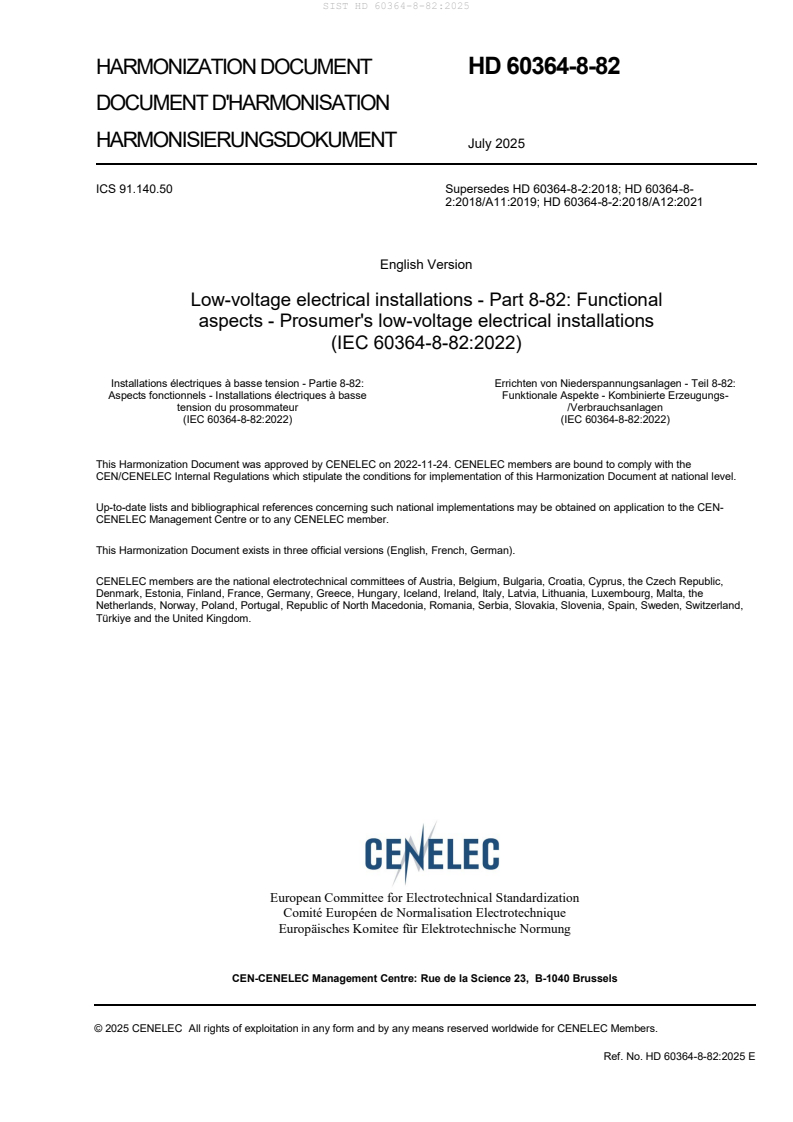
HARMONIZATION DOCUMENT HD 60364-8-82
DOCUMENT D'HARMONISATION
HARMONISIERUNGSDOKUMENT July 2025
ICS 91.140.50 Supersedes HD 60364-8-2:2018; HD 60364-8-
2:2018/A11:2019; HD 60364-8-2:2018/A12:2021
English Version
Low-voltage electrical installations - Part 8-82: Functional
aspects - Prosumer's low-voltage electrical installations
(IEC 60364-8-82:2022)
Installations électriques à basse tension - Partie 8-82: Errichten von Niederspannungsanlagen - Teil 8-82:
Aspects fonctionnels - Installations électriques à basse Funktionale Aspekte - Kombinierte Erzeugungs-
tension du prosommateur /Verbrauchsanlagen
(IEC 60364-8-82:2022) (IEC 60364-8-82:2022)
This Harmonization Document was approved by CENELEC on 2022-11-24. CENELEC members are bound to comply with the
CEN/CENELEC Internal Regulations which stipulate the conditions for implementation of this Harmonization Document at national level.
Up-to-date lists and bibliographical references concerning such national implementations may be obtained on application to the CEN-
CENELEC Management Centre or to any CENELEC member.
This Harmonization Document exists in three official versions (English, French, German).
CENELEC members are the national electrotechnical committees of Austria, Belgium, Bulgaria, Croatia, Cyprus, the Czech Republic,
Denmark, Estonia, Finland, France, Germany, Greece, Hungary, Iceland, Ireland, Italy, Latvia, Lithuania, Luxembourg, Malta, the
Netherlands, Norway, Poland, Portugal, Republic of North Macedonia, Romania, Serbia, Slovakia, Slovenia, Spain, Sweden, Switzerland,
Türkiye and the United Kingdom.
European Committee for Electrotechnical Standardization
Comité Européen de Normalisation Electrotechnique
Europäisches Komitee für Elektrotechnische Normung
CEN-CENELEC Management Centre: Rue de la Science 23, B-1040 Brussels
© 2025 CENELEC All rights of exploitation in any form and by any means reserved worldwide for CENELEC Members.
Ref. No. HD 60364-8-82:2025 E
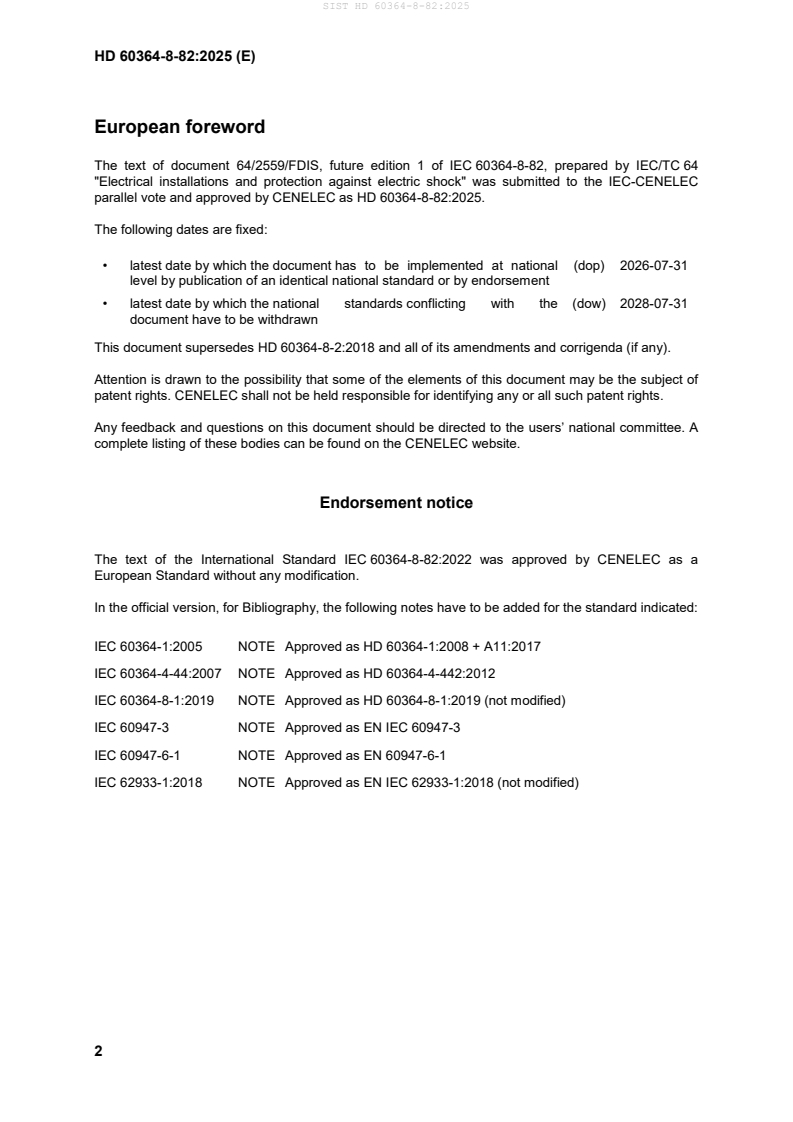
European foreword
The text of document 64/2559/FDIS, future edition 1 of IEC 60364-8-82, prepared by IEC/TC 64
"Electrical installations and protection against electric shock" was submitted to the IEC-CENELEC
parallel vote and approved by CENELEC as HD 60364-8-82:2025.
The following dates are fixed:
• latest date by which the document has to be implemented at national (dop) 2026-07-31
level by publication of an identical national standard or by endorsement
• latest date by which the national standards conflicting with the (dow) 2028-07-31
document have to be withdrawn
This document supersedes HD 60364-8-2:2018 and all of its amendments and corrigenda (if any).
Attention is drawn to the possibility that some of the elements of this document may be the subject of
patent rights. CENELEC shall not be held responsible for identifying any or all such patent rights.
Any feedback and questions on this document should be directed to the users’ national committee. A
complete listing of these bodies can be found on the CENELEC website.
Endorsement notice
The text of the International Standard IEC 60364-8-82:2022 was approved by CENELEC as a
European Standard without any modification.
In the official version, for Bibliography, the following notes have to be added for the standard indicated:
IEC 60364-1:2005 NOTE Approved as HD 60364-1:2008 + A11:2017
IEC 60364-4-44:2007 NOTE Approved as HD 60364-4-442:2012
IEC 60364-8-1:2019 NOTE Approved as HD 60364-8-1:2019 (not modified)
IEC 60947-3 NOTE Approved as EN IEC 60947-3
IEC 60947-6-1 NOTE Approved as EN 60947-6-1
IEC 62933-1:2018 NOTE Approved as EN IEC 62933-1:2018 (not modified)
IEC 60364-8-82 ®
Edition 1.0 2022-10
INTERNATIONAL
STANDARD
NORME
INTERNATIONALE
colour
inside
Low-voltage electrical installations –
Part 8-82: Functional aspects – Prosumer’s low-voltage electrical installations
Installations électriques à basse tension –
Partie 8-82: Aspects fonctionnels – Installations électriques à basse tension du
prosommateur
INTERNATIONAL
ELECTROTECHNICAL
COMMISSION
COMMISSION
ELECTROTECHNIQUE
INTERNATIONALE
ICS 91.140.50 ISBN 978-2-8322-3942-1
– 2 – IEC 60364-8-82:2022 © IEC 2022
CONTENTS
FOREWORD . 5
INTRODUCTION . 7
82.1 Scope . 8
82.2 Normative references . 8
82.3 Terms and definitions . 9
82.4 Integration of PEI in its environment . 12
82.4.1 Main objectives. 12
82.4.2 Safety . 12
82.4.3 Proper functioning . 12
82.5 PEI concept . 13
82.6 Types of PEI . 16
82.6.1 General . 16
82.6.2 Operating modes . 16
82.6.3 Interaction with the distribution network . 17
82.7 Control and monitoring . 24
82.7.1 General . 24
82.7.2 Architecture of control and monitoring system . 25
82.8 Protection of prosumer electrical installation . 25
82.8.1 General . 25
82.8.2 Protection against electric shock . 25
82.8.3 Protection against thermal effect . 41
82.8.4 Protection against overcurrent . 41
82.8.5 Protection against transient overvoltages . 45
82.9 Isolation and switching . 46
82.9.1 Isolation . 46
82.9.2 Emergency switching-off . 46
82.10 Load and source management . 46
82.10.1 Energy storage . 46
82.10.2 Design for flexibility of load and generators (demand/response) . 46
82.10.3 Electric vehicle . 46
Annex A (informative) Operating modes of PEI . 47
A.1 Direct feeding mode . 47
A.2 Island mode . 47
A.3 Reverse feeding mode . 48
Annex B (informative) Interaction with the supply system . 50
B.1 General . 50
B.2 Active power and frequency control . 50
B.3 Reactive power and voltage control . 50
B.4 Load shedding programme . 50
Annex C (informative) Architectures of PEI . 51
C.1 General . 51
C.2 Architecture of individual PEI . 51
C.3 Architecture of collective PEI . 52
C.4 Architecture of shared PEI . 57
Annex D (normative) Single dwelling or similar application islandable PEI . 61
IEC 60364-8-82:2022 © IEC 2022 – 3 –
D.1 General . 61
D.2 Type of system earthing . 61
D.3 Connection of the local source . 64
D.4 Fire switching-off . 64
D.5 Switching device for islanding and system referencing conductor switching
device . 64
D.6 Labelling. 64
D.7 Upgrading an existing single dwelling installation in islandable PEI . 65
D.8 Initial verification . 68
Annex E (informative) List of notes concerning certain countries . 69
Bibliography . 70
Figure 1 – Example of prosumer's low-voltage electrical installation with AC electrical
distribution within the PEI . 14
Figure 2 – Example of prosumer's low-voltage electrical installation with AC and DC
electrical distribution within the PEI . 15
Figure 3 – Example of grid connected PEI architecture . 18
Figure 4 – Example of islandable PEI architecture . 19
Figure 5 – Example of architecture of PEI connected to LV DSO operating in TN-C-S in
connected mode and becoming TN-S in island mode . 28
Figure 6 – Example of architecture of PEI connected to LV DSO operating in TNC-S in
connected mode and in island mode . 29
Figure 7 – Example of architecture of PEI connected to LV DSO with disconnection of
the neutral, operating in TT in connected mode and becoming TN in island mode . 30
Figure 8 – Example of PEI installation with neutral earthing on the HV/LV transformer
side: TT in connected mode, TN in island mode (as one unique earthing arrangement
in the installation) . 32
Figure 9 – Example of PEI installation in TN-S with neutral permanently earthed on
PEI side . 34
Figure 10 – Example of PEI installation in TN-S with neutral permanently earthed on
PEI side with RCD on the system referencing conductor . 37
Figure 11 – Example of PEI in IT system in island mode . 39
Figure 12 – Example of PEI in IT system in island mode with automatic disconnection
of supply . 40
Figure 13 – Example of double short-circuit protection for the same circuit . 43
Figure 14 – Example of selectivity with various power supplies . 44
Figure 15 – Potential selectivity issue with overcurrent protections . 45
Figure A.1 – Example of electrical design of PEI operating in direct feeding mode . 47
Figure A.2 – Example of electrical design of PEI operating in island mode . 48
Figure A.3 – Example of electrical design of individual PEI operating in reverse
feeding mode . 49
Figure C.1 – Example of electrical design of individual PEI . 51
Figure C.2 – Example of type of architecture of individual PEI . 52
Figure C.3 – Example of electrical design of collective PEI using DSO distribution
system . 53
Figure C.4 – Example of electrical design of collective PEI using a distribution system
within PEI . 54
Figure C.5 – Example of electrical design of collective PEI with distribution system
within PEI in parallel with DSO distribution system. 55
– 4 – IEC 60364-8-82:2022 © IEC 2022
Figure C.6 – Example of type of architecture for collective PEI . 56
Figure C.7 – Example of electrical design of shared PEI using DSO distribution system . 57
Figure C.8 – Example of electrical design of shared PEI with distribution system
within PEI . 58
Figure C.9 – Example of electrical design of shared PEI with distribution system within
PEI in parallel with DSO distribution system. 59
Figure C.10 – Example of type of architecture for shared PEI . 60
Figure D.1 – Example of single dwelling islandable PEI architecture in TN in connected
mode and in island mode (with disconnection of the neutral – TN-S) . 62
Figure D.2 – Example of single dwelling islandable PEI architecture in TT in connected
mode becoming TN in island mode . 63
Figure D.3 – Example of label . 65
Figure D.4 – Example of single dwelling electrical installation before being upgraded to
islandable PEI. 66
Figure D.5 – Example of single dwelling electrical installation upgraded to
islandable PEI. 67
Table 1 – Combinations of possible types of system earthing in connected mode and
island mode for PEIs and associated requirements for system referencing conductor
switching device . 27
IEC 60364-8-82:2022 © IEC 2022 – 5 –
INTERNATIONAL ELECTROTECHNICAL COMMISSION
____________
LOW-VOLTAGE ELECTRICAL INSTALLATIONS –
Part 8-82: Functional aspects –
Prosumer’s low-voltage electrical installations
FOREWORD
1) The International Electrotechnical Commission (IEC) is a worldwide organization for standardization comprising
all national electrotechnical committees (IEC National Committees). The object of IEC is to promote international
co-operation on all questions concerning standardization in the electrical and electronic fields. To this end and
in addition to other activities, IEC publishes International Standards, Technical Specifications, Technical Reports,
Publicly Available Specifications (PAS) and Guides (hereafter referred to as “IEC Publication(s)”). Their
preparation is entrusted to technical committees; any IEC National Committee interested in the subject dealt with
may participate in this preparatory work. International, governmental and non-governmental organizations liaising
with the IEC also participate in this preparation. IEC collaborates closely with the International Organization for
Standardization (ISO) in accordance with conditions determined by agreement between the two organizations.
2) The formal decisions or agreements of IEC on technical matters express, as nearly as possible, an international
consensus of opinion on the relevant subjects since each technical committee has representation from all
interested IEC National Committees.
3) IEC Publications have the form of recommendations for international use and are accepted by IEC National
Committees in that sense. While all reasonable efforts are made to ensure that the technical content of IEC
Publications is accurate, IEC cannot be held responsible for the way in which they are used or for any
misinterpretation by any end user.
4) In order to promote international uniformity, IEC National Committees undertake to apply IEC Publications
transparently to the maximum extent possible in their national and regional publications. Any divergence between
any IEC Publication and the corresponding national or regional publication shall be clearly indicated in the latter.
5) IEC itself does not provide any attestation of conformity. Independent certification bodies provide conformity
assessment services and, in some areas, access to IEC marks of conformity. IEC is not responsible for any
services carried out by independent certification bodies.
6) All users should ensure that they have the latest edition of this publication.
7) No liability shall attach to IEC or its directors, employees, servants or agents including individual experts and
members of its technical committees and IEC National Committees for any personal injury, property damage or
other damage of any nature whatsoever, whether direct or indirect, or for costs (including legal fees) and
expenses arising out of the publication, use of, or reliance upon, this IEC Publication or any other IEC
Publications.
8) Attention is drawn to the Normative references cited in this publication. Use of the referenced publications is
indispensable for the correct application of this publication.
9) Attention is drawn to the possibility that some of the elements of this IEC Publication may be the subject of patent
rights. IEC shall not be held responsible for identifying any or all such patent rights.
IEC 60364-8-82 has been prepared by IEC technical committee 64: Electrical installations and
protection against electrical shock, IEC technical committee 8: System aspects of electrical
energy supply and its subcommittee 8B: Decentralized electrical energy systems. It is an
International Standard.
This first edition cancels and replaces IEC 60364-8-2 published in 2018. This edition constitutes
a technical revision.
This edition includes the following significant technical changes with respect to
IEC 60364-8-2:2018:
a) the vocabulary and concepts have been aligned as much as possible with those used by
TC 8 and SC 8B, taking notably into account the IEC 62898 series and IEC TS 62786, still
respecting the installers mindset (installers being the first users of the IEC 60364 series and
being used to only refer to the IEC 60364 series);
b) the type of system earthing and the change of type of system earthing (sequencing) when
there is a change of mode of the prosuming installation, have been clarified;
– 6 – IEC 60364-8-82:2022 © IEC 2022
c) the conditions of connection and disconnection from the DSO network have also been
described, both from the safety point of view and the proper functioning point of view;
d) additional requirements have been introduced;
e) the figures have been updated;
f) a new normative Annex D on single dwelling or similar application islandable PEIs has been
added;
g) the numbering has also been reviewed to follow the updated numbering system of the
IEC 60364 series, in line with the IEC Directives and compatible with Parts 7.
The text of this International Standard is based on the following documents:
Draft Report on voting
64/2559/FDIS 64/2562/RVD
Full information on the voting for its approval can be found in the report on voting indicated in
the above table.
The language used for the development of this International Standard is English.
This document was drafted in accordance with ISO/IEC Directives, Part 2, and developed in
accordance with ISO/IEC Directives, Part 1 and ISO/IEC Directives, IEC Supplement, available
at www.iec.ch/members_experts/refdocs. The main document types developed by IEC are
described in greater detail at www.iec.ch/standardsdev/publications.
A list of all parts in the IEC 60364 series, published under the general title Low-voltage electrical
installations, can be found on the IEC website.
The reader's attention is drawn to the fact that Annex E lists all of the "in-some-country" clauses
on differing practices of a less permanent nature relating to the subject of this document.
The committee has decided that the contents of this document will remain unchanged until the
stability date indicated on the IEC website under "http://webstore.iec.ch" in the data related to
the specific document. At this date, the document will be
• reconfirmed,
• withdrawn,
• replaced by a revised edition, or
• amended.
IMPORTANT – The "colour inside" logo on the cover page of this document indicates that it
contains colours which are considered to be useful for the correct understanding of its
contents. Users should therefore print this document using a colour printer.
IEC 60364-8-82:2022 © IEC 2022 – 7 –
INTRODUCTION
Historically, utilities were managing the public transmission and distribution network from the
point of view of having a central production adapted to demand variation, a top-down energy
flow, a production/consumption balance done by integrated utility companies and with rather
passive users.
The following key factors are pushing the distribution network to change:
– the increasing number of electronic devices used daily and the growing needs as well as
future needs (e.g. charging electric vehicles) will result in the structural growing of electricity
consumption;
– the mediated pressure on climate change results in pressure on CO emissions reduction;
– the electricity market is also quickly changing due mainly to its unbundling and deregulation,
and to the greater number of intermittent renewable energy sources (global and local);
– users' expectations are also evolving as a result of an increasing need for better distribution
networks reliability and quality, the search for better economic performance and the
willingness to pro-actively manage their energy;
– technological evolution should also be considered as information and communication
technology (ICT) is affordable and new energy storage solutions are emerging.
All stakeholders directly involved in the electricity generation, transmission, distribution and
consumption have new expectations:
– customers are willing to reduce electrical energy costs in order to meet environment targets
(renewable energy, energy efficiency) but also wish to benefit from the quality of electricity
supply;
– suppliers wish to limit customer churn rate with price and service management;
– producers expect to maximize their yield of assets, to optimize their investments and to take
profit from energy trading;
– the aggregator wants to create conditions suitable for new market emergence;
– the transmission system operator (TSO) aspires to a robust transmission network and to
meet regulation objectives (price and level of services), while the distribution system
operator (DSO) wants to meet regulation objectives (price and level of services), to reduce
costs by productivity (including meter) and to have a flexible network;
– finally, governments and regulators are willing to create a competitive and sustainable
energy market.
The objective of this document is to ensure that the low-voltage electrical installation is
compatible with the current and future ways to deliver safely and functionally the electrical
energy to current-using equipment wherever the electrical energy comes from the DSO or local
generation. This document is not intended to influence all stakeholders of electricity supply on
how the electrical energy should be sold and delivered.
– 8 – IEC 60364-8-82:2022 © IEC 2022
LOW-VOLTAGE ELECTRICAL INSTALLATIONS –
Part 8-82: Functional aspects –
Prosumer’s low-voltage electrical installations
82.1 Scope
This part of IEC 60364 provides requirements and recommendations that apply to low-voltage
electrical installations connected or not to a distribution network able to operate:
– with local power supplies, and/or
– with local storage units,
and that monitors and controls the energy from the locally connected sources delivering it to:
– current-using equipment, and/or
– local storage units, and/or
– distribution networks.
Such electrical installations are designated as prosumer's electrical installations (PEIs).
These requirements and recommendations apply to new installations and modifications of
existing installations.
This document also provides requirements and recommendations for the safe, efficient and
correct behaviour of these installations when integrated into a smart grid.
NOTE Requirements for electrical sources for safety services are given in IEC 60364-5-56.
Information related to grid interaction to ensure the stability of the electrical system for grid
connected PEIs is given in Annex B.
This document covers the requirements related to stability of islanded and stand-alone PEIs.
82.2 Normative references
The following documents are referred to in the text in such a way that some or all of their content
constitutes requirements of this document. For dated references, only the edition cited applies.
For undated references, the latest edition of the referenced document (including any
amendments) applies.
IEC 60038, IEC standard voltages
IEC 60364 (all parts), Low-voltage electrical installations
IEC 60364-4-41:2005, Low-voltage electrical installations – Part 4-41: Protection for safety –
Protection against electric shock
IEC 60364-4-41/AMD1:2017
IEC 60364-4-42:2010, Low-voltage electrical installations – Part 4-42: Protection for safety –
Protection against thermal effects
IEC 60364-8-82:2022 © IEC 2022 – 9 –
IEC 60364-4-43:2008, Low-voltage electrical installations – Part 4-43: Protection for safety –
Protection against overcurrent
IEC 60364-5-51:2005, Electrical installations of buildings – Part 5-51: Selection and erection of
electrical equipment – Common rules
IEC 60364-5-53:2019, Low-voltage electrical installations – Part 5-53: Selection and erection
of electrical equipment – Devices for protection for safety, isolation, switching, control and
monitoring
IEC 60364-5-53:2019/AMD1:2020
IEC 60364-5-54:2011, Low-voltage electrical installations – Part 5-54: Selection and erection
of electrical equipment – Earthing arrangements and protective conductors
IEC 60364-5-55:2011, Electrical installations of buildings – Part 5-55: Selection and erection of
electrical equipment – Other equipment
IEC 60364-5-55:2011/AMD1:2012
IEC 60364-5-55:2011/AMD2:2016
IEC 60364-5-57, Low-voltage electrical installations – Part 5-57: Selection and erection of
electrical equipment – Erection of stationary secondary batteries
IEC 60364-6, Low voltage electrical installations – Part 6: Verification
IEC 60364-7-722, Low-voltage electrical installations – Part 7-722: Requirements for special
installations or locations – Supplies for electric vehicles
IEC 60947-2:2016, Low-voltage switchgear and controlgear – Part 2: Circuit-breakers
IEC 60947-2:2016/AMD1:2019
IEC 61557-12:2018, Electrical safety in low voltage distribution systems up to 1 000 V AC and
1 500 V DC – Equipment for testing, measuring or monitoring of protective measures – Part 12:
Power metering and monitoring devices (PMD)
IEC 62423, Type F and type B residual current operated circuit-breakers with and without
integral overcurrent protection for household and similar uses
IEC TS 62749, Assessment of power quality – Characteristics of electricity supplied by public
networks
82.3 Terms and definitions
For the purposes of this document, the following terms and definitions apply.
ISO and IEC maintain terminology databases for use in standardization at the following
addresses:
• IEC Electropedia: available at https://www.electropedia.org/
• ISO Online browsing platform: available at https://www.iso.org/obp
82.3.1
smart grid
intelligent grid
electric power system that utilizes information exchange and control technologies, distributed
computing and associated sensors and actuators, for purposes such as:
– to integrate the behaviour and actions of the network users and other stakeholders,
– 10 – IEC 60364-8-82:2022 © IEC 2022
– to efficiently deliver sustainable, economic and secure electricity supplies
[SOURCE: IEC 60050-617:2011, 617-04-13]
82.3.2
distribution network
electric power network for the distribution of electric power from and to network users for which
a distribution system operator (DSO) is responsible
[SOURCE: IEC TS 62786:2017, 3.4]
82.3.3
producer
entity or party generating electrical energy
[SOURCE: IEC 60050-617:2009, 617-02-01, modified – "entity or" has been added.]
82.3.4
consumer
entity or party which uses electricity
82.3.5
prosumer
entity or party which can be both a producer and a consumer of electrical energy
82.3.6
prosumer's electrical installation
PEI
low-voltage electrical installation connected or not to a distribution network able to operate:
– with local power supplies, and/or
– with local storage units,
that monitors and controls the energy from the connected sources delivering it to:
– current-using equipment, and/or
– local storage units, and/or
– distribution networks
82.3.7
electrical energy management system
EEMS
system monitoring, operating, controlling and managing energy resources and loads of the
installation
Note 1 to entry: The EEMS can be a dedicated system or part of an integrated system, such as a home and building
electronic system (HBES) or building management system (BMS or BACS) or other similar management system.
[SOURCE: IEC 60364-8-1:2019, 3.2.1, modified – Note 1 to entry has been added.]
82.3.8
operating mode
operation of an installation with respect to the different sources of electrical energy and to
energy flow
82.3.9
direct feeding mode
operating mode in which the distribution network supplies the PEI
IEC 60364-8-82:2022 © IEC 2022 – 11 –
Note 1 to entry: Local storage units can supply current-using equipment or be charged by local power supplies
and/or the distribution system.
82.3.10
reverse feeding mode
operating mode in which the PEI supplies the distribution network
Note 1 to entry: Local storage units can supply current-using equipment and/or the distribution system or be
charged by local power supplies.
82.3.11
connected mode
operating mode in which the PEI is connected to the distribution network
EXAMPLE Direct feeding mode, reverse feeding mode or no feeding mode (i.e. without any energy exchange
between the PEI and the distribution network).
82.3.12
island mode
operating mode in which the PEI is disconnected from the distribution network
Note 1 to entry: An island mode can be either the result of the action of automatic protections or the result of a
deliberate action.
[SOURCE: IEC 60050-692:2017, 692-02-11, modified – The term "electric island" has been
replaced with "island mode", the definition has been adapted to the PEI and Note 2 to entry has
been deleted.]
82.3.13
grid connected PEI
PEI intended for operating only when connected to a distribution network
82.3.14
stand-alone PEI
PEI permanently not connected to a distribution network
Note 1 to entry: A stand-alone PEI is in a permanent island mode.
82.3.15
islandable PEI
PEI intended for operating either being connected to a distribution network or being
disconnected from the distribution network
Note 1 to entry: An islandable PEI is in a connected mode or an intentionally island mode.
82.3.16
point of connection
POC
reference point where the prosumer's electrical installation is connected to the distribution
network
Note 1 to entry: A PEI can have several points of connection for resilience.
Note 2 to entry: In IEC 60364 (all parts), the concept of origin of the installation is also used, origin of the installation
meaning the point at which energy is delivered to the electrical installation. The POC is a specific origin of the
installation, the one connected to the distribution network. Other origins of the installation can be the connection to
the local power supply, to the storage system.
Note 3 to entry: Connection or disconnection of the prosumer electrical installation from the distribution network
generally occurs at the POC.
[SOURCE: IEC 60050-617:2009, 617-04-01 modified – The definition has been adapted to the
PEI and the notes to entry have been added.]
– 12 – IEC 60364-8-82:2022 © IEC 2022
82.3.17
load shedding
method(s) of optimizing demand by controlling the electrical loads for variable periods of time
[SOURCE: IEC 60364-8-1:2019, 3.2.2]
82.3.18
system referencing conductor
conductor that connects one live conductor of the power system to an earthing arrangement
Note 1 to entry: The live conductor connected is the neutral or the mid-point if existing, or a line conductor when
not existing.
82.3.19
electrical energy storage system
EES
installation able to absorb electrical energy, to store it for a certain duration and to release it
[SOURCE: IEC 62933-1:2018, 3.2, modified – The definition has been adapted to the PEI and
the notes to entry have been deleted.]
82.4 Integration of PEI in its environment
82.4.1 Main objectives
Where a smart grid and an electrical installation interact a dynamic power demand/response
concept should be implemented.
The smart grid has an impact on the electrical installations, thus:
– the consumer shall take into consideration the constraints of the electrical power system
and can adapt its needs (e.g. through time) with the EEMS;
– the design and configuration of the installation may include load shedding and source
selection by the EEMS.
As production of energy from the renewable sources such as PV or wind turbines is intermittent,
a storage capacity may be installed within the PEI to ensure continuity of supply in all modes
without being supplied by the grid, to support stability of the PEI and/or to maximize the self-
consumption in connected mode.
82.4.2 Safety
The implementation of the requirements provided in this document shall not impair the safety
of the PEI, as required by other parts of the IEC 60364 series. In case of change from any
energy supply configuration (e.g. from distribution network supply to local power supplies) all
protective measures shall continue to be operational or shall be automatically replaced by other
standardized protective measures providing an equivalent level of safety.
82.4.3 Proper functioning
The power quality parameters are used to demonstrate reliable operation of the PEI and should
not be outside the allowed operating range for all components in the PEI.
For a non stand-alone PEI, unless otherwise specified, the power quality levels at the point of
connection (POC) shall be in the same range allowed in grid-connected and island mode.
When a PEI is connected to a distribution system, it shall not cause unacceptable disturbances
to the other system users.
IEC 60364-8-82:2022 © IEC 2022 – 13 –
When operating in parallel with the distribution system the PEI shall not cause voltage
fluctuation at the distribution system or result in flicker and rapid voltage changes outside the
ranges defined in the IEC TS 62749.
NOTE See also IEC TS 60364-8-3:2020, Clause 11.
82.5 PEI concept
Any low-voltage PEI shall be considered as a set of electrical equipment having the following
functions (see Figure 1):
– supply (e.g. connection to public power supply, local generator, photovoltaic systems, wind
turbines, electrical energy storage system);
– distribution (e.g. distribution panel, wiring systems);
– consumption (e.g. motors, heating systems, lighting, lifts);
– energy management (e.g. load shedding equipment, monitoring device).
NOTE 1 An electrical energy storage system can be considered as a generator and as a load.
The electrical distribution within the PEI can be in alternating current (a.c), direct current (d.c),
or a combination of both (see examples in Figure 1 and Figure 2), as every low voltage electrical
installation covered by IEC 60364 (all parts).
The electrical installations shall consider both the requests from the DSO and the needs
expressed by the prosumer. An EEMS shall be implemented to combine information and/or data,
from/to the DSO, the availability of energy by the local sources and the prosumer's needs. The
EEMS shall ensure the data security.
An uninterruptible power supply (UPS) shall not be considered as a prosumer when this UPS
does not have a reverse feeding mode to supply energy to current-using equipment in the
upstream part of the electrical installation and/or the distribution network, if any.
– 14 – IEC 60364-8-82:2022 © IEC 2022
Key
1 Distribution network 10 Wind inverter
2 Electric vehicle 11 Other generator
3 Heaters 12 POC
4 Motors 13 Prosumer electrical installation
5 Lightings 14 Local consumption
6 Home appliances and electronic devices 15 Local generation
7 EEMS 16 Management signals (bidirectional exchanges)
8 Electrical energy storage system 17 EV charging station
9 Solar inverter
Figure 1 – Example of prosumer's low-voltage electrical installation
with AC electrical distribution within the PEI
IEC 60364-8-82:2022 © IEC 2022 – 15 –
Key
1 Distribution network 11 Other generator
2 Electric vehicle (sheddable load) 12 POC
3 Heaters (sheddable load) 13 Prosumer electrical installation
4 Motors, AC loads (home appliances) 14 Local consumption
5 Lightings (LED) 15 Local generation
6 DC loads (possibly sensitive loads if islandable PEI) 16 Management signals (bidirectional exchanges)
7 EEMS 17 EV charging station
8 Electrical energy storage system 18 Bidirectional AC/DC converter
9 Solar inverter
10 Wind inverter
Figure 2 – Example of prosumer's low-voltage electrical installation
with AC and DC electrical distribution within the PEI
The PEI installation owner should, in order to supply electrical loads in the most efficient and
cost-effective way, consider providing a system for supervision and control of the different
power supplies connected to the installation.
Connections shall comply with the IEC 60364 series.
NOTE 2 Specific parts of the IEC 60364 series include, for example, IEC 60364-5-55:2011, Clause 551, for power
supplies; IEC 60364-5-57 for energy storage systems; IEC 60364-7-712 for photovoltaic systems and
IEC 60364-7-722 for supplies for electric vehicles.
Energy locally produced can be used locally or can feed the distribution network. In such a case
the operator of the installation shall be considered as a consumer of electrical energy and as a
producer of electrical energy (prosumer).
– 16 – IEC 60364-8-82:2022 © IEC 2022
Interactions with
...