


SIST EN 14960:2013
(Main)Inflatable play equipment - Safety requirements and test methods
Inflatable play equipment - Safety requirements and test methods
This European Standard is applicable to inflatable play equipment intended for use by children fourteen years and under both individually and collectively.
This standard specifies safety requirements for inflatable play equipment for which the primary activities are bouncing and sliding. It sets measures to address risks and also to minimise accidents to users for those involved in the design, manufacture and supply of inflatable play equipment. It specifies information to be supplied with the equipment. The requirements have been laid down bearing in mind the risk factor based on available data.
This standard specifies the requirements that will protect a child from hazards that he or she may be unable to foresee when using the equipment as intended, or in a manner that can be reasonably anticipated.
This standard is not applicable to inflatable water-borne play and leisure equipment, domestic inflatable toys, air-supported buildings, inflatables used solely for protection, inflatables used for rescue, or other types of inflatable toys where the primary activity is not bouncing or sliding.
Aufblasbare Spielgeräte - Sicherheitstechnische Anforderungen und Prüfverfahren
Diese europäische Norm gilt für aufblasbare Spielgeräte für den bestimmungsgemäßen Gebrauch durch Kinder im Alter von vierzehn Jahren und darunter, entweder einzeln oder zu mehreren.
Diese Norm legt sicherheitstechnische Anforderungen für aufblasbare Spielgeräte, auf oder in denen die Hauptbetätigungen Springen und Rutschen sind, fest. Sie legt die Maßnahmen für die Handhabung der Gefahren und auch Verringerung von Unfällen der Benutzer fest, die von den mit der Konstruktion, Herstellung und Lieferung von aufblasbaren Spielgeräten befassten Stellen zu beachten sind. Diese Norm legt die mit den Spielgeräten mitzuliefernden Informationen fest. Die Anforderungen wurden unter Berücksichtigung des Risikofaktors, ausgehend von den verfügbaren Daten, festgelegt.
Diese Norm legt die Anforderungen fest, durch die ein Kind vor den Gefahren geschützt wird, die es möglicherweise nicht vorhersehen kann, wenn es das Gerät bestimmungsgemäß oder wie vernünftigerweise vorhersehbar benutzt.
Diese Norm gilt nicht für aufblasbare Spiel- und Freizeitgeräte zur Verwendung auf dem Wasser, aufblasbares Spielzeug für den privaten Gebrauch, Tragluftbauten und die nur zum Schutz und zur Rettung eingesetzten aufblasbaren Geräte oder anderes aufblasbares Spielzeug, auf dem die Hauptbetätigungen nicht Springen und Rutschen sind.
Équipements de jeux gonflables - Exigences de sécurité et méthodes d'essai
La présente Norme européenne s’applique aux équipements de jeu gonflables destinés à être utilisés par des enfants âgés de 14 ans ou moins, à titre individuel ou collectif.
La présente norme spécifie des exigences de sécurité relatives aux équipements de jeu gonflables permettant principalement aux enfants de rebondir et de glisser. Elle présente des mesures permettant de faire face aux risques et de réduire au minimum le nombre d’accidents d’utilisateurs, à l’intention des personnes impliquées dans la conception, la fabrication et la fourniture d’équipements de jeu gonflables. Elle spécifie les informations à fournir avec l’équipement. Les exigences ont été établies en tenant compte du facteur risque basé sur les données disponibles.
La présente norme spécifie les exigences qui permettront de protéger les enfants contre les risques qu’ils peuvent être incapables de prévoir lors de l’utilisation adaptée de l’équipement ou d’une manière qu’il est possible d’anticiper raisonnablement.
La présente norme ne s’applique pas aux structures gonflables ni aux équipements ludiques gonflables flottants, aux jouets gonflables domestiques, aux constructions pneumatiques, aux structures gonflables utilisées uniquement pour la protection, aux équipements gonflables utilisés pour le sauvetage, ni à d’autres types de jouets gonflables n’étant pas principalement destinés à permettre de rebondir ou de glisser.
La présente norme ne s’applique pas aux structures gonflables ni aux équipements ludiques gonflables
flottants, aux jouets gonflables domestiques, aux constructions pneumatiques, aux structures gonflables
utilisées uniquement pour la protection, aux équipements gonflables utilisés pour le sauvetage, ni à d’autres
types de jouets gonflables n’étant pas principalement destinés à permettre de rebondir ou de glisser.
Napihljiva igralna oprema - Varnostne zahteve in preskusne metode
Ta evropski standard se uporablja za napihljivo igralno opremo, namenjeno uporabi otrok, mlajših od 14 let, in sicer posamezno in v skupini. Ta standard določa varnostne zahteve za napihljivo igralno opremo, ki je namenjena zlasti skakanju in drsenju. Določa ukrepe za obravnavanje tveganj in čim večjo omejitev nesreč za uporabnike, ki naj jih upoštevajo načrtovalci, proizvajalci in dobavitelji napihljive igralne opreme. Določa informacije, ki jih je treba priložiti opremi. Zahteve so bile določene ob upoštevanju dejavnika tveganja na podlagi razpoložljivih podatkov. Ta standard določa zahteve, ki bodo otroka zaščitile pred nevarnostmi, ki jih morda ne more predvideti med uporabo opreme v skladu z načrtovano uporabo ali na način, ki ga je mogoče razumno pričakovati. Ta standard se ne uporablja za napihljivo vodno igralno opremo in opremo za prosti čas, domače napihljive igrače, napihljive stavbe, napihljive izdelke, ki se uporabljajo izključno za zaščito, napihljive izdelke, ki se uporabljajo za reševanje, ali druge vrste napihljivih igrač, ki niso namenjene predvsem skakanju ali drsenju.
General Information
- Status
- Withdrawn
- Public Enquiry End Date
- 19-Oct-2011
- Publication Date
- 08-Oct-2013
- Withdrawal Date
- 28-May-2019
- Technical Committee
- SPO - Sports
- Current Stage
- 9900 - Withdrawal (Adopted Project)
- Start Date
- 28-May-2019
- Due Date
- 20-Jun-2019
- Completion Date
- 29-May-2019
Relations
- Effective Date
- 01-Nov-2013
- Effective Date
- 01-Dec-2020
- Effective Date
- 01-Dec-2019
- Replaced By
SIST EN 14960-1:2019 - Inflatable play equipment - Part 1: Safety requirements and test methods - Effective Date
- 01-Jul-2019

Frequently Asked Questions
SIST EN 14960:2013 is a standard published by the Slovenian Institute for Standardization (SIST). Its full title is "Inflatable play equipment - Safety requirements and test methods". This standard covers: This European Standard is applicable to inflatable play equipment intended for use by children fourteen years and under both individually and collectively. This standard specifies safety requirements for inflatable play equipment for which the primary activities are bouncing and sliding. It sets measures to address risks and also to minimise accidents to users for those involved in the design, manufacture and supply of inflatable play equipment. It specifies information to be supplied with the equipment. The requirements have been laid down bearing in mind the risk factor based on available data. This standard specifies the requirements that will protect a child from hazards that he or she may be unable to foresee when using the equipment as intended, or in a manner that can be reasonably anticipated. This standard is not applicable to inflatable water-borne play and leisure equipment, domestic inflatable toys, air-supported buildings, inflatables used solely for protection, inflatables used for rescue, or other types of inflatable toys where the primary activity is not bouncing or sliding.
This European Standard is applicable to inflatable play equipment intended for use by children fourteen years and under both individually and collectively. This standard specifies safety requirements for inflatable play equipment for which the primary activities are bouncing and sliding. It sets measures to address risks and also to minimise accidents to users for those involved in the design, manufacture and supply of inflatable play equipment. It specifies information to be supplied with the equipment. The requirements have been laid down bearing in mind the risk factor based on available data. This standard specifies the requirements that will protect a child from hazards that he or she may be unable to foresee when using the equipment as intended, or in a manner that can be reasonably anticipated. This standard is not applicable to inflatable water-borne play and leisure equipment, domestic inflatable toys, air-supported buildings, inflatables used solely for protection, inflatables used for rescue, or other types of inflatable toys where the primary activity is not bouncing or sliding.
SIST EN 14960:2013 is classified under the following ICS (International Classification for Standards) categories: 97.190 - Equipment for children; 97.200.50 - Toys. The ICS classification helps identify the subject area and facilitates finding related standards.
SIST EN 14960:2013 has the following relationships with other standards: It is inter standard links to SIST EN 14960:2007, SIST EN 14960-3:2020, SIST EN 14960-2:2019, SIST EN 14960-1:2019. Understanding these relationships helps ensure you are using the most current and applicable version of the standard.
SIST EN 14960:2013 is available in PDF format for immediate download after purchase. The document can be added to your cart and obtained through the secure checkout process. Digital delivery ensures instant access to the complete standard document.
Standards Content (Sample)
2003-01.Slovenski inštitut za standardizacijo. Razmnoževanje celote ali delov tega standarda ni dovoljeno.Napihljiva igralna oprema - Varnostne zahteve in preskusne metodeAufblasbare Spielgeräte - Sicherheitstechnische Anforderungen und PrüfverfahrenÉquipements de jeux gonflables - Exigences de sécurité et méthodes d'essaiInflatable play equipment - Safety requirements and test methods97.200.50,JUDþHToys97.190Otroška opremaEquipment for childrenICS:Ta slovenski standard je istoveten z:EN 14960:2013SIST EN 14960:2013en,fr,de01-november-2013SIST EN 14960:2013SLOVENSKI
STANDARDSIST EN 14960:20071DGRPHãþD
EUROPEAN STANDARD NORME EUROPÉENNE EUROPÄISCHE NORM
EN 14960
September 2013 ICS 97.190; 97.200.50 Supersedes EN 14960:2006English Version
Inflatable play equipment - Safety requirements and test methods
Équipements de jeu gonflables - Exigences de sécurité et méthodes d'essai
Aufblasbare Spielgeräte - Sicherheitstechnische Anforderungen und Prüfverfahren This European Standard was approved by CEN on 29 June 2013.
CEN members are bound to comply with the CEN/CENELEC Internal Regulations which stipulate the conditions for giving this European Standard the status of a national standard without any alteration. Up-to-date lists and bibliographical references concerning such national standards may be obtained on application to the CEN-CENELEC Management Centre or to any CEN member.
This European Standard exists in three official versions (English, French, German). A version in any other language made by translation under the responsibility of a CEN member into its own language and notified to the CEN-CENELEC Management Centre has the same status as the official versions.
CEN members are the national standards bodies of Austria, Belgium, Bulgaria, Croatia, Cyprus, Czech Republic, Denmark, Estonia, Finland, Former Yugoslav Republic of Macedonia, France, Germany, Greece, Hungary, Iceland, Ireland, Italy, Latvia, Lithuania, Luxembourg, Malta, Netherlands, Norway, Poland, Portugal, Romania, Slovakia, Slovenia, Spain, Sweden, Switzerland, Turkey and United Kingdom.
EUROPEAN COMMITTEE FOR STANDARDIZATION
COMITÉ EUROPÉEN DE NORMALISATION EUROPÄISCHES KOMITEE FÜR NORMUNG
CEN-CENELEC Management Centre:
Avenue Marnix 17,
B-1000 Brussels © 2013 CEN All rights of exploitation in any form and by any means reserved worldwide for CEN national Members. Ref. No. EN 14960:2013: ESIST EN 14960:2013
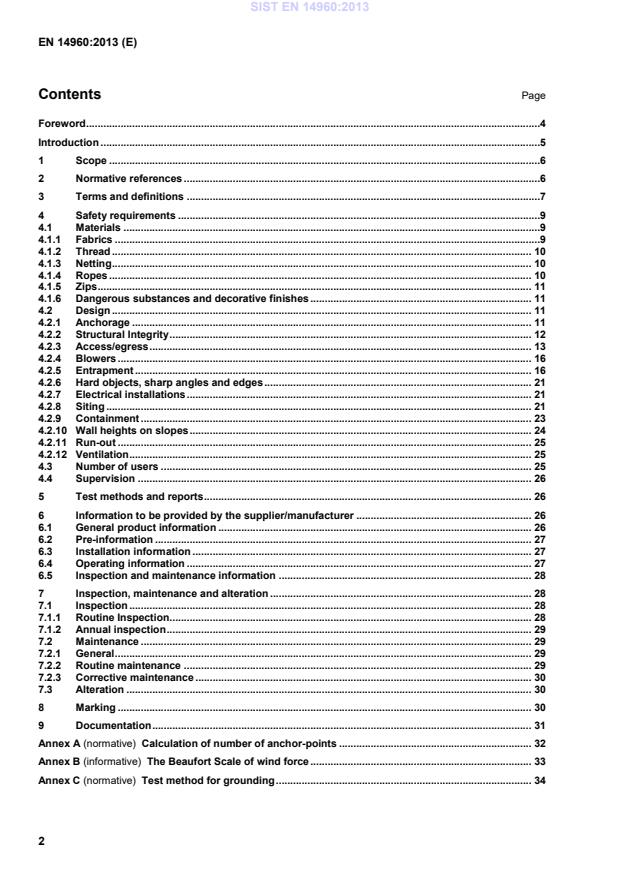
Calculation of number of anchor-points . 32 Annex B (informative)
The Beaufort Scale of wind force . 33 Annex C (normative)
Test method for grounding . 34 SIST EN 14960:2013
Test methods for entrapment . 35 D.1 General . 35 D.2 Head and neck entrapment . 35 D.2.1 Completely bound openings . 35 D.2.2 Partially bound and V-shaped openings . 36 D.3 Entrapment of clothing (Toggle test) . 41 D.3.1 Apparatus . 41 D.3.2 Procedure . 43 D.4 Finger entrapment . 43 D.4.1 Apparatus . 43 D.4.2 Procedure . 44 Annex E (normative)
Test method for tear strength . 45 E.1 Maximum value tongue tear, apparatus . 45 E.2 Preparation of test specimens . 45 E.3 Conditioning . 46 E.4 Preconditioning . 46 E.5 Characteristics of test atmospheres . 46 E.6 Methods of conditioning . 46 E.7 Procedure . 47 E.8 Calculation and expression of results . 47 E.9 Test report . 49 Bibliography . 50
This standard specifies safety requirements for inflatable play equipment for which the primary activities are bouncing and sliding. It sets measures to address risks and also to minimise accidents to users for those involved in the design, manufacture and supply of inflatable play equipment. It specifies information to be supplied with the equipment. The requirements have been laid down bearing in mind the risk factor based on available data.
This standard specifies the requirements that will protect a child from hazards that he or she may be unable to foresee when using the equipment as intended, or in a manner that can be reasonably anticipated. This standard is not applicable to inflatable water-borne play and leisure equipment, domestic inflatable toys, air-supported buildings, inflatables used solely for protection, inflatables used for rescue, or other types of inflatable toys where the primary activity is not bouncing or sliding. 2 Normative references The following documents, in whole or in part, are normatively referenced in this document and are indispensable for its application. For dated references, only the edition cited applies. For undated references, the latest edition of the referenced document (including any amendments) applies. EN 71-3, Safety of toys — Part 3: Migration of certain elements EN 1177, Impact attenuating playground surfacing — Determination of critical fall height EN 60529, Degrees of protection provided by enclosures (IP code) (IEC 60529/A1) EN ISO 1421:1998, Rubber- or plastics-coated fabrics — Determination of tensile strength and elongation at break (ISO 1421:1998) EN ISO 2307, Fibre ropes — Determination of certain physical and mechanical properties (ISO 2307) EN ISO 2411, Rubber- or plastics-coated fabrics — Determination of coating adhesion (ISO 2411) EN ISO 9554, Fibre ropes — General specifications (ISO 9554) EN ISO/IEC 17025, General requirements for the competence of testing and calibration laboratories (ISO/IEC 17025) SIST EN 14960:2013
a) Flat-bed (4 open sides) b) Castle (3 walled sides, 1 open side) c) A-Frame inflatable (3 walled sides, 1 open side)
d) Bounce/Slide combination
e) Multi-Play Centre f) Obstacle course
g) Inflatable slide h) Enclosed inflatable i) Soft mountain Figure 1 — Examples of inflatable play equipment SIST EN 14960:2013
3.3 connection tube part of the inflatable structure to which the blower is connected 3.4 controller person, company or hirer (those who hire to others), having responsibility for the overall control, inspection and maintenance of the equipment 3.5 operator person appointed by a controller to be in charge of the operation of the equipment at any time when it is available for use by the public 3.6 attendant person working under the control and direction of an operator to assist in the operation of the equipment 3.7 inspection body organisation, part of an organisation or individual with the appropriate competence to carry out one or more of the following inspections: design review; assessment of conformity to design; initial testing; annual main inspection 3.8 free height of fall greatest vertical distance from the clearly intended body support to the impact area below
[SOURCE: EN 1176-1:2008, 3.6] 3.9 critical fall height maximum free heights of fall, for which a surface will provide an acceptable level of impact attenuation 3.10 open side any external side of an inflatable with no containing wall 3.11 step step to aid the access/egress of users into and out of the playing area of the inflatable, making the transition between the height of the playing area and the ground 3.12 ramp ramp to aid the access/egress of users into and out of the playing area of the inflatable, making the transition between the height of the playing area and the ground SIST EN 14960:2013
falling space space in, or around the inflatable that can be passed through by a user falling from an elevated part of the equipment Note 1 to entry: The falling space commences at the free height of fall.
4 Safety requirements 4.1 Materials 4.1.1 Fabrics Fabrics shall be flame retardant. SIST EN 14960:2013
Figure 2 — 8 mm finger rod Clamber netting (commonly laid on slopes to form foot and hand holds) shall be securely fixed to prevent lifting by the user. The rope from which it is made shall be at least 12 mm in diameter and shall be securely knotted. Strand ends shall be treated to prevent fraying. Care shall be taken when heat sealing so as not to form hard or sharp edges. 4.1.4 Ropes Ropes shall be fixed at both ends and the total amplitude of swing shall not exceed 20 % of the distance between the fixing points such that it shall not be possible to make a loop in the rope of large enough diameter to allow probe E to pass through (see Figure D.1). NOTE This requirement is intended to remove the risk of strangulation. The rope diameter shall be between 18 mm and 45 mm. SIST EN 14960:2013
Key 1 direction of force 2 rounded tops 3 ground level Figure 3 — Examples of ground stakes On hard standing where ground stakes cannot be used, the inflatable shall be secured to the ground by equally effective method, e.g. attaching each of the anchorage points to fittings already in the ground, or to sandbags or other weights, if these are capable of supporting the 1 600 N load. If the inflatable is secured to a vehicle or other movable machinery, such vehicles or machinery shall be immobilised and be under the control of an operator. 4.2.2 Structural Integrity The minimum air pressure inside the structural parts of the inflatable shall be 1 kPa (100 mm water gauge). Inflated chambers that are entered by the user are not considered to be structural parts of the inflatable, e.g. enclosed dome type inflatables. Pressure in the playing area of soft mountains shall be no greater than 0,25 kPa (25 mm water gauge), but shall maintain a pressure sufficient to prevent grounding. Pressure in the surrounding safety apron of soft mountains shall be at least 1 kPa (100 mm water gauge); see Figure 4. The depth of the trough on the surface of any platform shall be a maximum of 33 % of the width of the adjacent panel, measured when inflated (see Figure 5). Containing walls shall be vertical (90 ± 5)°. Towers that support containing walls shall be in the same plane. Containing walls and towers shall be strong enough to contain the largest and/or heaviest user for whom the inflatable is designed. Playing areas, surrounding safety aprons, steps and/or ramps shall support the weight of the largest and/or heaviest user for whom the inflatable is designed, without grounding. See Annex C for the test method.
Key 1 surrounding safety apron 2 tread depth 3 playing area Figure 4 — Section through a soft mountain SIST EN 14960:2013
Key a depth of trough — measured when inflated b width of adjacent panel Figure 5 — Trough depth 4.2.3 Access/egress A step or ramp shall be wide enough to cover the entire access/egress aperture with overlap, according to Figure 6. A step or ramp shall have a tread depth of a minimum of 1,5 times the height of the adjacent playing area platform to which it is attached (see Figure 6). The playing area of soft mountains shall be completely surrounded by an inflated safety apron. This safety apron shall have a minimum tread depth of 1,6 m or 0,5 times the height of the playing area measured from the ground when inflated and in the unloaded condition, whichever is greater. In the event of air supply failure, the deflation time shall be sufficient to allow users of the inflatable to be evacuated safely. NOTE Deflation time can be considerably lengthened by inserting a non-return flap in the outlet nozzle of the blower or at the joint of the connection tube and structure. Inflatables shall be designed to ensure that adults are able to gain access in order to assist users. On any open side, the free height of fall shall be no greater than 630 mm from the ground in the unloaded condition, (600 mm in the loaded condition). On any open side, the extent of the impact area shall be at least 1,2 m. The surface in the impact area shall meet the requirements for impact attenuation so that the critical fall height of the surfacing, according to EN 1177, is at least 630 mm. The impact areas of adjacent inflatables and/or other play equipment shall not overlap. Materials such as soil, turf and sand have some impact attenuating properties. Impact absorbing mats may be used (see Figure 7). SIST EN 14960:2013
a) step detail
b) ramp detail Key 1 overlap 2 open side 3 height of adjacent playing area platform
4 tread depth 5 step 6 ramp Figure 6 — Step or ramp detailSIST EN 14960:2013
a) Castle type b) Flat-bed
c) Up and over slide Key 1 walled side 2 at least 1,2 m 3 open side
4 impact area 5 exit 6 entrance Figure 7 — Impact area Anchorage points in impact areas shall be avoided if possible but, where necessary, anchorage points shall be connected to the bottom perimeter edge or seam of the inflatable and shall extend as short a distance as practicable from the inflatable (see Figure 8). SIST EN 14960:2013
Key 1 side of inflatable 2 impact area 3 anchorage stake as close as practicable to the side of the inflatable 4 ground level Figure 8 — Anchorage in an impact area Totally enclosed inflatables shall have signs indicating exits, which shall be visible in all circumstances. When designed for more than 15 users, there shall be more than one exit, and users shall never be more than 5 m from an exit. 4.2.4 Blowers Blowers shall be protected to a minimum of IP23B as defined in EN 60529, except that the 8 mm finger rod, as illustrated in Figure 2, shall be used instead of the jointed 12 mm test finger. The 8 mm finger rod may pass through the guard mesh but shall not, in any position, come into contact with any moving part, hot surface or exposed electrical connections. The blower shall be positioned at least 1,2 m from a walled side and 2,5 m from an open side. The connection tube shall be long enough to allow this. If a blower is sited inside the inflatable structure, it shall be at least 2,5 m from the playing area, safety apron, step and/or ramp. The blower, including cabling and controls, shall not be readily accessible to the public. NOTE See also 4.2.7 Electrical installations. 4.2.5 Entrapment 4.2.5.1 General Test probes shall be applied with a force of 222 N unless otherwise stated in the text. 4.2.5.2 Entrapment of the head and neck Inflatables shall be constructed so that any openings do not create head and neck entrapment hazards by either head first or feet first passage. Hazardous situations in which this type of entrapment can be encountered include the following: completely bound openings through which a user may slide feet first or head first; SIST EN 14960:2013
a) Standing user
b) Example of a slide Figure 9 — Free space SIST EN 14960:2013
NOTE In case of hanging, h = 300 because of the possibility that the user pulls himself or herself up. NOTE In certain cases, the dimensions of the free space can be altered. In some cases, these will be given in the parts of this standard covering individual types of equipment. 4.2.5.4 Fingers entrapment
Inflatables shall be constructed so that there are no hazardous gaps in which fingers can be trapped while the rest of the body is moving or continuing in motion involuntarily, e.g. sliding, bouncing. Openings within the free space, where the user is subjected to forced movement, and holes which have a lower edge more than 1,0 m above the platform when tested in accordance with Annex D (D.4), shall conform to one of the following requirements: a) 8 mm finger rod (see Figure 2), when applied with a force of 30 N, shall not pass through the minimum cross section of the opening and the profile of the opening shall be such that the rod cannot be locked in any position when set in motion as given in Figure D.10; or b) if the 8 mm finger rod passes through the opening, the 25 mm finger rod (see Figure 10), when applied with a force of 30 N shall also pass though the opening provided that the opening does not permit access to another finger entrapment site. Dimensions in millimetres
Figure 10 — 25 mm finger rod 4.2.5.5 Body entrapment
Adjacent inflated surfaces shall be more than 120 mm apart if the aperture formed is more than 200 mm deep (see Figure 11). SIST EN 14960:2013
a)
b) Key 1 walled castle viewed from above 2 section across playing area 3 wall to tower attachment point 4 more than 200 mm
5 less than 120 mm 6 wall to tower attachment point 7 less than 200 mm 8
more than 120 mm
a) Wall to tower attachment at A forms an entrapment point. Wall to tower attachment at B does not form an entrapment point. b) Large slide at B forms an entrapment point. The ball fixed at A does not form an entrapment point. Figure 11 — Entrapment Inflatable tunnels: An inflatable tunnel of 75 cm length or less shall, for the purposes of this standard, be regarded as a squeeze. SIST EN 14960:2013
Key 1 at least 1,8 m 2 walled side 3 at least 3,5 m 4 open side 5 1 m gateway Figure 12 — Positioning of perimeter fence A clear area, free of any obstacle that could cause injury, shall be maintained around the inflatable. The extent of this clear area shall be established by dividing the height of the highest platform by two. The minimum clear area shall be 1,8 m on walled sides and 3,5 m on open sides (see Figure 13). An exception to this rule is when an inflatable with inflated walls is sited directly against a solid wall or walls, for example the walls of a building. In such a case, the solid wall(s) shall be 2,0 m higher than the highest platform height unless the platform has a permanent roof. Use of this exception shall not result in the creation of additional hazards. SIST EN 14960:2013
Key x height of highest platform y extent of clear area Figure 13 — Clear area around inflatable 4.2.9 Containment Containing wall height shall be measured from the surface of the platform to the top of the wall, at 90° to the platform. Walls for containing users, known as outside walls, are required where the platform height is greater than 0,6 m. Inflatables with a platform height between 0,6 m and 3,0 m shall have a containing wall height equal to at least the height of the user. Containing walls of 1,8 m height are sufficient for users of any height. Inflatables with a platform height between 3,0 m and 6,0 m shall have a containing wall height at least 1,25 times the height of the user, or the platform area shall be permanently roofed to contain the user. Inflatables with a platform height over 6,0 m shall have containing walls and a permanent roof fitted (see Figure 14). The minimum internal height of such containing walls and permanent roof, measured from the surface of the platform to the under-side of the roof, shall be at least 0,75 m. SIST EN 14960:2013
Key 1 no containing walls required 2 containing walls required of user height
3 containing walls required 1,25 times user height 4 alternative to 3, add a permanent roof 5 both containing walls and permanent roof required Figure 14 — Containing wall heights on platforms 4.2.10 Wall heights on slopes Slopes of less than 30° shall be treated as a platform. Containing wall heights on slopes shall be measured from the surface of the slope to the top of the wall, at 90° to the slope. The height of the containing walls on the slope of a slide or climbing ramp of more than a 30° inclination shall be, for the first metre at the top, at least the height of the user and for the remainder, at least 50 % of the height of the user (see Figure 15). On a slope or climbing ramp over 6,0 m high, containing walls and a permanent roof shall be fitted. The minimum internal height of such containing walls and roof, measured from the surface of the slope to the under-side of the roof, shall be 75 cm. On bounce/slide combinations, where the highest platform height is 1.5 m or lower (measured from the ground) and provided that users are forced to sit or crouch on entering the slide, containing walls for the highest 750 mm of the slope shall be at least 50 % of user height and for the remainder of the slope at least 300 mm. SIST EN 14960:2013
Key 1 first metre of slope 2 wall height 3 user height 4 50 % of user height 5 platform height
6 more than 30°
7 wall
8 platform surface
9 sliding surface 10 run-out Figure 15 — Containing wall heights on slopes 4.2.11 Run-out All slides shall include a run-out section at the bottom which shall have an average inclination of not more than 10°. The length of the run-out section, measured from the end of the radius or angle at the bottom of the sliding section, shall be a minimum of 50 % of the height of the highest platform of the slide, measured from the ground and in any case, a m
...
Questions, Comments and Discussion
Ask us and Technical Secretary will try to provide an answer. You can facilitate discussion about the standard in here.
Loading comments...