

SIST EN 1463-2:2021
(Main)Road marking materials - Retroreflecting road studs - Part 2: Road test performance specifications
General Information
- Abstract
This document describes the test method for carrying out road trials on retroreflecting road studs. Specifications are given for test sites, for the organization of the tests, and for the presentation of the results in the form of a test report.
- Status
- Published
- Public Enquiry End Date
- 19-Jan-2020
- Publication Date
- 28-Jun-2021
- Technical Committee
- OCE - Road equipment
- Current Stage
- 6060 - National Implementation/Publication (Adopted Project)
- Start Date
- 14-Jun-2021
- Due Date
- 19-Aug-2021
- Completion Date
- 29-Jun-2021


Overview - EN 1463-2:2021 (retroreflecting road studs)
EN 1463-2:2021 is a CEN European standard that specifies the road trial test method for retroreflecting road studs (road marking materials). It defines requirements for test site selection, test organization, measurement stages and the format of the individual test report. The document supports conformity assessment of studs in real traffic and climatic conditions and supersedes EN 1463-2:2000.
Key topics and technical requirements
- Scope: Road trials to evaluate in-service performance of retroreflecting road studs; reporting requirements for weather, traffic and surface conditions.
- Test duration: One year (minimum 11 consecutive months allowed if a full summer and winter are included).
- Test studs per trial: 50 test studs from a single applicant product (no mixing of products).
- Test site design:
- Two-lane carriageway in one direction, straight and flat (maximum slope guidance noted).
- No major obstacles, intersections or frequent dirt sources.
- Traffic conditions: Annual Average Daily Traffic (AADT) ≥ 5 000 in the test direction, with 10–25% heavy vehicles (>7 500 kg).
- Road surface: Asphaltic or concrete ≥ 1 year old, free of wheel-track damage or cracks.
- Application patterns: Studs may be applied as lane separation lines, in gaps between existing lanes, or immediately adjacent to lane lines; minimum longitudinal spacing 2.5 m.
- Measurement stages:
- Daylight visual examination
- Night-time examination (includes best-practice cleaning)
- Primary assessment and selection of studs for photometric testing
- Photometric testing of selected studs (portable in-field equipment allowed as noted)
- Reporting: Weather report (temperature, precipitation, snow/sand actions) - Annex C recommends using Köppen climate classification; model forms such as the Road Trial Assessment Form (Annex A) and a model test report (Annex B) are provided.
Practical applications and users
EN 1463-2:2021 is used to validate the long-term field performance of retroreflecting road studs for:
- Road authorities and highway agencies specifying durable road-marking safety devices
- Manufacturers seeking evidence of in-service performance and compliance with EN 1463 series
- Independent test laboratories and research organisations running road trials
- Contractors and installers verifying installation conditions and durability claims
Using EN 1463-2 helps stakeholders ensure product reliability in realistic traffic and climate exposure, supporting road safety and procurement decisions.
Related standards
- EN 1463-1 (Initial performance requirements for retroreflecting road studs) - referenced as the companion document.
- EN 1824 (Road marking materials - Road trials) - consistency aligned in the 2021 revision.
Keywords: EN 1463-2:2021, retroreflecting road studs, road marking materials, road trials, test sites, photometric testing, road safety, traffic conditions.
Relations
- Effective Date
- 01-Sep-2021
- Effective Date
- 28-Jan-2026
- Referred By
SIST EN 13212:2011 - Road marking materials - Requirements for factory production control - Effective Date
- 28-Jan-2026
Get Certified
Connect with accredited certification bodies for this standard

Zavod za gradbeništvo Slovenije (ZAG) - Inšpekcija
ZAG inspection body for construction products, structures, and materials.
Sponsored listings
Frequently Asked Questions
SIST EN 1463-2:2021 is a standard published by the Slovenian Institute for Standardization (SIST). Its full title is "Road marking materials - Retroreflecting road studs - Part 2: Road test performance specifications". This standard covers: This document describes the test method for carrying out road trials on retroreflecting road studs. Specifications are given for test sites, for the organization of the tests, and for the presentation of the results in the form of a test report.
This document describes the test method for carrying out road trials on retroreflecting road studs. Specifications are given for test sites, for the organization of the tests, and for the presentation of the results in the form of a test report.
SIST EN 1463-2:2021 is classified under the following ICS (International Classification for Standards) categories: 93.080.20 - Road construction materials. The ICS classification helps identify the subject area and facilitates finding related standards.
SIST EN 1463-2:2021 has the following relationships with other standards: It is inter standard links to SIST EN 1463-2:2002, SIST EN 1463-1:2022, SIST EN 13212:2011. Understanding these relationships helps ensure you are using the most current and applicable version of the standard.
SIST EN 1463-2:2021 is associated with the following European legislation: EU Directives/Regulations: 305/2011. When a standard is cited in the Official Journal of the European Union, products manufactured in conformity with it benefit from a presumption of conformity with the essential requirements of the corresponding EU directive or regulation.
SIST EN 1463-2:2021 is available in PDF format for immediate download after purchase. The document can be added to your cart and obtained through the secure checkout process. Digital delivery ensures instant access to the complete standard document.
Standards Content (Sample)
SLOVENSKI STANDARD
01-september-2021
Nadomešča:
SIST EN 1463-2:2002
Materiali za označevanje vozišča - Odsevniki - 2. del: Terenski preskusi
Road marking materials - Retroreflecting road studs - Part 2: Road test performance
specifications
Straßenmarkierungsmaterialien - Retroreflektierende Markierungsknöpfe - Teil 2:
Feldprüfungen
Produits de marquage routier - Plots rétroréfléchissants - Partie 2 : essai routier
Ta slovenski standard je istoveten z: EN 1463-2:2021
ICS:
93.080.20 Materiali za gradnjo cest Road construction materials
2003-01.Slovenski inštitut za standardizacijo. Razmnoževanje celote ali delov tega standarda ni dovoljeno.
EN 1463-2
EUROPEAN STANDARD
NORME EUROPÉENNE
May 2021
EUROPÄISCHE NORM
ICS 93.080.20 Supersedes EN 1463-2:2000
English Version
Road marking materials - Retroreflecting road studs - Part
2: Road test performance specifications
Produits de marquage routier - Plots Straßenmarkierungsmaterialien - Retroreflektierende
rétroréfléchissants - Partie 2 : essai routier Markierungsknöpfe - Teil 2: Feldprüfungen
This European Standard was approved by CEN on 12 April 2021.
CEN members are bound to comply with the CEN/CENELEC Internal Regulations which stipulate the conditions for giving this
European Standard the status of a national standard without any alteration. Up-to-date lists and bibliographical references
concerning such national standards may be obtained on application to the CEN-CENELEC Management Centre or to any CEN
member.
This European Standard exists in three official versions (English, French, German). A version in any other language made by
translation under the responsibility of a CEN member into its own language and notified to the CEN-CENELEC Management
Centre has the same status as the official versions.
CEN members are the national standards bodies of Austria, Belgium, Bulgaria, Croatia, Cyprus, Czech Republic, Denmark, Estonia,
Finland, France, Germany, Greece, Hungary, Iceland, Ireland, Italy, Latvia, Lithuania, Luxembourg, Malta, Netherlands, Norway,
Poland, Portugal, Republic of North Macedonia, Romania, Serbia, Slovakia, Slovenia, Spain, Sweden, Switzerland, Turkey and
United Kingdom.
EUROPEAN COMMITTEE FOR STANDARDIZATION
COMITÉ EUROPÉEN DE NORMALISATION
EUROPÄISCHES KOMITEE FÜR NORMUNG
CEN-CENELEC Management Centre: Rue de la Science 23, B-1040 Brussels
© 2021 CEN All rights of exploitation in any form and by any means reserved Ref. No. EN 1463-2:2021 E
worldwide for CEN national Members.
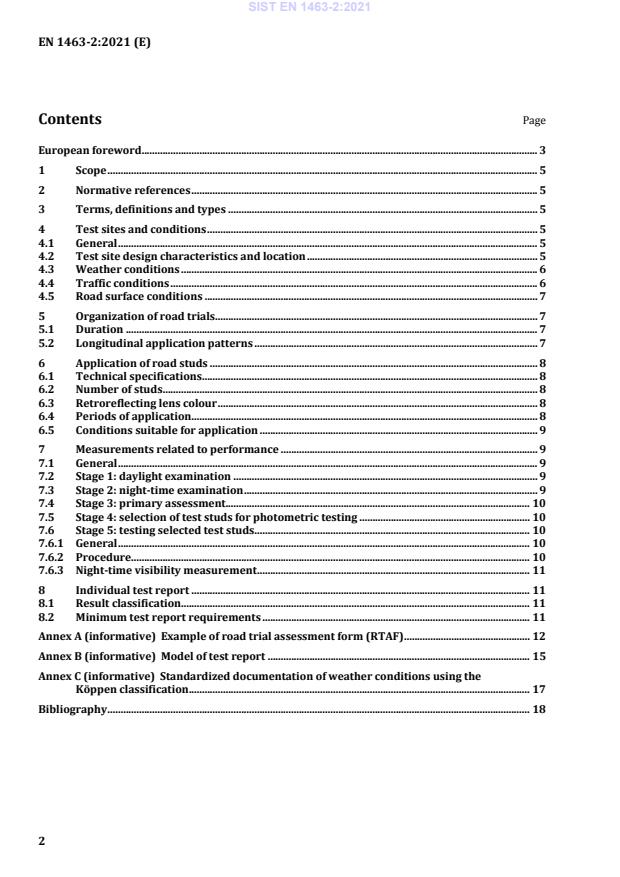
Contents Page
European foreword . 3
1 Scope . 5
2 Normative references . 5
3 Terms, definitions and types . 5
4 Test sites and conditions . 5
4.1 General . 5
4.2 Test site design characteristics and location . 5
4.3 Weather conditions . 6
4.4 Traffic conditions . 6
4.5 Road surface conditions . 7
5 Organization of road trials . 7
5.1 Duration . 7
5.2 Longitudinal application patterns . 7
6 Application of road studs . 8
6.1 Technical specifications . 8
6.2 Number of studs . 8
6.3 Retroreflecting lens colour . 8
6.4 Periods of application . 8
6.5 Conditions suitable for application . 9
7 Measurements related to performance . 9
7.1 General . 9
7.2 Stage 1: daylight examination . 9
7.3 Stage 2: night-time examination . 9
7.4 Stage 3: primary assessment. 10
7.5 Stage 4: selection of test studs for photometric testing . 10
7.6 Stage 5: testing selected test studs . 10
7.6.1 General . 10
7.6.2 Procedure. 10
7.6.3 Night-time visibility measurement . 11
8 Individual test report . 11
8.1 Result classification. 11
8.2 Minimum test report requirements . 11
Annex A (informative) Example of road trial assessment form (RTAF) . 12
Annex B (informative) Model of test report . 15
Annex C (informative) Standardized documentation of weather conditions using the
Köppen classification . 17
Bibliography . 18
European foreword
This document (EN 1463-2:2021) has been prepared by Technical Committee CEN/TC 226 “Road
equipment”, the secretariat of which is held by AFNOR.
This European Standard shall be given the status of a national standard, either by publication of an
identical text or by endorsement, at the latest by November 2021, and conflicting national standards shall
be withdrawn at the latest by November 2021.
Attention is drawn to the possibility that some of the elements of this document may be the subject of
patent rights. CEN shall not be held responsible for identifying any or all such patent rights.
This document supersedes EN 1463-2:2000.
The main changes with respect to the previous edition are listed below:
— This document has been prepared in order to achieve consistency with EN 1824 “Road marking
materials — Road trials”.
— To avoid redundancies, definitions which are stated in EN 1463-1:— have been removed from
Clause 3. For consistency, the Introduction has been also removed.
— Due to the fact that this document is a supporting document to harmonized EN 1463-1:— , the
content which refers to temporary products have been removed.
— In 4.5 “Road surface conditions” (former 4.1.5), concrete road surfaces have been added as a suitable
surface for carrying out the durability test.
— In 5.1 “Duration” (former 4.2.1), although it is fixed to one year, the-possibility of reducing it to 11
consecutive months (including, in any case, a complete summer and winter season) is also given, as
the number of available test sites in the EU is rather limited. Accordingly time needs to be planned
for removal and applying a new test.
— In 5.2 “Longitudinal application patterns” (former 4.2.2), drawings have been added to avoid any
misunderstanding.
— In 7.2 “Stage 1: daylight examination” (former 5.2), paragraph a) has been revised to avoid any
misunderstanding.
— In 7.3 Stage 2: night-time examination (former 5.3) process step a) “clean the retroreflectors” and a
note about cleaning has been added. While this just describes best practice, this information has been
added to avoid any misunderstanding.
— In 7.3 Stage 2: night-time examination (former 5.3) process step d) “if the total number of test studs
remaining is less than 43, the assessment shall be considered void” has been added, as a further
proceeding to stage 3 makes no sense under this condition.
— In 7.6 “Stage 5: testing selected test studs” (former 5.6), 7.6.3, a Note intended to open the possibility
to use portable equipment to carry out in field photometric measurements has been added.
— In Clause 8 “Individual test report” (former Clause 6) the classes S0-S3 have been removed, in
accordance with the changes introduced in EN 1463-1:— , and minimum test report requirements
have been added.
— Added informative Annex C “Standardized documentation of weather conditions using the Köppen
classification”.
According to the CEN-CENELEC Internal Regulations, the national standards organisations of the
following countries are bound to implement this European Standard: Austria, Belgium, Bulgaria, Croatia,
Cyprus, Czech Republic, Denmark, Estonia, Finland, France, Germany, Greece, Hungary, Iceland, Ireland,
Italy, Latvia, Lithuania, Luxembourg, Malta, Netherlands, Norway, Poland, Portugal, Republic of North
Macedonia, Romania, Serbia, Slovakia, Slovenia, Spain, Sweden, Switzerland, Turkey and the United
Kingdom.
1 Scope
This document describes the test method for carrying out road trials on retroreflecting road studs.
Specifications are given for test sites, for the organization of the tests, and for the presentation of the
results in the form of a test report.
2 Normative references
The following documents are referred to in the text in such a way that some or all of their content
constitutes requirements of this document. For dated references, only the edition cited applies. For
undated references, the latest edition of the referenced document (including any amendments) applies.
EN 1463-1:— , Road marking materials — Retroreflecting road studs — Part 1: Initial performance
requirements
3 Terms, definitions and types
For the purposes of this document, the following terms and definitions apply.
ISO and IEC maintain terminological databases for use in standardization at the following addresses:
— ISO Online browsing platform: available at https://www.iso.org/obp
— IEC Electropedia: available at https://www.electropedia.org/
3.1
test stud
retroreflecting road stud submitted for conformity testing in accordance with this document
3.2
applicant product
set of road studs provided by the manufacturer with the same commercial reference
4 Test sites and conditions
4.1 General
Test sites shall be arranged at suitable locations that meet at least the requirements of 4.2 to 4.5. The test
results will depend on the weather, traffic and road surface conditions. These shall all be described in the
corresponding individual test report (see 8.2).
4.2 Test site design characteristics and location
Studs shall be tested on a road with two lanes in one direction (Figure 1). On this test site there shall be
no other than the national maximum speed limit.
Under preparation. Stage at the time of publication: FprEN 1463-1:2021
Key
1 is indicating the driving direction
Figure 1 — Road with two lanes in one direction
Roads used for test sites shall be straight and flat, with the lowest longitudinal and transverse gradient
possible and free of singular points (such as traffic lights and intersections), substantial obstacles to
daylight, source of frequent dirt (such as quarries and field exits) and movement of tracked vehicles.
Any change of site conditions during the test period shall be avoided.
The lengthwise slope and any special circumstances shall be stated in the general report for the test site.
NOTE The in use specifications for “flat” refer to a maximum slope of 4 %.
4.3 Weather conditions
At the termination of a road trial, a weather report for the duration of the road trial shall be produced.
The weather report can be based on data from the nearest meteorological station and it can include data
obtained on the test site itself; it should include aspects of the weather of influence to the results of the
road trial.
Whether or not it is agreed between the participating parties that weather information is to be collected,
the weather report shall include as a minimum an account of temperature conditions during the testing
period.
NOTE Annex C is providing guidance for a simplified reporting method in accordance with the Köppen Climate
Classification. The weather report can include a monthly account of mean minimum and maximum day
temperatures, the cumulated precipitations in millimetres of water and the number of sand/grit scattering actions,
snow ploughing actions etc.
4.4 Traffic conditions
The annual average daily traffic (AADT) of test sites shall be at least 5 000 for the total carriageway in the
test direction and shall support between 10 % and 25 % heavy vehicles. A vehicle is considered a heavy
vehicle if its maximum gross mass is greater than 7 500 kg.
NOTE It is recommended to select the test site in a way that traffic can be re-directed for safe installation and
subsequent assessments.
Other special requirements (e.g. snow clearance, studded tyres) not included in the general minimum
requirements as specified in this Clause, but considered indispensable for some countries or special
applications, may be taken into account by the participating parties for the selection of the test site and
recorded in the report for the test site.
4.5 Road surface conditions
Road trials shall be carried out on asphaltic or concrete road
...