

SIST CWA 18398:2026
(Main)AI Professional Role Profiles and Educational Profiles
General Information
- Abstract
This document provides a set of professional role profiles as typically applied in an organisation in the area of artificial intelligence (AI) and a set of educational profiles that translate these organisation needs into educational terms. It builds on existing CEN reports, specifically the European e-Competence Framework ("e-CF"; EN 16234-1), the ICT Professional Role Profiles (CWA 16458), and the Guidelines for Developing ICT Professional Curricula (CEN/TS 17699).
It provides a high-level framework for AI role profiles, outlining elements such as tasks, deliverables, competences (aligned with the e-CF), AI descriptors, and AI skill areas. It is intended as an illustrative and exploratory resource rather than a prescriptive standard. The profiles and components presented here are designed to inspire and support organisations in shaping their own approaches, allowing them to select, adapt, and combine elements in ways that best fit their specific context. Recognising that real-world applications vary widely, this document encourages flexible use and interpretation rather than strict adherence.
Within this framework, tasks describe the key activities associated with a role, while deliverables capture the expected outputs or results. Competences, based on the e-CF, provide a structured view of the knowledge and capabilities required. AI descriptors and AI skill areas further contextualise these roles by highlighting AI-specific responsibilities and domains of expertise. Together, these elements offer a modular structure that can be tailored to different organisational needs.
In addition, the document extends these role profiles into an educational perspective by translating roles and competences into indicative learning outcomes and approaches to assessment. This linkage is intended to support education and training providers in designing programmes that align with emerging AI roles, while remaining adaptable to different pedagogical models and contexts.
This CWA aligns with activities and standards developed in the context of ISO/IEC JTC 1 SC 42 and CEN-CENELEC JTC 21 for Artificial intelligence. JTC 21 produces and adopts standardization deliverables to address European market and societal needs and to underpin primarily EU legislation, policies, principles, and values. JTC 21 plays a pivotal role in implementing the EU AI Act by developing harmonized standards.
This CWA has been developed at the intersection of AI and ICT professionalism, which is the focus of CEN/TC 428 ICT Professionalism and Digital Competences the committee that supports the development of digital skills across sectors. It focuses on competences, education, ethics, and knowledge frameworks, helping to close the digital skills gap in Europe.
- Status
- Published
- Publication Date
- 04-Oct-2026
- Technical Committee
- UMI - Artificial intelligence
- Current Stage
- 6060 - National Implementation/Publication (Adopted Project)
- Start Date
- 22-Jul-2026
- Due Date
- 26-Sep-2026
- Completion Date
- 05-Oct-2026

Get Certified
Connect with accredited certification bodies for this standard

BSI Group
BSI (British Standards Institution) is the business standards company that helps organizations make excellence a habit.

NYCE
Mexican standards and certification body.
Sponsored listings
Frequently Asked Questions
SIST CWA 18398:2026 is a standardization document published by the Slovenian Institute for Standardization (SIST). Its full title is "AI Professional Role Profiles and Educational Profiles". This standard covers: This document provides a set of professional role profiles as typically applied in an organisation in the area of artificial intelligence (AI) and a set of educational profiles that translate these organisation needs into educational terms. It builds on existing CEN reports, specifically the European e-Competence Framework ("e-CF"; EN 16234-1), the ICT Professional Role Profiles (CWA 16458), and the Guidelines for Developing ICT Professional Curricula (CEN/TS 17699). It provides a high-level framework for AI role profiles, outlining elements such as tasks, deliverables, competences (aligned with the e-CF), AI descriptors, and AI skill areas. It is intended as an illustrative and exploratory resource rather than a prescriptive standard. The profiles and components presented here are designed to inspire and support organisations in shaping their own approaches, allowing them to select, adapt, and combine elements in ways that best fit their specific context. Recognising that real-world applications vary widely, this document encourages flexible use and interpretation rather than strict adherence. Within this framework, tasks describe the key activities associated with a role, while deliverables capture the expected outputs or results. Competences, based on the e-CF, provide a structured view of the knowledge and capabilities required. AI descriptors and AI skill areas further contextualise these roles by highlighting AI-specific responsibilities and domains of expertise. Together, these elements offer a modular structure that can be tailored to different organisational needs. In addition, the document extends these role profiles into an educational perspective by translating roles and competences into indicative learning outcomes and approaches to assessment. This linkage is intended to support education and training providers in designing programmes that align with emerging AI roles, while remaining adaptable to different pedagogical models and contexts. This CWA aligns with activities and standards developed in the context of ISO/IEC JTC 1 SC 42 and CEN-CENELEC JTC 21 for Artificial intelligence. JTC 21 produces and adopts standardization deliverables to address European market and societal needs and to underpin primarily EU legislation, policies, principles, and values. JTC 21 plays a pivotal role in implementing the EU AI Act by developing harmonized standards. This CWA has been developed at the intersection of AI and ICT professionalism, which is the focus of CEN/TC 428 ICT Professionalism and Digital Competences the committee that supports the development of digital skills across sectors. It focuses on competences, education, ethics, and knowledge frameworks, helping to close the digital skills gap in Europe.
This document provides a set of professional role profiles as typically applied in an organisation in the area of artificial intelligence (AI) and a set of educational profiles that translate these organisation needs into educational terms. It builds on existing CEN reports, specifically the European e-Competence Framework ("e-CF"; EN 16234-1), the ICT Professional Role Profiles (CWA 16458), and the Guidelines for Developing ICT Professional Curricula (CEN/TS 17699). It provides a high-level framework for AI role profiles, outlining elements such as tasks, deliverables, competences (aligned with the e-CF), AI descriptors, and AI skill areas. It is intended as an illustrative and exploratory resource rather than a prescriptive standard. The profiles and components presented here are designed to inspire and support organisations in shaping their own approaches, allowing them to select, adapt, and combine elements in ways that best fit their specific context. Recognising that real-world applications vary widely, this document encourages flexible use and interpretation rather than strict adherence. Within this framework, tasks describe the key activities associated with a role, while deliverables capture the expected outputs or results. Competences, based on the e-CF, provide a structured view of the knowledge and capabilities required. AI descriptors and AI skill areas further contextualise these roles by highlighting AI-specific responsibilities and domains of expertise. Together, these elements offer a modular structure that can be tailored to different organisational needs. In addition, the document extends these role profiles into an educational perspective by translating roles and competences into indicative learning outcomes and approaches to assessment. This linkage is intended to support education and training providers in designing programmes that align with emerging AI roles, while remaining adaptable to different pedagogical models and contexts. This CWA aligns with activities and standards developed in the context of ISO/IEC JTC 1 SC 42 and CEN-CENELEC JTC 21 for Artificial intelligence. JTC 21 produces and adopts standardization deliverables to address European market and societal needs and to underpin primarily EU legislation, policies, principles, and values. JTC 21 plays a pivotal role in implementing the EU AI Act by developing harmonized standards. This CWA has been developed at the intersection of AI and ICT professionalism, which is the focus of CEN/TC 428 ICT Professionalism and Digital Competences the committee that supports the development of digital skills across sectors. It focuses on competences, education, ethics, and knowledge frameworks, helping to close the digital skills gap in Europe.
SIST CWA 18398:2026 is classified under the following ICS (International Classification for Standards) categories: 35.020 - Information technology (IT) in general. The ICS classification helps identify the subject area and facilitates finding related standards.
SIST CWA 18398:2026 is available in PDF format for immediate download after purchase. The document can be added to your cart and obtained through the secure checkout process. Digital delivery ensures instant access to the complete standard document.
Standards Content (Sample)
SLOVENSKI STANDARD
01-november-2026
Profili poklicnih vlog in izobraževalni profili za umetno inteligenco (UI)
AI Professional Role Profiles and Educational Profiles
Ta slovenski standard je istoveten z: CWA 18398:2026
ICS:
35.020 Informacijska tehnika in Information technology (IT) in
tehnologija na splošno general
2003-01.Slovenski inštitut za standardizacijo. Razmnoževanje celote ali delov tega standarda ni dovoljeno.
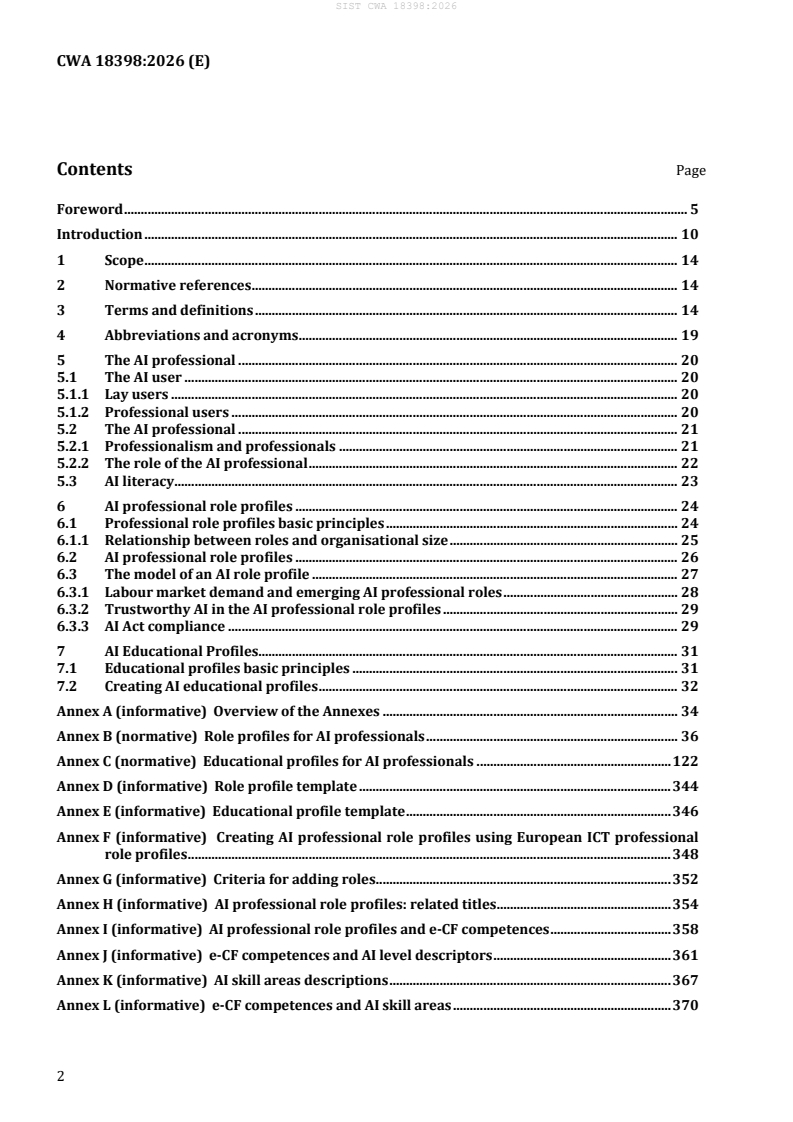
CEN
CWA 18398
WORKSHOP
June 2026
AGREEMENT
ICS 35.020
English version
AI Professional Role Profiles and Educational Profiles
This CEN Workshop Agreement was corrected and reissued by the CEN-CENELEC Management Centre on 8 September 2026.
This CEN Workshop Agreement has been drafted and approved by a Workshop of representatives of interested parties, the
constitution of which is indicated in the foreword of this Workshop Agreement.
The formal process followed by the Workshop in the development of this Workshop Agreement has been endorsed by the
National Members of CEN but neither the National Members of CEN nor the CEN-CENELEC Management Centre can be held
accountable for the technical content of this CEN Workshop Agreement or possible conflicts with standards or legislation.
This CEN Workshop Agreement can in no way be held as being an official standard developed by CEN and its Members.
This CEN Workshop Agreement is publicly available as a reference document from the CEN Members National Standard Bodies.
CEN members are the national standards bodies of Austria, Belgium, Bulgaria, Croatia, Cyprus, Czech Republic, Denmark, Estonia, Finland,
France, Germany, Greece, Hungary, Iceland, Ireland, Italy, Latvia, Lithuania, Luxembourg, Malta, Netherlands, Norway, Poland, Portugal,
Republic of North Macedonia, Romania, Serbia, Slovakia, Slovenia, Spain, Sweden, Switzerland, Türkiye and United Kingdom.
EUROPEAN COMMITTEE FOR STANDARDIZATION
COMITÉ EUROPÉEN DE NORMALISATIO N
EUROPÄISCHES KOMITEE FÜR NORMUN G
CEN-CENELEC Management Centre: Rue de la Science 23, B-1040 Brussels
© 2026 CEN All rights of exploitation in any form and by any means reserved worldwide for CEN national Members.
Ref. No.:CWA 18398:2026 E
Contents Page
Foreword . 5
Introduction . 10
1 Scope . 14
2 Normative references . 14
3 Terms and definitions . 14
4 Abbreviations and acronyms . 19
5 The AI professional . 20
5.1 The AI user . 20
5.1.1 Lay users . 20
5.1.2 Professional users . 20
5.2 The AI professional . 21
5.2.1 Professionalism and professionals . 21
5.2.2 The role of the AI professional . 22
5.3 AI literacy . 23
6 AI professional role profiles . 24
6.1 Professional role profiles basic principles . 24
6.1.1 Relationship between roles and organisational size . 25
6.2 AI professional role profiles . 26
6.3 The model of an AI role profile . 27
6.3.1 Labour market demand and emerging AI professional roles . 28
6.3.2 Trustworthy AI in the AI professional role profiles . 29
6.3.3 AI Act compliance . 29
7 AI Educational Profiles. 31
7.1 Educational profiles basic principles . 31
7.2 Creating AI educational profiles . 32
Annex A (informative) Overview of the Annexes . 34
Annex B (normative) Role profiles for AI professionals . 36
Annex C (normative) Educational profiles for AI professionals . 122
Annex D (informative) Role profile template . 344
Annex E (informative) Educational profile template . 346
Annex F (informative) Creating AI professional role profiles using European ICT professional
role profiles . 348
Annex G (informative) Criteria for adding roles . 352
Annex H (informative) AI professional role profiles: related titles . 354
Annex I (informative) AI professional role profiles and e-CF competences . 358
Annex J (informative) e-CF competences and AI level descriptors . 361
Annex K (informative) AI skill areas descriptions . 367
Annex L (informative) e-CF competences and AI skill areas . 370
Annex M (informative) AI role profiles and personal skills . 374
Annex N (informative) AI role profiles and interpersonal skills . 376
Annex O (informative) Comparing lay users, professional users and AI professionals . 378
Annex P (informative) AI literacy and AI professionalism differences . 379
Annex Q (informative) Application example: AI Health Specialist role profile . 380
Annex R (informative) Relation to other standards and frameworks . 385
Annex S (informative) AI skill areas in ESCO . 409
Annex T (informative) AI role profiles and AI Act actor categories . 418
Bibliography . 420
List of figures Page
Figure 1 — The professional user of AI . 21
Figure 2 — The AI professional. 23
Figure 3 — AI professional role profiles family tree . 26
Figure 4 — Elements of an educational profile . 32
Figure B.1 — AI professional role profiles family tree . 38
Figure F.1 — Selection of roles from European ICT professional role profiles . 349
Figure R.1 — Competences of the e-Competence Framework (EN 16234-1) . 387
Figure R.2 — Relation between role profiles and job descriptions . 390
Figure R.3 — AI related skills in SFIA . 392
Figure R.4 — AI competence integration in DigComp 3.0 . 394
Figure R.5 — NIST Functions organise AI risk management activities (AI RMF) . 398
Figure R.6 — NIST Relationship Between Cyber AI Profile Focus Areas . 399
Figure R.7 — EDISON Data science profiles . 400
Figure R. 8 — AI literacy as foundation . 403
List of tables Page
Table 1 — Abbreviations and acronyms . 19
Table F.1 — Related titles ICT role profiles and AI role profiles . 349
Table H.1 — AI role profile titles and related titles . 354
Table I.1 — Matrix AI professional role profiles and e-CF competences . 359
Table I.2 — e-CF proficiency levels and EQF levels . 360
Table J.1 — e-CF competences and their AI level descriptors . 361
Table K. 1 — AI skill areas and their descriptions . 367
Table L.1 — e-CF competences and AI skill areas . 370
Table L.2 — Matrix e-CF competences and AI skill areas . 373
Table M.1 — Matrix AI role profiles and personal skills . 375
Table N.1 — Matrix AI role profiles and interpersonal skills . 377
Table O.1 — Comparison between lay users, professional users and AI professionals . 378
Table P.1 — Key differences between AI literacy and AI professionalism . 379
Table R.1 — Related standards and frameworks . 385
Table R.2 — Proficiency levels of the e-Competence Framework . 388
Table R.3 — Incorporated SFIA AI skills . 393
Table R.4 — Incorporated ESCO AI related roles . 395
Table R.5 — e-CF proficiency levels and EQF levels with education types . 396
Table R.6 — Relation EDISON roles and AI role profiles . 401
Table R.7 — Standards and normative instruments related to AI (non-exhaustive list) . 404
Table T.1 — AI role profiles and AI Act actor categories . 418
Foreword
This CEN Workshop Agreement (CWA 18398:2026) has been developed in accordance with the CEN-
CENELEC Guide 29 “CEN/CENELEC Workshop Agreements – A rapid way to standardization” and
with the relevant provisions of CEN/CENELEC Internal Regulations - Part 2. It was approved by the
Workshop CEN AI “Professional Role Profiles and Educational Profiles”, the secretariat of which is
held by UNE consisting of representatives of interested parties on 2026-05-22, the constitution of
which was supported by CEN following the public call for participation made on 2025-04-16.
However, this CEN Workshop Agreement does not necessarily include all relevant stakeholders.
The final text of this CEN Workshop Agreement was provided to CEN for publication on 2026-06-03.
Results incorporated in this CWA received funding from the European Commission’s Erasmus+
programme (Partnerships for Innovation; Alliances for Sectoral Cooperation on Skills), project
ARISA (Artificial Intelligence Skills Alliance) under grant agreement No 101056236 — ERASMUS-
EDU-2021-PI-ALL-INNO.
The authors wish to acknowledge the valuable contributions received during the development of this
CEN Workshop Agreement (CWA).
Particular appreciation is extended to all stakeholders, experts, and workshop participants who provided
comments, feedback, and technical input throughout the drafting and review process. Their contributions
helped to strengthen the quality, relevance, and applicability of this document and supported the
achievement of consensus. The authors also gratefully acknowledge the support of all registered
Workshop participants whose engagement and commitment contributed to the successful development
of this CWA.
The following organisations and individuals developed and approved this CEN Workshop
Agreement:
— BCS Koolitus, Ants Sild (Estonia)
— Budapest University of Technology and Economics, Bálint Gyires-Tóth (Hungary)
— Chamber of Commerce and Industry of Slovenia – CCIS, Mateja Pucihar Baebler (Slovenia)
— DIGITAL EUROPE, José Martinez-Usero (Vice-Chair) (Belgium)
— EduSerPro, Wanda Saabeel (Chair) (The Netherlands)
— EXIN, Suzanne Galletly, Marianne Hubregtse (The Netherlands)
— Global Knowledge, Paul Aertsen (France)
— University of Applied Sciences Utrecht – HU, Pascal Ravestijn, Xander Lub (The
Netherlands)
— Warsaw School of Computer Science – WSCS, Andrew Tuson (Poland)
— Asociación Española de Normalización - UNE, José Antonio Jiménez Caballero (Secretary)
(Spain)
The following organisations and individuals are expressing their general support and endorse its
content:
— 28DIGITAL, Orestis Trasanidis, Andrea Biancini (Belgium)
— Adigital, Justo Hidalgo, Juliett Suárez Ferreira (Spain)
— Agile Design Aps, Tatiana Sørensen (Denmark)
— Agoria, Saskia Van Uffelen (Belgium)
— Ahead technology (taliko), Nicolas Majcherczak (France)
— AI For Global Education, Rolea Cato (United Kingdom)
— AI-advies en training, Hans Luyckx (The Netherlands)
— AIML Partners, John O'Sullivan (Ireland)
— AI Skills Development Institute - AISDI, Jan Viljoen, Erwin de Graaf (South Africa)
— Amazon Web Services - AWS, Pierre Tschirhart, Christina Cole (France)
— Association Française de Normalisation - AFNOR, Anna Medan (France)
— Associazione Italiana per l'Informatica e il Calcolo Automatico - AICA, Marina Cabrini,
Pierfranco Ravotto, Antonella Fancello (Italy)
— Breyer Publico SL, Jutta Breyer (Spain)
— C3L - Cadzow Communications Consulting Ltd, Cadzow Scott (United Kingdom)
— Centre for Applied Data Analytics and Artificial Intelligence, University College Dublin,
CeADAR UCD, Adrian Byrne (Ireland)
— Cisco, David De San Benito (Spain)
— Clock-IT-Skills, Terry Hook (United Kingdom)
— Consejo General de Colegios Profesionales de Ingeniería Informática - CCI, Juan Pablo
Peñarrubia, Fernando Suárez (Spain)
— Council of European Professional Informatics Societies - CEPIS, Jakub Christoph
(Belgium)
— Credible Platforms Inc., Santosh Putchala (USA)
— Cyprus Computer Society - CCS, Andreas Loutsios, Skevi Skordolou (Cyprus)
— DIGITAL EUROPE, Antonela Bardhoku (Belgium)
— Ekpedeftiki Paremvasi , Eleni Tsaireli (Greece)
— Estonian Association of Information Technology and Telecommunications - ITL, Jüri
Jõema (Estonia)
— European Education New Society Association (ENSA), Gerald Santucci (France)
— European Forum of Technical and Vocational Education and Training - EfVET, Enrique
Blanco (Belgium)
— European Quality Assurance Network for Informatics Education - EQANIE, Maria-Ribera
Sancho Samsó, Eduardo Vendrell Vidal
— ForHumanity, Paul Crafer
— Fraunhofer FIT, Collarana Diego (Germany)
— Fraunhofer FIT Generative AI Lab, Valentin Mayer (Germany)
— Fraunhofer Personnel Certification Authority, Dorothea Kugelmeier (Germany)
— Global AI Association, Daniela Leveratto, Flavio Bordignon (Switzerland)
— Global Research Institute of Technology and Engineering - GRITE, Faculty of AI and Data
Science, Alex Khang PH, Pham Thi Ngoc Anh (Vietnam and United States)
— Hongseok-Jang (South Korea)
— Human Partner Sp. z o. o., Robert Czajka (Poland)
— IBM, Jochen Friedrich (Germany)
— ICDL Foundation, Linda Keane (Ireland)
— Informatics Association of Turkey - IAT, Meltem Eryılmaz (Turkiye)
— Inspiring Futures - Europe, Gianluca Carlo Misuraca, Matteo Nicolosi (Spain)
— Institut Jacques Delors, Arnault Barichella (France)
— Institut Mines Telecom, Hakima Chaouchi (France)
— Irish Computer Society - ICS, Maria Moloney (Ireland)
— Jamk University of Applied Sciences, Satu Aksovaara, Minna Silvennoinen (Finland)
— Jheronimus Academy of Data Science - JADS, Jos Van Hillegersberg (The Netherlands)
— Knowledge Innovation Centre, Stefan Jahnke (Malta)
— Komi Djibrile Camara (Belgium)
— Koninklijke Nederlandse Vereniging van Informatieprofessionals (KNVI), Wouter
Bronsgeest (The Nederlands)
— KROG, Georg Krog (Switzerland)
— Lascò, Miriam Lanzetta (Italy)
— Legalaise Zorkoczy Law Office, Miklos Zorkoczy (Hungary)
— Lifelong Learning Platform, Andrei Frank (Belgium)
— Lightcast, Mauro Pelucchi (Italy)
— Malta Digital Innovation Authority, Carmel Cachia (Malta)
— ManpowerGroup, Sara Toticchi (Italy)
— Mary Cleary (Ireland)
— Microsoft, Pat Yongpradit
— Ministry of Internal Affairs, Ouren Kuiper (The Netherlands)
— Mylia_Adecco Formazione, Elena Somano (Italy)
— NECHO TECHLAW , Henrique Necho (Portugal)
— NHL Stenden University of Applied Sciences, Iris Johnson (The Netherlands)
— Numalis, Arnault Ioualalen (France)
— NVIDIA, Karine Vardazaryan, Juan Jose Durillo Barrionuevo (Germany)
— Open University of Cyprus, Styliani Kleanthous (Cyprus)
— PBL Future Labs, Phillip Alcock, Thom Markham (USA)
— Pearson - Career Ready, Fiona Fanning (Belgium)
— Pforzheim University, Peter Weiß (Germany)
— Professional Association of Kosovo Informaticians - SHPIK, Bekim Kasumi, Diellza
Shllaku Morina (Kosovo)
— Quidgest, Susanna Coghlan (Portugal)
— Reference Site Collaborative Network - RSCN, Maddalena Illario, Ana Carriazo (Belgium)
— Riina Vuorikari TMI, Riina Vuorikari (Finland)
— Saga University, Tetsuro Kakeshita (Japan)
— Salta Group BV, Oscar Helfferich, Lucie de Ridder (The Netherlands)
— Saule, Cēzars Torres-Rueda (Latvia)
— SFIA Foundation, Ian Seward (United Kingdom)
— Shift Mind AI Labs, Hamza Aoun (UAE)
— Slovak Society for Computer Science, - SSCS, Branislav Rovan (Slovakia)
— Technology LT, Marius Jurgutis (Lithuania)
— Thames Communications, John O'Sullivan (United Kingdom)
— The Adecco Group, Laure Joachim (Switzerland)
— The Adecco Group Italy, Elena Cantiani (Italy)
— The Lisbon Council, Francesco Mureddu, Marcello Verona, Federico Iannuli (Belgium)
— Tuhin Dixit (The Netherlands)
— TÜV Thüringen Italia, Peter Voelk (Italy)
— Universidad de Alcalá, Luis Fernandez-Sanz (Spain)
— Universidad Internacional de La Rioja - UNIR, Daniel Burgos (Spain)
— Università degli Studi di Milano, Alessandra Micheletti, Giuseppe Primiero (Italy)
— University of Crete, Stamatios Papadakis (Greece)
— University of Zagreb, Faculty of Organization and Informatics, Markus Schatten, Neven
Vrček, Renata Mekovec, Katarina Pažur Aničić (Croatia)
— Vilnius Business College, Gabija Skucaite, Mantas Blazevicius (Lithuania)
— Vytautas Magnus University, Judita Kasperiuniene (Lithuania)
— Waseda University, Hironori Washizaki (Japan)
— World Bank, Marius Dorian Nicolaescu, Anca Butnaru (Romania)
Attention is drawn to the possibility that some elements of this document may be subject to patent
rights. CEN-CENELEC policy on patent rights is described in CEN-CENELEC Guide 8 “Guidelines for
Implementation of the Common IPR Policy on Patent”. CEN shall not be held responsible for
identifying any or all such patent rights.
Although the Workshop parties have made every effort to ensure the reliability and accuracy of
technical and non-technical descriptions, the Workshop is not able to guarantee, explicitly or
implicitly, the correctness of this document. Anyone who applies this CEN Workshop Agreement
shall be aware that neither the Workshop, nor CEN, can be held liable for damages or losses of any
kind whatsoever. The use of this CEN Workshop Agreement does not relieve users of their
responsibility for their own actions, and they apply this document at their own risk. The CEN
Workshop Agreement should not be construed as legal advice authoritatively endorsed by
CEN/CENELEC.
Introduction
0.1 General
Artificial Intelligence (AI) constitutes a highly dynamic field, characterised by continuous technological
advances, shifting application domains, and changing societal and regulatory expectations. The pace of
innovation in AI methods, architectures and tools remains exceptionally high, driven by progress in data
availability, computational capacity and algorithmic development. As a result, the professional landscape
surrounding AI is in constant evolution: new roles, specialisations and skill requirements emerge, while
others evolve, merge or decline in relative importance.
This CWA is intended to function as a living reference point: a common baseline that can support dialogue,
alignment and comparability, while remaining open to revision as the AI field continues to mature and
transform. Readers and users of this document are encouraged to interpret and apply it with this dynamic
context in mind, recognising both its value as a shared framework and its limitations in a field defined by
rapid and ongoing change.
This CWA is partially based on the results of the Artificial Intelligence Skills Alliance (ARISA) project,
funded under the Erasmus+ programme ‘Partnerships for Innovation; Alliances for Sectoral Cooperation
on Skills’ of the European Commission.
0.2 Aim
CEN/CENELEC Workshop Agreement (CWA 18398:2026) seeks to provide a common language and
create a common ground between different stakeholders to discuss the needed roles, competences, skills
and knowledge necessary to develop a professional workforce in the field of AI.
It does not seek to provide a definitive or exhaustive taxonomy of AI professions. Instead, it offers a
structured snapshot of the current state of play, capturing roles, competences and learning needs that
are considered relevant and representative at the time of drafting. It reflects a synthesis of current
practice, expert consensus and observable trends, rather than a fixed or future-proof classification. The
intrinsic impermanence of the AI field underscores the importance of flexibility, continuous learning and
adaptability as core professional attributes. AI professionals are expected to engage in ongoing upskilling
and reskilling, while organisations and education providers must regularly reassess and update role
definitions, curricula and training pathways.
The work performed by the workshop participants to arrive at this workshop agreement is one of CEN’s
standardisation processes. The CWA focuses on the AI professional and further and ongoing shaping of
the AI field as a professional field. It does so by the identification of key roles, tasks, competences and
skills that are presented in a structured AI professional role profiles framework and an AI educational
profiles framework. The workshop itself and this resulting document are part of this codification and
systematisation process of the AI profession, in coherence with the ongoing professionalisation of the
whole ICT field and IT professionalism in general. The adherence to a formal CEN process amplifies this.
This CWA supports the professional development of a skilled European AI workforce aligned with market
needs, addressing existing skills gaps and skills shortages. It also supports the further development of
professionalism in the AI field, not only by highlighting the technical competences and skills, but also by
explicitly addressing cross-cutting skills and including concepts such as critical evaluation, validation,
ethics and governance at different levels throughout the document.
0.3 Relevance
It goes without saying that AI is currently considered a highly relevant topic. There are several reasons
for this, but some of the most important ones are its intrusive nature, the possibilities it offers and, at the
same time, its disadvantages and risks.
AI extends beyond basic automation and is not confined to routine tasks. It is increasingly embedded in
everyday life, ranging from personalised recommendations to fully autonomous systems. The field of AI is
developing at a rapid pace, with its applications expanding across a wide range of industries and
organisations. The adoption of AI provides a substantial competitive advantage, not only for individual
organisations or industries, but also at regional, national, and international scales.
This is also reflected in the definition of an AI system and its key characteristics, set out in the European
Union’s Artificial Intelligence Act (AI Act) [9]: “A machine-based system that is designed to operate with
varying levels of autonomy and that may exhibit adaptiveness after deployment, and that, for explicit or
implicit objectives, infers, from the input it receives, how to generate outputs such as predictions, content,
recommendations, or decisions that can influence physical or virtual environments” (Art. 3(1)). In the
first considerations of the AI Act, the key characteristics of AI systems are laid down (Recital 12): their
goal-oriented nature, their capacity to generate outputs that shape real-world outcomes, and their
operation across different levels of autonomy. It also deliberately encompasses a broad range of
techniques and approaches, reflecting the diversity and rapid evolution of the field.
While AI offers significant benefits, it also introduces numerous risks and challenges. Issues like
accountability, bias, privacy, and security pose serious concerns. Besides, there are also more
fundamental threats such as the use of AI in creating disinformation and social manipulation, a decline in
critical thinking based on a belief in the correctness of results, human disempowerment, the amplification
of socio-economic inequalities, and the possibility of uncontrollable self-conscious AI, to name just a few.
Given its transformative potential and huge competitive advantages, the stakes are high, and it has
become imperative to address these concerns and mitigate the risks in order to maintain confidence in
AI’s capabilities and exploit them in a harmless manner. Currently, one of the most fundamental
challenges is striking the right balance between fostering innovation and ensuring safety and ethical use.
This essential issue is clearly reflected in the first statement of the AI Act (Recital 1), describing the
purpose of the regulation: “[…] to improve the functioning of the internal market […] to promote the
uptake of human centric and trustworthy artificial intelligence (AI) while ensuring a high level of
protection of health, safety, fundamental rights […] to protect against the harmful effects of AI systems in
the Union, and to support innovation”.
In this uncertain environment, companies are struggling to find the right personnel and train their
existing staff with the right skills. Given the wide range of risks and concerns and their severity, it is also
clear that it is not just a matter of keeping pace with technological advances. There are regulations, ethical
principles and safety considerations that must be taken into account. Not in the least to gain and maintain
the trust of the general public and of controlling authorities, like regulatory and auditing bodies. The
people sought are largely professionals working in the information and communication technology (ICT)
sector, but they need to be trained not only as ICT professionals but also as AI professionals with the right
competences, skills and knowledge.
Although universities are producing a pool of highly skilled AI professionals, Europe still faces the
challenge of retaining talent and having enough diversified AI-related profiles. This is part of a broader
problem: the gap between the available number of ICT professionals versus the number of ICT
professionals that is actually needed. The gap is perceived from 8 currently to 20 million professionals
required in 2030. The EU has set itself two main goals for the digital transformation of businesses by
2030: more than 90% of SMEs should reach at least a basic level of digital intensity, and 75% of EU
companies should use cloud computing services, perform big data analysis or use artificial intelligence.
The demand for AI-related positions is increasing. A flexible, modular approach to education and training
that responds to rapid technological change is essential. This must begin with early-age AI literacy so that
young learners develop a foundational understanding of how AI works and how it affects their lives.
Strengthening teacher professional development is also crucial to ensure educators are equipped to teach
emerging AI concepts confidently and responsibly. Policymakers and decision-makers need a basic
understanding of the moral, ethical and legal dimensions of AI. Moreover, a societal approach to AI skills
development is needed to promote diversity and inclusion within the AI sector. As AI technologies
expand, organisations need to create a welcoming environment and prioritise retraining programmes for
workers in lower-paid, shrinking occupations.
Despite current initiatives, there remains a gap between educational supply and market demand.
Cooperation between academia and other education institutes and the labour market, rapid retraining
programmes and better access to existing initiatives are necessary steps. In addition, sectors that rely
heavily on AI technology should actively support AI skills development.
Guidelines on how to translate the needed competences, skills and knowledge into learning outcomes
that fit different AI roles at various levels are essential tools for trainers and educators. Such guidelines
ensure uniformity and comparability between courses and training providers and are also beneficial for
learners and employers. Therefore, this CWA includes educational profiles with learning outcomes at
different levels, directly linked to a set of role profiles for AI professionals that outline the necessary
competences as demanded by the market. The set of role profiles provides a clear orientation and
common reference point to public and private stakeholders on AI professional needs from organisation
and workplace perspective, with their related missions, tasks, deliverables, competences and
performance levels. These role profiles will contribute to a shared reference language for developing,
planning, and managing AI professionals’ needs, thereby supporting the maturity of the AI profession as
an important specialising field within the broader digital and IT professional domain overall.
0.4 Target audience
This document is addressed to a broad range of stakeholders involved in the development, deployment,
use and governance of AI, as well as in the education and professional development of the AI workforce.
It is intended to serve as a common reference point across organisational, professional, educational and
policy contexts.
For organisations and human resources departments, the CWA provides structured insight into the
capabilities associated with different AI professional roles. It supports workforce planning, recruitment
and talent management by enabling a clearer understanding of required competences and by facilitating
the comparability of individual qualifications across roles, organisations and sectors.
For professionals working in, or aspiring to work in, the field of AI, the document offers a framework for
self-evaluation and professional reflection. It supports the identification of training and upskilling
opportunities, continuous professional development and career progression, and facilitates mobility
across organisational and national boundaries by providing a shared reference language for roles and
competences.
For education, training and certification providers, as well as learning and development departments, this
CWA supports the design, development and quality assurance of learning programmes, training courses,
assessments and certifications. By linking professional role profiles to educational profiles and learning
outcomes, it enables the design of coherent learning and development trajectories, including modular
pathways and individualised learning routes aligned with labour market needs.
For students and learners, the document provides guidance for understanding current AI-related roles
and competence requirements. It supports self-assessment, the definition of learning goals, and informed
decision-making when selecting appropriate learning programmes or training courses, while also
facilitating mobility across educational institutions.
Finally, for social partners and policy makers at regional, national and European level, the CWA offers
insight into the AI and ICT labour market and emerging professional needs. It supports the identification
of skills gaps and shortages and informs the targeted design of skills, education and labour market
policies and initiatives. In doing so, it contributes to building confidence in the availability of a competent,
ethical and trustworthy AI workforce in Europe.
0.5 Use of this CWA
Clause 5 describes the AI professional in general terms and sets out a number of key characteristics. It
examines the differences between lay users and professional users and relates this to professionalism.
The relationship between AI professionalism and AI literacy is also explored.
Further details are provided in Annex O, which clarifies the distinction between lay users,
professional users and AI professionals, and Annex P, which clarifies the distinction between AI
literacy and AI professionalism.
Clause 6 introduces the AI role profiles framework. It describes the basis of this framework and outlines
how it relates to labour market developments, organisational size, trustworthy AI and the AI Act.
Clause 6 is closely linked to: Annex B that contains the full descriptions of the AI professional role
profiles defined in this CWA; Annex D which explains the template used to structure and present
the AI professional role profiles and Annex H, which provides an overview of the role profile titles
and their related titles.
A number of annexes address the development of the framework: Annex F provides a description
of how the AI Role Profiles were created and Annex G gives a list of criteria for adding roles to the
framework.
A number of summary tables with mappings is provided: Annex I maps the AI professional role
profiles to the competences of the European e-Competence Framework (e-CF)[1], including
indicative proficiency levels; Annex J contains a table that links each e-CF competence to its AI
descriptors at the relevant proficiency levels; Annex L links the e-CF competences to AI skill areas,
with Annex K containing the descriptions for each AI skill area; Annex M links role profiles to
personal skills; Annex N links role profiles to interpersonal skills.
Clause 7 addresses the educational profiles. It describes the basic principles and the benefits of using
these profiles.
Clause 7 is closely linked to Annex C, which contains the full descriptions of the educational
profiles corresponding to the AI professional role profiles and Annex E, describing the template
used to describe the AI Educational Profiles with.
Finally, Annex Q provides an example of application in a specific sector, i.e. the health sector; Annex R,
describes the relationship between this CWA and existing standards and frameworks; Annex S contains
a detailed mapping between the AI skill areas distinguished in this CWA and ESCO skills [30][31], and
Annex T contains a mapping between the AI Role Profiles and the roles distinguished in context of the AI
Act [9]. Annex A provides an overview of all the annexes, including short descriptions.
The Bibliography is included at the end of this CWA.
1 Scope
This document provides a set of professional role profiles as typically applied in an organisation in the
area of artificial intelligence (AI) and a set of educational profiles that translate these organisation needs
into educational terms. It builds on existing CEN reports, specifically the European e-Competence
Framework ("e-CF"; EN 16234-1), the ICT Professional Role Profiles (CWA 16458), and the Guidelines
for Developing ICT Professional Curricula (CEN/TS 17699).
It provides a high-level framework for AI role profiles, outlining elements such as tasks, deliverables,
competences (aligned with the e-CF), AI descriptors, and AI skill areas. It is intended as an illustrative and
exploratory resource rather than a prescriptive standard. The profiles and components presented here
are designed to inspire and support organisations in shaping their own approaches, allowing them to
select, adapt, and combine elements in ways that best fit their specific context. Recognising that real-
world applications vary widely, this document encourages flexible use and interpretation rather than
strict adherence.
Within this framework, tasks describe the key activities associated with a role, while deliverables capture
the expected outputs or results. Competences, based on the e-CF, provide a structured view of the
knowledge and capabilities required. AI descriptors and AI skill areas further contextualise these roles
by highlighting AI-specific responsibilities and domains of expertise. Together, these elements offer a
modular structure that can be tailored to different organisational needs.
In addition, the document extends these role profiles into an educational perspective by translating roles
and competences into indicative learning outcomes and approaches to assessment. This linkage is
intended to support education and training providers in designing programmes that align with emerging
AI roles, while remaining adaptable to different pedagogical models and contexts.
This CWA aligns with activities and standards developed in the context of ISO/IEC JTC 1 SC 42 and CEN-
CENELEC JTC 21 for Artificial intelligence. JTC 21 produces and adopts standardisation deliverables to
address European market and societal needs and to underpin primarily EU legislation, policies,
principles, and values. JTC 21 plays a pivotal role in implementing the EU AI Act by developing
harmonised standards.
This CWA has been developed at the intersection of AI and ICT professionalism, which is the focus of
CEN/TC 428 ICT Professionalism and Digital Competences the committee that supports the development
of digital skills across sectors. It focuses on competences, education, ethics, and knowledge frameworks,
helping to close the digital skills gap in Europe.
2 Normative references
There are no normative references in this document.
3 Terms and definitions
For the purposes of this document, the following terms and definitions apply.
ISO and IEC maintain terminological databases for use in standardization at the following addresses:
— ISO Online browsing platform: available at http://www.iso.org/obp/
— IEC Electropedia: available at http://www.electropedia.org/
3.1
information and communication technology
ICT
technology for gathering, storing, retrieving, processing, analysing and transmitting
information
[SOURCE: ISO 9241-20:2008 [11], 3.4]
3.2
information and communication technology
ICT
cross sector of enterprises, including manufacturers, product suppliers or
service providers relating to the ICT field
[SOURCE: EN 16234-1:2019 [1], 3.2]
3.3
artificial intelligence
AI
research and development of mechanisms and applications of AI systems (3.4)
Note 1 to entry: Research and development can take place across any number of fields such as computer science,
data science, humanities, mathematics and natural sciences.
[SOURCE: ISO/IEC 22989:2022(en) [10], 3.1.3]
3.4
artificial intelligence system
AI system
machine-based system that is designed to operate with varying levels of autonomy and that may exhibit
adaptiveness after deployment, and that, for explicit or implicit objectives, infers, from the input it
receives, how to generate outputs such as pre
...