

SIST EN 300 175-5 V2.2.1:2009
Digital Enhanced Cordless Telecommunications (DECT) - Common Interface (CI) - Part 5: Network (NWK) layer
- Abstract
The present document is one of the parts of the specification of the Digital Enhanced Cordless Telecommunications (DECT) Common Interface (CI). This part of the DECT CI specifies the Network (NWK) layer. The NWK layer is part 5 of the EN 300 175 and layer 3 of the DECT protocol stack. The present document only specifies the C-plane (control plane) of the DECT NWK layer. It contains no specification for the U-plane (user plane) because the U-plane is null for all services at the DECT NWK layer. The C-plane contains all of the internal signalling information, and the NWK layer protocols are grouped into the following families of procedures:
• Call Control (CC);
• Supplementary Services (SS);
• Connection Oriented Message Service (COMS);
• ConnectionLess Message Service (CLMS);
• Mobility Management (MM);
• Link Control Entity (LCE).
The present document uses the layered model principles and terminology as described in ITU-T Recommendations X.200 [i.3] and X.210 [i.4]. The present document includes New Generation DECT, a further development of the DECT standard introducing wideband speech, improved data services, new slot types and other technical enhancements.
- Status
- Published
- Publication Date
- 20-Nov-2008
- Technical Committee
- MOC - Mobile Communications
- Current Stage
- 6060 - National Implementation/Publication (Adopted Project)
- Start Date
- 14-Nov-2008
- Due Date
- 19-Jan-2009
- Completion Date
- 21-Nov-2008
Buy Documents

ETSI EN 300 175-5 V2.2.0 (2008-06) - Digital Enhanced Cordless Telecommunications (DECT); Common Interface (CI); Part 5: Network (NWK) layer
ETSI EN 300 175-5 V2.2.1 (2008-11) - Digital Enhanced Cordless Telecommunications (DECT); Common Interface (CI); Part 5: Network (NWK) layer



SIST EN 300 175-5 V2.2.1:2009 is the Slovenian adoption of ETSI EN 300 175-5 V2.2.1 for Digital Enhanced Cordless Telecommunications (DECT) Common Interface (CI). It specifies the DECT Network (NWK) layer, which is layer 3 of the DECT protocol stack, and focuses on the control plane used for signaling, procedures and message coding.
What does SIST EN 300 175-5 V2.2.1:2009 specify?
SIST EN 300 175-5 V2.2.1:2009 specifies the DECT NWK layer in the CI family. It covers the C-plane only, so it is the part a designer uses for call control, mobility, paging and message exchange rather than user payload transport.
Clause 1 sets the scope and places the NWK layer in the DECT stack. Clause 4 gives the overall NWK view, Clause 5 summarizes the procedures, Clause 6 defines message functions, Clause 7 defines S-FORMAT message structures and information elements, and Clause 8 defines B-FORMAT paging messages.
The standard groups NWK procedures into:
- Call Control (CC)
- Supplementary Services (SS)
- Connection Oriented Message Service (COMS)
- ConnectionLess Message Service (CLMS)
- Mobility Management (MM)
- Link Control Entity (LCE)
What are the key requirements of SIST EN 300 175-5 V2.2.1:2009?
The document’s main technical content is the signaling model, message coding rules and procedure families that DECT equipment must interpret consistently.
C-plane only
SIST EN 300 175-5 V2.2.1:2009 specifies the C-plane of the NWK layer and gives no U-plane procedure definitions in this part. In practice, implementers use it for control signaling, while user data handling is covered elsewhere in the DECT specification family.
Procedure families and their role
Clause 5 summarizes the procedure sets for CC, SS, COMS, CLMS, MM and LCE. This matters because each family covers a different operational task - for example CC for call setup and release, MM for identity and authentication, and LCE for paging and data-link handling.
Message definition and coding
Clause 6 defines message functions and groups them by service, including CC, CISS, COMS, CLMS, MM and LCE. Clause 7 then defines S-FORMAT message structures, including Protocol Discrimination (PD), Transaction Identifier (TI), message type, and the information elements carried in each message. In practice, this is the part you use to build or decode DECT signaling frames.
Information-element rules
Clause 7 explains fixed-length and variable-length information elements, including coding rules, extension bits, repeated elements and segmented information. This is important for interoperability because a receiver must interpret the same element boundaries and field order as the sender.
Call control and supplementary services
The CC message set includes setup, alerting, connect, release and service-change related messages. SS uses message forms such as FACILITY, HOLD and RETRIEVE. This is the signaling used to establish calls, modify them during use, and invoke supplementary services.
Mobility management and security-related procedures
MM covers identity procedures, authentication, location procedures, access rights, key allocation, parameter retrieval, ciphering-related procedures and external protocol information. For operators and manufacturers, this is the signaling needed to recognize a portable part, grant access, and manage authentication and cipher-related state.
Paging and link control
Clause 8 defines B-FORMAT messages for LCE request paging, including short, full and long formats. This matters for call delivery and access behavior, because the portable part uses the paging format and default setup behavior to decide how to respond.
What terms does SIST EN 300 175-5 V2.2.1:2009 define?
- DECT - Digital Enhanced Cordless Telecommunications, the cordless radio system family that this part of the CI specification supports.
- NWK layer - The Network layer, described here as layer 3 of the DECT protocol stack.
- C-plane - The control plane that carries internal signaling information.
- U-plane - The user plane; this part states that it is null for NWK services.
- COMS - Connection Oriented Message Service, the NWK procedure family for connection-based message transfer.
- MM - Mobility Management, the procedure family for identities, authentication, location and access rights.
- LCE - Link Control Entity, the procedure family used for paging and data-link control.
Who uses SIST EN 300 175-5 V2.2.1:2009?
SIST EN 300 175-5 V2.2.1:2009 is used by DECT equipment manufacturers, protocol implementers, test engineers, and interoperability labs. It is also relevant to quality managers and buyers who need to verify that a DECT product follows the expected NWK signaling behavior.
It is used when designing cordless base stations and portable parts, checking call control and mobility procedures, coding and decoding DECT messages, and validating interworking and profile behavior in New Generation DECT implementations.
Which standards are used with SIST EN 300 175-5 V2.2.1:2009?
- ITU-T X.200 and X.210 - provide the layered-model principles and terminology used by the document.
- EN 300 403-1 - provides the coding principles for variable-length information elements.
- EN 300 196-1 - provides the supplementary-services component coding referenced by FACILITY.
- EN 300 175-3, EN 300 175-4 and EN 300 175-6 - provide related DECT physical, DLC/U-plane, and identity/addressing details used by this part.
- EN 300 133, EN 300 700, EN 300 757, EN 300 765-1 and EN 300 765-2 - contribute character coding, WRS, LRMS and RAP-related profile material.
- EN 301 649, TS 101 863, TS 102 342, TS 102 379, TS 102 527-1 and TS 102 527-3 - support New Generation DECT, interworking and profile/application indicators.
- ITU-T, ISO/IEC, RFC and GSM references named in specific information elements - define character sets, identities and protocol codings such as T.50, V.110, X.30, X.121, Q.921, Q.931, V.120, V.42, E.164, E.163, I.460, X.263, ISO/IEC 646, 2022, 8208, 8348 and 8802-2.
What does the SIST EN 300 175-5 V2.2.1:2009 document contain?
The document contains clause-by-clause procedure overviews, message summaries and detailed coding definitions. It includes tables for CC, SS, COMS, CLMS, MM and LCE message types, plus the structures of S-FORMAT and B-FORMAT messages.
It also provides detailed information-element definitions for items such as CALL-ATTRIBUTES, CONNECTION-ATTRIBUTES, IWU-ATTRIBUTES, TERMINAL-CAPABILITY, WINDOW-SIZE, CODEC-LIST and EVENTS-NOTIFICATION. These sections are used for implementation, conformance testing and interoperability analysis.
The figures show the message identifier layout, single- and double-octet information elements, variable-length element format, and paging message layouts. The standard therefore serves as the coding and procedure reference for DECT NWK signaling, not as a product brochure or user guide.
Buy Documents
ETSI EN 300 175-5 V2.2.0 (2008-06) - Digital Enhanced Cordless Telecommunications (DECT); Common Interface (CI); Part 5: Network (NWK) layer
ETSI EN 300 175-5 V2.2.1 (2008-11) - Digital Enhanced Cordless Telecommunications (DECT); Common Interface (CI); Part 5: Network (NWK) layer
Get Certified
Connect with accredited certification bodies for this standard

BSI Group
BSI (British Standards Institution) is the business standards company that helps organizations make excellence a habit.

NYCE
Mexican standards and certification body.

ANCE
Mexican certification and testing association.
Sponsored listings
Frequently Asked Questions
SIST EN 300 175-5 V2.2.1:2009 is a standard published by the Slovenian Institute for Standardization (SIST). Its full title is "Digital Enhanced Cordless Telecommunications (DECT) - Common Interface (CI) - Part 5: Network (NWK) layer". This standard covers: The present document is one of the parts of the specification of the Digital Enhanced Cordless Telecommunications (DECT) Common Interface (CI). This part of the DECT CI specifies the Network (NWK) layer. The NWK layer is part 5 of the EN 300 175 and layer 3 of the DECT protocol stack. The present document only specifies the C-plane (control plane) of the DECT NWK layer. It contains no specification for the U-plane (user plane) because the U-plane is null for all services at the DECT NWK layer. The C-plane contains all of the internal signalling information, and the NWK layer protocols are grouped into the following families of procedures: • Call Control (CC); • Supplementary Services (SS); • Connection Oriented Message Service (COMS); • ConnectionLess Message Service (CLMS); • Mobility Management (MM); • Link Control Entity (LCE). The present document uses the layered model principles and terminology as described in ITU-T Recommendations X.200 [i.3] and X.210 [i.4]. The present document includes New Generation DECT, a further development of the DECT standard introducing wideband speech, improved data services, new slot types and other technical enhancements.
The present document is one of the parts of the specification of the Digital Enhanced Cordless Telecommunications (DECT) Common Interface (CI). This part of the DECT CI specifies the Network (NWK) layer. The NWK layer is part 5 of the EN 300 175 and layer 3 of the DECT protocol stack. The present document only specifies the C-plane (control plane) of the DECT NWK layer. It contains no specification for the U-plane (user plane) because the U-plane is null for all services at the DECT NWK layer. The C-plane contains all of the internal signalling information, and the NWK layer protocols are grouped into the following families of procedures: • Call Control (CC); • Supplementary Services (SS); • Connection Oriented Message Service (COMS); • ConnectionLess Message Service (CLMS); • Mobility Management (MM); • Link Control Entity (LCE). The present document uses the layered model principles and terminology as described in ITU-T Recommendations X.200 [i.3] and X.210 [i.4]. The present document includes New Generation DECT, a further development of the DECT standard introducing wideband speech, improved data services, new slot types and other technical enhancements.
SIST EN 300 175-5 V2.2.1:2009 is classified under the following ICS (International Classification for Standards) categories: 33.070.30 - Digital Enhanced Cordless Telecommunications (DECT); 35.100.30 - Network layer. The ICS classification helps identify the subject area and facilitates finding related standards.
SIST EN 300 175-5 V2.2.1:2009 is available in PDF format for immediate download after purchase. The document can be added to your cart and obtained through the secure checkout process. Digital delivery ensures instant access to the complete standard document.
Standards Content (Sample)
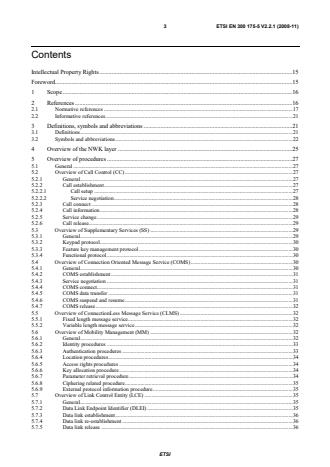
Contents
- 1 Scope
- 2 References
- 17 Final draft ETSI EN 300 175-5 V2.2.0 (2008-06)
- 2.1 Normative references
- 18 Final draft ETSI EN 300 175-5 V2.2.0 (2008-06)
- 19 Final draft ETSI EN 300 175-5 V2.2.0 (2008-06)
- 20 Final draft ETSI EN 300 175-5 V2.2.0 (2008-06)
- 21 Final draft ETSI EN 300 175-5 V2.2.0 (2008-06)
- 2.2 Informative references
- 3 Definitions, symbols and abbreviations
- 3.1 Definitions
- 22 Final draft ETSI EN 300 175-5 V2.2.0 (2008-06)
- 3.2 Symbols and abbreviations
- 23 Final draft ETSI EN 300 175-5 V2.2.0 (2008-06)
- 24 Final draft ETSI EN 300 175-5 V2.2.0 (2008-06)
- 25 Final draft ETSI EN 300 175-5 V2.2.0 (2008-06)
- 4 Overview of the NWK layer
- 26 Final draft ETSI EN 300 175-5 V2.2.0 (2008-06)
- 27 Final draft ETSI EN 300 175-5 V2.2.0 (2008-06)
- 5 Overview of procedures
- 5.1 General
- 5.2 Overview of Call Control (CC)
- 28 Final draft ETSI EN 300 175-5 V2.2.0 (2008-06)
- 29 Final draft ETSI EN 300 175-5 V2.2.0 (2008-06)
- 5.3 Overview of Supplementary Services (SS)
- 30 Final draft ETSI EN 300 175-5 V2.2.0 (2008-06)
- 5.4 Overview of Connection Oriented Message Service
- 31 Final draft ETSI EN 300 175-5 V2.2.0 (2008-06)
- 32 Final draft ETSI EN 300 175-5 V2.2.0 (2008-06)
- 5.5 Overview of ConnectionLess Message Service (CLMS)
- 5.6 Overview of Mobility Management (MM)
- 33 Final draft ETSI EN 300 175-5 V2.2.0 (2008-06)
- 34 Final draft ETSI EN 300 175-5 V2.2.0 (2008-06)
- 35 Final draft ETSI EN 300 175-5 V2.2.0 (2008-06)
- 5.7 Overview of Link Control Entity (LCE)
- 36 Final draft ETSI EN 300 175-5 V2.2.0 (2008-06)
- 37 Final draft ETSI EN 300 175-5 V2.2.0 (2008-06)
- 6 Message functional definitions
- 6.1 Overview of message structures
- 38 Final draft ETSI EN 300 175-5 V2.2.0 (2008-06)
- 6.2 Message summaries
- 39 Final draft ETSI EN 300 175-5 V2.2.0 (2008-06)
- 6.3.4.4 {COMS-NOFIFY} F=>P 6.3.4.7
- 40 Final draft ETSI EN 300 175-5 V2.2.0 (2008-06)
- 41 Final draft ETSI EN 300 175-5 V2.2.0 (2008-06)
- 6.3 S-FORMAT message functional contents
- 42 Final draft ETSI EN 300 175-5 V2.2.0 (2008-06)
- 43 Final draft ETSI EN 300 175-5 V2.2.0 (2008-06)
- 44 Final draft ETSI EN 300 175-5 V2.2.0 (2008-06)
- 45 Final draft ETSI EN 300 175-5 V2.2.0 (2008-06)
- 46 Final draft ETSI EN 300 175-5 V2.2.0 (2008-06)
- 47 Final draft ETSI EN 300 175-5 V2.2.0 (2008-06)
- 48 Final draft ETSI EN 300 175-5 V2.2.0 (2008-06)
- 49 Final draft ETSI EN 300 175-5 V2.2.0 (2008-06)
- 50 Final draft ETSI EN 300 175-5 V2.2.0 (2008-06)
- 51 Final draft ETSI EN 300 175-5 V2.2.0 (2008-06)
- 52 Final draft ETSI EN 300 175-5 V2.2.0 (2008-06)
- 53 Final draft ETSI EN 300 175-5 V2.2.0 (2008-06)
- 54 Final draft ETSI EN 300 175-5 V2.2.0 (2008-06)
- 55 Final draft ETSI EN 300 175-5 V2.2.0 (2008-06)
- 56 Final draft ETSI EN 300 175-5 V2.2.0 (2008-06)
- 57 Final draft ETSI EN 300 175-5 V2.2.0 (2008-06)
- 58 Final draft ETSI EN 300 175-5 V2.2.0 (2008-06)
- 59 Final draft ETSI EN 300 175-5 V2.2.0 (2008-06)
- 60 Final draft ETSI EN 300 175-5 V2.2.0 (2008-06)
- 61 Final draft ETSI EN 300 175-5 V2.2.0 (2008-06)
- 62 Final draft ETSI EN 300 175-5 V2.2.0 (2008-06)
- 63 Final draft ETSI EN 300 175-5 V2.2.0 (2008-06)
- 64 Final draft ETSI EN 300 175-5 V2.2.0 (2008-06)
- 65 Final draft ETSI EN 300 175-5 V2.2.0 (2008-06)
- 66 Final draft ETSI EN 300 175-5 V2.2.0 (2008-06)
- 67 Final draft ETSI EN 300 175-5 V2.2.0 (2008-06)
- 68 Final draft ETSI EN 300 175-5 V2.2.0 (2008-06)
- 69 Final draft ETSI EN 300 175-5 V2.2.0 (2008-06)
- 70 Final draft ETSI EN 300 175-5 V2.2.0 (2008-06)
- 71 Final draft ETSI EN 300 175-5 V2.2.0 (2008-06)
- 72 Final draft ETSI EN 300 175-5 V2.2.0 (2008-06)
- 73 Final draft ETSI EN 300 175-5 V2.2.0 (2008-06)
- 74 Final draft ETSI EN 300 175-5 V2.2.0 (2008-06)
- 75 Final draft ETSI EN 300 175-5 V2.2.0 (2008-06)
1 Scope
The present document is one of the parts of the specification of the Digital Enhanced Cordless Telecommunications (DECT) Common Interface (CI).
This part of the DECT CI specifies the Network (NWK) layer. The NWK layer is part 5 of the EN 300 175 and layer 3 of the DECT protocol stack.
Network layer Network layer C-plane (3) U-plane DLC layer DLC layer C-plane (2b) U-plane MAC layer (2a) Physical layer (1) Figure 1a The present document only specifies the C-plane (control plane) of the DECT NWK layer. It contains no specification for the U-plane (user plane) because the U-plane is null for all services at the DECT NWK layer. The C-plane contains all of the internal signalling information, and the NWK layer protocols are grouped into the following families of procedures:
- Call Control (CC);
- Supplementary Services (SS);
- Connection Oriented Message Service (COMS);
- ConnectionLess Message Service (CLMS);
- Mobility Management (MM);
- Link Control Entity (LCE).
The present document uses the layered model principles and terminology as described in ITU-T Recommendations X.200 [78] and X.210 [79].
The present document includes New Generation DECT, a further development of the DECT standard introducing wideband speech, improved data services, new slot types and other technical enhancements.
2 References
References are either specific (identified by date of publication and/or edition number or version number) or non-specific.
- For a specific reference, subsequent revisions do not apply.
- Non-specific reference may be made only to a complete document or a part thereof and only in the following cases:
- if it is accepted that it will be possible to use all future changes of the referenced document for the purposes of the referring document;
- for informative references.
Referenced documents which are not found to be publicly available in the expected location might be found at http://docbox.etsi.org/Reference.
ETSI
17 Final draft ETSI EN 300 175-5 V2.2.0 (2008-06)
For online referenced documents, information sufficient to identify and locate the source shall be provided. Preferably, the primary source of the referenced document should be cited, in order to ensure traceability. Furthermore, the reference should, as far as possible, remain valid for the expected life of the document. The reference shall include the method of access to the referenced document and the full network address, with the same punctuation and use of upper case and lower case letters.
NOTE: While any hyperlinks included in this clause were valid at the time of publication ETSI cannot guarantee their long term validity.
2.1 Normative references
The following referenced documents are indispensable for the application of the present document. For dated references, only the edition cited applies. For non-specific references, the latest edition of the referenced document (including any amendments) applies.
[1] ETSI EN 300 175-1: "Digital Enhanced Cordless Telecommunications (DECT); Common Interface (CI); Part 1: Overview".
[2] ETSI EN 300 175-2: "Digital Enhanced Cordless Telecommunications (DECT); Common Interface (CI); Part 2: Physical Layer (PHL)".
[3] ETSI EN 300 175-3: "Digital Enhanced Cordless Telecommunications (DECT); Common Interface (CI); Part 3: Medium Access Control (MAC) layer".
[4] ETSI EN 300 175-4: "Digital Enhanced Cordless Telecommunications (DECT); Common Interface (CI); Part 4: Data Link Control (DLC) layer".
[5] Void.
[6] ETSI EN 300 175-6: "Digital Enhanced Cordless Telecommunications (DECT); Common Interface (CI); Part 6: Identities and addressing".
[7] ETSI EN 300 175-7: "Digital Enhanced Cordless Telecommunications (DECT); Common Interface (CI); Part 7: Security features".
[8] ETSI EN 300 175-8: "Digital Enhanced Cordless Telecommunications (DECT); Common Interface (CI); Part 8: Speech and audio coding and transmission". [9] ETSI EN 300 403-1: "Integrated Services Digital Network (ISDN); Digital Subscriber Signalling System No. one (DSS1) protocol; Signalling network layer for circuit-mode basic call control; Part 1: Protocol specification [ITU-T Recommendation Q.931 (1993), modified]". [10] ETSI TS 144 018: "Digital cellular telecommunications system (Phase 2+); Mobile radio interface layer 3 specification; Radio Resource Control (RRC) protocol (3GPP TS 44.018)". [11] ISO/IEC 2022: "Information technology - Character code structure and extension techniques". [12] ETSI ETS 300 133 (all parts): "ElectroMagnetic Compatibility and Radio Spectrum Matters (ERM); Enhanced Radio MEssage System (ERMES)".
[13] ETSI EN 300 001: "Attachments to the Public Switched Telephone Network (PSTN); General technical requirements for equipment connected to an analogue subscriber interface in the PSTN". [14] ETSI EN 300 196-1: "Integrated Services Digital Network (ISDN); Generic functional protocol for the support of supplementary services; Digital Subscriber Signalling System No. one (DSS1) protocol; Part 1: Protocol specification".
[15] ETSI ETS 300 125: "Integrated Services Digital Network (ISDN); User-network interface data link layer specification; Application of CCITT Recommendations Q.920/I.440 and Q.921/I.441". [16] ITU-T Recommendation T.71: "Link Access Protocol Balanced (LAPB) extended for half-duplex physical level facility".
ETSI
18 Final draft ETSI EN 300 175-5 V2.2.0 (2008-06)
[17] ISO/IEC 8802-2: "Information technology - Telecommunications and information exchange between systems - Local and metropolitan area networks - Specific requirements - Part 2: Logical link control".
[18] ISO/IEC 8208: "Information technology - Data communications - X.25 Packet Layer Protocol for Data Terminal Equipment".
[19] ISO/IEC 8348: "Information technology - Open Systems Interconnection - Network service definition".
[20] ISO/IEC 8473 (all parts): "Information technology - Protocol for providing the connectionlessmode network service". [21] ITU-T Recommendation X.263: "Information technology - Protocol identification in the Network Layer".
[22] ETSI EN 300 130-1: "Integrated Services Digital Network (ISDN); Malicious Call Identification (MCID) supplementary service; Digital Subscriber Signalling System No. one (DSS1) protocol; Part 1: Protocol specification".
[23] ETSI EN 300 207-1: "Integrated Services Digital Network (ISDN); Diversion supplementary services; Digital Subscriber Signalling System No. One (DSS1); Part 1: Protocol specification". [24] ETSI EN 300 286-1: "Integrated Services Digital Network (ISDN); User-to-User Signalling (UUS) supplementary service; Digital Subscriber Signalling System No. one (DSS1) protocol; Part 1: Protocol specification".
[25] ETSI EN 300 092-1: "Integrated Services Digital Network (ISDN); Calling Line Identification Presentation (CLIP) supplementary service; Digital Subscriber Signalling System No. one (DSS1) protocol; Part 1: Protocol specification".
[26] ETSI EN 300 093-1: "Integrated Services Digital Network (ISDN); Calling Line Identification Restriction (CLIR) supplementary service; Digital Subscriber Signalling System No. one (DSS1) protocol; Part 1: Protocol specification".
[27] ETSI EN 300 097-1: "Integrated Services Digital Network (ISDN); Connected Line Identification Presentation (COLP) supplementary service; Digital Subscriber Signalling System No. one (DSS1) protocol; Part 1: Protocol specification".
[28] ETSI EN 300 098-1: "Integrated Services Digital Network (ISDN); Connected Line Identification Restriction (COLR) supplementary service; Digital Subscriber Signalling System No. one (DSS1) protocol; Part 1: Protocol specification".
[29] ETSI EN 300 359-1: "Integrated Services Digital Network (ISDN); Completion of Calls to Busy Subscriber (CCBS) supplementary service; Digital Subscriber Signalling System No. one (DSS1) protocol; Part 1: Protocol specification".
[30] ETSI EN 300 210-1: "Integrated Services Digital Network (ISDN); Freephone (FPH) supplementary service; Digital Subscriber Signalling System No. one (DSS1) protocol; Part 1: Protocol specification".
[31] ETSI EN 300 182-1: "Integrated Services Digital Network (ISDN); Advice of Charge (AOC) supplementary service; Digital Subscriber Signalling System No. one (DSS1) protocol; Part 1: Protocol specification".
[32] ETSI EN 300 061-1: "Integrated Services Digital Network (ISDN); Subaddressing (SUB) supplementary service; Digital Subscriber Signalling System No. one (DSS1) protocol; Part 1: Protocol specification".
[33] ETSI EN 300 055-1: "Integrated Services Digital Network (ISDN); Terminal Portability (TP) supplementary service; Digital Subscriber Signalling System No. one (DSS1) protocol; Part 1: Protocol specification".
ETSI
19 Final draft ETSI EN 300 175-5 V2.2.0 (2008-06)
[34] ETSI EN 300 058-1: "Integrated Services Digital Network (ISDN); Call Waiting (CW) supplementary service; Digital subscriber Signalling System No. one (DSS1) protocol; Part 1: Protocol specification".
[35] ETSI EN 300 064-1: "Integrated Services Digital Network (ISDN); Direct Dialling In (DDI) supplementary service; Digital Subscriber Signalling System No. one (DSS1) protocol; Part 1: Protocol specification".
[36] ETSI EN 300 052-1: "Integrated Services Digital Network (ISDN); Multiple Subscriber Number (MSN) supplementary service; Digital Subscriber Signalling System No. one (DSS1) protocol; Part 1: Protocol specification".
[37] ETSI EN 300 138-1: "Integrated Services Digital Network (ISDN); Closed User Group (CUG) supplementary service; Digital Subscriber Signalling System No. one (DSS1) protocol; Part 1: Protocol specification".
[38] ETSI EN 300 369-1: "Integrated Services Digital Network (ISDN); Explicit Call Transfer (ECT) supplementary service; Digital Subscriber Signalling System No. one (DSS1) protocol; Part 1: Protocol specification".
[39] ETSI EN 300 185-1: "Integrated Services Digital Network (ISDN); Conference call, add-on (CONF) supplementary service; Digital Subscriber Signalling System No. one (DSS1) protocol; Part 1: Protocol specification".
[40] ETSI EN 300 141-1: "Integrated Services Digital Network (ISDN); Call Hold (HOLD) supplementary service; Digital Subscriber Signalling System No. one (DSS1) protocol; Part 1: Protocol specification".
[41] ETSI EN 300 188-1: "Integrated Services Digital Network (ISDN); Three-Party (3PTY) supplementary service; Digital Subscriber Signalling System No. one (DSS1) protocol; Part 1: Protocol specification".
[42] ITU-T Recommendation E.182: "Application of tones and recorded announcements in telephone services".
[43] ETSI TS 144 006: "Digital cellular telecommunications system (Phase 2+); Mobile Station - Base Stations System (MS - BSS) Interface Data Link (DL) layer specification (3GPP TS 44.006)". [44] ITU-T Recommendation X.25: "Interface between Data Terminal Equipment (DTE) and Data Circuit-terminating Equipment (DCE) for terminals operating in the packet mode and connected to public data networks by dedicated circuit".
[45] ITU-T Recommendation T.70: "Network-independent basic transport service for the telematic services".
[46] ISO 1745: "Information processing - Basic mode control procedures for data communication systems".
[47] ISO/IEC 8859-1: "Information technology - 8-bit single-byte coded graphic character sets - Part 1: Latin alphabet No. 1".
[48] ETSI EN 300 757: "Digital Enhanced Cordless Telecommunications (DECT); Low Rate Messaging Service (LRMS); including Short Messaging Service (SMS)". [49] ETSI EN 300 370: "Digital Enhanced Cordless Telecommunications (DECT); Global System for Mobile communications (GSM); DECT/GSM Interworking Profile (IWP); Access and mapping (protocol/procedure description for 3,1 kHz speech service)".
[50] ETSI EN 300 765-1: "Digital Enhanced Cordless Telecommunications (DECT); Radio in the Local Loop (RLL) Access Profile (RAP); Part 1: Basic telephony services". [51] ETSI EN 300 444: "Digital Enhanced Cordless Telecommunications (DECT); Generic Access Profile (GAP)".
[52] ISO/IEC 8859-15: "Information technology - 8-bit single-byte coded graphic character sets - Part 15: Latin alphabet No. 9".
ETSI
20 Final draft ETSI EN 300 175-5 V2.2.0 (2008-06)
[53] ISO/IEC 8859-7: "Information technology - 8-bit single-byte coded graphic character sets - Part 7: Latin/Greek alphabet".
[54] ISO/IEC 8859-9: "Information technology - 8-bit single-byte coded graphic character sets - Part 9: Latin alphabet No. 5".
[55] ITU-T Recommendation V.110: "Support by an ISDN of data terminal equipments with V-Series type interfaces".
[56] ITU-T Recommendation V.120: "Support by an ISDN of data terminal equipment with V-Series type interfaces with provision for statistical multiplexing".
[57] ITU-T Recommendation X.30: "Support of X.21, X.21 bis and X.20 bis based Data Terminal Equipments (DTEs) by an Integrated Services Digital Network (ISDN)". [58] ETSI EN 300 765-2: "Digital Enhanced Cordless Telecommunications (DECT); Radio in the Local Loop (RLL) Access Profile (RAP); Part 2: Advanced telephony services". [59] ISO/IEC 646: "Information technology - ISO 7-bit coded character set for information interchange".
[60] ITU-T Recommendation X.400: "Message handling system and service overview". [61] ETSI TS 101 863 (all parts): "Digital Enhanced Cordless Telecommunications (DECT); DECT/UMTS Interworking Profile (IWP)".
[62] ETSI TS 124 008: "Digital cellular telecommunications system (Phase 2+); Universal Mobile Telecommunications System (UMTS); Mobile radio interface Layer 3 specification; Core network protocols; Stage 3 (3GPP TS 24.008)".
[63] ETSI EN 300 700: "Digital Enhanced Cordless Telecommunications (DECT); Wireless Relay Station (WRS)".
[64] IETF RFC 791 (STD5): "Internet Protocol".
[65] IETF RFC 1661 (STD51): "The Point-to-Point Protocol (PPP)". [66] IETF RFC 2460: "Internet Protocol, Version 6 (IPv6) Specification". [67] IETF RFC 3261: "SIP: Session Initiation Protocol".
[68] ITU-T Recommendation V.42: "Error-correcting procedures for DCEs using asynchronous-tosynchronous conversion". [69] ETSI TS 102 265: "Digital Enhanced Cordless Telecommunications (DECT); DECT access to IP networks".
[70] ETSI TS 102 342: "Digital Enhanced Cordless Telecommunications (DECT); Cordless multimedia communication system; Open Data Access Profile (ODAP)".
[71] ETSI TS 102 379: "Digital Enhanced Cordless Telecommunications (DECT); Fixed network Multimedia Message Service (F-MMS) Interworking Profile".
[72] ETSI EN 301 649: "Digital Enhanced Cordless Telecommunications (DECT); DECT Packet Radio Service (DPRS)".
[73] ETSI TS 102 527-1: "Digital Enhanced Cordless Telecommunications (DECT); New Generation DECT; Part 1: Wideband speech".
[74] ETSI TS 102 527-2: "Digital Enhanced Cordless Telecommunications (DECT); New Generation DECT; Part 2: Support of transparent IP packet data".
[75] ETSI TS 102 527-3: "Digital Enhanced Cordless Telecommunications (DECT); New Generation DECT; Part 3: Extended wideband speech services".
ETSI
21 Final draft ETSI EN 300 175-5 V2.2.0 (2008-06)
2.2 Informative references
The following referenced documents are not essential to the use of the present document but they assist the user with regard to a particular subject area. For non-specific references, the latest version of the referenced document (including any amendments) applies.
[76] ETSI TR 101 178: "Digital Enhanced Cordless Telecommunications (DECT); A High Level Guide to the DECT Standardization".
[77] ETSI ETR 043: "Digital Enhanced Cordless Telecommunications (DECT); Common Interface (CI); Services and facilities requirements specification".
[78] ITU-T Recommendation X.200: "Information technology - Open Systems Interconnection - Basic Reference Model: The basic model".
[79] ITU-T Recommendation X.210: "Information technology - Open systems interconnection - Basic Reference Model: Conventions for the definition of OSI services". [80] ITU-T Recommendation T.50: "International Reference Alphabet (IRA) (Formerly International Alphabet No. 5 or IA5) - Information technology - 7-bit coded character set for information interchange".
[81] ETSI I-ETS 300 022: "Digital cellular telecommunications system (Phase 1) (GSM); Mobile radio interface; Layer 3 specification".
[82] ITU-T Recommendation E.163: "Numbering plan for the international telephone service". [83] ITU-T Recommendation E.164: "The international public telecommunication numbering plan". [84] ITU-T Recommendation X.121: "International numbering plan for public data networks". [85] ITU-T Recommendation I.460: "Multiplexing, rate adaption and support of existing interfaces". [86] IEEE 802.3: "IEEE 802.3 Systems Networking Guide: How to Optimize Your Network Using the ISO/IEC 8802-3 Carrier Sense Multiple Access with Collision Detection (CSMA/CD) Standard". [87] ITU-T Recommendation Q.921: "ISDN user-network interface - Data link layer specification". [88] ETSI EN 301 238: "Digital Enhanced Cordless Telecommunications (DECT); Data Service Profile D Class 2 (D 2)".
[89] ETSI ETS 300 435 (historic): "Digital Enhanced Cordless Telecommunications (DECT); Data Service Profile A/B Class 1 (A/B 1)".
[90] ITU-T Recommendation Q.931: "ISDN user-network interface layer 3 specification for basic call control".
3 Definitions, symbols and abbreviations
3.1 Definitions
For the purposes of the present document, the terms and definitions given in EN 300 175-1 [1], EN 300 175-8 [8] and the following apply:
active terminal/member: member of a DCDL-net that is powered-up, has locked to the MASTER and has announced itself as being present to the MASTER DECT Local Network (DL-net): local network comprising number of DECT terminals capable of inter-communicating which may but need not be connected to an external network LAPC: DLC layer C-plane protocol entity ETSI
22 Final draft ETSI EN 300 175-5 V2.2.0 (2008-06)
MASTER: specially dedicated terminal determining the DCDL-net synchronization and providing means of intra DCDL-net control and exchange of information NOTE: By definition a MASTER is always an Active terminal.
RS: value used to establish authentication session keys XRES1: eXpected RESponse calculated by a FT XRES2: eXpected RESponse calculated by a PT
3.2 Symbols and abbreviations
For the purposes of the present document, the following symbols and abbreviations apply:
3PTY Three ParTY AC Authentication Code ACC ACCount number ACK ACKnowledgement ADPCM Adaptive Differential Pulse Code Modulation AK Authentication Key AOC Advice Of Charge ARC Access Rights Class ARD Access Rights Details ARI Access Rights Identity A-VOL Adaptive - VOLume BACN Bank ACcount Number BCD Binary Coded Decimal BRAT Basic Rate Adaption Service C/L ConnectionLess mode C/O Connection Oriented mode CACN Credit card ACcount Number CAP CTM Access Profile CBI Collective Broadcast Identifier CC Call Control CCBS Completion of Calls to Busy Subscriber CCEI Call Control Endpoint Identifier CD Call Deflection C higher layer signalling Channel (fast) F CFB Call Forwarding Busy CFNR Call Forwarding No Reply CFU Call Forwarding Unconditional CH Call Hold CI Cell Identity CI Common Interface CISS Call Independent Supplementary Services CK Cipher Key CLEI CLMS Endpoint Identifier CLIP Calling Line Identification Presentation CLIR Calling Line Identification Restriction CLMS ConnectionLess Message Service CNIP Calling Name Identification Presentation COEI COMS Endpoint Identifier COLP COnnected Line identification Presentation COLR COnnected Line identification Restriction COMS Connection Oriented Message Service CONF CONFerence call add-on C-plane Control plane CRFP Cordless Radio Fixed Part CRSS Call Related Supplementary Services CSDb Common System Database CTA Cordless Terminal Adapter ETSI
...
Contents
- 1 Scope
- 2 References
- 17 ETSI EN 300 175-5 V2.2.1 (2008-11)
- 2.1 Normative references
- 18 ETSI EN 300 175-5 V2.2.1 (2008-11)
- 19 ETSI EN 300 175-5 V2.2.1 (2008-11)
- 20 ETSI EN 300 175-5 V2.2.1 (2008-11)
- 21 ETSI EN 300 175-5 V2.2.1 (2008-11)
- 2.2 Informative references
- 3 Definitions, symbols and abbreviations
- 3.1 Definitions
- 22 ETSI EN 300 175-5 V2.2.1 (2008-11)
- 3.2 Symbols and abbreviations
- 23 ETSI EN 300 175-5 V2.2.1 (2008-11)
- 24 ETSI EN 300 175-5 V2.2.1 (2008-11)
- 25 ETSI EN 300 175-5 V2.2.1 (2008-11)
- 4 Overview of the NWK layer
- 26 ETSI EN 300 175-5 V2.2.1 (2008-11)
- 27 ETSI EN 300 175-5 V2.2.1 (2008-11)
- 5 Overview of procedures
- 5.1 General
- 5.2 Overview of Call Control (CC)
- 28 ETSI EN 300 175-5 V2.2.1 (2008-11)
- 29 ETSI EN 300 175-5 V2.2.1 (2008-11)
- 5.3 Overview of Supplementary Services (SS)
- 30 ETSI EN 300 175-5 V2.2.1 (2008-11)
- 5.4 Overview of Connection Oriented Message Service
- 31 ETSI EN 300 175-5 V2.2.1 (2008-11)
- 32 ETSI EN 300 175-5 V2.2.1 (2008-11)
- 5.5 Overview of ConnectionLess Message Service (CLMS)
- 5.6 Overview of Mobility Management (MM)
- 33 ETSI EN 300 175-5 V2.2.1 (2008-11)
- 34 ETSI EN 300 175-5 V2.2.1 (2008-11)
- 35 ETSI EN 300 175-5 V2.2.1 (2008-11)
- 5.7 Overview of Link Control Entity (LCE)
- 36 ETSI EN 300 175-5 V2.2.1 (2008-11)
- 37 ETSI EN 300 175-5 V2.2.1 (2008-11)
- 6 Message functional definitions
- 6.1 Overview of message structures
- 38 ETSI EN 300 175-5 V2.2.1 (2008-11)
- 6.2 Message summaries
- 39 ETSI EN 300 175-5 V2.2.1 (2008-11)
- 6.3.4.4 {COMS-NOFIFY} F=>P 6.3.4.7
- 40 ETSI EN 300 175-5 V2.2.1 (2008-11)
- 41 ETSI EN 300 175-5 V2.2.1 (2008-11)
- 6.3 S-FORMAT message functional contents
- 42 ETSI EN 300 175-5 V2.2.1 (2008-11)
- 43 ETSI EN 300 175-5 V2.2.1 (2008-11)
- 44 ETSI EN 300 175-5 V2.2.1 (2008-11)
- 45 ETSI EN 300 175-5 V2.2.1 (2008-11)
- 46 ETSI EN 300 175-5 V2.2.1 (2008-11)
- 47 ETSI EN 300 175-5 V2.2.1 (2008-11)
- 48 ETSI EN 300 175-5 V2.2.1 (2008-11)
- 49 ETSI EN 300 175-5 V2.2.1 (2008-11)
- 50 ETSI EN 300 175-5 V2.2.1 (2008-11)
- 51 ETSI EN 300 175-5 V2.2.1 (2008-11)
- 52 ETSI EN 300 175-5 V2.2.1 (2008-11)
- 53 ETSI EN 300 175-5 V2.2.1 (2008-11)
- 54 ETSI EN 300 175-5 V2.2.1 (2008-11)
- 55 ETSI EN 300 175-5 V2.2.1 (2008-11)
- 56 ETSI EN 300 175-5 V2.2.1 (2008-11)
- 57 ETSI EN 300 175-5 V2.2.1 (2008-11)
- 58 ETSI EN 300 175-5 V2.2.1 (2008-11)
- 59 ETSI EN 300 175-5 V2.2.1 (2008-11)
- 60 ETSI EN 300 175-5 V2.2.1 (2008-11)
- 61 ETSI EN 300 175-5 V2.2.1 (2008-11)
- 62 ETSI EN 300 175-5 V2.2.1 (2008-11)
- 63 ETSI EN 300 175-5 V2.2.1 (2008-11)
- 64 ETSI EN 300 175-5 V2.2.1 (2008-11)
- 65 ETSI EN 300 175-5 V2.2.1 (2008-11)
- 66 ETSI EN 300 175-5 V2.2.1 (2008-11)
- 67 ETSI EN 300 175-5 V2.2.1 (2008-11)
- 68 ETSI EN 300 175-5 V2.2.1 (2008-11)
- 69 ETSI EN 300 175-5 V2.2.1 (2008-11)
- 70 ETSI EN 300 175-5 V2.2.1 (2008-11)
- 71 ETSI EN 300 175-5 V2.2.1 (2008-11)
- 72 ETSI EN 300 175-5 V2.2.1 (2008-11)
- 73 ETSI EN 300 175-5 V2.2.1 (2008-11)
- 74 ETSI EN 300 175-5 V2.2.1 (2008-11)
- 75 ETSI EN 300 175-5 V2.2.1 (2008-11)
1 Scope
The present document is one of the parts of the specification of the Digital Enhanced Cordless Telecommunications (DECT) Common Interface (CI).
This part of the DECT CI specifies the Network (NWK) layer. The NWK layer is part 5 of the EN 300 175 and layer 3 of the DECT protocol stack.
Network layer Network layer C-plane (3) U-plane DLC layer DLC layer C-plane (2b) U-plane MAC layer (2a) Physical layer (1) Figure 1a The present document only specifies the C-plane (control plane) of the DECT NWK layer. It contains no specification for the U-plane (user plane) because the U-plane is null for all services at the DECT NWK layer. The C-plane contains all of the internal signalling information, and the NWK layer protocols are grouped into the following families of procedures:
- Call Control (CC);
- Supplementary Services (SS);
- Connection Oriented Message Service (COMS);
- ConnectionLess Message Service (CLMS);
- Mobility Management (MM);
- Link Control Entity (LCE).
The present document uses the layered model principles and terminology as described in ITU-T Recommendations X.200 [i.3] and X.210 [i.4].
The present document includes New Generation DECT, a further development of the DECT standard introducing wideband speech, improved data services, new slot types and other technical enhancements.
2 References
References are either specific (identified by date of publication and/or edition number or version number) or non-specific.
- For a specific reference, subsequent revisions do not apply.
- Non-specific reference may be made only to a complete document or a part thereof and only in the following cases:
- if it is accepted that it will be possible to use all future changes of the referenced document for the purposes of the referring document;
- for informative references.
Referenced documents which are not found to be publicly available in the expected location might be found at http://docbox.etsi.org/Reference.
ETSI
17 ETSI EN 300 175-5 V2.2.1 (2008-11)
For online referenced documents, information sufficient to identify and locate the source shall be provided. Preferably, the primary source of the referenced document should be cited, in order to ensure traceability. Furthermore, the reference should, as far as possible, remain valid for the expected life of the document. The reference shall include the method of access to the referenced document and the full network address, with the same punctuation and use of upper case and lower case letters.
NOTE: While any hyperlinks included in this clause were valid at the time of publication ETSI cannot guarantee their long term validity.
2.1 Normative references
The following referenced documents are indispensable for the application of the present document. For dated references, only the edition cited applies. For non-specific references, the latest edition of the referenced document (including any amendments) applies.
[1] ETSI EN 300 175-1: "Digital Enhanced Cordless Telecommunications (DECT); Common Interface (CI); Part 1: Overview".
[2] ETSI EN 300 175-2: "Digital Enhanced Cordless Telecommunications (DECT); Common Interface (CI); Part 2: Physical Layer (PHL)".
[3] ETSI EN 300 175-3: "Digital Enhanced Cordless Telecommunications (DECT); Common Interface (CI); Part 3: Medium Access Control (MAC) layer".
[4] ETSI EN 300 175-4: "Digital Enhanced Cordless Telecommunications (DECT); Common Interface (CI); Part 4: Data Link Control (DLC) layer".
[5] Void.
[6] ETSI EN 300 175-6: "Digital Enhanced Cordless Telecommunications (DECT); Common Interface (CI); Part 6: Identities and addressing".
[7] ETSI EN 300 175-7: "Digital Enhanced Cordless Telecommunications (DECT); Common Interface (CI); Part 7: Security features".
[8] ETSI EN 300 175-8: "Digital Enhanced Cordless Telecommunications (DECT); Common Interface (CI); Part 8: Speech and audio coding and transmission". [9] ETSI EN 300 403-1: "Integrated Services Digital Network (ISDN); Digital Subscriber Signalling System No. one (DSS1) protocol; Signalling network layer for circuit-mode basic call control; Part 1: Protocol specification [ITU-T Recommendation Q.931 (1993), modified]". [10] ETSI TS 144 018: "Digital cellular telecommunications system (Phase 2+); Mobile radio interface layer 3 specification; Radio Resource Control (RRC) protocol (3GPP TS 44.018)". [11] ISO/IEC 2022: "Information technology - Character code structure and extension techniques". [12] ETSI ETS 300 133 (all parts): "ElectroMagnetic Compatibility and Radio Spectrum Matters (ERM); Enhanced Radio MEssage System (ERMES)".
[13] ETSI EN 300 001: "Attachments to the Public Switched Telephone Network (PSTN); General technical requirements for equipment connected to an analogue subscriber interface in the PSTN". [14] ETSI EN 300 196-1: "Integrated Services Digital Network (ISDN); Generic functional protocol for the support of supplementary services; Digital Subscriber Signalling System No. one (DSS1) protocol; Part 1: Protocol specification".
[15] ETSI ETS 300 125: "Integrated Services Digital Network (ISDN); User-network interface data link layer specification; Application of CCITT Recommendations Q.920/I.440 and Q.921/I.441". [16] ITU-T Recommendation T.71: "Link Access Protocol Balanced (LAPB) extended for half-duplex physical level facility".
ETSI
18 ETSI EN 300 175-5 V2.2.1 (2008-11)
[17] ISO/IEC 8802-2: "Information technology - Telecommunications and information exchange between systems - Local and metropolitan area networks - Specific requirements - Part 2: Logical link control".
[18] ISO/IEC 8208: "Information technology - Data communications - X.25 Packet Layer Protocol for Data Terminal Equipment".
[19] ISO/IEC 8348: "Information technology - Open Systems Interconnection - Network service definition".
[20] ISO/IEC 8473 (all parts): "Information technology - Protocol for providing the connectionlessmode network service". [21] ITU-T Recommendation X.263: "Information technology - Protocol identification in the Network Layer".
[22] ETSI EN 300 130-1: "Integrated Services Digital Network (ISDN); Malicious Call Identification (MCID) supplementary service; Digital Subscriber Signalling System No. one (DSS1) protocol; Part 1: Protocol specification".
[23] ETSI EN 300 207-1: "Integrated Services Digital Network (ISDN); Diversion supplementary services; Digital Subscriber Signalling System No. One (DSS1); Part 1: Protocol specification". [24] ETSI EN 300 286-1: "Integrated Services Digital Network (ISDN); User-to-User Signalling (UUS) supplementary service; Digital Subscriber Signalling System No. one (DSS1) protocol; Part 1: Protocol specification".
[25] ETSI EN 300 092-1: "Integrated Services Digital Network (ISDN); Calling Line Identification Presentation (CLIP) supplementary service; Digital Subscriber Signalling System No. one (DSS1) protocol; Part 1: Protocol specification".
[26] ETSI EN 300 093-1: "Integrated Services Digital Network (ISDN); Calling Line Identification Restriction (CLIR) supplementary service; Digital Subscriber Signalling System No. one (DSS1) protocol; Part 1: Protocol specification".
[27] ETSI EN 300 097-1: "Integrated Services Digital Network (ISDN); Connected Line Identification Presentation (COLP) supplementary service; Digital Subscriber Signalling System No. one (DSS1) protocol; Part 1: Protocol specification".
[28] ETSI EN 300 098-1: "Integrated Services Digital Network (ISDN); Connected Line Identification Restriction (COLR) supplementary service; Digital Subscriber Signalling System No. one (DSS1) protocol; Part 1: Protocol specification".
[29] ETSI EN 300 359-1: "Integrated Services Digital Network (ISDN); Completion of Calls to Busy Subscriber (CCBS) supplementary service; Digital Subscriber Signalling System No. one (DSS1) protocol; Part 1: Protocol specification".
[30] ETSI EN 300 210-1: "Integrated Services Digital Network (ISDN); Freephone (FPH) supplementary service; Digital Subscriber Signalling System No. one (DSS1) protocol; Part 1: Protocol specification".
[31] ETSI EN 300 182-1: "Integrated Services Digital Network (ISDN); Advice of Charge (AOC) supplementary service; Digital Subscriber Signalling System No. one (DSS1) protocol; Part 1: Protocol specification".
[32] ETSI EN 300 061-1: "Integrated Services Digital Network (ISDN); Subaddressing (SUB) supplementary service; Digital Subscriber Signalling System No. one (DSS1) protocol; Part 1: Protocol specification".
[33] ETSI EN 300 055-1: "Integrated Services Digital Network (ISDN); Terminal Portability (TP) supplementary service; Digital Subscriber Signalling System No. one (DSS1) protocol; Part 1: Protocol specification".
ETSI
19 ETSI EN 300 175-5 V2.2.1 (2008-11)
[34] ETSI EN 300 058-1: "Integrated Services Digital Network (ISDN); Call Waiting (CW) supplementary service; Digital subscriber Signalling System No. one (DSS1) protocol; Part 1: Protocol specification".
[35] ETSI EN 300 064-1: "Integrated Services Digital Network (ISDN); Direct Dialling In (DDI) supplementary service; Digital Subscriber Signalling System No. one (DSS1) protocol; Part 1: Protocol specification".
[36] ETSI EN 300 052-1: "Integrated Services Digital Network (ISDN); Multiple Subscriber Number (MSN) supplementary service; Digital Subscriber Signalling System No. one (DSS1) protocol; Part 1: Protocol specification".
[37] ETSI EN 300 138-1: "Integrated Services Digital Network (ISDN); Closed User Group (CUG) supplementary service; Digital Subscriber Signalling System No. one (DSS1) protocol; Part 1: Protocol specification".
[38] ETSI EN 300 369-1: "Integrated Services Digital Network (ISDN); Explicit Call Transfer (ECT) supplementary service; Digital Subscriber Signalling System No. one (DSS1) protocol; Part 1: Protocol specification".
[39] ETSI EN 300 185-1: "Integrated Services Digital Network (ISDN); Conference call, add-on (CONF) supplementary service; Digital Subscriber Signalling System No. one (DSS1) protocol; Part 1: Protocol specification".
[40] ETSI EN 300 141-1: "Integrated Services Digital Network (ISDN); Call Hold (HOLD) supplementary service; Digital Subscriber Signalling System No. one (DSS1) protocol; Part 1: Protocol specification".
[41] ETSI EN 300 188-1: "Integrated Services Digital Network (ISDN); Three-Party (3PTY) supplementary service; Digital Subscriber Signalling System No. one (DSS1) protocol; Part 1: Protocol specification".
[42] ITU-T Recommendation E.182: "Application of tones and recorded announcements in telephone services".
[43] ETSI TS 144 006: "Digital cellular telecommunications system (Phase 2+); Mobile Station - Base Stations System (MS - BSS) Interface Data Link (DL) layer specification (3GPP TS 44.006)". [44] ITU-T Recommendation X.25: "Interface between Data Terminal Equipment (DTE) and Data Circuit-terminating Equipment (DCE) for terminals operating in the packet mode and connected to public data networks by dedicated circuit".
[45] ITU-T Recommendation T.70: "Network-independent basic transport service for the telematic services".
[46] ISO 1745: "Information processing - Basic mode control procedures for data communication systems".
[47] ISO/IEC 8859-1: "Information technology - 8-bit single-byte coded graphic character sets - Part 1: Latin alphabet No. 1".
[48] ETSI EN 300 757: "Digital Enhanced Cordless Telecommunications (DECT); Low Rate Messaging Service (LRMS); including Short Messaging Service (SMS)". [49] ETSI EN 300 370: "Digital Enhanced Cordless Telecommunications (DECT); Global System for Mobile communications (GSM); DECT/GSM Interworking Profile (IWP); Access and mapping (protocol/procedure description for 3,1 kHz speech service)".
[50] ETSI EN 300 765-1: "Digital Enhanced Cordless Telecommunications (DECT); Radio in the Local Loop (RLL) Access Profile (RAP); Part 1: Basic telephony services". [51] ETSI EN 300 444: "Digital Enhanced Cordless Telecommunications (DECT); Generic Access Profile (GAP)".
[52] ISO/IEC 8859-15: "Information technology - 8-bit single-byte coded graphic character sets - Part 15: Latin alphabet No. 9".
ETSI
20 ETSI EN 300 175-5 V2.2.1 (2008-11)
[53] ISO/IEC 8859-7: "Information technology - 8-bit single-byte coded graphic character sets - Part 7: Latin/Greek alphabet".
[54] ISO/IEC 8859-9: "Information technology - 8-bit single-byte coded graphic character sets - Part 9: Latin alphabet No. 5".
[55] ITU-T Recommendation V.110: "Support by an ISDN of data terminal equipments with V-Series type interfaces".
[56] ITU-T Recommendation V.120: "Support by an ISDN of data terminal equipment with V-Series type interfaces with provision for statistical multiplexing".
[57] ITU-T Recommendation X.30: "Support of X.21, X.21 bis and X.20 bis based Data Terminal Equipments (DTEs) by an Integrated Services Digital Network (ISDN)". [58] ETSI EN 300 765-2: "Digital Enhanced Cordless Telecommunications (DECT); Radio in the Local Loop (RLL) Access Profile (RAP); Part 2: Advanced telephony services". [59] ISO/IEC 646: "Information technology - ISO 7-bit coded character set for information interchange".
[60] ITU-T Recommendation X.400: "Message handling system and service overview". [61] ETSI TS 101 863 (all parts): "Digital Enhanced Cordless Telecommunications (DECT); DECT/UMTS Interworking Profile (IWP)".
[62] ETSI TS 124 008: "Digital cellular telecommunications system (Phase 2+); Universal Mobile Telecommunications System (UMTS); Mobile radio interface Layer 3 specification; Core network protocols; Stage 3 (3GPP TS 24.008)".
[63] ETSI EN 300 700: "Digital Enhanced Cordless Telecommunications (DECT); Wireless Relay Station (WRS)".
[64] IETF RFC 791 (STD5): "Internet Protocol".
[65] IETF RFC 1661 (STD51): "The Point-to-Point Protocol (PPP)". [66] IETF RFC 2460: "Internet Protocol, Version 6 (IPv6) Specification". [67] IETF RFC 3261: "SIP: Session Initiation Protocol".
[68] ITU-T Recommendation V.42: "Error-correcting procedures for DCEs using asynchronous-tosynchronous conversion". [69] ETSI TS 102 265: "Digital Enhanced Cordless Telecommunications (DECT); DECT access to IP networks".
[70] ETSI TS 102 342: "Digital Enhanced Cordless Telecommunications (DECT); Cordless multimedia communication system; Open Data Access Profile (ODAP)".
[71] ETSI TS 102 379: "Digital Enhanced Cordless Telecommunications (DECT); Fixed network Multimedia Message Service (F-MMS) Interworking Profile".
[72] ETSI EN 301 649: "Digital Enhanced Cordless Telecommunications (DECT); DECT Packet Radio Service (DPRS)".
[73] ETSI TS 102 527-1: "Digital Enhanced Cordless Telecommunications (DECT); New Generation DECT; Part 1: Wideband speech".
[74] ETSI TS 102 527-2: "Digital Enhanced Cordless Telecommunications (DECT); New Generation DECT; Part 2: Support of transparent IP packet data".
[75] ETSI TS 102 527-3: "Digital Enhanced Cordless Telecommunications (DECT); New Generation DECT; Part 3: Extended wideband speech services".
ETSI
21 ETSI EN 300 175-5 V2.2.1 (2008-11)
2.2 Informative references
The following referenced documents are not essential to the use of the present document but they assist the user with regard to a particular subject area. For non-specific references, the latest version of the referenced document (including any amendments) applies.
[i.1] ETSI TR 101 178: "Digital Enhanced Cordless Telecommunications (DECT); A High Level Guide to the DECT Standardization".
[i.2] ETSI ETR 043: "Digital Enhanced Cordless Telecommunications (DECT); Common Interface (CI); Services and facilities requirements specification".
[i.3] ITU-T Recommendation X.200: "Information technology - Open Systems Interconnection - Basic Reference Model: The basic model".
[i.4] ITU-T Recommendation X.210: "Information technology - Open systems interconnection - Basic Reference Model: Conventions for the definition of OSI services". [i.5] ITU-T Recommendation T.50: "International Reference Alphabet (IRA) (Formerly International Alphabet No. 5 or IA5) - Information technology - 7-bit coded character set for information interchange".
[i.6] ETSI I-ETS 300 022: "Digital cellular telecommunications system (Phase 1) (GSM); Mobile radio interface; Layer 3 specification".
[i.7] ITU-T Recommendation E.163: "Numbering plan for the international telephone service". [i.8] ITU-T Recommendation E.164: "The international public telecommunication numbering plan". [i.9] ITU-T Recommendation X.121: "International numbering plan for public data networks". [i.10] ITU-T Recommendation I.460: "Multiplexing, rate adaption and support of existing interfaces". [i.11] IEEE 802.3: "IEEE 802.3 Systems Networking Guide: How to Optimize Your Network Using the ISO/IEC 8802-3 Carrier Sense Multiple Access with Collision Detection (CSMA/CD) Standard". [i.12] ITU-T Recommendation Q.921: "ISDN user-network interface - Data link layer specification". [i.13] ETSI EN 301 238: "Digital Enhanced Cordless Telecommunications (DECT); Data Service Profile D Class 2 (D 2)".
[i.14] ETSI ETS 300 435 (historic): "Digital Enhanced Cordless Telecommunications (DECT); Data Service Profile A/B Class 1 (A/B 1)".
[i.15] ITU-T Recommendation Q.931: "ISDN user-network interface layer 3 specification for basic call control".
3 Definitions, symbols and abbreviations
3.1 Definitions
For the purposes of the present document, the terms and definitions given in EN 300 175-1 [1], EN 300 175-8 [8] and the following apply:
active terminal/member: member of a DCDL-net that is powered-up, has locked to the MASTER and has announced itself as being present to the MASTER DECT Local Network (DL-net): local network comprising number of DECT terminals capable of inter-communicating which may but need not be connected to an external network LAPC: DLC layer C-plane protocol entity ETSI
22 ETSI EN 300 175-5 V2.2.1 (2008-11)
MASTER: specially dedicated terminal determining the DCDL-net synchronization and providing means of intra DCDL-net control and exchange of information NOTE: By definition a MASTER is always an Active terminal.
RS: value used to establish authentication session keys XRES1: eXpected RESponse calculated by a FT XRES2: eXpected RESponse calculated by a PT
3.2 Symbols and abbreviations
For the purposes of the present document, the following symbols and abbreviations apply:
3PTY Three ParTY AC Authentication Code ACC ACCount number ACK ACKnowledgement ADPCM Adaptive Differential Pulse Code Modulation AK Authentication Key AOC Advice Of Charge ARC Access Rights Class ARD Access Rights Details ARI Access Rights Identity A-VOL Adaptive - VOLume BACN Bank ACcount Number BCD Binary Coded Decimal BRAT Basic Rate Adaption Service C/L ConnectionLess mode C/O Connection Oriented mode CACN Credit card ACcount Number CAP CTM Access Profile CBI Collective Broadcast Identifier CC Call Control CCBS Completion of Calls to Busy Subscriber CCEI Call Control Endpoint Identifier CD Call Deflection C higher layer signalling Channel (fast) F CFB Call Forwarding Busy CFNR Call Forwarding No Reply CFU Call Forwarding Unconditional CH Call Hold CI Cell Identity CI Common Interface CISS Call Independent Supplementary Services CK Cipher Key CLEI CLMS Endpoint Identifier CLIP Calling Line Identification Presentation CLIR Calling Line Identification Restriction CLMS ConnectionLess Message Service CNIP Calling Name Identification Presentation COEI COMS Endpoint Identifier COLP COnnected Line identification Presentation COLR COnnected Line identification Restriction COMS Connection Oriented Message Service CONF CONFerence call add-on C-plane Control plane CRFP Cordless Radio Fixed Part CRSS Call Related Supplementary Services CSDb Common System Database CTA Cordless Terminal Adapter ETSI
...
2003-01.Slovenski inštitut za standardizacijo. Razmnoževanje celote ali delov tega standarda ni dovoljeno.Digital Enhanced Cordless Telecommunications (DECT) - Common Interface (CI) - Part 5: Network (NWK) layer35.100.30Omrežni slojNetwork layer33.070.30'(&7Digital Enhanced Cordless Telecommunications (DECT)ICS:Ta slovenski standard je istoveten z:EN 300 175-5 Version 2.2.1SIST EN 300 175-5 V2.2.1:2009en01-januar-2009SIST EN 300 175-5 V2.2.1:2009SLOVENSKI
STANDARD
ETSI ETSI EN 300 175-5 V2.2.1 (2008-11) 2
Reference REN/DECT-000248-5 Keywords DECT, IMT-2000, mobility, radio, TDD, TDMA ETSI 650 Route des Lucioles F-06921 Sophia Antipolis Cedex - FRANCE
Tel.: +33 4 92 94 42 00
Fax: +33 4 93 65 47 16
Siret N° 348 623 562 00017 - NAF 742 C Association à but non lucratif enregistrée à la Sous-Préfecture de Grasse (06) N° 7803/88
Important notice Individual copies of the present document can be downloaded from: http://www.etsi.org The present document may be made available in more than one electronic version or in print. In any case of existing or perceived difference in contents between such versions, the reference version is the Portable Document Format (PDF). In case of dispute, the reference shall be the printing on ETSI printers of the PDF version kept on a specific network drive within ETSI Secretariat. Users of the present document should be aware that the document may be subject to revision or change of status. Information on the current status of this and other ETSI documents is available at http://portal.etsi.org/tb/status/status.asp If you find errors in the present document, please send your comment to one of the following services: http://portal.etsi.org/chaircor/ETSI_support.asp Copyright Notification No part may be reproduced except as authorized by written permission. The copyright and the foregoing restriction extend to reproduction in all media.
© European Telecommunications Standards Institute 2008. All rights reserved.
DECTTM, PLUGTESTSTM, UMTSTM, TIPHONTM, the TIPHON logo and the ETSI logo are Trade Marks of ETSI registered for the benefit of its Members. 3GPPTM is a Trade Mark of ETSI registered for the benefit of its Members and of the 3GPP Organizational Partners. SIST EN 300 175-5 V2.2.1:2009
ETSI ETSI EN 300 175-5 V2.2.1 (2008-11) 3
Contents Intellectual Property Rights.15 Foreword.15 1 Scope.16 2 References.16 2.1 Normative references.17 2.2 Informative references.21 3 Definitions, symbols and abbreviations.21 3.1 Definitions.21 3.2 Symbols and abbreviations.22 4 Overview of the NWK layer.25 5 Overview of procedures.27 5.1 General.27 5.2 Overview of Call Control (CC).27 5.2.1 General.27 5.2.2 Call establishment.27 5.2.2.1 Call setup.27 5.2.2.2 Service negotiation.28 5.2.3 Call connect.28 5.2.4 Call information.28 5.2.5 Service change.29 5.2.6 Call release.29 5.3 Overview of Supplementary Services (SS).29 5.3.1 General.29 5.3.2 Keypad protocol.30 5.3.3 Feature key management protocol.30 5.3.4 Functional protocol.30 5.4 Overview of Connection Oriented Message Service (COMS).30 5.4.1 General.30 5.4.2 COMS establishment.31 5.4.3 Service negotiation.31 5.4.4 COMS connect.31 5.4.5 COMS data transfer.31 5.4.6 COMS suspend and resume.31 5.4.7 COMS release.32 5.5 Overview of ConnectionLess Message Service (CLMS).32 5.5.1 Fixed length message service.32 5.5.2 Variable length message service.32 5.6 Overview of Mobility Management (MM).32 5.6.1 General.32 5.6.2 Identity procedures.33 5.6.3 Authentication procedures.33 5.6.4 Location procedures.34 5.6.5 Access rights procedures.34 5.6.6 Key allocation procedure.34 5.6.7 Parameter retrieval procedure.34 5.6.8 Ciphering related procedure.35 5.6.9 External protocol information procedure.35 5.7 Overview of Link Control Entity (LCE).35 5.7.1 General.35 5.7.2 Data Link Endpoint Identifier (DLEI).35 5.7.3 Data link establishment.36 5.7.4 Data link re-establishment.36 5.7.5 Data link release.36 SIST EN 300 175-5 V2.2.1:2009
ETSI ETSI EN 300 175-5 V2.2.1 (2008-11) 4
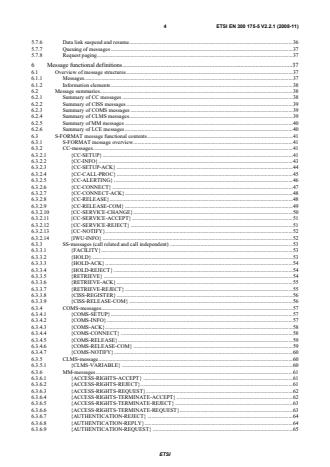
5.7.6 Data link suspend and resume.36 5.7.7 Queuing of messages.37 5.7.8 Request paging.37 6 Message functional definitions.37 6.1 Overview of message structures.37 6.1.1 Messages.37 6.1.2 Information elements.38 6.2 Message summaries.38 6.2.1 Summary of CC messages.38 6.2.2 Summary of CISS messages.39 6.2.3 Summary of COMS messages.39 6.2.4 Summary of CLMS messages.39 6.2.5 Summary of MM messages.40 6.2.6 Summary of LCE messages.40 6.3 S-FORMAT message functional contents.41 6.3.1 S-FORMAT message overview.41 6.3.2 CC-messages.41 6.3.2.1 {CC-SETUP}.41 6.3.2.2 {CC-INFO}.43 6.3.2.3 {CC-SETUP-ACK}.44 6.3.2.4 {CC-CALL-PROC}.45 6.3.2.5 {CC-ALERTING}.46 6.3.2.6 {CC-CONNECT}.47 6.3.2.7 {CC-CONNECT-ACK}.48 6.3.2.8 {CC-RELEASE}.48 6.3.2.9 {CC-RELEASE-COM}.49 6.3.2.10 {CC-SERVICE-CHANGE}.50 6.3.2.11 {CC-SERVICE-ACCEPT}.51 6.3.2.12 {CC-SERVICE-REJECT}.51 6.3.2.13 {CC-NOTIFY}.52 6.3.2.14 {IWU-INFO}.52 6.3.3 SS-messages (call related and call independent).53 6.3.3.1 {FACILITY}.53 6.3.3.2 {HOLD}.53 6.3.3.3 {HOLD-ACK}.54 6.3.3.4 {HOLD-REJECT}.54 6.3.3.5 {RETRIEVE}.54 6.3.3.6 {RETRIEVE-ACK}.55 6.3.3.7 {RETRIEVE-REJECT}.55 6.3.3.8 {CISS-REGISTER}.56 6.3.3.9 {CISS-RELEASE-COM}.56 6.3.4 COMS-messages.57 6.3.4.1 {COMS-SETUP}.57 6.3.4.2 {COMS-INFO}.57 6.3.4.3 {COMS-ACK}.58 6.3.4.4 {COMS-CONNECT}.58 6.3.4.5 {COMS-RELEASE}.59 6.3.4.6 {COMS-RELEASE-COM}.59 6.3.4.7 {COMS-NOTIFY}.60 6.3.5 CLMS-message.60 6.3.5.1 {CLMS-VARIABLE}.60 6.3.6 MM-messages.61 6.3.6.1 {ACCESS-RIGHTS-ACCEPT}.61 6.3.6.2 {ACCESS-RIGHTS-REJECT}.61 6.3.6.3 {ACCESS-RIGHTS-REQUEST}.62 6.3.6.4 {ACCESS-RIGHTS-TERMINATE-ACCEPT}.62 6.3.6.5 {ACCESS-RIGHTS-TERMINATE-REJECT}.63 6.3.6.6 {ACCESS-RIGHTS-TERMINATE-REQUEST}.63 6.3.6.7 {AUTHENTICATION-REJECT}.64 6.3.6.8 {AUTHENTICATION-REPLY}.64 6.3.6.9 {AUTHENTICATION-REQUEST}.65 SIST EN 300 175-5 V2.2.1:2009
ETSI ETSI EN 300 175-5 V2.2.1 (2008-11) 5
...