


oSIST prEN 50600-1:2026
(Main)Information technology - Data centre facilities and infrastructures - Part 1: General concepts
Information technology - Data centre facilities and infrastructures - Part 1: General concepts
This document:
a) describes the general principles for data centres upon which the requirements of the EN 50600 series are based;
b) defines the common aspects of data centres including terminology, parameters and reference models (functional elements and their accommodation) addressing both the size and complexity of their intended purpose;
c) describes general aspects of the facilities and infrastructures required to support data centres;
d) specifies a classification system, based upon the key criteria of “availability”, “security” and “resource and energy efficiency enablement” over the planned lifetime of the data centre, for the provision of effective facilities and infrastructure;
e) details the issues to be addressed in a business risk and operating cost analysis enabling application of the classification of the data centre;
f) provides reference to documentation, operation and management of data centres;
g) introduces the concepts of Key Performance Indicators (KPIs) for resource management and resilience of data centre facilities and infrastructures;
h) defines the use of an environmental sustainability strategy.
The following topics are outside of the scope of this series of documents:
1) the selection of information technology and network telecommunications equipment, software and associated configuration issues are outside the scope of this document;
2) quantitative analysis of overall service availability resulting from multi-site data centres;
3) safety and electromagnetic compatibility (EMC) requirements (covered by other standards and regulations. However, information given in this document can be of assistance in meeting these standards and regulations).
Informationstechnik - Einrichtungen und Infrastrukturen von Rechenzentren - Teil 1: Allgemeine Konzepte
Technologie de l'information - Installation et infrastructures de centres de traitement de données - Partie 1: Concepts généraux
Informacijska tehnologija - Vzpostavitev podatkovnega centra in infrastruktura - 1. del: Splošna zasnova
General Information
- Status
- Not Published
- Public Enquiry End Date
- 30-Mar-2026
- Technical Committee
- ELI - Electrical and communication installations
- Current Stage
- 4020 - Public enquire (PE) (Adopted Project)
- Start Date
- 29-Jan-2026
- Due Date
- 18-Jun-2026
Relations
- Effective Date
- 09-Apr-2024
Overview
oSIST prEN 50600-1:2026 – "Information technology - Data centre facilities and infrastructures - Part 1: General concepts" – is a foundational standard developed by CLC for data centre design and management. This document establishes general concepts, principles, terminology, and classification criteria for data centre facilities and infrastructures, forming the basis for the broader EN 50600 standards series. It aims to support consistent, efficient, and sustainable data centre operations, regardless of the centre's size or complexity.
Key focus areas include availability, physical security, energy and resource efficiency, and risk-based classification systems. The standard is designed to help data centre owners, operators, designers, and integrators ensure their facilities meet evolving business, operational, and sustainability requirements while supporting high levels of resilience and performance.
Key Topics
oSIST prEN 50600-1:2026 covers essential topics related to the holistic design and operation of data centre facilities:
- General Principles and Terminology
- Defines common aspects, terminology, and reference models relevant to all types of data centres.
- Establishes a shared language for stakeholders, enhancing communication and design consistency.
- Classification System
- Introduces a classification system based on key criteria: availability, security, and resource and energy efficiency enablement.
- Supports selection of appropriate classes over the entire lifecycle of a data centre.
- Business Risk and Cost Analysis
- Provides guidance for performing business risk analysis and assessing operating costs.
- Encourages alignment between risk tolerance, investment, and needed facility capabilities.
- Key Performance Indicators (KPIs)
- Introduces KPIs related to resource management and resilience.
- Facilitates ongoing performance monitoring and continual improvement.
- Environmental Sustainability
- Encourages the development and implementation of an environmental sustainability strategy.
- Supports energy efficiency objectives and responsible resource management.
- Design and Implementation Process
- Outlines design phases and principles supporting operational excellence, resilience, and energy/resource efficiency.
Notably, this standard deliberately excludes the selection and configuration of IT and network telecommunications equipment, as well as quantitative analysis of availability for multi-site data centres and safety/EMC requirements, which are addressed by other standards.
Applications
oSIST prEN 50600-1:2026 has broad practical applications across the data centre lifecycle and is beneficial for a wide range of stakeholders:
- Owners, Operators, and Facility Managers
- Use the standard to specify requirements, guide investment decisions, and benchmark operational objectives.
- Apply the classification and risk analysis frameworks to align data centre features with business needs.
- Consulting Engineers, Architects, and Designers
- Reference the standard for designing scalable, resilient, and efficient data centre facilities.
- Leverage shared terminology and reference models throughout design and construction phases.
- Auditors, Integrators, and Suppliers
- Support compliance assessment and integration of equipment in accordance with recognized standards.
- Assist in selecting infrastructure that fits the desired classification levels for availability and security.
- Sustainability and Resource Managers
- Use introduced KPIs and sustainability strategies to improve energy efficiency and minimize environmental impacts.
- Operation and Management Teams
- Reference the documentation, management practices, and ongoing monitoring guidance provided by the standard.
By applying oSIST prEN 50600-1:2026, organizations contribute to more secure, reliable, and environmentally responsible data centre operations.
Related Standards
oSIST prEN 50600-1:2026 forms the backbone of the EN 50600 standards series, and is closely related to the following:
- EN 50600-2-X: Detailed requirements for data centre design aspects such as physical security and energy efficiency.
- EN 50600-3-1: Guidance on operational processes and management of data centres.
- EN 50600-4-X: Key Performance Indicators (KPIs) for resource usage efficiency and data centre resilience.
- CLC/TS 50600-5-1: Maturity model for energy management and environmental sustainability.
- EN IEC 31010, ISO 31000: Guidelines for risk assessment and risk management, referenced for risk and business impact analyses.
For professionals involved in planning, building, and maintaining modern data centres, adopting oSIST prEN 50600-1:2026 ensures alignment with best practices for reliability, security, energy efficiency, and long-term sustainability.

Get Certified
Connect with accredited certification bodies for this standard

BSI Group
BSI (British Standards Institution) is the business standards company that helps organizations make excellence a habit.

NYCE
Mexican standards and certification body.
Sponsored listings
Frequently Asked Questions
oSIST prEN 50600-1:2026 is a draft published by the Slovenian Institute for Standardization (SIST). Its full title is "Information technology - Data centre facilities and infrastructures - Part 1: General concepts". This standard covers: This document: a) describes the general principles for data centres upon which the requirements of the EN 50600 series are based; b) defines the common aspects of data centres including terminology, parameters and reference models (functional elements and their accommodation) addressing both the size and complexity of their intended purpose; c) describes general aspects of the facilities and infrastructures required to support data centres; d) specifies a classification system, based upon the key criteria of “availability”, “security” and “resource and energy efficiency enablement” over the planned lifetime of the data centre, for the provision of effective facilities and infrastructure; e) details the issues to be addressed in a business risk and operating cost analysis enabling application of the classification of the data centre; f) provides reference to documentation, operation and management of data centres; g) introduces the concepts of Key Performance Indicators (KPIs) for resource management and resilience of data centre facilities and infrastructures; h) defines the use of an environmental sustainability strategy. The following topics are outside of the scope of this series of documents: 1) the selection of information technology and network telecommunications equipment, software and associated configuration issues are outside the scope of this document; 2) quantitative analysis of overall service availability resulting from multi-site data centres; 3) safety and electromagnetic compatibility (EMC) requirements (covered by other standards and regulations. However, information given in this document can be of assistance in meeting these standards and regulations).
This document: a) describes the general principles for data centres upon which the requirements of the EN 50600 series are based; b) defines the common aspects of data centres including terminology, parameters and reference models (functional elements and their accommodation) addressing both the size and complexity of their intended purpose; c) describes general aspects of the facilities and infrastructures required to support data centres; d) specifies a classification system, based upon the key criteria of “availability”, “security” and “resource and energy efficiency enablement” over the planned lifetime of the data centre, for the provision of effective facilities and infrastructure; e) details the issues to be addressed in a business risk and operating cost analysis enabling application of the classification of the data centre; f) provides reference to documentation, operation and management of data centres; g) introduces the concepts of Key Performance Indicators (KPIs) for resource management and resilience of data centre facilities and infrastructures; h) defines the use of an environmental sustainability strategy. The following topics are outside of the scope of this series of documents: 1) the selection of information technology and network telecommunications equipment, software and associated configuration issues are outside the scope of this document; 2) quantitative analysis of overall service availability resulting from multi-site data centres; 3) safety and electromagnetic compatibility (EMC) requirements (covered by other standards and regulations. However, information given in this document can be of assistance in meeting these standards and regulations).
oSIST prEN 50600-1:2026 is classified under the following ICS (International Classification for Standards) categories: 35.020 - Information technology (IT) in general; 35.160 - Microprocessor systems. The ICS classification helps identify the subject area and facilitates finding related standards.
oSIST prEN 50600-1:2026 has the following relationships with other standards: It is inter standard links to SIST EN 50600-1:2019. Understanding these relationships helps ensure you are using the most current and applicable version of the standard.
oSIST prEN 50600-1:2026 is available in PDF format for immediate download after purchase. The document can be added to your cart and obtained through the secure checkout process. Digital delivery ensures instant access to the complete standard document.
Standards Content (Sample)
SLOVENSKI STANDARD
01-marec-2026
Informacijska tehnologija - Vzpostavitev podatkovnega centra in infrastruktura - 1.
del: Splošna zasnova
Information technology - Data centre facilities and infrastructures - Part 1: General
concepts
Informationstechnik - Einrichtungen und Infrastrukturen von Rechenzentren - Teil 1:
Allgemeine Konzepte
Technologie de l'information - Installation et infrastructures de centres de traitement de
données - Partie 1: Concepts généraux
Ta slovenski standard je istoveten z: prEN 50600-1:2026
ICS:
35.020 Informacijska tehnika in Information technology (IT) in
tehnologija na splošno general
2003-01.Slovenski inštitut za standardizacijo. Razmnoževanje celote ali delov tega standarda ni dovoljeno.
EUROPEAN STANDARD DRAFT
prEN 50600-1
NORME EUROPÉENNE
EUROPÄISCHE NORM
January 2026
ICS 35.020; 35.160 Will supersede EN 50600-1:2019
English Version
Information technology - Data centre facilities and infrastructures
- Part 1: General concepts
Technologie de l'information - Installation et infrastructures Informationstechnik - Einrichtungen und Infrastrukturen von
de centres de traitement de données - Partie 1: Concepts Rechenzentren - Teil 1: Allgemeine Konzepte
généraux
This draft European Standard is submitted to CENELEC members for enquiry.
Deadline for CENELEC: 2026-04-17.
It has been drawn up by CLC/TC 215.
If this draft becomes a European Standard, CENELEC members are bound to comply with the CEN/CENELEC Internal Regulations which
stipulate the conditions for giving this European Standard the status of a national standard without any alteration.
This draft European Standard was established by CENELEC in three official versions (English, French, German).
A version in any other language made by translation under the responsibility of a CENELEC member into its own language and notified to
the CEN-CENELEC Management Centre has the same status as the official versions.
CENELEC members are the national electrotechnical committees of Austria, Belgium, Bulgaria, Croatia, Cyprus, the Czech Republic,
Denmark, Estonia, Finland, France, Germany, Greece, Hungary, Iceland, Ireland, Italy, Latvia, Lithuania, Luxembourg, Malta, the
Netherlands, Norway, Poland, Portugal, Republic of North Macedonia, Romania, Serbia, Slovakia, Slovenia, Spain, Sweden, Switzerland,
Türkiye and the United Kingdom.
Recipients of this draft are invited to submit, with their comments, notification of any relevant patent rights of which they are aware and to
provide supporting documentation.
Warning : This document is not a European Standard. It is distributed for review and comments. It is subject to change without notice and
shall not be referred to as a European Standard.
European Committee for Electrotechnical Standardization
Comité Européen de Normalisation Electrotechnique
Europäisches Komitee für Elektrotechnische Normung
CEN-CENELEC Management Centre: Rue de la Science 23, B-1040 Brussels
© 2026 CENELEC All rights of exploitation in any form and by any means reserved worldwide for CENELEC Members.
Project: 79731 Ref. No. prEN 50600-1:2026 E
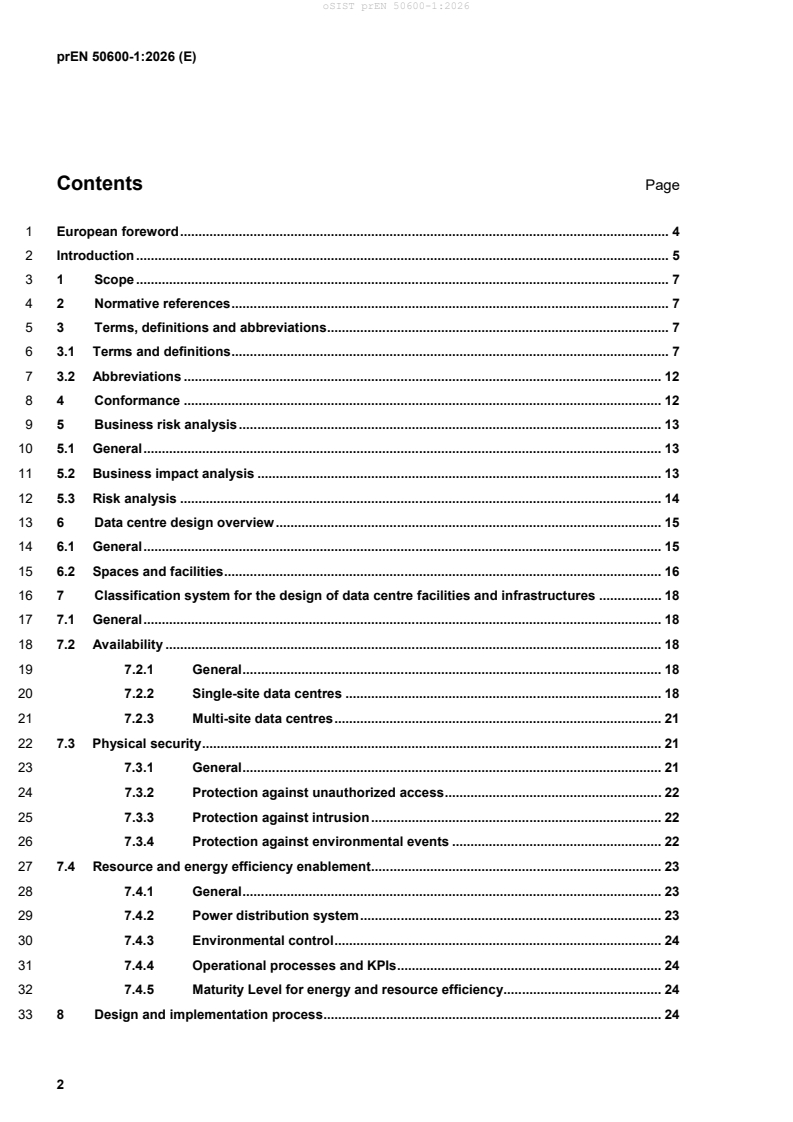
Contents Page
1 European foreword . 4
2 Introduction . 5
3 1 Scope . 7
4 2 Normative references . 7
5 3 Terms, definitions and abbreviations . 7
6 3.1 Terms and definitions . 7
7 3.2 Abbreviations . 12
8 4 Conformance . 12
9 5 Business risk analysis . 13
10 5.1 General . 13
11 5.2 Business impact analysis . 13
12 5.3 Risk analysis . 14
13 6 Data centre design overview . 15
14 6.1 General . 15
15 6.2 Spaces and facilities . 16
16 7 Classification system for the design of data centre facilities and infrastructures . 18
17 7.1 General . 18
18 7.2 Availability . 18
19 7.2.1 General . 18
20 7.2.2 Single-site data centres . 18
21 7.2.3 Multi-site data centres . 21
22 7.3 Physical security . 21
23 7.3.1 General . 21
24 7.3.2 Protection against unauthorized access . 22
25 7.3.3 Protection against intrusion . 22
26 7.3.4 Protection against environmental events . 22
27 7.4 Resource and energy efficiency enablement . 23
28 7.4.1 General . 23
29 7.4.2 Power distribution system . 23
30 7.4.3 Environmental control . 24
31 7.4.4 Operational processes and KPIs . 24
32 7.4.5 Maturity Level for energy and resource efficiency . 24
33 8 Design and implementation process . 24
34 8.1 General . 24
35 8.2 Design phases . 25
36 8.2.1 Phase 1 - Strategy . 25
37 8.2.2 Phase 2 - Objectives . 26
38 8.2.3 Phase 3 - System specifications . 26
39 8.2.4 Phase 4 - Design proposal . 26
40 8.2.5 Phase 5 - Decision . 27
41 8.2.6 Phase 6 - Functional design . 27
42 8.2.7 Phase 7 - Approval . 27
43 8.2.8 Phase 8 - Final design and project plan . 27
44 8.2.9 Phase 9 - Contract . 27
45 8.2.10 Phase 10 – Construction and acceptance testing . 28
46 8.2.11 Phase 11 - Operation . 28
47 9 Design principles to support energy efficiency, resource efficiency and environmental
48 sustainability . 28
49 9.1 Design reference documentation . 28
50 9.2 Design principles to support energy efficiency, resource efficiency and environmental
51 sustainability . 28
52 9.3 Design principles for EMI . 28
53 9.4 Design principles to support operational excellence . 28
54 9.5 Design principles to improve resilience . 29
55 Annex A (informative) Availability classes, resilience and efficiency . 30
56 Annex B (informative) Availability and resilience criteria . 35
57 Bibliography . 37
58 Tables
59 Table 1 — Availability Classes and example implementations . 20
60 Table A.1 — Availability and annual downtime . 32
61 Table B.1 — Summary of availability classification for power supply, power distribution and environmental
62 control . 35
63 Table B.2 — Summary of availability classification for telecommunications cabling . 36
64 Figures
65 Figure 1 — Schematic relationship between EN 50600 series of documents . 6
66 Figure 2 — Example of risk map . 15
67 Figure 3 — Typical schematic diagram of premises containing a data centre . 17
68 Figure 4 — Design phases . 25
69 Figure A.1 — Unplanned disruptions — duration vs. cost . 31
70 European foreword
71 This document (prEN 50600-1:2026) has been prepared by CLC/TC 215 “Electrotechnical aspects of
72 telecommunication equipment”.
73 This document is currently submitted to the Enquiry.
• latest date by which the existence of this (doa) dav + 6 months
document has to be announced at national level
• latest date by which this document has to be (dop) dav + 12 months
implemented at national level by publication of
an identical national standard or by
endorsement
• latest date by which the national standards (dow) dav + 36 months
conflicting with this document have to be
(to be confirmed or
withdrawn modified when voting)
74 This document will supersede EN 50600-1:2019.
75 prEN 50600-1:2026 includes the following significant technical changes with respect to EN 50600-1:2019:
76 a) the whole document has been revised technically and editorially, aligning with EN 50600-2-2 and
77 EN 50600-2-3;
78 b) resource enablement aspects included;
79 c) Clause 3 updated and aligned with terms and definitions of CLC/TC 50600-4-31 and implemented
80 throughout the document;
81 d) Clause 5 updated to include e.g. resilience analysis aspects according to CLC/TS 50600-4-31 and
82 improved terminology (“services” replaced with “functional capability”);
83 e) Clause 7 revised, in particular regarding the application of the data centre maturity model of CLC/TS 50600-
84 5-1 and 7.2.3 on multi-site data centres;
85 f) Clause 8 design phases 1 to 4, 6 and 10 revised and aligned with EN 50600-2-5;
86 g) Clause 9 updated and supplemented with new 9.5 on design principles for improved resilience;
87 h) Annex A completely revised considering the specifications of CLC/TS 50600-4-31;
88 i) Annex B contains a new Table B.2 summarizing the availability classification for telecommunications
89 cabling.
90 Introduction
91 The unrestricted access to internet-based information demanded by the information society has led to an
92 exponential growth of both internet traffic and the volume of stored/retrieved data. Data centres are housing and
93 supporting the information technology and network telecommunications equipment for data processing, data
94 storage and data transport. They are required both by network operators (delivering those services to customer
95 premises) and by enterprises within those customer premises.
96 Data centres usually need to provide modular, scalable and flexible facilities and infrastructures to easily
97 accommodate the rapidly changing requirements of the market. In addition, energy consumption and
98 water/resource usage of data centres has become critical both from an environmental point of view (reduction
99 of environmental footprint) and with respect to economical considerations (cost of energy) for the data centre
100 operator.
101 The implementation of data centres varies in terms of:
102 a) purpose (enterprise, co-location, co-hosting or network operator facilities);
103 b) security level;
104 c) physical size;
105 d) accommodation (mobile, temporary and permanent constructions).
106 The needs of data centres also vary in terms of availability of service, the provision of security and the objectives
107 for energy efficiency. These needs and objectives influence the design of data centres in terms of building
108 construction, power distribution, environmental control, telecommunications cabling and physical security as
109 well as the operation of the data centre. Effective management and operational information is required to monitor
110 achievement of the defined needs and objectives.
111 Recognizing the substantial resource consumption, particularly of energy, of larger data centres, it is also
112 important to provide tools for the assessment of that consumption both in terms of overall value and of source
113 mix and to provide Key Performance Indicators (KPIs) to evaluate trends and drive performance improvements.
114 At the time of publication of this document, the EN 50600 series have been designed as a framework of
115 standards, technical specifications and technical reports covering the design, the operation and management,
116 the key performance indicators for energy efficient operation of the data centre as well as a maturity model for
117 energy management and environmental sustainability.
118 This series of documents specifies requirements and recommendations to support the various parties involved
119 in the design, planning, procurement, integration, installation, operation and maintenance of facilities and
120 infrastructures within data centres. These parties include:
121 1) owners, operators, facility managers, ICT managers, project managers, main contractors;
122 2) consulting engineers, architects, building designers and builders, system and installation designers,
123 auditors, test and commissioning agents;
124 3) facility and infrastructure integrators, suppliers of equipment;
125 4) installers, maintainers.
126 This document is intended for use by and collaboration between all parties involved, however, at least by
127 consulting engineers, architects, building designers and builders, system and installation designers.
128 The inter-relationship of the documents within the EN 50600 series is shown in Figure 1.
130 Figure 1 — Schematic relationship between EN 50600 series of documents
131 EN 50600-1 introduces the general concepts relevant for the design and operation of data centres.
132 EN 50600-2-X documents define the requirements for the data centre design and specify requirements and
133 recommendations for particular facilities and infrastructures to support the relevant classification for
134 “availability”, “physical security” and “energy efficiency enablement” selected from EN 50600-1.
135 EN 50600-3-1 specifies requirements and recommendations for data centre operations, processes and
136 management.
137 EN 50600-4-X documents specify requirements and recommendations for key performance indicators (KPIs)
138 used to assess and improve the resource usage efficiency and effectiveness, respectively, and criteria of
139 resilience of a data centre.
140 CLC/TS 50600-5-1 specifies the maturity model for energy management and environmental sustainability and
141 refers amongst others to EN 50600-4-X for KPIs as appropriate.
142 This document, EN 50600-1, specifies general requirements for all kinds of data centres irrespective of their
143 size and physical construction. It introduces a classification system for availability, physical security and energy
144 efficiency enablement based on business risk/impact analysis outcome.
145 This series of documents does not address the selection of information technology and network
146 telecommunications equipment, software and associated configuration issues.
147 1 Scope
148 This document:
149 a) describes the general principles for data centres upon which the requirements of the EN 50600 series are
150 based;
151 b) defines the common aspects of data centres including terminology, parameters and reference models
152 (functional elements and their accommodation) addressing both the size and complexity of their intended
153 purpose;
154 c) describes general aspects of the facilities and infrastructures required to support data centres;
155 d) specifies a classification system, based upon the key criteria of “availability”, “security” and “resource and
156 energy efficiency enablement” over the planned lifetime of the data centre, for the provision of effective
157 facilities and infrastructure;
158 e) details the issues to be addressed in a business risk and operating cost analysis enabling application of
159 the classification of the data centre;
160 f) provides reference to documentation, operation and management of data centres;
161 g) introduces the concepts of Key Performance Indicators (KPIs) for resource management and resilience of
162 data centre facilities and infrastructures;
163 h) defines the use of an environmental sustainability strategy.
164 The following topics are outside of the scope of this series of documents:
165 1) the selection of information technology and network telecommunications equipment, software and
166 associated configuration issues are outside the scope of this document;
167 2) quantitative analysis of overall service availability resulting from multi-site data centres;
168 3) safety and electromagnetic compatibility (EMC) requirements (covered by other standards and regulations.
169 However, information given in this document can be of assistance in meeting these standards and
170 regulations).
171 2 Normative references
172 The following documents are referred to in the text in such a way that some or all of their content constitutes
173 requirements of this document. For dated references, only the edition cited applies. For undated references, the
174 latest edition of the referenced document (including any amendments) applies.
175 CLC/TS 50600-5-1, Information technology - Data centre facilities and infrastructures - Part 5-1: Maturity Model
176 for Energy Management and Environmental Sustainability
177 3 Terms, definitions and abbreviations
178 3.1 Terms and definitions
179 For the purposes of this document, the following terms and definitions apply.
180 ISO and IEC maintain terminological databases for use in standardization at the following addresses:
181 — IEC Electropedia: available at http://www.electropedia.org/
— ISO Online browsing platform: available at http://www.iso.org/obp
183 3.1.1
184 availability
185 ability to be in a state to perform as required
186 [SOURCE: CLC/TS 50600-4-31:2024, 3.1.1.]
187 3.1.2
188 building entrance facility
189 facility that provides all necessary services, and which complies with all relevant regulations for the entry of
190 infrastructures or specific services into a building
191 [SOURCE: EN 50173-1:2018, 3.1.18, modified — “telecommunication cables” was replaced with
192 “infrastructures or specific services”; “and which can enable transmission from outdoor to indoor cable” was
193 deleted; “mechanical and electrical” was deleted]
194 3.1.3
195 cabinet
196 enclosed construction for housing closures and other information technology equipment
197 [SOURCE: EN 50174-1:2018, 3.1.7]
198 3.1.4
199 co-hosting data centre
200 data centre in which multiple customers are provided with access to network(s), servers and storage equipment
201 on which they operate their own services/applications
202 Note 1 to entry: Both the information technology equipment and the support infrastructure of the building are provided as a
203 service by the data centre operator.
204 [SOURCE: EN 50174-2:2018, 3.1.2]
205 3.1.5
206 co-location data centre
207 data centre in which multiple customers locate their own network(s), servers and storage equipment
208 Note 1 to entry: The support infrastructure of the building (such as power distribution and environmental control) is provided
209 as a service by the data centre operator.
210 [SOURCE: EN 50174-2:2018, 3.1.3]
211 3.1.6
212 computer room space
213 area within the data centre that accommodates the data processing, data storage and telecommunication
214 equipment that provides the primary function of the data centre
215 3.1.7
216 control room space
217 area within the data centre used to control the operation of the data centre and to act as a central point for all
218 control and monitoring functions
219 3.1.8
220 data centre
221 structure, or group of structures, dedicated to the centralised accommodation, interconnection and operation of
222 information technology and network telecommunications equipment providing data storage, processing and
223 transport services together with all the facilities and infrastructures for power distribution and environmental
224 control together with the necessary levels of resilience and security required to provide the desired service
225 availability
226 Note 1 to entry: A structure can consist of multiple buildings and/or spaces with specific functions to support the primary
227 function.
228 Note 2 to entry: The boundaries of the structure or space considered the data centre which includes the information and
229 communication technology equipment and supporting environmental controls can be defined within a larger structure or
230 building.
231 3.1.9
232 demarcation point
233 point where the operational control or ownership changes
234 3.1.10
235 downtime
236 duration of the time interval for which the item is in a down state
237 Note 1 to entry: Item can be a device, a functional element or a system.
238 3.1.11
239 electrical distribution space
240 area used for housing facilities to distribute electrical power between the transformer space and electrical
241 spaces within the data centre or elsewhere within the premises or individual buildings within the premises
242 3.1.12
243 electrical space
244 area within the data centre used for housing facilities to deliver and control electrical power to the data centre
245 spaces (including switchboards, batteries, uninterruptible power systems (UPS) etc.)
246 3.1.13
247 enterprise data centre
248 data centre that is operated by an enterprise which has the sole purpose of the delivery and management of
249 services to its employees and customers
250 [SOURCE: EN 50174-2:2018, 3.1.8]
251 3.1.14
252 energy efficiency enablement
253 ability to measure the energy consumption and to allow calculation and reporting of energy efficiency of the
254 various facilities and infrastructures
255 3.1.15
256 facility
257 spaces and pathways that accommodate a specific infrastructure
258 3.1.16
259 failure
260 loss of ability to perform as required
261 Note 1 to entry: In this context it is irrelevant if the cause was planned or unplanned.
262 [SOURCE: CLC/TS 50600-4-31:2024, 3.1.8]
263 3.1.17
264 fault
265 inability to perform as required, due to an internal state
266 Note 1 to entry: Opposite of success. In the context of the expected resilience level (RL), at a specified operation point (OP).
267 [SOURCE: CLC/TS 50600-4-31:2024, 3.1.10]
268 3.1.18
269 functional capability
270 ability of the data centre (or system or subsystem) to deliver its intended function
271 3.1.19
272 functional element
273 source of supply, device or path
274 3.1.20
275 generator space
276 area used for housing the installation of electrical power supply generation equipment together with control
277 systems, storage of associated fuels or energy conversion equipment
278 3.1.21
279 holding space
280 area within the data centre used for the holding of equipment prior to being brought into service or having been
281 taken out of service
282 3.1.22
283 infrastructure
284 technical systems providing functional capability of the data centre (e.g. power distribution, environmental
285 control and physical security)
286 3.1.23
287 main distributor
288 distributor used to make connections between the main distribution cabling subsystem, network access cabling
289 subsystem and active equipment
290 [SOURCE: EN 50173-5:2018, 3.1.10]
291 3.1.24
292 mechanical space
293 area that is used for housing mechanical equipment and infrastructure that provides environmental control for
294 the data centre spaces (including chillers and water treatment, air handling and fire suppression systems)
295 3.1.25
296 network operating centre
297 room or workplace to monitor ICT and network equipment and receive alarms from building management
298 systems
299 3.1.26
300 network operator data centre
301 data centre that has the primary purpose of the delivery and management of broadband services to the
302 operators’ customers
303 [SOURCE: EN 50174-2:2018, 3.1.18]
304 3.1.27
305 physical security
306 measures (combining physical and technological controls), procedures and responsibilities to maintain the
307 desired level of availability for the facilities and infrastructures of the data centres in relation to access control,
308 intrusion and environmental events
309 3.1.28
310 planned downtime
311 period of time during which a system or subsystem does not provide functional capability whilst it undergoes
312 maintenance or is switched off to test the response of a related system or subsystem
313 3.1.29
314 premises entrance facility
315 space that provides all necessary mechanical and electrical services for the entry of cables into the premises
316 3.1.30
317 redundancy
318 provision of more than one means for performing a function
319 Note 1 to entry: In a data centre, redundancy can be achieved by duplication of devices, functional elements, and/or supply
320 paths.
321 [SOURCE: CLC/TS 50600-4-31:2024, 3.1.27]
322 3.1.31
323 reliability
324 ability to perform as required, without failure, for a given time interval, under given conditions
325 [SOURCE: CLC/TS 50600-4-31:2024, 3.1.28.]
326 3.1.32
327 resilience
328 ability to withstand and reduce the magnitude and/or duration of disruptive events, including the capability to
329 anticipate, absorb, adapt to, and/or rapidly recover from such an event
330 [SOURCE: CLC/TS 50600-4-31:2024, 3.1.25]
331 3.1.33
332 storage space
333 area where general goods and/or data centre goods to be used in the premises and data centre are stored
334 3.1.34
335 system
336 set of interrelated functional elements considered in a defined context as a whole and separated from their
337 environment
338 [SOURCE: IEC 60050-151:2001, 151-11-27, modified – Note 1 to entry to Note 4 to entry were deleted]
339 3.1.35
340 telecommunications
341 technology concerned with the transmission, emission, and reception of signs, signals, writings, images, and
342 sounds, by cable, radio, optical, or other electromagnetic systems
343 Note 1 to entry: The term telecommunications has no legal meaning when used in this document
344 [SOURCE: EN 50173-1:2018, 3.1.49]
345 3.1.36
346 telecommunications cabling
347 infrastructure from the telecommunications space(s) to the premises entrance facility
348 3.1.37
349 telecommunication equipment
350 equipment within the data centre that provides telecommunication services
351 3.1.38
352 telecommunications space
353 area which may house demarcation points and telecommunication equipment associated with the building
354 entrance facility
355 3.1.39
356 testing space
357 area within the data centre used for the testing and configuring of equipment prior to being brought into service
358 Note 1 to entry: Testing space is sometimes called staging area.
359 3.1.40
360 transformer space
361 area used for housing equipment necessary to convert voltage levels and/or provide necessary isolation for the
362 connection to the equipment within the premises or individual buildings within the premises
363 3.1.41
364 uninterruptible power system
365 combination of convertors, switches and energy storage devices (such as batteries), constituting a power
366 system for maintaining continuity of load power in case of input power failure
367 Note 1 to entry: Continuity of load power occurs when voltage and frequency are within rated steady-state and transient
368 tolerance bands and with distortion and interruptions within the limits specified for the output port. Input power failure occurs
369 when voltage and frequency are outside rated steady-state and transient tolerance bands or with distortion or interruptions
370 outside the limits specified for the UPS.
371 [SOURCE: EN IEC 62040-1:2019, 3.101]
372 3.1.42
373 unplanned downtime
374 unexpected time taken, following a failure of functional capability, to repair the relevant infrastructure together
375 with the “re-boot” time necessary to recover functional capability following that repair
376 3.2 Abbreviations
377 For the purposes of this document the following abbreviations apply:
CFR cabinet, frame or rack
CRAC computer room air conditioning (unit)
CRAH computer room air handler (unit)
EMI electromagnetic interference
ffs for further study
ICT information and communications technology
ITE information technology equipment
KPI key performance indicator
MTBF mean time between failures
MTTR mean time to repair
NOC network operating centre
UPS uninterruptible power system
378 4 Conformance
379 For a data centre design to conform to this document:
380 a) a business risk analysis according to Clause 5 shall be completed;
381 b) an appropriate Availability Class in 7.2 shall be selected using a business risk analysis in Clause 5;
382 c) appropriate Protection Classes for the data centre pathways and spaces shall be selected in accordance
383 with 7.3.1;
384 d) an appropriate energy efficiency enablement level in 7.4 shall be selected;
385 e) the design process of Clause 8 (or equivalent) shall be applied;
386 f) the design principles of Clause 9 shall be applied.
387 NOTE The application of the design process in Clause 8 is not mandatory for an assessment of existing data centres.
388 5 Business risk analysis
389 5.1 General
390 The overall availability of a data centre is a measure of the continuity of its data processing, storage and
391 transport functions. The acceptable level of the overall availability of a data centre is determined by a number
392 of factors including:
393 a) a business impact analysis (see 5.2) evaluating the cost and/or other consequences associated with a
394 failure of service provision, which depends upon a number of factors including the function and importance
395 of the data centre;
396 b) externally applied commercial pressures (e.g. insurance cost, market/customer expectations).
397 There is a link between the availability of the infrastructures specified in EN 50600-2-X standards and the overall
398 availability but it should be recognized that the recovery of intended data processing, storage, and transport
399 functionality following the repair of an infrastructure failure depends on many factors related to the configuration
400 of the hardware and software providing that functionality.
401 As a result, the role of the infrastructure is to support overall availability objectives but is not the sole factor in
402 their attainment.
403 The availability of each of the facilities and infrastructures of the data centre required to support the desired
404 overall availability is described by an availability classification (see 7.2). The design of each of the data centre
405 infrastructures shall take account of their impact on overall availability and the costs associated with the
406 predicted downtime associated with failure or planned downtime for maintenance.
407 The design and physical security of the facilities and infrastructures of the data centre shall be subjected to a
408 risk analysis (see 5.3) which maps identified risk events against the requirements of the availability classification
409 (see 7.2). The availability classification for each infrastructure is described as providing low, medium, high and
410 very high availability. Clause 7 further describes the situations (risk events) for which each infrastructure is
411 protected against failure. A further optimization approach within the given Availability Classes is an availability
412 analysis of the infrastructures in accordance with CLC/TS 50600-4-31.
413 A business risk analysis identifies the aspects of the facilities and infrastructures that require investment in terms
414 of design improvements to reduce their impact and/or probability of those risk events. Appropriate Availability
415 Classes, as defined in 7.2, shall be selected for each infrastructure to reduce business risks to an acceptable
416 level. The benefits and effectiveness of individual optimizations within a given Availability Class can be
417 demonstrated by resilience analysis as described in CLC/TS 50600-4-31.
418 5.2 Business impact analysis
419 This document does not define methods of analysis for the cost of downtime. Standards such as EN IEC 31010,
420 ISO/TS 22317 or EN ISO 22301 provide useful guidance.
421 The parameters to be considered within such an analysis will depend upon the purpose of the data centre.
422 Some organisations can assign a monetary value (or range) to loss of service which may include the following:
423 a) immediate financial penalties;
424 b) consequential losses;
425 c) an assessment of longer-term damage to business reputation e.g. an Internet Service Provider or a financial
426 institution.
427 Although cost is often considered when analysing downtime, other impacts should also be considered. Data
428 centres containing life safety, legal, medical and criminal information may have individually recognized
429 consequences from unplanned downtime.
430 5.3 Risk analysis
431 This document does not define methods of risk analysis. Standards such as ISO 31000 and EN IEC 31010
432 provide useful guidance on this topic.
433 Risk analysis may be used as a management tool allowing the comparison with the acceptable total risk and
434 showing trends resulting from mitigation activity. For the purposes of this document the risk associated with an
435 event concerning the facilities and infrastructures of the data centre which disrupts the provision of the ICT
436 service of the data centre is defined as event risk which is a function of impact and probability where
437 a) impact is the magnitude or severity of adverse incidents or impacts, expressed numerically or nominally
438 expected duration of loss of service (availability) of the event;
439 b) probability is the likelihood that an event will occur.
440 The impact of risk may be assessed using different units of measure e.g. expected downtime, cost and/or other
441 consequences, safety etc.
442 The total risk to the functional capability of the data centre is a function of the event risks associated with each
443 facility and infrastructure provided that those risks are quantified on the same basis. If related to the output of
444 the business impact analysis (see 5.2) the financial value and other consequences of the total risk can be
445 estimated.
446 The risks considered should include external threats which can affect the facilities and infrastructures including
447 in particular the location, which could be geographical (e.g. air traffic, flooding etc.), political (e.g. wars, trouble
448 spots, terror etc.) or affecting neighbourhood relations (e.g. fire hazards exist due to filling stations, chemical
449 storage etc.) and thus influence the likelihood of a potential downtime. In addition, potential risks resulting from
450 internal and external attacks by the staff or others should be part of the overall risk evaluation.
451 Impact can be categorized as:
1) low: e.g. loss of non-critical functional capability;
2) medium: e.g. failure of critical system functional elements but no loss of redundancy;
3) high: e.g. loss of critical system redundancy but no loss of functional capability;
4) critical: e.g. loss of critical functional capability or loss of life (which may be extended to address
personal injury).
452 The probability of an event occurring can be categorized in a similar way, that is:
1) very low: e.g. event expected in more than 100 years;
2) low: e.g. event expected in 25 to 100 years;
3) medium: e.g. event expected in 10 to 25 years;
4) high: e.g. event expected in 10 years.
453 Each risk can be categorized on a risk map as shown in Figure 2 and can differ from project to project. High risk
454 events inhabit the top right-hand corner of the figure and low risk events inhabit the bottom left-hand corner.
456 Figure 2 — Example of risk map
457 Having identified the risk of the possible events associated with data centre facilities and infrastructures, the
458 downtime cost and/or other consequences with that event shall be determined to enable design decisions to be
459 made that reduce the risk (by means of reducing the impact or probability of the event).
460 6 Data centre design overview
461 6.1 General
462 Data centres differ in terms of their purpose e.g. co-hosting data centre, co-location data centre, enterprise data
463 centre, network operator data centre. Data centres can also differ significantly with respect to their physical size
464 ranging from:
465 a) a data centre in a building housing a small quantity of storage and server equipment to provide information
466 technology services to the occupants of that building, to
467 b) a data centre housing a large quantity of such equipment providing information technology services via
468 diverse internal and external telecommunications networks and requiring sophisticated power distribution
469 and environmental control facilities housed in one or more buildings dedicated to ensure the operation of
470 the data centre.
471 This clause provides a general design overview for data centres independent of their purpose and their size.
472 6.2 Spaces and facilities
473 Figure 3 shows a schematic representation of the spaces required by a large data centre within a building and
474 within premises containing one or more building.
475 The data centre may share certain spaces with the rest of the building including:
476 a) building entrance facilities;
477 b) personnel entrance(s);
478 c) docking/loading bay(s);
479 d) generators space(s);
480 e) transformer space(s);
481 f) electrical distribution space(s);
482 g) mechanical space(s) accommodating environmental control systems;
483 h) telecommunications spaces(s).
484 The need for the above spaces and facilities within the building depends upon the purpose of both the building
485 and the data centre. Any sharing of these spaces and facilities and the corresponding pathways will depend not
486 only on the size but also on the defined Availability and Protection Classes of the data centre and the functions
487 of the remainder of the building. For example, in buildings housing large data centres, the facilities and spaces
488 supporting the data centre can be dedicated to the data centre with separate spaces being provided for the
489 remainder of the building.
490 The area within the building designated as a data centre can contain the following spaces:
491 1) personnel entrance(s);
492 2) main distributor space(s);
493 3) computer room space(s) and associated testing space(s);
494 4) electrical space(s);
495 5) mechanical space(s) accommodating e.g. e
...
Questions, Comments and Discussion
Ask us and Technical Secretary will try to provide an answer. You can facilitate discussion about the standard in here.
Loading comments...