


SIST EN 71-3:2013+A3:2018
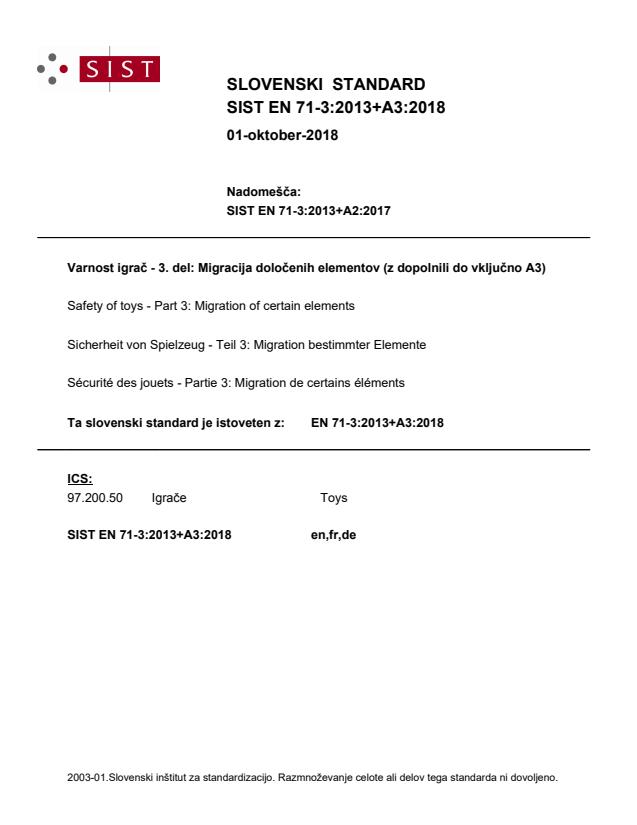
(Main)Safety of toys - Part 3: Migration of certain elements
Safety of toys - Part 3: Migration of certain elements
This European Standard specifies requirements and test methods for the migration of aluminium, antimony, arsenic, barium, boron, cadmium, chromium (III), chromium (VI), cobalt, copper, lead, manganese, mercury, nickel, selenium, strontium, tin, organic tin and zinc from toy materials and from parts of toys.
Packaging materials are not considered to be part of the toy unless they have intended play value.
NOTE 1 See guidance document of the European Commission guidance document no. 12 [2] on the application of the Directive on the safety of toys – packaging.
The standard contains requirements for the migration of certain elements from the following categories of toy materials:
— Category I: Dry, brittle, powder like or pliable materials;
— Category II: Liquid or sticky materials;
— Category III: Scraped-off materials.
The requirements of this standard do not apply to toys or parts of toys which, due to their accessibility, function, volume or mass, clearly exclude any hazard due to sucking, licking or swallowing or prolonged skin contact when the toy or part of toy is used as intended or in a foreseeable way, bearing in mind the behaviour of children.
NOTE 2 For the purposes of this standard, for the following toys and parts of toys the likelihood of sucking, licking or swallowing toys is considered significant (see H.2 and H.3):
— all toys intended to be put in the mouth or to the mouth, cosmetics toys and writing instruments categorized as toys can be considered to be sucked, licked or swallowed;
— all the accessible parts and components of toys intended for children up to 6 years of age can be considered to come into contact with the mouth. The likelihood of mouth contact with parts of toys intended for older children is not considered significant in most cases (see H.2).
Sicherheit von Spielzeug - Teil 3: Migration bestimmter Elemente
Diese Europäische Norm legt Anforderungen an und Prüfverfahren für die Migration von Aluminium, Antimon, Arsen, Barium, Bor, Cadmium, Chrom (III), Chrom (VI), Cobalt, Kupfer, Blei, Mangan, Quecksilber, Nickel, Selen, Strontium, Zinn, Organozinnverbindungen und Zink aus Spielzeugmaterialien und Spielzeugteilen fest.
Verpackungsmaterialien werden nicht als Teil des Spielzeugs angesehen, es sei denn, sie haben einen beabsichtigten Spielwert.
ANMERKUNG 1 Siehe hierzu Leitlinie Nr. 12 der Europäischen Kommission zur Anwendung der Richtlinie über die Sicherheit von Spielzeug — Verpackungen [2].
Diese Norm enthält Anforderungen an die Migration bestimmter Elemente aus den folgenden Kategorien von Spielzeugmaterialien:
— Kategorie I: Trockene, brüchige, staubförmige oder geschmeidige Materialien;
— Kategorie II: Flüssige oder haftende Materialien;
— Kategorie III: Abgeschabte Materialien.
Die Anforderungen dieser Norm gelten nicht für Spielzeug und Spielzeugbestandteile, die bei bestimmungs¬gemäßem oder vorhersehbarem Gebrauch und unter Berücksichtigung des Verhaltens von Kindern wegen ihrer/ihres Zugänglichkeit, Funktion, Volumens oder Masse jegliche Gefährdung durch Saugen, Lecken oder Verschlucken oder längeren Hautkontakt eindeutig ausschließen.
ANMERKUNG 2 Für die Zwecke dieser Norm wird für folgendes Spielzeug und Teile von Spielzeug die Wahrschein-lichkeit von Saugen, Lecken oder Verschlucken an/von Spielzeug als wesentlich angesehen (siehe H.2 und H.3):
— bei jedem Spielzeug, das dazu bestimmt ist, in oder an den Mund genommen zu werden, sowie bei Kosmetik-spielzeug und Schreibgeräten, die als Spielzeug eingestuft sind, kann davon ausgegangen werden, das sie gesaugt, geleckt oder verschluckt werden;
— bei allen zugänglichen Teilen und Bestandteilen von Spielzeug, das für Kinder bis zu 6 Jahren vorgesehen ist, kann von Mundkontakt ausgegangen werden. Die Wahrscheinlichkeit des Mundkontakts mit Teilen von Spielzeug, das für ältere Kinder vorgesehen ist, wird in den meisten Fällen als nicht signifikant angesehen (siehe H.2).
Sécurité des jouets - Partie 3: Migration de certains éléments
La présente Norme européenne spécifie les exigences et les méthodes d’essai applicables à la migration de l’aluminium, de l’antimoine, de l’arsenic, du baryum, du bore, du cadmium, du chrome (III), du chrome (VI), du cobalt, du cuivre, du plomb, du manganèse, du mercure, du nickel, du sélénium, du strontium, de l’étain, des composés organostanniques et du zinc à partir des matériaux-jouet et des parties de jouets.
Les matériaux d’emballage ne sont pas considérés comme des parties de jouets sauf s’ils ont une valeur ludique.
NOTE 1 Voir Document d’orientation n° 12 de la Commission Européenne [2] sur l’application de la Directive relative à la sécurité des jouets – Emballage.
La présente norme contient des exigences relatives à la migration de certains éléments à partir des catégories de matériaux-jouet suivantes :
Catégorie I : matériau-jouet sec, friable, poudreux ou souple ;
Catégorie II : matériau-jouet liquide ou collant ;
Catégorie III : matériau-jouet gratté.
Les exigences de la présente norme ne s’appliquent pas aux jouets ou parties de jouets qui, en raison de leur accessibilité, fonction, volume ou masse, excluent manifestement tout danger par succion, léchage, ingestion ou contact prolongé avec la peau. Les usages prévus et prévisibles doivent être pris en compte, en gardant le comportement des enfants à l’esprit.
NOTE 2 Pour les besoins de la présente norme, pour les jouets et parties de jouets suivants, la probabilité de succion, léchage ou ingestion des jouets est considérée significative (voir H.2 et H.3) :
tous les jouets destinés à être mis dans la bouche ou portés à la bouche, les jouets cosmétiques et les articles d’écriture classés comme jouets peuvent être considérés comme étant sucés, léchés ou ingérés ;
toutes les parties accessibles et tous les composants de jouets destinés aux enfants jusqu’ à l’âge de 6 ans peuvent être considérés comme entrant en contact avec la bouche. La probabilité de contact oral avec des parties de jouets destinés à des enfants plus âgés n’est pas jugée significative dans la plupart des cas (voir H.2).
Varnost igrač - 3. del: Migracija določenih elementov (z dopolnili do vključno A3)
Ta evropski standard določa zahteve in preskusne metode za migracijo aluminija, antimona, arzena, barija, bora, kadmija, kroma (III), kroma (VI), kobalta, bakra, svinca, mangana, živega srebra, niklja, selena, stroncija, kositra, organskega kositra in cinka iz materialov igrač in delov igrač.
Materiali, ki se uporabljajo za embalažo, se ne upoštevajo kot del igrače, razen če imajo igralni namen.
OPOMBA 1 Glejte dokument z napotki Evropske komisije št. 12 [2] o uporabi direktive o varnosti igrač – embalaže.
Ta standard vsebuje zahteve za migracijo določenih elementov iz naslednjih kategorij materialov igrač:
–Kategorija I: Suhi, lomljivi, prahasti ali prožni materiali;
–Kategorija II: Tekoči ali lepljivi materiali;
–Kategorija III: Materiali, postrgani s površine igrače.
Zahteve za ta standard ne veljajo za igrače ali dele igrač, ki zaradi svoje dostopnosti, funkcije, velikosti ali teže jasno izključujejo nevarnost zaradi sesanja, lizanja ali zaužitja oz. podaljšanega stika s kožo, kadar se igrača ali del igrače uporablja v skladu s predvideno uporabo ali na predvidljiv način, pri čemer je pri tem treba upoštevati vedenje otrok.
OPOMBA 2 Pri naslednjih igračah in delih igrač, omenjenih v tem standardu, je verjetnost sesanja, lizanja ali zaužitja igrače zelo velika (glej točki H.2 in H.3):
– vse igrače, namenjene dajanju v usta ali na usta, igralna kozmetika in pisalne potrebščine je mogoče kategorizirati za sesanje, lizanje ali zaužitje;
– za vse dostopne dele in komponente igrač, namenjene za otroke do 6. leta starosti, je mogoče predvidevati, da lahko pridejo v stik z usti. Verjetnost, da deli igrač, namenjenih za starejše otroke, pridejo v stik z usti, v večini primerov ni bistvena (glej točko H.2).
General Information
- Status
- Withdrawn
- Publication Date
- 11-Sep-2018
- Withdrawal Date
- 08-May-2019
- Technical Committee
- OTR - Child use and care article
- Current Stage
- 9900 - Withdrawal (Adopted Project)
- Start Date
- 08-May-2019
- Due Date
- 31-May-2019
- Completion Date
- 09-May-2019
Relations
- Effective Date
- 01-Oct-2018
- Effective Date
- 01-Jun-2019
- Effective Date
- 18-Jan-2023
- Consolidates
SIST EN 71-3:2013+A2:2017/oprA3:2017 - Safety of toys - Part 3: Migration of certain elements - Effective Date
- 01-Oct-2018


Frequently Asked Questions
SIST EN 71-3:2013+A3:2018 is a standard published by the Slovenian Institute for Standardization (SIST). Its full title is "Safety of toys - Part 3: Migration of certain elements". This standard covers: This European Standard specifies requirements and test methods for the migration of aluminium, antimony, arsenic, barium, boron, cadmium, chromium (III), chromium (VI), cobalt, copper, lead, manganese, mercury, nickel, selenium, strontium, tin, organic tin and zinc from toy materials and from parts of toys. Packaging materials are not considered to be part of the toy unless they have intended play value. NOTE 1 See guidance document of the European Commission guidance document no. 12 [2] on the application of the Directive on the safety of toys – packaging. The standard contains requirements for the migration of certain elements from the following categories of toy materials: — Category I: Dry, brittle, powder like or pliable materials; — Category II: Liquid or sticky materials; — Category III: Scraped-off materials. The requirements of this standard do not apply to toys or parts of toys which, due to their accessibility, function, volume or mass, clearly exclude any hazard due to sucking, licking or swallowing or prolonged skin contact when the toy or part of toy is used as intended or in a foreseeable way, bearing in mind the behaviour of children. NOTE 2 For the purposes of this standard, for the following toys and parts of toys the likelihood of sucking, licking or swallowing toys is considered significant (see H.2 and H.3): — all toys intended to be put in the mouth or to the mouth, cosmetics toys and writing instruments categorized as toys can be considered to be sucked, licked or swallowed; — all the accessible parts and components of toys intended for children up to 6 years of age can be considered to come into contact with the mouth. The likelihood of mouth contact with parts of toys intended for older children is not considered significant in most cases (see H.2).
This European Standard specifies requirements and test methods for the migration of aluminium, antimony, arsenic, barium, boron, cadmium, chromium (III), chromium (VI), cobalt, copper, lead, manganese, mercury, nickel, selenium, strontium, tin, organic tin and zinc from toy materials and from parts of toys. Packaging materials are not considered to be part of the toy unless they have intended play value. NOTE 1 See guidance document of the European Commission guidance document no. 12 [2] on the application of the Directive on the safety of toys – packaging. The standard contains requirements for the migration of certain elements from the following categories of toy materials: — Category I: Dry, brittle, powder like or pliable materials; — Category II: Liquid or sticky materials; — Category III: Scraped-off materials. The requirements of this standard do not apply to toys or parts of toys which, due to their accessibility, function, volume or mass, clearly exclude any hazard due to sucking, licking or swallowing or prolonged skin contact when the toy or part of toy is used as intended or in a foreseeable way, bearing in mind the behaviour of children. NOTE 2 For the purposes of this standard, for the following toys and parts of toys the likelihood of sucking, licking or swallowing toys is considered significant (see H.2 and H.3): — all toys intended to be put in the mouth or to the mouth, cosmetics toys and writing instruments categorized as toys can be considered to be sucked, licked or swallowed; — all the accessible parts and components of toys intended for children up to 6 years of age can be considered to come into contact with the mouth. The likelihood of mouth contact with parts of toys intended for older children is not considered significant in most cases (see H.2).
SIST EN 71-3:2013+A3:2018 is classified under the following ICS (International Classification for Standards) categories: 97.200.50 - Toys. The ICS classification helps identify the subject area and facilitates finding related standards.
SIST EN 71-3:2013+A3:2018 has the following relationships with other standards: It is inter standard links to SIST EN 71-3:2013+A2:2017, SIST EN 71-3:2019, SIST EN 71-3:2013+A2:2017, SIST EN 71-3:2013+A2:2017/oprA3:2017. Understanding these relationships helps ensure you are using the most current and applicable version of the standard.
SIST EN 71-3:2013+A3:2018 is associated with the following European legislation: EU Directives/Regulations: 2009/48/EC; Standardization Mandates: M/445. When a standard is cited in the Official Journal of the European Union, products manufactured in conformity with it benefit from a presumption of conformity with the essential requirements of the corresponding EU directive or regulation.
SIST EN 71-3:2013+A3:2018 is available in PDF format for immediate download after purchase. The document can be added to your cart and obtained through the secure checkout process. Digital delivery ensures instant access to the complete standard document.
Standards Content (Sample)
2003-01.Slovenski inštitut za standardizacijo. Razmnoževanje celote ali delov tega standarda ni dovoljeno.Sicherheit von Spielzeug - Teil 3: Migration bestimmter ElementeSécurité des jouets - Partie 3: Migration de certains élémentsSafety of toys - Part 3: Migration of certain elements97.200.50,JUDþHToysICS:Ta slovenski standard je istoveten z:EN 71-3:2013+A3:2018SIST EN 71-3:2013+A3:2018en,fr,de01-oktober-2018SIST EN 71-3:2013+A3:2018SLOVENSKI
STANDARDSIST EN 71-3:2013+A2:20171DGRPHãþD
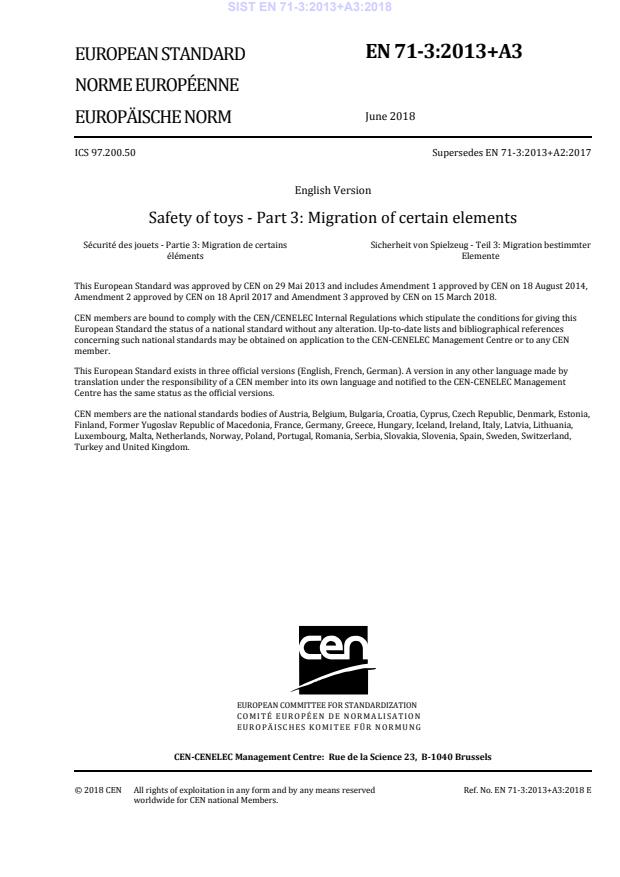
EUROPEAN STANDARD NORME EUROPÉENNE EUROPÄISCHE NORM
EN 71-3:2013+A3
June 2018 ICS 97.200.50 Supersedes EN 71-3:2013+A2:2017
English Version
Safety of toys - Part 3: Migration of certain elements
Sécurité des jouets - Partie 3: Migration de certains éléments
Sicherheit von Spielzeug - Teil 3: Migration bestimmter Elemente This European Standard was approved by CEN on 29 Mai 2013 and includes Amendment 1 approved by CEN on 18 August 2014, Amendment 2 approved by CEN on 18 April 2017 and Amendment 3 approved by CEN on 15 March 2018.
CEN members are bound to comply with the CEN/CENELEC Internal Regulations which stipulate the conditions for giving this European Standard the status of a national standard without any alteration. Up-to-date lists and bibliographical references concerning such national standards may be obtained on application to the CEN-CENELEC Management Centre or to any CEN member.
This European Standard exists in three official versions (English, French, German). A version in any other language made by translation under the responsibility of a CEN member into its own language and notified to the CEN-CENELEC Management Centre has the same status as the official versions.
CEN members are the national standards bodies of Austria, Belgium, Bulgaria, Croatia, Cyprus, Czech Republic, Denmark, Estonia, Finland, Former Yugoslav Republic of Macedonia, France, Germany, Greece, Hungary, Iceland, Ireland, Italy, Latvia, Lithuania, Luxembourg, Malta, Netherlands, Norway, Poland, Portugal, Romania, Serbia, Slovakia, Slovenia, Spain, Sweden, Switzerland, Turkey and United Kingdom.
EUROPEAN COMMITTEE FOR STANDARDIZATION
COMITÉ EUROPÉEN DE NORMALISATION
EUROPÄISCHES KOMITEE FÜR NORMUNG
CEN-CENELEC Management Centre:
Rue de la Science 23,
B-1040 Brussels © 2018 CEN All rights of exploitation in any form and by any means reserved worldwide for CEN national Members. Ref. No. EN 71-3:2013+A3:2018 E SIST EN 71-3:2013+A3:2018
Significant technical changes between this European Standard and the previous version . 21 Annex B (informative)
Method performance . 23 B.1 Method performance . 23 B.2 Use of measurement uncertainty in compliance assessment . 23 B.3 Information on round robin test . 23 Annex C (normative)
Sieve requirements . 25 Annex D (informative)
Preparation and analysis of test portion . 26 Annex E (informative)
Method of analysis for general elements . 27 E.1 Principle . 27 E.2 Working solutions . 27 E.3 Procedure . 29 E.4 Analysis . 29 Annex F (informative)
Methods of analysis for speciation of Chromium (III) and (VI) . 32 F.1 Principle . 32 F.2 Reagents . 32 F.3 Apparatus . 33 F.4 Procedure . 34 F.5 Analysis . 34 Annex G (informative)
Method of analysis for organic tin (see H.10) . 37 G.1 Principle . 37 G.2 Terms and definitions . 38 G.3 Reagents . 38 G.4 Apparatus . 41 G.5 Procedure . 41 G.6 Analysis . 42 Annex H (informative)
Rationale . 47 H.1 General . 47 H.2 Mouthing behaviour of children (Scope) . 47 H.3 Skin contact (Scope) . 47 H.4 Toy categories (4.1). 48 SIST EN 71-3:2013+A3:2018
Conformity assessment . 51 I.1 General . 51 I.2 Chromium VI . 51 Annex J (informative)
List of other organic tin compounds . 52 Annex ZA (informative)
Relationship between this European Standard and the Essential Requirements of EU Directive 2009/48/EC aimed to be covered . 53 Bibliography . 54 SIST EN 71-3:2013+A3:2018
Note 1 to entry: The use of k = 3 will usually suffice. 3.4 limit of quantification lowest amount of analyte in a sample that can be quantitatively determined with a suitable precision and accuracy Note 1 to entry: For the purpose of this standard, the limit of quantification is twice the limit of detection. 3.5 other material, whether mass coloured or not material such as wood, leather or other porous substances which may absorb colouring matter without forming a coating 3.6 paper sheet formed by irregularly intervened fibres with a mass per unit area of 400 g/m2 or less 3.7 paper board sheet formed by irregularly intervened fibres with a mass per unit area over 400 g/m2 Note 1 to entry: The term paperboard also includes materials commonly referred to as card or cardboard with a mass per unit area over 400 g/m2. SIST EN 71-3:2013+A3:2018
X Polymeric and similar materials, including laminates, whether textile reinforced or not, but excluding other textiles
X Paper and paper board
X Textiles, whether natural or synthetic
X Glass, ceramic, metallic materials
X Other materials whether mass coloured or not (e.g. wood, fibre board, hard board, bone and leather)
X Compressed paint tablets, materials intended to leave a trace or similar materials in solid form appearing as such in the toy (e.g. the cores of colouring pencils, chalk, crayons) X
Pliable modelling materials, including modelling clays and plaster [3] X
Liquid paints, including finger paints, varnishes, lacquers, liquid ink in pens and similar materials in liquid form appearing as such in the toy (e.g. slimes, bubble solution)
X
Glue sticks
X
4.2 Specific requirements The migration of elements from toy materials categorized in accordance with 4.1 shall not exceed the migration limits given in Table 2 when tested in accordance with Clauses 7 and 8. SIST EN 71-3:2013+A3:2018
This requirement does not preclude the preparation of test portions which represent the material and any base material upon which it is deposited. If the total weight of available toy material is less than 10 mg test portions are disregarded (see H.5). The above does not preclude the possibility of testing toy materials before they are used to manufacture a toy in order to prove compliance of the final toy. In this case, it shall be assessed that the manufacturing process does not influence the migration of elements from the toy materials. 7.2 Standards preparation Prepare standard solutions covering a suitable working range appropriate to the required limits for each element for the three categories. Examples for ICP-MS and ICP-OES are included in Annex E. 7.3 Sample preparation 7.3.1 General A blank solution shall be determined for any bias. The analytical results shall be corrected for any bias due, for example, to contaminants present in the filter paper (6.2.6) or the gastric simulant. When there is a significant bias the method should be checked. 7.3.2 Category I: Dry, brittle, powder like or pliable and Category II: Liquid or sticky If possible obtain a test portion of not less than 100 mg of the material from the laboratory sample. If a test portion of 100 mg or more cannot be obtained, a test portion shall be obtained from each toy material present in the laboratory sample in a mass greater than 10 mg. If the weight of the test portion obtained is between 10 mg and 100 mg, that weight shall be reported (see Clause 10 h)). In this case the analytical results shall be calculated as though 100 mg of the test portion had been used (see H.5). If the toy material contains any grease, oil, wax or similar material, material shall be de-waxed. De-waxing shall not be carried out on test portions being analysed for organic tin. Dry a high retention filter paper (see 6.2.6) for 4 h at 37 °C ± 4°C. Weigh the filter paper to the nearest 0,1 mg (Wfp1). The filter paper used should be as small as possible without risking loss of the test portion during the de-waxing procedure. Weigh the test portion, to the nearest 0,1 mg, onto the pre-dried and weighed filter paper. Calculate the mass of the test portion. Use this mass for the calculation of the results of the test. Fold the filter paper carefully to enclose the test portion without loss. Extract the test portion within the filter paper with boiling n-heptane (6.2.5) using suitable laboratory apparatus. The use of a de-waxing step shall be reported (see Clause 10 h)). It has been shown that Soxhlet extraction with n-heptane for 6 h is usually sufficient to completely remove non-polar ingredients from waxy toy materials. Alternative methods should be validated to show that they are capable of completely removing the non-polar ingredients from relevant toy materials. SIST EN 71-3:2013+A3:2018
...
Questions, Comments and Discussion
Ask us and Technical Secretary will try to provide an answer. You can facilitate discussion about the standard in here.
Loading comments...